This is being equated by some to A Nation at Risk. This report may or may not have seismic potential though. We'll see. It costs $19.95 and may be purchased at this link. Check out here Jay Mathews' analysis of this report in the 12-26-06 issue of the WASHINGTON POST. Also check out this report by Lynn Olsn titled, "U.S. Urged to Reinvent Its Schools," appearing in the 12-20-06 issue of Ed Week.
I agree that the most problematic recommendation is creating to tracks or classes of high s students at age 16. Low achievers (based on standardized test scores) would head to community college or trade schools while their higher achieving counterparts will go on a path toward selective colleges after finishing high school.
Of course, we can already predict the types of students that would head in each direction as this will be correlated with race, class, and presumably gender. Re-stratifying our country according to these lines is no solution.
-Angela
December 15, 2006
Expert Panel Proposes Far-Reaching Redesign of the American Education System
By DAVID M. HERSZENHORN
Warning that Americans face a grave risk of losing their prosperity and high quality of life to better educated workers overseas, a panel of education, labor and other public policy experts yesterday proposed a far-reaching redesign of the United States education system that would include having schools operated by independent contractors and giving states, rather than local districts, control over school financing.
The panel, the New Commission on the Skills of the American Workforce, included two former federal education secretaries, Rod Paige, a Republican, and Richard W. Riley, a Democrat; two former labor secretaries, William E. Brock, a Republican, and Ray Marshall, a Democrat; and an array of other luminaries, including former Gov. John Engler of Michigan, and the New York City schools chancellor, Joel I. Klein.
The commission’s report, released at a news conference in Washington, rethinks American schooling from top to bottom, going beyond the achievement goals of the federal education law known as No Child Left Behind, and farther than many initiatives being pursued by the Bush administration or by experimental state and local school authorities. Among other things, the report proposes starting school for most children at age 3, and requiring all students to pass board exams to graduate from high school, which for many would end after 10th grade. Students could then go to a community or technical college, or spend two years preparing for selective colleges and universities.
“We have run out the string on a whole series of initiatives that were viewed as hopeful,” said Lewis H. Spence, commissioner of the Massachusetts Department of Social Services and a member of the panel. “This puts a whole new set of ideas on the table.”
Mr. Spence, a former deputy schools chancellor in New York City, and other commission members acknowledged that enacting the proposals would be difficult, requiring legislation in all states and the cooperation of the federal government. Some, like one for merit pay for teachers, would require renegotiating teacher contracts nationwide and persuading local school boards to relinquish authority and take a new role enforcing performance contracts with schools.
“You can’t implement something like this overnight,” said Mr. Klein, who had been scheduled to appear at yesterday’s news conference with Mayor Michael R. Bloomberg of New York, but whose flights were grounded by thick fog in Washington. Mr. Klein strongly applauded the commission’s proposals, and pointed to many efforts in New York — including sharp increases in teacher pay, a new master-teacher career step; increased roles for private groups in running public schools and performance agreements signed by 331 principals in exchange for greater freedom from superintendents — as examples of how some of the commission’s goals could begin to be accomplished. “We need to think big,” he said.
The commission’s work was quickly hailed by some as a potentially groundbreaking document. “This report has the potential to change the debate on education at the national level,” said Jack Jennings, the president of the Center on Education Policy, who is a Democrat and prominent expert on the federal education law.
The national teachers’ unions were apprehensive. Antonia Cortese, executive vice president of the American Federation of Teachers, said the proposals included “some seriously flawed ideas with faddish allure that won’t produce better academic results.” Reg Weaver, the president of the National Education Association, urged “caution in calling for drastic changes.”
The commission was organized by the National Center on Education and the Economy, a nonprofit, nonpartisan group based in Washington, and partly financed by the Bill and Melinda Gates foundation. The center organized a similar commission that issued a similar report 16 years ago. Marc S. Tucker, the group’s president, said globalization had created new urgency. “There is this growing mismatch between the demands of the economy and what our schools are supplying,” Mr. Tucker said.
In its report, the commission warned of dire consequences should the country not adopt a strikingly bold approach. “If we continue on our current course, and the number of nations outpacing us in the education race continues to grow at its current rate,” it said, “the American standard of living will steadily fall relative to those nations, rich and poor, that are doing a better job.”
“If the gap gets to a certain but unknowable point,” the report said, “the world’s investors will conclude that they can get a greater return on their funds elsewhere, and it will be almost impossible to reverse course.”
Paul Romer, an economist at Stanford University, said that some of the fears about competition with India and China might be overblown but that the education system still needed improvement. He said the current effort was driven by improvements in technology, much as advances in the early 20th century led to universal high school.
“High productivity investments in education are one of the most universally supported and effective policies that governments have ever undertaken,” Mr. Romer said. “The left and the right are both on board for high payoffs in education.”
Copyright 2006 The New York Times Company
Monday, December 25, 2006

State and union leaders debate beneficial changes to teacher contracts
Very interesting conversation about teacher/teacher union power involving a meeting of the National Governors Association. Incisive commentary below by Randi Weingarten, president of the New York City teachers’ union: "The alternative to teacher participation in setting policy for curriculum and instruction is, at best, she said, a mentality of compliance with rules as opposed to responsibility for results." In other words, to narrow/limit collective bargaining is to ensure a compliance-officer mentality. Also interesting in light of the far-reaching recommendations made by the New Commission on the Skills of the American Workforce. -Angela
Published: December 20, 2006
Event Provides Entree Into Bargaining Talks
State and union leaders debate beneficial changes to teacher contracts.
By Bess Keller
Newport, R.I.
In a move likely to raise the profile of teachers’ contracts as a force in school success or failure, education policymakers and union leaders came together here last week under the auspices of the National Governors Association for a mutual look at collective bargaining.
The meeting largely lived up to its billing as a “new dialogue,” with civil expression of sometimes starkly different views about how the process should change to raise student achievement. The conference drew some 100 people representing nine states, for what organizers described as the first state-focused conversation on the topic between teachers’ union and education-agency leaders.
“We’ve taken the first step in having a very public discussion and trying to figure out the state’s role in the discussion,” said Dane Linn, who heads the education division of the NGA’s Best Practices Center. The center hosted the Dec. 10-11 gathering along with Gov. Donald L. Carcieri of Rhode Island, several Rhode Island organizations, and the Annenberg Institute for School Reform and the Urban Education Policy Program at Brown University in nearby Providence.
“It’s a little bit of a leap of faith to bring to fruition a conference like this, because the groups are often seen at loggerheads,” Gov. Carcieri, a Republican, said.
Problems Spotted
Rhode Island’s Educational Partnership, a citizen and business group that was one of the meeting’s sponsors, stirred up local public interest in teacher contracts with reports this year and last comparing contract provisions from district to district. But the governor said it was in beginning to use an NGA grant for high school improvement that he saw problems with teacher-bargaining agreements. Given stiff global competition, especially from Asian nations, he said, the nation’s standard of living and its system of public schools will face unprecedented threats if students go unprepared.
In a talk that kicked off the discussion, Andrew J. Rotherham, a co-director of the Washington-based research and policy group Education Sector, advised steering a course between those who contend unions are the “root cause” of underachievement and those who maintain they have nothing to do with it.
The problem, he argued, is much more that teachers’ unions have grown conservative and, like other educational institutions, have failed to keep up with the escalating demands on schools. They can be protective of teachers’ rights at the expense of teachers’ opportunities and, worse, student achievement, especially for the most disadvantaged children, said Mr. Rotherham, who was an education adviser to President Clinton.
“I’d argue [the unions are] not living up to their promise as the powerful, tectonic institutions they are,” he said, allowing for some exceptions such as the United Federation of Teachers’ two charter schools in New York City and a new pay plan for teachers crafted in part by the Denver Classroom Teachers Association.
To help end collective bargaining that deals an unfair hand to students, Mr. Rotherham called for greater openness about the contracts and participation by more groups in framing them.
Who Wields the Power?
In a discussion that took on state law as a context for bargaining, the panelists split sharply over whether the “scope of bargaining,” a matter generally set by the state, should be broad or narrow.
Alan D. Bersin, who recently stepped down as the California secretary of education and formerly headed the San Diego schools, said that teachers aren’t necessarily ready to set the agenda for reform.
“You may have a system requiring a very strong dose of knowledge-building,” he said. “There’s going to be a period where top-down is necessary: They call it leadership.”
But Randi Weingarten, the president of the New York City teachers’ union, said that as the most important “agents” for raising student achievement, teachers are a fundamental part of any school improvement equation. The alternative to teacher participation in setting policy for curriculum and instruction is, at best, she said, a mentality of compliance with rules as opposed to responsibility for results.
The two even disagreed, calmly, over where power lay. Mr. Bersin held that the union is “the most powerful institution in the sector, and yet they constantly feel under seige.” Ms. Weingarten countered that the union is the “secondary player” because it can block but generally not implement changes. “Management has far more power to say ‘yes’ than we do,” she said.
Brad Jupp, who as a union leader headed the successful overhaul of Denver’s pay system for teachers, agreed with Ms. Weingarten that state law should allow districts and unions to “bargain anything.”
In a presentation, he said that to make the deal in Denver, which required school board, union, and voter support, the union and the district had initially agreed only “to say ‘maybe’ together” with a plan for researching and devising a new system.
“We pushed the envelope of collective bargaining,” said Mr. Jupp, who before he began working as an adviser to the Denver superintendent was a member of the National Education Association.
Although the American Federation of Teachers was well represented among the presenters, Mr. Jupp was the only speaker with an NEA connection. Organizers said NEA officials had been “equally invited” to make presentations. A spokeswoman for the union suggested that its top officers might have been busy with governance meetings.
The kind of change wrought in Denver will not necessarily be easy to come by, said Valerie Forti, who helped organize the conference as the president of the Educational Partnership. “I see the sliver of the sun on the horizon,” she said. “It’s not like the issue is bowling at anybody.”
But Steven F. Smith, the president of the Providence, R.I., teachers’ union, pronounced himself satisfied. He said he had feared that the gathering would focus on changing collective bargaining laws.
“I’m pleased the discussion evolved into really talking about collaboration,” Mr. Smith said, “about unions working together with districts and states.”
Vol. 26, Issue 16, Pages 5,13
© 2006 Editorial Projects in Education
Published: December 20, 2006
Event Provides Entree Into Bargaining Talks
State and union leaders debate beneficial changes to teacher contracts.
By Bess Keller
Newport, R.I.
In a move likely to raise the profile of teachers’ contracts as a force in school success or failure, education policymakers and union leaders came together here last week under the auspices of the National Governors Association for a mutual look at collective bargaining.
The meeting largely lived up to its billing as a “new dialogue,” with civil expression of sometimes starkly different views about how the process should change to raise student achievement. The conference drew some 100 people representing nine states, for what organizers described as the first state-focused conversation on the topic between teachers’ union and education-agency leaders.
“We’ve taken the first step in having a very public discussion and trying to figure out the state’s role in the discussion,” said Dane Linn, who heads the education division of the NGA’s Best Practices Center. The center hosted the Dec. 10-11 gathering along with Gov. Donald L. Carcieri of Rhode Island, several Rhode Island organizations, and the Annenberg Institute for School Reform and the Urban Education Policy Program at Brown University in nearby Providence.
“It’s a little bit of a leap of faith to bring to fruition a conference like this, because the groups are often seen at loggerheads,” Gov. Carcieri, a Republican, said.
Problems Spotted
Rhode Island’s Educational Partnership, a citizen and business group that was one of the meeting’s sponsors, stirred up local public interest in teacher contracts with reports this year and last comparing contract provisions from district to district. But the governor said it was in beginning to use an NGA grant for high school improvement that he saw problems with teacher-bargaining agreements. Given stiff global competition, especially from Asian nations, he said, the nation’s standard of living and its system of public schools will face unprecedented threats if students go unprepared.
In a talk that kicked off the discussion, Andrew J. Rotherham, a co-director of the Washington-based research and policy group Education Sector, advised steering a course between those who contend unions are the “root cause” of underachievement and those who maintain they have nothing to do with it.
The problem, he argued, is much more that teachers’ unions have grown conservative and, like other educational institutions, have failed to keep up with the escalating demands on schools. They can be protective of teachers’ rights at the expense of teachers’ opportunities and, worse, student achievement, especially for the most disadvantaged children, said Mr. Rotherham, who was an education adviser to President Clinton.
“I’d argue [the unions are] not living up to their promise as the powerful, tectonic institutions they are,” he said, allowing for some exceptions such as the United Federation of Teachers’ two charter schools in New York City and a new pay plan for teachers crafted in part by the Denver Classroom Teachers Association.
To help end collective bargaining that deals an unfair hand to students, Mr. Rotherham called for greater openness about the contracts and participation by more groups in framing them.
Who Wields the Power?
In a discussion that took on state law as a context for bargaining, the panelists split sharply over whether the “scope of bargaining,” a matter generally set by the state, should be broad or narrow.
Alan D. Bersin, who recently stepped down as the California secretary of education and formerly headed the San Diego schools, said that teachers aren’t necessarily ready to set the agenda for reform.
“You may have a system requiring a very strong dose of knowledge-building,” he said. “There’s going to be a period where top-down is necessary: They call it leadership.”
But Randi Weingarten, the president of the New York City teachers’ union, said that as the most important “agents” for raising student achievement, teachers are a fundamental part of any school improvement equation. The alternative to teacher participation in setting policy for curriculum and instruction is, at best, she said, a mentality of compliance with rules as opposed to responsibility for results.
The two even disagreed, calmly, over where power lay. Mr. Bersin held that the union is “the most powerful institution in the sector, and yet they constantly feel under seige.” Ms. Weingarten countered that the union is the “secondary player” because it can block but generally not implement changes. “Management has far more power to say ‘yes’ than we do,” she said.
Brad Jupp, who as a union leader headed the successful overhaul of Denver’s pay system for teachers, agreed with Ms. Weingarten that state law should allow districts and unions to “bargain anything.”
In a presentation, he said that to make the deal in Denver, which required school board, union, and voter support, the union and the district had initially agreed only “to say ‘maybe’ together” with a plan for researching and devising a new system.
“We pushed the envelope of collective bargaining,” said Mr. Jupp, who before he began working as an adviser to the Denver superintendent was a member of the National Education Association.
Although the American Federation of Teachers was well represented among the presenters, Mr. Jupp was the only speaker with an NEA connection. Organizers said NEA officials had been “equally invited” to make presentations. A spokeswoman for the union suggested that its top officers might have been busy with governance meetings.
The kind of change wrought in Denver will not necessarily be easy to come by, said Valerie Forti, who helped organize the conference as the president of the Educational Partnership. “I see the sliver of the sun on the horizon,” she said. “It’s not like the issue is bowling at anybody.”
But Steven F. Smith, the president of the Providence, R.I., teachers’ union, pronounced himself satisfied. He said he had feared that the gathering would focus on changing collective bargaining laws.
“I’m pleased the discussion evolved into really talking about collaboration,” Mr. Smith said, “about unions working together with districts and states.”
Vol. 26, Issue 16, Pages 5,13
© 2006 Editorial Projects in Education
Report Says Poor Students Shortchanged
Problems in federal education funding formula:
1. a guaranteed minimum amount for small states per poor student
2. Tying of federal dollars to how much $ states spend on education (unrelated to efforts to educate kids)
3. Layered over existing inequities where high-poverty districts get less local $ than high-wealth districts
4. Politically difficult to change if it means taking away $ from certain states (despite NCLB which calls for targeting the neediest students)
"On average, states and local governments spend $825 less per student in districts educating the poorest students compared with what is spent in the wealthiest school districts."
Kennedy wants to re-consider funding, though, in order to address the imbalances.
-Angela
December 20, 2006
By THE ASSOCIATED PRESS
Filed at 10:17 p.m. ET
WASHINGTON (AP) -- Poor students are shortchanged by federal and state school aid policies, a report released Wednesday says.
At the federal level, the Education Department gives states nearly $13 billion a year to help students in low-income districts.
The complex formula used to determine each state's share guarantees a minimum amount for small states. That means Wyoming and Vermont, for example, can get more money per poor student than do more populous states.
Federal school dollars also are tied to the amount that each state spends on education. States that spend more get more from Washington.
But this link rewards states more for their wealth than their efforts to educate poor kids, according to the Education Trust, a Washington-based children's advocacy group.
For example, the report shows Maryland has fewer poor children than Arkansas but gets about 50 percent more federal aid per poor child, $1,522, than does Arkansas, at $1,009.
The gap occurs even though Arkansas dedicates a larger share of its resources to education than does wealthier Maryland, the report says.
The authors say that when Congress reviews federal education spending in the coming year, lawmakers should rethink how they distribute funds for poor students.
''The least needy states get the most, and the most needy states get the least. That's perverse,'' said Goodwin Liu, an assistant law professor at the University of California at Berkeley and one of the report's authors.
Liu acknowledges it could be politically difficult to change the formula for distributing funds if those changes lead to cuts for some states.
But there is some recent precedent for doing so. When the No Child Left Behind education law was passed in 2001, lawmakers put in a provision that targeted more federal aid to schools with high concentrations of poor children.
Sen. Edward Kennedy, D-Mass., the incoming chairman of the committee that oversees education policy, is showing a willingness to re-examine how school aid is distributed.
''We cannot close the education achievement gap in this country without addressing the funding gap which keeps our low-income and minority children at a disadvantage,'' Kennedy said in a statement Wednesday. ''States must take responsibility for ensuring access to resources for all our children, but the federal government has to do its part as well.''
Like the government, states also are failing to allocate their own school dollars in a way that targets the neediest students, the report says.
In more than half the states, school districts with high poverty rates get less in state and local money than wealthy districts, according to the report.
It found that on average, states and local governments spend $825 less per student in districts educating the poorest students compared with what is spent in the wealthiest school districts.
The biggest gaps in funding between poor and wealthy districts occur in Illinois, New Hampshire, New York and Pennsylvania.
In contrast, Massachusetts and Kentucky were singled out for targeting more money to high-poverty districts and for having measures to ensure the money is used to boost student achievement.
The report also highlights funding gaps within school districts, which often result from differences in how salaries are distributed. In general, wealthier schools have more senior, higher-paid teachers.
For example in Austin, Texas -- a city with one of the largest salary gaps -- the average teacher salary at the poorest school is $3,837 less than the average teacher salary at the wealthiest school, the study found.
^------
On the Net:
Education Trust: http://www2.edtrust.org/edtrust/
Copyright 2006 The Associated Press
http://www.nytimes.com/aponline/us/AP-Education-Spending.html?_r=1&oref=slogin
1. a guaranteed minimum amount for small states per poor student
2. Tying of federal dollars to how much $ states spend on education (unrelated to efforts to educate kids)
3. Layered over existing inequities where high-poverty districts get less local $ than high-wealth districts
4. Politically difficult to change if it means taking away $ from certain states (despite NCLB which calls for targeting the neediest students)
"On average, states and local governments spend $825 less per student in districts educating the poorest students compared with what is spent in the wealthiest school districts."
Kennedy wants to re-consider funding, though, in order to address the imbalances.
-Angela
December 20, 2006
By THE ASSOCIATED PRESS
Filed at 10:17 p.m. ET
WASHINGTON (AP) -- Poor students are shortchanged by federal and state school aid policies, a report released Wednesday says.
At the federal level, the Education Department gives states nearly $13 billion a year to help students in low-income districts.
The complex formula used to determine each state's share guarantees a minimum amount for small states. That means Wyoming and Vermont, for example, can get more money per poor student than do more populous states.
Federal school dollars also are tied to the amount that each state spends on education. States that spend more get more from Washington.
But this link rewards states more for their wealth than their efforts to educate poor kids, according to the Education Trust, a Washington-based children's advocacy group.
For example, the report shows Maryland has fewer poor children than Arkansas but gets about 50 percent more federal aid per poor child, $1,522, than does Arkansas, at $1,009.
The gap occurs even though Arkansas dedicates a larger share of its resources to education than does wealthier Maryland, the report says.
The authors say that when Congress reviews federal education spending in the coming year, lawmakers should rethink how they distribute funds for poor students.
''The least needy states get the most, and the most needy states get the least. That's perverse,'' said Goodwin Liu, an assistant law professor at the University of California at Berkeley and one of the report's authors.
Liu acknowledges it could be politically difficult to change the formula for distributing funds if those changes lead to cuts for some states.
But there is some recent precedent for doing so. When the No Child Left Behind education law was passed in 2001, lawmakers put in a provision that targeted more federal aid to schools with high concentrations of poor children.
Sen. Edward Kennedy, D-Mass., the incoming chairman of the committee that oversees education policy, is showing a willingness to re-examine how school aid is distributed.
''We cannot close the education achievement gap in this country without addressing the funding gap which keeps our low-income and minority children at a disadvantage,'' Kennedy said in a statement Wednesday. ''States must take responsibility for ensuring access to resources for all our children, but the federal government has to do its part as well.''
Like the government, states also are failing to allocate their own school dollars in a way that targets the neediest students, the report says.
In more than half the states, school districts with high poverty rates get less in state and local money than wealthy districts, according to the report.
It found that on average, states and local governments spend $825 less per student in districts educating the poorest students compared with what is spent in the wealthiest school districts.
The biggest gaps in funding between poor and wealthy districts occur in Illinois, New Hampshire, New York and Pennsylvania.
In contrast, Massachusetts and Kentucky were singled out for targeting more money to high-poverty districts and for having measures to ensure the money is used to boost student achievement.
The report also highlights funding gaps within school districts, which often result from differences in how salaries are distributed. In general, wealthier schools have more senior, higher-paid teachers.
For example in Austin, Texas -- a city with one of the largest salary gaps -- the average teacher salary at the poorest school is $3,837 less than the average teacher salary at the wealthiest school, the study found.
^------
On the Net:
Education Trust: http://www2.edtrust.org/edtrust/
Copyright 2006 The Associated Press
http://www.nytimes.com/aponline/us/AP-Education-Spending.html?_r=1&oref=slogin
Universal Access, Student Loan Debt and Pell Grants: The College Crisis
Powerful quote: "For the price of
just two weeks of the cost of Iraq, they could almost
double the Pell Grant program and free up our college
graduates to spend their incomes in ways that improve
both their lives and the economy." -Angela
By PAT WILLIAMS
It was just about this time of year 35 years ago, when
the United States Congress passed into law a
peculiarly American idea--every person should have
access to a college or university.
That 1972 federal law, initially named Basic Grants
and later Pell Grants, has during this one-third of a
century awarded more than $100 billion to more than 30
million college-bound students.
Pell Grants represented a significant departure from
the earlier higher education acts with money provided
directly to moderate-income students for the purpose
of tuition, books, and services at the college of
their choice.
Pell Grants were initially intended for families whose
young people attended college full time. During the
decades since, students are beyond the traditional
families of the 1950s, 60s, 70s. Many of today's
students have their own families, work part time, are
enrolled not only in four-year institutions, but also
in two-year or vocational programs.
The Pell Grant program has not only had policy changes
throughout the years but politics at the national
level have also influenced the awarding of the grants.
During the early 1970s and despite President Nixon's
statements in favor of Pell Grants, his Office of
Education refused to release the $122 million dollars
appropriated by Congress. In the late 1970s, under
Presidents Ford and Carter, Pell Grants were at their
dollar value peak, covering almost 80% of college
costs.
The 1980s and 90s, however, were a different story.
Budget tightening by the Reagan administration fell
heavily on moderate income college students.
Purchasing power fell and with increasing numbers of
low income people, Pell Grant eligibility was
stretched too thin. In the 1990s President Clinton
ordered the largest dollar increase in Pell Grant
history, but even that boost left the grants'
purchasing far below its peak in the 1970s.
Both trends and projections verify the difficulty that
now faces college students. Throughout America, state
support for college assistance has been declining,
with public spending per-student, that is FTE, at an
all time low.
Public spending shortfalls in education are bad for
this country because they effectively both limit
college admissions and quality of the school's
offerings. Young people from families who are in the
top 20% of incomes receive 80% of college degrees.
Those students from families earning in the bottom 20%
of incomes will get only 5% of the college degrees.
The gap between the poor and the better-off is growing
and lack of a college degree is one of the reasons.
Both unemployment rates and earnings data demonstrate
the importance of education. Unemployment is three
times higher for those who drop out of high school
than it is for those with a bachelor's degree. Median
earning for those with a master,s degree is $62,000
per year in America; it is half of that for those who
only finish high school.
An obvious difficulty for today's college students is
student loan debt--it is a crushing burden on the
shoulders of today's students and tomorrow's
professionals. More than 30 years ago, Pell Grants
were created precisely to help moderate income
families pay for their student,s college costs. For a
number of reasons, including the lack of political
will on the part of presidents and the Congress, the
purchasing power of Pell Grants has fallen by
two-thirds and so our students have no choice but to
accept the burdening loans.
President Bush and the next Congress could begin to
dramatically change the reliance on loans by
significantly increasing Pell Grants, which as the
name says, are grants--not loans. For the price of
just two weeks of the cost of Iraq, they could almost
double the Pell Grant program and free up our college
graduates to spend their incomes in ways that improve
both their lives and the economy.
Pat Williams served nine terms as a U.S.
Representative from Montana. After his retirement, he
returned to Montana and is teaching at The University
of Montana where he also serves as a Senior Fellow at
the Center for the Rocky Mountain West.
just two weeks of the cost of Iraq, they could almost
double the Pell Grant program and free up our college
graduates to spend their incomes in ways that improve
both their lives and the economy." -Angela
By PAT WILLIAMS
It was just about this time of year 35 years ago, when
the United States Congress passed into law a
peculiarly American idea--every person should have
access to a college or university.
That 1972 federal law, initially named Basic Grants
and later Pell Grants, has during this one-third of a
century awarded more than $100 billion to more than 30
million college-bound students.
Pell Grants represented a significant departure from
the earlier higher education acts with money provided
directly to moderate-income students for the purpose
of tuition, books, and services at the college of
their choice.
Pell Grants were initially intended for families whose
young people attended college full time. During the
decades since, students are beyond the traditional
families of the 1950s, 60s, 70s. Many of today's
students have their own families, work part time, are
enrolled not only in four-year institutions, but also
in two-year or vocational programs.
The Pell Grant program has not only had policy changes
throughout the years but politics at the national
level have also influenced the awarding of the grants.
During the early 1970s and despite President Nixon's
statements in favor of Pell Grants, his Office of
Education refused to release the $122 million dollars
appropriated by Congress. In the late 1970s, under
Presidents Ford and Carter, Pell Grants were at their
dollar value peak, covering almost 80% of college
costs.
The 1980s and 90s, however, were a different story.
Budget tightening by the Reagan administration fell
heavily on moderate income college students.
Purchasing power fell and with increasing numbers of
low income people, Pell Grant eligibility was
stretched too thin. In the 1990s President Clinton
ordered the largest dollar increase in Pell Grant
history, but even that boost left the grants'
purchasing far below its peak in the 1970s.
Both trends and projections verify the difficulty that
now faces college students. Throughout America, state
support for college assistance has been declining,
with public spending per-student, that is FTE, at an
all time low.
Public spending shortfalls in education are bad for
this country because they effectively both limit
college admissions and quality of the school's
offerings. Young people from families who are in the
top 20% of incomes receive 80% of college degrees.
Those students from families earning in the bottom 20%
of incomes will get only 5% of the college degrees.
The gap between the poor and the better-off is growing
and lack of a college degree is one of the reasons.
Both unemployment rates and earnings data demonstrate
the importance of education. Unemployment is three
times higher for those who drop out of high school
than it is for those with a bachelor's degree. Median
earning for those with a master,s degree is $62,000
per year in America; it is half of that for those who
only finish high school.
An obvious difficulty for today's college students is
student loan debt--it is a crushing burden on the
shoulders of today's students and tomorrow's
professionals. More than 30 years ago, Pell Grants
were created precisely to help moderate income
families pay for their student,s college costs. For a
number of reasons, including the lack of political
will on the part of presidents and the Congress, the
purchasing power of Pell Grants has fallen by
two-thirds and so our students have no choice but to
accept the burdening loans.
President Bush and the next Congress could begin to
dramatically change the reliance on loans by
significantly increasing Pell Grants, which as the
name says, are grants--not loans. For the price of
just two weeks of the cost of Iraq, they could almost
double the Pell Grant program and free up our college
graduates to spend their incomes in ways that improve
both their lives and the economy.
Pat Williams served nine terms as a U.S.
Representative from Montana. After his retirement, he
returned to Montana and is teaching at The University
of Montana where he also serves as a Senior Fellow at
the Center for the Rocky Mountain West.
New Harvard Research on the Segregation of American Teachers
New Harvard Research on the Segregation of American Teachers
Click here to get Full report (PDF format, 440KB).
Cambridge, MA — December 21, 2006 — Data from a survey of over 1,000 teachers in K-12 public schools across the country show that our teaching force — like public school students — is largely segregated. Teachers of different races are teaching students of very different racial composition, adding an extra dimension to growing student racial segregation.
The Civil Rights Project’s research has consistently documented the growing segregation of American public school students. Understanding racial equity in schools requires that we understand who the teachers are, whether they are products of segregated schools, what kind of schools they work in, and how faculty racial patterns relate to student segregation. There is a great deal of discussion but little systematic national evidence on the racial experiences and attitudes of teachers. This unique national survey offers us a chance to explore those issues in this and forthcoming reports.
This report shows that in an increasingly segregated national system of schools, faculty segregation tends to add to — rather than counteract — the separation of students. We see that the white teachers, who continue to dominate the teaching profession, tend to grow up with little racial/ethnic diversity in their own education or experience. Not only did white teachers, on average, attend schools when they were elementary school students that were over 90% white, they are currently teaching in schools where almost 90% of their faculty colleagues are white and over 70% of students are white.
“America’s public schools and schools of education must work to create a diverse teaching force to serve a changing nation and assure that all schools seek integrated faculties to better prepare our students,” commented Gary Orfield, Director of the Civil Rights Project.
Additional findings include:
White teachers teach in schools with fewer poor and English Language Learner students. The typical black teacher teaches in a school were nearly three-fifths of students are from low-income families while the average white teacher has only 35% of low-income students.
Latino and Asian teachers are in schools that educate more than twice the share of English Language Learners than white teachers.
The South has the most diverse teaching force of any region in the country, along with the most integrated students. One-quarter of southern teachers are nonwhite, and 19% of southern teachers are African-American. Early concerns about the loss of African American teachers at the beginning of desegregation in the South no longer holds.
The West is the only region of the country with a sizeable percentage (11%) of Latino teachers. The majority of students in the West are nonwhite, with a large share of Latino students.
Nonwhite teachers and teachers that teach in schools with high percentages of minority and/or poor students are more likely to report that they are contemplating switching schools or careers.
The percentage of white teachers is lower in schools that did not make adequate yearly progress, a standard defined by the No Child Left Behind Act.
Schools with high concentrations of nonwhite and poor students tend to have less experience and qualified teachers despite NCLB’s emphasis that qualified teachers be equally distributed.
Nonwhite teachers are often teaching in schools that may be more difficult to teach in.
The findings make clear that there is a need for policies focused on diversifying the teaching force and ensuring that schools serving students of all backgrounds have a racially integrated, highly qualified faculty. Creating schools with integrated faculties will help prepare students for living and working in our racially diverse society, including giving our nation's future teachers early, important experiences with diversity.
About the Authors:
Erica Frankenberg, M.Ed., is a Research Assistant at The Civil Rights Project. She is a doctoral candidate in education policy at the Harvard Graduate School of Education, where her research focuses on school desegregation. Recent publications include "The Impact of School Segregation on Residential Housing Patterns: Mobile, AL and Charlotte, NC," in School Resegregation: Must the South Turn Back?. She is also co-author of a series of reports on desegregation trends. She is the co-editor of Lessons in Integration: Realizing the Promise of Racial Diversity in America’s Schools (with Gary Orfield, 2007 from University of Virginia Press).
Professor Gary Orfield is Professor of Education and Social Policy and Director of the Civil Rights Project at Harvard University. He is an author or editor of many books and articles on school desegregation including, Dismantling Desegregation: The Quiet Reversal of Brown v. Board of Education, School Resegregation: Must the South Turn Back?, Higher Education and the Color Line, and other civil rights issues. Professor Orfield’s complete biography is available online at: http://www.civilrightsproject.harvard.edu/aboutus/bios/orfield.php
Press Contacts:
Erica Frankenberg
Office: 617-496-4753
Email: ericafrankenberg@gmail.com
Professor Gary Orfield
Cell: (617) 359-2892
Office: (617) 496-6367
Email: orfield@gmail.com (preferred)
Email: orfielga@gse.harvard.edu
Jennifer Blatz
Assistant to Gary Orfield
617-495-1898
blatzje@gse.harvard.edu
About the Civil Rights Project:
The Civil Rights Project at Harvard University (CRP), founded in 1996, is a leading organization
devoted to civil rights research and a leading resource for information on racial justice based at
the Harvard Graduate School of Education. CRP strives to improve the channels through which
research findings are translated and communicated to policymakers and the broader public by
publishing reports and books on critical civil rights issues. It has found eager collaborators
among researchers nationwide, and wide open doors among advocacy organizations, policymakers, and journalists. Focusing initially on education reform, it has convened dozens of national conferences and roundtables; commissioned over 400 new research and policy studies; produced major reports on desegregation, student diversity, school discipline, special education, dropouts, and Title I programs; and published ten books, with four more in the editing stage. Note: The Civil Rights Project will move to UCLA in mid-2007.
Copyright © 2002 by The President and Fellows of Harvard College.
Click here to get Full report (PDF format, 440KB).
Cambridge, MA — December 21, 2006 — Data from a survey of over 1,000 teachers in K-12 public schools across the country show that our teaching force — like public school students — is largely segregated. Teachers of different races are teaching students of very different racial composition, adding an extra dimension to growing student racial segregation.
The Civil Rights Project’s research has consistently documented the growing segregation of American public school students. Understanding racial equity in schools requires that we understand who the teachers are, whether they are products of segregated schools, what kind of schools they work in, and how faculty racial patterns relate to student segregation. There is a great deal of discussion but little systematic national evidence on the racial experiences and attitudes of teachers. This unique national survey offers us a chance to explore those issues in this and forthcoming reports.
This report shows that in an increasingly segregated national system of schools, faculty segregation tends to add to — rather than counteract — the separation of students. We see that the white teachers, who continue to dominate the teaching profession, tend to grow up with little racial/ethnic diversity in their own education or experience. Not only did white teachers, on average, attend schools when they were elementary school students that were over 90% white, they are currently teaching in schools where almost 90% of their faculty colleagues are white and over 70% of students are white.
“America’s public schools and schools of education must work to create a diverse teaching force to serve a changing nation and assure that all schools seek integrated faculties to better prepare our students,” commented Gary Orfield, Director of the Civil Rights Project.
Additional findings include:
White teachers teach in schools with fewer poor and English Language Learner students. The typical black teacher teaches in a school were nearly three-fifths of students are from low-income families while the average white teacher has only 35% of low-income students.
Latino and Asian teachers are in schools that educate more than twice the share of English Language Learners than white teachers.
The South has the most diverse teaching force of any region in the country, along with the most integrated students. One-quarter of southern teachers are nonwhite, and 19% of southern teachers are African-American. Early concerns about the loss of African American teachers at the beginning of desegregation in the South no longer holds.
The West is the only region of the country with a sizeable percentage (11%) of Latino teachers. The majority of students in the West are nonwhite, with a large share of Latino students.
Nonwhite teachers and teachers that teach in schools with high percentages of minority and/or poor students are more likely to report that they are contemplating switching schools or careers.
The percentage of white teachers is lower in schools that did not make adequate yearly progress, a standard defined by the No Child Left Behind Act.
Schools with high concentrations of nonwhite and poor students tend to have less experience and qualified teachers despite NCLB’s emphasis that qualified teachers be equally distributed.
Nonwhite teachers are often teaching in schools that may be more difficult to teach in.
The findings make clear that there is a need for policies focused on diversifying the teaching force and ensuring that schools serving students of all backgrounds have a racially integrated, highly qualified faculty. Creating schools with integrated faculties will help prepare students for living and working in our racially diverse society, including giving our nation's future teachers early, important experiences with diversity.
About the Authors:
Erica Frankenberg, M.Ed., is a Research Assistant at The Civil Rights Project. She is a doctoral candidate in education policy at the Harvard Graduate School of Education, where her research focuses on school desegregation. Recent publications include "The Impact of School Segregation on Residential Housing Patterns: Mobile, AL and Charlotte, NC," in School Resegregation: Must the South Turn Back?. She is also co-author of a series of reports on desegregation trends. She is the co-editor of Lessons in Integration: Realizing the Promise of Racial Diversity in America’s Schools (with Gary Orfield, 2007 from University of Virginia Press).
Professor Gary Orfield is Professor of Education and Social Policy and Director of the Civil Rights Project at Harvard University. He is an author or editor of many books and articles on school desegregation including, Dismantling Desegregation: The Quiet Reversal of Brown v. Board of Education, School Resegregation: Must the South Turn Back?, Higher Education and the Color Line, and other civil rights issues. Professor Orfield’s complete biography is available online at: http://www.civilrightsproject.harvard.edu/aboutus/bios/orfield.php
Press Contacts:
Erica Frankenberg
Office: 617-496-4753
Email: ericafrankenberg@gmail.com
Professor Gary Orfield
Cell: (617) 359-2892
Office: (617) 496-6367
Email: orfield@gmail.com (preferred)
Email: orfielga@gse.harvard.edu
Jennifer Blatz
Assistant to Gary Orfield
617-495-1898
blatzje@gse.harvard.edu
About the Civil Rights Project:
The Civil Rights Project at Harvard University (CRP), founded in 1996, is a leading organization
devoted to civil rights research and a leading resource for information on racial justice based at
the Harvard Graduate School of Education. CRP strives to improve the channels through which
research findings are translated and communicated to policymakers and the broader public by
publishing reports and books on critical civil rights issues. It has found eager collaborators
among researchers nationwide, and wide open doors among advocacy organizations, policymakers, and journalists. Focusing initially on education reform, it has convened dozens of national conferences and roundtables; commissioned over 400 new research and policy studies; produced major reports on desegregation, student diversity, school discipline, special education, dropouts, and Title I programs; and published ten books, with four more in the editing stage. Note: The Civil Rights Project will move to UCLA in mid-2007.
Copyright © 2002 by The President and Fellows of Harvard College.
Immigration law changes not a top Democratic priority
Sentiments about immigration and immigration reform cuts through party lines. On the upside, bipartisan proposals can be pursued. On the downside is the possibility of bipartisan, bad ideas. -Angela
Immigration law changes not a top Democratic priority
By Hernan Rozemberg
San Antonio Express-News
12.20.2006
Sen.-elect Claire McCaskill wants the U.S. government to ramp up security by building a new border fence, avoid giving undocumented immigrants a chance for legalization, punish employers that hire them, and resist business-lobby pressures to create a temporary guest worker program for foreigners.
Meet the incoming senator from Missouri, representing the Democratic Party's new face on immigration and border security. She defeated an incumbent Republican not known for his tenderness toward undocumented migrants.
As the new Democratic-led Congress prepares for its session in January, prospects for changes in immigration laws remain unknown: The matter is not on the top-priority list of Democratic leaders.
The enforcement-only view championed by McCaskill and other newcomers could create a rift within party ranks, akin to the chasm the issue opened among Republicans last year.
Democratic leaders have vowed to introduce legislation to improve ethical conduct in Washington, raise the minimum wage and cut student loan interest rates ˜ but immigration isn't on their initial agenda.
The issue is too thorny for a quick fix, said Drew Hammill, spokesman for Nancy Pelosi, the incoming House speaker.
"Immigration is absolutely a top priority for her, and she has talked to the president about it," Hammill said. "But it's complex, and she'll want to go through committees and hearings."
A leading national immigration analyst said last week that immigration legislation is expected to be introduced in March or April. But if people think a Democratic-led Congress will be able to easily break the legislative impasse seen under Republican control this year, they'd better think again, said Tamar Jacoby, who follows immigration issues for the Manhattan Institute, a conservative New York City think tank.
The public isn't expecting much: Forty percent of respondents in a Rasmussen poll last week didn't expect to see immigration reform enacted.
Still, immigration advocates remain optimistic that last year's gridlock won't be repeated. "Most disagreements are on the edges now, such as on working out acceptable numbers of visas and guest workers allowed," said Michelle Waslin, spokeswoman for the National Council of La Raza.
Opponents of illegal immigration lamented losing some big-name supporters of their cause in the election.
Immigration law changes not a top Democratic priority
By Hernan Rozemberg
San Antonio Express-News
12.20.2006
Sen.-elect Claire McCaskill wants the U.S. government to ramp up security by building a new border fence, avoid giving undocumented immigrants a chance for legalization, punish employers that hire them, and resist business-lobby pressures to create a temporary guest worker program for foreigners.
Meet the incoming senator from Missouri, representing the Democratic Party's new face on immigration and border security. She defeated an incumbent Republican not known for his tenderness toward undocumented migrants.
As the new Democratic-led Congress prepares for its session in January, prospects for changes in immigration laws remain unknown: The matter is not on the top-priority list of Democratic leaders.
The enforcement-only view championed by McCaskill and other newcomers could create a rift within party ranks, akin to the chasm the issue opened among Republicans last year.
Democratic leaders have vowed to introduce legislation to improve ethical conduct in Washington, raise the minimum wage and cut student loan interest rates ˜ but immigration isn't on their initial agenda.
The issue is too thorny for a quick fix, said Drew Hammill, spokesman for Nancy Pelosi, the incoming House speaker.
"Immigration is absolutely a top priority for her, and she has talked to the president about it," Hammill said. "But it's complex, and she'll want to go through committees and hearings."
A leading national immigration analyst said last week that immigration legislation is expected to be introduced in March or April. But if people think a Democratic-led Congress will be able to easily break the legislative impasse seen under Republican control this year, they'd better think again, said Tamar Jacoby, who follows immigration issues for the Manhattan Institute, a conservative New York City think tank.
The public isn't expecting much: Forty percent of respondents in a Rasmussen poll last week didn't expect to see immigration reform enacted.
Still, immigration advocates remain optimistic that last year's gridlock won't be repeated. "Most disagreements are on the edges now, such as on working out acceptable numbers of visas and guest workers allowed," said Michelle Waslin, spokeswoman for the National Council of La Raza.
Opponents of illegal immigration lamented losing some big-name supporters of their cause in the election.
Low ratings put more schools on transfer list
This came out earlier. Most kids don't take care of transfer options suggesting the limitations of so-called "choice."
-Angela
Low ratings put more schools on transfer list
Few students likely to use choice law; state may try to help
06:59 AM CST on Tuesday, December 19, 2006
By TERRENCE STUTZ / The Dallas Morning News
AUSTIN – The ranks of low-rated public schools swelled again this year under Texas' education choice law, giving hundreds of thousands of students at the state's worst campuses the right to transfer to a better school – though few are expected to do so.
The Texas Education Agency identified 924 campuses across the state Monday where students will be able to bail out and enroll at another public school if their parents wish. The total was up 12.5 percent from a year ago and constitutes about 12 percent of the state's schools.
The Dallas Independent School District had the second-most campuses at 78, one more than last year. District officials could not be reached for comment. Houston had 112 schools, and Fort Worth had 30.
The Public Education Grant program allows for students to transfer, but the state provides no funding for transportation to a new school, and districts aren't required to provide busing. Only 321 students exercised their option to move last year, education agency officials said Monday.
Since the program began in the late 1990s, fewer than 2,500 students have used it to transfer to a new school.
Also Online
See the complete list of underperforming schools
That issue, though, could be up for review by the Legislature. The Senate Education Committee, in a report this month, called on lawmakers to explore transportation funding. Officials have said the lack of transportation is one of the biggest obstacles for students and parents interested in another school. The report did not address what that might cost.
Voucher debate
The program may also play a prominent role in the debate on private-school vouchers expected in the upcoming legislative session. Schools on the transfer list would be primary candidates for a pilot voucher plan or another school choice program, and Republican leaders may argue that with the number of failing schools continuing to rise, parents need new options.
Voucher opponents, though, say that removing students and funding from public schools will make it harder to fix them.
The number of low-performing schools on the list has jumped significantly three years in a row. Three years ago, just 126 schools were eligible for the grant program.
Tougher standards
State education officials attributed the large increase to tougher performance standards that have been used to rate schools in recent years, particularly in science and math.
"Science and math continue to be a challenge for schools across the state," said TEA spokeswoman Suzanne Marchman. More students had to pass both subjects on the Texas Assessment of Knowledge and Skills for a school to be rated acceptable.
Even though the passing standards were not demanding this year – requiring at least 35 percent of each student group to pass in science and 40 percent in math – those percentages were up from the previous year.
"It looks like science was the larger hurdle for schools to clear, and that is a key reason we saw more schools on the list this year," Ms. Marchman said, noting that passing standards will climb again next year.
"As the passing standards continue to increase, it is very likely we will see the number of schools on the list increase as well," she added.
The names of eligible schools are being published now because most districts consider transfer requests several months before the start of each school year. Parents must be notified of the option by Feb. 1, with students allowed to enroll at a new school for the next fall.
Students can transfer to another public school in their own district or another district – if that district agrees to accept them. Those that do enroll students under the program receive a financial incentive from the state – an extra 10 percent in funding per pupil.
That financial incentive has not been enough to spur participation in the program, particularly when no transportation funding has been available. In addition, school districts are not required to accept transfer students from neighboring districts.
Thousands affected
On Monday, officials didn't say exactly how many students will have the transfer option, but as many as 600,000 students may be enrolled at the 924 campuses.
Other school districts in the Dallas area that had campuses on the list were Arlington, Birdville, Cedar Hill, Denton, DeSoto, Garland, Grand Prairie, Hurst-Euless-Bedford, Irving, Lancaster, Lewisville, Mesquite and Richardson.
Schools on the list had to have more than 50 percent of their students fail the TAKS in two of the last three years or have had an "academically unacceptable" rating in any one of the last three years.
Other than transportation concerns, education officials also cite other reasons for low participation, including the many school options that students already have.
Among those are independent charter schools, magnet schools and open enrollment schools in many districts that accept students who live anywhere within the district.
Low-rated charter schools are not included on the list because students attend those campuses voluntarily and may transfer back to their home district at any time.
E-mail tstutz@dallasnews.com
ABOUT THE PROGRAM
How the state's Public Education Grant system works:
Students can transfer out of any school where more than half the students failed the TAKS test in any two of the last three years or where the school was rated academically unacceptable any of the last three years.
Students can move to another school in the district or to another district if the district accepts them.
Parents must be notified of the right to switch by Feb. 1. Transfers take effect the next fall.
Transportation is not provided.
MORE SCHOOLS ELIGIBLE
Here's how the number of schools that students were allowed to leave has grown:
2000: 207
2001: 191
2002: 205
2003: 126
2004: 420
2005: 821
2006: 924
CHANGES COMING?
Since the Legislature's last regular session in 2005, the Senate Education Committee has been studying ways to improve school choice. Among its recommendations:
Consider providing money for school districts to transport to different campuses those students who want to leave bad schools.
Allow parents to consider choosing a different school more quickly, even in the same academic year.
SOURCE: Dallas Morning News research© 2006 The Dallas Morning News Co.
http://www.dallasnews.com/sharedcontent/dws/dn/education/stories/121906dntextransfers.34efccb.html#
-Angela
Low ratings put more schools on transfer list
Few students likely to use choice law; state may try to help
06:59 AM CST on Tuesday, December 19, 2006
By TERRENCE STUTZ / The Dallas Morning News
AUSTIN – The ranks of low-rated public schools swelled again this year under Texas' education choice law, giving hundreds of thousands of students at the state's worst campuses the right to transfer to a better school – though few are expected to do so.
The Texas Education Agency identified 924 campuses across the state Monday where students will be able to bail out and enroll at another public school if their parents wish. The total was up 12.5 percent from a year ago and constitutes about 12 percent of the state's schools.
The Dallas Independent School District had the second-most campuses at 78, one more than last year. District officials could not be reached for comment. Houston had 112 schools, and Fort Worth had 30.
The Public Education Grant program allows for students to transfer, but the state provides no funding for transportation to a new school, and districts aren't required to provide busing. Only 321 students exercised their option to move last year, education agency officials said Monday.
Since the program began in the late 1990s, fewer than 2,500 students have used it to transfer to a new school.
Also Online
See the complete list of underperforming schools
That issue, though, could be up for review by the Legislature. The Senate Education Committee, in a report this month, called on lawmakers to explore transportation funding. Officials have said the lack of transportation is one of the biggest obstacles for students and parents interested in another school. The report did not address what that might cost.
Voucher debate
The program may also play a prominent role in the debate on private-school vouchers expected in the upcoming legislative session. Schools on the transfer list would be primary candidates for a pilot voucher plan or another school choice program, and Republican leaders may argue that with the number of failing schools continuing to rise, parents need new options.
Voucher opponents, though, say that removing students and funding from public schools will make it harder to fix them.
The number of low-performing schools on the list has jumped significantly three years in a row. Three years ago, just 126 schools were eligible for the grant program.
Tougher standards
State education officials attributed the large increase to tougher performance standards that have been used to rate schools in recent years, particularly in science and math.
"Science and math continue to be a challenge for schools across the state," said TEA spokeswoman Suzanne Marchman. More students had to pass both subjects on the Texas Assessment of Knowledge and Skills for a school to be rated acceptable.
Even though the passing standards were not demanding this year – requiring at least 35 percent of each student group to pass in science and 40 percent in math – those percentages were up from the previous year.
"It looks like science was the larger hurdle for schools to clear, and that is a key reason we saw more schools on the list this year," Ms. Marchman said, noting that passing standards will climb again next year.
"As the passing standards continue to increase, it is very likely we will see the number of schools on the list increase as well," she added.
The names of eligible schools are being published now because most districts consider transfer requests several months before the start of each school year. Parents must be notified of the option by Feb. 1, with students allowed to enroll at a new school for the next fall.
Students can transfer to another public school in their own district or another district – if that district agrees to accept them. Those that do enroll students under the program receive a financial incentive from the state – an extra 10 percent in funding per pupil.
That financial incentive has not been enough to spur participation in the program, particularly when no transportation funding has been available. In addition, school districts are not required to accept transfer students from neighboring districts.
Thousands affected
On Monday, officials didn't say exactly how many students will have the transfer option, but as many as 600,000 students may be enrolled at the 924 campuses.
Other school districts in the Dallas area that had campuses on the list were Arlington, Birdville, Cedar Hill, Denton, DeSoto, Garland, Grand Prairie, Hurst-Euless-Bedford, Irving, Lancaster, Lewisville, Mesquite and Richardson.
Schools on the list had to have more than 50 percent of their students fail the TAKS in two of the last three years or have had an "academically unacceptable" rating in any one of the last three years.
Other than transportation concerns, education officials also cite other reasons for low participation, including the many school options that students already have.
Among those are independent charter schools, magnet schools and open enrollment schools in many districts that accept students who live anywhere within the district.
Low-rated charter schools are not included on the list because students attend those campuses voluntarily and may transfer back to their home district at any time.
E-mail tstutz@dallasnews.com
ABOUT THE PROGRAM
How the state's Public Education Grant system works:
Students can transfer out of any school where more than half the students failed the TAKS test in any two of the last three years or where the school was rated academically unacceptable any of the last three years.
Students can move to another school in the district or to another district if the district accepts them.
Parents must be notified of the right to switch by Feb. 1. Transfers take effect the next fall.
Transportation is not provided.
MORE SCHOOLS ELIGIBLE
Here's how the number of schools that students were allowed to leave has grown:
2000: 207
2001: 191
2002: 205
2003: 126
2004: 420
2005: 821
2006: 924
CHANGES COMING?
Since the Legislature's last regular session in 2005, the Senate Education Committee has been studying ways to improve school choice. Among its recommendations:
Consider providing money for school districts to transport to different campuses those students who want to leave bad schools.
Allow parents to consider choosing a different school more quickly, even in the same academic year.
SOURCE: Dallas Morning News research© 2006 The Dallas Morning News Co.
http://www.dallasnews.com/sharedcontent/dws/dn/education/stories/121906dntextransfers.34efccb.html#
Friday, December 22, 2006
The Growth of the Linguistic Minority Pop in the U.S. & CA, 1980-2005
Check out this new report (pdf) on the growth of the language minority population nationally and in California from the Linguistic Minority Research Institute at the University of California, Santa Barbara. -Angela
Texas colleges are still accessible, affordable
Mark G. Yudof, THE UNIVERSITY OF TEXAS SYSTEM
Friday, December 22, 2006
Since we continue to read alarmist stories about rising tuition and the affordability of a UT System education, we hope you will permit us to offer a few facts regarding tuition at University of Texas institutions.
We work hard to keep the cost of education as low as possible. In fact, total revenue per student adjusted for inflation has remained relatively flat. Between 2002 and 2005, revenues per student increased by just $229 — from $12,728 to $12,957 — or 1.8%. The actual cost of producing a semester credit hour is not out of control; we are not seeing annual double-digit increases, as in the case of health care.
But the price charged to students has risen significantly. Like state legislatures across the country, the Texas Legislature is confronted with competing priorities amid rising costs for many vital services including public schools and health and human services. As a consequence, over the past four years, state support for UT academic institutions has been fairly consistent, but enrollment growth and inflation have eroded the share of costs the state covers. And it is fair to say that students have made up most of the difference. In round figures, the state share of funding has gone down $1,000 per student and tuition has gone up $900.
Though students and their families are picking up more of the tab, a college education at a UT institution remains affordable. About half of our undergraduate students receive financial aid. As has been the case in every tuition-setting process, we set aside funds for student financial aid — more than the 20 percent required by law. Many students of moderate means will pay little or none of their tuition increases. The average student gets more than a 30 percent discount from the sticker price.
Professor Bridget Terry Long of the Harvard Graduate School of Education describes what she calls the "list" tuition price — as it appears in college catalogs — and the "net" tuition price — the average price actually paid by students once scholastic grants are factored in. She invokes College Board figures to show that from 1996-97 to 2006-07, at public four-year colleges across the nation, the average list price (tuition and fees) increased 49 percent, but net price increased only 29 percent. That certainly reflects our experience in Texas. And it reflects general trends in inflation.
To help students and their families calculate the net price, we established www.texascollegemoney.org, which allows Texans to determine costs, find available financial assistance and seek additional financial aid counseling.
With the advent of tuition flexibility, we have been able to establish incentives for students to graduate in a timely fashion. Our campuses are using innovative approaches such as flat-rate tuition, tuition rebates, discounted tuition for courses offered at off-peak hours and guaranteed tuition rates for a set period of time to encourage students to take more credits each semester and graduate within four years.
Graduating on time saves students far more than they pay in tuition increases. Taking longer to get a degree costs students and their families in two ways: extra tuition and the opportunity cost of not moving into the work force.
Besides, UT institutions are still great values. According to the federal Department of Education, among the 10 most populous states, the total price of attendance and tuition and fees at Texas four-year public institutions continues to rank among the lowest. And all UT System academic institutions have tuition levels well below the average for top-tier public institutions in the 10 most populous states. UT-Austin ranks 7th out of the 10.
Finally, a college education is still the best investment for students and for Texas. College graduates in the United States earn nearly twice as much as their peers with only a high school diploma. Even if students must borrow to attend, as graduates their higher income makes their loans easier to repay.
Education, like all investments, should be evaluated on the basis of anticipated return. By that standard, it's a solid investment for everyone.
Yudof is chancellor of The University of Texas System.
http://www.statesman.com/opinion/content/editorial/stories/12/22/22yudof_edit.html
Friday, December 22, 2006
Since we continue to read alarmist stories about rising tuition and the affordability of a UT System education, we hope you will permit us to offer a few facts regarding tuition at University of Texas institutions.
We work hard to keep the cost of education as low as possible. In fact, total revenue per student adjusted for inflation has remained relatively flat. Between 2002 and 2005, revenues per student increased by just $229 — from $12,728 to $12,957 — or 1.8%. The actual cost of producing a semester credit hour is not out of control; we are not seeing annual double-digit increases, as in the case of health care.
But the price charged to students has risen significantly. Like state legislatures across the country, the Texas Legislature is confronted with competing priorities amid rising costs for many vital services including public schools and health and human services. As a consequence, over the past four years, state support for UT academic institutions has been fairly consistent, but enrollment growth and inflation have eroded the share of costs the state covers. And it is fair to say that students have made up most of the difference. In round figures, the state share of funding has gone down $1,000 per student and tuition has gone up $900.
Though students and their families are picking up more of the tab, a college education at a UT institution remains affordable. About half of our undergraduate students receive financial aid. As has been the case in every tuition-setting process, we set aside funds for student financial aid — more than the 20 percent required by law. Many students of moderate means will pay little or none of their tuition increases. The average student gets more than a 30 percent discount from the sticker price.
Professor Bridget Terry Long of the Harvard Graduate School of Education describes what she calls the "list" tuition price — as it appears in college catalogs — and the "net" tuition price — the average price actually paid by students once scholastic grants are factored in. She invokes College Board figures to show that from 1996-97 to 2006-07, at public four-year colleges across the nation, the average list price (tuition and fees) increased 49 percent, but net price increased only 29 percent. That certainly reflects our experience in Texas. And it reflects general trends in inflation.
To help students and their families calculate the net price, we established www.texascollegemoney.org, which allows Texans to determine costs, find available financial assistance and seek additional financial aid counseling.
With the advent of tuition flexibility, we have been able to establish incentives for students to graduate in a timely fashion. Our campuses are using innovative approaches such as flat-rate tuition, tuition rebates, discounted tuition for courses offered at off-peak hours and guaranteed tuition rates for a set period of time to encourage students to take more credits each semester and graduate within four years.
Graduating on time saves students far more than they pay in tuition increases. Taking longer to get a degree costs students and their families in two ways: extra tuition and the opportunity cost of not moving into the work force.
Besides, UT institutions are still great values. According to the federal Department of Education, among the 10 most populous states, the total price of attendance and tuition and fees at Texas four-year public institutions continues to rank among the lowest. And all UT System academic institutions have tuition levels well below the average for top-tier public institutions in the 10 most populous states. UT-Austin ranks 7th out of the 10.
Finally, a college education is still the best investment for students and for Texas. College graduates in the United States earn nearly twice as much as their peers with only a high school diploma. Even if students must borrow to attend, as graduates their higher income makes their loans easier to repay.
Education, like all investments, should be evaluated on the basis of anticipated return. By that standard, it's a solid investment for everyone.
Yudof is chancellor of The University of Texas System.
http://www.statesman.com/opinion/content/editorial/stories/12/22/22yudof_edit.html
Business group calls for overhauling higher education
Check out what's being recommended right now--an overhaul of Texas higher education called "The Texas Compact." Among the recommendations are what will likely become high-stakes testing at the higher education level and the creation of a corporation that will replace the Texas Higher Education Coordinating Board. Stay tuned for proposals this legislative session which begins soon on January 9th. -Angela
Business group calls for overhauling higher education
Recommendations include creation of a powerful new oversight agency and an increase in financial aid.
By Ralph K.M. Haurwitz
AMERICAN-STATESMAN STAFF
Friday, December 22, 2006
A panel that advises Gov. Rick Perry is calling for the creation of a new and powerful entity to oversee higher education along with an increase in financial aid for students from low-income families and mandatory testing to measure achievement and learning in college.
The latest draft of a report by the Governor's Business Council also recommends giving the state's two public flagship campuses, the University of Texas at Austin and Texas A&M University at College Station, more independence to focus on research and graduate education. It says greater restraints should be imposed on other campuses that aspire to become research universities without the essential private sector and regional support.
The recommendations are certain to be controversial among lawmakers and higher education leaders, particularly one calling for a new entity, organized as a public corporation, to replace the Texas Higher Education Coordinating Board.
The Texas Higher Education Board proposed by the business council would have greater authority, responsibility and stature. It would be the final authority on the creation of new campuses and the addition of new degree programs, and it would be in charge of developing a long-range financing plan to achieve statewide educational goals. The Legislature historically has played a strong role in such matters, but the report concludes that it is necessary to insulate policymaking from "institutional, regional or political pressures."
The report emerged from a review that began more than a year ago at Perry's request. Despite its name, the Governor's Business Council is not an arm of the governor's office. Rather, it is a nonprofit organization of the state's top business executives, but governors from both political parties have sought its advice for years.
It's not clear which, if any, recommendations Perry might endorse. Members of his staff, as well as the governor himself, have said in recent weeks that he is working on a higher education initiative for the legislative session that begins next month.
"We need to look at ways to make higher ed more affordable, more accessible, more efficient," Perry told the Austin American-Statesman last month.
Kathy Walt, his special assistant for communications, said the governor's interests include securing greater transparency in higher education budgets.
"He'll be laying out some higher ed issues in coming weeks that go to issues of accessibility and affordability," Walt said. "We're going to let the governor make his announcement when he's ready to."
The governor might do so during his state-of-the-state address in February, she said.
Some of the business council's recommendations echo themes in a report issued earlier this year by a panel advising U.S. Education Secretary Margaret Spellings. That panel, led by Houston investor Charles Miller, a former chairman of the UT System regents, called for, among other things, testing of students to assess their intellectual gains during college and greater transparency about colleges' spending practices.
The business council paints a grim picture of the state's future if current trends are not reversed: a less-educated population, a decline in per capita income and reduced tax revenues.
"Our education pipeline is leaking badly. Only 13 percent of Texas ninth-graders graduate with a degree or certificate nine years later," the report concludes. "It is time for Texas to take a hard look at our system of higher education."
Such warnings aren't new, but noteworthy is that an influential organization of business leaders has taken them to heart. Studies by the coordinating board have shown that, although college enrollment is increasing, Hispanics aren't keeping up. Because Hispanics are the fastest-growing population group in Texas, that trend is worrisome.
One factor in lagging enrollment and graduate rates could be a shortfall in financial aid. More than 70,000 students eligible for a Texas Grant aren't getting one because full funding would require nearly twice the $332 million allotted to the program in the current two-year budget, according to the coordinating board. The business council did not specify how much financial aid should increase.
The council's report focuses on public colleges and universities because only about 10 percent of the 1.2 million students enrolled in postsecondary education in Texas attend private institutions, said Woody Hunt, a former UT System regent who chairs the council's committee on higher education. Hunt said the council hired the National Center for Higher Education Management Systems, a nonprofit organization in Boulder, Colo., to help prepare the report.
"We're waiting for the governor's response to the report," Hunt said. "I think there's a very compelling case that some change is necessary."
Improving higher education
Recommendations in a draft report from the Governor's Business Council:
•Enact legislation, dubbed "the Texas Compact," to establish long-term goals for educating students to globally competitive levels and building top-quality universities.
•Replace the Texas Higher Education Coordinating Board with a new entity organized as a public corporation and given authority, responsibility and status to pursue long-range plans despite regional and political pressures.
•Increase funding for Texas Grants, the main state-funded financial aid program.
•Require public colleges and universities to measure their students' achievement and improvement over time and to be more transparent about costs and other operational matters.
•Free the University of Texas at Austin and Texas A&M University at College Station from some state and university system constraints to increase their focus on research and graduate education.
•Emphasize, through state appropriations and other mechanisms, the undergraduate teaching mission of most of the state's four-year public schools.
rhaurwitz@statesman.com; 445-3604. Additional material from staff writer W. Gardner Selby.
Find this article at:
http://www.statesman.com/news/content/news/stories/local/12/22/22perryplans.html
Business group calls for overhauling higher education
Recommendations include creation of a powerful new oversight agency and an increase in financial aid.
By Ralph K.M. Haurwitz
AMERICAN-STATESMAN STAFF
Friday, December 22, 2006
A panel that advises Gov. Rick Perry is calling for the creation of a new and powerful entity to oversee higher education along with an increase in financial aid for students from low-income families and mandatory testing to measure achievement and learning in college.
The latest draft of a report by the Governor's Business Council also recommends giving the state's two public flagship campuses, the University of Texas at Austin and Texas A&M University at College Station, more independence to focus on research and graduate education. It says greater restraints should be imposed on other campuses that aspire to become research universities without the essential private sector and regional support.
The recommendations are certain to be controversial among lawmakers and higher education leaders, particularly one calling for a new entity, organized as a public corporation, to replace the Texas Higher Education Coordinating Board.
The Texas Higher Education Board proposed by the business council would have greater authority, responsibility and stature. It would be the final authority on the creation of new campuses and the addition of new degree programs, and it would be in charge of developing a long-range financing plan to achieve statewide educational goals. The Legislature historically has played a strong role in such matters, but the report concludes that it is necessary to insulate policymaking from "institutional, regional or political pressures."
The report emerged from a review that began more than a year ago at Perry's request. Despite its name, the Governor's Business Council is not an arm of the governor's office. Rather, it is a nonprofit organization of the state's top business executives, but governors from both political parties have sought its advice for years.
It's not clear which, if any, recommendations Perry might endorse. Members of his staff, as well as the governor himself, have said in recent weeks that he is working on a higher education initiative for the legislative session that begins next month.
"We need to look at ways to make higher ed more affordable, more accessible, more efficient," Perry told the Austin American-Statesman last month.
Kathy Walt, his special assistant for communications, said the governor's interests include securing greater transparency in higher education budgets.
"He'll be laying out some higher ed issues in coming weeks that go to issues of accessibility and affordability," Walt said. "We're going to let the governor make his announcement when he's ready to."
The governor might do so during his state-of-the-state address in February, she said.
Some of the business council's recommendations echo themes in a report issued earlier this year by a panel advising U.S. Education Secretary Margaret Spellings. That panel, led by Houston investor Charles Miller, a former chairman of the UT System regents, called for, among other things, testing of students to assess their intellectual gains during college and greater transparency about colleges' spending practices.
The business council paints a grim picture of the state's future if current trends are not reversed: a less-educated population, a decline in per capita income and reduced tax revenues.
"Our education pipeline is leaking badly. Only 13 percent of Texas ninth-graders graduate with a degree or certificate nine years later," the report concludes. "It is time for Texas to take a hard look at our system of higher education."
Such warnings aren't new, but noteworthy is that an influential organization of business leaders has taken them to heart. Studies by the coordinating board have shown that, although college enrollment is increasing, Hispanics aren't keeping up. Because Hispanics are the fastest-growing population group in Texas, that trend is worrisome.
One factor in lagging enrollment and graduate rates could be a shortfall in financial aid. More than 70,000 students eligible for a Texas Grant aren't getting one because full funding would require nearly twice the $332 million allotted to the program in the current two-year budget, according to the coordinating board. The business council did not specify how much financial aid should increase.
The council's report focuses on public colleges and universities because only about 10 percent of the 1.2 million students enrolled in postsecondary education in Texas attend private institutions, said Woody Hunt, a former UT System regent who chairs the council's committee on higher education. Hunt said the council hired the National Center for Higher Education Management Systems, a nonprofit organization in Boulder, Colo., to help prepare the report.
"We're waiting for the governor's response to the report," Hunt said. "I think there's a very compelling case that some change is necessary."
Improving higher education
Recommendations in a draft report from the Governor's Business Council:
•Enact legislation, dubbed "the Texas Compact," to establish long-term goals for educating students to globally competitive levels and building top-quality universities.
•Replace the Texas Higher Education Coordinating Board with a new entity organized as a public corporation and given authority, responsibility and status to pursue long-range plans despite regional and political pressures.
•Increase funding for Texas Grants, the main state-funded financial aid program.
•Require public colleges and universities to measure their students' achievement and improvement over time and to be more transparent about costs and other operational matters.
•Free the University of Texas at Austin and Texas A&M University at College Station from some state and university system constraints to increase their focus on research and graduate education.
•Emphasize, through state appropriations and other mechanisms, the undergraduate teaching mission of most of the state's four-year public schools.
rhaurwitz@statesman.com; 445-3604. Additional material from staff writer W. Gardner Selby.
Find this article at:
http://www.statesman.com/news/content/news/stories/local/12/22/22perryplans.html
Texas leads in population growth

See graphic for more detail/info. -Angela
Texas leads in population growth
By Suzannah Gonzales
AMERICAN-STATESMAN STAFF
Friday, December 22, 2006
Fastest-Growing States
July 1, 2005 cq to July 1, 2006 cq
State, Percent Change
1. Arizona, 3.6 cq
2. Nevada, 3.5 cq
3. Idaho, 2.6 cq
4. Georgia, 2.5 cq
5. Texas, 2.5 cq
Top Numeric Gainers
July 1, 2005 cq to July 1, 2006 cq
State, Total Population Change
1. Texas, 579,275 cq
2. Florida, 321,697 cq
3. California, 303,402 cq
4. Georgia, 231,388 cq
5. Arizona, 213,311 cq
Annual estimates of the components of population change for Texas
Where'd they come from?
July 1, 2004 cq to July 1, 2005 cq
Total population change: 388,419 cq
Natural increase: 227,906 cq
International migration: 109,467 cq
Domestic migration: 51,067 cq
July 1, 2005 cq to July 1, 2006 cq
Total Population Change: 579,275 cq
Natural Increase*: 235,558 cq
International Migration: 125,770 cq
Domestic Migration: 218,745 cq
July 1, 2004 cq to July 1, 2005 cq
Total Population Change: 388,419 cq
Natural Increase:
Total: 227,906 cq
Births: 381,828 cq
Deaths: 153,922 cq
Net Migration:
Total: 160,534 cq
Net International Migration: 109,467 cq
Net Domestic Migration: 51,067 cq
July 1, 2005 cq to July 1, 2006 cq
Total Population Change: 579,275 cq
Natural Increase:
Total: 235,558 cq
Births: 393,114 cq
Deaths: 157,556 cq
Net Migration:
Total: 344,515 cq
Net International Migration: 125,770 cq
Net Domestic Migration: 218,745 cq
Source: U.S. Census Bureau
•Texas gained 579,275 people, more than any other state, and Texas is the fifth fastest-growing state in the nation between July 1, 2005 and July 1, 2006, according to the U.S. Census Bureau. That brings the state to an estimated total of 23.5 million
•No one knows for sure, but it's reasonable to say that 120,000 cq to 160,000 cq of the population gain is Hurricane Katrina related, said state demographer Steve Murdock cq.
•But with or without Hurricane Katrina, Texas would see a substantial population growth, Murdock said. By 2010 cq, there will be 25 million cq Texans, he said.
sgonzales@statesman.com; 445-3616
Find this article at:
http://www.statesman.com/news/content/news/stories/local/12/22/22census.html
Wednesday, December 20, 2006
Georgia Colleges to Stop Giving Tuition Breaks to Undocumented Students
And Georgia had made such progress.... The costs of NOT educating them should be considered. -Angela
From Diverse Online
Current News
By Associated Press
Dec 19, 2006, 08:03
ATLANTA
High-performing students who grew up in Georgia but are undocumented immigrants soon won’t qualify for discounted tuition at state colleges.
The change is necessary to comply with the state’s aggressive new immigration laws, which went into effect in July, says Burns Newsome, attorney for the Georgia Board of Regents. The new policy means students who have high grades but are in the country illegally will have to pay the much higher out-of-state tuition rates rather than being allowed to pay in-state tuition.
Sen. Chip Rogers, R-Woodstock, architect of the tough immigration laws, says the state should not subsidize the education of students who won’t be able to work legally after graduation. The policy shift also wards off any potential lawsuits, which have plagued states like California and New York, he says.
“Georgia doesn’t need to be put through that,” Rogers says.
But others say the change will only hurt communities where high school dropout rates are high and college attendance rates are paltry at best.
“It’s unconscionable to punish children for the sins of their parents,” says state Sen. Sam Zamarripa, D-Atlanta, who fought against the new laws. “This initiative is essentially going after kids that are more Georgian than anybody who has moved here in the past five years. They like boiled peanuts. They like Southern rock. They like the Braves.”
It is unclear how many students will be affected because the regents don’t track the number of illegal immigrants at state colleges.
This year, in-state students pay $1,819 per semester to attend Georgia State University, compared to the $7,276 per semester that out-of-state students pay.
Ten states offer in-state tuition to illegal immigrants, according to the National Council of La Raza. Many of those states have faced lawsuits from U.S. citizens paying out-of-state tuition rates.
— Associated Press
© Copyright 2005 by DiverseEducation.com
From Diverse Online
Current News
By Associated Press
Dec 19, 2006, 08:03
ATLANTA
High-performing students who grew up in Georgia but are undocumented immigrants soon won’t qualify for discounted tuition at state colleges.
The change is necessary to comply with the state’s aggressive new immigration laws, which went into effect in July, says Burns Newsome, attorney for the Georgia Board of Regents. The new policy means students who have high grades but are in the country illegally will have to pay the much higher out-of-state tuition rates rather than being allowed to pay in-state tuition.
Sen. Chip Rogers, R-Woodstock, architect of the tough immigration laws, says the state should not subsidize the education of students who won’t be able to work legally after graduation. The policy shift also wards off any potential lawsuits, which have plagued states like California and New York, he says.
“Georgia doesn’t need to be put through that,” Rogers says.
But others say the change will only hurt communities where high school dropout rates are high and college attendance rates are paltry at best.
“It’s unconscionable to punish children for the sins of their parents,” says state Sen. Sam Zamarripa, D-Atlanta, who fought against the new laws. “This initiative is essentially going after kids that are more Georgian than anybody who has moved here in the past five years. They like boiled peanuts. They like Southern rock. They like the Braves.”
It is unclear how many students will be affected because the regents don’t track the number of illegal immigrants at state colleges.
This year, in-state students pay $1,819 per semester to attend Georgia State University, compared to the $7,276 per semester that out-of-state students pay.
Ten states offer in-state tuition to illegal immigrants, according to the National Council of La Raza. Many of those states have faced lawsuits from U.S. citizens paying out-of-state tuition rates.
— Associated Press
© Copyright 2005 by DiverseEducation.com
Tuesday, December 19, 2006
Putting Children Behind Bars in Taylor [Texas]
I'm glad to see the Statesman take a stand on this. It's going to be a horribly sad Xmas for these children and families. 200 children are being held with their parents in the Hutto detention center. Check out this piece, BTW, to see who is profiting from this: Halliburton to build "immigration detention centers in US" at the following Link. It cites a NYTimes piece that came out the first week in February but I've not tracked it down. Before our very eyes, our country is repeating a very ignominious history of familial incarceration. We all need to express moral outrage and write our Congressmen and Congresswomen. I know there are exceptions, but I imagine that even those that call for tougher enforcement don't envision government action that is this drastic and harmful. If you don't know who represents you, go to this link. I just placed calls myself. -Angela
EDITORIAL
Putting children behind bars in Taylor
EDITORIAL BOARD
Tuesday, December 19, 2006
There has to be a better way. It cannot be right to imprison children guilty of nothing more than following their parents into the United States illegally.
The American-Statesman's Juan Castillo recently reported on a private prison in Williamson County where families of illegal immigrants are held to await disposition of their cases. It is one of two Immigration and Customs Enforcement facilities in the United States holding non-Mexican unauthorized immigrants on noncriminal charges.
The facilities also are living testimony to a broken system for adjudicating immigration cases. There are 215 federal immigration judges serving in 53 immigration courts across the country. Last year, they handled more than 350,000 specific matters, including 270,000 individual cases.
The backlog is so strained that U.S. Attorney General Alberto Gonzalez, the grandson of Mexican immigrants, noted: "The department and the federal courts are straining under the weight of an immigration litigation system that is broken. Under the current system, criminal aliens generally receive more opportunities for judicial review of their removal orders than noncriminal aliens."
In short, illegal immigrants who commit crimes get speedier legal attention than these children, who have done nothing wrong other than follow their parents.
Nothing will change until reforms are initiated, and Congress has done little to fix a broken immigration policy and the machinery to enforce it. The result is the private prison facility in Taylor and a smaller one in Pennsylvania.
According to those familiar with the families in the private prison, children of those apprehended are dressed in prison jumpsuits and receive only one hour of schooling and one hour of recreation a day. The trade-off is that they get to remain with their families.
Hard information on the program and the private prison is difficult to come by. The company running the prison refers questions to the immigration office, and the immigration office has had little to say about the situation.
News of the 400 people — 200 of them children — being held in the T. Don Hutto unit in Taylor has sparked protests from several groups interested in immigrant issues. They are concerned about everything from care and feeding of those being held to the psychological effect of incarceration on children and families.
Federal authorities began detaining all unauthorized immigrants last summer. The reason for the detention was that so many who were charged with unauthorized entry into the United States never appeared for their court dates. They melted back into the population.
It is understandable in this age of terrorism that authorities want to keep tabs on illegal immigrants and ensure their appearances in courts. But there should be a way to see that they have their day in court without imprisoning their children.
Keeping families intact would appear to be a humane policy, as well. But the result of the new detention policy has been to jail children, and that is not acceptable. Those who have visited the detainees, some of whom are seeking political asylum, say the detention is damaging.
Little kids in prison jumpsuits and nametags presents a sad picture. Children are truly at the mercy of their parents, and incarceration cannot be good for their physical, mental or emotional health.
For reasons of security and the law, a close watch on the nation's borders is warranted. But what isn't acceptable is jailing mothers and children awaiting a hearing on their status.
There has to be a better way.
Find this article at:
http://www.statesman.com/opinion/content/editorial/stories/12/19/19taylor_edit.html
EDITORIAL
Putting children behind bars in Taylor
EDITORIAL BOARD
Tuesday, December 19, 2006
There has to be a better way. It cannot be right to imprison children guilty of nothing more than following their parents into the United States illegally.
The American-Statesman's Juan Castillo recently reported on a private prison in Williamson County where families of illegal immigrants are held to await disposition of their cases. It is one of two Immigration and Customs Enforcement facilities in the United States holding non-Mexican unauthorized immigrants on noncriminal charges.
The facilities also are living testimony to a broken system for adjudicating immigration cases. There are 215 federal immigration judges serving in 53 immigration courts across the country. Last year, they handled more than 350,000 specific matters, including 270,000 individual cases.
The backlog is so strained that U.S. Attorney General Alberto Gonzalez, the grandson of Mexican immigrants, noted: "The department and the federal courts are straining under the weight of an immigration litigation system that is broken. Under the current system, criminal aliens generally receive more opportunities for judicial review of their removal orders than noncriminal aliens."
In short, illegal immigrants who commit crimes get speedier legal attention than these children, who have done nothing wrong other than follow their parents.
Nothing will change until reforms are initiated, and Congress has done little to fix a broken immigration policy and the machinery to enforce it. The result is the private prison facility in Taylor and a smaller one in Pennsylvania.
According to those familiar with the families in the private prison, children of those apprehended are dressed in prison jumpsuits and receive only one hour of schooling and one hour of recreation a day. The trade-off is that they get to remain with their families.
Hard information on the program and the private prison is difficult to come by. The company running the prison refers questions to the immigration office, and the immigration office has had little to say about the situation.
News of the 400 people — 200 of them children — being held in the T. Don Hutto unit in Taylor has sparked protests from several groups interested in immigrant issues. They are concerned about everything from care and feeding of those being held to the psychological effect of incarceration on children and families.
Federal authorities began detaining all unauthorized immigrants last summer. The reason for the detention was that so many who were charged with unauthorized entry into the United States never appeared for their court dates. They melted back into the population.
It is understandable in this age of terrorism that authorities want to keep tabs on illegal immigrants and ensure their appearances in courts. But there should be a way to see that they have their day in court without imprisoning their children.
Keeping families intact would appear to be a humane policy, as well. But the result of the new detention policy has been to jail children, and that is not acceptable. Those who have visited the detainees, some of whom are seeking political asylum, say the detention is damaging.
Little kids in prison jumpsuits and nametags presents a sad picture. Children are truly at the mercy of their parents, and incarceration cannot be good for their physical, mental or emotional health.
For reasons of security and the law, a close watch on the nation's borders is warranted. But what isn't acceptable is jailing mothers and children awaiting a hearing on their status.
There has to be a better way.
Find this article at:
http://www.statesman.com/opinion/content/editorial/stories/12/19/19taylor_edit.html
Monday, December 18, 2006
Happiness Vs. Achievement?

December 2006/January 2007 | Volume 64 | Number 4
Science in the Spotlight Pages 7-7
Perspectives / Happiness Vs. Achievement?
Marge Scherer
Countries that embrace self-esteem, joy, and real-world relevance in learning mathematics are lagging behind others that don't promote self-regard and relevance to the same degree, the Washington Post reports, describing findings of the Brookings Institution's recent comparative study of 8th graders in the TIMSS study (2006). Because U.S. students report higher self-confidence but lower math scores than do their counterparts in Japan, Korea, and Singapore, the researchers conclude that U.S. schools overestimate the importance of student happiness.
The study itself is quick to disclaim a cause/effect relationship between unhappiness and high achievement. Rather it concludes that an "inverse correlation" of confidence, enjoyment, and relevance with achievement signals that "the American infatuation with the happiness factor in education may be misplaced" (Loveless, 2006, p. 18). The study also notes:
The intuitive attractiveness of the idea that making students happier results in better education should be held in abeyance.... When it comes to education, for some reason, the limitations of happiness are forgotten. (p. 14)
All this makes me wonder about the limitations of correlative research. In their haste to make competitiveness trump the pursuit of happiness, the researchers stoke another U.S.-centric debate between traditionalists and progressives. Wouldn't it be better if they would use their research to help educators figure out how to produce students who are both confident and competent, creative and knowledgeable?
Although authors in this issue offer plenty of support for making science courses more rigorous, they also emphasize the importance of making learning science meaningful to students--not only to entice more of them to pursue careers in science but also to inform future world citizens. Here are their recommendations:
Join the world science enterprise. Today one-third of the world's science and engineering graduates are employed in the United States, and the United States accounts for 40 percent of the world's research and development expenditure. This eminence may not last, Alan Leshner points out (p. 8). Scientists in the European Union now outpublish U.S. scientists, and China is increasing its science funding. As Leshner notes, however, the more countries that have first-rate scientific enterprises, the better. Today's world demands more expert scientists. It also demands that ordinary citizens get beyond basic understanding of science if they are to tackle important concerns: product research, medical treatments, climate change, and technology
Shore up teacher knowledge. The need for science teachers who not only have a firm grasp of content but also know how to teach students is enormous. Simply requiring candidates to major in science or attracting former scientists to work in schools are partial answers at best, our authors tell us (pp. 16, 24). Generalist teachers who teach science now or who will be assigned to teach science in the near future need both professional development and support to apply their new learning in the classroom (pp. 24, 72, 80).
Streamline the content. National science standards contain far too many concepts, writes Gerald F. Wheeler (p. 30). More science content is not necessarily better science content.
Junlei Li (2006) explains the problem:
Should 8th graders know some, or all, of the periodic table? Some, or all, of the planets in the solar system? Some, or all, of the kingdoms, phyla, classes, and orders of the classification system? The "mile-wide, inch-deep" curriculum in K–12 education has been decried for decades, yet every subset of scientists remains adamant that its topic be included in a nontrivial way in the curriculum, thereby creating "mile-wide and mile-deep" science expectation. (2006)
Make assessment mean something. Researchers have found that feedback that focuses on the person and not on the task can actually cause decline in performance, Jacqueline Clymer and Dylan Wiliam tell us (p. 16). In addition, grades should account for cumulative achievement rather than aptitude, thereby informing students that “smart is not something you are--it's something you become." Clymer and Wiliam describe standards-based assessment that supports the teacher to improve learning rather than just measure it.
Share best practices. Kathleen Roth and Helen Garnier (p. 16) describe contrasting practices in five countries in the TIMSS study. Whereas teachers in the Czech Republic publicly quiz students on multiple concepts, Japanese teachers develop a few ideas in depth. Whereas the Japanese teachers lead students to discover evidence in experiments, the Dutch hold students responsible for learning from textbooks. U.S. teachers discuss real-life issues with their students, but, unlike the Australians, they often fail to connect such issues to curriculum concepts. The authors recommend building science lessons sequentially and linking hands-on inquiry to the development of science content understandings.
Should one country discard its practices in favor of another's? Such a task might be impossible, given that "all teaching is a cultural activity." But certainly we can learn from one another—and must, if we want more budding--and I hope, happy--scientists in our world.
References
Li, J. (2006, April 26). Not ready for science tests. Education Week, p. 40.
Loveless, T. (2006). How well are students learning? The 2006 Brown Center report on American education. The Brookings Institution. Available: www.brookings.edu/gs/brown/bc_report/2006/2006report.htm
Mathews, J. (2006, Oct. 18). For math students, self esteem might not equal high scores. Washington Post, p. A02.
Copyright © 2006 by Association for Supervision and Curriculum Development
© Copyright ASCD. All rights reserved.
Decade of Change for Charter Schools
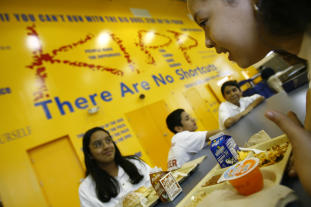
Dec. 17, 2006, 1:46PM
Decade of change for charter schools
Experts say spotty success keeps them from competing with traditional system
By JENNIFER RADCLIFFE
Copyright 2006 Houston Chronicle
Texas lawmakers approved public charter schools in 1995 to increase options for parents, attract new teachers to public schools, create competition for public schools and encourage innovative learning methods.
• Admission must be open to all students — except in some cases, including those with documented criminal histories or discipline problems. Charters are not allowed to charge tuition.
• Today, 192 charter holders operate 358 campuses in Texas. Current legislation limits the number of charters that can be issued by the State Board of Education to 215.
Source: Texas Education Agency
When Texas opened its first charter schools a decade ago, some public school educators feared that the radical new option would lure away the best and brightest students from traditional public schools.
Ten years and 358 charter campuses later, that fear hasn't been realized. Rather, most of Texas' charters — free public schools that don't have to comply with some state regulations — are catering to poor and minority students at risk of dropping out.
The dramatic shift in the target audience hasn't been the only surprise in Texas' charter school experiment. Policy-makers have found it nearly impossible to close struggling campuses, including Houston's Gulf Shores Academy. On the other hand, even skeptics applaud the successes of some charters, such as the Houston-based Knowledge Is Power Program and YES Prep Public Schools.
For the movement to become a truly competitive force in public education, charter school reform must be a top issue in the legislative session that starts in January, experts said.
"We have to reward really good charters, and we need to close those schools that are not meeting the needs of the students," said Senate Education Chairwoman Florence Shapiro, R-Plano.
A bill to be introduced this session would pull the plug on every Texas charter school in the fall and then instantly reopen the strong campuses with perpetual licenses, said Rep. Rob Eissler, R-The Woodlands. The move could close 20 to 30 underperforming schools, officials said.
"It kind of starts everything with a clean slate," Eissler said. "The debate will be interesting, and the results will be interesting."
Despite the political attention it garners, Texas' charter school movement is still in its infancy.
About 90,000 of Texas' 4.5 million public students attend state- or district-approved charter schools, just 2 percent of the student population.
Houston presence
Even with a state-mandated charter cap, enrollment is growing by a robust 10 percent a year. In the Houston area, charters may have a market share as high as 15 percent, said Todd Ziebarth, a researcher with the National Alliance for Public Charter Schools.
HISD officials estimate that 12,000 to 13,000 children who live inside district boundaries attend state-approved charter schools. Another 10,000 or so attend HISD charter schools.
However, the disparity in the quality of education those children receive is wide. Texas charter schools are more likely than traditional public schools to earn state ratings at the very top and the very bottom of the scale.
This August, nearly 16 percent of Texas charter systems were deemed "unacceptable," compared with just 3 percent of traditional districts. Just 1.3 percent of traditional districts earned "exemplary" ratings, compared with 3 percent of charter systems.
A handful of charters made headlines for serious financial and academic concerns. Three former employees of the defunct Prepared Table Charter School in Houston were sentenced to prison last year for helping defraud the government of $6 million. The Gulf Shores Academy and Alphonso Crutch charter schools have owed the state as much as $10.6 million and $1.6 million, respectively.
"The biggest problem that the high-performing charters have is perception, and the perception the citizens of Texas have is of low-performing charters," said John Pitts, a Houston lobbyist who represents two charter school coalitions.
Marquette University professor Howard Fuller, chairman of the Black Alliance for Educational Options, told more than 650 people at a charter school conference in Houston last month that charter operators must be their own toughest critics. They can't make excuses for failing to educate their poor and minority students.
"That's why charter schools were created — because we said, 'It's hard, but we can do it,' " Fuller said. "Now that you are there, you can't be whining and crying about how hard it is. It's supposed to be hard."
Charter schools that aren't preparing students for college should be closed, he said. "You cannot be committed to charter schools," Fuller said. "You have to be committed to the students who come to charter schools."
Great expectations
More than 1,000 students are waiting for spots in KIPP's southwest Houston schools. The multischool campus houses KIPP Academy Middle School, one of Texas' oldest charters.
With 52 schools nationally, KIPP has produced results by extending the schoolday, holding Saturday classes, mandating parental involvement and fostering a culture of high expectations among its low-income students. College pennants line the walls, and the names of the former KIPP students who now attend those universities are proudly listed underneath.
The philosophical differences are not lost on students new to the school this year.
"At my old school, they didn't care if we went to college," said Guillermo Vizcardo, a 10-year-old who attended Petrosky Elementary in Alief last year.
Former HISD student Ivan Sepulveda, 10, added: "This school teaches more about life — how we can get a good job and what to expect."
Even with his school's popularity, KIPP co-founder Mike Feinberg said he knows the charter movement hasn't rattled traditional schools.
"We're not there yet. We're not even close," he said, adding the state must shut low-performing schools before the movement can really take root.
Three students are waiting for each seat at Harmony Science Academy, a charter system that consistently earns an "exemplary" state rating.
Still, Harmony Superintendent Soner Tarim acknowledges they're not big enough to scare traditional schools.
"In Houston, it's difficult to see the impact charter schools are having," he said.
Nearby, native-Spanish-speaking students at SER-Niños Charter School alternate weekly between English and Spanish lessons in the school's innovative dual-language program.
The little-publicized campus operated from a church before gaining the wherewithal to finance a $5 million building.
"We fly under the radar," said Charmaine Constantine, who runs the school.
Still, SER-Niños is wildly popular. Even though students are selected through a lottery, parents lined up at the crack of dawn to hand-deliver their applications this school year.
"We had like 50 applications in the first two hours," Constantine said, adding that the waiting list is 188 students long.
Putting reforms on radar
Though Constantine measures her campus' scores to those of neighboring schools, HISD Superintendent Abelardo Saavedra said he doesn't view charters as competition.
"You don't have enough success with charters yet," he said. "In the state of Texas, at least, there's been more failures than successes with the charters."
Patsy O'Neill, executive director of the Resource Center for Charter Schools, however, credits the state's strongest charters with putting reforms such as school uniforms, International Baccalaureate and a college-prep focus on the radar of traditional public schools.
Educators took notice, for instance, when YES College Prep started requiring students to earn college admission before receiving their high school diplomas. Just this year, the Houston Independent School District released a draft college-going plan that asks all high schoolers to fill out a Texas college application prior to graduation.
"The competition from YES and KIPP in Houston have probably made the HISD and other traditional districts in Houston look harder at academics," O'Neill said.
Others say that charters haven't lived up to their billing as innovative alternatives.
"That's been the problems with charter schools — very, very few of them have offered anything unique other than their privatized management. Most of them are structured like our neighborhood schools, they're just not doing as good of a job," said John O'Sullivan, secretary for the Texas Federation of Teachers.
Though he supports charters, he says they don't deserve credit for reforming traditional schools.
"It's a little bit irritating. Texas public schools have been on an upward curve in terms of improving student achievement for 20 years, well before the advent of charter schools," he said. "It's a little boisterous, I'd say, for charter schools to be claiming credit for our successes. I think they need to focus on their own success, or lack thereof."
Full steam ahead
Since Minnesota penned the nation's first charter school law in 1991, the movement has attracted 1.1 million children throughout the U.S.
While especially active in Washington D.C., Chicago and New Orleans, charters are just starting to gain steam in many areas.
It took California's movement — the second-oldest in the country — 10 years to get its footing. The state's 600 charter campuses serve nearly 220,000 students.
Good times predicted
"Between years 10 and 15, we've really seen a maturation in the movement," said Gary Larson, vice president of the California Charter Schools Association, who predicts that the Texas' movement will experience the same success in the next five years.
Finally, Larson said, public schools in Oakland and Los Angeles are starting to respond to the increased market pressure. Strong charters should not be seen as a threat, he said.
"We need to prioritize the real threats, like dropouts and illiteracy," Larson said.
San Antonio Express-News writer Gary Scharrer contributed to this report.
jennifer.radcliffe@chron.com
http://www.chron.com/disp/story.mpl/front/4407558.html
Thursday, December 14, 2006
Bilingual education put to the test in federal court

Students in Carolina Duncan's binlingual class
www.news8austin.com
Bilingual education put to the test in federal court
Updated: 12/4/2006 7:26:44 PM
By: Hermelinda Vargas
The Austin Independent School District considers Oak Hill Elementary teacher Carolina Duncan to be one of its best bilingual teachers.
Duncan trains other teachers and said her efforts show on the TAKS test and on her students' overall success.
"I have a lot of students that come having a lot of hardship with
reading. And when they leave first grade, they're on level, which
means they're reading very well, 60 words per minute, or even
they read at second or third grade level," Duncan said.
But not all Texas bilingual teachers can count the same successes. That's part of the reason why the Mexican American Legal Defense and Educational Fund (MALDEF) is suing the state.
The lawsuit claims accountability measures put in place for the
general population of students is not there to help students in
bilingual programs.
It names the Texas Education Agency (TEA) and the State Board of Education as defendants.
"English language learners are failing. They're being retained in the grade levels and they're being eventually pushed out of the schools that are meant to educate them. And the state isn't doing anything about it," David Hinojosa of MALDEF said.
MALDEF sued the state of Texas in 1971 for similar reasons and won. But Hinojosa said the court victory didn't translate in
the classroom.
"The state has retracted on many of of its monitoring obligations. You know, the Legislature used to require on-site monitoring and now on-site monitoring is done very minimally," he said.
MALDEF points to TAKS test results posted by the Texas
Education Agency that show large gaps between students in bilingual programs and their peers. The passing gap widens beginning in fifth grade.
For example, only 18 percent of seventh graders in bilingual programs passed the TAKS test. The passing rate for all seventh
graders was 64 percent.
Duncan said that will not happen with her students. She expects them to do well in middle school and in high school.
"When I see the students changing from not knowing, or
understanding, not even what a word is, or how you make it or how you say it into writing full paragraphs, it just gives me
chills. I love it," she said.
Now it's up to a federal judge to decide if the same kind of
learning is happening in every bilingual classroom.
The Attorney General's office represents the state in this case and declined to interview.
http://www.news8austin.com/content/your_news/default.asp?ArID=176025
Rags to Riches in U.S. Largely a Myth, Scholars Write
For More Info read "Opportunity in America: The Role of Education (pdf)" by the Brookings Institution. -Angela
October 25, 2006
Rags to Riches in U.S. Largely a Myth, Scholars Write
Education seen as key to chance for moving out of lowest income groups.
By Debra Viadero
Among Americans’ most cherished beliefs is the idea that the United States is a land of opportunity, a place where all children have an equal shot at success regardless of the circumstances of their birth. A growing body of research suggests, however, that idea may be a myth.
Going from rags to riches in this country, some studies conducted over the past 10 to 15 years say, may be harder than it used to be. In fact, newer international studies suggest that children born into poor families in the United States have a smaller chance of rising out of poverty than their counterparts in many other industrialized nations.
Given those bleak assessments, some analysts say that education—perhaps now more than ever—is critical to breaking or perpetuating that intergenerational cycle.
“Education is the quintessential way in which people move beyond the circumstances of their birth,” said Isabel V. Sawhill, a senior fellow in economics at the Brookings Institution, a think tank based in Washington that is generally seen as centrist in its political orientation. “Yet when you look at education under a microscope, you discover it’s not as much of an opportunity-enhancing vehicle as many of us thought it was.”
Ms. Sawhill edited a volume of papers published by Brookings last month that explores education’s potential for increasing intergenerational mobility. Focusing public attention on that issue is particularly important now, she said, because statistics show that the income gap between America’s poorest and richest citizens has widened since the 1980s.
“Greater inequality means it takes longer for any income differences to disappear in subsequent generations,” Ms. Sawhill writes. “The United States could be in danger of creating a poverty trap at the bottom and an enclave of wealth at the top.”
Better Data
Experts differ, though, over how much social mobility has changed in the United States. Some contend opportunities to get ahead were more plentiful in the 19th century, when frontier land was still widely available. The Brookings scholars say opportunities to move forward—or fall behind—remained high for much of the next century but appeared to diminish in the 1980s.
Other scholars contend that the nation may never have been as open a society as it was believed to be.
“It’s just that now, researchers have gotten more interested in this, and they’ve gotten better data,” said Gary Solon, an economics professor at the University of Michigan in Ann Arbor. “We don’t have good data from 100 years ago.”
There is more consensus around the idea that the United States has no unique claim, among nations, as a land of opportunity. Measured in terms of income, studies over the past two or three years have shown, the nation offers less opportunity for upward or downward mobility than Britain, Canada, Denmark, Finland, Norway, Sweden, and possibly Germany. In terms of occupational mobility, the United States remains around the middle of pack, according to the Brookings report.
Moving On Up?
These data, showing intergenerational wealth from 1979 to 2000, illustrate that there is less mobility for people who start out in life in the poorest and richest groups of Americans.
*Click image to see the full chart.
SOURCE: “Opportunity in America: The Role of Education”
A study released in January by the Institute for the Study of Labor, a research group based in Bonn, Germany, suggests one reason for the United States’ poor showing. While wealth begets wealth in most countries, the United States is different in that there is “stickiness” across generations at both ends of the income scale. Compared with other industrialized nations, such as the Scandinavian countries, relatively smaller proportions of poor American children ever rise out of poverty, those scholars say.
In the new Brookings volume, “Opportunity in America: The Role of Education,” the writers contend that opportunities to break those persistent economic cycles exist across the education spectrum—in preschool, in K-12 schools, and in higher education. The problem, though, is that education systems operate in some ways that can reinforce the gaps between the haves and have-nots.
During early childhood, for instance, children from wealthier families are still more likely than poor children to attend preschool, and more likely to attend a better-quality preschool, the Brookings authors say. That is true, they add, even though more than half of poor 3- and 4-year-olds now attend some form of preschool.
Likewise, school districts in poorer areas spend on average about the same per pupil as wealthier districts do, according to another essay.
Class Disparities
Yet disadvantaged children are more likely to attend elementary and secondary school in buildings with fewer certified or experienced teachers, less adequate facilities, and fewer Advanced Placement courses than is the case in the schools that more advantaged children attend. Children from lower socioeconomic backgrounds are also more likely to drop out of school and rack up low test scores than their better-off peers, the volume points out.
At the postsecondary level, the scholars find, class disparities are widening even as college attendance rises. Nearly three-quarters of students enrolled in top-tier colleges and universities come from families in the highest socioeconomic group. Three percent are from the lowest group.
The Brookings scholars explore a variety of strategies for increasing intergenerational mobility. At the preschool level, they write, policymakers get stymied over whether to increase access to preschool for all children or to target more-intensive programs to disadvantaged children. A better idea, the authors say, is to do both.
“That way, you’re moving everybody up the ladder, and you’re moving the bottom of the ladder up more steps,” said W. Steven Barnett, who is the director of the National Institute for Early Education Research at Rutgers University, in New Brunswick, N.J., and the co-author of the essay on early-childhood education.
After reviewing research on strategies for improving K-12 schools, Princeton University economist Cecelia E. Rouse and her co-author conclude that programs aimed at reducing class sizes and raising the quality of teachers in the schools that poor children attend may be a better bet than school choice programs or measures, such as the federal No Child Left Behind Act, that hold schools accountable for improving students’ test scores.
“We have a lot of theories in education, but not as much direct evidence,” Ms. Rouse said in an interview. “But we see larger gains with interventions, such as reducing class sizes, that are much more expensive.”
To even the playing field in higher education, policymakers have to pay attention to both preparing precollegiate students to be able to succeed and to increasing public financing of college tuition, argue Robert H. Haveman, a professor of economics and public affairs at the University of Wisconsin-Madison, and Timothy M. Smeeding, a public-policy professor at Syracuse University in Syracuse, N.Y.
Colleges can also cut tuition costs, they say, by focusing on their core educational missions and letting others provide services such as room and board. They also call for funneling state aid for higher education directly to students, rather than to institutions.
Though education “may be the best escalator we’ve got,” said Christopher S. Jencks, a professor of social policy at Harvard University’s John F. Kennedy School of Government, such solutions to reducing social disparities also raise a lot of questions.
“How on earth would you imagine getting the best teachers to the most disadvantaged kids?” said Mr. Jencks, who was not part of the Brookings project. “I don’t know how far down that road we can get before there would be a revolt in the upper classes.”
Coverage of education research is supported in part by a grant from the Spencer Foundation.
Vol. 26, Issue 09, Page 8
“Race and Class: Separate and Not Equal,” September 12, 2006.
“Signs of Early Exit for Dropouts Abound,” June 22, 2006.
“The Dropout Crisis Debate,” March 28, 2006.
“It’s Time to Focus on the Forgotten Middle,” November 2, 2005.
© 2006 Editorial Projects in Education
October 25, 2006
Rags to Riches in U.S. Largely a Myth, Scholars Write
Education seen as key to chance for moving out of lowest income groups.
By Debra Viadero
Among Americans’ most cherished beliefs is the idea that the United States is a land of opportunity, a place where all children have an equal shot at success regardless of the circumstances of their birth. A growing body of research suggests, however, that idea may be a myth.
Going from rags to riches in this country, some studies conducted over the past 10 to 15 years say, may be harder than it used to be. In fact, newer international studies suggest that children born into poor families in the United States have a smaller chance of rising out of poverty than their counterparts in many other industrialized nations.
Given those bleak assessments, some analysts say that education—perhaps now more than ever—is critical to breaking or perpetuating that intergenerational cycle.
“Education is the quintessential way in which people move beyond the circumstances of their birth,” said Isabel V. Sawhill, a senior fellow in economics at the Brookings Institution, a think tank based in Washington that is generally seen as centrist in its political orientation. “Yet when you look at education under a microscope, you discover it’s not as much of an opportunity-enhancing vehicle as many of us thought it was.”
Ms. Sawhill edited a volume of papers published by Brookings last month that explores education’s potential for increasing intergenerational mobility. Focusing public attention on that issue is particularly important now, she said, because statistics show that the income gap between America’s poorest and richest citizens has widened since the 1980s.
“Greater inequality means it takes longer for any income differences to disappear in subsequent generations,” Ms. Sawhill writes. “The United States could be in danger of creating a poverty trap at the bottom and an enclave of wealth at the top.”
Better Data
Experts differ, though, over how much social mobility has changed in the United States. Some contend opportunities to get ahead were more plentiful in the 19th century, when frontier land was still widely available. The Brookings scholars say opportunities to move forward—or fall behind—remained high for much of the next century but appeared to diminish in the 1980s.
Other scholars contend that the nation may never have been as open a society as it was believed to be.
“It’s just that now, researchers have gotten more interested in this, and they’ve gotten better data,” said Gary Solon, an economics professor at the University of Michigan in Ann Arbor. “We don’t have good data from 100 years ago.”
There is more consensus around the idea that the United States has no unique claim, among nations, as a land of opportunity. Measured in terms of income, studies over the past two or three years have shown, the nation offers less opportunity for upward or downward mobility than Britain, Canada, Denmark, Finland, Norway, Sweden, and possibly Germany. In terms of occupational mobility, the United States remains around the middle of pack, according to the Brookings report.
Moving On Up?
These data, showing intergenerational wealth from 1979 to 2000, illustrate that there is less mobility for people who start out in life in the poorest and richest groups of Americans.
*Click image to see the full chart.
SOURCE: “Opportunity in America: The Role of Education”
A study released in January by the Institute for the Study of Labor, a research group based in Bonn, Germany, suggests one reason for the United States’ poor showing. While wealth begets wealth in most countries, the United States is different in that there is “stickiness” across generations at both ends of the income scale. Compared with other industrialized nations, such as the Scandinavian countries, relatively smaller proportions of poor American children ever rise out of poverty, those scholars say.
In the new Brookings volume, “Opportunity in America: The Role of Education,” the writers contend that opportunities to break those persistent economic cycles exist across the education spectrum—in preschool, in K-12 schools, and in higher education. The problem, though, is that education systems operate in some ways that can reinforce the gaps between the haves and have-nots.
During early childhood, for instance, children from wealthier families are still more likely than poor children to attend preschool, and more likely to attend a better-quality preschool, the Brookings authors say. That is true, they add, even though more than half of poor 3- and 4-year-olds now attend some form of preschool.
Likewise, school districts in poorer areas spend on average about the same per pupil as wealthier districts do, according to another essay.
Class Disparities
Yet disadvantaged children are more likely to attend elementary and secondary school in buildings with fewer certified or experienced teachers, less adequate facilities, and fewer Advanced Placement courses than is the case in the schools that more advantaged children attend. Children from lower socioeconomic backgrounds are also more likely to drop out of school and rack up low test scores than their better-off peers, the volume points out.
At the postsecondary level, the scholars find, class disparities are widening even as college attendance rises. Nearly three-quarters of students enrolled in top-tier colleges and universities come from families in the highest socioeconomic group. Three percent are from the lowest group.
The Brookings scholars explore a variety of strategies for increasing intergenerational mobility. At the preschool level, they write, policymakers get stymied over whether to increase access to preschool for all children or to target more-intensive programs to disadvantaged children. A better idea, the authors say, is to do both.
“That way, you’re moving everybody up the ladder, and you’re moving the bottom of the ladder up more steps,” said W. Steven Barnett, who is the director of the National Institute for Early Education Research at Rutgers University, in New Brunswick, N.J., and the co-author of the essay on early-childhood education.
After reviewing research on strategies for improving K-12 schools, Princeton University economist Cecelia E. Rouse and her co-author conclude that programs aimed at reducing class sizes and raising the quality of teachers in the schools that poor children attend may be a better bet than school choice programs or measures, such as the federal No Child Left Behind Act, that hold schools accountable for improving students’ test scores.
“We have a lot of theories in education, but not as much direct evidence,” Ms. Rouse said in an interview. “But we see larger gains with interventions, such as reducing class sizes, that are much more expensive.”
To even the playing field in higher education, policymakers have to pay attention to both preparing precollegiate students to be able to succeed and to increasing public financing of college tuition, argue Robert H. Haveman, a professor of economics and public affairs at the University of Wisconsin-Madison, and Timothy M. Smeeding, a public-policy professor at Syracuse University in Syracuse, N.Y.
Colleges can also cut tuition costs, they say, by focusing on their core educational missions and letting others provide services such as room and board. They also call for funneling state aid for higher education directly to students, rather than to institutions.
Though education “may be the best escalator we’ve got,” said Christopher S. Jencks, a professor of social policy at Harvard University’s John F. Kennedy School of Government, such solutions to reducing social disparities also raise a lot of questions.
“How on earth would you imagine getting the best teachers to the most disadvantaged kids?” said Mr. Jencks, who was not part of the Brookings project. “I don’t know how far down that road we can get before there would be a revolt in the upper classes.”
Coverage of education research is supported in part by a grant from the Spencer Foundation.
Vol. 26, Issue 09, Page 8
“Race and Class: Separate and Not Equal,” September 12, 2006.
“Signs of Early Exit for Dropouts Abound,” June 22, 2006.
“The Dropout Crisis Debate,” March 28, 2006.
“It’s Time to Focus on the Forgotten Middle,” November 2, 2005.
© 2006 Editorial Projects in Education
Wednesday, December 13, 2006
Lobbyists now seeing need for campaign contribution limits
This is a healthy discussion in our state. Campaign finance reform is a tough issue, but clearly in our interest as a state to address in order to minimize the undue influence of select individuals. -Angela
by Clay Robison
Web Posted: 12/10/2006 09:57 PM CST
San Antonio Express-News
AUSTIN — Bob Perry and James Leininger aren't the only poster children for campaign finance reform in Texas, but they and other mega-donors are inspiring more talk about the need for contribution limits.
And the talk isn't coming from just the public advocacy groups that have been preaching reform for years. A number of prominent Austin lobbyists, whose business clients also play the money game, are increasingly beginning to feel the same way.
"The whole money thing ... has gotten totally out of hand. I support any restrictions of any kind, and most of the lobby would too," said one lobbyist, who didn't want to be named.
Reform still has at least two major obstacles, however, in Gov. Rick Perry and Speaker Tom Craddick. Two of the governor's biggest contributors are Bob Perry (to whom he isn't related) and Leininger.
Some reformers suggest that Lt. Gov. David Dewhurst, a multimillionaire who can largely fund his own campaigns if necessary, may be receptive to contribution limits because they could partially disarm opponents in a future governor's race. But Dewhurst may not want to fight this uphill battle.
Business lobbyists could help renew an old debate, but many don't want to be publicly associated with campaign finance reform, at least not yet, because they and their clients have to work with lawmakers on both sides of the issue.
Jack Gullahorn, an Austin attorney and former lobbyist, said he has slowly come around to the need for contribution limits partly, but not totally, because of the super-rich donors who, of late, have been dumping tens or hundreds of thousands of dollars into selected legislative races.
"I think that over the last few years, I've been hearing from more people that they're feeling disenfranchised," Gullahorn said.
In other words, a growing number of lobbyists and their corporate clients are worried about their own preservation in an arena in which money is considered essential to political influence.
Gullahorn said the Professional Advocacy Association of Texas, an organization of lobbyists he heads, won't take the lead on campaign finance reform but will support efforts to impose contribution limits.
He said the group also would support the legalization of direct, but limited, corporate contributions to candidates, a practice now banned by state law. That proposal may spark even more controversy, but Gullahorn said such a law could be easier to administer than the system of political action committees, through which many corporate-related donations are now made.
Bob Perry, a Houston home builder, and Leininger, a San Antonio businessman, are among donors now outgunning most traditional givers, including the vast majority of business executives, doctors and plaintiffs lawyers.
Perry, who has headed the Texas donors' list for the past three elections, spent $16 million on state and federal races in 2005-06, according to a report by Texans for Public Justice, which tracks money in Texas politics. He gave $6.7 million of the total to state candidates, mostly Republicans, and conservative Texas political committees.
Leininger gave about $5 million in pursuit of a law allowing tax dollars to be spent on vouchers for private school tuition. He helped unseat two Republican legislators who voted against him in 2005, but overall lost more races than he won.
A handful of other contributors, including plaintiffs lawyers John O'Quinn of Houston and Fred Baron of Dallas, gave about $1 million or more. O'Quinn was Democratic gubernatorial nominee Chris Bell's single biggest contributor.
And Texans for Lawsuit Reform, to which Bob Perry has generously contributed, gave more than $3 million in the recent election cycle, far outpacing most political action committees.
One bill already has been prefiled to limit an individual's total contributions in state races to $100,000 per election cycle, and there will be other proposals, including public funding of campaigns.
The above unnamed lobbyist believes donation limits will get more support from legislators after the large sums of money that Leininger, in particular, spent against House members who had voted the "wrong" way on vouchers.
"If they have a brain at all, they have to be smart enough to understand that the first time they step out of line, they're going to be the target next time," he said.
clay.robison@chron.com
Look for the latest news in Texas politics each Monday from Austin Bureau Chief Clay Robison.
by Clay Robison
Web Posted: 12/10/2006 09:57 PM CST
San Antonio Express-News
AUSTIN — Bob Perry and James Leininger aren't the only poster children for campaign finance reform in Texas, but they and other mega-donors are inspiring more talk about the need for contribution limits.
And the talk isn't coming from just the public advocacy groups that have been preaching reform for years. A number of prominent Austin lobbyists, whose business clients also play the money game, are increasingly beginning to feel the same way.
"The whole money thing ... has gotten totally out of hand. I support any restrictions of any kind, and most of the lobby would too," said one lobbyist, who didn't want to be named.
Reform still has at least two major obstacles, however, in Gov. Rick Perry and Speaker Tom Craddick. Two of the governor's biggest contributors are Bob Perry (to whom he isn't related) and Leininger.
Some reformers suggest that Lt. Gov. David Dewhurst, a multimillionaire who can largely fund his own campaigns if necessary, may be receptive to contribution limits because they could partially disarm opponents in a future governor's race. But Dewhurst may not want to fight this uphill battle.
Business lobbyists could help renew an old debate, but many don't want to be publicly associated with campaign finance reform, at least not yet, because they and their clients have to work with lawmakers on both sides of the issue.
Jack Gullahorn, an Austin attorney and former lobbyist, said he has slowly come around to the need for contribution limits partly, but not totally, because of the super-rich donors who, of late, have been dumping tens or hundreds of thousands of dollars into selected legislative races.
"I think that over the last few years, I've been hearing from more people that they're feeling disenfranchised," Gullahorn said.
In other words, a growing number of lobbyists and their corporate clients are worried about their own preservation in an arena in which money is considered essential to political influence.
Gullahorn said the Professional Advocacy Association of Texas, an organization of lobbyists he heads, won't take the lead on campaign finance reform but will support efforts to impose contribution limits.
He said the group also would support the legalization of direct, but limited, corporate contributions to candidates, a practice now banned by state law. That proposal may spark even more controversy, but Gullahorn said such a law could be easier to administer than the system of political action committees, through which many corporate-related donations are now made.
Bob Perry, a Houston home builder, and Leininger, a San Antonio businessman, are among donors now outgunning most traditional givers, including the vast majority of business executives, doctors and plaintiffs lawyers.
Perry, who has headed the Texas donors' list for the past three elections, spent $16 million on state and federal races in 2005-06, according to a report by Texans for Public Justice, which tracks money in Texas politics. He gave $6.7 million of the total to state candidates, mostly Republicans, and conservative Texas political committees.
Leininger gave about $5 million in pursuit of a law allowing tax dollars to be spent on vouchers for private school tuition. He helped unseat two Republican legislators who voted against him in 2005, but overall lost more races than he won.
A handful of other contributors, including plaintiffs lawyers John O'Quinn of Houston and Fred Baron of Dallas, gave about $1 million or more. O'Quinn was Democratic gubernatorial nominee Chris Bell's single biggest contributor.
And Texans for Lawsuit Reform, to which Bob Perry has generously contributed, gave more than $3 million in the recent election cycle, far outpacing most political action committees.
One bill already has been prefiled to limit an individual's total contributions in state races to $100,000 per election cycle, and there will be other proposals, including public funding of campaigns.
The above unnamed lobbyist believes donation limits will get more support from legislators after the large sums of money that Leininger, in particular, spent against House members who had voted the "wrong" way on vouchers.
"If they have a brain at all, they have to be smart enough to understand that the first time they step out of line, they're going to be the target next time," he said.
clay.robison@chron.com
Look for the latest news in Texas politics each Monday from Austin Bureau Chief Clay Robison.
Saturday, December 09, 2006
Strayhorn: Undocumented immigrants leave state holding a mixed bag
The downloadable report is available here (pdf).
-Angela
Strayhorn: Undocumented immigrants leave state holding a mixed bag
Carole Keeton Strayhorn, TEXAS COMPTROLLER
Saturday, December 09, 2006
Immigration was a heated topic of debate leading up to the November elections and will continue to fuel discussion and action in 2007. This month, I released a special report, "Undocumented Immigrants in Texas: A Financial Analysis of the Impact to the State Budget and Economy," which clearly shows the state receives an economic benefit from the growing number of undocumented immigrants in Texas, but it also sheds light on the challenges facing local governments providing services to undocumented immigrants.
The report (online at www.window.state.tx.us) marks the the first time any state has done a comprehensive financial analysis of the effect of undocumented immigrants on its budget and economy, looking at gross state product, revenues generated, taxes paid and the cost of state services.
The absence of the estimated 1.4 million undocumented immigrants in Texas in fiscal 2005 would have been a loss to our gross state product of $17.7 billion. Undocumented immigrants produced $1.58 billion in state revenues, which exceeded the $1.16 billion in state services they received. However, local governments bore the burden of $1.44 billion in uncompensated health care and law enforcement costs not paid for by the state.
The report estimates that undocumented immigrants in Texas generate more in state taxes and fees than the costs incurred by the state in providing education, health care and emergency medical services, and incarceration.
Texas is more likely than other states to capture tax revenues from undocumented immigrants because it has no income tax and relies heavily on consumption taxes.
Services for undocumented migrants include K-12 education, emergency medical care, health care for children with special needs, mental health aid, substance abuse aid, immunizations and public health.
Undocumented immigrants are not eligible for Medicare, Medicaid, the Children's Health Insurance Program, food stamps, welfare, Supplemental Security Income, public housing, job opportunities for low-income individuals and child care and development.
The report estimated the state spent $957 million on K-12 education for undocumented students during the 2004-2005 school year. States may not deny access to public education to immigrant children residing within their boundaries, regardless of legal status.
I estimated the state spent $11.2 million for higher education for undocumented students who are classified as Texas residents and thus paid in-state tuition during the 2004-2005 school year. Most of these students attended community colleges.
In fiscal 2005, I estimated the state spent $58 million for health care services for undocumented immigrants. Most of the state's costs ($38.7 million) were for emergency Medicaid services, most of which is tied to childbirth.
I estimated the state spent $130.6 million on incarceration for undocumented immigrants in fiscal 2006.
Local governments and hospitals feel the effect from undocumented immigrants. In 2004, undocumented immigrants cost hospitals an estimated $1.3 billion in uncompensated care, while in 2005 local governments spent $141.9 million to cover costs associated with incarceration.
The report estimated undocumented immigrants paid $513 million in fiscal 2005 in local taxes, including city, county and special district sales and property taxes.
Revenues from undocumented immigrants exceed what the state spent on services by more than $420 million. Though state revenues exceed expenditures for those immigrants, local governments and hospitals experience the opposite, with the estimated difference being more than $920 million for 2005.
Find this article at:
http://www.statesman.com/opinion/content/editorial/stories/12/9/9strayhorn_edit.html
-Angela
Strayhorn: Undocumented immigrants leave state holding a mixed bag
Carole Keeton Strayhorn, TEXAS COMPTROLLER
Saturday, December 09, 2006
Immigration was a heated topic of debate leading up to the November elections and will continue to fuel discussion and action in 2007. This month, I released a special report, "Undocumented Immigrants in Texas: A Financial Analysis of the Impact to the State Budget and Economy," which clearly shows the state receives an economic benefit from the growing number of undocumented immigrants in Texas, but it also sheds light on the challenges facing local governments providing services to undocumented immigrants.
The report (online at www.window.state.tx.us) marks the the first time any state has done a comprehensive financial analysis of the effect of undocumented immigrants on its budget and economy, looking at gross state product, revenues generated, taxes paid and the cost of state services.
The absence of the estimated 1.4 million undocumented immigrants in Texas in fiscal 2005 would have been a loss to our gross state product of $17.7 billion. Undocumented immigrants produced $1.58 billion in state revenues, which exceeded the $1.16 billion in state services they received. However, local governments bore the burden of $1.44 billion in uncompensated health care and law enforcement costs not paid for by the state.
The report estimates that undocumented immigrants in Texas generate more in state taxes and fees than the costs incurred by the state in providing education, health care and emergency medical services, and incarceration.
Texas is more likely than other states to capture tax revenues from undocumented immigrants because it has no income tax and relies heavily on consumption taxes.
Services for undocumented migrants include K-12 education, emergency medical care, health care for children with special needs, mental health aid, substance abuse aid, immunizations and public health.
Undocumented immigrants are not eligible for Medicare, Medicaid, the Children's Health Insurance Program, food stamps, welfare, Supplemental Security Income, public housing, job opportunities for low-income individuals and child care and development.
The report estimated the state spent $957 million on K-12 education for undocumented students during the 2004-2005 school year. States may not deny access to public education to immigrant children residing within their boundaries, regardless of legal status.
I estimated the state spent $11.2 million for higher education for undocumented students who are classified as Texas residents and thus paid in-state tuition during the 2004-2005 school year. Most of these students attended community colleges.
In fiscal 2005, I estimated the state spent $58 million for health care services for undocumented immigrants. Most of the state's costs ($38.7 million) were for emergency Medicaid services, most of which is tied to childbirth.
I estimated the state spent $130.6 million on incarceration for undocumented immigrants in fiscal 2006.
Local governments and hospitals feel the effect from undocumented immigrants. In 2004, undocumented immigrants cost hospitals an estimated $1.3 billion in uncompensated care, while in 2005 local governments spent $141.9 million to cover costs associated with incarceration.
The report estimated undocumented immigrants paid $513 million in fiscal 2005 in local taxes, including city, county and special district sales and property taxes.
Revenues from undocumented immigrants exceed what the state spent on services by more than $420 million. Though state revenues exceed expenditures for those immigrants, local governments and hospitals experience the opposite, with the estimated difference being more than $920 million for 2005.
Find this article at:
http://www.statesman.com/opinion/content/editorial/stories/12/9/9strayhorn_edit.html
Subscribe to:
Posts (Atom)