Friends:
I want to call readers’ attention to this provocative and important two-part essay by UT-Austin Professor Joshua Gunn in The Higher Ed Advocate, both posted below. Densely documented with links to primary documents, investigative reporting, scholarship, and the institutions’ own materials, Gunn raises questions about the transformation of Texas higher education that deserve serious public scrutiny.
In Part One, he examines changes in the language and governance of Texas public universities, drawing particular attention to terms appearing in official UT and UT System documents—academic “integrity,” “stewardship,” “solemn covenant,” “sacred space,” “spirit of grace,” and related formulations—and argues that their cumulative significance looks different when situated within the broader political ascendancy of Christian nationalism. The language itself is not in dispute: UT Austin’s Texas Statement on Academic Integrity describes the classroom as a “sacred space” and invokes a “spirit of grace,” while the UT System’s 2026 teaching policy describes teaching as a “solemn covenant” between faculty and students.
In Part Two, Gunn moves from rhetoric to institutional development, examining the Civitas Institute and School of Civic Leadership and the political and financial forces surrounding their emergence. That history is significant: Civitas was initially established with $12 million in state and UT System funding following documented involvement by political leaders and conservative donors, the Regents created the School of Civic Leadership in 2023, and in 2025 committed another $100 million for its permanent home.
The public should be concerned not because conservative scholars, religious scholars, or people of faith have no place in public universities—they unquestionably do. Pluralism requires their presence, too.
The concern arises when governmental power, university governance, major private wealth, and particular ideological or religious projects begin converging in ways that can determine which fields flourish, which departments disappear, which subjects become “controversial,” which forms of knowledge receive extraordinary institutional investment, and which become administratively vulnerable. That is a fundamentally different question from whether conservative ideas deserve a hearing. They do.
The question is whether a public university remains a genuinely pluralistic institution when the state itself increasingly participates in deciding which ideas, histories, and intellectual traditions merit institutional protection and amplification.
Read together, Gunn’s essays therefore raise a larger and more consequential question of institutional capture: Who gets to determine what counts as legitimate knowledge, which histories universities teach, which questions professors may safely ask, and ultimately what kind of citizen public education is intended to produce? I encourage readers to read Part One and Part Two for themselves, follow Gunn’s many links, examine the underlying documents, and reach their own conclusions about what these developments mean for academic freedom, church-state boundaries, shared governance, and the democratic purposes of public education.
And there is one final connection we should not miss. The University of Texas System is governed by nine regents who are appointed by the governor and confirmed by the Texas Senate, serving staggered six-year terms. University governance can therefore seem distant from electoral politics, but it is not. Who Texans elect determines who appoints the people who govern our public universities—and who confirms those appointments.
Gubernatorial and state Senate elections are higher-education elections, too. Elections matter, my friends.
-Angela Valenzuela
 |
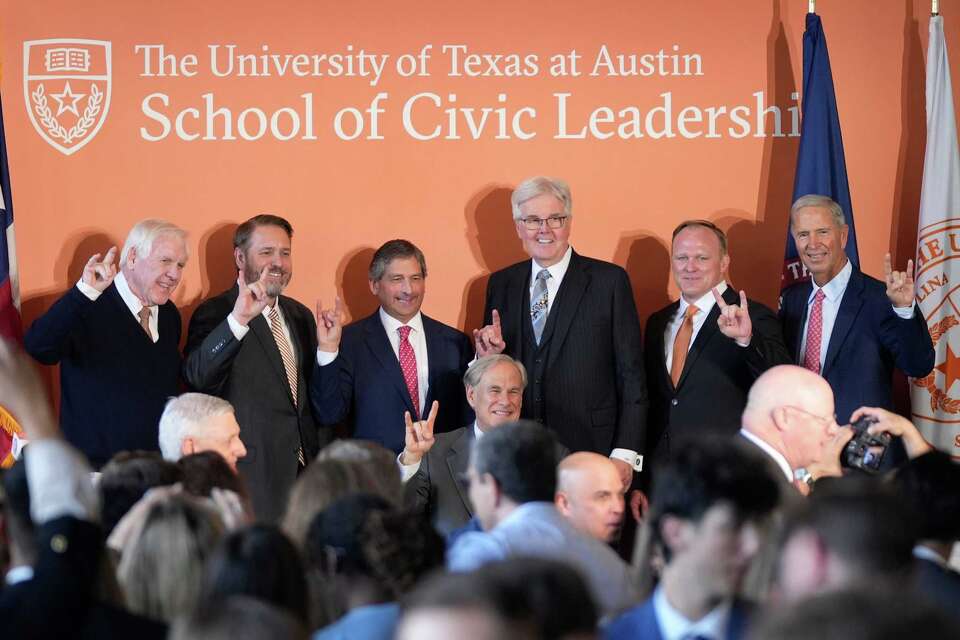
Jim Davis, University of Texas at Austin interim president, Gov. Greg Abbott, UT System Chairman Kevin Eltife, Lt. Gov. Dan Patrick, and Justin Dyer, the dean of UT's School of Civic Leadership, gathered Thursday at the UT-Austin campus for the announcement that $100 million is being invested into the civic leadership school. Lorianne Willett/The Texas Tribune, May 8, 2025 Christian Nationalism Captures Higher Education, or, On Mandatorily Managing the Mystery of the Maker, Part One by Joshua Gunn | Jul 22, 2026 | The Higher Ed Advocate In this newsletter I argue that the far right-wing capture of Texas public universities —well, all public schools in the state—is fundamentally motivated by Christian Nationalism, a political movement that deviates substantially from the so-called “movement conservatism” or the (old) New Right associated with William F. Buckley and Ronald Reagan (what many folks associate with the label “conservative”). The goal of this ideology is the fusion of civic and religious identity through a forceful and (usually) fundamentalist interpretation of the Bible, establishing total control of local and federal governments, most especially in respect to education. To this end, US democracy is critiqued for its pluralism, the assumption of universal or “natural” rights, and an ever-increasing ethnic and racial diversity. The most vocal proponents of this ideology seem to long for social hierarchies (only straight white men at the top!) and to suggest that autocracies are permissible—if not encouraged—because the ends of dominion justify the means. Those ends have upended the Texas public university in covert, deliberately opaque, cut-throat calculations. Rather than arguing for incremental change and the preservation of institutions and traditions, many self-identified Texas “conservatives” have perversely embraced rapid, revolutionary change, big government, usurping public schools and promoting private religious education (e.g., vouchers and charter schools), bigotry, more bigotry, and the wholesale abandonment of the liberalism advanced in the second sentence of the Declaration of Independence. Although the massive restructuring and oversight of higher education in Texas has been made in the name “intellectual diversity” and restoring “public trust,” the disbandment of faculty governance, the dissolution of departments, legitimization of discrimination, the chilling of free speech and thought, and mass firings have more to do with a sanctimonius religious conviction than cultivating a public faith that was never lost. As a movement, Christian Nationalism represents an array of denominations, from charismatic Pentecostals, to Southern Baptists, to the Catholic prelature Opus Dei (the Heritage Foundation is helmed by an Opus Dei affiliate), and to nation-state or cultural crusades, such as the New Apostolic Reformation and Christian Reformism or Neo-Calvinism respectively. Although there are numerous theological differences among these groups, they are united in the misinformed or deliberately deceptive conviction that the United States was created as a “Christian nation,” and in the dogged pursuit of an illiberal, theocratic government outlined in the now (in)famous “Project 2025“ and the lesser known white paper on family fun. For example, recently the Trump administration’s “Freedom 250,” a quasi-privatized, partisan alternative to the nonpartisan Congressional Semiquincentennial Commission “America 250,” hosted a “jubilee” on the National Mall dubbed “Rededicate 250.” This national party of prayer, praise, and “thanksgiving” was unabashedly a Christian Nationalist event calling for “God’s blessing, guidance, and grace for the next 250.” The celebration was presented as a victory lap for this growing religious minority (with the help of disingenuous Trumpeteering mobsters and technofacists), having captured all three branches of the federal government (and in Texas, too). After publicly arguing with Pope Leo XIV about so-called just war theory, recent Catholic convert, Opus Dei affiliate, and technofascist plant J.D. Vance delivered a canned keynote to the commemoration, during which he declared that “the morality and religion that formed the American consciousness were decidedly Christian, founded upon the principles and the divinity of Jesus Christ.” While most were religious, the Founders were decidedly unorthodox and against religious tests for public office or citizenship; despite the late Charlie Kirk’s lauded claims to the contrary, the First Amendment explicitly outlaws a national religion. The administrator-politicians (a turn of phrase that recalls “student-athletes”) of the University of Texas System apparently agree with the Vice President, but have been deliberately reluctant to admit so publicly; as—however ironic—board chair, former state senator, and “fervent Catholic” Kevin Eltife said at a public meeting last semester, “we are in difficult times . . . . Vagueness can be our friend.” A closer attention to recent, equivocal policy rhetoric about Texas education registers a dog whistle sampler of Christian Nationalist code words and deeds. For example, in the convocation of friendly vagueness last February, UT System Regents unanimously passed a “Standards for Teaching Controversial Topics” policy, which adds nothing new to existing policy or common sense—but for this: instructors should “eschew topics and controversies that are not germane to the course,” and that any required courses (“core” or “general ed”) cannot include the study of “unnecessary controversial subjects.” Although censorship and self-censorship are certainly not in the “spirit” of academic freedom, the vagueness of the rule for the UT system misdirects from what the policy sets-up (a coming, radical change in humanities curricula), and more importantly, the unusual language that frames it. The statement on teaching controversial issues begins, “The University of Texas System affirms teaching as a solemn covenant between faculty and students” (my emphasis), which could refer to a strict rule (e.g., as with real estate law), but which usually connotes a religious promise (e.g., God’s promises to Noah and Abraham in the Hebrew Bible). Other terms in the document have a religious sheen: instructors must “adhere faithfully” to their syllabi (or else!) and be “careful stewards of their pedagogical responsibilities,” which implies teachers serve their institutions or “the public” and thus are not in charge of their affective and intellectual labor, especially of the invisible labor that is expected but not compensated (e.g., non-contractural yet demanded student caretaking; the exploitation of graduate workers, and so on). Biblically, rooted in the Greek oikos or “house” and nemein “to manage,” “stewarding” is a foundational if not imperative theological principle: humans are but servants of the Master of Creation, Who has mercifully gifted humans dominion over His handiwork. In the New Testament, a steward or servant is often a slave. Perhaps more alarmingly, however, is the policy’s tacit claim about the true authorities of knowledge in a public, secular university, who are apparently political appointees, not the longstanding, traditional expertise of trained and degreed educators. (How soon we forget The Inquisition! with props to Monty Python.) Insofar as “truth” is God’s word, for this analogy Senate Bill 37 has rendered instructors into deacons, establishing public university administrations as a priestly class, looming over “knowledge” and interpreting the “truth,” guided by grace and spirit (and in this analogy, legislators would be bishops). UT-Austin has always navigated a top-down, “serve at the pleasure of X” management style, it’s just now been squeezed of any democratic governance that was left. Not coincidentally, similar religious code words were pioneered and published by the University of Texas at Austin months earlier in November, 2025, which was—at least in part—in response to the Trump administration’s offer to sign a “compact” in exchange for preferential federal funding; the university did not sign the bribe, but apparently more or less told the Trump administration, “daddy got this, hold my beer!” which was curiously followed by a 10 million dollar, non-competitive grant from the National Endowment for the Humanities to hire more “conservative” faculty. After the regency dissolved the Faculty Council and related committees (e.g., the Faculty Grievance Committee, on which I was serving), new president Jim Davis, a former lead lawyer for the university and deputy for AG Ken Paxton, hand-picked a faculty committee, led by Provost William Inboden, to develop a document on the cheesy “Texas Way” of academic “integrity” (apparently no relation to the “foundling future” of the Mandalorian motto). The resulting “Statement on Academic Integrity“ ballyhooed by UT-Austin’s comms office prefigures the system-wide policy on controversial topics, but curiously swaps out “freedom” with the moral stricture connoted by “integrity.” These concepts are not the same, as academic freedom represents an ability to speak publicly on both professional or private concerns without fear of getting fired, while integrity concerns honesty, transparency, and telling the truth. The conflation of one with the other is literally an eclipse of one with the other, or at the very least, a new reading of policy that holds truth-telling is the prerequisite for job protection to speak freely (again, as if this is not common sense for most academics—at least the properly trained ones). The conflation of these two concepts would probably have gone unnoticed if the Hartzell-cum-Davis administration has not been so committed to strategic opacity (almost always with the false promise, “we’re protecting you behind the scenes,” a variation of academic “daddy got dis” paternalism) and outright lying, over and over, repeatedly. Replacing “freedom” with “integrity” is some variation of irony, I’m just not sure which one. Hypocrisy is probably a better word. The statement opens with reference to the biblical verse inscribed on the south wall of the famous, central, penis-shaped administrative building in the mid-1930s: “Ye shall know the truth, and the truth shall make you free” (John 8:32). The distinguished professor who recommended the verse was a deeply respected, religious man and the double-meaning of “truth,” at the time, was as sincere as it was normative (he was Senior Warden at All Saints Episcopal right next to campus). The opening, biblical conflation of knowledge and spiritual verity, however, is followed by a paragraph later that “academic integrity includes intellectual honesty and pedagogical responsibility,” the latter a term repeated in the regents’ controversial topics statement months later. Then comes more explicit religious language: [Academic integrity] embraces the university classroom as a sacred space for learning. For students, faculty, and our institution alike, a spirit of humility should prevail in the face of the mysterious and unknown, coupled with a spirit of audacity in questioning received verities and exploring new vistas. A sprit of grace should leaven the contentions and disputations that are central to academic inquiry. The statement concludes: At its core, academic integrity forges a solemn trust between the instructor and the students, and between the university and the state and nation. It is that trust that we reaffirm here. And it is that trust that will continue to ensure that what starts here changes the world. Apparently unbeknownst to some of the faculty on the committee, the language here is shamelessly pastoral, written in a quasi-King James style (sans the “thee/thous “and “-eths”). Aside from words like “sacred,” “spirit,” “humility,” “solemn” and reference to the “mysterious and unknown”—which, combined with “steward,” is an obvious echo of 1 Corinthians 4—and aside from almost verbatim language from the regency months later implicating an obvious coordination of biblical prose, the surest tell here is the phrase “spirit of grace.” Grace is a generalized Christian concept that references, more or less, the (unearned) gift of Deity’s love through Jesus, as well as, of course, a short prayer before a meal. Given the stress on humility and stewardship before mystery, the “grace” deployed in the statement faintly echoes the Calvinist doctrine of “Irresistible Grace.” Regardless, any one word, phrase, or sentence in these “statements,” in and of themselves, are plausibly metaphorical, but collectively and in the present socio-political context, it is clear they reflect the swift religious, right-wing political capture of the Texas public university, conserving very little of the tradition of academic freedom in the US and related long-standing norms, such as tenure, shared governance, faculty input on the liquefaction of departments and related layoffs, all of which used to act as protection from political meddling and ideologically-inspired punishment since they were defined by the American Association of University Professors in the early 20th century. The norms were widely adopted by both public and private universities across the country, and eventually identified as a constitutional right for public schools by the Supremes. Academic speech, however, operates under different rules than does “general speech,” which is part of the problem here. The pickle the current academic, professional managerial class appears to be struggling with is mediating private, religious dedication and the constitutionally secular demands of public service, which is the stated, legalistic rationale for an arranged, definitional marriage between “controversial topics” and friendly “vagueness.” I’m claiming that this rationale is a ruse. The real pickle for a public school is and will remain what forms of a teacher’s or student’s deeply held religious beliefs are appropriate to share and declare in public education setting. To make the point more concrete and personal: in church I was taught that part of my responsibility as a Christian was to witness to others and tell them the “Good News” when I could, including at public school. I am no longer a part of that church (nor did it survive its descent into extreme Pentecostalism). As UT-Austin Provost Inboden once put it in the context of foreign policy: “When is it right to leverage the kingdom of man for the ends of the kingdom of God?” The Establishment Clause of the First Amendment answers “never,” but such leveraging is happening in Texas under the aegis of “Civitas”--about which more shortly. To be continued… Christian Nationalism Captures Higher Education, or, On Mandatorily Managing the Mystery of the Maker, Part Two Editor's Note: This is the second part of an essay, the first of which was published on July 22nd. The Higher Ed Advocate Jul 29, 2026 Joshua Gunn As a scholar and teacher of persuasion or “rhetoric“ (in a non-pejorative sense) for 30 years now, I am trained to “read into” texts to notice non-obvious stuff, especially in speeches about civil society and politics, but I would also point to a number of parallel deeds and institutional changes at UT-Austin that echo a theocratic imperative statewide (notably, newer administrative rhetoric refers to the Austin campus as, simply, “Texas,” a telling and long-bemoaned metonymy). A significant example is the Civitas Institute (née Liberty Institute), initially spearheaded by faculty in the non-religious Salem Center for Policy in the business school, until Lt. Governor Dan Patrick and private megadonors got involved (such as Texas billionaire and fascist memorabilia collector Harlan Crow), wresting the think-tank from Ayn Rand acolytes and delivering it to the right-wing, Christian crowd using the call for a revival of civic education to run cover for Christian authoritarianism (curiously, the libertarians have struck back in a surprising way). After its controversial founding in 2022, the Texas legislature elevated the institute to a college , The School of Civic Leadership, presumably so the tank could hire its own tenure track faculty, although rumors abound that the regents created the college to runaround Patrick’s support of a bill. The bill was “written” by former chair of the Senate Education Committee and current chancellor of the Texas Tech System, Brandon Creighton, which would have done the same legislatively. The rumor is that the governor, who appoints the regents, wanted to take the credit. I underscore this is gossip among faculty and staff; try as I might I could not confirm the regents’ motive, but the tension between the Evangelical Protestant and Roman Catholic is well known. In any event, after the defection or removal of the original, business school faculty from Civitas—one of whom resigned and is now the president of Bari Weiss’s still-unaccredited, “anti-woke” University of Austin—the former director and current dean, Department of Government alum Justin Dyer, took the helm. Prof. Dyer describes himself as a “straight out of central casting, a pro-life evangelical who is an unapologetic admirer of the American Founding Fathers and the U.S. Constitution.” Of course, the First Amendment protects and promotes such vocal faith and admiration, however, as I have argued previously, at UT-Austin free speech seems increasingly limited to actors from far-right central casting. Reading Dyer’s work, the line separating personal evangelical commitment and public proselytization is murky. In May of 2025, the creation of the new politicized college came with a 100 million dollar investment from the UT regents, who are not educators but political appointees (mostly Republican business persons of one sort or another, giving lie to the claim that some Texas universities are “too liberal”). Although many colleges and departments have been losing the trust and persons of admin and faculty rapidly, at present the School of Civic Leadership has dozens of tenure track faculty and fellows, announcing 26 of them as new faculty just this summer. The institute recently published an edited volume with the University of Texas Press, The Civitas Collection 250, echoing a titular trend started by the Heritage Foundation and repeated by the federal administration with “Freedom 250.” Promotion for the book reads, “Discover what it truly means to be an American citizen,” because apparently there is only one way—“The Texas Way.” Two prominent and unusual arguments in the Civitas collection are glaring. The first is that the Founding Fathers supported Unitary Executive Theory, championed most vocally by the author of the Bush II torture memos and the first appointed institute fellow, John Yoo. Less famously, the legal opinions Yoo penned while at the Justice Department and his work on presidential signing statements are almost equally as alarming. The second conspicuous argument is that the United States was founded as a Christian nation. There is widespread, scholarly consensus that neither the Declaration nor the US Constitution support a unitary executive (this what Nazi jurist Carl Schmitt termed an illiberal, “democratic dictatorship”) nor a national religion. The collection should lead us to question whether or not the ideological shift in political power it reflects simply means “democracy” as the spectacle of voting—free, fair, or neither—and not necessarily the consent of the governed. The political and ideological gambit reflected in the Civitas collection of alternative facts was announced and celebrated by an invite-only imprimatur session with Justice Clarence Thomas, who delivered what respected, conservative icon and jurist J. Michael Luttig describes as “the most important speech of political and constitutional philosophy that never should have been given.” Governor Greg Abbott and dark money billionaire and Justice Thomas’ bestie Harlan Crow praised the lecture and were in attendance (speaking of crowing, one might joke that the SCL is actually The Murder Institute for Right-wing Indoctrination, but one should not joke about these serious matters and so I won’t). In other words, Thomas’ visit to campus was announced as another victory lap for Christian Nationalism. The Opus Dei affiliated justice said as much. Given the ideological underpinnings of the political capture of Texas public education, it should not be surprising that UT-Austin’s Civitas hosted a Christian Nationalist event on campus in the Lyndon B. Johnson Auditorium. On May 28th of this year, a friend and I attended their sponsored, advanced screening of the film Young Washington (2026), which was produced by the religious, right wing studio and streaming provider Angel. Originally passed over by Disney after acquiring 20th Century Fox, the studio is perhaps most known for the unexpected, QAnon-inspired hit, Sound of Freedom (2023), a farcical, “true story” thriller about self-proclaimed anti-sex trafficking child rescuer Tim Ballard (played by Jim Caviezel, most famous for becoming Mel Gibson’s version of masochist, macho Jesus), who resigned from his own rescue organization after sexual misconduct allegations. Young Washington has not fared nearly as well at the box office, although the yarn has a relatively high audience score on film review aggregator, Rotten Tomatoes. Civitas made plain in promotional material that the film would portray our first president as a Rambo revolutionary, but it turned out less exciting and more tedious than promised. As with Sound of Freedom, Young Washington is loose with the truth in both senses (the second of which is the Bible), if not more offensive: Indigenous Americans are portrayed as savages (consistent, however, with the Declaration); the French are pampered queens; and Black slaves and women are mostly mute and devoid of agency, except for a monologue by Washington’s mother Mary, during which she channels God’s grace to assure him of a divine a plan. George was a Freemason, however, a foundational principle of which is the separation of church and state. What did surprise us was how the screening was openly framed by representatives of the local faith-based promotion, production, and streaming service company working with Angel, Wonder Productions. CEO, UT-Austin alum, and former Netflix and YouTube executive Kelly Merryman Hoogstraten both introduced and closed the screening by telling the audience that their partnership with Angel and the “civic education” think-tank Bill of Rights Institute was forged to address middle and high school age teens and preteens (similar to Praeger U’s successful racist, “Judeo-Christian” strategies, which got them into public schools). She introduced her husband as a co-screenwriter of the film to great applause. The film exists to make money, of course, but she also stressed it is a non-denominational, Christian ideological strategy. It was clear to us, like many of us across a broad spectrum of beliefs, her passion for teaching US Civics was as sincere as her faith, and she carefully but ambitiously disclosed that she and her colleagues created The Wonder Project because cinema is the best way to reach young people. Hoogstraten concluded by telling us that the film is intended to be taught in schools, and to purchase two tickets to gift to young people, a strategy that Angel has used for box office success. She presented a QR code that leads to lesson plans for teachers to use in conjunction with the film. The film certainly makes its ideological intentions clear, but the liberties taken for politics and dramatic effect, despite depicting some verifiably crazy stories, make the film as appropriate for teaching “true” US history as Gone with the Wind (1939) or Song of the South (1946). Having been raised in a charismatic, quasi-Reformed Baptist church myself (which was right of the SBC until recently), none of these indoctrination strategies are new or surprising to me, it’s just admitting them aloud at a public university was unexpected. In my youth, before meetings or sermons the congregation pledged loyalty to the Christian flag before we pledged to Old Glory, which reflects the stance of a number of Texan political leaders. For example, Texas’ second in command is fond of announcing he is first a Christian, then a conservative, then a Republican (he also brags about giving the late talk-show host Rush Limbaugh his start). Studying recent, presumably secular university policy did startle me, however, because I almost instantly recognized phrases and concepts from scripture. Seeing a jingoist film intended for “formation”or “discipleship,” the total fusion of civic and religious identity, would not surprise me if screened at a church or religious private school; neither would it have surprised me if the studio leased university space for screening their holy history lesson (as did the supremacists of “The Natal Conference”). Instead, however, the university’s Civitas Institute enthusiastically promoted the film, supporting the indoctrination mission of the producers . . . on a secular, public university campus that presumably embraces institutional neutrality. Although I suspect many folks in Texas recognize the religious character of this higher ed reformation, the dominant narrative nationally and officially is that the speedy, extreme changes of new administration at UT-Austin (or Texas A&M, Texas Tech, and North Texas) simply reflect the secular revitalization of a presumed social contract; less officially, a dominant narrative is that the coup is a re-ascent of conservative or Republican politics nationwide. As with Young Washington’s script, these narratives are only partially factual and intentionally misleading. Insofar as Texas state politics have “nationalized,” I’m arguing that the most important frame for understanding and resisting political or state capture is the Jefferson Doctrine, extracted from a letter the famous Framer wrote to progressive Baptists in Connecticut in 1802, long before the SBC split off to “biblically” defend slavery in 1845: Believing with you that religion is a matter which lies solely between Man & his God, that he owes account to none other for his faith or his worship, that the legitimate powers of government reach actions only, & not opinions, I contemplate with sovereign reverence that act of the whole American people which declared that their legislature should “make no law respecting an establishment of religion, or prohibiting the free exercise thereof,” thus building a wall of separation between Church & State. Until the Justice Thomas era, Jefferson’s interpretation of the First Amendment that Madison drafted has guided the national understanding of the Establishment Clause. Academic freedom will not return to Texas public schools unless the “wall of separation” between church and state is rebuilt (we are beyond reinforcements of the proverbial wall; its a pile of rocks at the moment). This nativist, religious wrecking ball is not just a deliberately deceptive educational coup (remember, for this interest group the ends of God’s Kingdom justify the means to bring it down to Earth), but the kind of theocratic capture bestselling novelist Margaret Atwood warned us about in dystopian fiction. The Handmaid’s Tale is non-fiction now. Christian Nationalists, who may or may not identify with party politics or “conservatism,” are forcing Texas teachers to slump toward Sodom and the Dead Sea. AUTHOR NOTE: AI was not used in any way to write this newsletter. |

No comments:
Post a Comment