Translate

Showing posts with label Honduras. Show all posts

Sunday, March 08, 2026

Próspera, Honduras, Inc. and the Startup-Nation Dream: Silicon Valley’s New Colonial Experiment, by Angela Valenzuela, Ph.D. March 8, 2026

Próspera, Honduras, Inc. and the Startup-Nation Dream: Silicon Valley’s New Colonial Experiment

by

Angela Valenzuela, Ph.D.
March 8, 2026

One of the lessons of the past decade is that we ignore strange ideas at our peril. When something first sounds too bizarre to be taken seriously, our instinct is often to dismiss it as fringe—an internet curiosity, a Silicon Valley fantasy, or a thought experiment that will never leave the realm of TED Talks and venture capital conferences.

But we have learned, especially by this point in Donald Trump’s second presidency, that ideas once considered outlandish can quickly migrate from the margins to the center of political life. Policies that once sounded implausible—mass deportations, open attacks on democratic institutions, the normalization of authoritarian rhetoric—have repeatedly shown how quickly the unthinkable can become ordinary.

So when powerful actors begin talking about replacing nation-states with startup-style jurisdictions run by investors and technologists, it would be wise to pay attention.

A growing movement among Silicon Valley investors and libertarian technologists imagines a radically different political future—one in which governance operates like software and cities function like startups. Advocates call this “startup freedom.” The idea is that new jurisdictions could bypass slow democratic institutions and instead experiment with governance models designed by entrepreneurs, technologists, and investors.

A revealing example is unfolding in Honduras. On the Caribbean island of Roatán, the enclave Próspera was established under the country’s controversial ZEDE (Zones for Employment and Economic Development) framework, which allows investors to create semi-autonomous jurisdictions with their own legal and regulatory systems. 

As a recent investigation by Leaños & Hinojosa (2026) with Latino USA explains, Honduras has effectively become a testing ground for experimental governance, where the rules of political authority are being redesigned in the name of innovation.

As someone who is Spanish-speaking, I cannot help but notice something else about the acronym, ZEDE, pronounced aloud, it sounds strikingly similar to the Spanish verb, "ceder," which means to yield, to relinquish, or to give up control. I may be mistaken, of course, but the resonance is uncanny.

After all, the ZEDE qua "cede" framework effectively allows the Honduran state to cede governing authority—over law, regulation, and taxation—to private investors operating within these zones. Whether intentional or coincidental, the linguistic echo feels oddly fitting. 

If it is not coincidental, one is tempted to wonder whether the name itself functions almost like a linguistic stink bomb—a small, ironic signal of what the framework actually accomplishes: the quiet ceding of public authority to private power. One almost wants to ask: Was the clue there all along?

These experiments are not accidental. They are linked to a broader ideological 
Link
project promoted within segments of Silicon Valley. One of the clearest articulations comes from entrepreneur and investor Balaji Srinivasan, whose book, 
The Network State, proposes that digital communities should eventually organize themselves into new sovereign entities. In this model, online networks form first, align around shared values, pool capital, and eventually acquire territory—creating new political jurisdictions that operate like decentralized startups (Srinivasan, 2022).

Within this worldview, governance becomes modular and voluntary. Instead of citizenship rooted in place and democratic participation, people join jurisdictions the way they join platforms. If they dislike the rules, they simply exit.

The philosophical backdrop to this vision often overlaps with transhumanist thinking, which views technological innovation as capable of transcending biological, social, and even political constraints. Nation-states appear antiquated within this frame—too slow for the speed of technological progress.

Yet the real-world implications of these ideas are far from abstract.

As Jean Guerrero in the New York Times recently noted in its analysis of Próspera and the political networks surrounding it, the project sits at the intersection of libertarian ideology, global investment, and U.S. politics, particularly following the controversial pardon of former Honduran president Juan Orlando Hernández, whose administration helped create the legal architecture enabling ZEDEs (Guerrero, 2026).

For critics, Próspera represents something more troubling: a privatization of sovereignty.

Techno-Colonialism

Seen through a decolonial lens, these experiments resemble a new form of techno-colonialism—the extension of colonial patterns through technological and financial infrastructures rather than military conquest.

Decolonial theorist Walter Mignolo argues that modern systems of power are structured through what he calls the “colonial matrix of power,” in which economic, political, and epistemic control are intertwined with global hierarchies established during colonial expansion (Mignolo, 2011). From this perspective, projects like Próspera do not represent a radical break from history but rather a continuation of older patterns: external actors acquiring extraordinary authority over territory in the Global South.

Similarly, Tuck & Yang (2012) warn that many contemporary reform movements invoke the language of transformation while leaving underlying colonial relations intact. In their influential essay "Decolonization Is Not a Metaphor," they argue that decolonization requires the restoration of land and sovereignty to Indigenous and local communities—not simply new governance experiments layered on top of existing inequalities.

Viewed in this light, the rhetoric of startup freedom begins to look familiar. It echoes earlier colonial narratives that framed foreign control as modernization, progress, or development.

The difference today is that the architects of these projects are not imperial administrators but venture capitalists, blockchain engineers, and techno-libertarian thinkers.

Platform States

The idea of states operating like digital platforms has roots in Silicon Valley thinking about “government as a platform” (O’Reilly, 2010), and more recently in Balaji Srinivasan’s vision of the “network state,” where digitally organized communities eventually acquire territory and sovereignty (Srinivasan, 2022).

The Honduran case suggests that the future imagined by advocates of the Network State may not simply be a world of innovative jurisdictions. It may also be a world of platform states—political systems designed by investors and technologists rather than by citizens.

In such a world, governance risks becoming a service provided to users rather than a collective project shaped through democratic struggle.

This is why the debate surrounding Próspera matters far beyond Honduras. The question at stake is not merely whether startup cities will succeed economically. It is whether the logic of venture capital and technological disruption will come to shape the very foundations of political authority.

Why This Matters Now

It may be tempting to treat projects like Próspera or ideas like the Network State as exotic experiments unfolding far from home. But the deeper logic behind them—the belief that markets, investors, and technologists should design institutions once governed through democratic processes—is already reshaping public life across the United States. 

We see it in the privatization of public education, the weakening of shared governance in universities, the growing influence of billionaire philanthropy in policy, and the steady redefinition of citizenship as consumer choice. What Honduras reveals is simply the most explicit version of a larger project: the transformation of governance itself into a platform managed by elites. If that trajectory continues, the question will not only be who governs—but whether democracy remains the framework through which governance is decided at all.

If the architects of the Network State succeed, democracy will not disappear overnight—it will simply be redesigned until citizens become users and sovereignty becomes a subscription service.

References

Guerrero, J. (2026, January 29). Trump is not a nationalist. He’s something worse, The New York Times.
https://www.nytimes.com/2026/01/29/opinion/prospera-honduras-trump-pardon.html

Leaños Jr., R., & Hinojosa, M. (2026, February 27). Testing grounds: Startup cities and experimental governance in Honduras, Latino USA.  https://www.latinousa.org/2026/02/27/testinggrounds/

Mignolo, W. D. (2011). The darker side of Western modernity: Global futures, decolonial options. Duke University Press.

O'Reilly, T. (2011). Government as a platform. 
https://tinyurl.com/5y9xu4u8

Próspera, Honduras. https://www.prospera.co/en

Srinivasan, B. (2022). The network state: How to start a new country.
https://thenetworkstate.com/

Tuck, E., & Yang, K. W. (2012). Decolonization is not a metaphor. Decolonization: Indigeneity, Education & Society, 1(1), 1–40. https://ikdll.nau.edu/id/eprint/84/1/titusland,+18630-43262-1-CE.pdf

Wednesday, June 23, 2021

Climate crisis forces many Hondurans to migrate to find better lives

Great reporting from Franc Contreras on the climate emergency that

Hondurans have experienced. In November 2020, two major hurricanes slammed the country of Honduras. We need to consider that many of the migrants entering the U.S. are climate change migrants.  Their farmlands were either destroyed or disappeared altogether. Add this to the political corruption, violence, poverty, and hunger they're encountering and they have no other choice than to migrate to the north.

What a horrible crisis. We must have compassion in our laws and policies.

-Angela Valenzuela

Wednesday, August 12, 2020

Why is El Salvador so dangerous? 4 essential reads," by Beth Daley

 Catesby Holmes, of "The Conversation," provides a quick synopsis here for folks to acquire an understanding of gang violence in Central American that has resulted in thousands of families fleeing for their lives to the U.S.-Mexico border.  In 2016 alone in El Salvador, the country registered a staggering 81.2 murders per 100,000, making it, as stated in this piece below, the "deadliest place in the world that’s not a war zone." I doubt that much has changed given the level of corruption related to gangs' increased political power, that includes their ability to provide political backing to politicians that, as a consequence, sustain, if not institutionalize rampant violence on the streets of El Salvador and other places like Honduras and Guatemala.

It may come as a surprise to you the truth that these violent gangs have their literal origins in the U.S., dating back to the 1980s in Los Angeles. Not only did the gangs become transnational as a result of migration patterns, but the police response in both the U.S. and El Salvador was similar. 

Termed the "mano duro" (firm hand) approach of rounding up and imprisoning thousands of gang members both in the U.S. and El Salvador may have been symbolically good for "tough-on-crime" politicians, but it had the collateral impact of not only bringing gang members into contact with others who had been previously imprisoned, but it also hardened gang members' attitudes toward police.

Another excellent article to read in order to get a more complete picture is this piece— also from "The Conversation" and authored by Jose Miguel Cruz—from May 8, 2017 is titled, "Central American gangs like MS-13 were born out of failed anti-crime policies."

It's unfortunate that our country failed to properly address gang violence to begin with by addressing the underlying conditions like poverty, subtractive schooling, segregation, low wages, and so on that marginalize and alienate youth in schools and in society. The punitive response that ignored such factors only increased their levels of marginalization and in the long run, their power in the streets of many Central American cities that account for increased migration to the U.S. from these places in recent years.

-Angela Valenzuela


Transnational gangs like MS-13 are a major driver of violence in El Salvador, 
but they are far from the only problem. Jose Cabezas/Reuters

International Editor, The Conversation US

Editor’s note: This is a roundup of material from The Conversation archive.

The Department of Homeland Security has confirmed that it will eliminate the Temporary Protected Status that gave provisional U.S. residency to Salvadoran migrants after a 2001 earthquake. Some 200,000 Salvadorans now have until Sept. 9, 2019, to leave the United States, obtain a green card or be deported.

According to a Jan. 8 DHS statement, the decision was made “after a review of the disaster-related conditions upon which the country’s original designation was based,” which determined that they “no longer exist.”

Immigration advocates have condemned the move, saying it overlooks El Salvador’s extreme violence, which has surged since the Bush administration first offered Salvadorans protective status. With 81.2 murders per 100,000 people in 2016, El Salvador is the deadliest place in the world that’s not a war zone. More than 5,200 people were killed there in 2016.

How did El Salvador become so violent? These four articles shed some light on the country’s complex crime problem. Spoiler: It’s not just about the gangs.

1. It all started in the U.S.

President Donald Trump and Attorney General Jeff Sessions often claim that lax immigration policies allowed fearsome Central American gangs like MS-13 to spread from El Salvador into the U.S.

The truth is quite the opposite, writes Florida International University professor José Miguel Cruz.

“The street gang Mara Salvatrucha 13, commonly known as MS-13, was born in the United States,” he explains.

Formed in Los Angeles in the early 1980s by the children of Salvadoran immigrants who’d fled that country’s civil war, MS-13 was at first just “kids who met hanging out on street corners,” writes Cruz.

It wasn’t until the early 2000s that the group spread into Central America. There, it has brutally deployed extortion, human smuggling and drug trafficking, terrorizing neighborhoods and helping to turn the so-called Northern Triangle – El Salvador, Guatemala and Honduras – into the world’s deadliest place.

2. It’s not just El Salvador

El Salvador may be particularly dangerous, but it isn’t the only Latin American country facing a homicide epidemic, writes Robert Muggah, a Brazilian crime researcher.

As a whole, “Latin America is where the most murders in the world happen,” Muggah writes. Home to just 8 percent of the world’s population, the region sees over 38 percent of global homicides. Every day some 400 Latin Americans are killed.

Many factors contribute to this homicide epidemic, according to Muggah, including “the war on drugs, abundant unlicensed firearms, persistently unequal gender relations and, in Mexico and Central America, thousands of marginalized, uprooted, and sometimes convicted U.S. deportees.”

Governments have responded to rising violence by sinking money into police forces, prosecutors and prisons. It hasn’t worked, Muggah writes. Only 20 percent of murders in Latin America results in conviction. And in San Salvador, El Salvador – last year the seventh-deadliest city in the world – just 10 percent do.

3. Women can be targets

“Criminal violence, while potent, is just part of a dangerous cocktail” of crime in Central America, writes Ariadna Estévez of Mexico’s National Autonomous University.

For example, in 2015, Honduras had the highest rate of feminicide – or female murder – in the world. Environmental advocates who stand up to illegal mining and other kinds of resource exploitation in Central America are also frequent targets of violence.

Those two facts are not unrelated, Estévez warns. “It’s a common mistake to consider violence against women a private, non-political act. But women are often on the front lines of activism” she writes, because they tend to fight against activities that are “harmful to their children, homes and communities.”

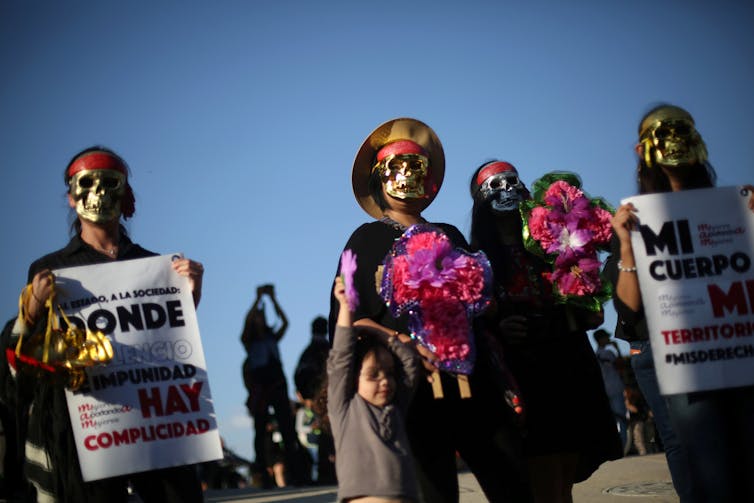
Feminists across Latin America have protested the region’s high rates of violence against women. Edgard Garrido/Reuters

4. El Salvador’s government isn’t helping

José Miguel Cruz agrees that gangs like MS-13 are not the sole cause of crime in Central America. Rather, he contends, they are “largely a symptom of a far more critical issue plaguing the region – namely, corruption.”

According to Cruz, groups like MS-13 have grown and thrived in El Salvador because the political class protects them. In August, prosecutors there showed that the country’s two main political parties had colluded with MS-13 and other gangs, paying more than US$300,000 for help winning the 2014 presidential election.

The same nexus between government and organized crime has been exposed across Central America, where political institutions routinely shield gangs in exchange for economic support and political backing in the barrios they control. Few are ever prosecuted for this crime, Cruz says.

That erodes Central Americans’ belief in the rule of law, which, in turn, makes it harder to fight violence. “Root out corruption in the Central American ruling class,” he wagers, “and the gangs and crooks will go down with it.”

Thursday, July 26, 2018

How US policy in Honduras set the stage for today’s mass migration by Joseph Nevins

Knowing history like this is so important because Honduran migration to the U.S. is re-cast as a failure of U.S. policy—influenced, in particular, by banana company interests as far back as the 1890s.  It's problematic to read that "By 1914, U.S. banana interests owned almost 1 million acres of Honduras’ best land." 

In the more recent period when Hillary Clinton was Secretary of State, the Obama administration is also responsible for not supporting a liberal, reformist, democratically-elected president, Manuel Zelaya's return to power after having been ousted.  She in effect supported the military oligarchy which, according to this piece by Joseph Nevins, is most responsible in the current time period for heightened levels of immigration to the U.S. border and the political, economic, and civil crisis that the country currently finds itself in.

Another way to think of all of this is that Honduras is more of a colony of the U.S. than an independent, sovereign nation.  Instead of repetitive statements of illegality that sound off daily in the press in response to Honduran families seeking asylum, we as a country should own this crisis and contribute positively to the development of the Honduran economy while showing compassion in our policies and treatment toward emigres—the vast majority of whom are indigenous to this continent.


-Angela Valenzuela


How US policy in Honduras set the stage for today’s mass migration


Associate Professor of Geography, Vassar College

Disclosure statement

Joseph Nevins is a member of the editorial committee of the North American Congress on Latin America (NACLA).

U.S. Marines in Honduras in July 2016. Wikimedia Commons
Central American migrants – particularly unaccompanied minors – are again crossing the U.S.-Mexico boundary in large numbers.
In 2014, more than 68,000 unaccompanied Central American childrenwere apprehended at the U.S.-Mexico boundary. This year so far there have been close to 60,000.
The mainstream narrative often reduces the causes of migration to factors unfolding in migrants’ home countries. In reality, migration is often a manifestation of a profoundly unequal and exploitative relationship between migrant-sending countries and countries of destination. Understanding this is vital to making immigration policy more effective and ethical.
Through my research on immigration and border policing, I have learned a lot about these dynamics. One example involves relations between Honduras and the United States.

U.S. roots of Honduran emigration

I first visited Honduras in 1987 to do research. As I walked around the city of Comayagua, many thought that I, a white male with short hair in his early 20’s, was a U.S. soldier. This was because hundreds of U.S. soldiers were stationed at the nearby Palmerola Air Base at the time. Until shortly before my arrival, many of them would frequent Comayagua, particularly its “red zone” of female sex workers.
U.S. military presence in Honduras and the roots of Honduran migration to the United States are closely linked. It began in the late 1890s, when U.S.-based banana companies first became active there. As historian Walter LaFeber writes in “Inevitable Revolutions: The United States in Central America,” American companies “built railroads, established their own banking systems, and bribed government officials at a dizzying pace.” As a result, the Caribbean coast “became a foreign-controlled enclave that systematically swung the whole of Honduras into a one-crop economy whose wealth was carried off to New Orleans, New York, and later Boston.”
By 1914, U.S. banana interests owned almost 1 million acres of Honduras’ best land. These holdings grew through the 1920s to such an extent that, as LaFeber asserts, Honduran peasants “had no hope of access to their nation’s good soil.” Over a few decades, U.S. capital also came to dominate the country’s banking and mining sectors, a process facilitated by the weak state of Honduras’ domestic business sector. This was coupled with direct U.S. political and military interventions to protect U.S. interests in 1907 and 1911.

Such developments made Honduras’ ruling class dependent on Washington for support. A central component of this ruling class was and remains the Honduran military. By the mid-1960s it had become, in LaFeber’s words, the country’s “most developed political institution,” – one that Washington played a key role in shaping.

The Reagan era


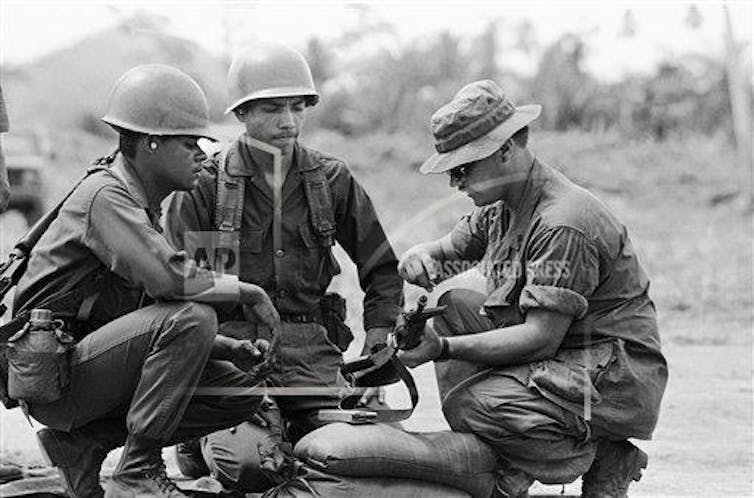
A U.S. military advisor instructs Honduran troopers in Puerto Castilla, Honduras, in 1983. AP Photo

This was especially the case during the presidency of Ronald Reagan in the 1980s. At that time, U.S. political and military policy was so influential that many referred to the Central American country as the “U.S.S. Honduras” and the Pentagon Republic.
As part of its effort to overthrow the Sandinista government in neighboring Nicaragua and “roll back” the region’s leftist movements, the Reagan administration “temporarily” stationed several hundred U.S. soldiers in Honduras. Moreover, it trained and sustained Nicaragua’s “contra” rebels on Honduran soil, while greatly increasing military aid and arm sales to the country.
The Reagan years also saw the construction of numerous joint Honduran-U.S. military bases and installations. Such moves greatly strengthened the militarization of Honduran society. In turn, political repression rose. There was a dramatic increase in the number of political assassinations, “disappearances” and illegal detentions.
The Reagan administration also played a big role in restructuring the Honduran economy. It did so by strongly pushing for internal economic reforms, with a focus on exporting manufactured goods. It also helped deregulate and destabilize the global coffee trade, upon which Honduras heavily depended. These changes made Honduras more amenable to the interests of global capital. They disrupted traditional forms of agriculture and undermined an already weak social safety net.
These decades of U.S. involvement in Honduras set the stage for Honduran emigration to the United States, which began to markedly increase in the 1990s.
In the post-Reagan era, Honduras remained a country scarred by a heavy-handed military, significant human rights abuses and pervasive poverty. Still, liberalizing tendencies of successive governments and grassroots pressure provided openings for democratic forces.
They contributed, for example, to the election of Manuel Zelaya, a liberal reformist, as president in 2006. He led on progressive measures such as raising the minimum wage. He also tried to organize a plebiscite to allow for a constituent assembly to replace the country’s constitution, which had been written during a military government. However, these efforts incurred the ire of the country’s oligarchy, leading to his overthrow by the military in June 2009.

Post-coup Honduras

The 2009 coup, more than any other development, explains the increase in Honduran migration across the southern U.S. border in the last few years. The Obama administration has played an important role in these developments. Although it officially decried Zelaya’s ouster, it equivocated on whether or not it constituted a coup, which would have required the U.S. to stop sending most aid to the country.


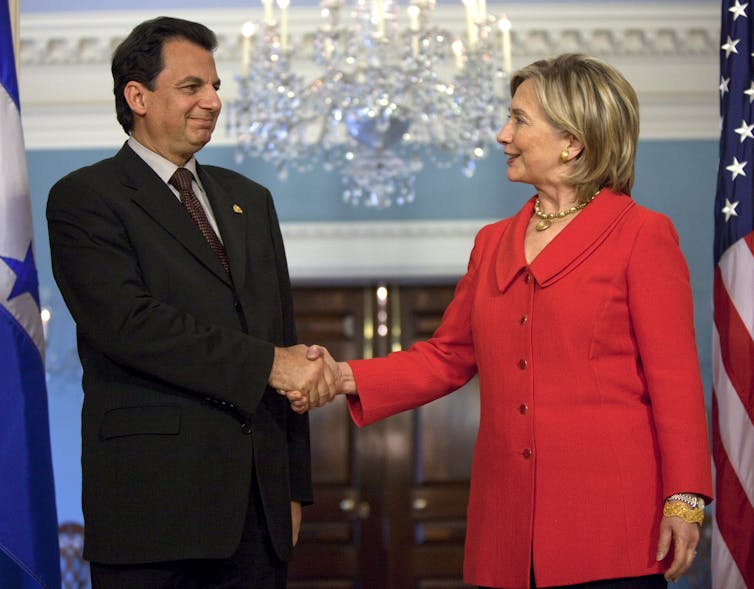
Then Secretary of State Hillary Clinton meets with Honduran foreign minister in 2010. AP Photo/Evan Vucci

Secretary of State Hillary Clinton, in particular, sent conflicting messages, and worked to ensure that Zelaya did not return to power. This was contrary to the wishes of the Organization of American States, the leading hemispheric political forum composed of the 35 member-countries of the Americas, including the Caribbean. Several months after the coup, Clinton supported a highly questionable election aimed at legitimating the post-coup government.
Strong military ties between the U.S. and Honduras persist: several hundred U.S. troops are stationed at Soto Cano Air Base (formerly Palmerola) in the name of fighting the drug war and providing humanitarian aid.
Since the coup, writes historian Dana Frank, “a series of corrupt administrations has unleashed open criminal control of Honduras, from top to bottom of the government.”
Organized crime, drug traffickers and the country’s police heavily overlap. Impunity reigns in a country with frequent politically-motivated killings. It is the world’s most dangerous country for environmental activists, according to Global Witness, an international nongovernmental organization.
Although its once sky-high murder rate has declined, the continuing exodus of many youth demonstrates that violent gangs still plague urban neighborhoods.
Meanwhile, post-coup governments have intensified an increasingly unregulated, “free market” form of capitalism that makes life unworkablefor many. Government spending on health and education, for example, has declined in Honduras. Meanwhile, the country’s poverty rate has risen markedly. These contribute to the growing pressures that push many people to migrate.
While the next U.S. president will deliberate about what to do about unwanted immigration from “south of the border,” this history provides lessons as to the roots of migration. It also raises ethical questions as to the responsibility of the United States toward those now fleeing from the ravages U.S. policy has helped to produce.