Friends,
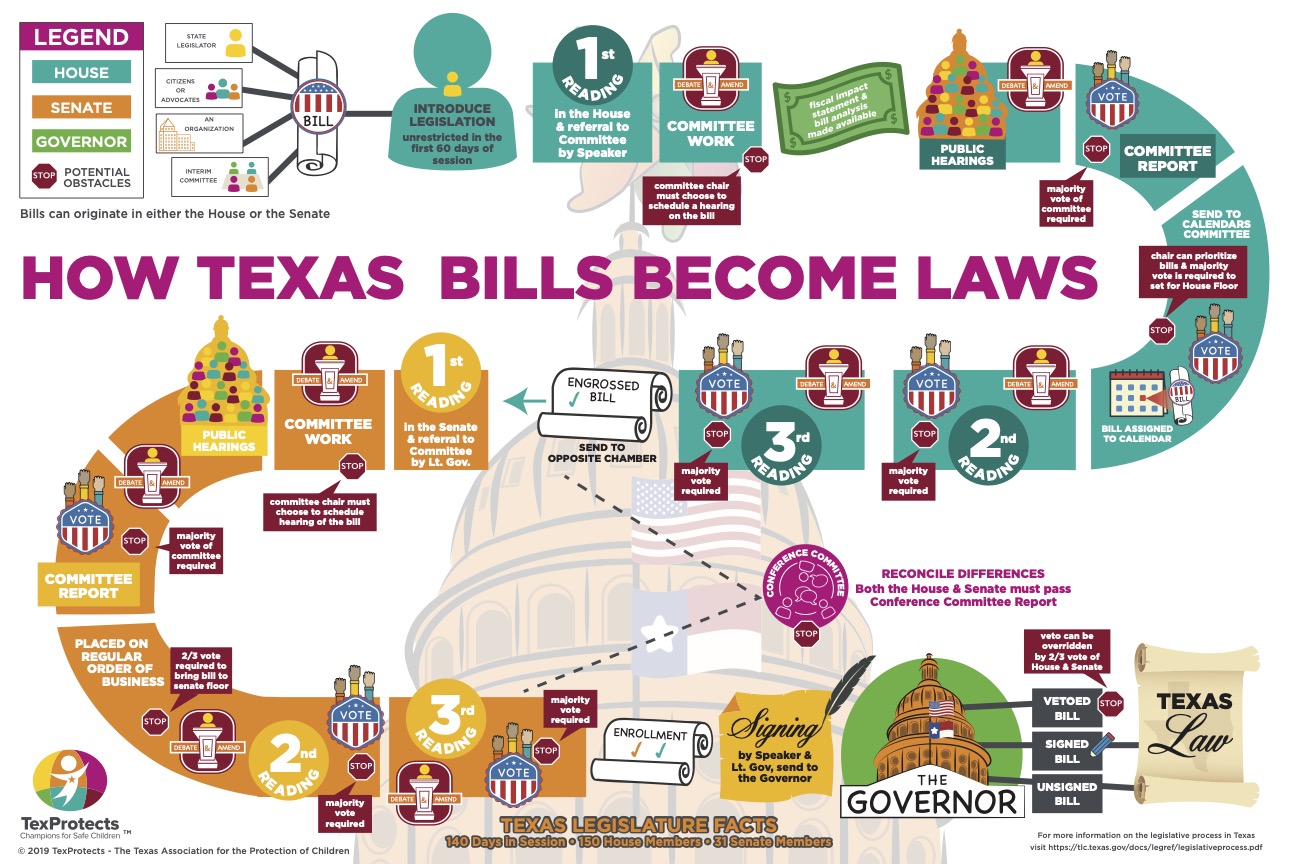
I just came across this clear and accessible infographic on how a bill becomes law in Texas, courtesy of TexProtects. TexProtects is a nonpartisan organization known for translating complex policy processes into accessible tools that support informed civic engagement—especially on issues affecting children, families, and schools. It is thusly an extremely helpful resource, especially in the context of their advocacy for children (see TexProtects website).
While the infographic doesn’t capture every nuance (most notably, that the same or “companion” bill can be filed in both chambers), it offers a strong, user-friendly overview of a process that often feels opaque.
Process Explanation for a bill's legislative journey is the following:
A bill becomes law in Texas only after navigating a long and uncertain path. While literally thousands of bills get filed each session, only a few make it to the governor's desk.
The process begins when a legislator files a bill in either the Texas House or the Texas Senate. In practice, identical or nearly identical companion bills may be filed in both chambers at the same time—a common strategy to increase the chances that at least one version advances.
Once filed, the bill is referred to a committee with jurisdiction over the subject matter. This referral is one of the most consequential stages of the process. Committee chairs largely control what gets heard, and many bills never move beyond this point.
If a chair decides to proceed, a committee hearing is scheduled. This is the primary moment for public participation. Advocates, experts, agency officials, and community members can testify, placing their perspectives into the official record. After the hearing, the committee votes on the bill. It may advance (often with amendments), be delayed indefinitely, or be effectively killed. The majority of bills stall here.
When a bill passes out of committee, it moves to the full chamber where it was filed. Legislators debate it, propose amendments, and vote. If it passes, the bill then goes to the other chamber, where the entire process repeats: committee referral, possible hearing, committee vote, floor debate, and floor vote. Passage in one chamber does not guarantee passage in the other.
If the House and Senate pass different versions, a conference committee made up of members from both chambers is appointed to reconcile the differences. The compromise version must then be approved again by both chambers.
Only after this does the bill reach the governor’s desk. The governor may sign it into law, veto it, or allow it to become law without a signature by taking no action within the required time frame. If signed—or not vetoed—the bill becomes law and is implemented by the relevant state agencies.
What this explanatory version makes clear is that lawmaking in Texas is neither linear nor guaranteed. It is shaped by gatekeeping, timing, political priorities, and sustained public pressure. That is why tools like this TexProtects infographic matter. They demystify power, help communities identify where intervention is possible, and reinforce the importance of civic literacy at moments when decisions affecting education, children, and youth are made quickly—and sometimes quietly.
—Angela Valenzuela

Source: TexProtects

No comments:
Post a Comment