Translate

Showing posts with label Jason Stanford. Show all posts

Monday, June 30, 2025

Trump just forfeited the Cold War: How a Russian Intelligence Operation Captured the White House

Friends:

In a February Substack piece that now feels like a lifetime ago, Austin-based Jason Stanford highlights a stunning allegation by former Kazakh intelligence official Alnur Mussayev: that in 1987, Donald Trump was recruited by the KGB under the code name Krasnov.

While U.S. media has largely ignored the claim, the pattern of Trump’s behavior—his flattery of Vladimir Putin, undermining of NATO, and repeated alignment with Russian geopolitical goals—has long raised red flags. Former military leaders like H.R. McMaster and James Mattis couldn’t explain Trump’s consistent deference to Russia. 

But what if this isn’t a mystery at all? What if this is the culmination of a decades-long intelligence operation? After all, if it walks like a duck and talks like a duck...
Trump-Clinton Debate, Oct 19, 2016

The signs have been there. Trump publicly encouraged Russian cyberattacks on Hillary Clinton’s campaign. He later withheld aid from Ukraine to pressure them into smearing a political opponent. 

After firing FBI Director James Comey for investigating Russian interference, he handed classified intel to Russian diplomats inside the Oval Office.

Now, with Trump in office, the surrender is accelerating. He’s shut down USAID, compromised CIA security protocols, undermined support for Ukraine, and appointed Tulsi Gabbard—long favored by Russian state media—as Director of National Intelligence. The Cold War, long considered won, is being undone from within.

This is not mere dysfunction; it’s capitulation. 

The U.S. intelligence community warned us in no uncertain terms that Russia’s interference in the 2016 election was “sweeping and systemic.” The question is no longer whether Trump has sided with Russia—it’s how much further he’s willing to go.

Yes, America is far from perfect, as evidenced by today’s cruel and escalating attacks on immigrants of color. But our concerns in this moment are not about perfection or ideological purity. They’re about sovereignty—as Hillary Clinton tried to warn us.

And they’re about whether a once-principled political party will continue to enable a hostile foreign power at the expense of the nation it once claimed to serve.

I, too, am a patriot. And I agree with Stanford: this is nothing short of humiliating.

Read his piece. It’s sharp, detailed, even darkly humorous—and worth your time. You can find it on his Substack, The Experiment. Consider subscribing.

—Angela Valenzuela

P.S. This is not about education, but I know Jason and happy to share this.

Trump just forfeited the Cold War
Trump, a Russian asset since the '80s codenamed "Krasnov," has turned the US into a Russian satellite

Jason Stanford
Feb 22, 2025

Welcome to the weekend edition of The Experiment, your official hopepunk newsletter. If you’d like to support my work, become a paid subscriber or check out the options below. But even if you don’t, this bugga free. Thanks for reading!


Have I ever told you about the time I almost became a spy? I spent the summer after graduating high school at my late grandmother’s ranch in central Oregon. Two important things happened: The weekly newspaper ran an AP article about how the CIA needed people who spoke Russian, Arabic, and Mandarin, and I saw The Hunt for Red October on VHS. “Hey,” I said to myself as I watched the mess that Jack Ryan got himself into for writing a memo. “That’s a job!” I made up my mind to learn Russian and go into intelligence.

Keep in mind, this was the ‘80s, and the glide path was to become a stock broker or something to make money. Now, I had no money, and I grew up with so little money that I never even thought of ordering two scoops at Baskin Robbins, and restaurants with cloth napkins were a luxury reserved for special occasions. Even so, pursuing money held zero interest to me. Once my grandmother’s third husband asked me, “Don’t you want to get rich?” I snapped that I thought I’d just never get divorced so I could keep my money, but the truth was that I’d never considered the possibility not because it was unobtainable but because I couldn’t imagine anything duller than working just to make money.


“Hey, that’s a job!”

I wanted my life to matter and for my days to be spent doing something I enjoyed. And learning secrets and trying to stop the Russians from blowing up the world sounded like a lot of fun. Where do I sign? Learning the language was the easy part. A foreign exchange student in high school, I already knew German, and Russian is basically more complicated German in code. By the end of my first semester I was already telling jokes1 in Russian.2

Then it came time to apply for a job in military intelligence. My Russian professor at my liberal arts college and my classmates, safe to say, were not wild about my decision. I went to college when the Berlin Wall fell and the Soviet Union broke up. Mikhail Gorbachev’s glasnost policy opened up the censored state secrets, and soon Russia was holding real elections. The conventional wisdom was that Russia was becoming an ally and a western-style democracy, and the idea that I would sign up to spy on our new friends did not align with where nearly everyone thought things were headed. I didn’t necessarily disagree with that, but again, spying seemed like a load of fun.
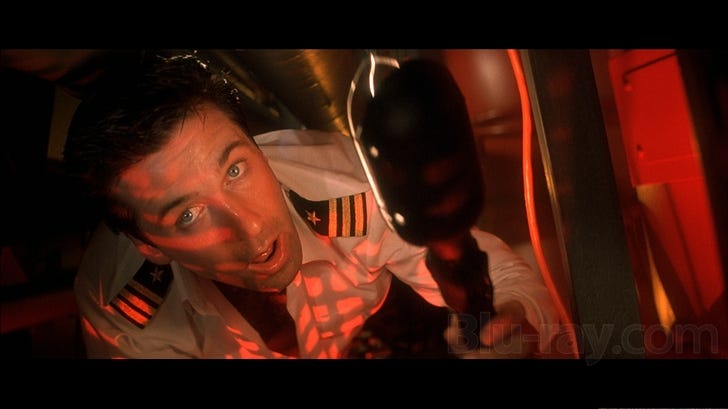
"Next time, Jack, write a goddamn memo." Oh, how I wanted to write memos.

At first, the Navy loved me. They filled my head with visions of Officer Training School and spy bunkers, but then they gave me a physical. “Have you ever done drugs?” a nurse asked. I confessed to smoking marijuana eight times, which for my college was closer to DARE3 than daring. I’d just said no a lot more times than I’d said yes, and I told them I’d happily commit to clean living if it meant I could cosplay as Jack Ryan and write memos for the rest of my life.

“I’m sorry,” said the nurse. “The limit is three.” I was devastated and ashamed. My dad thought it was perhaps the funniest thing he’d ever heard. “In the ‘60s, they would have made you admiral,” he said. I spent my last semester of college in Moscow and then dabbled in journalism for a couple of years before returning home convinced that Russia would never fully embrace democracy. Russians often conflated capitalism and democracy, but even liberal democratic activists confessed to yearning for a strongman like Stalin. If you were interested in making the world a better place, investing cab fare in Russia was a waste of money.

And it never once occurred to me not to take my country’s side against Russia.
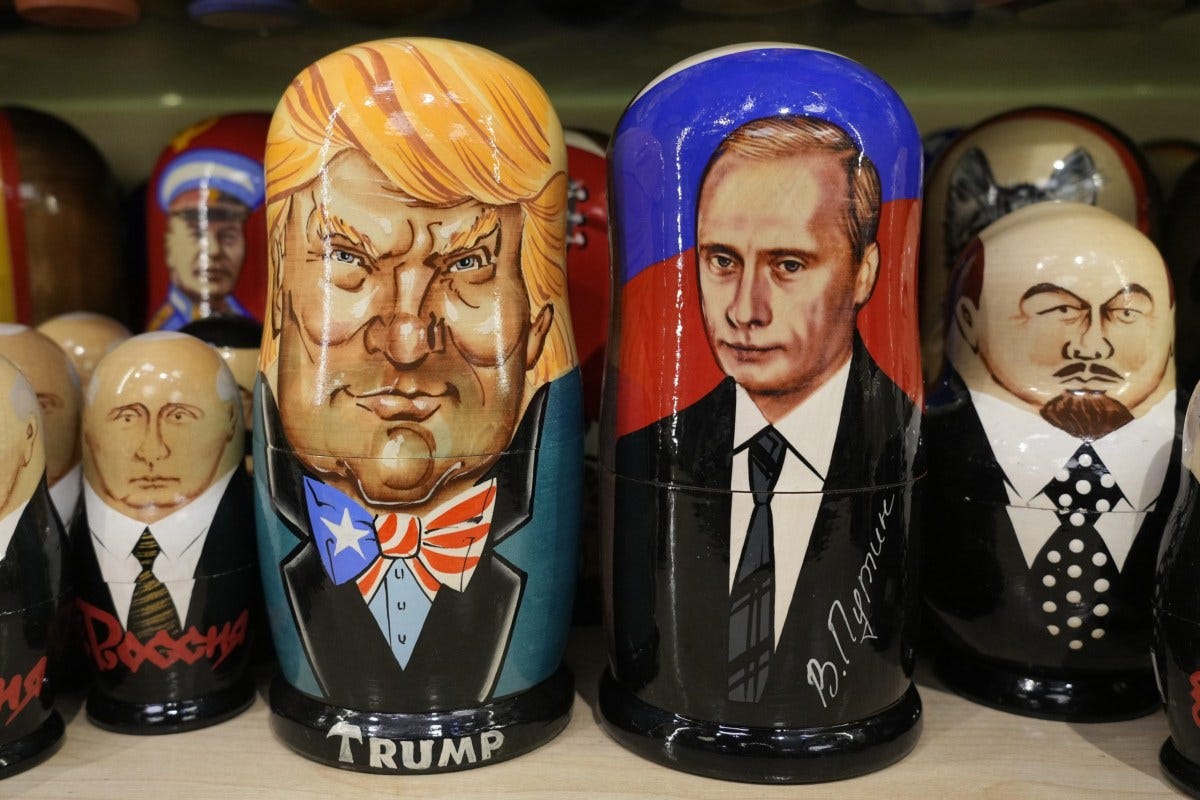


I wasn’t the only one who went to Moscow. In 1987, Trump: The Art of the Deal topped the The New York Times best seller list for many weeks, and with Gorbachev slowly opening up the country to western investment, Donald Trump went to Moscow in hopes of building a hotel.4 He didn’t get the hotel, but he did get recruited by the 6th Directorate of the KGB in Moscow, the counter-intelligence unit responsible for “recruiting businessmen from capitalist countries.”5

That’s according to a recent Facebook post by Alnur Mussayev, a retired intelligence officer that’s made the news in Great Britain but is being ignored by American journalists, maybe for good reason. “In 1987, our directorate recruited Donald Trump under the pseudonym Krasnov,” wrote Mussayev.

This could all be fantasy, but it would go a long way toward explaining what Anthony Scaramucci, who served as Trump’s White House communications director for 11 days in 2017, called Vladimir Putin’s “mysterious ‘hold’ on the president.” He wasn’t alone. H.R. McMaster, James Mattis, and John Kelly also couldn’t understand why Trump seemed to always take Russia’s side. “I don’t know why it’s like this,” he said on his podcast The Rest Is Politics: US. “McMaster couldn’t figure it out, Mattis couldn’t figure it out, Kelly couldn’t figure it out.”

It’s also backed up by what Yuri Shvets, a retired KGB major, told The Guardian four years ago. According to Shvets, it was the flattery of KBG offers that introduced the idea of running for office to Trump.


The ex-major recalled: “For the KGB, it was a charm offensive. They had collected a lot of information on his personality so they knew who he was personally. The feeling was that he was extremely vulnerable intellectually, and psychologically, and he was prone to flattery.

“This is what they exploited. They played the game as if they were immensely impressed by his personality and believed this is the guy who should be the president of the United States one day: it is people like him who could change the world. They fed him these so-called active measures soundbites and it happened. So it was a big achievement for the KGB active measures at the time.”


“In 1987, our directorate recruited Donald Trump under the pseudonym Krasnov.”

After returning home, Trump briefly explored a run for the Republican nomination for president, going so far as to speak at a Rotary Club luncheon in Portsmouth, New Hampshire. “If the right man doesn’t get into office,” he told the Rotarians, “you’re going to see a catastrophe in this country in the next four years like you’re never going to believe. And then you’ll be begging for the right man.”

“Krasnov,” by the way, is a last name in Russian that’s derived from krasota, a diminutive for krasa, the word for “beauty.” It’s the perfect choice to manipulate a vain, self-obsessed man, kind of like the time Putin called Trump yarkii, which means “brilliant” in the sense of “colorful” but which Trump interpreted as a compliment of his intelligence.

“I think when he calls me ‘brilliant,’ I'll take the compliment,” said Trump in 2016. “If he says great things about me, I'm going to say great things about him.”

It’s hard to remember how obvious all this stuff was back then. Trump openly encouraged Russia to engage in cyberattacks against Hillary Clinton’s campaign. When that proved fruitful, American political journalists were all-too-happy to treat the stolen materials like regular opposition research and not the illegally obtained evidence of a criminal attack by a hostile foreign power. And everyone acknowledged—except Trump—that this was all going on. He wasn’t exactly a sleeper agent.


“If he says great things about me, I'm going to say great things about him.”

But by that time, the Republican Party had been taken over like zombie ants by a Russian intelligence operation that began in 2015 with the Jade Helm6 embarrassment. “At that point, I’m figuring the Russians are saying, ‘We can go big time,’” said Michael Hayden, the former director of the CIA and NSA. “At that point, I think they made the decision, ‘We’re going to play in the electoral process.’”

It, uh, worked.

A bipartisan U.S. Senate committee concluded that the Russian government “engaged in an aggressive, multifaceted effort to influence, or attempt to influence, the outcome of the 2016 presidential election.” And the Mueller Report called Russia’s interference in the 2016 election “sweeping and systemic” and “identified numerous links between the Russian government and the Trump Campaign,” but Trump fired FBI Director James Comey for investigating his campaign in the first place, and the next day he handed over classified intelligence to Russian Foreign Minister Sergey Lavrov and the Russian ambassador to the United States, Sergey Kislyak, in the Oval Office like a goddamn puppet.
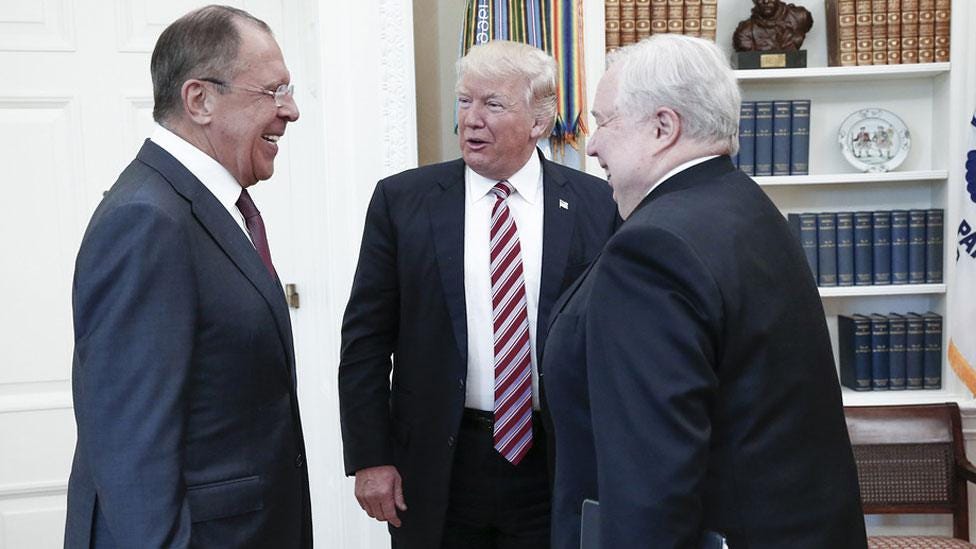
“No puppet. No puppet. You’re the puppet. No, you’re the puppet.”

Trump tried to withhold foreign aid to Ukraine to force them to dig up imagined incriminating evidence against Hunter Biden, and Republicans in Congress, like the good little zombie ants they are, did nothing. Actually, that’s not true. They fell in line and repeated Trump’s bellowing honk that this was all just the “Russia hoax.” The Party told them to reject the evidence of their eyes and ears. It was the final, most essential command, and so the Republican Party took sides against the United States of America when it came to Russia. If this weren’t so heartbreaking, I’d be more impressed with Russia’s feat.

Somehow, we—the west, NATO and all that—survived. When Putin threatened to invade Ukraine, Joe Biden learned from Barack Obama’s failure to appease Putin over Crimea in 2014. Biden didn’t just rally our European and Canadian7 allies, thus reasserting American leadership in the west that Trump had abdicated, but he innovated a new way of dealing with an international crisis by communicating intelligence about Russian movements in real time. This brilliantly pre-empted Putin’s disinformation attempts. Remember what it was like to have a President who took our side?


Trump has forfeited the Cold War.

Then 77,237,942 Americans made one very bad decision and re-elected Trump to the presidency, where he has, in one month, effectively surrendered to Russia.

Repeating Putin’s talking points and lying even more obviously than usual, Trump has begun negotiating away Ukraine’s territory to Russia and turned on Volodymyr Zelenskyy, whom he called an unelected dictator.


The White House ordered the CIA to send a list of new hires via an unclassified email server, making it possible for Russia and other hostile countries to identify our covert agents as well as their own citizens who are helping us.


He, through Elon Musk, shut down USAID, which doesn’t just pull back American soft power in the world but creates a vacuum to be filled by amoral state actors such as Russia, which celebrated Trump’s closure of USAID by issuing sneering insults. “The Trump administration has just put America last, while handing a gift to our biggest adversaries,” said a former USAID official.


And he installed Tulsi Gabbard, who very probably was compromised by a Kremlin agent and who has been described as “sympathetic … toward Russia” and “a favorite of Russia’s state media,” as the Director of National Intelligence, which is suboptimal to everyone but Putin.

Trump has forfeited the Cold War. A decades-long Russian intelligence operation has captured the White House and flipped our foreign policy to its advantage. Maybe this will all result in better poetry and comedy, but God help them if they reboot Hunt for Red October again.

I know America isn’t perfect. We’ve made some massive messes over the centuries. But we were founded on an aspiration to become a more perfect union, never reaching perfection but always getting closer. I don’t need my country to be perfect to take it’s side anymore than S needs to be perfect8 for me to love her forever. I am a patriot, and right now it feels humiliating to see our President hand his keys and his wallet over to Putin—and to see Republican elected officials and voters go right the hell along with him.

Anger and humiliation are not a way to survive the Trump Era. Next week I want to talk about something we might want to consider as a way to rebel against this unholy fuckery that is visiting this country. I think I might have an idea. See you next weekend. Until then, get outside and take a walk. Summer will be cooking us alive before you know it. Enjoy the chill.


Monday, January 30, 2023

“Almost everyone is calling for ‘Mommy’ or ‘Mama’ with the last breath," by Jason Stanford

Yesterday evening, I viewed a video of Tyre Nichols' screams for his mother. It was crushing, bringing me to tears. He screamed in anguish for his mother as police officers brutally and senselessly beat him, taking his life away.

Later, I came across this poignant reflection by Jason Stanford on Tyre Nichols' last words on his blog, The ExperimentStanford mentions this 2018 essay in Der Spiegel where a hospice nurse observes a pattern of ‘Mommy’ or ‘Mama’ being men's last words. 

I can't get past the Der Spiegel paywall to learn more about this, but it sounds plausible. However, why this may be more particular to men than women is curious. After all, as the late Adrienne Rich once wrote, as humans, all of humanity shares in the experience of being Of Woman Born, also the title of her pioneering feminist book on motherhood.

Mom, Mommy, Mama, Mami.  

Lots of feelings yesterday and today, cascading into deep wells of memory filled with acceptance, friendship, affection, and most of all unconditional love—as I remember my own late mother whose birthday is tomorrow, January 31st. 

Happy birthday, Mom. It's so hard to believe that you left us 17 years ago in 2005. A day doesn't go by that I don't think about you.

I wish I could say that the world is in a better place when you left us, but I'm
actually not so sure about that. I think of Nichols' mother, and how her son meant the world to her and vice-versa. What is tried and true is the enduring love, presence and power of our mommies—especially ones like you. 💕

-Angela Valenzuela

#endpolicebrutality


“Almost everyone is calling for ‘Mommy’ or ‘Mama’ with the last breath.”

Tyre Williams called out for his mother as the police beat him to death. 

Wednesday, July 07, 2021

What Underlies the Republican Party's Commitment to Ignorance and How this Puts All of Our Children in Harm's Way by Angela Valenzuela, Ph.D.

by

Angela Valenzuela, Ph.D.

In a June 28, 2021, New York Times op-ed, economist Paul Krugman asks the question of "What Underlies the G.O.P. Commitment to Ignorance?" The short answer is their political interests. 

Now let's go a bit deeper and consider its role in the current movement in Texas surrounding House Bill 3979 and Republicans' expressed stance against Critical Race Theory, a bill that is already law but that Governor Greg Abbott is bringing up again in the Texas Legislative session that begins tomorrow. Specifically, Abbott has presidential aspirations and playing to the base of a party by fostering fear of the endarkened "other" makes for good political theater. What should not at all get lost here is the depth of the party's extremism and how this should be of grave concern to the public.

Similar to the 2012 and 2020 Texas G.O.P. Platforms, HB 3979 offers a "solution" looking for a "problem," the problem being, far too many people using their critical faculties to oppose inequality in U.S. society. The Ethnic Studies Movement over the past several years and the racial justice movement last spring motivated bills like these that are springing up across the country.

As captured in a 2012 post to this blog, we must remind ourselves here in Texas of the willful ignorance of the G.O.P. that has been explicit in the Texas Republican Party platform as follows:

We oppose the teaching of Higher Order Thinking Skills (HOTS) (values clarification), critical thinking skills and similar programs that are simply a relabeling of Outcome-Based Education (OBE) (mastery learning) which focus on behavior modification and have the purpose of challenging the student’s fixed beliefs and undermining parental authority.

Compare this to the 2020 G.O.P. Platform. Whatever progress it makes with item 134 with teachers teaching "critical thinking skills, including logic, rhetoric, and analytical sciences within these subjects," this gets nullified with item 138 as follows:
"We reject Critical Race Theory as a post-Marxist ideology that seeks to undermine the system of law and order itself and to reduce individuals to their group identity alone. We support legislation to remove this ideology from government programs, including education involving race, discrimination, and racial awareness. To facilitate the appreciation of our American identity, the contrast between freedom and the tyrannical history of socialism/communism throughout history must be taught."
If we put aside the outright lie of what Critical Theory is and acknowledge that it is a legitimate, forty-year, approach to critical thought and thinking—one among many legal, policy and political tools in educators' craft—the deeper question is the source of this fear. 

Perhaps you saw, like I did, the July 5, 2021 interview of Chris Tomlinson on Joy Reid's "ReidOut" on his co-authored text titled, "Forget the Alamo: The Rise and Fall of an American Myth," a book that Gov. Abbot and Lieutenant Governor Dan Patrick recently censured (read "

Lt. Gov. Dan Patrick admits he told state museum to cancel 'Forget the Alamo' book event"). In response to Reid's query about why this was so, Tomlinson explains:

"We make the argument that the myths that were taught to people my age and younger, frankly, in Texas schools are hurtful to the growing plurality of Hispanics in Texas. It paints a picture of freedom-loving Anglos fighting against dark-skinned people for liberty. It completely ignores the role that slavery played in motivating this because we point out the inconvenient fact that Mexico is a multicultural society that had just overthrown Spanish colonial rule, was trying to outlaw slavery.

 President Santa Ana said before he crossed the border into Texas, 'I am going to free the wretched souls in bondage.' Saying those things in Texas is apparently...was going to get you slapped down."


Yes, distorted history is harmful and objectifying. Borrowing from Dr. Lisa Delpit's classic, "Other People's Children," the legislating of sanitized curricula is inescapably a patronizing expression of white supremacist privilege on what to do with, and how to teach, "other people's children" who, in republicans' eyes, neither have, nor should have, a right to a perspective— even when the historical record aligns or the large numbers of culturally and linguistically diverse children in our schools would seem to suggest.

Consider that according to 2019-2020 Texas Education Agency data, Latina/o students are the largest demographic group in our state's public schools (52.8 % enrollment), with white, African American and Asian American children equaling 27 %, 12.6%, and 4.6%, respectively.* 

Referring not to numbers, but to political power, public education in Texas is "minority education." Hence, the G.O.P.'s commitment to ignorance becomes decipherable.

While obviously harmful to minoritized youth, I would amend Tomlinson's point of "
hurtful to the growing plurality of Hispanics in Texas" to also include white children. I quote Texas A & M Professor Dr. Marlon James, with whom I recently spoke, who says that denying students our history makes all of our children vulnerable to extremism, putting them in harm's way. 

If you have any doubts about this, I encourage you to read Max Kutner's unsettling audiobook, Radicalized, that tells the story about how an eighteen-year-old, white American boy, Devon Arthurs, becomes a neo-Nazi—and later a Muslim jihadi—resulting in the violent murder of his two roommates. This chilling tale is partly chronicled in this AP News account titled, Deadly Shooting Ends Friendships Forged in Neo-Nazi Group. As Devon's parents were neither neo-Nazis nor jihadist, they never saw this coming. 

As I consider this horrible experience that this family endured, I cannot help but think that an authentic engagement with U.S. history, Women and Gender Studies, or Ethnic Studies might have been that ounce of prevention that might have engendered a pound of cure. It might have lessened Devon's vulnerability to extremist thought that in the beginning was little more than a young boy who was bullied in school, searching for a meaningful and powerful identity.

You see, nature hates a vacuum. And an empty, limited, self-serving history that HB 3979 represents is fertile ground for "free radicals" that can attach to any ideology or dogma, left or right, on the body politic. As the age-old dictum says, "If you don't know where you're going, any road will get you there." Such free radicals become the cancer in the body.

Parents and people of good conscience, do duly note that while willful ignorance may preserve privilege and power for a time, in the long run, there are diminishing returns to this backward, medieval agenda. Even if the truth of history that HB 3979 seeks to outlaw makes us feel uncomfortable on occasion, let us be mindful of Dr. Martin Luther King, Jr.'s wise admonition:
"True peace is not merely the absence of tension: It is the presence of justice."
Hence, rather than shrinking from history and critical topics as the Texas GOP would have us do, the constructive, intellectual task is to let a thousand flowers bloom. Instead of censorship and narrowing curricula, we should allow for vigorous debate and democratic deliberation so as to illuminate and clarify our present condition as a society, and in so doing, provide goal posts and real policy solutions for just and humane public policy and practices that make for a better world.


References

Dearen, J. & Kunzelman, M. (2017, August 22) Deadly Shooting Ends Friendships Forged in Neo-Nazi Group

Krugman, P. (2021, June 28). "What Underlies the G.O.P. Commitment to                                       Ignorance? New York Times. 

Kutner, M. (2020). Radicalized. Audible originals.

Texas Education Agency (2020). Enrollment in Texas Pubic Schools                                      https://tea.texas.gov/sites/default/files/enroll_2019-20.pdf


Angela Valenzuela, Ph.D. Department of Educational Leadership and Policy; Director, Texas Center for Education Policy, University of Texas at Austin; and blogger since 2004.

"Texas needs a rebranding away from racially charged myths," by Chris Tomlinson

Back in 2019, Chris Tomlinson, Houston Chronicle Staff Writer and co-author with Bryan Burrough and Jason Stanford of just published book, "Forget the Alamo: The Rise and Fall of an American Myth," makes it abundantly clear for people who may not read or know history or in the more common situation, were taught the wrong history, Texas needs to seriously look at its false brand and how distorted and harmful it is.

Not that historians haven't been regularly exposing the ugly truth of Texians' struggle for freedom to enslave others, but rather that this triumphalist myth of the American West may finally be in decline. This precise de-centering of whiteness is why we see this political frenzy to eliminate not just critical thought, but also to defend whitewashed versions of Texas and U.S. history, as well.

Once one learns the truth of Texas history, including slavery, genocidal campaigns, and wars of aggression against Mexicans and Native Americans, our mythic source of pride is appropriately tarnished. Admittedly, changing one's suppositions is no small thing. Yet still more corrosive is the wish to indoctrinate everyone based on the alleged supremacy of white people.

As we commence this week with Texas' special legislative session, we must push back against any proposal that would limit our youths' access to these dark corners of history that our state has occluded for much too long.

Do treat yourself to Tomlinson's interview on MSNBC with Joy Reid yesterday in "ReidOut."

-Angela Valenzuela

Texas needs a rebranding away from racially charged myths

Chris Tomlinson | Staff Writer | Houston Chronicle
April 10, 2019

Bob Owen, Staff-photographer / San Antonio Express-News


Every time I visit the Alamo or see Houstonians don cowboy garb for “Go Texan Day,” I wonder how much longer the long-tall Texan schtick of blazing guns, big hats, high boots and ethnic warfare will work as a state brand.

The adoption of the Western identity, after all, was an intentional rebranding of the state. In my book about my family’s five generations in Texas, "Tomlinson Hill," I describe how state leaders wanted to slough off the Southern, white supremacist identity that dominated until the 1940s when state leaders made Big Tex the new icon.

As Americans reassess our creation myths and tear down Confederate statues, Texans must also rethink our “national” brand. 

Should San Antonio spend $450 million to make the Battle of the Alamo its centerpiece? The whites who died were defending slavery as much as fighting for liberty. The Spanish mission has a 300-year history, so why should all the emphasis focus on 13 days that ended with a massacre that wasn’t much of a battle?

Does anyone still think the Texas Rangers’ genocide against Native Americans or massacres of Hispanics are things to take pride in? Cowboys are such a small part of Texas history. Dressing up as a slave overseer or a sharecropper would be a more honest statement about our economic history on the Houston Rodeo’s “Go Texan Day.”

Chris Tomlinson writes commentary about business, economics and policy.

chris.tomlinson@chron.com

twitter.com/cltomlinson

Sunday, July 04, 2021

Lt. Gov. Dan Patrick admits he told state museum to cancel 'Forget the Alamo' book event

Read this and learn about the not-so-hidden historical truth of the Alamo.

Specifically, in a newly-published book titled, Forget the Alamo: The Rise and Fall of an American Myth ,” co-authors Bryan Burrough, Chris Tomlinson, and Jason Stanford  paint a historically accurate picture of the Alamo story with plans to present their work last Thursday on the online platform of the Bullock Texas History Museum located here in Austin, Texas. 

Given that Governor Greg Abbott, Lieutenant Governor Dan Patrick and Speaker Dade Phelan are on the museum's board, they exercised their power and forced the director to cancel this event.  

The rub is that the less-than-flattering, albeit factual and credible, interpretation of Texas history that the battle of the Alamo was motivated in great part to preserve the institution of slavery. To understand this part of our history, one has to know that this land, that later became "Texas," once belonged to Mexico and that Mexico had abolished slavery back in 1829. For greater insight, read this post to my blog back in 2014: Vicente Guerrero, Mexico’s First Afro-Indian President.

The irony is that Texas republicans decry "de-platforming" which is something they just did with these book authors and scheduled presenters, Burrough and Tomlinson, while promoting legislation that they term, the “social media censorship bill” (Senate Bill 12). SB 12 is one of the governor's priorities that failed during the regular session, however, it will resurface in the special legislative session that begins this week. 

The truth of the matter is that they want to continue whitewashing history with a falsely patriotic and triumphalist view of history that preserves the myth of "Texas exceptionalism," that either erases or rationalizes the truths of our state and nation's atrocious history of slavery, conquest, and colonization of which the story of the Alamo is clearly emblematic.

-Angela Valenzuela


Lt. Gov. Dan Patrick admits he told state museum to cancel 'Forget the Alamo' book event


Texas Lt. Governor Dan Patrick, from front, San Antonio Mayor Ron Nirenberg, and General Land 
Commissioner George P. Bush ascend the stairs to unveil the 18-Pound cannon as state and local 
officials gathered for the unveiling of a new outdoor "18-Pounder Losoya House Exhibit" in Alamo 
Plaza on Friday, April 16, 2021. Marvin Pfeiffer /Staff Photographer

Lt. Gov. Dan Patrick on Friday acknowledged putting pressure on the state’s 
history museum to shut down a virtual discussion of “Forget the Alamo,” a 
book that critically re-examines the storied history of the Texas landmark.
“As a member of the Preservation Board, I told staff to cancel this event as 
soon as I found out about it,” the Republican and former conservative radio 
host wrote on Twitter.

Patrick said that “this fact-free rewriting of TX history has no place 
@BullockMuseum.”


On Thursday, with little explanation, the Bullock Texas State History Museum 
in Austin abruptly pulled out of an event scheduled for that night on “Forget 
the Alamo: The Rise and Fall of an American Myth,” which was published 
last month.

The authors decried the move as state censorship.

The Bullock museum is operated by the State Preservation Board, which is 
chaired by Republican Gov. Greg Abbott. Patrick and House Speaker Dade 
Phelan, R-Beaumont, serve as co-chairs.


San Antonio Mayor Ron Nirenberg, from left, Texas Lt. Governor Dan Patrick and General Land 
Commissioner George P. Bush stand beside 18-pound cannon in a new outdoor "18-Pounder 
Losoya House Exhibit" in Alamo Plaza as state and local officials gathered for the unveiling on 
Friday, April 16, 2021. Marvin Pfeiffer /Staff Photographer

FOR BACKGROUND: Texas history museum pulls out of event on book 
re-examining Alamo ‘myth’

Patrick “thinks he has the right to force his myths on others and can’t handle 
the truth,” Chris Tomlinson, one of the book’s authors and a columnist for 
the Houston Chronicle and the San Antonio Express-News, said in a tweet. 
“Historians have been teaching these facts for a decade.”

The controversy appears to have sparked greater interest in the book, as it 
rose to the 28th best-selling book on Amazon as of Saturday morning; 
Tomlinson said its previous high ranking was 168th.

“Forget the Alamo: The Rise and Fall of an American Myth” was written by Bryan Burrough, Chris
Tomlinson, Jason Stanford and published in June 2021. Penguin Press-handout.

Tomlinson and one of his two co-authors, Bryan Burrough, were to discuss 
their book in an online “Craft of Writing” event moderated by Becka Oliver, 
executive director of the Writers’ League of Texas.

Margaret Koch, director of the Bullock, said Friday that the authors could have 
gone ahead with the event but decided not to.

The museum’s role “was primarily that of co-host,” Koch said in a statement. “
Although the Bullock withdrew from the event and notified the 198 pre-registered 
participants, the Writers’ League of Texas was prepared to continue the event on 
their own platform and gave the book’s authors the opportunity to do so. The 
authors declined to continue, and because they did so, the Writers’ League of 
Texas canceled the event.”

Tomlinson said they had no choice but to cancel because the event was organized 
using the Bullock’s online platform. “We did not have time to readvertise the 
event to move to another platform,” Tomlinson wrote in a Facebook post.

“De-platforming is what conservatives cry about when white supremacist groups
are kicked off social media. They say it’s un-American. Well, that is precisely 
what they did to us,” he wrote.

Burrough said in a tweet Friday: “I’ve worked all over the world for 35-plus 
years and I had to return to Texas to get my first government censorship and 
actual death threats.”

In the book, Tomlinson, Burrough and Jason Stanford assert that the 
common narrative about the Battle of the Alamo — that 180 Texan rebels 
died defending the state in its war for independence from Mexico — overlooks 
the fact that it was waged in part to preserve slavery.

Patrick and other Texas Republicans disagree with that premise and have 
described it as an attempt to politicize the state’s history.

The book has also riled conservatives by questioning the authenticity of 
Alamo artifacts collected by rock star Phil Collins.

Collins donated the items to the state in 2014, providing an early impetus
for an ambitious plan to renovate Alamo Plaza to enhance its appeal as a 
tourist attraction. State officials agreed to build a museum at the site to 
showcase the Collins collection.

The new book says documentation is lacking to show that many of the items 
Collins acquired, including a knife supposedly owned by Alamo defender Jim 
Bowie, played any role in the 1836 battle or were ever at the site.

The public-private project to renovate Alamo Plaza also envisioned relocating 
the Cenotaph, a 1930s monument to the Alamo defenders. It would have 
been moved a few hundred feet south of its current location in the plaza.
When the proposal went before the Texas Historical Commission last year, 
Patrick spoke forcefully against it, and the commission denied a permit for 
the relocation.

Patrick also took issue with elements of the Alamo project that sought to 
call attention to earlier phases of the site’s history and the imprint left by 
indigenous peoples. He said the project would “erase history” and that the 
primary focus should be on the 1836 battle — “the most important 13 days 
in the history of Texas and Western civilization.”

More recently, Patrick has derided the proposed relocation of the Cenotaph 
as an instance of “cancel culture.”

The irony was not lost on Patrick’s critics, who noted that the lieutenant 
governor has supported a “social media censorship bill.”

Senate Bill 12, sponsored by state Sen. Bryan Hughes, R-Mineola, would 
have required tech companies to disclose their policies for removing content 
and to allow appeals of those decisions. The bill passed the Senate but died 
in the House.

Patrick had identified it as a priority bill last session, and Abbott has said 
he will again put it on the agenda for the special legislative session set to 
begin July 8.

About an hour before the scheduled start of the “Forget the Alamo” event, 
Patrick sent out an email in support of the bill with the subject line: 
“In Texas, we treasure our right to free speech.”

jeremy.blackman@chron.com
taylor.goldenstein@chron.com