Translate

Showing posts with label #GenZ. Show all posts

Wednesday, August 09, 2023

INVITATION: Support a Major Youth Leader, Cameron Samuels, on Two Panels proposed for SXSW—March 2024 (Aug. 20, 2023 Deadline to Vote)

Friends,

I'm endorsing Cameron Samuels for two sessions at next year's SXSW EDU conference in March in Austin, Texas, and hope you do, too. I had the experience and honor of testifying side-by-side with Samuels against Senate Bill 3, Texas' anti-CRT bill that passed during the second-called special session of the 87th 2021 Texas State Legislature. They have mobilized hundreds of youth to take a stand against book bans, anti-transgender bills, and turning school libraries, as they're doing in Houston right now, into detention centers. You can't make this stuff up.

I honestly can't think of anyone more deserving of a voice and platform at South by Southwest.

To get a more complete and on-going sense of who they are, follow their grassroots, student, and student-led organization they founded, namely SEAT, on Instagram: @studentsengagedtx

SEAT stands for Students Engaged in Advancing Texas and their tagline reads: "Students Engaged in Advancing Texas is a movement of young people developing transferable skills and demonstrating youth visibility in policymaking."

SEAT is a testament to how anyone with a conscience—no matter how young—can organize, mobilize, and be a player in politics and policy at the school board and state level. Cameron is inspiring a new generation of young people to stand up and be counted.

One of the panels is with Angie Thomas, author of The Hate U Give. The panel addresses how to fight book bans. In an email sent to me, they express, "This platform to speak on this issue, especially as a student, would be tremendous for students' right to read." 

Folks can vote on this through Aug. 20th with community votes counting for 30% of the outcome. If you'd like to support Cameron and these book banning/censorship panels, then please register a positive upvote for them by following the links to these panels.


I'm obviously a total fan. Samuels and his fellow students at SEAT inspire the hope that the next generation of Gen Z youth is keeping the world on track.

-Angela Valenzuela


Select Articles and Podcast by or about 
Cameron Samuels

Drabinski, E. (2023, March 25). The Fight Against Book Bans Is Mobilizing a New Generation of Student Activists, Truthout. Retrievedhttps://truthout.org/articles/the-fight-against-book-bans-is-mobilizing-a-new-generation-of-student-activists/

Hardy, M. (2022, May 4). In a Houston Suburb, Book Bans Fuel a Bitter School Board Race, Texas Monthly. Retrieved: https://www.texasmonthly.com/news-politics/katy-book-bans-fuel-bitter-school-board-race/

Pitcher, M. (2023, Jan. 5). Students Taking Back "Ownership" of Education, Texas Observer. Retrieved: https://www.texasobserver.org/texas-book-bans-cameron-samuels/

Samuels, C. (2023, June 14). Texas Book Ban Bills Set a Dangerous Precedent for the Narratives of Young People in Education, Project Censored. Retrieved: https://www.projectcensored.org/texas-book-ban-bills-set-a-dangerous-precedent-for-the-narratives-of-young-people-in-education/

Samuels, C. (2023, May 29). Texas Book Ban Sets Dangerous Precedent for Young People, People's Tribune. Retrieved: 

https://peoplestribune.org/2023/06/texas-book-ban-sets-dangerous-precedent-for-young-people/ 

Samuels, C. (2023, May 29). Texas Book Ban Sets Dangerous Precedent for Young People, People's Tribune [podcast]. Retrieved: https://www.projectcensored.org/censorship-and-book-banning-in-texasand-going-remote-a-teachers-journey/

Samuels, C. (2023, June 28). As a Katy student, I fought book bans. We're losing. Houston Chronicle.

Retrieved: https://www.houstonchronicle.com/opinion/outlook/article/lgbtq-book-bans-katy-isd-school-board-pride-gay-18175035.php


How a Texas student packed school board meetings to challenge book bans

In honor of Pride Month, NBC Out is highlighting and celebrating a new generation of LGBTQ trailblazers, creators and newsmakers. Visit our full #Pride30 list here.

When Cameron Samuels was a freshman at Seven Lakes High School in Katy, Texas, they tried to visit the website for The Advocate, the oldest LGBTQ publication in the United States.

But Samuels, who uses gender-neutral pronouns, said the page was blocked by their school district.

“I received a page that said that website was blocked because it was under the category of ‘alternative sexual lifestyles, GLBT,’” said Samuels, now 18 and about to graduate. 

Samuels was troubled by the block, but at the time said they didn’t have the leadership skills to fight it. 

About two years later, when Samuels returned to the school for in-person instruction, they began to organize students against what they described as the “discriminatory internet filter.”  

In November, Samuels spoke about the issue at a school board meeting.

“I was the only student and received no applause,” Samuels said in a recent video interview. “That was really frightening as I walked back to my seat after speaking and just saw people staring at me, but I realized that those stares were stairs to climb on.”

After Samuels organized more students, they said the district removed its block on the website for the Montrose Center, a local LGBTQ group in the state, in December. In January, it removed restrictions on websites for three national organizations: Human Rights Campaign, the largest LGBTQ advocacy group in the country; GLSEN, which fights for the rights of LGBTQ students; and PFLAG, which supports LGBTQ people and their families, among other sites. 

But Samuels said the district continues to block The Trevor Project, an LGBTQ youth suicide prevention and crisis intervention organization, because of a chat feature that connects young people with trained counselors. 

“They’re claiming it’s because of a chat feature, but really the category that it’s blocked under had been ‘alternative sexual lifestyles,’” Samuels told NBC News in February.

Students will have to continue to challenge the block after Samuels graduates in June, which Samuels said they’re well-equipped to do. Samuels said one of their proudest moments has been mobilizing students from all nine of the high schools in the district — a total student body population of 90,000 — to fight not just the internet filter but also book bans. 

Their district, the Katy Independent School District, has been one of many where school board meetings have turned into heated debates over books and instruction on topics related to race. The district pulled nine books off shelves earlier this year, NBC News reported in February. All of the titles are related to LGBTQ issues or race. 

Students, including Samuels, responded by organizing book drives at schools across the district and at several public spaces. In late February, Samuels said more than 80 people showed up to a book distribution event at Jordan High School. 

“The librarian said that was the most people that had ever been in the library, which is where the event took place,” Samuels told NBC in February. “It was like a record for the school. … They distributed 70 books, so more people showed up than could get a book. But we have hundreds more that we’re hoping to continue distributing.” 

They said some of the students who attended the book distributions were not out as LGBTQ, because they feared their parents or friends wouldn’t support them. They’ve taken books that affirm who they are, and “they have told me with such great appreciation that these books have helped them, that these books will help them, and that is why it’s so important that students have access to literature that affirms their identity,” Samuels said, recalling the events.

At a school board meeting, also in February, Samuels said students packed the room and so many of them spoke against the book bans that they outnumbered the opposition. 

“There were Pride flags and stickers across the room, and almost every seat was filled, which was such an empowering moment to see that I, as a single student with no applause, have now built this movement where students are coming to school board meetings, outnumbering the opposition in February, in March, in May and hopefully in the future,” they said.

Samuels said the movement they started is sustainable, and it will be something they leave behind after they leave to go to Brandeis, a private research university outside Boston, to study computer science and politics, “and maybe legal studies and journalism,” they said.

They said their advice to younger LGBTQ students who want to oppose book bans or other anti-LGBTQ efforts is to seek support where you can find it. 

“Seek friends who will accept you for who you are, and don’t try to fit someone else’s expectations,” they said. “You are you. There’s nobody else that is you.”

Sunday, July 16, 2023

What’s the Matter with Men? by Idrees Kahloon, The New Yorker

I read every word of this piece that delves into the disparities that many of us are observing between men and women in U.S. society. Author, Idrees Kahloon, notes that 

"[M]any social scientists agree that contemporary American men are mired in malaise, even as they disagree about the causes." 

Kahloon cites interesting research that focuses on males, while also considering academic achievement and pay differentials between women and men, as well as physiological differences in maturational development that translate into increased chances of getting diagnosed with ADHD (attention deficit hyperactivity disorder), higher rates of school suspension and dropping out relative to girls.

The answer to this malaise, Kahloon suggests, is not resorting to the kind of "vintage masculinity" that fosters an entitled sense of dominance and power over others. He cites a British scholar and sociologist, Richard V. Reeves who has studied this phenomenon who concludes "It's not that men have fewer opportunities. It is that they are not taking them."

"Prosocial masculinity" as a remedy derives from Kahloon's readings on the matter. He delves into race a bit, but insufficiently. He also doesn't provide any specific insights into our younger, Generation Z youth for whom observed significant differences on a range of political attitudes that serve as indicators of progressivism that markedly distinguish females and males (Twenge, 2023). I "see" Gen Z in his analysis but he pivots simplistically between younger and older males. In all fairness to Kahloon, his is a synopsis of the literature that is, by definition, abbreviated. Reeves (2023) is who people are reading right now. If you keyword him in Google you'll see that he's ignited the press and the blogosphere.

I still wonder of Kahloon's insufficient attention to the impact of the culture wars in reifying notions of traditional masculinity that tend to be at odds with more complex, fluid and non-binary notions of gender. A related factor is that this malaise is occurring simultaneously with a generation of youth that researchers maintain is the most queer generation in U.S. history (Twenge, 2023). What a combination!

Societally, what this means, among other things, is that many of us Baby Boomers did not pass on the stigmas held by our earlier generations and that's a good thing. 

In my parents'—and their parents' generation, they used such terms as "out-of-wedlock" to describe children born outside of the bounds of marriage. When was the last time you heard that expression? It used to be a matter of tremendous shame to get a divorce. And how shameful to be someone's "second husband" or "second wife." Forget being lesbian, gay, or transgendered. "Coming out of the closet" was a common expression in my younger years.

All of these stigmas—atop existing ones like race and class—were socially, emotionally, and psychologically costly, if not brutal, for earlier generations. The social movements of the late 1960s and early 1970s were impactful and a clear departure from the past—to which today's culture wars tortuously, if impossibly, seek to reverse.

I completely agree that we have to be intentional in our caring for our young men and boys. We need to also remain focused on our girls, too, who to their credit, tend to be more prosocial than boys. Still mental health is a huge issue for Gen Z so we cannot be over-attentive to such matters. Much to consider and ponder.

-Angela Valenzuela

References

Reeves, R. (2022). Of Boys and Men: Why the Modern Male is Struggling, why it Matters, and what to Do about it. Brookings Institution Press.

Twenge, J. M. (2023). Generations: The Real Differences Between Gen Z, Millennials, Gen X, Boomers, and Silents—and What They Mean for America's Future. Simon and Schuster.

What’s the Matter with Men?

They’re floundering at school and in the workplace. Some conservatives blame a crisis of masculinity, but the problems—and their solutions—are far more complex.

First, there was Adam, whose creation takes center stage on the ceiling of the Sistine Chapel. Then, fashioned out of Adam’s spare rib, there was Eve, relegated to a smaller panel. In Michelangelo’s rendition, as in the Bible’s, the first man sleeps through the miraculous creation of his soul mate, the first woman and the eventual mother of humanity. Many of our foundational myths are, in this way, stories about men, related by men to other men. The notion of female equality is, historically, an innovation. “Woman has always been man’s dependent, if not his slave; the two sexes have never shared the world in equality,” Simone de Beauvoir wrote in “The Second Sex,” published in 1949. “And even today woman is heavily handicapped, though her situation is beginning to change.” Nearly three-quarters of a century later, that change has continued. By a variety of metrics, men are falling behind parity. Is the second sex becoming the better half?

Many social scientists agree that contemporary American men are mired in malaise, even as they disagree about the causes. In academic performance, boys are well behind girls in elementary school, high school, and college, where the sex ratio is approaching two female undergraduates for every one male. (It was an even split at the start of the nineteen-eighties.) Rage among self-designated “incels” and other elements of the online “manosphere” appears to be steering some impressionable teens toward misogyny. Men are increasingly dropping out of work during their prime working years, overdosing, drinking themselves to death, and generally dying earlier, including by suicide. And men are powering the new brand of reactionary Republican politics, premised on a return to better times, when America was great—and, unsubtly, when men could really be men. The question is what to make of the paroxysm. For the revanchist right, the plight of American men is existential. It is an affront to biological (and perhaps Biblical) determinism, a threat to an entire social order. Yet, for all the strides that women have made since gaining the right to vote, the highest echelons of power remain lopsidedly male. The detoxification of masculinity, progressives say, is a messy and necessary process; sore losers of undeserved privilege don’t merit much sympathy.

Richard V. Reeves, a British American scholar of inequality and social mobility, and a self-described “conscientious objector in the culture wars,” would like to skip past the moralizing and analyze men in the state that he finds them: beset by bewildering changes that they cannot adapt to. His latest book, “Of Boys and Men: Why the Modern Male Is Struggling, Why It Matters, and What to Do About It” (Brookings), argues that the rapid liberation of women and the labor-market shift toward brains and away from brawn have left men bereft of what the sociologist David Morgan calls “ontological security.” They now confront the prospect of “cultural redundancy,” Reeves writes. He sees telltale signs in the way that boys are floundering at school and men are leaving work and failing to perform their paternal obligations. All this, he says, has landed hardest on Black men, whose life prospects have been decimated by decades of mass incarceration, and on men without college degrees, whose wages have fallen in real terms, whose life expectancies have dropped markedly, and whose families are fracturing at astonishing rates. Things have become so bad, so quickly, that emergency social repairs are needed. “It is like the needles on a magnetic compass reversing their polarity,” Reeves writes. “Suddenly, working for gender equality means focusing on boys rather than girls.”


Saturday, June 17, 2023

Texas Gov. Abbott signs law shutting diversity offices at public universities

During the last regular 2021 legislative session, advocates absolutely knew that the attack on diversity in K-12 schools under the auspices of "anti-CRT" bills (HB 3979 and SB 3), that this agenda was migrating upwardly into higher education. This is, of course, part of a broader agenda that intends to demonize K-12 schools as teaching a curriculum that they're not actually teaching. 

Extremist movements like these rely on deception, manipulation and dishonesty. They are intended to scare the base of the Republican party—as well as the general public—away from public schools that elites want to privatize. 

At the higher education level, this is not just about ethnic cleansing, but also about miseducating white youth every bit as much as youth of color who are demographically ascendant in our state—indeed the majority attending our K-12 schools. 

If you haven't read Dr. Emilio Zamora's petition, Protesting the Anti-Diversity Assault Bills, I strongly urge you to read it and by all means, sign it, as well. It has already garnered over 30K signatures.

Rest assured, my friends, that the struggle for DEI will continue. We know well that not only is Texas a battleground state, but that it could very well turn blue (Democrat). When? We do not know. According to Longman (2019), when this happens, it will "crush the conservative movement for good." The stakes are high for all concerned.

In the meantime, may our hearts not grow weary in the cause for social justice. I myself am encouraged and inspired by what I witnessed this session as unprecedented level of youth activism in our state. This youth demographic is in fact what the right seeks to suppress in great part because it is an emergent left (Kaplan, 2020). That said, a reactionary, new children's crusade is also in full swing (Lee, 2023). These are dynamic times, to say the least. 

We must continue to fight the good fight. 

As Emilio Zamora often says, "Even if we lose some battles, we are definitely winning the war of ideas and history is on our side." I couldn't agree more.

Sí se puede! Yes we can!

-Angela Valenzuela, Ph.D.

References

Kaplan, E. B. (2020). The Millennial/Gen Z Leftists Are Emerging: Are Sociologists Ready for Them? Sociological Perspectives63(3), 408–427. https://doi.org/10.1177/0731121420915868

Lee, J. (2023, March 6). The New Children's Crusade: Recruiting for America's Culture War: Powerful Interests are sending Texas youth out to do battle against LGBTQ+, Abortion and Progressive CausesTexas Observer.

Longman, M. (2019, June 17). If Texas Goes Blue, It Will Change American Politics Permanently, Washington Monthly.

 
Texas Gov. Abbott signs law shutting diversity offices at public universities
The law comes as the Supreme Court later this month is widely expected to ban colleges and universities from considering race as a factor in their admissions decisions.


Montinique Monroe / Getty Images file


June 16, 2023, 7:52 AM CDT / Source: Reuters 
By Reuters


All state-funded colleges and universities in Texas will have to close their diversity, equity and inclusion offices under a measure signed into law by Texas Governor Greg Abbott.

The law, which one of its sponsors in the Texas state Senate called the most significant ban on diversity offices in higher education in the country, comes as the U.S. Supreme Court later this month is widely expected to ban colleges and universities from considering race as a factor in their admissions decisions.

Under the Texas law, signed by Abbott on Wednesday, any public college or university that does not certify it is in compliance with the measure would not be able to spend state funds allocated to it.

It also mandates that state officials every two years through 2029 conduct studies to gauge the impact of the law on students broken down by race. It will look at the rates of application, acceptance, matriculations, retention and graduation, along with grade point averages. The law does not explain the reasoning for conducting these studies.

The law is the latest salvo from Texas’ Republican lawmakers and Abbott, also a Republican, and comes as critics assail diversity, equity and inclusion, or DEI, efforts as divisive or anti-white, while proponents say they can help people from different backgrounds learn to work together.

“Texas is leading the nation and ensuring our campuses return to focusing on the strength of diversity and promoting a merit-based approach where individuals are judged on their qualifications, skills, and contributions,” state Senator Brandon Creighton, a Republican who was one of the bill’s authors, said in a statement.

But Paulette Granberry Russell, president of the National Association of Diversity Officers in Higher Education, said in a statement that the bill’s signature marked a “sad occasion for all students at Texas’ public universities.”

“By dismantling diversity, equity, and inclusion programs and offices at these institutions, Texas lawmakers have chosen to prioritize a political agenda instead of the success of these students,” Russell wrote.

She said all students, regardless of race, benefit from having a diverse student body, and that her organization would not stop working for Texas universities to be increasingly accessible and inclusive.

Thursday, May 25, 2023

BBDP Teach In, featuring NAACP President Gary Bledsoe, Esq., Emilio Zamora, Ph.D., and Angela Valenzuela, Ph.D., Moderator

Colleagues:

I am happy to share with you this
full video of an April 4, 2023, presentation, featuring
NAACP President Gary Bledsoe, Esq. and Emilio Zamora, Ph.D., and myself as moderator.

This Black Brown Dialogues on Policy (BBDP) Teach In took place with UT Austin Policy Analysis masters' and Ph.D. students sharing opinions on the 88th (2023) Texas Legislative Session, addressing Texas politics, history, electoral power, political strategy, and Diversity Equity and Inclusion (DEI) bills that are currently at play in the Texas State Legislature.

Besides moderating, my specific contribution is to suggest how the role of Gen Z youth in the current moment might could get amplified.

Thanks a million to BBDP member and documentarian, Lana Husband, for recording this important conversation.

Enjoy!

-Angela Valenzuela

#GenZ #Diversity


https://www.youtube.com/watch?v=bdGvgHus8tA&t=1616s

Wednesday, May 24, 2023

The Return of the Emerging Democratic Majority? by By Eric Levitz

Interesting—and indeed, hopeful—analysis of how the vote is trending across generations. Key quote:

 "If Republicans do not reconcile themselves to a more modern set of cultural values (and/or less plutocratic set of economic policies), generational churn will eventually make it very difficult for them to compete in national elections."

With the Texas Republican party in mind, the irony is that they see their cultural values and plutocratic economic policies as the very tools through which they can preserve their incumbencies, allowing them to use elective office for power hoarding and personal, as opposed to civic, gain.

In light of these trends, they would do well to re-think their strategy.

Angela Valenzuela

#GenZ #2024election


The Return of the Emerging Democratic Majority? 

by By Eric Levitz

Photo: SOPA Images/SOPA Images/LightRocket via Gett

The 2022 election was strange. Historically, the president’s party tends to suffer large losses in midterms, as its base grows complacent and swing voters indulge their fetish for divided government. And there was little reason to believe that last year would be an exception.

After all, last November, Joe Biden was a historically unpopular president presiding over exceptionally high inflation. Polls showed widespread disapproval of the Democratic administration in general and its economic management in particular. A “red wave” appeared to be cresting.

And yet that wave ebbed before it touched the nation’s most highly contested races: Even as Republicans won the two-party national vote for House control by a 51 to 49 percent margin in 2022, Democrats won 40 of the 64 races that were deemed very competitive by the Cook Political Report.

And in the closest Senate and gubernatorial races, the outcomes were even more odd. In the contests that Cook deemed either “toss-ups” or merely “leaning” toward one party, Democrats won 51 percent of the two-party vote — a higher share than they had secured in such races in 2020 — while claiming victories in 13 of 18 elections.

Altogether, this increased the Democratic Party’s power in the Senate and at the state level while leaving Republicans with a relatively meager nine-vote majority in the House. Had a few thousand more votes (in very specific places) shifted from Republicans to Democrats, Biden’s party would have retained full control of the federal government. As is, it still mounted one of the strongest midterm performances for an in-power party in modern American history.

By now, election analysts have produced plenty of compelling explanations for how this came to be. One is that the Supreme Court’s overturning of Roe v. Wade scrambled conventional midterm dynamics. Major policy changes often spur short-term electoral backlashes. This is one reason why the president’s party has often struggled in midterm elections, which frequently follow ambitious legislative sessions. But in 2022, even though a Democrat was in the White House, Republicans delivered the year’s most disruptive policy change. Thus, in purple states where abortion policy was a live issue, swing voters in general (and women in particular) gave Democrats unusually strong support.

Another explanation for the red ripple was Donald Trump’s singularly bad taste in general-election candidates. In various competitive Senate and gubernatorial races, Republican primary voters nominated MAGA extremists at Trump’s request. This predictably rendered the party less competitive.

But a new analysis from the Democratic-data firm Catalist points to another critical factor: the political ascendance of millennials and zoomers.

America’s youngest adult generations had been integral to the 2018 blue wave. Millennials saw their turnout rate surge from 22 percent in the 2014 midterm to 42 percent four years later. In 2018, the oldest zoomers became eligible to vote in a midterm for the first time. And they cast ballots at a higher rate than millennials or Gen-Xers had in their respective first midterms. Critically, zoomers and millennials collectively cast more than 60 percent of their votes for Democrats, helping the party win the national House vote by a landslide margin.

This was an ominous development for the GOP. Still, Republican operatives could comfort themselves with a pair of thoughts. First, while America’s rising generations might turn out in historically high numbers to rebuke President Trump, their participation was bound to fall sharply once politics grew more banal. And second, though millennials and zoomers were currently the least Republican generations that America had produced since Lincoln’s time, they would surely age into a more ordinary partisan distribution.

The 2022 results were not kind to such wishful thinking. As Catalist’s analysis of voter-file data reveals, millennial and Gen-Z voters collectively comprised 26 percent of the 2022 electorate, up from 23 percent in 2018. This was partly a function of aging. More zoomers were eligible to vote last year than in 2018. But turnout among eligible voters was also a factor. Nationally, millennials and zoomers turned out at a rate comparable to their historically high 2018 mark, and in highly contested races, the two generations actually voted at a higher rate than they had in such races in 2018.


This is a big long-term problem for the Republican Party. With each passing election cycle, zoomers and millennials will become more likely to vote. As this chart from Catalist illustrates, generations tend to grow more and more electorally influential until they reach their mid-70s and then start aging out of the electorate owing to illness or death. Boomers have already passed their political peak. Millennials will be building toward theirs for a long time to come.

Graphic: Catalist

It is not surprising that millennials have retained their exceptionally strong Democratic lean even as they’ve exited their youth. Although cohorts do tend to grow a bit more conservative when (or if) they have children and buy a home, most voters’ political affiliations are cemented in adolescence and early adulthood, when myriad other aspects of their identities are forged. Millennials spent their formative years watching George W. Bush preside over catastrophic wars and an economic disaster while his party embraced soon-to-be-discredited social crusades (such as opposition to gay marriage). And millennials were also raised by parents who were markedly more socially liberal than the boomers’ forebears. It is therefore unsurprising that the generation has proven durably hostile to a Republican Party that refuses to abandon the cultural commitments of America’s white Evangelical minority.

The durability of birth cohorts’ political leanings means that generational churn by itself can remake our politics. There are many reasons why Barack Obama’s first midterm was a political disaster for the Democratic Party while Biden’s was a relative success. But one is that boomers constituted 69 percent of the electorate in 2010 but only 48 percent of it in 2022.

To this point, Republicans have managed to weather the rise of millennials and zoomers just fine. This is largely because America’s older generations have all shaded to the right since 2012. As a result, the political divide between millennials and zoomers on the one hand, and their elders on the other, has never been more stark:


Graphic: @williamjordann/Twitter

Further, the GOP’s historically high support from non-college-educated white voters — combined with the overrepresentation of those voters in the Senate and Electoral College battlegrounds — has enabled the party to win power in excess of its popular support.

Both of these factors are likely to attenuate the GOP’s millennial problem in the near term. For one thing, Generation X is a right-leaning cohort that came of age during the Reagan recovery and is about to enter its prime voting years.

But Gen X is also a small generation. And the boomers are growing smaller with each passing year. If Republicans do not reconcile themselves to a more modern set of cultural values (and/or less plutocratic set of economic policies), generational churn will eventually make it very difficult for them to compete in national elections.

Here, three other quick takeaways from the Catalist report:

Women were critical to Democratic success. Female voters backed Democrats nationally at levels comparable to 2020, and in highly competitive Senate and gubernatorial elections, Democrats actually won a slightly higher share of women’s ballots than they had in similar races two years earlier (winning 57 percent, up from 55 percent in 2020). Resiliently strong support among white college-educated women helped to compensate for a sharp drop in Democratic voting among white college-educated men, who gave Democrats 51 percent of their votes in 2020 but only 44 percent two years later.

In competitive races, education polarization eased. Beyond America’s generational cleavage, a growing “diploma divide” between college-educated and working-class voters has been one of the defining dynamics of U.S. politics in recent years. This gap remains vast, but in 2022 it declined a bit from its Trump-era peak, particularly in competitive races. In such contests, Democrats gained four points of support among non-college-educated white voters, relative to 2020, while losing two points of support among college-educated ones.

Democrats’ performance with non-white voters was suboptimal in 2022. In last year’s midterm, Democrats lost seven points of support among both college-educated and non-college-educated Asian American and Pacific Islander voters relative to 2020. Their performance with Hispanic voters was largely unchanged from the Biden-Trump race with the party winning 62 percent of that demographic. In 2016 and 2012, however, the party had won upwards of 70 percent of Hispanic voters.

Black voters, meanwhile, remained overwhelmingly Democratic. But both their turnout rate and support for Democrats declined slightly from previous midterms. In 2018, Black voters represented 12 percent of the electorate; in 2022, they comprised 10 percent. In 2020, Black voters delivered 91 percent of their votes to Democrats — two years later, they gave just 88 percent of them to Biden’s party.

Monday, March 13, 2023

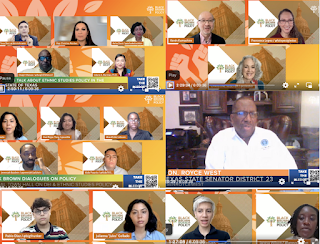
Saturday's Black Brown Dialogues on Policy Virtual Town Hall on DEI and Ethnic Studies

Friends:

Feeling so happy and blessed to have had our first event as Black Brown Dialogues on Policy last Saturday, March 11th with the assistance of our amazing design team and panelists to discuss Diversity, Equity and Inclusion (DEI) and Ethnic Studies Policy in the 88th Session of the Texas State Legislature last Saturday.

Many thanks to our sponsors: the Texas Legislative Black Caucus and the Mexican American Legislative Caucus, Texas NAACP, Texas LULAC, the Texas Legislative Education Equity Coalition, the Mexican American School Board Association, Texas Association for Chicanos in Higher Education, Texas Association for Diversity Officers of Higher Education, and the National Association for Chicana & Chicano Studies Tejas Foco Pre-K 12 Committee for their solidarity and support.

Beginning with Senator Royce West, the morning focused on DEI and the afternoon focused on Ethnic Studies. The noon hour consisted of a teach-in on Critical Race Theory and its Critics as well as a session by our esteemed chairs of the Texas Legislative Black Caucus and the Mexican American Legislative Caucus this session, namely, Rep. Ron Reynold and Rep. Victoria Neave Criado, and MALC Vice-Chair Christina Morales.


Collectively, the conversation centered on the passing of Ethnic Studies legislation House Bill 45, on the one hand, and on the other, defeating terrible bills like House Bill 1006, House Bill 1607, and House Bill 1046 which are listed below.

All of the panels were informative and encouraging, most especially the Gen Z panels that shared important insights on how DEI and Ethnic Studies policies have been beneficial to them. Thanks to Tony Diaz who moderated the afternoon panel on Ethnic Studies.


As BBDP, we are deeply committed to raising youth voices considering the ongoing legislative attacks on their generation as manifest in the various bill proposals that seek to curb their power and influence (e.g., transgender bills, voting rights, anti-CRT, anti-abortion, anti-DEI).


Our timing couldn't be better considering the mobilizing of youth by the right to their cause: The New Children's Crusade: Recruiting for America's Culture War: Powerful Interests are sending Texas youth out to do battle against LGBTQ+, Abortion and Progressive Causes. Gen Z youth, as a whole, are not conservative, but lean liberal, if not progressive. Accordingly, read this peer-reviewed article titled, "The Millennial/Gen Z Leftists Are Emerging: Are Sociologists Ready for Them?"


Why this focus on our Gen Z youth—meaning youth born around 1995 and 1996? They succeed the Millennial generation, born between 1996 and the mid-2000s. They are our many undergraduate- and younger graduate student-level college students today.

GenZ-ers are "digital natives," meaning that they know of no other world than the digital one they've inherited from earlier generations comprised of Boomers, Gen X-ers and Millennials. They are also the most diverse age-generational cohort in the history of the United States. Diversity and inclusion are their super power.

They were, by most accounts, a definite factor in the results of the 2022 midterms as pretty much any Google search will support including this piece authored by marketing expert, Mark Beal, titled, "Did Gen Z Voters Stop a Red Wave in the Midterm Elections?" Beal said that pollsters aren't getting at this demographic that "does not regularly view network and cable television." They clearly subverted Trump's 2020 election rally in Tulsa, Oklahoma, meriting mention in Wikipedia. The marketing world is ablaze with its focus on Gen Z right now.

For us "older" folks—us "Boomers" and 40-year old Millennials—I am getting increasingly convinced that understanding Gen Z and younger Millennials is a window to fostering intergenerational understanding, healing, and progressive values. Hence, the legislative attack on their generation that will trickle down to Gen Alpha born in the early 2010s.

Abundant thanks to all that participated and to our talented BBDP design team of media industry professionals and creatives. Thanks, as well, to co-founders, Gary Bledsoe of the NAACP and Colette Phillips, CEO of Get Konnected! in Boston. You can view the entire event here.

Many ideas came out of this event, including the importance of black brown unity in the faith community, youth organizing, and most importantly, what the data on DEI and Ethnic Studies indicate.

Please take the pledge for diversity, equity and inclusion at our Black Brown Dialogues on Policy website so that you can be apprised of other events and opportunities to engage, particularly at this crucial moment in state policy and politics.

-Angela Valenzuela

References

Kaplan, E. B. (2020). The Millennial/Gen Z Leftists Are Emerging: Are Sociologists Ready for Them? Sociological Perspectives, 63(3), 408–427. https://doi.org/10.1177/0731121420915868

Lee, J. (2023, March 6). The New Children's Crusade: Recruiting for America's Culture War: Powerful Interests are sending Texas youth out to do battle against LGBTQ+, Abortion and Progressive Causes, Texas Observer.


House Bill 1006 seeks to “prohibit: (A) the funding, promotion, sponsorship, or support of: (i) any office of diversity, equity, and inclusion; and (ii) any office that funds, promotes, sponsors, or supports an initiative or formulation of diversity, equity, and inclusion beyond what is necessary to uphold the equal protection of the laws under the Fourteenth Amendment to the United States Constitution.”

House Bill 1607 is the higher education analogue to Senate Bill 3 last legislative session that some have dubbed the “Texas anti-CRT” bill.

House Bill 1046 seeks to prohibit what they’re calling “political tests” in higher education utilized in hiring decisions or in student admissions as a condition of employment, promotion, or admission, to identify a commitment to or make a statement of personal belief supporting any specific partisan, political, or ideological set of beliefs, including an ideology or movement that promotes the differential treatment of any individual or group based on race or ethnicity.