Translate

Showing posts with label ACLU. Show all posts

Saturday, July 18, 2026

What Florida's Illegitimate "Stop WOKE Act" Ruling means for Texas, by Angela Valenzuela, Ph.D.

What Florida's Illegitimate "Stop WOKE Act" Ruling means for Texas

by 

Angela Valenzuela, Ph.D.

July 18, 2026

The federal courts have now said plainly what many educators, students, civil rights advocates, and defenders of academic freedom have been saying for years: the state cannot turn the university classroom into an ideological command center.

As reported by Politico, a divided panel of the U.S. Court of Appeals for the Eleventh Circuit struck down key higher education provisions of Florida’s so-called Stop WOKE Act, the 2022 law championed by Governor Ron DeSantis to restrict how race, gender, white privilege, systemic racism, sexism, and related concepts could be taught in public colleges and universities. The ruling is a major blow to one of the signature laws in the anti-DEI, anti-“woke,” anti-academic freedom playbook.

The court’s language is striking. Judge Britt Grant, a Trump appointee, called Florida’s theory a “breathtaking assertion of power to ban unpopular ideas from public discourse” in the very classrooms where students are supposed to wrestle with difficult ideas (Atterbury, 2026). The court also stated that, “If the First Amendment offers any boundary of protection at all for public university classrooms, this statute crosses it" (Atterbury, 2026).

That language matters. It refuses the cynical argument that because professors at public universities are paid by the state, their teaching becomes government speech. In other words, the state cannot simply say: “We pay your salary, therefore we own your mind, your syllabus, your interpretation of history, and your professional judgment.”

This is not a small legal technicality. It is a profound defense of the university as a space of inquiry.

The Stop WOKE Act sought to regulate not simply what could be said, but which perspectives could be made available to students. It targeted concepts involving racism, sexism, privilege, unconscious bias, and systemic inequality, while imposing serious institutional and employment penalties. 

The Legal Defense Fund noted that violations carried potentially severe consequences: universities could lose access to state performance funding, while individual instructors could face dismissal. The ACLU’s case describes the law as a classroom censorship measure that severely restricted educators and students from learning and talking about race and gender in higher education classrooms.

This ruling therefore speaks beyond Florida. It speaks to a broader authoritarian impulse in state policy: the effort to use legislative power to chill teaching, narrow curriculum, punish dissent, intimidate faculty, and erase the histories and lived experiences of Black, Latinx, Indigenous, Asian American, LGBTQIA+, women, immigrant, and other marginalized communities.

For Florida, the decision is a repudiation of a governing strategy that has treated public higher education as a battlefield for culture war politics. The state’s attack on “wokeness” has not been about intellectual openness. It has been about control—control over language, history, curriculum, faculty governance, hiring, student support, and institutional mission.

Florida has become a testing ground for this politics, from the Stop WOKE Act to the hostile takeover of New College of Florida. The goal has been to remake public higher education not as a democratic public good, but as an instrument of state ideology. The Eleventh Circuit ruling interrupts that project and reaffirms that the First Amendment still has something to say when politicians attempt to police the boundaries of knowledge.

For Texas, the ruling should be read carefully.

Texas’ SB 17 is not identical to Florida’s Stop WOKE Act. SB 17 focuses primarily on banning diversity, equity, and inclusion offices, programs, required DEI statements, and certain DEI-related activities at public institutions of higher education. The University of Texas at Austin describes SB 17 as a law that prohibits public institutions from engaging in specified DEI activities, effective January 1, 2024. The enrolled bill itself amends the Texas Education Code to regulate “diversity, equity, and inclusion initiatives at public institutions of higher education.”

Still, the family resemblance is unmistakable. Florida’s law and Texas’ law emerge from the same national movement. Both are premised on the idea that state legislatures should decide which institutional commitments to equity are permissible, which histories may be taught without fear, which student supports may exist, and which words become suspect.

The consequences of SB 17 were already severe within months of its implementation. On May 14, 2024, then–University of Texas System Chancellor J. B. Milliken testified before the Texas Senate Subcommittee on Higher Education that UT institutions had closed 21 DEI offices, eliminated 311 full- and part-time positions that had previously focused on DEI, and canceled 681 contracts, programs, and trainings. Milliken estimated that more than $25 million had been saved or redirected to other university purposes. These figures came from Milliken’s legislative testimony—not from a separate UT System report—and were documented in the official Senate hearing and contemporary reporting by KUT (Fogel, 2026).

The Florida ruling does not automatically invalidate Texas’ SB 17. But it does send an unmistakable warning: when state policy crosses from governance into viewpoint discrimination, when it chills academic speech, when it punishes institutions or educators for making certain ideas available to students, it enters dangerous constitutional territory.

This is especially important because anti-DEI laws rarely operate only through their text. They operate through fear. They invite over-compliance. They encourage administrators to preemptively close programs, cancel events, rename offices, erase webpages, avoid words, discipline faculty, and interpret the law more broadly than required in order to avoid political retaliation.

That is how censorship works in practice. It does not always arrive as a direct order. Sometimes it arrives as a memo, a compliance training, a legislative hearing, a threat to funding, or a phone call from someone who “just wants to make sure” the university understands the political climate.

The Eleventh Circuit’s ruling pushes back against this climate of fear. It reminds us that public universities are not simply agencies of the state. They are institutions with a democratic function: to cultivate inquiry, foster debate, preserve knowledge, produce research, and educate students capable of thinking critically about the world they inherit.

That democratic function is especially urgent in states like Florida and Texas, where demographic change, racial inequality, attacks on public education, and struggles over curriculum are deeply intertwined. The fight over DEI is not only about university bureaucracy or so-called "viewpoint diversity." It is about whether public institutions will tell the truth about our histories and prepare students to build a more just future.

The deeper question is who gets to decide what students are allowed to know?

If politicians can ban disfavored ideas in the name of “anti-discrimination,” then anti-discrimination law itself is turned upside down. Rather than protecting people from exclusion, it becomes a weapon for suppressing conversations about exclusion. Rather than expanding freedom, it narrows the intellectual life of the university.

That is why this ruling matters. It reasserts the university as a place where difficult ideas may be confronted rather than prohibited, where professors exercise professional judgment rather than serve as instruments of the state, and where education prepares students for democratic thought—not political obedience.

For Florida, the ruling is a devastating rebuke to the DeSantis administration’s effort to govern higher education through ideological prohibition.

For Texas, it is a cautionary signal that laws targeting DEI, Ethnic Studies, gender studies, race-conscious inquiry, and academic freedom may face serious constitutional scrutiny when they attempt to control speech, viewpoint, curriculum, or the conditions under which faculty and students pursue knowledge.

And for the rest of us, it is a reminder that higher education must be defended not only as a workplace or a credentialing system, but as one of the remaining public spaces where democracy can still be practiced.

This decision does not end the struggle. Florida may continue to litigate. Texas lawmakers may continue to expand their attacks. Other states may refine their strategies. But the ruling gives educators, students, civil rights groups, faculty organizations, and communities a powerful language of resistance.

A university worthy of the name cannot be built on state-mandated silence.

It must be a place where students can ask hard questions, where faculty can teach with integrity, where histories of racism and resistance are not erased, and where the freedom to learn is understood as inseparable from the freedom to teach.

That is the meaning of this ruling. And that is why it matters far beyond Florida. 

There's a lot more to the policy context, of course, with other bills like SB 12 and SB 37 at play, the former restricting instruction, programming, student support, and educator conduct in K–12 schools, and the latter impacting faculty governance, changing controls curricula and academic programs. The cumulative effect is a vertically integrated system of ideological control stretching from prekindergarten through graduate education.

References

Atterbury, A. (2026, July 7). “Breathtaking assertion of power”: Appeals court slams door on Florida “Stop WOKE” law championed by DeSantis,Politicohttps://www.politico.com/news/2026/07/07/florida-desantis-stop-woke-law-ruling-00988728

Fogel, B. (2024, May 14). Are public universities doing enough to comply with Texas’ DEI ban? Lawmakers will decide, KUT 90.5https://www.kut.org/education/2024-05-14/are-public-universities-doing-enough-to-comply-with-texas-dei-ban-lawmakers-will-decide

Pernell v. Commissioner of the Florida State Board of Education, Nos. 22-13992, 22-13994 & 23-10616 (11th Cir. July 7, 2026). https://law.justia.com/cases/federal/appellate-courts/ca11/23-10616/23-10616-2026-07-07.html

Texas Legislature. (2025). Senate Bill 12, 89th Legislature, Regular Session: Enrolled version.

Texas Legislature. (2025). Senate Bill 37, 89th Legislature, Regular Session: Enrolled version.

Texas Senate, Subcommittee on Higher Education. (2024, May 14). Senate Subcommittee on Higher Education [Video recording].


‘Breathtaking assertion of power’: Appeals court slams door on Florida ‘Stop Woke’ law championed by DeSantis

The decision from a divided 2-1 panel of the U.S. Court of Appeals for the 11th Circuit is a devastating, possibly final blow to the so-called Stop WOKE act touted by the DeSantis administration.


Florida’s Legislature approved the “anti-woke” legislation touted by Gov. Ron DeSantis in 2022. The state, though, has been blocked from enforcing the policies ever since. | Lynne Sladky/AP

By Andrew Atterbury

07/07/2026 02:25 PM EDT|Updated: 07/07/2026 05:35 PM EDT

TALLAHASSEE, Florida — Florida’s anti-woke law restricting how lessons on race and gender can be taught in colleges and universities — policies championed by Gov. Ron DeSantis — violates the free speech rights of professors, a panel of appeals court judges ruled Tuesday.

The decision from a divided 2-1 panel of the U.S. Court of Appeals for the 11th Circuit is a devastating, possibly final blow to the so-called Stop WOKE Act touted by the DeSantis administration. The judges affirmed a 2022 decision that labeled Florida’s rules as “positively dystopian,” doubling down by arguing the law is “a breathtaking assertion of power to ban unpopular ideas from public discourse” in the very classroom space where students are supposed to “puzzle through ideas that are good and bad, easy and hard, ideally getting ever closer to the truth.”

“If the First Amendment offers any boundary of protection at all for public university classrooms, this statute crosses it,” Judge Britt C. Grant, an appointee of President Donald Trump, wrote in the opinion.

Grant was joined by Judge Charles R. Wilson, a Bill Clinton appointee, in the ruling. But another Trump-appointed judge, Barbara Lagoa — a former Florida Supreme Court judge picked by DeSantis — wrote a striking dissent of the decision, contending the First Amendment “does not compel all viewpoints to be worthy of state-sponsored endorsement.”

“This panel is not free to rewrite precedent simply because we dislike where it leads,” Lagoa wrote.

Florida’s Republican-led Legislature approved the “anti-woke” legislation, H.B. 7, or the Individual Freedom Act, in 2022. The state, though, has been blocked from enforcing the policies as it has been fighting in court ever since.

Directly inspired by DeSantis, the law expanded Florida’s anti-discrimination laws to prohibit schools and companies from leveling guilt or blame to students and employees based on race or sex. As such, it targets lessons over issues like “white privilege” by creating new protections for students and workers, including that a person should not be instructed to “feel guilt, anguish, or any other form of psychological distress” due to their race, color, sex or national origin.

The other portion of Florida’s law restricting what DeSantis called “woke” workplace trainings faced a similar fate after also being rejected by an 11th Circuit panel. And, notably, it was Grant who wrote that opinion, decrying the DeSantis-backed policies as “the greatest First Amendment sin” for penalizing certain viewpoints on the job.

Tuesday’s higher education ruling was triggered by two lawsuits that have been fighting the Stop WOKE law for years. One of the lawsuits was filed by Foundation for Individual Rights and Expression, a nonprofit free speech group, on behalf of a University of South Florida professor, student, and student group, while the other was brought by the ACLU, ACLU of Florida and Legal Defense Fund on behalf of students and educators.

Both challenges alleged that the legislation pushed by DeSantis violates their freedom of speech, evidenced by how it could restrict lessons on critical topics, claiming it’s a discriminatory classroom censorship law that severely restricts how race and gender can be taught and talked about in schools.

“This ruling sets a strong precedent that higher education cannot be limited to the whims of politicians,” Leah Watson, senior staff attorney with the ACLU’s Racial Justice Program, said in a statement Tuesday.

FIRE, meanwhile, also celebrated the decision and its implications for higher education:

“Today’s important decision means that college remains a place where professors and students are allowed to debate controversial topics — even if politicians disagree with them,” said Greg H. Greubel, FIRE senior attorney.

The DeSantis administration did not immediately respond to a request for comment about the ruling. State Attorney General James Uthmeier, though, did throw praise at Lagoa.

“Barbara Lagoa may be the best jurist in our country,” Uthmeier said on social media. “She should be on SCOTUS.”

Sunday, August 31, 2025

'Chilling Attempt to Evade Accountability': Trump to Boycott UN Human Rights Review--Time for Action!

Friends, Students, Community Members, and Colleagues:

The Trump administration has once again turned its back on global human rights accountability—this time by refusing to participate in the United Nations’ Universal Periodic Review (UPR), the process where every country is asked to account for its human rights record. The U.S. has taken part in every review since 2010, but this year it walked away—at the very moment when international scrutiny is most urgent.

The ACLU blasted the boycott as “a chilling attempt to evade accountability,” warning it emboldens authoritarian regimes and weakens protections for basic freedoms at home and abroad. It’s not hard to see why Trump is ducking the process: the U.S. government is already facing mounting criticism for human rights violations committed by ICE—ripping families apart, caging children, and forcing undocumented immigrants into what can only be described as modern-day concentration camps.

By abandoning the UPR, the administration is shielding itself from global accountability while doubling down on its attacks on vulnerable communities. This is not leadership—it is complicity in cruelty.

We cannot stay silent. Communities, students, and allies must make clear that we reject bigotry, authoritarianism, and the dismantling of democratic institutions.

Join Austin SDS Rally—UT Students in Opposition to the Trump Administration’s Bigoted and Reactionary Agenda! Thursday, September 4th at 5PM.

-Angela Valenzuela

Reference

Corbett, J. (2025, Aug. 28). 'Chilling Attempt to Evade Accountability': Trump to Boycott UN Human Rights Review, Common Dreams. https://www.commondreams.org/news/trump-un-human-rights-council


Join Austin SDS Rally—UT Students in Opposition to the Trump Administration’s Bigoted and Reactionary Agenda! Thursday, September 4th at 5PM

@austin.sds


Join Austin SDS and other UT students in opposition to the Trump administration’s bigoted and reactionary agenda!

Deportations have only increased since Trump was inaugurated last January, tearing apart families and forcing many undocumented immigrants into modern-day concentration camps. Meanwhile, Israel’s genocide against Palestine continues, with our government supplying Israel with money and arms, while also repressing activists for speaking out against the very same atrocities that our government is funding. Coupled with the many attacks against LGBTQ rights at the federal level, it’s necessary that we, the students, continue our historic fight toward progress and stand up against these injustices!

📆 Date: Thursday, September 4th
🕛 Time: 5:00 PM
📍 Location: Main Mall (Outside the UT Tower)

Stop Trump’s Agenda!
No Deportations!
Protect Immigrant Students!

Friday, June 27, 2025

Immigrants' Rights: Know your rights, compliments of the American Civil Liberties Union (ACLU)

Friends, 

Tragically, we are hearing of a lot of people getting picked up by ICE in our communities. It's important theat people know their rights. 

Here is great information on what your rights are from the American Civil Liberties Union (ACLU) that has been carefully developed to help you navigate encounters with law enforcement and immigration officials safely and confidently.

If you’re ever questioned about your immigration status, it’s critical to know your rights—you do not have to answer questions about your citizenship or status, and you absolutely have the right to remain silent. Never lie or present false documents. Remember that you can refuse a search unless there’s probable cause. 

Please take a moment to review this important guidance so you can protect yourself and your loved ones. 

My best suggestion is to go directly to the ACLU website for detailed explanations and various scenarios. 

May our Creator—who sees no borders and draws no distinctions among us—bless and protect you always. These are the hard times.

-Angela Valenzuela


Know your rights

Immigrants' Rights

Regardless of your immigration status, you have guaranteed rights under the Constitution. Learn more here about your rights as an immigrant, and how to express them.

Law enforcement asks about my immigration status

Saturday, August 31, 2024

Student threatened with suspension sues University of Texas for 'unlawful retaliation': ON THE IMPORTANCE OF FACULTY VOICE AND GOVERNANCE

Friends:

This is an evolving story at UT. One notes the importance of faculty voice and governance for due process and democracy as this student's lawsuit cites a UT Faculty Council committee report that supports Ammer Qaddumi's case. I agree with the American Civil Liberties Union's statement that free speech rights should be "generously protected." To this, I would include university faculty, as well, together with the academic freedom we need to teach truthfully in the college classroom. I am proud of our faculty and our faculty leadership for expressing their voices.

I am also proud of the great work by the American Association of University Professors (AAUP) members at UT who contributed to the Faculty Council committee report, as well. Our chapter may be among the largest in our state.

To be clear, the Texas Conference of the American Association of University Professors (AAUP) and the Texas Faculty Association (TFA), along with their partners in other Southern states, have been leading the fight against interference in academic freedom, advocating for the protection of shared governance, due process, and tenure.

Our AAUP state leader, Dr. Brian Evans, together with other fantastic AAUP leaders at UT and statewide are currently organizing to have a voice in the upcoming 2025 Texas Legislative Session, as well.

Another important, related point that should also be abundantly clear is that when faculty fight for free speech and academic freedom at the legislature and beyond, these are student issues that both students and advocates need to vigorously support, as well. Similarly, when students and advocates fight for K-12 issues in the Texas State Legislature, these are higher education issues. 

After all, the attack on academic freedom in 2023 was presaged by the attack on Critical Race Theory in 2021. Expressed differently, many of us knew in 2021 that this issue would re-appear in higher education in the following 2023 legislative session—and it did in the form of SB 16 (related to higher education curriculum), SB 17 (attack on DEI), and SB 18 (attack on tenure). of the three, the latter two bills become law.

This speaks to a tendency in policy for folks to say, "I do K-12" or "I do higher ed." I maintain that these logics make us vulnerable that extremists are happy to exploit. Not that all have to know or do everything, but rather it's important to have a little epistemic humility and to know that there is a larger policy arena out there to which we must also be mindful. 

Here is where networks and partnerships matter. For example, I'm thrilled that Texas AFT and AAUP recently voted on March 30, 2024 in favor of this partnership: Affiliation Agreement Between Texas AFT and the Texas AAUP Conference. After all, censorship is an issue that affects the entire educational pipeline. I would also argue that we need to give our K-12 teachers much more academic freedom over their classrooms than they do now. The teachers we work with at Academia Cuauhtli—who are dual language/bilingually certified teachers—always tell us that what they like about our school is their freedom to impart their craft and to develop curriculum that is specific to the communities they teach.

You may join AAUP at this link. Here are several reasons to consider joining. No worries. Membership is kept confidential. You can also learn about how to start your own chapter at your own college or university, public or private, here.

Follow Texas AAUP on X @TexasAaup and @aaup_utAustin.

AAUP makes a difference. A big one.

-Angela Valenzuela

Student threatened with suspension sues University of Texas for 'unlawful retaliation'


by Lily Kepner | Aug. 30, 2024 | Austin American-Statesman


Pro-Palestine protesters hold a rally after The University of Texas at Austin’s commencement ceremony at Royal-Memorial Stadium on Saturday, May 11, 2024 in Austin. About 100 protesters, which included current and graduating students and faculty and staff, gathered to call for the University of Texas at Austin to divest from weapon manufacturers that supply arms to Israel. -Aaron E. Martinez/American-Statesman

A student threatened with suspension is suing the University of Texas, UT President Jay Hartzell and former Provost Sharon Wood, claiming they violated his First Amendment rights when he was arrested at a pro-Palestinian protest on April 24.

The suit, filed Tuesday, alleges that UT "unlawfully attempted to prevent that speech" and is now trying to suspend the student and bar him from campus for three semesters pending a hearing Friday. In an additional motion filed Wednesday, the student seeks a temporary restraining order against the disciplinary hearing, which a federal judge denied Thursday afternoon.

"It's pretty evident that the university's actions targeting that demonstration were really just unambiguously unlawful," Brian McGivern, the lawyer representing the case from Austin Community Law Center, told the American-Statesman in an interview. "My hope is that the lawsuit will also deter them from blindly, unapologetically breaking the law."


More:Can Texas public universities remove protesters from campus? First Amendment experts explain

McGivern said the discipline threatened against the student is "unlawful retaliation."

Ammer Qaddumi, the plaintiff in the lawsuit, is a member of the Palestine Solidarity Committee, the group that organized the April 24 protest and was the first person arrested by police after a dispersal order.

"The police sought out a mediator from among the crowd to communicate directives to, and Mr. Qaddumi volunteered to fill that role. At their request, Mr. Qaddumi shared with the other demonstrators the officers’ directives to disperse," the lawsuit states.

More:$5,200 for Pok-e-Jo's barbecue: A look at UT's expenses for pro-Palestinian protests

It describes Qaddumi addressing the crowd when they regathered on Speedway to listen to officers and communicating to officers about the challenges with dispersal when "at that moment, at approximately 12:49 p.m., he was arrested by UT Police Department officers on the accusation of criminal trespass."

Video evidence posted by the news service Al Jazeera, as well as reporter accounts, show Qaddumi helping police before a UT police officer arrested him. Fifty-six other people were arrested that day, though all criminal trespassing charges were quickly dropped "due to insufficient evidence."

Because of Senate Bill 18, a 2019 Texas law, all university public spaces are established as traditional public forums, affording them the highest scrutiny in free speech law, McGivern said.

This conduct would not meet the standard required to allow censorship, McGivern argues, even for a university.

"The University is a state entity, and it's one of the bedrock principles of our democracy that the state cannot casually censor speech ... except in very specific situations," McGivern said. "There's no good faith argument that they can make that what they are doing is lawful, except by relying on statements of facts that are pure fiction."

More:Analysis: UT increases limits on free speech after pro-Palestinian protests, Abbott order

On April 23, the university preemptively canceled the registered student group's plans to protest due to officials' belief the demonstrators planned to break rules and disrupt the campus. Wood, whom Hartzell announced Tuesday would return to the engineering faculty starting Sept. 1 after stepping down as provost, emailed the Dean's Council early the next morning to say UT "is working to ensure this type of disruption doesn't happen." Hartzell has said he asked outside law enforcement to meet protesters, fearing the protest would break rules and disrupt campus.

The president and provost were named and sued for damages in their personal capacity due to both parties showing their involvement in prior restraint with the protest, McGivern said.

More:UT offers deferred suspension to some pro-Palestinian student protesters, one suspension

University spokesperson Mike Rosen said the university is aware of the lawsuit and will respond in court filings, but he pointed to Hartzell's comment in April that UT followed its rules and protocols and that it protects free speech that follows those rules.

"Today, our University held firm, enforcing our rules while protecting the Constitutional right to free speech. Peaceful protests within our rules are acceptable. Breaking our rules and policies and disrupting others’ ability to learn are not allowed," Hartzell wrote then. "The group that led this protest stated it was going to violate Institutional Rules. Our rules matter, and they will be enforced. Our University will not be occupied."

The lawsuit states the Palestine Solidarity Committee was not intending to break university rules, accusing the university of conflating their intentions with national groups.

Protests largely organized by chapters of Students for Justice in Palestine, which the Palestine Solidarity Committee is a part of, spread across universities nationwide last spring after more than 100 protesters in an encampment were arrested at Columbia University on April 18 when demanding their institution divest from weapons manufactures contributing to Israel's war against Hamas in Gaza.

The UT protest was held in solidarity with others across the nation but was planned to be a gathering on the South Lawn with workshops, teach-ins and pizza, organizers said on social media. At a protest April 29 not organized by the Palestine Solidarity Committee, protesters did briefly set up a surprise encampment and police arrested 79 people.

More:Seventy-nine pro-Palestinian protesters arrested after setting up encampment at UT Austin

The lawsuit heavily cites a UT Faculty Council committee report that says the university broke its rules in silencing protesters' free speech preemptively, something UT denies.

The Statesman's reporting has showed the university changed its free speech rules this summer to state off-campus police can in some instances enforce university rules, something that was not present explicitly at the time of the arrests, though police have assisted the UT police before. It also changed the rules to cite drumming as amplified sound. The April protests didn't use amplified sound but they did involve drums.

More:UT faculty panel accuses school of violating its own rules during pro-Palestinian protests

The American Civil Liberties Union of Texas previously raised concerns about the disciplinary process, encouraging the university in a letter to Hartzell to treat students in a content-neutral way and to protect their free speech rights generously. At least one other student protester also faces suspension, the Statesman previously reported.

The university has said disciplinary proceedings are separate from the law, though it publicly criticized County Attorney Delia Garza for dropping criminal trespassing charges because they did not meet the highest standard of evidence that protesters broke the law.

U.S. District Judge David Ezra on Thursday denied the temporary restraining order motion sought by Qaddumi, saying "no injury currently exists," as the hearing Friday will determine whether or not Qaddumi is suspended, and the university is following due process through having a hearing, according to his order.

In his lawsuit, Qaddumi seeks compensatory and punitive damages from defendants and a permanent injunction against disciplinary proceedings.

"This (is part of) a larger phenomenon that we see today with certain leaders, very publicly, very unapologetically, breaking the law in ways that they know are illegal ... and then trying to gaslight the public or lie to the public to justify it," McGivern said. "What people should know is that they deserve better leadership."

Saturday, April 11, 2020

"They Don't Care if You Die": Immigrants in ICE Detention Fear the Spread of COVID-19

This is urgent, my friends. Anguishing story of substandard care during this awful COVID crisis.  Among other things, what is revealed is how easy it actually is for folks to get released from detention—currently  36,000 people strong, located in facilities throughout the country.

Great organizations like the ACLU are attending to this crisis. ACLU Deputy Director of the Immigrants' Rights Project says that ICE is "playing Russian Roulette with people's lives."  Folks are panicked inside of these detention facilities,  as the care is substandard even under normal conditions and people are getting ill with the virus.

Please consider making a donation here so that the ACLU can continue advocating for these prisoners' lives.  

-Angela Valenzuela
URGENT: SUPPORT OUR RESPONSE TO COVID-19
Your gift will fund our critical work to protect voting rights, demand that vulnerable people in prisons, jails and immigration detention centers be released, and fight to ensure reproductive health care remains open and accessible to all who need it. Now more than ever, we the people means all of us.
Donations to the ACLU are not tax-deductible.
Ashoka Mukpo Staff Reporter
April 8, 2020
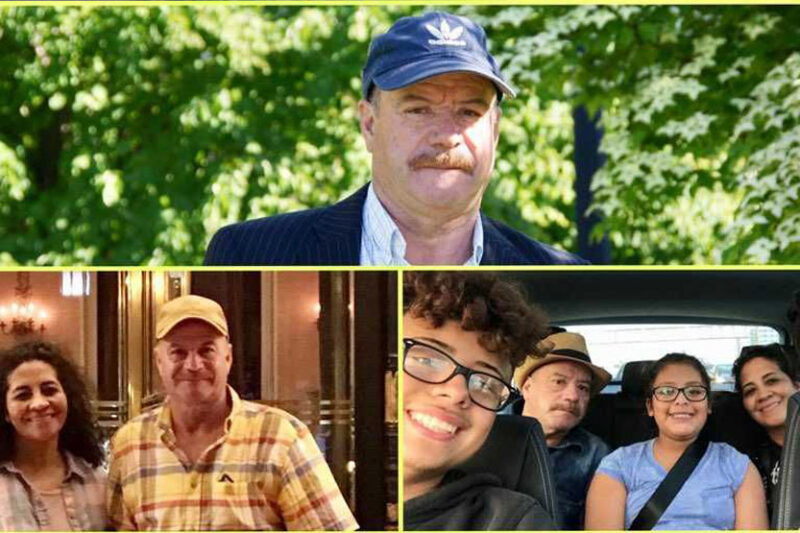
Mario Rodas, Sr. first found out there was a deadly virus spreading through the country while he was watching television at the Plymouth County Correctional Facility in Massachusetts. In early March, Rodas had been pulled over and arrested by Immigration and Customs Enforcement (ICE) agents while driving to the supermarket with his wife, a legal resident and the mother of his three U.S. citizen children. Since then, he’d been in the custody of ICE, mostly at Plymouth.
The more Rodas heard about the disease, the more fearful the 59-year-old became.
“I was scared for my health,” he told the ACLU. “I was worried because I have diabetes, high cholesterol, and high blood pressure. It was stressful, you know?”
Just days later, word spread through the prison — a staff member had tested positive for Covid-19. When they heard the news, Rodas’s son — also named Mario — and the rest of his family were terrified.
“Just do whatever you can to stay alive and hopeful,” he said he told his father over the phone. “We are doing everything we can to get you out of there.”

Mario Rodas, Sr. in family photos with his wife and children.

Across the country, there are nearly 36,000 people in the custody of ICE on an average day. Some are in county jails and state prisons, others are in facilities run by private contractors like the GEO Group. Many are asylum seekers who have asked the U.S. to protect them from persecution abroad. Others — like Rodas — are undocumented workers who lived in the U.S. for years before being swept up by ICE.
Now, public health officials say that overcrowding and poor access to sanitation inside ICE detention facilities is a crisis in the making, with two doctors contracted by the Department of Homeland Security calling them a “tinderbox” for infections in a letter to Congress on March 19.
“As local hospital systems become overwhelmed by the patient flow from detention center outbreaks, precious health resources will be less available for people in the community,” they wrote.
Across the country, tensions are rising inside of ICE facilities, with detained immigrants and their families fearing that cramped conditions and an indifferent bureaucracy are a deadly threat to their safety — and to the wider public’s health. So far, at least 20 detainees and dozens of staff at facilities housing them are confirmed to have contracted COVID-19. Many others are under quarantine, raising fears that the virus is spreading undetected and potentially infecting guards who shuttle in and out for their shifts before returning home.
These numbers are likely a significant underestimate due to shortages of COVID-19 tests. In a hearing last week on an ACLU lawsuit, an attorney working for the government admitted that there were no tests available at two Maryland facilities, while simultaneously arguing that detainees there were not at risk due to the lack of confirmed cases. ICE has said they aren’t required to disclose information about staff at privately-run detention facilities who have tested positive.
“The nature of these facilities is such that it’s really impossible to engage in the social distancing that we’re all practicing right now,” former director of ICE John Sandweg told Democracy Now.
After the staffer at Plymouth fell ill, Rodas said that guards started bringing him and the others in his cell block to meals in shifts. But each group was still as large as 80 people at a time, and none were given masks or gloves to wear.
“The government is asking everyone to stay home and not have physical contact with other individuals. But meanwhile, my dad was out there amongst 80 to 150 other individuals, and you don’t know if they could potentially have something and be contagious,” said Rodas’s son.
Realizing the danger he was in, Rodas’s lawyer, Kerry Doyle, reached out to friends at the ACLU of Massachusetts. On March 25the ACLU filed a petition asking a judge to order ICE to release Rodas along with another detained immigrant on the grounds that their medical conditions placed them at high risk for COVID-19 complications, in violation of their constitutional rights.
Two days later, Rodas received word. He would be able to go home.
“They released him on pretty strict conditions,” said Doyle. “He has a GPS bracelet.”
Rodas’s son rushed to Plymouth to pick him up. “I was so happy, I couldn’t believe it,” he told the ACLU. Now, Rodas is quarantining in a room in the house until 14 days have passed since his release.
“I think that the whole thing highlights how easy it is for immigration [authorities] to release detainees that have cases that are low priority and allow them to go back home during these very uncertain times,” said his son.

Mario Rodas, Sr. on the day he was released from the Plymouth County Correctional Facility.
Mario Rodas, Sr. being released from Plymouth County Correctional Facility on March 27th.
Mario Rodas, Jr.

The suit that led to his father’s release was one of a series that have been filed across the country in recent weeks seeking similar orders. Fifteen were filed by the ACLU and its affiliates, with over thirty people released from detention as a result of those suits so far.
Alfredo Garza was one of those lucky few. He was released on March 26 from the Tacoma Northwest Detention Center, a private facility run by the GEO Group in Washington, following a suit filed by the ACLU and the Northwest Immigrant Rights Project. Garza suffered a heart attack while detained this past January and says he was chained to a bed in the hospital while receiving treatment.
“Doctor care is terrible there,” he said. “The worst there is.”
In 2018, an investigation by Seattle Weekly revealed that the Tacoma facility had been providing substandard medical care to immigrants housed there.
Washington was the first state in the country to experience a substantial outbreak of COVID-19, and in early March Garza says that he and others in the facility became afraid when another detainee fell ill with what they assumed was COVID-19.
“They took him out in a suit, like one of the people who catch bees,” he said.
Geo Group and ICE have not confirmed any cases of COVID-19 in Tacoma Northwest Detention Center, but Garza says that his unit was placed under quarantine and kept away from contact with others anyway:
“We said, ‘Hey we need sanitizer or chlorine.’ But they said, ‘No, we don’t have any.’”
After the ACLU’s suit was filed, Garza was released along with another detainee who suffers from high blood pressure. Since then, 80 people housed in the facility have gone on hunger strike to raise attention to the danger they say they face from the pandemic.
“I have a friend who has diabetes and he was worried when he found out that there were people with coronavirus inside,” Garza said. “They didn’t even tell him, ‘Hey, we are going to put you somewhere else’ or ‘We’re going to do something.’ They don’t care if you die.”
Despite widespread calls from public health experts that the detained population must be drastically reduced in order to prevent COVID-19 from spreading unchecked and taxing the healthcare system, so far ICE has largely refused pressure to release people in its custody.
On Tuesday, the agency indicated it had identified 600 detainees deemed "vulnerable" to COVID-19, and released 160 of them. But that same day, lawyers for the Department of Homeland Security (DHS) asked a judge to stay a ruling that would have released 22 detainees with medical conditions from two county jails in Pennsylvania.
"Families were getting ready to pick up their loved ones when the stay came down," said Michael Tan, Deputy Director of the Immigrants' Rights Project at the ACLU. "ICE is playing an unacceptable game of Russian Roulette with people's lives."
Karlyn Kurichety is a supervising attorney with Al Otro Lado, a California-based organization that provides legal services to asylum seekers and other immigrants. She says that her clients in the Adelanto ICE Processing center — another Geo Group-run facility — are scared.
“It’s just cruel and really disturbing, there's basically no precautions being taken,” she said. “The detainees are not given any information about COVID-19. There are no signs, no talks, no advisories, nothing of that nature.”
Adelanto has put strict measures in place requiring visiting attorneys to wear N95 masks — despite the fact that even health care workers in the state aren’t able to find them. Since then, Kurichety says she hasn’t been able to visit her clients —most of whom are asylum seekers — or arrange a non-recorded phone call to discuss their case.
Recently, she says she spoke with one client who told her that two people in his dorm collapsed with symptoms that sounded like those of COVID-19. The dorm was subsequently placed under quarantine. Another said that he’d been cleaning his cell with body wash.
“It’s like if you wanted to design a situation where a virus would spread, this is what you’d do,” she said.
On March 30, the ACLU filed suit on behalf of six detainees in Adelanto with serious medical conditions, arguing that “without a rigorous testing regime, it is impossible to conclude that COVID-19 has not already entered Adelanto.”
Two days later, a federal judge ordered all six released.
But Kurichety says that those who remain are fraying emotionally.
“They’re really scared. I would say it’s almost like panic,” she said. “Their families, too, because we've been talking to their sponsors and sometimes they break down in tears. They're really frightened for their loved ones.”

Friday, November 01, 2019

"I Went to Mexico to Meet Asylum-Seekers Trapped at the Border. This Is What I Saw." by Ashoka Mukpo

Here is an update on asylum seekers in Juarez. These stories reflect the impunity of our country's asylum process and the terrible suffering experienced by vulnerable people whose every waking moment is fraught with precarity. The unjust conditions under which they await their hearings—for many, months away—has become a literal matter of life and death.  

Justice! Where are you?

-Angela


Two weeks ago, I traveled to northern Mexico along with Mexican photographer Guillermo Arias to meet with asylum-seekers who’ve been trapped at the southern U.S. border by Trump Administration policies. Neither of us was prepared for what we saw there.
We visited two cities – Ciudad Juarez and Matamoros – to track down people who had been placed into the deceptively misnamed “Migrant Protection Protocols” that have slammed America’s door shut to people fleeing persecution and violence in their home countries. Before we arrived, we wondered whether the stories we’d read of kidnappings, assaults, and despair were as widespread as they sounded. It didn’t take long for us to get our answer.
There is – right now, at this very moment – a humanitarian crisis unfolding at our southern border. And we are not paying enough attention to it.
First, a little context. The Trump Administration has been waging an all-out war on the U.S.’s asylum system, which for more than 50 years has provided shelter for people who need protection. To accomplish this reversal of tradition, they’ve put into place a series of policies that have made it nearly impossible for people to quickly and safely claim asylum at the southern border. Chief among them is the forced return to Mexico program, which has trapped tens of thousands of people in dangerous cartel-controlled cities in northern Mexico while they wait for distant court dates inside the U.S.
The circumstances these vulnerable people are facing in the meantime are dire. We saw them first-hand.

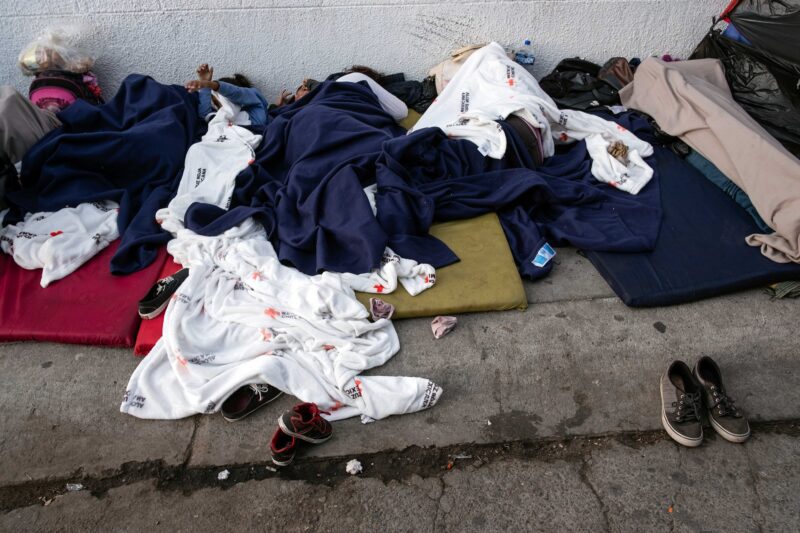
Mexican asylum-seekers sleep on the street near the Paso del Norte bridge in Ciudad Juarez, October 7, 2019.  Guillermo Arias for the ACLU.

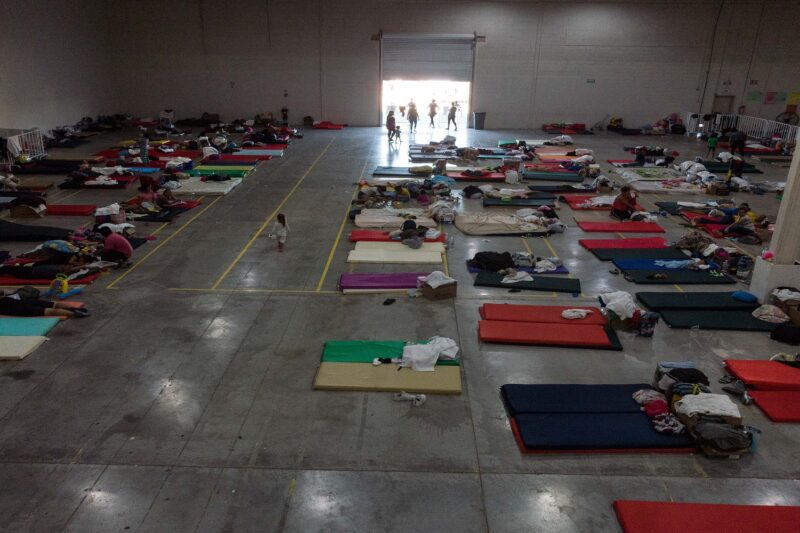
Everywhere we went, people told us stories of being kidnapped or extorted while stuck in Mexico. Many were sleeping in tent encampments on the streets while safety across the border was literally within sight, but legally out of reach. Some were packed into shelters set up by the Mexican government, sleeping shoulder-to-shoulder on thin mattresses on the floor of converted warehouses. Others were living in privately-run shelters with no security protocols to prevent intruders from intimidating or preying on them.
Matamoros is a small city right across the Rio Grande from Brownsville, Texas, just along the coast of the Gulf of Mexico. It’s in the Mexican state of Tamaulipas, where corruption and cartel-related violence is so bad that the U.S. state department has given it the same travel advisory as Afghanistan and Somalia. It’s also become home to thousands of people who’ve fled Central America, South America, the Caribbean, Africa, and other parts of Mexico searching for safety.
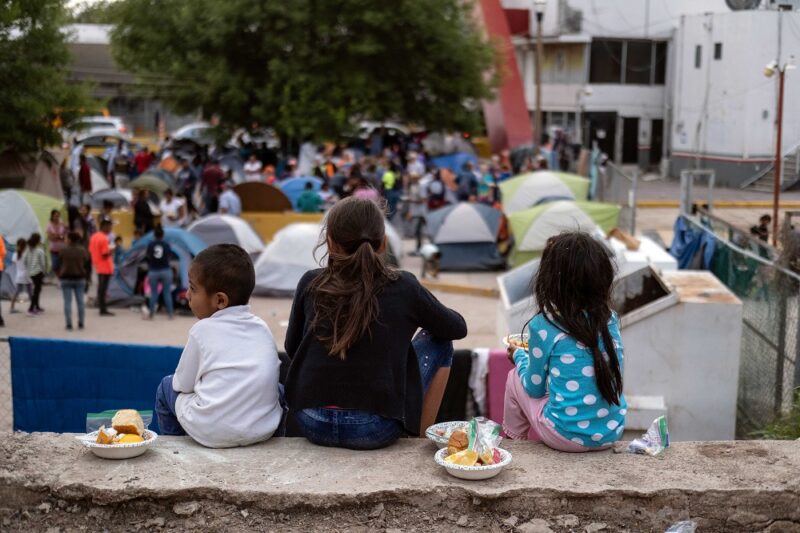
Previously, they would have been processed through the asylum system and then either detained or released inside the U.S. while their claims were evaluated by an immigration judge. But now, they’re given a sheet of paper that tells them to come back to the border months later for their first hearing. In the meantime, they’re stuck, with nowhere to go and most often nobody to help them. Next to the Matamoros-Brownsville bridge, a tent camp has sprung up on a patch of pavement and dirt that around 2,000 asylum-seekers call home. The camp is growing every day.


Children of asylum-seekers eat near the Puente Nuevo Internacional bridge in Matamoros, October 12, 2019.

Guillermo Arias for the ACLU.
The night before we visited, a storm system had swept through Texas, flooding the inside of the low-quality tents people were living in with rain. There was mud everywhere, and it was cold. Few people had the clothing to cope with the chilly temperatures, and the first few people we talked to were shivering, their teeth chattering as they spoke. Everywhere we looked, there were very young children sitting on curbs or hanging onto their parents.
One young man told us that in a tent nearby there was a Honduran woman with a newborn baby, so we stopped in to visit them. She’d delivered just five days earlier. Only 21 years old herself, she’d been living in the tent with her four-year-old daughter since being sent back to Matamoros by Customs and Border Protection agents. She said that when she’d first told CBP officers that she was pregnant, they suggested she get an abortion before telling her to come back for a court date over a month in the future.
The tiny child was bundled into blankets in the small tent where it was spending its first days of life. Her mother coughed when she spoke, visibly exhausted. She said that she’d fled an abusive spouse and was too afraid to return to him. Later, one of the few health responders who visits the camp regularly told me that she was fearful about whether the child would survive conditions at the camp, which she said reminded her of refugee camps she’d worked at in Bangladesh.
“If there’s a cholera outbreak here, half of them could die,” she said.
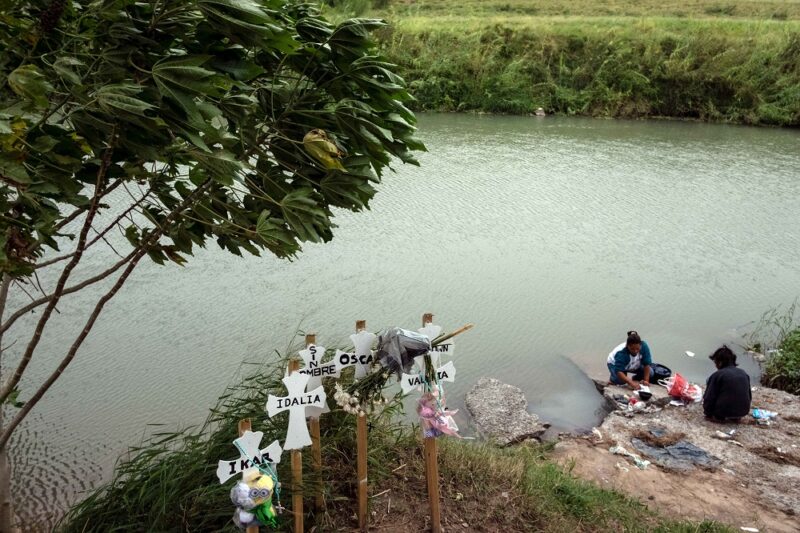
Further up the hill next to the camp, along a wooded grove, lies the Rio Grande. There are a few makeshift showers near the camp, but they aren’t nearly enough for the entire camp to bathe, so many choose to wash and do their laundry at the bank of the river. The river is rife with pollution, and people living in the camp have developed rashes and other skin problems from bathing in it. Next to a small, muddy clearing, a series of white crosses stood in remembrance of the children who’ve died by drowning in the river in recent months.

Wooden crosses honoring children of asylum-seekers who drowned in the Rio Grande in Matamoros, October 12, 2019.
Guillermo Arias for the ACLU.

A few nights before we visited the camp in Matamoros, some of its frustrated residents had staged a protest against conditions in the camp and the policies that have trapped them there, shutting down the bridge for 15 hours. “They keep telling us we have to wait longer and longer,” one told Buzzfeed News. “When will it end?”
Walking among the tents and meeting their gracious and welcoming occupants, I felt the weight of my country’s responsibility for their suffering. The insecurity, desperation, and discomfort of the people we were speaking with isn’t a corollary effect of the policy, it’s the core intent. The “Migrant Protection Protocols” were designed to make it so uncomfortable and dangerous for people who are seeking asylum that they will simply give up, exhausted and defeated, and return back to the dangerous situations they fled.
Many have, indeed, already done so.
Further along the border, in Ciudad Juarez, we visited a network of shelters that have been set up in recent months to cope with the roughly 17,000 asylum-seekers who’ve been returned there since mid-April. On one side of the spectrum was the newly-opened federal shelter, supervised by the Mexican government, which was housing over 500 people the week we were there. A converted warehouse with no individual rooms, people were sleeping on rows and rows of small mattresses lined up against the walls and across the middle of the large hall. Its inhabitants were there waiting for court hearings as far out as January of next year.

Asylum-seekers inside the Leona Vicario Federal shelter in Ciudad Juarez, October 9, 2019.
Guillermo Arias for the ACLU.

We met with Venezuelans who’d fled the political crisis in their country and El Salvadorans who spoke of witnessing family members gunned down in front of them. People told us they'd been dropped off on darkened streets in Juarez by Customs and Border Protection with no idea where to go or what to do. One parent told us she'd had to wrestle with a man who tried to abduct her daughter in front of her. Some spoke of the dawning realization that they might now have no choice but to return to the very danger they’d run away from to begin with.
As we walked through the shelter, a woman approached us cautiously. She broke into tears and told us that a few nights earlier she’d woken up to see a man from the shelter trying to sexually assault her underage daughter. Could we help, she asked? We passed on her story to one of the administrative staff at the shelter.
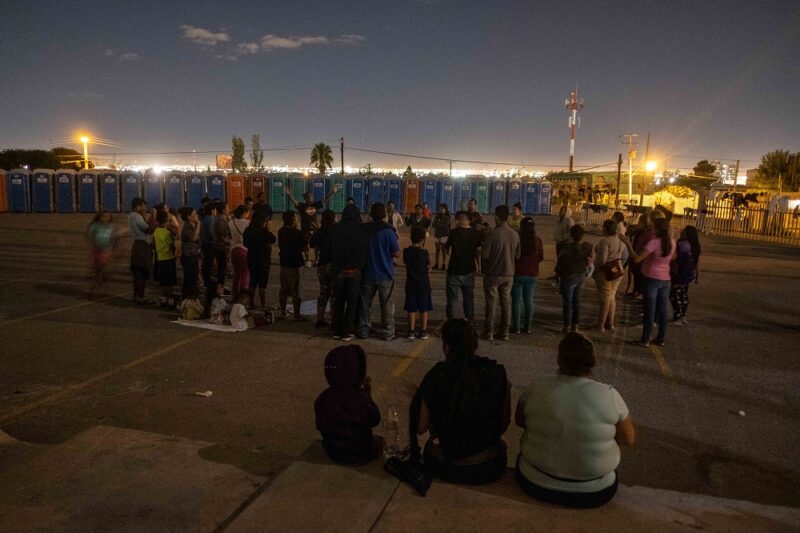
At night, people gathered in a circle to sing hymns, the glittering lights of Juarez in the distance.

Asylum-seekers pray at the Leona Vicario Federal shelter in Ciudad Juarez, October 9, 2019.
Guillermo Arias for the ACLU.

The Mexican government has been providing assistance to asylum-seekers who’ve grown exhausted with the long wait times and difficult conditions, helping to arrange travel back to their countries of origin. A staff member showed us a list of people who’d relented and returned home. In just two months, 205 people had made use of the program and left for Guatemala, Honduras, and El Salvador. 97 of them were minors.
While that shelter was crowded and lacking the barest level of privacy, it did have security protocols set up to protect people living there. There were heavy gates surrounding the facility and guards who checked the names and credentials of every visitor. This was not the case in other shelters we visited.
At one, a small horseshoe of villas surrounding a decrepit playground on the outskirts of Juarez, there was no gate or security guards at all. The risks facing people stuck there were immediately apparent. Juarez is a dangerous city, and criminals there have realized that migrants have relatives who will often pay ransoms if they are kidnapped. An unsecured shelter is a prime target.
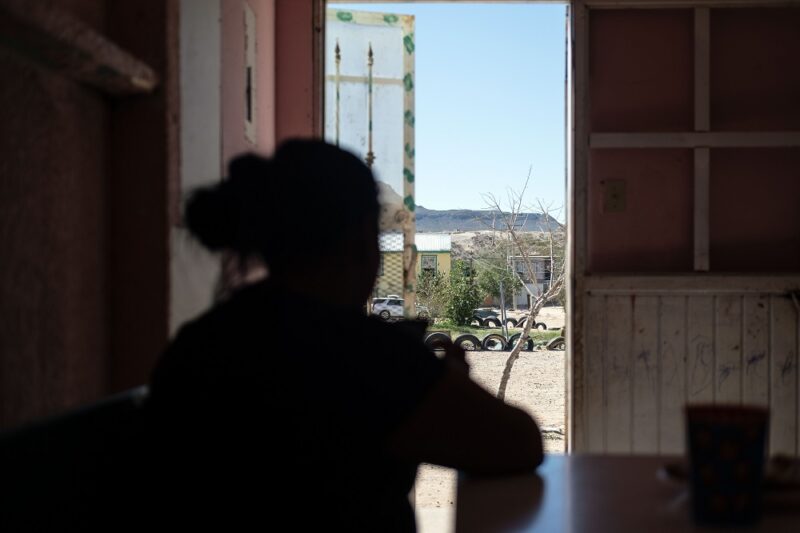
We were there to interview a woman who said she’d been kidnapped near the border by Mexican police officers. She played messages for us that the kidnappers had sent from her phone to her relatives back home. And she told us that not long ago a truck filled with masked men had driven into the shelter and slowly circled the courtyard. Since then she hadn’t left her corner of the shelter very often.

An asylum-seeker in a private shelter in Ciudad Juarez, October 10, 2019.
Guillermo Arias for the ACLU.

As she was telling us her story, we heard crying outside. A legal aid worker who’d brought us to the shelter said that a family living next door had just received word from their son that he’d been kidnapped that day. The boy had been picked up near the shelter and was now texting his mother the ransom demands of his assailants. Our escort offered to take her to a new shelter but she declined, saying she feared that it might seem like she was abandoning her son.
In the wake of a kidnapping the victim’s family may be placed under observation by the culprits, and we were told that the presence of journalists with cameras could further endanger the young man. So we quickly left.
In just a brief visit, we’d heard one detailed story of a kidnapping-for-ransom and witnessed another family living through that trauma in real time. The experience underscored the insecurity and fear that tens of thousands of asylum-seekers are being subjected to across the U.S. border right now.
Supporters of the new, punitive asylum processes say that most of the people seeking shelter at our southern border are liars who are after better work opportunities in the U.S. That simply did not gel with much of what we heard. One man said he’d been a municipal employee back home. He liked Honduras, and he hadn’t wanted to leave. But a street gang had threatened to murder him and his son if the young boy didn’t start selling drugs for them, so he felt they had no choice but to flee.
Another young woman from Nicaragua showed us pictures of the street demonstrations she’d participated in against President Daniel Ortega’s government. One of her friends who she’d marched with was killed and others were arrested, so she fled north. Only 19, she looked like a high-school student, speaking in a soft voice with her shoulders drooping as she recounted her separation from her sister at the border.
I have covered challenging stories across the world. For both Guillermo and I, this was a particularly difficult trip. I will not soon forget the eyes of the people we spoke with, at once tired and hopeful, nor their stories of determination, horror, and resilience. The shame I felt as an American while interviewing them was profound. Our country is turning its back on vulnerable people who need our help, right at our doorstop. We have to do better.
The danger they face will not soon come to an end, either. ACLU lawyers have filed suit against every anti-asylum policy the Trump Administration has tried to implement, but the courts have allowed several policies to go forward for now while the litigation against them continues.

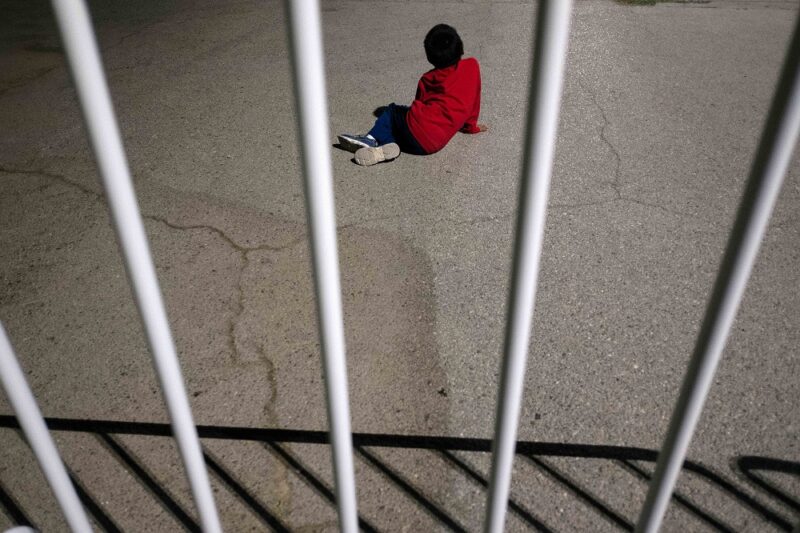
A young boy sits in the parking lot at the Leona Vicario Federal shelter in Ciudad Juarez, October 7, 2019.
Guillermo Arias for the ACLU.

The attack on vulnerable people seeking asylum at our border is a political crisis, and we have to start approaching it as the matter of life-and-death that it is. We need our elected representatives – including Democrats vying for the nomination – to take a clear stand and explain what they’ll do to roll back these abusive policies as soon as possible.
At stake is our identity as a country. The people asking us for help at our border are no less human than we are, and we have the capacity to help them. How will we respond to their suffering? Will we allow the most hateful and uncaring among us to write our history, or will we fight back and demand better? There are tens of thousands of eyes cast towards us at the border right now waiting for our answer.
The author of this post appeared on the ACLU's 'At Liberty' podcast along with Astrid Dominguez, director of the ACLU Border Rights Center. To listen to the episode, click here.