Translate

Showing posts with label American slavery. Show all posts

Monday, August 03, 2026

The Rot We Refuse to Name: Montgomery, Alabama, and the Living Legacy of Racial Terror, by Angela Valenzuela, Ph.D., August 3, 2026

The Rot We Refuse to Name: Montgomery, Alabama, and the Living Legacy of Racial Terror

by

Angela Valenzuela

August 3, 2026

Legacy Museum link

Last week, during a weeklong stay in Montgomery, Alabama as part of the Legacy Summit hosted by the the African American Policy Forum (AAPF), I visited the Equal Justice Initiative’s Legacy Museum—an experience that unsettled me in ways I am still trying to process. I am deeply grateful to Dr. Kimberlé Crenshaw and for everyone at the AAPF—as well as to American Association of University Professors and the Center for the Defense of Academic Freedom, for making the visit possible for me and so many others.

Inside the museum, the history of racial terror ceased to feel like a distant past. It became immediate and embodied: a history carried in names, voices, stories, images, places, and lives, and one whose consequences remain painfully present. I encourage all to consider this opportunity next Summer or alternatively, to take some time off yourself to visit the various sites in Montgomery to get a complete experience.

While there, you must also visit the National Memorial for Peace and Justicethe Freedom Monument and Sculpture Park, and Montgomery Square. Together, these places illuminate the extraordinary decade of struggle that helped transform the United States and, without exaggeration, changed the world. They also remind us that the rights secured through that struggle are neither permanent nor self-sustaining. They are now being challenged by forces of religious nationalism that seek to reverse many of the democratic gains for which earlier generations sacrificed so much.

The museum itself stands on the sacred grounds of a former cotton warehouse where enslaved Black people were once held and forced to labor. From that location, it traces a historical continuum linking the transatlantic slave trade and enslavement to the violent overthrow of Reconstruction, racial terror lynching, Jim Crow, mass incarceration, and the contemporary criminal legal system. Personal testimony, archival evidence, art, and data reveal not a succession of unrelated injustices, but the recurring adaptation of racial domination as older systems were challenged and new ones took their place.

What struck me most forcefully was the depth and pervasiveness of the terror that Black people throughout the South endured. Terror was not limited to the moment when a person was seized, tortured, or killed. It was directed at entire communities. It instructed Black parents about what could happen to their children. It warned Black veterans against wearing their uniforms with pride. It threatened Black citizens who attempted to vote, acquire land, build businesses, organize workers, attend better schools, or insist upon being addressed with dignity.

Lynching was not simply spontaneous mob violence committed by a few extremists. It was a system of public terrorism intended to restore white supremacy after emancipation and suppress Black civil and political rights. The Equal Justice Initiative has documented at least 2,000 Black women, men, and children killed in racial terror lynchings during Reconstruction and more than 4,400 racial terror lynchings between 1877 and 1950. These acts were often committed publicly and with impunity, sometimes before crowds that included community leaders, elected officials, and children.

#JusticeForJamesCooper

I pause here to acknowledge James Cooper, whose body was found hanging from a utility pole in Metcalfe, Mississippi. Jay Fletcher first reported on the unresolved questions surrounding Cooper’s death in 2024 with the Delta Democrat-Times revisiting the case two years later (Fletcher, 2024, 2026). Kim Dockery (2026) has also drawn renewed attention to the case and the family’s continuing demand for answers. Although local authorities ruled Cooper’s death a suicide, his family and members of the community dispute that conclusion and are calling for a federal investigation.

Cooper’s story reminds us why the thousands documented by the Equal Justice Initiative cannot remain an abstraction. Each number represents a person with a name, a life, relationships, aspirations, and a community forced to live with the terror and injustice surrounding that person’s death. Naming him here is one small act of refusing the erasure upon which racial terror has long depended.

The museum makes clear that the targets of this violence were not only the people who were murdered. Terror entered homes, churches, schools, workplaces, and everyday relationships. It constrained movement, speech, aspiration, and political participation. It produced forced migration as Black families fled communities where the threat of violence had become unbearable. It also taught white communities that violence against Black people would be tolerated, celebrated, or ignored. Geez, isn't this what's getting "taught" anew with each unresolved case today like James Cooper's?

This is what makes the history so difficult to absorb. The cruelty was not incidental to the social order. It helped create and maintain that order.

Emancipation formally ended enslavement, but it did not eliminate the ideology that had justified it. The mythology of Black inferiority was transformed into new presumptions: that Black people were dangerous, criminal, incapable of citizenship, or naturally suited for subordination. During Reconstruction, violence sought to destroy emerging Black political power. After Reconstruction, lynching and Jim Crow enforced segregation and racial hierarchy. As the museum demonstrates, these narratives did not disappear with the end of legally mandated segregation. They became embedded in policing, prosecution, sentencing, imprisonment, and capital punishment.

After getting back to the hotel, I reached out to my husband, Emilio Zamora, professor emeritus of history at the University of Texas at Austin, to share the anger and sorrow I felt as I confronted this sustained history of racial terror and injustice. His response was that it represents the “rot” of this country

The word stayed with me.

By “rot,” he did not mean only a shameful chapter in an otherwise unblemished national history. He meant something deeper: a foundational moral and institutional decay that has been repeatedly covered over without being removed. The legal forms have changed, but the underlying presumption of Black guilt, dangerousness, and disposability has remained disturbingly resilient. 

Although this system is rooted most fundamentally in anti-Blackness, its logics have extended outward, shaping the criminalization and punishment of Latino men, immigrants, Indigenous people, and other racialized communities. Through policing, immigration enforcement, detention, incarceration, and unequal sentencing, these groups have also been cast as dangerous, foreign, or undeserving of full protection under the law. Recognizing these connections should not blur the distinct history of Black oppression; rather, it reveals how institutions built through anti-Black racial domination have generated broader systems of surveillance, exclusion, and punishment.

According to the Bureau of Justice Statistics, at year-end in 2023, 1,862 Black males per 100,000 Black male U.S. residents were serving sentences of more than one year under state or federal correctional jurisdiction—more than five times the corresponding rate for white males, 341 per 100,000 (Mueller & Kluckow, 2025). 

See Table 13 in Mueller & Kluckow (2025).

The Equal Justice Initiative aptly describes the modern death penalty as a direct descendant of racial terror lynching and links the terror era to racially biased capital punishment, excessive sentencing, wrongful convictions, and the continuing presumption of Black criminality.

This does not mean that lynching and imprisonment are identical. It means that institutions of punishment developed within a society that had never fully repudiated the racial assumptions underlying enslavement and racial terror. Black men who were once portrayed as threats requiring mob violence have continued to be treated as presumptively dangerous within schools, courts, prisons, and systems of capital punishment. The rope, the electric chair, the execution chamber, and the prison cell belong to different historical moments, but the Legacy Museum compels us to examine the ideas about race, guilt, innocence, and human worth that connect them.

Montgomery also reminded us that terror and resistance have always existed alongside one another. Black people did not merely endure this history. They built families, churches, schools, businesses, civic organizations, freedom movements, and cultures of extraordinary beauty and intellectual depth. They organized against slavery, challenged lynching, fought segregation, registered voters, contested wrongful convictions, and continued to demand that the nation honor principles it repeatedly denied them.

That resistance, however, should never be used to soften our understanding of the terror they endured and endure. Celebrating Black resilience without confronting the conditions that made such resilience necessary can become another way of avoiding the truth. The moral burden belongs not to those who survived oppression, but to the institutions and communities that produced it, benefited from it, tolerated it, or refused to remember it.

I left the Legacy Museum with a clearer understanding that racial injustice cannot be overcome through commemoration alone. Museums and memorials matter because they interrupt national amnesia. They restore names, lives, and histories that official narratives have—have long suppressed—and, in many cases, continue to suppress. So remembrance must also change how we understand contemporary policy and practice. It must shape how we approach policing, incarceration, sentencing, voting rights, education, housing, and the death penalty.

The rot persists whenever racial inequality is treated as accidental, whenever Black suffering is explained without reference to history, and whenever institutions celebrate true heroes like the Reverend Dr. Martin Luther King or civil rights victories while continuously, if hypocritically, reproducing the conditions those movements opposed.

Our week in Montgomery left me grieving, but it also left me more convinced of the necessity of truth-telling. We cannot repair what we refuse to name. We cannot understand mass incarceration without understanding enslavement, Reconstruction, lynching, and Jim Crow. And we cannot claim to oppose racial terror while accepting institutions that continue to treat Black lives, and especially the lives of Black men, as inherently suspect or expendable.

The Legacy Museum asks the nation to do more than remember. It asks us to confront the rot—to expose it, remove it, and build institutions no longer dependent upon the degradation, terror, and punishment of Black people. To this, I will only add that it was a validating experience in terms of the policy battles we are fighting and have fought in coalition as Latinas and Latinos with the Black community.

Reference

Dockery, K. [@thicknpretty215]. (2026, August 3). James Cooper’s family continues to seek answers concerning his death in Metcalfe, Mississippi, and is calling for a federal investigation [Video]. Instagram. https://www.instagram.com/p/DbeCtzFB1nA/

Fletcher, J. (2024, May 8). Update on the James Cooper case. Delta Democrat-Times. https://www.ddtonline.com/crime-communities-local-content/update-james-cooper-case

Fletcher, J. (2026, August 3). One year later seeking justice for James. Delta Democrat-Times. https://www.ddtonline.com/communities-crime-local-content/one-year-later-seeking-justice-james

Mueller, D., & Kluckow, R. (2025). Prisoners in 2023—Statistical tables (NCJ 310197). U.S. Department of Justice, Bureau of Justice Statistics. https://bjs.ojp.gov/document/p23st.pdf

Sunday, September 10, 2023

My Great Grandfather was a Racist: Once we take down Confederate statues, Texans must still grapple with monsters in the past.

Gabriel Arana speaks candidly about discoveries he has made from researching his own family's history. I think everyone should do this so that we can learn about what has made us individually—as well as us, collectively—into who we are today. He speaks of the cringe-worthy, "Lost Cause" icons on the grounds of the Texas State Capitol in the form of flags, statues, and street signs that honor Confederate figures who, by definition, upheld racist policies.

Most telling is how their prevalence today on Texas Capitol grounds indeed aligns to the current cultural war with politics, policies, shrill rhetoric and propaganda that seek to whitewash Texas history that is further playing out at the highest levels of the Texas State Historical Association (TSHA). The organization has been roiled by conflict over how Texas history is to get interpreted. Accordingly, read the following:

D'Amico, R. (2023, July). Traditionalists Protest What Some Consider a “Woke” Takeover of the Texas State Historical Association, Inside the arguments, lawsuit, and angry outbursts that are dividing a key authority on historical matters, Texas Monthly. Retrieved: https://www.texasmonthly.com/news-politics/texas-state-historical-association-drama/ 

deGrood, M. (2023, July 18). Galveston billionaire, board to face off in mediation in case over how Texas history is taught, Houston Chronicle.Retrieved: https://www.houstonchronicle.com/news/houston-texas/trending/article/mediation-in-case-over-how-texas-history-is-taught-18205227.php

Dey, S. (2023, June 22).  A battle over who gets to tell Texas history is brewing into a war over the state historical association’s future, Texas Tribune. Retrieved: https://www.texastribune.org/2023/06/22/texas-state-historical-association-lawsuit/

I like how a personal narrative like this illustrates well the feminist notion that the personal is political. And boy is it, as you can see from the historic battle taking place within the TSHA.

What we can easily infer from these struggles is how for the dominant group, it's not sufficient to be politically and economically dominant. Rather, the intellectual, cultural, and what is construed as the moral sphere of our (in)glorious tradition must be so, as well, even if by force.

That said, history teaches us that grassroots struggles from below that challenge these symbolic orders matter enormously for the kinds of change those of us involved in such struggles seek, not the least of which is a truthful teaching of our state's and nation's history.

-Angela Valenzuela

My Great Grandfather was a Racist: Once we take down Confederate statues, Texans must still grapple with monsters in the past. by GABRIEL ARANA | Texas Observer 

SEPTEMBER 4, 2023, 11:47 AM, CDT A version of this story ran in the September / October 2023 issue.

My great-grandfather, José-María Arana, was a racist. 

After the United States barred Chinese men from immigrating under the Chinese Exclusion Act of 1882, tens of thousands sought a new life in Mexico, where they faced no warmer a welcome as they established themselves. A former schoolteacher and businessman, José-María led a vicious campaign against the Chinese in the Mexican states of Sonora, Sinaloa, and Baja California in the early 1900s.  

Seeking “all legal means to eliminate the Asian merchant,” whose growing prosperity he viewed as a threat to the working class and Mexican national identity, José-María formed a junta of local businessmen in 1912 to address what he called “the tremendous calamity of the Chinese jaundice.” He launched a newspaper, Pro-Patria, whose masthead boldly proclaimed, “Mexico for the Mexicans and China for the Chinese.” Featuring racist jokes and caricatures, the broadsheet portrayed Chinese immigrants as carriers of disease and a threat to Mexican women. 


JOSÉ-MARÍA ARANA ORGANIZED TO EXCLUDE CHINESE IMMIGRANTS FROM MEXICAN LIFE AND PROSPERITY. JOSÉ-MARIA ARANA/SPECIAL COLLECTIONS AT THE UNIVERSITY OF ARIZONA LIBRARY

“We cannot live together because there exists an absolute incompatibility in race, social customs, and economy,” José-María wrote in its pages. 

My great-grandfather carried his message throughout Northern Mexico, making speeches in working-class towns like Cananea—whose poor copper miners he thought ripe for radicalization—and urging city and state leaders to restrict the types of businesses that Chinese immigrants could run, relegate them to ghettos, and expel them de manera definitiva [in a definitive way]. 

I’ve thought increasingly about my great-grandfather and his ignoble legacy as I’ve settled into life in Texas, where the Confederate cause is memorialized on statues, flags, and street signs. Growing up on the U.S.-Mexico border in Nogales, Arizona—where José-María’s widow, my great-grandmother, settled after his death in 1921—I knew little about my family tree’s racist roots. Like a lot of gay kids who come from a small town, I left to find people like me in bigger cities and only much later started to contemplate my origins.


CHINESE IMMIGRANTS SENT JOSÉ-MARÍA POSTCARDS WITH DERISIVE POEMS IN SPANISH. TRANSLATION: OF YOUR ATTACKS I LAUGH / AND YOU EVEN GIVE ME COMPASSION / AND IT MAKES ME NEITHER HOT NOR COLD / YOUR RIDICULOUS ORATION. / AND THEY SAY FROM GRAND CHINA / THAT YOU’RE GOTTEN INVOLVED WITH THE DANCE / WITH YOUR GROSS PROPAGANDA / TO FILL YOUR BELLY. —JU KUN LEEJOSÉ-MARÍA ARANA, SPECIAL COLLECTION AT THE UNIVERSITY OF ARIZONA

Afew months after moving here in the summer of 2022, I visited the Capitol grounds with my in-laws from London. The Texas State Capitol is an imposing Renaissance revival structure made of pink granite with a dome that, Texans remind you, is taller than the U.S. Capitol. But what impressed us all the most on that first visit was the enormous Confederate Soldiers Monument on the right as one walks up to the entrance from 11th Street. 

bronze statue of Confederate President Jefferson Davis stands atop one of five pillars, the other four support figures representing the branches of the Confederate military. The inscription on the pedestal below commemorates the 437,000 soldiers who “died for states [sic] rights guaranteed under the Constitution” and asserts that “the People of the South, animated by the spirit of 1776, to preserve their rights, withdrew from the federal compact.” 

“It’s Texas,” I said preemptively, feeling defensive and embarrassed at the same time as my in-laws looked on in horror. It’s the same way I feel when an outsider mentions the state’s abortion ban or attacks on LGBTQ+ people. 

The Confederate Soldiers Monument is one of 12 memorials on the grounds that perpetuate the “lost cause”—the historical myth that the Confederate cause was heroic and not about slavery. 


It is a lie easily debunked by looking at Texas’ Ordinance of Succession, which laid out the state’s own reasoning for withdrawing from the union. The document declares that Blacks were “rightfully held and regarded as an inferior and dependent race” and that “the servitude of the African race … is mutually beneficial to both bond and free” as well as ordained by God. Even the monument’s Confederate death count, scholars have pointed out, is inflated. 

The endurance of the Confederate cult here does not, of course, reflect the prejudices of most Texans, which is what makes these symbols so corrosive to a shared sense of state identity. An implicit endorsement of white supremacy, they most directly exclude Black Texans, whose struggle for freedom offers a far more edifying narrative to rally around—one that embodies our national values and unity rather than doubling down on a lost war. But they set up an identity conflict for anyone of good conscience who wants to claim Texas as their own: Every assertion of Texas identity must come with a “but.” 

Reminders of the Confederacy abound here in Austin, considered the state’s bluest city: In the Texas State Cemetery, civil rights hero and Congresswoman Barbara Jordan and former Governor Ann Richards lie yards away from Albert Sidney Johnston, a slave owner and Confederate general whose Gothic tomb looks out on the Confederate Fields on the cemetery’s southeast side, where 2,200 Confederate veterans are interred, each plot marked by a white cross. 

Some of my Southern friends have said that when you grow up in the South, the paraphernalia is so commonplace, it can blur into the background. But if you’re new to it, it’s striking to see the resentments of the 1800s enshrined in what are supposed to be shared expressions of our civic ideals. 

It was perhaps easier to dismiss them before the Obama and Trump presidencies brought the Nazis and white, Christian nationalists out of the woodwork, when it was at least a bit more plausible to reassure oneself that “America is getting better.” It’s become harder to think of racism as a healing wound on the body politic when white nationalists demonstrate openly in public and Republicans in the Legislature try to ensure K-12 students only get taught a sanitized fairy tale about Texas history. 

“Most Texans do not support erasing our history … out of political correctness,” ​​Lieutenant Governor Dan Patrick wrote in an August 2022 letter to Senate Democrats who had urged the Legislature to remove Confederate monuments on the Capitol grounds. 

The irony is that whitewashing Texas history is the very purpose of Confederate propaganda—and the impetus behind state Republicans’ attacks on education. Last year, Governor Greg Abbott signed a law that limits how K-12 teachers can talk about racism and slavery; it bans educators from discussing the New York Times’ 1619 Project, which reframes the nation’s founding as inextricably linked to the arrival of slaves on American shores in 1619. 


Since the “Unite the Right” rally in Charlottesville, Virginia, in 2017, and the George Floyd protests in 2020, some Texans have begun to change their minds about memorializing the Confederacy. While a bare majority once opposed their removal, now 52 percent say they should be taken out of public view or relocated to museums where they can teach us about the past rather than help keep its prejudices alive. 

Amid our national reckoning about race, reminders of the Confederacy have started to come down in Texas. In 2017, the Texas State Preservation Board voted to remove the Children of the Confederacy plaque, which proclaimed that “the War Between the States was not a rebellion, nor was its underlying cause to sustain slavery,” from the Capitol. The University of Texas at Austin relocated four Confederate statues on its campus in 2015 and 2017. But this only scratches the surface: Statewide, only 34 of 240 Confederate symbols have been removed, including nine monuments, according to the Southern Poverty Law Center. 


My great-grandfather has no monuments dedicated to him, nor do I think he deserves any. What he represents is too corrosive to memorialize. 

I don’t have trouble condemning José-María as racist and acknowledging the harm he caused the Chinese community in Northern Mexico. I have come to take a qualified pride in my Mexican heritage, but to the extent it is synonymous with the racism José-María espoused, I must condemn it. Being members of a pluralistic society requires us to put our civic ideals, like the belief in human equality, above allegiance to our ancestry. 

I never heard about José-María as a kid. My grandparents died when I was young, and my father never spoke of him. One Christmas when I was home, I happened upon a collection of my grandfather’s writing about our family history. His father, he wrote, had been mayor of Magdalena, Sonora, and his papers were preserved in a collection at the University of Arizona. 

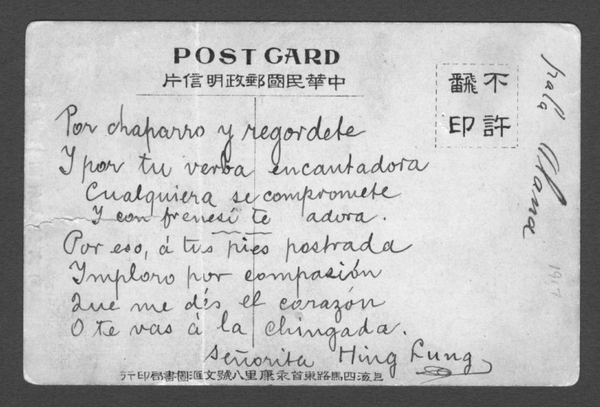
CHINESE IMMIGRANTS SENT JOSÉ-MARÍA POSTCARDS WITH DERISIVE POEMS IN SPANISH. TRANSLATION: FOR [BEING] SHORT AND FAT / AND YOUR ENCHANTING ORATION / WHOEVER HEARS IT / AND WITH FERVOR ADORES YOU / BECAUSE OF THAT, AT YOUR FEET PROSTRATED / I IMPLORE YOUR COMPASSION / OR YOU GO FUCK YOURSELF. —SEÑORITA HING LUNGJOSÉ-MARÍA ARANA, SPECIAL COLLECTION AT THE UNIVERSITY OF ARIZONA

I looked up the collection online, which featured speeches, newspaper clippings, and correspondence, including hate mail from Chinese Sonorans. A quick trip to Google Scholar filled in his biography. 

José-María was indeed elected mayor of Magdalena in 1919 after running twice, his first campaign derailed by a stint in prison for inciting violence against Chinese immigrants. As mayor, he was only able to pass laws taxing Chinese businesses, but his advocacy helped inspire the Sonoran legislature to relegate Chinese immigrants to ghettos and expel them in 1919—a move later overruled by the federal government. He died in 1921, supposedly from being poisoned, after which his widow moved to Arizona with my grandfather, where the family was reduced to poverty. 

Though I think it is good to have learned about the monster in my bloodline, I’m glad that ultimately, his name will only exist only for those who want to discover it. That’s where I think my great-grandfather’s shameful legacy belongs—in the historical record, the subject of debate and reflection about the mistakes of our ancestors, as a warning of what happens when one is too proud of one’s identity.

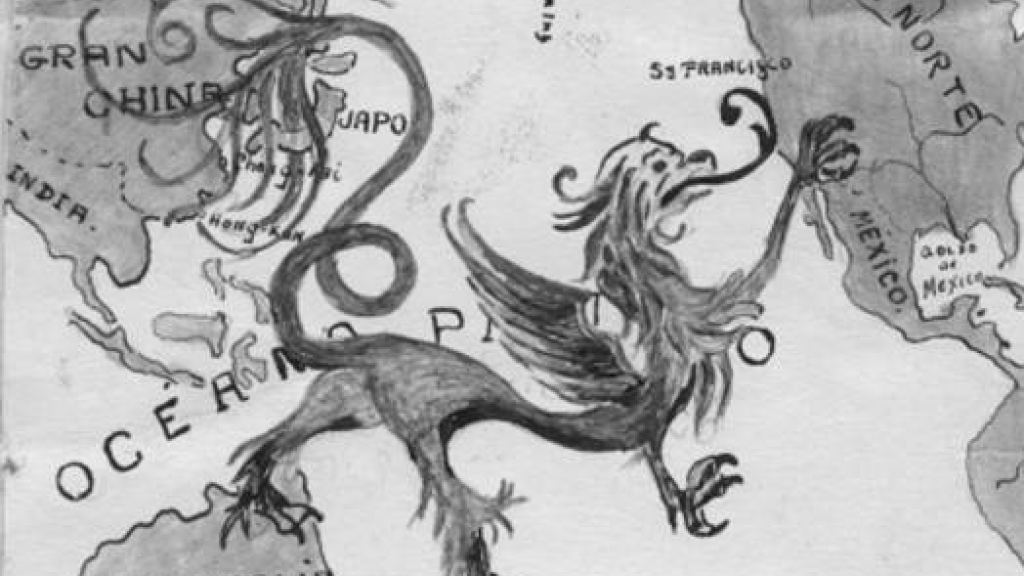
An old-fashioned black and white cartoon of an early 20th-century map of China and the West Coast of North and Central America. In between is a depiction of a cartoon dragon, poised with its claw upraised as if it is about to attack Mexico.
A CARTOON DEPICTION OF THE SUPPOSED “THREAT” JOSÉ-MARÍA AND OTHERS BELIEVED CHINESE IMMIGRANTS POSEDJOSÉ-MARIA ARANA/SPECIAL COLLECTIONS AT THE UNIVERSITY OF ARIZONA LIBRARY

Wednesday, August 31, 2022

Extremists are Using the State to Consciously Manipulate People's Opinions to Both Control and Shrink the Public Mind

Things are heating up at the Texas SBOE. They're wanting to delay decisions until a more conservative board comes in. The basic request is for a first reading this week of the Social Studies TEKS. The fringe groups like the Texas Freedom Caucus diverge from what parents and educators want and know to make for a good education. A first reading will allow the public to then weigh in on the proposed changes in a deliberative, civil manner. 

If you have any question about what Texans really want, read the Charles Butt Foundation Report titled, Connected Through Our Schools where Texans overwhelmingly express the following:

#2 Texans expect and value what public schools do for students, families, and communities.

Student opportunities: Critical thinking and problem-solving skills (92%)

Self-management, interpersonal skills, and decision-making skills (91%)

Preparation to succeed in the workforce (91%)


Texans don't want Texans to be ignorant, much less for education to be engineered. Anything short of this is censorship of the kind that fascist, totalitarian governments are fond of doing. 

That is, these extremists use the state to consciously manipulate people's opinions to control the public mind, that is inclusive of their habits, tastes, and even their memories. This is the antithesis of an expansive, inclusive, and most of all, respectful and representative curriculum.

When will they learn just how much they harm not just society, but also themselves, as well as their children and grandchildren, by narrowing thought and opinion that propagate small minds?

We're struggling for inclusion not just for our children, but for theirs, as well. And that's healthy and good for Texas. Below are their numbers where they can be reached. Do consider reaching out to them.

-Angela Valenzuela

Connect with your SBOE Representative

Reach out to your SBOE representative and tell them to do their job by scheduling first reading of the Work Group drafts and complete the TEKS review process in 2022. We encourage you to focus on the starred numbers and your rep. Find your rep here. We will be updating talking points here; the existing ones have not changed so if you are ready now, go ahead and connect! Also, if you have the time, send a note to SBOE Members Davis, Pérez-Díaz, and Bell-Metereau for their unwavering commitment to the process and their prioritization of truth and humanity.

District

Name

Email and Twitter

Phone

1

Georgina Perez

georgina.perez@tea.texas.gov

@ginaTXSBOE1

(915) 261–8663

2

Ruben Cortez, Jr.

rubencortezfortexas@gmail.com

@RubenforTexas

(956) 639–9171

3

Marisa Perez-Diaz

marisa.perez@tea.texas.gov

@Marisa4PubEd

(512) 422–9019

4

Lawrence Allen, Jr.

sboesupport@tea.texas.gov

(713) 203–1355

5

Rebecca Bell-Metereau

rebecca.bellmetereau@tea.texas.gov

@voterebecca

(512) 665–2157

6

Will Hickman

will.hickman@tea.texas.gov

(832) 304–0051

7

Matt Robinson

matt.robinson@tea.texas.gov

@MRDist7SBOE

(281) 635–1962*

8

Audrey Young

audrey.young@tea.texas.gov

(936) 569–3150*

9

Keven Ellis

ellisSBOE@gmail.com

@KevenEllisDC

(512) 710–7915*

10

Tom Maynard

tom@maynardfortexas.com

(512) 763–2801

11

Patricia Hardy

pat.hardy.1109@gmail.com

@pathardy2008

(817) 732–1786*

12

Pam Little

pam.little@tea.texas.gov

(972) 342–6697*

13

Aicha Davis

Aicha.Davis@tea.texas.gov

(469) 340–3643

14

Sue Melton-Malone

smelton51@gmail.com

(254) 749–0415*

15

Jay Johnson

jay.johnson@tea.texas.gov

(806) 680–3245*

Texas education board moves to delay updates to social studies curriculum after conservative pushback

Opponents of the recommended changes, including Republican legislators, complained that they downplayed Texan and American exceptionalism and didn't present opposing views on the gay rights movement.

by Brian Lopez | Texas Tribune |  AUG. 30, 2022