Translate

Showing posts with label Book Review. Show all posts

Friday, November 01, 2019

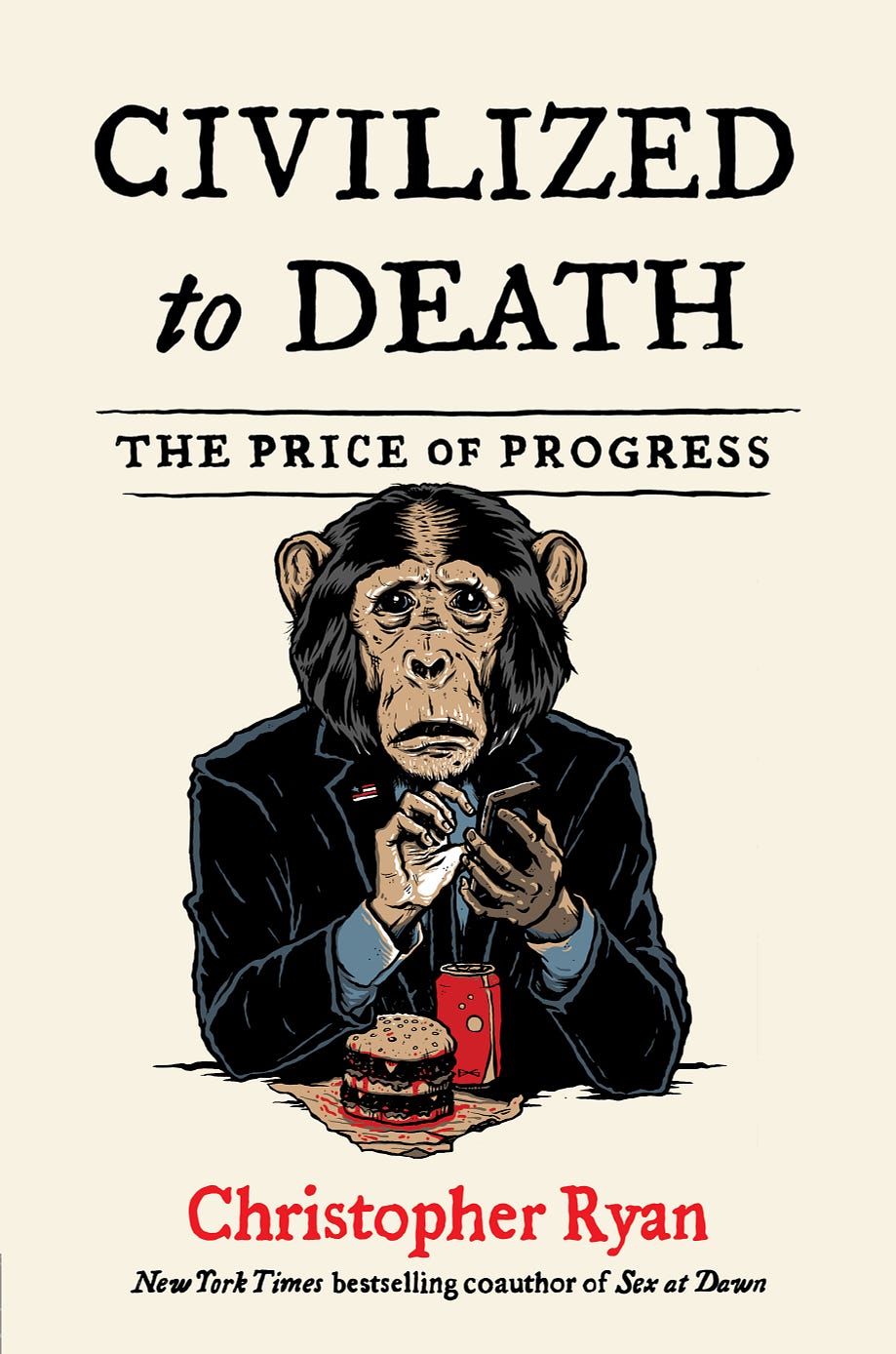
Book Review of Civilized to Death — The Price of Progress

I'm intrigued by books like this.  Author, Christopher Ryan suggests that "forager practices" ought to replace "top-down corporate structures with communal alternatives" that help to reduce the widespread sense of alienation we collectively experience in modern society.  Maternity and paternity leaves to take care of our newborns is indeed a great starting place.

Another point made sounds a bit cynical:
"[T]oday’s longevity is a net loss from that period in terms of functional longevity; we are simply expanding the period of suffering from dying."
It's not like our early ancestors didn't also suffer, albeit under a dramatically different array of circumstances.  And it smacks as contradictory to the extend that we need our grandparents and great grandparents.  My beloved 93-year-old mother-in-law, herself a great grandparent to dozens of grandchildren and great-grandchildren is a total total rock star in our family and community. So it's not solely an issue how we fare as elders, but how we value them, alongside the very idea of becoming elderly, as well.

Moreover, there's no analysis that I can tell of the havoc wrought by Western European colonialism. In any case, his point is well taken that we indeed pay a terribly high cost for so-called "civilization."  

Here's a review. 

-Angela Valenzuela

Civilization Has Led Us To Misery, Adopt The Practices Of The Past And Be Happier.
In Civilized to Death — The Price of Progress, author Christopher Ryan proposes the most controversial explanation offered today for what is wrong with our world. The problem began with advent of agriculture which gave rise to civilization: the movement of human activity from a life of cooperative community foraging together to one of individual competition for personal gain. Ryan notes that scholars wonder why for thousands of years, when humans lived in hunter-gatherer (forager) societies, “nothing was happening” to signify progress. His explanation is that humans were essentially happy and satisfied with their lives. Then they became civilized promoting the concept of progress that has led humanity into misery.
Digging into a treasure trove of research on pre-historic societies and those of the few existing forager societies, Ryan demonstrates that measures of health, longevity, security, and leisure have all declined because of civilization. He notes that “skeletal remains confirm that neither famine nor obesity were common until the advent of civilization.” Researcher Eileen Crimmins found that while pre-historic life was short lived, data shows that today’s longevity is a net loss from that period in terms of functional longevity; we are simply expanding the period of suffering from dying.
Ryan posits that civilization has given rise to competitive institutions that thrive on ever expanding commerce, displacing the sense of meaning and happiness that humans had during the 99% of our existence on this planet. This decline is due to the stratification of communities into hierarchical status groups that accompanied agriculture, such as owner and worker, man and women, and wealthy and poor.
Using data from modern day American life as a prime example of how this stratification has taken us from a past paradise to our current dystopia, Ryan cites a 2013 Gallup poll showing “that 70 percent of Americans hate their jobs…” The impact is that “the use of antidepressants in the U.S. is up nearly 400 percent since 1990.” A section of his book shows how our culture even denies us one of the few nonaddictive drugs that the ancients used to achieve happiness, psychedelics.
Another section focuses on how the free expression of sexuality is thwarted in our society, unlike the sexually liberal forager societies. This repression results in enraged perversions of desire, particularly among males. Ryan references an essay by philosopher Stephen Asma linking this condition to the rise of male terrorist acts. In 2016, Asma wrote “Of the past 129 mass shootings in the United States, all but three have been men. The shooter is socially alienated, and he can’t get laid.”
While these examples illustrate how civilization has corrupted our initial non-aggressive human nature, the author could have tackled some possible exceptions. For instance, there is not a word about the fate of the foraging Neanderthals, our closest relation in the Homo genus. They disappeared when foraging Homo Sapiens came into contact with them. Could possible aggressive behavior from us account for their demise?
Ryan draws a hard line between forager and farmer societies, but fails to analyze the role of herders, which are as nomadic at the foragers, but they tend animals. Would they be inclined toward peaceful or aggressive behavior? The nomadic Mongols were not considered civilized by the great states that existed in the thirteenth century; however, they all fell violently to Genghis Kahn and his herder-hunter tribes.
Civilized to Death is a fascinating read, with plenty of references to studies. However, Ryan provides only a few examples of how to foster and preserve elements of our lost forager culture. He does cite the practices of the progressive European societies that replicate the forager parenting values by assuring community support for parents via generous maternity and paternity leave.
Ryan barely mentions that foraging societies usually consisted of fewer than a 150 people. Yet he says that close personal contact was critical to fostering community cooperation. Because he recognizes that the advent of agriculture accelerated population growth, and stratified communities into competing groups, he supports reducing birth rates.
Ryan also encourages capturing the egalitarianism and empathy of the forager societies by promoting “peer networking”. The successful non-centralized Kickstarter app, which uses cooperation to fund projects, is his prime example.
After blaming civilization’s problems on the idea of progress, Ryan returns to it as something positive, describing another period of Enlightenment, when progressive thought celebrated ancient Rome and Greece. This time, progress would mean introducing forager practices into our modern world, replacing top-down corporate structures with communal alternatives.
Progress may just be what saves our civilization

Thursday, April 26, 2018

Book Review: Growing Critically Conscious Teachers: A Social Justice Curriculum for Educators of Latino/a Youth


I am so thrilled to get this excellent book review published today authored by Christine Zabala in the Bilingual Research Journal of 
Growing Critically Conscious Teachers: A Social Justice Curriculum for Educators of Latino/a Youth, edited by Valenzuela, A. (2016). New York, NY: Teachers College Press, 208 pp. 

Thanks to Dr. Deb Palmer for sharing!

Go HERE to read the review in its entirety. 

What can I say...?  It feels wonderful!

-Angela


Friday, August 04, 2017

BOOK REVIEW Our Sacred Maíz is Our Mother by Dr. Esther Díaz Martín


Excellent review of an excellent book written by University of Arizona professor, Dr. Roberto Cintli Rodriguez. 

-Angela

BOOK REVIEW
The University of Arizona Press, 2014

288 pages

by Roberto Cintli Rodriguez


$35.00


Reviewed by Dr. Esther Díaz Martín


Our Sacred Maíz is Our Mother: Indigeneity and Belonging in the Americas represents Roberto Cintli Rodriguez’s understanding of maíz culture, which largely influenced the design of the Mexican American Studies curriculum and pedagogy at the Tucson Unified School District in recent years. Despite its record of success in graduating 97.5% of its high school students and a 70% college continuation rate, the MAS program was recently dismantled by Arizona House Bill 2281 which, it must be noted, came at the heels of Senate Bill 1070, another anti-Mexican and anti-immigrant measure which, among other trespasses, required children to identify the immigration status of their parents and permitted law enforcement to question people about their citizenship based on “reasonable suspicion.” It is in this political context that Our Sacred Maíz, is published, making this text a necessary read in order to understand the epistemological underpinnings of Ethnic studies at TUSD and the ideological conflicts that inspired such an unsympathetic response to the MAS curriculum from right-wing politicians.


In sum, Our Sacred Maíz outlines Rodriguez’s understanding of indigeneity in the Americas, paying special importance to la gente de maíz, that is, a people united by a seven thousand year-old story that begins with the domestication of corn in Southern Mexico. It highlights the continuity and resilience of maíz culture against colonialist discourses that discount the lives of indigenous and what Rodriguez understands as the ‘deindigenized people’ in the Americas—people who have been denied their culture, kinship, ceremony, story, narratives, and from recognizing themselves as indigenous. The continuity of maiz culture is found in Mixtec and Nahuatl codices, colonial era cantos and cantares, nineteenth-century maps of Aztlán, oral traditions, paintings, murals, sculpture, poetry, song, theater, ceremony, danza, the tamalada, tortillas, and even in tortilla packaging iconography in the US.


The core of the book centers on three sets of narratives: the centeotzintli narratives, “used by Mexican and Central American peoples, including Chicanos/Chicanas, to assert a sense of belonging to this continent”; Aztlán resistance narratives, “which argue that Mexican people are not simply Indigenous to the continent, [but] are also Indigenous to what is today the U.S. Southwest”; and a dominant ‘master narrative’ that locates Mexicans and Central Americans as alien, suspect, illegitimate, and subservient in US society. Each of the six chapters focuses on conflicts between European efforts to colonize the Americas, as well as indigenous and de-indigenized people's resistance and survival.


First, Rodriguez examines the forceful imposition of Christianity by Spanish colonial forces through the retooling of indigenous sacred iconography in an effort to eradicate indigenous spirituality. The most famous example is the reworking of the figure of Tonanzin as La Virgen de Guadalupe. Rodriguez disputes common justifications within the master narrative that account for the extreme violence of European colonization of the Americas. For instance, the explanation of the demise of indigenous populations is frequently attributed to disease and poor immune systems “as opposed to conditions of war, famine, starvation, brutality, and exploitation.” The negative stereotypes of indigenous people formulated by Spanish priests in the 1500s and continued by Euro-Americans, argues Rodriguez, is continued today by anti-Central American and anti- Mexican rhetoric "that views Indigenous people from the south as aliens in the United States.”


Central to this position is the claim that, “Chicanas/Chicanos and Mexicans and Central Americans in the United States are not merely descendants of Indigenous people but Indigenous people themselves.” The author defends a fluid and evolving indigenous identity and opposes scholars who brush-off indigeneity "as [a] romanticized or culturally nationalistic history, or as applying only to Mexico's culturally isolated populations.” Calling for a more radical decentering of the European and Western-centered narratives, Rodriguez refuses to position maíz-centered narratives as ‘counternarratives.’ Instead, he argues that centeotlzintli narratives, "can be seen as an antithesis to the Western master narrative of history... for [they predate] the western narrative on this continent... a continent that does not figure meaningfully into Euro- American timeline until 1492.” Rodriguez insists that his arguments here should not be called “revisionist,” but rather “an acknowledgment of an ancient narrative that is documented in both ancient codices and the living and dynamic oral traditions of maíz based peoples.” This position refuses to engage in the ‘civilizational war’ that state of Arizona representatives wish to portray as the objective of MAS-TUSD curriculum.


Rodriguez states, “What we want is to end these contrived wars-on the basis of mutual respect—not win them.” The Aztlán resistance narratives argue for the rightful belonging of Mexican people in the U.S. Southwest.


They are found in nineteenth-century archives and twentieth-century metaphors that read Aztlán as a “hidden script” that also contains “a narrative about unity of the continent based on maíz” which resonates with deindigenized people of the Americas functioning as a “belonging story.” To support this claim, Rodriguez looks at El Plan Espiritual de Aztlan (Alurista 1970) as a declaration of political and cultural insurrection for Chicanas and Chicanos and as a proclamation of “Indigeneity to lands in which Mexicans had traditionally been framed by the U.S. master narrative as aliens and unwanted strangers.” Yet, contemporary Mesoamerican cultural expressions of maíz, such as oral histories, iconography of the Chicana/Chicano movement, festive meals and ceremonies, danza traditions, and Teatro Campesino’s Theater of the Sphere, demonstrate that the very efforts to erase maíz-based culture only serve to make its messages more amenable to those treated as alien in the US.


This proclamation of belonging is also found in the tortilla. Rodriguez posits the tortilla in a visual culture war counterposed with white bread in “the quintessential civilization binary: corn versus wheat, round versus rectangular.” Through the examination of tortilla package iconography from examples collected in US stores in the Midwest and the Southwest, Rodriguez concludes that the tortilla serves as a site where memory, culture, and place are stored. This discussion introduces a compelling question as to the possible outcomes of the production of genetically modified seeds and industrial style farming to the wholesomeness of the round tortilla and consequently, to la gente de maíz.

In closing, Rodriguez asks why the narratives of the continent enclosed within indigenous images, signs, and symbols remain unrecognizable to modern day de-indigenized Mexicans and Central Americans in the US. He proposes a research path that inquires if and how newly deciphered maíz culture symbols will be recognized by de-indigenized peoples as things of their ancestors or as a culture of their own. This question compels scholars to continue charting maíz stories and to continue thinking about “how maíz-based people use corn for the purposes of identity formation, how it is used to confer legitimacy, and how stories also communicate a sense of belonging.”