Here is a fairly thorough piece in last week's Los Angeles Times on a three-decades old alliance between Latino and Black leaders in Los Angeles that's been impacted by the racist vitriol of Council Member Martinez and her colleagues, Gil Cedillo and Kevin de León where they worked behind closed doors with a labor leader to map out an electoral strategy.
Do read for yourself. I'm encouraged by what nevertheless has been an intentional process of working together as Black and Brown communities for a better L.A. No question about it. Such alliances are what must continue to happen in L.A. and everywhere possible.
-Angela Valenzuela
L.A.’s coalition game: Alliances drive city politics. Despite the vitriol on that tape, Black and Latino leaders have long united on major goals.
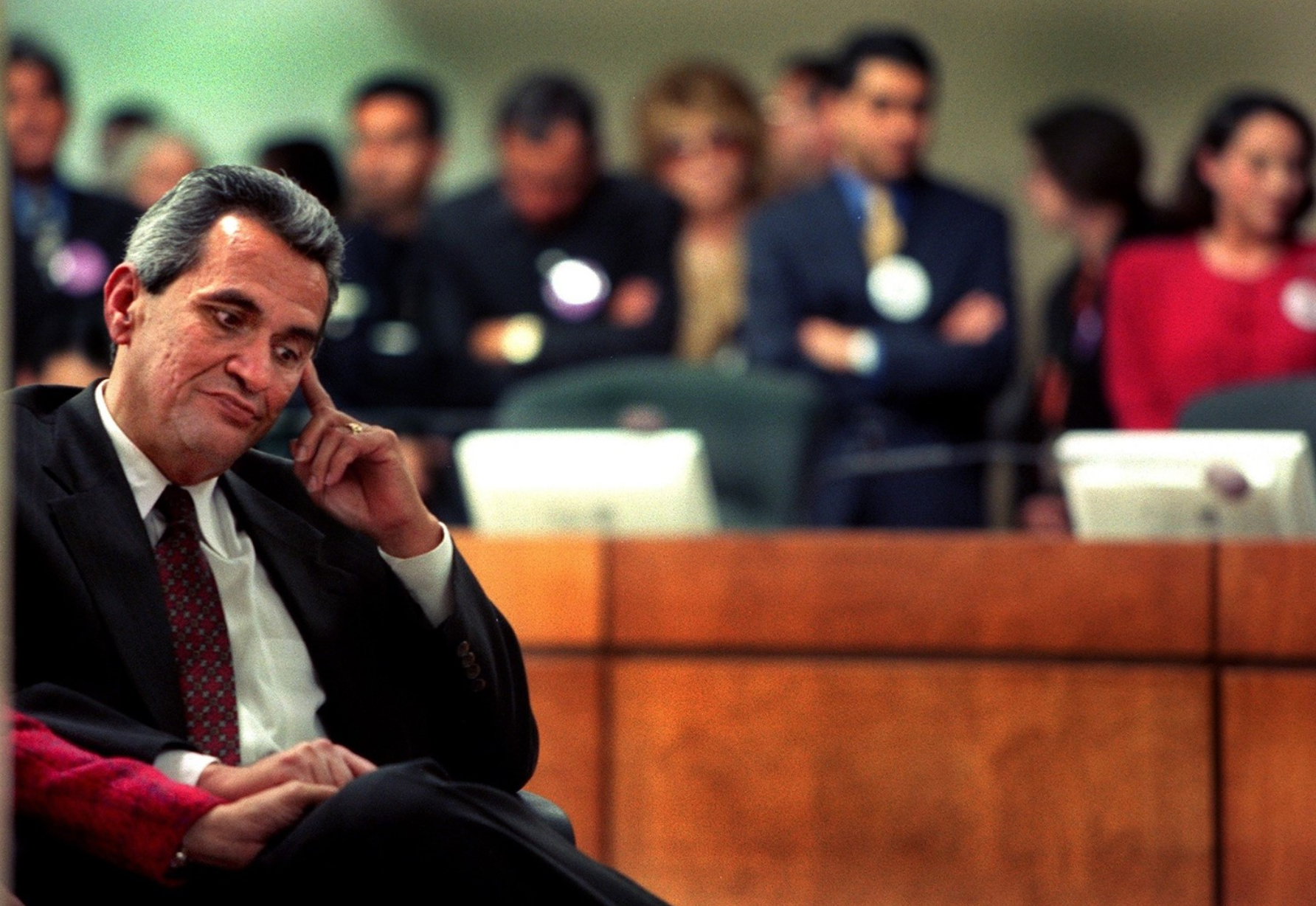
RICHARD ALATORRE, the son of an East L.A. beautician and repairman, served 13 years in the state Assembly and was a close ally of California’s first Black speaker, Willie Brown. (Wally Skalij Los Angeles Times) MICHAEL WOO, the L.A. City Council’s first Asian member, was infuriated by district maps drawn up by Alatorre. Woo served from 1985 to 1993. (Al Seib Los Angeles Times) COUNCILMEMBER Nury Martinez addresses the crowd as then-Council President Herb Wesson, center, and Councilmember Gil Cedillo listen at a 2019 rally. (Genaro Molina Los Angeles Times)
By Jessica Garrison, Ruben Vives, Marisa Gerber, Angel Jennings and David Zahniser | Los Angeles Time | October 16, 2022
Jorge Nuño learned the hard way how race, power and politics work in Los Angeles.
Nuño, 45, the son of immigrants from Jalisco, Mexico, grew up in South Los Angeles near Vernon Avenue and Main Street, then built a successful graphic design business and a printing business, launched a multiracial youth services nonprofit, and threw himself into grass-roots organizing among both Black and Latino groups in his neighborhood.
With this background, he decided to run for City Council representing the 9th District — its constituents majority Latino — expecting his campaign would garner at least some interest from the city’s traditional Latino establishment.
Instead, word filtered down: No way.
“What I heard was that no Latino [power brokers] are going to come support any candidate coming out of South L.A.,” he said, “because there is a coordination between Black and brown caucuses about keeping it Black” through the tenure of the current councilman.
Nuño lost that election to the incumbent, Curren Price, a Black former state lawmaker who also grew up in South L.A. He said he simply did not understand the complicated alliances brokered by Black and Latino politicians and their allies in labor.
“Naive to the game,” he said of himself back then.
City government has been thrown into crisis by the racist rhetoric of a secretly recorded conversation in which three Latino councilmembers — Nury Martinez, Gil Cedillo, and Kevin de León — plotted electoral strategy with a labor leader. The language was so outrageous that President Biden waded into city politics, calling on them all to resign.
Nuño said he too was sickened by the racism, but he said he was also struck by what the conversation revealed about the complex way politicians use race to exercise power in a sprawling multicultural city. Even as she said terrible things about Black people, including comparing a colleague’s Black child to a monkey, Martinez kept circling back to one of her major political goals: helping Price — a Black councilman representing a district that is now fourth-fifths Latino — hold on to his seat against a Latina challenger.
 Politics in Los Angeles has always been organized along racial lines. But those lines are not as stark as the crass and hateful language on the recordings might lead many to conclude. Instead, in a city where more than 100 languages are spoken, leaders have put together coalitions to win elections and move their legislative priorities through the City Council, where eight votes are required to approve anything. And in the last three decades, the center of those coalitions has often been an alliance between Latino and Black leaders.
That alliance, which often includes strong backing from organized labor, has achieved major progressive goals, winning one of the highest minimum wages in the country, for example, and pushing initiatives to benefit renters, immigrants and neighborhoods long beset by environmental hazards. For much of the last few decades, Black and brown leadership provided vital focus on social issues in core areas of L.A., as many whites moved to suburbs and wrote off older neighborhoods in the central city as no-go crime zones.
But the foundations of that alliance are threatened by the shift of the demographics it was built on: the Latino population has grown rapidly for generations while the number of Black people has continuously decreased. Over the last four decades the Latino share of the city’s population has grown from 27% to 48%, while the Black share has dipped from 17% to just below 9%.
A critical factor in keeping the alliance alive and essential: high Black voter turnout to counterbalance the decline in numbers of residents. Martinez, Cedillo, De León and Herrera have been as skillful as any at building and maintaining these Black-brown coalitions, which made the racist tape all the more shocking.
“I think that is exactly why people are so offended, because that is not who we are,” said Councilman Marqueece Harris-Dawson, who is Black and represents South Los Angeles’ 8th Council District. He predicted that “coalition politics in Los Angeles comes back stronger than ever now.”
“The path to prosperity in Los Angeles is through a Black-brown coalition,” he said.
The framework for modern coalition politics built across racial lines in Los Angeles, and, in many ways, the nation as a whole, was forged in the early 1970s when Angelenos elected Mayor Tom Bradley, the son of former sharecroppers and the grandson of slaves.
His election, making him the first Black mayor in Los Angeles, but also one of the first in any major city in the nation, became a defining narrative in American politics — a win credited to his broad support among many groups in the city, but anchored by Black and Jewish voters.
Until the 1950s, Los Angeles was a city that offered essentially no political access to Black, Latino, Asian and Jewish Angelenos, according to Raphael Sonenshein, executive director of Cal State L.A.’s Pat Brown Institute for Public Affairs.
The first real break in that status quo, he said, came with the election of Edward Roybal to the City Council in 1949, making him the first Latino to serve in the role in nearly 70 years. (In an interview years later, Roybal recalled that at his first City Council meeting, he was introduced as “our new Mexican councilman who also speaks Mexican.”)
In one of the first and most powerful examples of the Black and Latino communities working together to advance common political goals, Roybal in 1962 supported the appointment of Gilbert Lindsay , who was Black, to take over his seat when he left for Congress.
“Progressive politics in Los Angeles is fundamentally coalition politics,” said Sonenshein.
Nowhere is that more true than in South Los Angeles, the sprawling land of farms and agricultural fields that gave way to white suburbs before it became a Black space and then, in more recent decades, a majority Latino area.
Between the 1940s and 1970s, hundreds of thousands of Black people moved to the area amid a labor shortage and a manufacturing boom in the wake of World War II .
Housing covenants prevented Black Angelenos and other minorities from living in other parts of the city, while in South L.A. banks and insurance companies denied loans and insurance policies, keeping the area economically depressed and increasingly dilapidated. When Black people finally defeated housing discrimination policies in court, some moved into the middle class. But South L.A. just became impoverished and neglected, served by substandard schools and hospitals, patrolled by a hostile police force, and otherwise largely ignored by City Hall.


