On the topic of Mexicanidad, or "Mexican-ness," by University of Arizona Mexican American Studies professor, Dr. Roberto Rodriguez. It's important to keep colonization in the equation for understanding the imposition of identity on U.S. Mexicans, even by U.S. Mexicans themselves.
-Angela Valenzuela
June 5, 2017 / DIVERSE ISSUES IN HIGHER EDUCATION
A couple years ago, someone from California wrote me to tell me that: “Mexicans are taking over Chicano Studies.”
Apparently, the person did not know I was born in Mexico. And they
knew less about what this topic triggers within me. During the late
1960s and early 1970s, I did become part of the Chicano Movement, and
thus identified as such during that time, though throughout most of my
life, my constant identity has been Mexicano. At times: Me-Xicano.
Because of my parents’ guidance and influence (stories), and because
of my relatives from Southern Mexico, I have pretty much always
identified as part of the original peoples of this continent, including
as hombre de maiz (man of maiz), or macehual, a Maya-Nahua term, for a
simple human being. Both of these are identities rooted to the land,
though they have nothing to do with nation-states, nor do they
acknowledge borders. Many peoples from maiz-based cultures identify as
such and ask no one for permission to do so. In this country also,
neither of these will be found on Census or any other bureaucratic
forms, and they generally are also outside of the mainstream media.
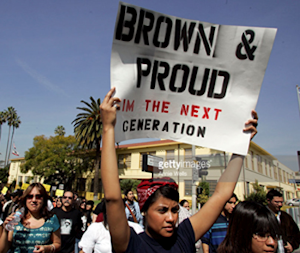
 |
Wells,
Annie –– – 134872.ME.0308.walkout Sonia Salazar, 20, a UCSB student in
Chicano Studies and Belmont HS graduate, joins over 1,000 people to
commemorate the historic East LA student walkouts of 1968.
They marched
from Lincoln High School (in the background)
to Hazard Park. The 1968
action launched the Chicano Civil Rights Movement .
Photo by Annie Wells
03/08/08
|
I feel comfortable with my own identity, yet, when I received that
above message, it resuscitated negative memories that I had from the
early 1960s. That was the pre-Chicano movement era, an era in which I
was reminded by Mexican Americans almost on a daily basis that I was
Mexican as opposed to Mexican American. This was prior to the ascendancy
of the terms Chicano/Chicana and Raza or La Raza or gente (people), in
the latter part of that decade. But even then, that same attitude
persisted while Mexican-Americans were exploring or adopting these new
identities.
One
of the identities they previously identified with was Spanish. This was
not New Mexico, whose residents were notorious for denying their
Mexican ancestry, but Los Angeles. Elsewhere, Latin or Spanish American
was popular and “respectable.” As Chicano historian Rudy Acuña has
noted, “Anything But Mexican.”
While we are not in the same political climate today, we do seem to
be part of an era in which the identity of these same peoples continues
to change. However, there is a difference between how one sees oneself,
versus the “official” terms one identifies with in public.
For me, one’s identity rises to the level of sacred and thus, when
the government, media and other institutions impose identities upon
individuals, communities or peoples, it can be very violating. This is
generally true in regards to peoples of any culture, but especially true
for peoples of Mexican descent, that have a long and sordid history of
having false identities thrust upon them here. This is referred to as
epistemic violence.
After the height of the Chicano movement, umbrella terms such as the
government-sponsored Hispanic or Latino/Latina, came to supplant
specific terms such as Mexican, Guatemalan Puerto Rican or Peruvian,
etc. These umbrella terms generally have always emphasized a European or
colonial identity, as opposed to the Indigenous or African roots of the
people.
But to be sure, false identities did not begin in this country in the
past generation, but instead are rooted in 300-year colonial practices
imposed by Spain upon the Americas, especially in Mexico. If one does
not understand why this is a problem, it is akin to asking the slave to
identify with the slavemaster.
Suffice
to say that identities that connote “property of Spain” or Europe,
don’t quite cut it in the 21st century — or even the 16th-20th
centuries. While perhaps it is confusing to others, indeed, there are
some constants here. Most identities are imposed and historically, most
U.S. institutions always have suppressed and denigrated the Mexican
identity. Incidentally, the word Mexico is of authentically Indigenous
origins; it is probably the reason it is generally suppressed here.
That said, like most Mexicans, I will always be Mexicano — or
Mexicana, for women — and will continue to identify as gente the maiz
and macehual.
When that person warned me about Mexicans taking over Chicano
Studies, I asked him if he was familiar with Luis Leal, the “founder” of
Chicano literature; poet Alurista, author of El Plan Espiritual de
Aztlan; Chihuahua-born poet Abelardo “Stupid America” Delgado;
journalist Ruben Salazar (killed on Aug. 29, 1970, in East L.A.);
Chicano Moratorium co-founder Ramses Noriega; and torture survivor, Olga
Talamante. All were born in Mexico and all central figures in the
Chicano Movement.
I didn’t even mention Carlos Santana.
Dr. Roberto Rodriguez is an associate professor in Mexican American studies at the University of Arizona.