Every student, from
preschoolers up through high school, is aware of the tone, rhetoric and
catchphrases of this particular campaign season. Students are hearing
conversations at home. They’re chatting, posting and joking on social
media. Whether teachers decide to bring it into the classroom or not,
kids are talking about it, modeling their behavior on that of political
candidates and bringing heightened emotion to school along with their
backpacks.
One California teacher noted, “YouTube, Instagram and Twitter make
everything ‘live’ and interactive.” Some students attend candidates’
rallies. And then there is the endless cycle of talk radio, 24-hour news
and cable comedy shows. “The explosive headlines and conversations have
caught their attention,” a middle school teacher in Providence, Rhode
Island, wrote about her students. “They want to talk about a
cartoon/headline/video they saw.”
The 2016 campaign and the antics of its contestants are omnipresent.
As one Bloomfield Hills, Michigan, elementary school teacher told us,
“Shying away from difficult conversations doesn’t mean the conversations
aren’t taking place.” A Portland, Oregon, middle school teacher
reported that her principal had imposed a “gag order” on teachers,
prohibiting them from talking about the election. But the order didn’t
stop one of her students from telling an immigrant classmate, “When
Trump wins, you and your family will get sent back.” On the survey she
posed the question, “What does a teacher do? I can assure you that if a
student says that loudly and brazenly in class, far worse is happening
in the hallway.”
For almost all students, the campaign is personal and their support
or opposition to candidates—actually to one candidate mainly—is intense.
But the effect of the campaign on students depends very much on where
they stand in the school pecking order. Those who have been marginalized
in the past are bearing the brunt of behavior and comments that often
cross over into abuse.
Marginalized students are “terrified”
Over two-thirds (67 percent) of educators reported that young people
in their schools—most often immigrants, children of immigrants, Muslims,
African Americans and other students of color—had expressed concern
about what might happen to them or their families after the election.
Close to one-third of the students in American classrooms are children
of foreign-born parents. This year, they are scared, stressed and in
need of reassurance and support from teachers. Muslim children are
harassed and worried. Even native-born African-American children, whose
families arrived here before the American Revolution, ask about being
sent back to Africa. Others, especially younger students, have worries
that are the stuff of nightmares, like a return to slavery or being
rounded up and put into camps. Overall, these vulnerable students are
disillusioned and depressed at the hatred they’re hearing from
candidates, in the news, from classmates and even, sometimes, from
trusted adults. They’re discouraged to find out what people really
think. Teachers struggle to help them feel safe.
Undocumented students or students with undocumented family members
are especially vulnerable. These students have a legal right to a public
school education, but many of them come to school every day fearful
that their families will be separated. Teachers, in general, are very
protective of students and sensitive to their pain.

Anti-Muslim sentiment in the U.S. has
risen steadily since the 2016 election season began. Schools are no
exception. Photo credit: AP Images/Tony Gutierrez
Fears are pervasive. Students tell teachers they are worried about
deportation, having their families split, being put in jail or attacked
by police, losing their homes, seeing their places of worship closed,
going into hiding and being sent to detention camps. Some Muslim
students think that, if Trump becomes president, they will have
microchips implanted under their skin.
Students are stressed and anxious in a way that is threatening their
health, emotional well-being and their schoolwork. We heard from dozens
of educators about young students who expressed daily worries about
“being sent back” or having their parents sent back. In many cases, the
students are American citizens or come from families that are here
legally. It doesn’t matter: Regardless of immigration status, they feel
under attack. We heard about students from second grade to high school
crying in class.
A Tennessee kindergarten teacher reported that she has a student who
asks her every day if the wall has been built yet. “Imagine the fear in
my students’ eyes when they look to me for the truth,” she said.
In Massachusetts, an elementary school social worker described what
was happening to her 8-year-old son, who was adopted from Korea. “He
came home from school and recounted a conversation he’d had with his
friends on the playground. Many … come from immigrant families and/or
are black or brown. He told me they know that if Donald Trumpet [sic]
was elected that we would have to move to another continent to be safe
and that there would be a big war. He is very nervous about being sent
away with my husband who is also Korean American.”
Stressed students have a harder time learning, and we saw many
reports that anxiety was having an impact on grades and ability to
concentrate. In Washington state, a teacher told us about a 10-year-old
boy who can’t sleep at night because he is worried his immigrant parents
will be sent away. A California art teacher described a fifth-grader
who had begun having “full-blown panic attacks.” After fellow students
in Washington state had repeatedly shouted slurs from their cars at one
Muslim teenager, her teacher reported, the girl expressed suicidal
thoughts.
For immigrants whose home countries are unsafe places to which they
can’t return, the fear is “tremendous and profound.” One teacher
observed that the campaign season is particularly traumatizing for
students who have “suffered through exile, migration and even asylum.”
Others reported that their Iraqi and Syrian students are terrified of
being sent back to their war-torn countries.
They’re not just scared. Teachers used words like “hurt” and
“dejected” to describe the impact on their charges. The ideas and
language coming from the presidential candidates are bad enough, but
many students—Muslim, Hispanic and African-American—are far more upset
by the number of people, including classmates and even teachers, who
seem to agree with Trump. They are struggling with the belief that
“everyone hates them.”
An elementary school administrator in Vancouver, Washington, wrote,
“Students who had undocumented family members and relatives are afraid
of what other kids will think of them if they find out. One
[fourth-grade] student reported that she thought everyone hated her
because her mother was illegal and she didn’t want to come to school.
Over 35 percent of our students are Mexican. I’ve never had this …
before this year.”
African-American students aren’t exempt from the fears. Many teachers
reported an increase in use of the n-word as a slur, even among very
young children. And black children are burdened with a particularly
awful fear that has been reported from teachers in many states—that they
will “be deported to Africa” or that slavery will be reinstated. As an
Oklahoma elementary teacher explains, “My kids are terrified of Trump
becoming [p]resident. They believe he can/will deport them—and NONE of
them are Hispanic. They are all African American.”
Even in schools where a majority of students are African American and
don’t face racial taunts on the playground, students feel uneasy. A
teacher in Ferguson, Missouri, where nearly nine out of 10 students are
African American, says, “We do not have the language and hate of any
candidates repeated at the high school where I teach. … However, I do
hear students wonder if they are being let in on what all white people
truly think and feel. This is so disappointing and hard to combat.”
According to their teachers, these vulnerable students feel that
Trump is a “rich racist who hates them.” Young children can’t understand
why people hate them without even knowing them. One teacher’s comment,
“It breaks my heart,” was echoed by dozens of others.
Another wrote simply that, in her diverse school, “My students have one thing in common. Apparently America hates them.”
Students are confused. Their teachers have worked hard—and often
successfully—to teach them about American ideals. They are, according to
one Boston high school teacher, “confused as to how a person who has no
respect for American ideals can be so popular.” On one hand, they are
taught that the United States is a nation of immigrants, but their
current experience doesn’t match the lesson. Many immigrant students
feel that “they don’t belong here” and they have “no value” to the
country.
All students, regardless of whether they are members of targeted
groups, are vulnerable to the stress. Kids are worried about their
friends and want to protect them. A Minnesota teacher wrote about her
own middle school daughter who felt terribly guilty after a “dear Muslim
friend was called a ‘terrorist’ by another classmate.” The teacher
reported, “We had a lengthy conversation about what to do if there was a
‘next time.’”
Teachers struggle to provide safety in their classrooms and
reassurance to their students. Often that means breaking their usual
rule against discussing their own politics and assuring children who
“beg [them] not to vote for Trump because he will send their parents out
of the country” that, indeed, they will not. Others try to explain how
our system actually works, underscoring the point that the president
alone doesn’t make laws, or that it’s unlikely Mr. Trump will actually
be elected. But, as one California teacher explained, “I have tried to
reassure my students that no matter the outcome, they will be okay. I
don’t even know if that’s true, but I can’t have them worry and stress
about it.”
Teachers work to keep their classrooms respectful. Often that means
constant reminders that the rules for classroom discussion aren’t the
same as the rules on the debate stage. Sometimes it means declaring some
things off limits. “I really don’t want to have his [Trump’s] name
invoked in my classroom,” said a teacher from Pennsylvania. “It feels
like it makes it an unsafe place for my students of color.”
And often, it means expressing affection. A teacher at a Virginia
Title I (high poverty) school where nearly two-thirds of the students
are Hispanic said, “My second-graders are scared. They’re scared of
being sent back to their home countries. They’re scared of losing their
education. As their teacher, I hug them each day to let them know they
are safe and they are loved.”
Students seem “emboldened”
The gains made by years of anti-bullying work in schools have been
rolled back in a few short months. Teachers report that students have
been “emboldened” to use slurs, engage in name-calling and make
inflammatory statements toward each other. When confronted, students
point to the candidates and claim they are “just saying what everyone is
thinking.” Kids use the names of candidates as pejoratives to taunt
each other.
If marginalized students are fearful and hurting, it’s partly because
other “students seem emboldened to make bigoted and inflammatory
statements about minorities, immigrants, the poor, etc.,” wrote a high
school teacher in Michigan.
Teachers in New Hampshire—where the first primary was held—reported
some of the greatest increases in disturbing behavior. One high school
teacher from Westmoreland wrote, “A lot of students think we should kill
any and all people we do not agree with. They also think that all
Muslims are the same and are a threat to our country and way of life.
They believe all Muslims want to kill us.”
Muslim students—along with the Sikh and Hindu students who are
mistaken for Muslims—have endured heightened levels of abuse. According
to reports from around the nation, Muslim students regularly endure
being called
ISIS,
terrorist or
bomber. These
opinions are expressed boldly and often. Even in schools where such
behavior isn’t tolerated, current-events discussions often become
uncomfortable for teachers and Muslim students.
The harassment of students who are immigrants or children of
immigrants is another particular problem, because nearly one-third of
U.S. public school students have foreign-born parents. Teachers in every
state reported hostile language aimed at immigrants, mainly Mexicans. A
Wisconsin middle school teacher told us, “Openly racist statements
towards Mexican students have increased. Mexican students are worried.” A
middle school teacher in Anaheim, California, reported, “Kids tell
other kids that soon they will be deported.” Regardless of their ethnic
background or even their immigration or citizenship status, targeted
students are taunted with talk of a wall or threats of forcible removal.
Neither are the slurs limited to schools with immigrant populations.
“At the all-white school where I teach, ‘dirty Mexican’ has become a
common insult,” a Wisconsin middle school educator said. “Before
election season it was never heard.” Indeed, what teachers
described—slurs and negative comments repeatedly directed at particular
students or groups of students—is essentially the definition of
bullying. In recent years, a large swath of the American public has been
alerted to the dangerous effect of bullying on school children. It
affects health, academic achievement and, in some cases, leads to
self-harm. As a result of efforts at both the state and federal levels,
schools now have comprehensive policies and programs to prevent and
address bullying. In many schools, these programs have made a real
difference in creating a culture of respect. The educators who reported
that the election wasn’t having too much of an effect cited their
school’s values and commitment to civility.
In other places, much of that hard work—achieved over years—is being
undone. A Michigan middle school teacher described an exchange that
followed an anti-bullying assembly: “I had students tell me it [insults,
name-calling, trash talk] isn’t bullying, they’re just ‘telling it like
it is.’”
Or, as a New Mexico high school teacher lamented, “Any unity developed by Mix It Up at lunchtime has flown out the window.”
It’s not just that “they seem to talk more smack,” as one Sacramento,
California, elementary teacher wrote. The campaign has actually become
part of the new bullying vocabulary. One New Orleans teacher told us,
“Students have used support of candidates as a ‘dis.’”
We heard reports that both elementary and middle school students have
taken to chanting, “Trump! Trump! Trump!” in a “taunting tone.” Others
cited an increase in the use of words like
loser and
deadbeat.
The bullying crosses party lines. An Albuquerque, New Mexico, middle
school teacher identified “an anti-Trump bias” among her students, “and
ridicule for those who might support Trump.”
Behavior is harder to manage—and explain
Teachers report an increase in anger and “acting out” among students
and a decreased ability to engage in civil discourse. Discussions turn
into shouting matches, verbal hostility and sometimes even fights.
“Students have become very hostile to opposing points of view,
regardless of the topic,” a Jefferson, Georgia, high school teacher
wrote, adding, “Any division now elicits anger and personal attacks.”
In Pampa, Texas, where 50 percent of the students are Hispanic, “The
word ‘Trump’ is enough to derail a class,” reported a middle school
teacher. Especially in middle school, where behavior is notoriously hard
to manage, discourse spirals quickly into anger. We heard multiple
accounts of students yelling at each other, and “increased hostility in
conversations between students.” A New York City middle teacher put it
succinctly: “Students on both sides are angry.”
Angry words can escalate quickly. “My fifth-graders got in a fist
fight on the playground yesterday,” a Queens, New York, teacher wrote.
“It started when one of the boys quoted Donald Trump.”
Clearly, educators want to prevent those kinds of fights while
encouraging a lively exchange of ideas in healthy debate. One of the
goals of education is to teach students how to make persuasive
arguments, support opinions with facts and listen to the perspectives of
others. Those goals are out the window in many classrooms. A Biddeford,
Maine, middle school teacher observed that, “Students are quick to
become accusatory and condemn others for having a different point of
view.”
Another middle school teacher in Indiana wrote, “Students are more
apt to get into shouting matches than to have a discussion about
something.”
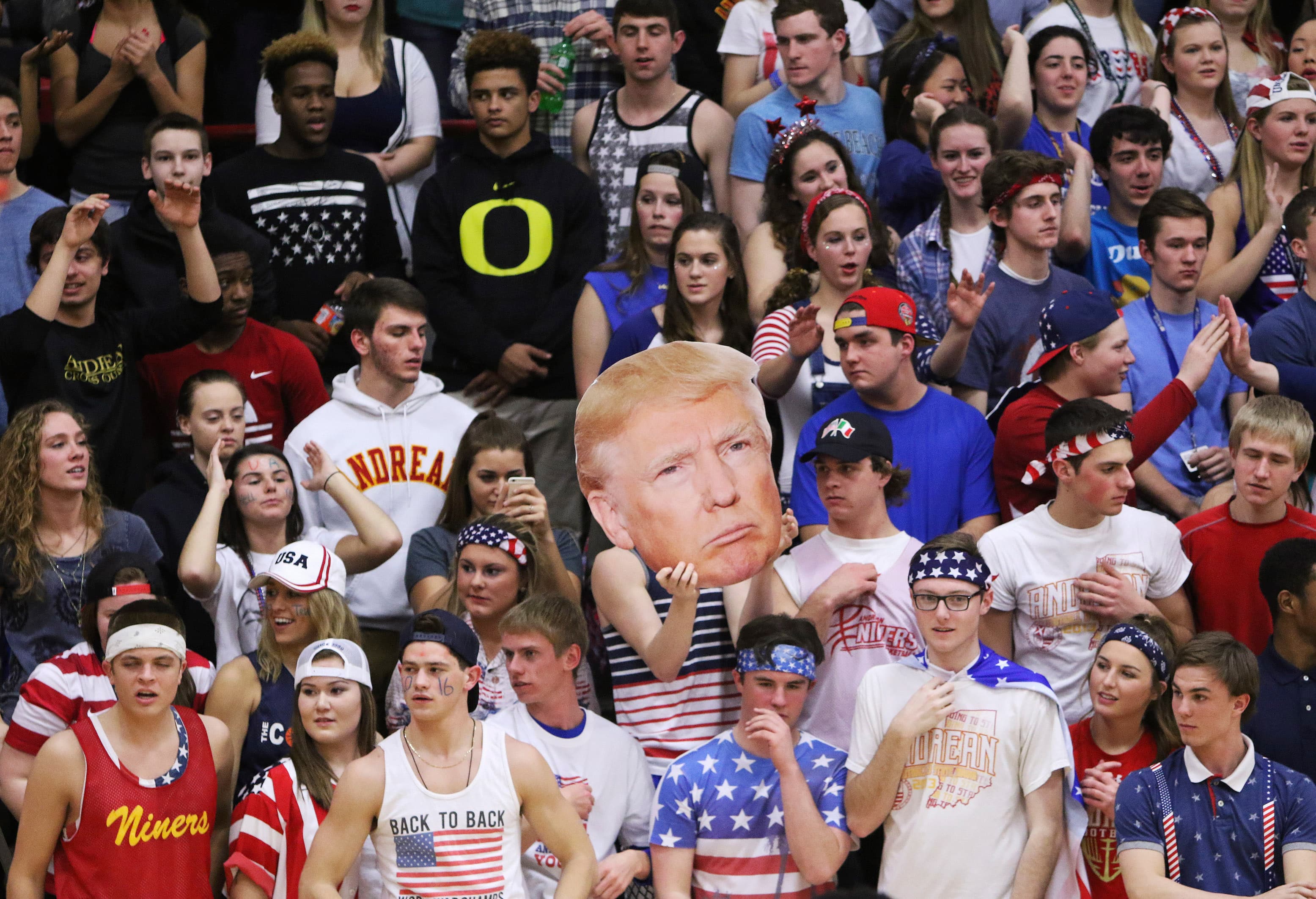
Students in Merrillville, Indiana, found
themselves in the news after chanting, "Build a wall!" during a
basketball game against a rival team made up of mostly Latino players.
Photo credit: AP Images/Jonathan Miano
For some students, this level of conflict is hard to handle. “A
student said he’d prefer another Obama term, and it angered another
student who has been vocal about her support of Donald Trump,” a Texas
high school teacher said. “The angry student began yelling, ‘What is the
matter with you?’ and ‘This is why I HATE people.”
While the increased tension sends some students into tears, other,
often older students, are more likely to find the campaign a springboard
to adolescent humor. The comments indicated that students in middle and
high school, especially boys, seem to have a hard time distinguishing
between entertainment and politics. Not only do they see the campaign,
the candidates and the debates as a joke, but they’re missing the fact
that something significant is happening.
“My students seem more interested in the campaign this year, but only
in the same way they are interested in circling a couple of kids who
are about to fight on the playground,” wrote a sixth-grade teacher from
Roseville, California. “It is pure entertainment.” A Boston high school
teacher laments, “Our students see the whole presidential campaign as a
game, with the real common people having no real input.”
Sometimes a joke just isn’t funny, and students are learning that the
hard way. A Chicago elementary school teacher reported, “Some of the
first-graders were talking about who their parents voted for. One jumped
in, apparently as a joke (because the students are old enough to know
that Donald Trump is an easy butt of a joke), and said ‘What about
Donald Trump?’ His friends, not realizing he was joking, proceeded to
yell at him until he cried.”
A consistent theme from teachers across grade levels was that their
students understood the behavior on display isn’t okay. Middle school
students on New York’s Long Island “are confused as to how certain
campaigns have been allowed to promote racism, violence and hate.” And
high school students in Lake Worth, Florida, display “lots of negativity
about the candidates and the way they speak” and “discuss the
immaturity of some of the rhetoric presented by adults.”
Or, as a middle school administrator from Omak, Washington,
commented, “Students do not understand why this has become such an angry
and dishonorable campaign. They are taught better behavior by their
teachers, and then they see this mess on TV and are confused.”
Conventional wisdom and
common sense dictate that teachers keep their partisan politics out of
the classroom. This year, though, educators are finding it tough to
remain nonpartisan when all the talk about civility—something they need
to uphold in schools—is primarily commentary on a single candidate. In
general, they’ve chosen one of three ways forward. Some, mainly
experienced social studies teachers, are doing what they’ve always done.
Others are making significant changes, opting either to abandon
neutrality or focus on something specific to this year’s campaign, like
the use of rhetoric. And others, including 50 percent of elementary
school teachers who responded to the survey, are simply avoiding it
altogether.
The biggest curriculum challenge is figuring what, whether or how to
teach about the election. In most presidential election years, students
from kindergarten to high school get some exposure to the process and
the candidates. Elementary teachers festoon classrooms with red, white
and blue, conduct mock elections, and use the campaign to reinforce
lessons on geography, the presidency and the importance of voting. In
middle and high school, social studies teachers take a deeper dive into
both the process and the issues; they may stage mock debates and voting
registration drives for graduating seniors.
But it’s different this year.
Teachers who normally don’t teach civics are getting involved. In San
Diego, a high school teacher explained, “I am not a history teacher,
but the issues of this election are spilling over into everything.” And
in Arlington, Texas, another high school teacher worried about her
students who have told her they “feel alienated from a particular math
teacher who advocates for Trump.”
Teachers whose lessons would usually involve the election are
struggling to make plans this year. Some are resolutely plowing ahead,
focusing discussion on issues, insisting students support their claims
with evidence from credible sources. Among the stalwarts who responded
to the survey, a few were downright enthusiastic, like the middle school
teacher from New Mexico who wrote, “The students are more vocal about
this election and it’s a great opportunity to educate them on the facts
versus gossip about all presidential campaigns. It’s also a great
opportunity to teach them about media bias.”
But even educators committed to teaching in a way that would allow
students to draw valid conclusions are struggling to find factual
age-appropriate information. Over and over, when telling what they need,
teachers listed factual candidate profiles, facts about the issues and fact-based
explanations of the policy differences. More than one respondent
reported launching a vast exercise on media literacy and fact checking,
turning to sites like PolitiFact (home of the Truth-O-Meter) and
procon.com.
“Avoiding it”
Many educators, worried about maintaining both objectivity and order,
are tiptoeing around the campaign. In response to the statement “I am
hesitant to teach about the 2016 presidential election,” 43 percent of
K-12 educators answered “yes.” That percentage shifts depending on the
age of the students taught; while only 37 percent of high school
teachers indicated hesitation, half the respondents who teach in
elementary schools indicated they were thinking twice.
Some teachers are simply avoiding the campaign altogether. “I’m
staying completely away from teaching about this election,” said an
Anchorage, Alaska, elementary teacher. From a teacher in Maryland: “I
have just stopped.” In Hawaii: “I try not to talk about it.” In
California: “I refuse to teach it.”
Avoiding the issue doesn’t sit well with many teachers. A New York
middle school administrator who saw his staff “tiptoeing,” explained,
“It is so inflammatory that no one wants to even discuss it. Not good
when we should be talking about issues.” In San Antonio, one teacher
knew her young students were missing out. “Last election was amazing in
my class!” she wrote. “We even learned about electoral votes using other
first-grade classrooms. Not this year!! Not touching it!!! Not sure
what’s worse, the candidates or what they stand for!!”
The avoidance often arises from a desire to maintain civility and
keep kids safe and calm. In Arlington, Virginia, a teacher explained, “I
try to not bring it up since it is so stressful for my students.” Even
in high school, “I try to be more careful—rather than stoke the fires,”
wrote one Utah teacher. In Kansas, a high school teacher sounded
apologetic as she explained, “I bring it up twice a month out of
obligation.”
The possibility of parental complaints or crossing a principal’s
directive has had a distinctly chilling effect on teachers’ willingness
to bring the election into class. “My principal does not want us
discussing politics with the kids,” one Virginia teacher said. To the
west in Colorado, an elementary teacher told us students in her school
were arguing so much that “We have been asked by our principal to
encourage students to save political discussions for home with their
parents and with peers outside of school.” Other educators described
themselves as politically out of step with the community and parents.
One, from a New England state, pointed to the bottom line: “I need my
job so I must walk this fine line.”
“Teaching for our lives”
For many educators, the question is not if the election—and the issues it raises—needs to be part of their curriculum; the question is how.
“The usual course of an election does not apply here,” wrote a
Pasadena, California, high school teacher. “It’s been difficult for me
because this is an unprecedented situation.”
Faced with the choice between maintaining neutrality and denouncing
rhetoric that’s counter to their values, many respondents indicated they
would abandon neutrality.
When the classroom is filled with brown faces, teachers told us, they
felt a moral imperative to speak out. “I am less neutral,” a Jersey
City, New Jersey, high school teacher volunteered. “I want to reassure
my students I don’t buy into racist rhetoric.” Others echoed the need to
stand as allies to their students.
Educators indicated they are focusing on staying true to the ideals
and values of their schools. A Blue Hill, Maine, elementary teacher
explained, “I am more vocal. I make connections between how we are
expected to treat each other at school and how the candidates treat each
other and segments of the population.” A Michigan teacher added,
“Normally I don’t tell students about my political opinions. This year I
feel it is appropriate to say that I wouldn’t vote for someone who
isn’t going to be respectful of others.”
A Renton, Washington, high school teacher said, “For the first time
in my career, I state bluntly what is appropriate conduct for a
candidate for this country’s highest office.” She spelled it out for
students: “If it can get you suspended from high school, you shouldn’t
be espousing it as a candidate.” Another Washington teacher wrote, “This
is probably the first time I haven’t been unbiased about it. My
students need to know that some of what they are witnessing is not
okay.”
In schools where student partisanship leans heavily to one side,
educators find themselves needing to speak up for students whose
political values are in the minority. “The rhetoric has set up a school
community that is hostile to conservatives and the Republican Party,” a
Michigan high school teacher said. “It makes it difficult if not
impossible to not take sides in my classroom because I can’t be silent
in the face of this kind of rhetoric, lest I lose my students’ respect
or trust.”
No one can fault an educator who stands up for values like respect,
dignity and honesty—values that have long been central to character
education and anti-bullying programs. But this year has pushed some
educators to go further and take risks. “I have thrown caution into the
wind and have spoken out against certain candidates which I have NEVER
done,” wrote a Michigan high school teacher, “but I feel it’s my duty to
speak out against ignorance!”
These are high-stakes decisions. Several wrote about parents
registering complaints when they raised issues of values, fact-checking
and critical thinking. But, as one Indianapolis high school teacher put
it, “I am a point where I’m going to take a stand even if it costs me my
position.”
In Washington state, one high school teacher admitted, “I am teaching
off the hook before anyone ‘catches’ me and puts me in a Common Core
box; we are reading Howard Zinn, Anne Frank, Haig Bosmajian, Jane Yolen,
Ayn Rand, George Orwell and survivors’ testimonies from the Holocaust
and the genocides around the world. … I am making it as real and as
connected to my students as I can. I feel like I am teaching for our
lives.”
High stakes for all of us
Every presidential election is important, of course. What may be most
important about this election is something few pundits have talked
about: its impact on the next generation of voters.
What’s at stake in 2016 is not simply who will be our 45th president
or how the parties might realign, but how well we are preparing young
people for their most important job: the job of being a citizen. If
schools avoid the election—or fail to find ways to help students discuss
it productively—it’s akin to taking civics out of the curriculum.
Public schools were established in the 19th century mainly to serve a
civic mission and ensure that our system of self-government would
survive. That mission continues today. Preparing students for
citizenship continues to be one of the three broad goals that all sides
have agreed must be the purpose of schools: college, career and citizenship.
Since the 1970s, voter participation rates have steadily declined, to
the point that only 57.5 percent of eligible voters turned out for the
2012 presidential election. Will this election inspire more students to
become voters when they turn 18, or will it add to the burden of voter
apathy?
The good news is—according to the survey respondents—young people are
taking an interest in politics, more than they have in years. That
message came in from across the country. In Oakland, California, middle
school students “go home to watch the news with their families on their
own. They ask for permission to research and blog about political
candidates and speeches every day.” In Massachusetts, a high school
teacher says it’s the “one positive” impact of the election on her
students. “They WANT to know how primaries and conventions look, what
limitations on a president’s power exist, and what other elections have
been so outrageous,” she wrote. Middle schoolers in Tampa, Florida, “are
completely immersed,” says their teacher. “They engage in intense
debate about it in and out of the classroom.” And, in Pleasanton,
California, another middle school teacher reports, “For the first time
in my 20 years of teaching I have a group of students who have formed a
Politics Club.”
But what about the schools that aren’t even teaching the election
this year, or where students feel disillusioned or disconnected? The
survey gave ample evidence that—even if students are more interested in
this year’s campaign—this election cycle may also be diminishing their
faith in electoral politics. “The sad part is that students are losing
respect for the political process and for the office of the
[p]resident,” said a high school teacher from East Hartford,
Connecticut. “They see the candidates as jokes and are offended and
dismayed for the future.”
A New York high school teacher summed up the dilemma. “They are
increasingly political (which is good),” she wrote, “but the extreme
rhetoric being modeled is not helping their ability to utilize reason
and evidence, rather than replying in kind.”
Learning to participate in government, even simply as an informed
voter, cannot be achieved by interest alone. Preparation for the job of
citizen means developing a civic disposition, like being willing to
listen to multiple points of view, debate issues, support claims and
work with others. Citizens must understand fundamental principles like
the role of free speech and of a free press; the fact that majority rule
can never undercut minority rights; and the rule of law. What makes
presidential elections so compelling—most of the time—is that they’re
live, real-time case studies in civic life. While no election or
candidate is a paradigm of civic virtue, and there have been some
disgraceful election campaigns in our past, this one stands out for
modeling the worst kind of behavior.
“One of the things that worries me is that this is the first
presidential campaign my high school students are old enough to
understand,” an Edmonds, Washington, teacher said. “I hope they don’t
walk away thinking this is what politics is all about.”
The discussion in this
report summarizes responses to questions posed by Teaching Tolerance via
an informal online survey conducted from March 23 to April 2, 2016.
A link to the survey was sent to educators who subscribe to the
Teaching Tolerance newsletter and was also shared on Teaching
Tolerance’s social media sites. It was open to any educator who wanted
to participate. Several other groups, including Facing History and
Ourselves and Teaching for Change, also shared the survey link with
their social media audiences.
Respondents were asked if they agreed or disagreed with each of the following statements:
- There has been an increase in anti-immigrant sentiment at my school since the 2016 presidential campaign began.
- There has been an increase in anti-Muslim sentiment at my school since the 2016 presidential campaign began.
- I have heard an increase in uncivil political discourse at my school since the 2016 presidential campaign began.
- My students have expressed concern about what might happen to them or their families after the election.
Respondents were also able to provide free responses to these open-ended questions:
- How have you seen the rhetoric of this year’s presidential campaign affect your students? Your school?
- If you have witnessed bullying or biased language at your
school—from adults or students—that mimics the rhetoric of the campaign,
please tell us about it.
- Have you changed the way you approach teaching about the election this year? If so, how?
- What resources do you need to help you teach safely and effectively about the 2016 election?
- Do you have additional comments?
In the course of just over a week, almost 2,000 people responded
to the survey. Collectively, they submitted over 5,000 comments. Nearly
all respondents identified themselves by name, email address, grade
level and state.
Cover photo: AP Photo/Carolyn Kaster

