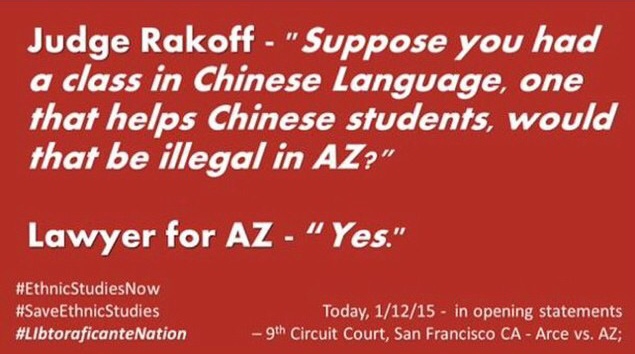
Excellent update by journalist, Roque Planas, on the Mexican American Studies court case in the Tucson Unified School District in Arizona. Yes, the judge will rule soon.
There is a fundamental misunderstanding among Arizona leadership of what "La Raza" means. It does not mean race, but "people," or "the people." Race relations scholarship clarifies that all groups, by definition, are ethnocentric. "Ethnos" is a Greek term for "people." "Ethnology" is the study of people and how their characteristics are distinct and overlap.
Donald Noel is a sociologist who posits, based on his own scholarship, that the problem is not ethnocentrism itself—since all groups are, by nature, ethnocentric. Instead, the problem is extreme ethnocentrism. That is not what we are seeing in TUSD's Mexican American Studies curriculum Arizona even if they have previously used "Raza Studies" as a self identifier.
Instead it was a well conceived, college-preparatory, compassionate pedagogy that served those children and youth well—and to which all the available evidence squarely points (see previous blog posts on this). I should know. I was an expert witness in the case.
It is tragic that the state ended an excellent program that was graduating students and sending them on to college in record numbers.
At the end of the day, officials'—as well as official—action was caught up with a decision to not empower them—and in fact, to disempower them by dismantling the program. Shameful and sad.
I am hopeful that Justice Tashima rules on the side of justice—which includes the right to live in an open society where all of our communities can be free to study "the American experience," if you will.
Do read this excellent piece for an update on the MAS Trial. And thank you, Roque Planas, for doing your due diligence as a conscientious and honest journalist.
Angela Valenzuela
08/08/2017 05:46 am ET | Updated 15
hours ago
Arizona
Republicans accused teachers of stoking racial discord. But the law they passed
in response may violate the Constitution.
ARNIE BERMUDEZ
A lawyer for the state of Arizona
repeatedly asked Sean Arce, the former director of Tucson’s Mexican-American
studies program, who the “oppressors” are.
TUCSON, Ariz. ― When Sean Arce, former
director of Tucson’s banned Mexican-American studies program, took the witness
stand in June, the state attorney’s line of questioning betrayed a clear
agenda: She wanted to get Arce to describe white people as “oppressors.”
Despite repeated prodding, Arce offered
a more subtle explanation of his views. “If you look at the disparities that
exist within our society, if you look at prison rates ― if we look at a number
of indicators, you see that there is, in fact, a dominant society and a
subordinate society and you see that folks are marginalized,” the high school
social studies teacher testified. “I am speaking of systems of racism and
systems of oppression.”
The 47-year-old educator was testifying
on the fourth day of a trial that concluded last month ― and that will soon
decide whether Republican state officials violated students’ constitutional
rights when they torpedoed Tucson’s unique ethnic studies program in 2012.
Arce and a group of likeminded teachers
in the Tucson Unified School District banded together in the 1990s to create a
Mexican-American studies program that aimed to narrow the wide achievement gap
between white students and the Hispanic students who constitute the district’s
majority.
“Their self-esteem was really low,”
Curtis Acosta, another former teacher, testified of his Hispanic students. “We
wanted to work on that self-image while giving them an academic foundation.”
Some of the programs’ teaching methods
were commonsense. They taught books by Hispanic authors that students were
rarely exposed to otherwise, and they studied overlooked episodes of Latino
history in the United States.
Other methods were less conventional.
The teachers believed that mending their students’ fractured relationship with
school meant boosting their confidence and helping them find inspiration in
their culture, which the traditional curriculum had largely ignored. Some
teachers began class with the “unity clap” ― a nod to the United Farm Workers
movement ― or recited “In Lak’ Kech,” a bilingual poem
inspired by Mayan teachings, in unison. The curriculum often
homed in on the most contentious issues that students in the largely Hispanic
district were facing, like illegal immigration and racial inequality. At its
peak, the program served 1,200 students, from kindergarten through high school.
Arizona’s Republican-dominated
legislature, however, viewed the classes as an example of thinly veiled
left-wing indoctrination that used discussions about “oppression” to breed
resentment against whites.
In 2010, the legislature passed a four-part law forbidding
any public school classes designed for a specific ethnicity or promoting
“the overthrow of the United States government,” “resentment toward a race or
class of people,” or “ethnic solidarity” instead of “the treatment of pupils as
individuals.” Then-state Superintendent of Public Instruction Tom Horne and
then-State Sen. John Huppenthal, both Republicans, crafted the bill to outlaw
the Mexican-American studies classes specifically.
In 2011, Huppenthal took Horne’s place
as state superintendent of public instruction and issued an order finding
Tucson’s program in violation of the law he’d helped pass the prior year. To
avoid losing state funding, the Tucson school board voted 4-1 to dismantle the
classes in January 2012.
Students and parents in the district
filed a lawsuit to overturn the state’s restrictions, accusing Arizona
officials of passing and implementing the law with the goal of discriminating
against Hispanics. The lawsuit argues that the ethnic studies law violates the
14th Amendment’s guarantee to equal protection before the law and students’
First Amendment right to receive information freely.
While Arizona Republicans accused the
teachers of indoctrinating students, the state’s defense of its ethnic studies
law was also largely ideological. Rob Ellman, one of the lawyers representing
Arizona, accused the teachers of using “inflammatory materials” to “portray
America as a racist society” ― and argued that it was well within lawmakers’
purview to ban such a program.
“If you characterize the relationship
as Hispanics being oppressed and whites being oppressors, I think that’s of
grave concern to any policymaker,” Huppenthal said.
One thing is clear: When U.S. District
Court Judge A. Wallace Tashima rules on the case some time in the coming weeks,
he will set a precedent for how far legislators are allowed to go when pushing
their political views into the classroom.
Nixing Talk of “Oppression”
The argument that the Mexican-American
studies program taught students to despise whites formed the crux of Arizona’s
defense during the two-week bench trial, leading to the contentious line of
questioning about who Arce thinks the “oppressors” are.
It was a bizarre interaction. People of
Hispanic heritage can belong to any racial group, and Arce’s daughter Maya
Arce, a 19-year-old university student who also appeared as a witness
against the state’s ban, is both Mexican-American and light-skinned. The state
seemed to be arguing that Arce would devote his professional life to sowing
resentment against a group of people that might include his own immediate
family.
Acosta testified that maligning white
people would offend him personally because he is himself biracial, and loves
his Anglo mother. Sally Rusk ― one of the program’s former teachers, who
watched the trial from the audience ― is a white woman with no Hispanic
ancestry.
Lacking direct evidence that the
teachers railed against whites in the classroom, the state of Arizona then
sought to prove that the curriculum itself was overtly racist and
politically biased.
Huppenthal testified that
discussions of “oppression” have no place in classrooms if they delve too far
into the subject of the privileged place of white Americans or the marginalized
place of Hispanics in the United States. Doing so, he argued, would only
undermine students’ ability to succeed in life.
“The idea that you have oppression
taking place in society, I thought that was a dominant idea of the classes,”
Huppenthal testified. “I thought that was an unhealthy idea.”
Yet the program’s outcomes appeared to
show that teachers were successfully narrowing the achievement gap. Students
who took the elective classes graduated at higher rates and scored higher on
state tests than their peers, according to studies led by University of Arizona
education professor Nolan Cabrera, who testified as an expert witness during
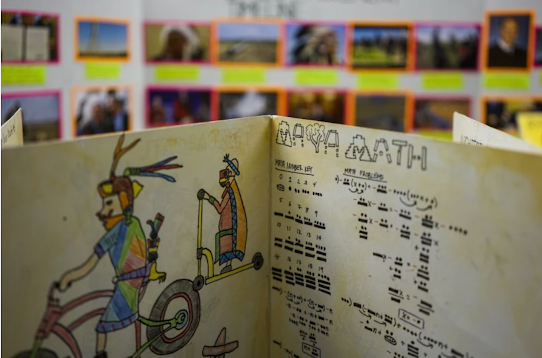
trial. They even performed better on math tests, a subject the Mexican-American
studies program didn’t cover at all. This unforeseen result may indicate that
students’ attitudes toward education improved overall because of the program,
Cabrera said.
The state’s defense made clear that
officials’ criticism of the Mexican-American studies program hinged more on
ideology than pedagogy.
Horne, Huppenthal’s predecessor as
head of Arizona schools, first launched the state’s battle against ethnic
studies in 2006, after civil rights leader Dolores Huerta said “Republicans
hate Latinos” in a speech at a Tucson high school while referring to the toxic
immigration debate. Horne testified that he had crafted the 2010 law to ban all
ethnic studies from the state, based on his personal belief that they fostered
separatism.
“Philosophically, I disagreed with
dividing students up by race,” Horne said on the stand.
And the officials who spearheaded the
passage of the ethnic studies law both testified that they had never
witnessed a single class. Horne based his assessment largely on complaintsfrom
two Tucson teachers outside the program ― Jon Ward and Hector Ayala ― who
accused the Mexican-American studies teachers of politicizing the classroom,
using racially charged language and making white students feel out of place.
(Neither Ward nor Ayala testified at trial.)
Horne said on the stand that he’d made
of a point of not visiting the classes, arguing that teachers would mask their
alleged racial and political agendas in the presence of a state official.
Instead, he said he offered to videotape the classes at the expense of the
state. The school district declined.
Huppenthal met with students in
Acosta’s high school Latino literature class for a discussion once in the
spring of 2010, when he was serving as a state senator. On the witness stand,
Huppenthal described Acosta as an effective teacher, admired by his students.
He also praised Acosta’s well-groomed appearance and neatly pressed shirt.
But Huppenthal testified that he walked
away from the visit concerned about the poster of Argentine revolutionary
Ernesto “Che” Guevara on Acosta’s classroom wall. (Acosta said he put it up at
the request of a student.) And Huppenthal said he
was disturbed when one of the program’s administrators described Benjamin
Franklin as a “racist.” In 2011, he signed the order finding the Tucson classes
in violation of the ethnic studies law he helped pass the year before.
Arizona’s attorneys often focused on
passages from the program’s textbooks they viewed as inflammatory, emphasizing
Brazilian educator Paulo Freire’s Pedagogy of the Oppressed.They
described Freire as a Marxist, intimating that such writings were unsuitable
for a classroom ― despite the fact that the book is widely studied in American
universities. The Tucson school board approved it for
classroom use in 2013, after the Mexican-American studies program
was dismantled, without complaint from the state.
Huppenthal said he viewed the book as
emblematic of an “oppressor-versus-oppressed” framework that would teach
Hispanics to resent white people. When a plaintiffs’ lawyer asked him to
describe the parts of the book he found troubling, Huppenthal told the court:
“Well, it’s hard to get past the name.”
Former Superintendent of Public Instruction John
Huppenthal testified that he opposed what he viewed as an
“oppressed-versus-oppressor framework” that would undermine Hispanic student
achievement.
Horne echoed that sentiment in
disputing the educational value of Rodolfo Acuña’s classic Chicano history, Occupied
America. “The mere title shows what kind of propaganda it is,” he
said. “I read it and I was shocked by it.”
The state often objected to specific
terms in course texts as well, like “Aztlán,” a Mexica word used to describe
the area known today as the U.S. Southwest. Horne testified that he suspected
the term implied a desire to reconquer that territory on behalf of Mexico.
“They keep referring to the ‘artificial’ borders, which are the borders of the
United States,” Horne said.
Former Republican officials fixated in
particular on the term “la raza,” which was once part of the curriculum’s
title. The Spanish word can literally be translated as “the race” or “the
breed.” But Mexican-Americans in the Southwest use “la raza” to refer to the
mixed-race people of Mexico and Central America, a usage Mexican philosopher
José Vasconcelos coined in the
years after the Mexican revolution. He envisioned a “cosmic race” ―
“la raza cósmica” ― would emerge from the racial mixing of European, indigenous
and other peoples in Mexico. Chicano activists
adopted the term during the civil rights era to describe
Mexican-Americans living in the United States.
When Acosta tried to explain on the
stand that the teachers used the term “la raza” as roughly equivalent to
“Latino” or “Hispanic,” Arizona’s lawyers objected, arguing he wasn’t qualified
to give expert linguistic testimony. Judge Tashima sustained the objection.
But both Huppenthal and Horne testified
at length that they viewed the term “la raza” as a racist affront to whites.
Huppenthal stood by his 2010 campaign vow to “stop la raza.” Horne described
any other interpretation as preposterous, pointing out that the civil rights group
National Council of La Raza had just weeks before his
testimony changed its name to“UnidosUS.”
“‘La Raza’ means ‘the race,’” Horne
said. “When they say it doesn’t mean ‘the race,’ it means ‘the people,’ they’re
being deceptive. The people is the ‘gente.’”
Proving ‘Racial Animus’
Judge Tashima has considered the ethnic
studies law before. In a summary judgment in 2013, he invalidated the section
of Arizona’s law forbidding classes aimed only at a specific ethnicity. A
three-judge panel of the 9th U.S. Circuit Court of Appeals upheld that part of
his decision in 2014, but ordered Tashima to hold a trial because there may
have been evidence that Arizona officials discriminated against Hispanics when
they passed and implemented the law.
Proving that elected officials passed a
law with racist intent ― “racial animus,” in legal jargon ― is difficult in a
world where politicians rarely use ethnic epithets and are sensitive to
allegations of racism. But Huppenthal gave the students’ lawyers an unusual
gift in this case: When he was up for re-election as the head of the Arizona
Department of Education in 2014, local media discovered that Huppenthal
had made a string of
racially charged and often offensive blog comments over the last four years.
Using the names “Thucydides” and
“Falcon9,” Huppenthal had called for the end of all Spanish-language media ―
except for some words on Mexican restaurant menus ― and compared the
Mexican-American studies teachers to the Ku Klux Klan. He cried at a press
conference after the local media exposed him, saying he “renounced and
repudiated” his insulting commentary. The incident played a role in the failure
of his re-election bid.
But on the stand this year, Huppenthal
recanted his apology, arguing that the comments he’d made were
racially neutral, if indelicately phrased. Rather than showing racial animus,
he said, his comments reflected a desire to help Mexican-American students
excel in school by learning fluent English.
Huppenthal emphasized that he grew up
in majority-Hispanic south Tucson and retains Latino friends from those years.
He testified that after losing his re-election bid, he dedicated his time to
teaching math to Hispanic students.
Horne, for his part, described his life
as a “crusade against racism,” saying that he’d attended Martin Luther King
Jr.’s “I Have a Dream” speech in person and that he reads Mexican history books
in Spanish in his free time.
But the students’ lawyers don’t have to
show that Horne or Huppenthal are raging racists to clear the legal bar for
proving racial animus. The U.S. Supreme Court set the legal standard for
proving racial animus in Arlington Heights
vs. Metropolitan Housing Corporation, a 1977 ruling that found it’s
enough to show that officials’ actions disproportionately affected a specific
group, fit into a larger pattern of targeting that group, and that officials
took unusual measures to get the law passed.
So far, Arizona’s ethnic studies law
has only shut down the Mexican-American studies program in Tucson ― though
Horne testified that he hoped his law would eventually ban all
ethnic studies classes from public schools.
The plaintiffs’ lawyers appeared to
have less success in convincing Tashima that the law was part of a broader
legislative trend that targeted mostly Hispanics. The lawyers pointed out that
Arizona’s ethnic studies law was passed the same year as S.B. 1070, the state’s
immigration crackdown that the Supreme Court later gutted. But Tashima sought
to keep the trial focused on educational issues, rather than immigration laws.
The question of whether Republican
officials strayed from normal procedures in banning the Mexican-American
studies classes was less cut and dry. Lawyers for the state argued that nothing
about the legislative process was unusual. Horne had written a law with the
hope of banning ethnic studies across Arizona, submitted it to the
Republican-majority legislature, and lawmakers voted to pass it.
But lawyers for the students noted that
Arizona already had a law on the books restricting partisan materials in
classes. If state officials objected to the books in Tucson’s classrooms, they
could have lodged complaints without banning the program altogether. “They
passed, enacted and enforced a law they didn’t need,” argued Steven Reiss, one
of six lawyers representing the students, on the last day of trial.
Even if the students’ challenge is
successful, it’s unclear whether the prohibited curriculum will resurface in
Tucson. Some of the teachers who started the program have since left the
district. Others lost their jobs, went on to teach different subjects, or tried
to salvage the work they started by joining a “Culturally Relevant Curriculum”
program that Tucson created to replace Mexican-American studies.
But in the wake of the nearly
decade-long battle over the unique Tucson program, ethnic studies courses have
spread across the United States, largely as a response to the controversy in
Arizona. Several districts in California implemented elective ethnic studies
classes ― including the state’s largest ones in Los Angeles and San Francisco ―
and theCalifornia
legislature voted to create a model course so all schools can
have access.Individual schools
in Texas are adopting Mexican-American studies courses inspired
by the Tucson curriculum, with the blessing (but not funding) of the State
Board of Education. Indiana passed a state law in May requiring public schools
to offer elective
ethnic studiesclasses once a year.
The Tucson school board dismissed Arce
in 2012 after shuttering the program he directed. He now works in Azusa,
California, where he teaches classes similar to the ones Arizona banned.
Officials in California have sought Arce’s input for its model ethnic studies
course. Other educators routinely ask him to share the material from the
defunct Tucson courses so they can replicate it.
“That’s probably the most lasting thing
from this whole legal struggle ― people have become aware of this issue. We’ve
formed all these relationships. People see real promise,” Arce told HuffPost
after the trial. “It happened as a direct result of what transpired in
Arizona.”
Do you have information you want to
share with HuffPost? Here’s how.
Suggest a correction
©2017 Oath Inc. All rights
reserved.