This blog on Texas education contains posts on higher education, as well as preK-12 policy accountability, testing, bilingual education, immigration, school finance, race, class, and gender issues at both the state and national level. It also represents my digital footprint, of life and career, as a community-engaged scholar in Texas.
Reading Minority Civil Rights and the Texas Legislature (2018), a 22-page historical pamphlet I picked up in a legislative office last session is like holding a mirror to the present.
The document offers an unflinching account of how Texas—since its founding—has been shaped by racial hierarchy, exclusion, and the enduring efforts of Black, Mexican American, and other minoritized communities to claim the full rights of citizenship. I appreciate the honesty. However, what becomes abundantly clear is this: the culture wars roiling Texas today are not new. They are the latest iteration of a long struggle over whose history, humanity, and political power this state will recognize.
Texas was built as a slaveholding society, its early laws explicitly designed to secure racial domination. Black Texans were denied citizenship, movement, literacy, and basic protections. Tejanos (Spanish for 'Texan')—despite their leadership in the revolution and early Republic—were pushed to the margins once Anglos consolidated power.
After the Civil War, Reconstruction gains were met with Black Codes, Jim Crow statutes, and violent backlash. Mexican Americans faced parallel systems of segregation (“Juan Crow”), discriminatory policing, and routine exclusion from juries, schools, and the vote.
Yet the record also reminds us that resistance has always been part of the story—from Reconstruction legislators like Matthew Gaines and George Ruby, to Tejano lawmakers like Navarro and Seguin, to civil rights leaders such as Barbara Jordan, Héctor García, and the activists of LULAC, the NAACP, and the G.I. Forum. Each generation confronted efforts to roll back rights and narrow the definition of who counted as a “real” Texan.
Today’s culture wars follow this same pattern. Current battles—over teaching race and gender, restricting Ethnic Studies, banning books, suppressing voting rights, policing immigrants, and centralizing state authority over local communities—mirror earlier attempts to solidify racial power under the guise of “neutrality,” “order,” or “protecting children.”
Just as past lawmakers used Black Codes, literacy tests, poll taxes, and segregation statutes to preserve social hierarchy, today’s leaders deploy curriculum bans, border militarization, and mid-decade redistricting efforts to limit democratic participation and narrow the public imagination.
What the historical record makes clear is that Texas has repeatedly oscillated between moments of democratic expansion and reactionary retrenchment. The culture war is simply the latest backlash against multiracial democracy—another attempt to redefine belonging by silencing the histories and communities whose presence destabilizes myths of Anglo exceptionalism.
But history also teaches us that backlash never has the final word. The same state that produced Jim Crow also produced Barbara Jordan. The same state that once denied Tejanos entry into the legislature now sees Latino lawmakers shaping statewide policy. Every wave of repression has been met by movements that expand freedom and insist on truth.
We are living through another such moment. What is being targeted is not only DEI, Ethnic Studies, or “divisive concepts,” but the capacity of Texans to understand their own history and to build a multiracial, pluralistic democracy. The historical record reveals a simple truth: when Texas suppresses knowledge, it is preparing to suppress rights. When it restricts whose stories may be told, it is deciding whose lives matter.
Understanding the deeper historical roots of Texas’ culture war does not diminish its urgency—but it does give us clarity: we have inherited a long, unfinished struggle to make Texas the democratic society it claims to be. And as past generations showed, progress comes not from silence or retreat, but from organized, principled resistance.
History is not repeating itself—it is calling upon all people of good conscience to finish the work.
True. While Arredondo is the first officer to ever get dismissed for a school shooting—a curious fact unto itself—what sticks out for me in this piece is a "Change.org petition calling on authorities to fire every officer who stood in the hallway [on] May 24th." It has received more than 89,000 signatures, my own included.
Hope to see folks at the March For Our Lives rally tomorrow at 11AM.
We need to urge the Texas State Legislature to pursue commonsense, gun and school safety legislation.
Arredondo is the first officer dismissed over law enforcement response to one of the worst school shootings in U.S. history.
Uvalde schools police Chief Pedro “Pete” Arredondo speaks during a press conference at Uvalde County Fairplex after nineteen students and two teachers were killed in the shooting at Robb Elementary School on Tuesday, May 24, 2022, in Uvalde, TX.(Juan Figueroa / Staff Photographer)
More than two months after being placed on administrative leave, an embattled Pete Arredondo was fired from his position as Uvalde Consolidated ISD police chief Wednesday.
The Uvalde Consolidated Independent School District’s board of trustees said it voted unanimously to dismiss Arredondo.
Arredondo was not in attendance but through his attorney released a blistering and defiant 17-page letter that lashed out at state officials, defended the police response to the May 24 massacre and accused the school board of putting his safety at risk.
As the board convened into a closed session, some in the auditorium yelled “Coward!” and “What about our children?”
Arredondo is the first officer dismissed over the hesitant and fumbling law enforcement response to one of the worst school shootings in U.S. history. Only one other officer — Uvalde Police Department Lt. Mariano Pargas, who was the city’s acting police chief on the day of massacre — is known to have been placed on leave for his actions during the shooting.
Superintendent Hal Harrell had first moved to fire Arredondo in July but postponed the decision at the request of the police chief’s attorney.
Arredondo was placed on administrative leave June 22 after weeks of rising criticism surrounding the law-enforcement response at Robb Elementary School, when 19 children and two teachers were killed in Texas’ deadliest school shooting.
Eighty minutes elapsed between the first call to 911 and police confronting the shooter, who fired at least 142 rounds, according to a timeline from Texas Department of Public Safety Director Steve McCraw.
Arredondo said afterward he didn’t believe he was in charge of the response. Yet in the district’s written active-shooter plan, Arredondo assigned himself incident commander, according to a report examining the response released by a Texas House committee. In interviews conducted or obtained by the committee, police officers said they either assumed Arredondo was in command, or did not know who was in charge, with some describing the scene as “chaos.”
Minutes before Wednesday’s meeting of the Uvalde school board got underway, Arredondo’s attorney released a scathing 4,500-word letter that amounted to the police chief’s fullest defense to date of his actions. Over 17 defiant pages, Arredondo is not the fumbling school police chief who a damning state investigation blamed for not taking command and wasted time by looking for keys to a likely unlocked door, but a brave officer whose level-headed decisions saved the lives of other students.
The letter also accused Uvalde school officials of putting his life at risk by not letting him carry a weapon to the school board meeting.
“Chief Arredondo is a leader and a courageous officer who with all of the other law enforcement officers who responded to the scene, should be celebrated for the lives saved, instead of vilified for those they couldn’t reach in time,” Hyde wrote.
McCraw testified before the state Senate that Arredondo’s decisions cost lives.
“The only thing stopping a hallway of dedicated officers from [entering rooms] 111 and 112 was the on-scene commander who decided to place the lives of officers before the lives of children,” he said.
Arredondo resigned from his seat on the Uvalde City Council on July 2. He was elected to the council May 7 and was sworn into the role May 31, behind closed doors.
“After much consideration, I regret to inform those who voted for me that I have decided to step down as a member of the City Council for District 3,” Arredondo told the UvaldeLeader-News then. “The mayor, the city council and the city staff must continue to move forward without distractions. I feel this is the best decision for Uvalde.”
A Change.org petition calling on authorities to fire every officer who stood in the hallway May 24 has garnered over 89,000 signatures.
“Their failure to not only stop the shooter from entering Robb Elementary School, but refusal to enter the building to engage the shooter cost the lives of 19 children and 2 adults,” the petition says. “These officers should be held accountable for their ineptitude and released from their positions, as they have no intentions on serving and protecting the children of Uvalde.”
New security measures
School officials have said the campus at Robb Elementary will no longer be used. Instead, campuses elsewhere in Uvalde will serve as temporary classrooms for elementary school students, not all of whom are willing to return to school in-person following the shooting.
School officials say a virtual academy will be offered for students. The district has not said how many students will attend virtually, but a new state law passed last year in Texas following the pandemic limits the number of eligible students receiving remote instruction to “10% of all enrolled students within a given school system.”
Schools can seek a waiver to exceed the limit but Uvalde has not done so, according to Melissa Holmes, a spokeswoman for the Texas Education Agency.
New measures to improve school safety in Uvalde include “8-foot, non-scalable perimeter fencing” at elementary, middle and high school campuses, according to the school district. Officials say they have also installed additional security cameras, upgraded locks, enhanced training for district staff and improving communication.
However, according to the district’s own progress reports, as of Tuesday no fencing had been erected at six of the eight campuses where it was planned, and cameras had been installed only at the high school. Some progress had been made on locks at three of eight campuses, and communication improvement was marked as half complete for each campus.
Uvalde CISD did not immediately respond to a request for comment.
Staff writer Catherine Marfin contributed to this report.
Jamie Landers, Breaking News Reporter. Jamie Landers is a breaking news reporter at The Dallas Morning News. She is a graduate of The Walter Cronkite School of Journalism and Mass Communication in Phoenix, where she studied journalism and political science. Jamie previously reported for The Arizona Republic and Arizona PBS.
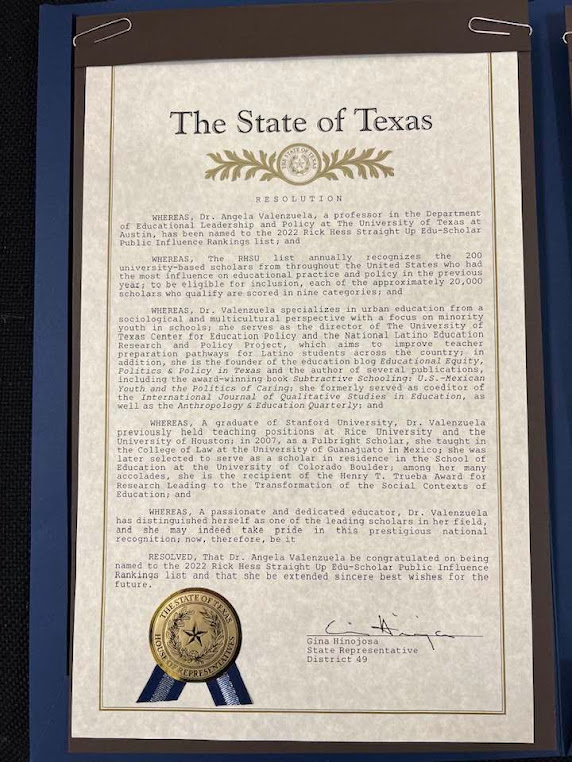
I went to the office this evening and opened a large manila folder that I thought was a calendar from the Texas House and much to my surprise and deep honor, received this acknowledgment from Texas State Representative Gina Hinojosa!
Rep. Hinojosa, thank you so very much for this House Resolution that recognizes my efforts and accomplishments, as well as for your own unflagging support and caring for Texas' children! I'm very humbled as it is an honor and privilege to do what we do.
Someday, the truth of the devastation of fracking shall be fully revealed—and sooner rather than later, I hope. All Texans and all states impacted by fracking, drought, water scarcity and frankly, by climate change—which means every state—need to read this piece. Since we know that water is life, then the deeper question of whether a resource so precious should even be owned. Never mind that we've already been socialized accordingly, and much to the satisfaction of the profiteers. A movie that features famous movie actor, Gael García Bernal titled, "Aún la lluvia," or in English, "Even the Rain," raises this very question. Check out the trailer and consider seeing this very impactful film either in English or Spanish to consider how things should be, rather than how they are. -Angela Valenzuela
Aquifer water is pumped into an irrigation canal at a Williams property this month near Fort Stockton, Texas.
By
Christopher M. Matthews | Photographs by Loren Elliott for The Wall Street Journal
FORT STOCKTON, Texas—Wildcatter Clayton Williams Jr. made his first fortune in oil. He aims to make another off a treasure buried beneath his family’s West Texas land. It’s a massive trove of water.
The plan is pitting neighbor against neighbor and rekindling a debate over who should control fresh water in a bone-dry region. Many of the region’s farmers and ranchers depend on income from selling their water to oil producers. Desert towns like Fort Stockton, near the Williams farm, fear their water sources will dry up.
“I don’t know why the hell you would want to pipe water out of the desert,” said Kirby Warnock, 67, whose family has owned a ranch near the Williams farm for nearly a century. “It’s like space shuttle astronauts selling their oxygen. It boggles my mind.”
Another influential Texas oil family is suing the local water regulator, hoping to limit how much the Williamses can pump. The family investment office of the Cockrells, for whom the University of Texas engineering school is named, is worried over-pumping could deplete water wells on their farm and put their 68,000 pecan trees at risk.
For the Williamses, the issue is straightforward: Under Texas law, they can pump water from under their land and use it for whatever commercial purpose they choose, with few limits. Their farm’s main product is alfalfa, used to make hay, which is sold to customers as far away as China.
“If we sell alfalfa to Saudi Arabia or China, it’s basically us exporting water there, so what’s the difference?” said Jeff Williams, 45, who runs the family farm for his father, in an interview last year. He didn’t respond to fresh inquiries this month.
Mark Tisdale, a lawyer for the family company, Clayton WilliamsCo s., said the area has more than enough water to support the Williamses’ plans.
Humans have fought over water for much of recorded history, especially in the American West, where it is scarce in many places and control of it can yield fortunes. The fight here comes as competition is heating up for water around the world, in dry regions and wet ones. Surging populations, rising demand for industrial-scale farming and manufacturing, and hotter temperatures are putting new stress on the constrained resource.
There has never been a better time to sell West Texas water, thanks to the fracking boom. Shale companies use large volumes in hydraulic fracturing, blasting underground rock with water, sand and chemicals to unlock oil and gas.
Frackers in the region pay an average 50 to 75 cents for a barrel of water, according to Bluefield Research, a water advisory firm. That amounts to more than $200,000 a well. Supplying water for fracking in the Permian is a roughly $1.2 billion industry annually, and including transportation and other costs, water spending for fracking there will surge to as much as $54 billion over the next decade, the firm said.
The Williams family has so far sold limited amounts of water for fracking, says Mr. Tisdale. The family wants to build a pipeline to sell water outside Pecos County—a process called “exporting”—to oil producers and others. It obtained a permit in 2017, following a decade of litigation that resulted in a settlement with the Middle Pecos Groundwater Conservation District, which regulates aquifer water levels.
The Cockrell family sued the groundwater district last July in the District Court of Pecos County, calling the settlement with the Williams “a sham” and arguing the family should have been allowed to weigh in on the Williamses’ plans.
Ernest Cockrell founded Cockrell Oil Corp. in 1901, and the family manages substantial oil-and-gas and real-estate assets. “We are a big believer in private property rights, but it’s also a shared resource and it’s a high-plains desert,” said Robert Hatcher, 56, who runs the family office, Cockrell Interests LLC.
The Cockrells are worried the Williamses, if they export water, will pump year-round, limiting the aquifer’s winter recharge. The lawsuit has been temporarily stayed as the parties attempt to negotiate how much of the aquifer can be drained at any given time before pumping must be halted.
‘Water is for fighting’
“What’s the old saying, ‘whiskey is for drinking, water is for fighting,’ ” said Jeff Williams. “My father always understood the value of water.”
SHARE YOUR THOUGHTS
Who should be able to benefit from underground water reserves? Join the conversation below.
The Williamses moved to Fort Stockton in the 19th century, establishing themselves as farmers and ranchers before striking it rich in oil in the 20th century. Tensions in Fort Stockton still run high decades after Clayton Williams Sr. and others began drilling water wells near town, pumping millions of gallons a day for industrial-scale farming in the 1950s.
Following the pumping, many of the farms on the east side of town lost their water supply, destroying livelihoods. The town’s Comanche Springs, which fed a swimming pool that hosted its annual Water Carnival, dried up. Today, the event is hosted at a chlorinated pool.
Water Strain
Water in Texas has been under stress for decades but is experiencing new demands from heightened oil activity in shale basins, including the Permian and Eagle Ford.
OKLAHOMA
NEW MEXICO
Dallas
PERMIAN
TEXAS
Fort Stockton
Austin
Baseline
water stress*
Houston
San Antonio
Extremely high
High
EAGLE FORD
Medium-high
Low-medium
Low
Arid/low water use
*When demand exceeds available water
Source: World Resources Institute
The local water district concluded the depletion was due to the pumping and sued Clayton Williams Sr. in 1951 on behalf of farmers who had lost their water, seeking to more stringently regulate pumping. The El Paso Court of Appeals sided with the Williamses and enshrined an unusual water law. Unlike many states, Texas follows the rule of capture, a common-law tenet dating to Henry IV that holds anything below a property belongs to its owner.
Clayton Williams Sr. would sell the farm years later, and his son spent decades buying it back. Known by his friends as “Claytie,” Clayton Williams Jr., now 87, struck it rich as an oilman, eventually selling his company to Noble EnergyInc. for $2.7 billion in 2017; he declined to be interviewed.
0:00 / 0:00
How the Permian Basin Became North America’s Hottest Oilfield
The U.S. has more than doubled its crude output over the last decade. Much of the growth is due to the Permian Basin of West Texas and New Mexico. WSJ traces the hotspot of North America’s crude oil boom, with a look at challenges that producers in the region face.
He is perhaps best-known as a Texas Republican gubernatorial nominee who lost to Democrat Ann Richards in 1990 after an acrimonious campaign still legendary in Texas—one of his campaign promises was to introduce first-time drug offenders to the “joys of bustin’ rocks.”
By the 1980s, Mr. Williams had amassed about 18,000 acres above a number of aquifers, deep deposits trapped in a natural underground dam some scientists believe an asteroid impact formed millions of years ago. The aquifers are valuable because they fill every winter from nearby mountains. The Williamses are Texas’ largest private water owners, some hydrogeologists estimate.
For years, Fort Stockton opposed the family’s plan to export water from the county. It backs the plan now, and in 2017, the city of about 8,000 reached its own deal to sell up to 390,000 barrels a day for around 10 cents a barrel to a company supplying the oil-and-gas industry, a move some residents criticize.
“Since becoming mayor, I don’t go out much anymore,” said Fort Stockton Mayor Chris Alexander. “I can’t go anywhere without someone coming up to me complain about water.”
Selling groundwater to oil companies is a lifeline for ranchers and farmers who struggle in a region that often gets less than 10 inches of annual rain. When an oil company leases land to drill, the contract often contains requirements it buy water for operations from the landowner.
“It basically saved them,” said Ty Edwards, general manager of the Middle Pecos water district. “Most of the farmers were bankrupt or about to be bankrupt.”
That growing demand has created friction with landowners. Oil producer Jagged Peak Energy Inc. has been drilling on Bob Hayter’s ranch in northern Pecos County, buying water from him for years. Around 2017, it bought a strip of land in the middle of his ranch about 150 yards wide and more than a mile long, he said.
“I thought I owned it, but I didn’t,” said Mr. Hayter, 69. “They only bought it for one thing, and that’s the water.”
The company drilled four water wells there for fracking, according to the water district. Mr. Hayter said they dried up a well on his property. Jagged Peak settled with the district in May for improperly drilling wells and paid it $25,000. The company disputes it drained Mr. Hayter’s well but has drilled him a new one to make amends.
David Eckelberger, a Jagged Peak vice president, said the company “is always trying to put its best foot forward and have good landowner relations.”
Water for oil
Clayton Williams Jr.’s original plan, according to his family and permit applications, was to sell water for municipal use to the cities of Odessa and Midland, the site of his primary residence, about 100 miles northeast of Fort Stockton. The farm has historical permits to use water for agricultural purposes and in 2009 applied for a license to export large amounts of water.
The Middle Pecos Groundwater Conservation District initially refused to consider the application, then rejected it in 2011. The Williams family sued the regulator in federal district court in Texas in 2010 alleging their rights were violated. In separate litigation, it also appealed the regulator’s 2011 decision in District Court of Pecos County.
Groundwater districts are primarily charged with permitting new wells and setting limits on how much water can be pumped. The Williamses’ core argument was that the district could limit only pumping, not what to do with the water.
The family lobbied extensively on the issue, tapping its sway in the Austin legislature. In 2016, Republican State Representative Lyle Larson, a family friend, held a hearing in Fort Stockton to examine whether the water districts were preventing growth in cities by blocking water exports.
Rep. Larson, who chairs the House Natural Resources Committee, in a June interview said the state, not local officials, needed to set water regulation to ensure Texas’ rapid population growth. “We have social scientist-wannabes in these water districts,” he said, “that are making decisions that are not their decision to make.”
In March 2017, Rep. Larson proposed legislation to review whether the Middle Pecos district should be disbanded. Within months, the district and the Williamses settled out of court. Under the terms, the farm can’t pump more water than it was permitted to use for crops but can export about 60% of its permitted historical volumes, around 9 billion gallons a year. The Williamses agreed to pay the district $404,000, drop all lawsuits and stop lobbying on related issues for several years.
The Williamses may have missed their window to send water to Midland and Odessa, which have found alternative sources, said Michael Thornhill, a hydrogeologist who works for the family. While their long-term hope is still to sell to the cities, he said, they are now trying to sell to drillers.
“What’s the highest and best use for our water?” said Jeff Williams. “It’s a subjective question. Personally I think it’s the municipal use, but I will sell to oil and gas in the meantime.”
The family has spoken to some of the area’s largest oil producers, but hasn’t signed any supply contracts, said Mr. Tisdale, the family-company lawyer. “It’s a function of what does it cost to get water to somebody,” he said.
The family farm has been relatively far from some of the hottest drilling areas, adding significant transportation cost. But drilling picked up this year in northern Pecos County, about 30 miles away.
“Am I worried about them pulling out too much water? Sure I am,” said Mr. Hayter, a neighboring rancher, of the oil producers. “Money and water, how volatile can you get it, especially in West Texas?”