Translate

Showing posts with label White House. Show all posts

Tuesday, June 07, 2022

Matthew McConaughey tells the story of those killed in Uvalde in emotional plea for action on guns (CNN)

Friends,

Combining a Youtube video and CNN report, these are must-hear and must-read, respectively, news that capture a talk delivered today by Matthew McConaughey at the White House. A disclaimer is that parts of it are graphic and are not appropriate for younger audiences or particularly sensitive individuals.

Matthew McConaughey is from beautiful Uvalde, Texas, and visited last week with his wife, Camila AlvesThey also set up a Uvalde Relief Fund where donations can be made on their Just Keep Livin Relief Fund. They accept credit cards, Apply Pay, Google Pay, or Paypal.

McConaughey's testimony is persuasive, gripping, and passionate, speaking from his heart based on what he learned about the tragic loss of so many lives together with a fervent plea to "make their lives matter."

Do take a minute to read McConaughey's excellent June 6, 2022 op-ed in the Austin American-Statesman titled, "It’s time to act on gun responsibility" where he lays out a great path for policymakers to enact commonsense legislation. Like McConaughey, many of us agree that with so many senseless murders in Uvalde, Philadelphia, Tulsa, Tennessee, Charleston, Phoenix, and counting, now is the time for change.

Bless you, Matthew and Camila Alves McConaughey, for using your voices to express the deep sense of urgency and clear thinking that this moment requires.

-Angela Valenzuela


Updated 6:15 PM EDT, Tue June 7, 2022

Monday, July 02, 2018

F for Fascism. You can use the word now.

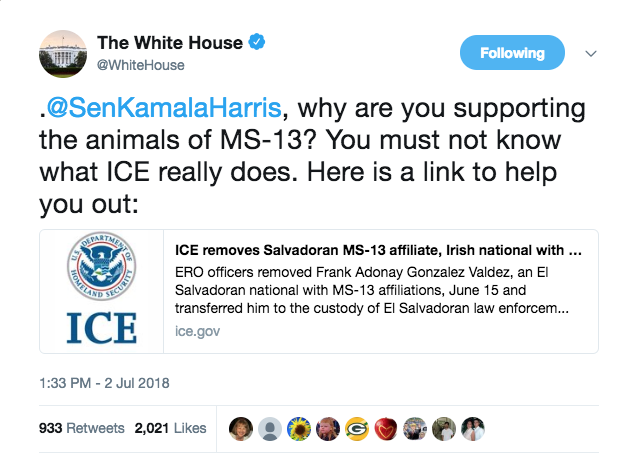
"F" for fascism.  I am appalled.  Please read this message from Senator Kamala Harris below.  Personally, the alarm here is not to discover that Trump is a fascist—since many of us knew early on—but rather that Senator Harris got openly attacked on Twitter by the “White House,” from a taxpayer-funded, White House Twitter account—@WhiteHouse

This White House action is nothing short of extreme and we should all be very concerned.

Whoever tweeted this should lose their job!  And Senator Harris is owed an apology! And the asylee community is desperate for a solution—and not twisted, hateful bigotry.

Friends, let’s be careful not to get distracted from the goal of Comprehensive Immigration Reform by pivoting to other discussions like abolishing ice.  I appreciate the passion and energy around this, but it takes us away from the most important conversation that we should be having like #FreeTheChildren #FamiliesBelongTogether


Angela —
A few moments ago, this White House used its official, taxpayer-funded Twitter account to launch a completely false attack on me:
 
Let me be very clear: As a career prosecutor, I actually went after gangs and transnational criminal organizations. That's being a leader on public safety. What is not, is ripping babies from their mothers.I will never stop fighting to hold Trump and his Administration accountable and I will never stop speaking out against their immoral policies like separating parents from their families. Are you with me?
Chip in $10 or more right now to help us fight back — and send a message to this White House today that we’ll never stop fighting to defeat their anti-immigrant, anti-public safety agenda:If you've saved your payment information with ActBlue Express, your donation to Senator Kamala Harris will go through immediately:EXPRESS DONATE: $10EXPRESS DONATE: $25EXPRESS DONATE: $50EXPRESS DONATE: $100EXPRESS DONATE: $250OR, DONATE ANOTHER AMOUNTEvery single day feels like a race to the bottom with this Administration, and the American people deserve better. You deserve better.
When our kids and grandkids ask you where you were and what you did at this moment in time, what will your answer be? Mine will be that I did everything I could to stop this Administration’s reprehensible agenda.
Thanks for standing with me today,
—Kamala


"Freedom is never really won. You earn it and win it in every generation."- Coretta Scott King
PAID FOR BY KAMALA HARRIS FOR SENATE 
There are those that argue that Trump isn't fascist, but rather that he is a right-wing populist.  Because of its implications, this is an important polemic to engage.  To this end, read Dr. Robert Reich's piece titled, "Trump: The American Fascist," as well as Madeleine Albright's authoritative new book, Fascism: A Warning, to arrive at a judgement based on the historical evidence that arguably signals creeping fascism in the U.S.  This piece by Thomas Frank is also interesting and germane.  

Italian charismatic dictator, Benito Mussolini's, writings on the corporate state are also revealing.  Is it not fascist that corporations now have individual rights in the U.S.? 

Join me and many others in abolishing Corporate Personhood.  

Call all who represent you.  Write those who represent you.  Register to vote.  Run for office. Join a political party or any entity that can help you extend voice in a respectful manner, observing everybody's dignity, as a matter of course.  

Whether Trump is a right-wing populist or an American fascist , he is definitely immoral.  And it is to our own peril that we fail to acknowledge that because of this, our democracy is in crisis.

Angela Valenzuela


Wednesday, July 27, 2016

Bill O'Reilly's Offensive Remarks on Slavery Help Illuminate What is at Stake in this Election by A. Valenzuela


Bill O'Reilly's Offensive Remarks on Slavery Help Illuminate What is at Stake in this Election*
by 
Angela Valenzuela

Bill O’Reilly’s comments yesterday on Fox News in reaction to Michelle Obama’s democratic convention speech, were profoundly demeaning, patronizing and injurious.  Specifically, Michelle Obama acknowledged living every day in a house built by slaves.   

With respect to a very obviously charged, poignant, and unsettled part of our history, what his comments help to unveil is not only his hubris and hard-heartedness on the matter, but also the far reaches of the ideology of white, Western European supremacy and its continuing justification for our country’s history of war, conquest, and colonization against indigenous people of which the brutal and degrading institution of chattel slavery was a significant part.

People think of race and racial nomenclature as natural, as a fact of existence.  Yet these are inescapably modern terms today since none existed in Europe prior to the early 1600s.  Nor were they present on this continent prior to Columbus' arrival.  For millennia instead, aboriginal people identified themselves as members of specific clans, tribes, nations, or ancestries.


The very categories of "white" and “black” came into existence with the consolidation of slavery in the early-mid 1600s (Omi & Winant, 2014).  Race—and the terms we casually use in speech as personal identifiers, hateful, prejudicial discourse, or terms of endearment—is a modern construct.

In the history of humanity, there has always been slavery unfortunately, but historically for millennia, no group ever enslaved members of a race. Instead, PEOPLE/OR A PEOPLE/OR PEOPLES were enslaved and not the members of any race because race did not exist as a concept and especially not for the purpose of classifying and categorizing humanity on all manner of characteristics (especially, notions of intelligence and ability).

So race emerges over time, sharing analytical and ideological affinity with Darwinism together with the idea of the "survival of the fittest" as a basis for hierarchy in society—the latter of which had earlier European antecedents in the ideological notion of “The Great Chain of Being.” 
This phrase of "survival of the fittest" actually derives from English philosopher and political theorist, Herbert Spencer, and meets up with the ideologies of individualism and meritocracy that work in tandem to reduce economic, cultural, political, and social success of both individuals and groups to individuals’ hard work, talent, and investments in human capital.  This is a power-neutral, power-evasive, succinct, sterilzed (dominant) narrative.
Society’s structure of opportunity—that even this story of the white house and Michelle Obama’s re-telling of it illustrates—privileges the voices of some over others regardless of how offensive they are, underscoring exactly how privilege can work not only as a weapon, but also as a shield for reactionaries and bigots in a racist society.

The concept of race therefore emerges historically precisely out of colonialism, the occupation of native lands, colonization, and slavery and it finds regular expression today in everyday ways, but most visibly in high-profile arenas and struggles.  Take, for instance, curriculum battles such as those at the legendary Texas State Board of Education, as well as in the dismantling of Mexican American Studies in the Tucson Unified School District by the Arizona State Legislature in the form of House Bill 2281 passed in 2010. To wit, many of us are currently involved in a battle with Texas' State Board of Education challenging the adoption of a racist, secondary-level, textbook published by a former SBOE member that is currently under consideration by the board (see link for news on this unfolding story).
 
Social Darwinism is also embodied in our state and nation’s high-stakes, standardized testing system that despite stubborn and consistent correlations to race/ethnicity and poverty is content to disproportionately promote the ascendancy of white, middle class children on the basis of such narrow measures that test score results represent.  Before testing, tracking students into high and low tracks was the primary sorting mechanism through which the rewards of schooling were (and still are) allocated


It also finds expression in minority group members themselves that similarly subscribe to the negative images by the dominant group toward them, making them feel ashamed about their origins, dialects, and native tongues.  The scholarly literature calls this “internalized oppression” or “internalized racism.”  I have written about such things in my own work.

A vexed history involving battles over school finance, segregation, and representation in the curriculum are arguably the most enduring and stable expressions of struggles over white privilege wherein challenges to white hegemony in arenas where whites (especially white men) dominate are either flatly ignored, consist of piecemeal, token remedies, or met with poisonous invectivesuch as that spewed by Bill O’Reilly that he, for the most part, has never had to justify.  

According to this (il)logic, O’Reilly not only never risks his job, but he and Fox news get further empowered to continue silencing constructive discourse on race that may be good for ratings, but that are nevertheless an obstacle to the goal of inter-ethnic and inter-racial dialogue, peace and harmony. Instead, he injects cynicism and a mean spirit into the atmosphere.
The scientific racism that grew out of Darwinism and individualism generated an extensive body of scholarship that was widely discredited in the aftermath of World War II.  It nevertheless regularly resurfaces and holds sway among a small, but dedicated segment of eugenics scholars, publications, websites, etc.  
In Texas, the State Board of Education social studies curriculum battles reveal the presence of a neo-Confederate agenda that seeks to elevate the likes of Jefferson Davis and the Confederate cause even as they decry the inclusion of women and minorities in the curriculum (especially see Erekson, 2014).

The most well-known, recent manifestation of scientific racism regards Richard Herrnstein and Charles Murray’s 1994 book, The Bell Curve.  It argues for a genetic explanation regarding the black-white IQ gap, setting off one of the most contested debates over the racist notion of the heritability of these measured differences.

The motivations to keep this kind of “institutionalized deficit thinking” alive are not only their profitability—as this story of the building of the White House by slave labor directly implies—but also as a sufficient rationale for the dominant group’s maintenance of power and privilege.
   
Racist demagogues like Bill O’Reilly, together with legions of others who are pretty much okay with our highly uneven status quo arguably have an emotional commitment to institutionalized racism.  Or, to use Dr. George Lipsitz’ (2006) words from his classic work on white privilege, a “possessive investment in whiteness.”  In addition to the sensibilities of people of color, decent human beings, and hard-working Americans, what gets sacrificed by this possessive investment in whiteness is a deeper engagement with a topic that could serve as a bridge to difference, mutual respect, and understanding.
 
It would be interesting to know, for example, the impact of this extraordinary experience of building the White House and other buildings on the slaves themselves, particularly in the context of working with some “free blacks, whites, and immigrants” that O’Reilly mentions. Who were they?  Where did they come from? How were they changed by this experience?

And what about West African aesthetics and how this may have found expression in architecture? Was it ever a factor in design for the monumental structures that draw so much admiration world wide?  This is clearly difficult work since many records weren’t kept; however, this memory may reside in folks songs, journals, diaries, music, or in oral narratives handed down generationally.  We need to promote this kind of work in our universities and communities through story-telling and archival projects in order to preserve our respective histories. 

Our children could also take time to reflect on, to think about what Michelle Obama—instead of Bill O'Reilly—said.  Her spirit and intention opens possibilities for great, imaginative discussions on what could have been, and most especially, the strength of African American families to survive and struggle in myriad ways against slavery.  Volumes of literary works and scholarship on slavery already exists that every generation needs to engage.
 

So for O'Reilly to position himself through his blatantly racist and condescending comments that “slaves that worked there were well fed and had decent lodgings provided by the government, which stopped hiring slave labor in 1802," is minimally to be an apologist for slavery, and maximally, to inadvertently position himself as an imperialist, enslaving conqueror looking down on Michelle Obama and the rest of us who were forced to reflect, however "inconveniently," on the fact of this massively important history that is our collective history in her public address.

The ideology of white supremacy is clearly one to which O'Reilly is wed and upon which he and othersFox News includedthrive.  And it is precisely this supremacist speech, thinking, and ideology—together with an emotional investment in whiteness—that is at stake in this election.

July 28 Reflection

Ok, so how do we get around this possessive in whitenessHow do we as a society get around this? Well, it's asking those in power and that support current constellations of economic, political, social, and cultural power to join the human race and to at least listen to demands and grievances that promote human and civil rights, peace, dignity, and domestic tranquility.  Plus, if it matters, it'll be great for profits, too, to go in this direction.

Perhaps counter-intuitively, this gets accomplished not by evading history and being dismissive of others' narrative power and most particularly, extraordinary, much-admired women like Michelle Obama. Rather, one must face it directly.  And who better to mediate this than our primary, secondary, and higher education faculty, researchers, and practitioners throughout the system in partnership with our community-based organizations and our schools districts, as well as our colleges and universities?

Falta de respeto, interpreted as a lack of respect that is deeply felt, is what we call it in my community.  

We get there by researching, archiving, teaching, and sharing our very profound and complex stories and histories in relation to this continent. We get there through ethnic studies, area studies, humanities, social studies, history, sciences, education, and wherever possible. Rather than through blindness, we get there through class, color, gender, culture, and power consciousness   We get there by connecting to the grassroots in our schools, churches, civil rights organizations, unions, professional associations, political party and non-partisan organizations, nonprofit sector, and beyond.

It is a way of knowing and being in the worldIt is about values and the rearing of our children and grandchildren with intention in a loving family and community, and with a good and clear sense of direction for a brighter future not only for ourselves but for all of humanity.

We, of course, all see the thinning of hatred's wall. However, we remain hopeful that despite all the hate-mongering, a spirit of good will, constructive dialogue, open-mindedness, cultural respect, and peace in our families, will prevail.


References

Erekson, K. (Ed.). (2012). Politics and the history curriculum: The struggle over standards in Texas and the Nation. Springer.
Herrnstein, R. J., & Murray, C. (2010). Bell curve: Intelligence and class structure in American life. Simon and Schuster.

Lewis, D. (July 27, 2016). The White House Was, in Fact, Built by Slaves: Along with the Capitol and other iconic buildings in Washington, D.C. smithosonian.com


Lipsitz, G. (2006). The possessive investment in whiteness: How white people profit from identity politics. Temple University Press.


Obama, M. (July 25, 2016). Democratic National Convention speech. https://www.youtube.com/watch?v=4ZNWYqDU948


Omi, M., & Winant, H. (2014). Racial formation in the United States. Routledge.

O’Reilly, B. (July 26, 2016). Slaves who built White House were 'well-fed and had decent lodgings' http://www.politico.com/story/2016/07/bill-oreilly-slaves-white-house-226257


Saturday, September 26, 2015

Grow Your Own Teachers recognized by White House as ‘Bright Spot’

Glad to see the White House recognize the importance of growing our own teachers to address the diversity needs (or lack thereof) in the teaching ranks.  It does so by highlighting GYO Illinois that has clearly moved the needle in this regard.  There's a lot to know about this.  I want to do a shout out to Dean Maureen Gillette who has been a true leader in this regard at Northeastern Illinois University in Chicago.  This is at least a partial but nevertheless quite substantive approach to bringing in fresh recruits from our communities into the teaching ranks so that they can return to their communities (or communities that are similar to the ones from which they originate) in order to be teachers who are oftentimes more effective with our school demographic populations because of shared experiences, frames of references, and capacities in the languages, cultures, and dialects of their communities.  This is a bright spot indeed for the direction that education reform can and should take.

-Angela


Grow Your Own Teachers recognized by White House as ‘Bright Spot’

Illinois program to recruit and retain diverse teachers honored for positive impact on Hispanic education; featured in national report on the status of teacher diversity in U.S. cities
Stalemate in Springfield cuts off tuition support for GYO candidates pursuing college degrees

CHICAGO, IL – Fatima Salgado was inspired to pursue teaching when she was a part-time tutor. Some of her students were struggling to learn because they were not yet fluent in English. Fatima remembered having difficulties in elementary school when she moved here to Logan Square from Mexico and spent most of second grade without any bilingual language supports.
Now a teacher candidate at Northeastern Illinois University, Fatima is looking forward to teaching middle school math and science in Little Village—the predominantly Latino community where she lives---when she graduates in a couple years.
Paving the way for Latinos and other diverse candidates to become teachers is what Grow Your Own Teachers was created to do. Despite increased awareness of the positive impact and need for more teachers of color, only 3.6 percent of public school teachers in Illinois are Latino. Meanwhile, Latino and African American students now comprise the majority in the state’s public schools.
This week, the White House Initiative on Educational Excellence for Hispanics named t Spots in Hispanic Education.” As a Bright Spot,
Grow Your Own Teachers, will be part of a national online catalog that includes over 230 programs that invest in key education priorities for Hispanics.
“Our teachers are making a difference in classrooms across the state,” says Grow Your Own Illinois Executive Director Kate VanWinkle. “Our program is addressing achievement gaps at two critical junctures. For our teacher candidates, we provide wraparound services that enable them to persist in college and graduate. And for students of color in Illinois public schools, we are training more high-quality teachers of color who live and work in the same communities they do and who help them reach their full potential.”
A new report, “The State of Teacher Diversity in American Education,” highlights Grow Your Own Teachers as one of only eight state and local programs in the nation that focus on both recruitment and retention of minority teachers, and have proven results.
Since it was launched, Grow Your Own has graduated 108 teachers; 88 are currently classroom teachers. By recognizing GYO candidates as untapped resources for their communities, the program addresses teacher turnover, teacher-student cultural mismatch, faculty diversity and stifled career opportunities for those living in poverty who wish to become teachers.
Yet career prospects for GYO candidates in the pipeline are now uncertain as Gov. Bruce Rauner and legislators are at loggerheads and have yet to agree on a budget. Some GYO teacher candidates in Chicago and downstate no longer have the funds to pay for college tuition and are unable to continue their studies.
“This angers me because Grow Your Own works,” says GYO candidate Fatima Salgado. “I’m battling for the money to stay in school and finish. I don’t deserve this and my fellow GYO candidates don’t deserve it. They’re worried. I’m worried, too.”

About Grow Your Own (GYO) Illinois

Grow Your Own Illinois advances the efforts of Grow Your Own Teachers programs across the state to achieve equity, excellence and diversity in the new teacher pipeline. GYO Illinois supports the education and excellence of GYO teacher candidates and graduates; advocates for policies that facilitate increasing the number of teachers of color; and coordinates and aligns the work of innovative partnerships of universities, community colleges, school districts and community organizers that host GYO programs.
For more information, visit www.growyourownteachers.org

About the White House Initiative for Educational Excellence for Hispanics

The Initiative was established in 1990 to address the educational disparities faced by the Hispanic community. The Initiative seeks to leverage these Bright Spots to encourage collaboration between stakeholders focused on similar issues in sharing data-driven approaches, promising practices, peer advice, and effective partnerships, ultimately resulting in increased support for the educational attainment of the Hispanic community, from cradle-to-career.
To learn more about the Initiative and to view the Bright Spots in Hispanic Education national online catalog, visit www.ed.gov/HispanicInitiative.

Grow Your Own Teacher Graduation

Grow Your Own Teacher Graduation
From WIFR Rockford:
ROCKFORD (WIFR) – Some Rockford moms are getting a second chance at living their dream by educating our kids.
Three Rockford natives are now teachers through Rock Valley College’s “Grow Your Own Teachers” Program. The program is geared toward working adults with families who’ve always dreamed of teaching our kids. This is the second graduating class from RVC’s program. The graduates will soon work for District 205 as either elementary or middle school science teachers.
“I would definitely say there were a lot of times where I wanted to throw in the towel, but I just kept striving through and had very good support between Grow Your Own and just kept going,” says graduate Kelly Kloster.
The “Grow Your Own” program plans to start a dual enrollment program with District 205 for high school students who want to become teachers.
Last Updated (Tuesday, 22 September 2015 05:15)

Growing your own teachers worth the wait

Featured at catalyst-chicago.org

During the 12 years that I attended CPS, I encountered very few minority teachers and no teachers with a Mexican background like me. I always wished for one. I felt that a teacher who shared my background would understand my heritage and would inspire me. Now, I can be that teacher who has a positive influence on the children I teach.
By: Idalia Vasquez / February 4, 2015
Grow Your Own Teachers helps low-income people of color who have the desire to become teachers earn a bachelor’s degree in Education—a goal that would otherwise be almost impossible for them to achieve. Yet a recent news article falls short by viewing the program as a conveyor belt, and failing to capture what I and many other graduates felt by becoming the first person in our family to graduate from a university and get a job as a CPS teacher.
It also fails to capture how important it is for children in my classroom to have a teacher who looks like them and who shares their life experience. (“Illinois falls short in $20 million effort to develop 1,000 teachers,” Jan. 16, Chicago Tribune.)
I am a Hispanic female, born to Mexican immigrant, working parents.  I was born and raised in Chicago, one of five siblings.  I attended four different CPS elementary schools and, given the bad timing of my parents’ divorce, graduated with a very low GPA from a low-performing, low-income high school on the Northwest Side.  I can count on one hand how many of my fellow high school graduates went on to complete a bachelor’s degree.  With a lot of struggle, I earned an associate’s degree from a community college, and at the age of 19, seven months before receiving that degree, I gave birth to my first child.
While growing up, my parents constantly reminded me of the hardships and poverty they endured in their small village in Guerrero, Mexico.  My mom is the oldest of eight siblings and completed school through 6th grade. My father had to help my grandfather work the land and attended school only up to 3rd grade.  My parents would always tell me and my siblings how important it was for us to take advantage of the opportunities of this great country.  Unfortunately, I was missing two of the most important factors that impact college attendance:  financial support and, most importantly, informed guidance.  I knew I was going to graduate from a university one day but I had no idea how to make that a reality.
Crucial support to overcome hurdles
That’s where Grow Your Own Teachers comes into play.  By the age of 31, I had gone back to school at Northeastern Illinois University.  I was a part-time student and a stay-at-home mother of two, studying for a degree in elementary education. But it was a constant struggle, especially when it came to math. Pre-algebra, for instance, was one of three math courses that I had to pass before I was eligible to take college math--but it would not earn me any credits toward graduation. I also struggled to pay for books since my loan did not cover them and my husband’s income was barely enough to cover the family expenses.
That same year, I was a parent volunteer at my son’s CPS preschool. An assistant preschool teacher there told me about a program called Grow Your Own Teachers that could help me. The program was for parent volunteers and school paraprofessionals who wanted to get a degree in elementary education at Northeastern Illinois, where I was already enrolled.  I applied and got in.
I became a full-time student, attending year-round.  During the summer, I took four classes—the maximum number of classes allowed.  That was difficult because my husband worked and my children were out of school.  On some occasions, my children would wait for me outside of my classroom in the study area.  The professor knew I was a mom and did not object to my frequent breaks to check on my children. Other times, Grow Your Own Teachers provided child care and I was able to focus in the classroom.
Another hurdle was passing the Basic Skills Test.  Now known as TAP or the Test of Academic Proficiency, it is one of three state tests that teachers have to pass before they can earn a teaching license.  Grow Your Own Teachers provided me with a math tutor and test workshops.  I finally passed the five-hour test on the second try.
Those were just a few of the many hurdles that Grow Your Own Teachers helped me to overcome.
After three and a half years, I graduated with honors from Northeastern Illinois University. One of the best moments in my life was having my mom watch me walk across the stage to receive my degree.
Understanding heritage, inspiring students
Today, I am proud to say that I am a kindergarten teacher at a low-income CPS school.  Every day I go to my classroom ready to inspire my students.  Most of them are amazed that my background is similar to theirs. For example, no one in our families has a college degree, our parents do not speak English and they were born in another country. The children get a kick out of the fact that I also secretly ate hot Cheetos for breakfast when I was young because my parents left early for work and they didn’t have time to make breakfast.
During the 12 years that I attended CPS, I encountered very few minority teachers and no teachers with a Mexican background like me.  I always wished for one. I felt that a teacher who shared my background would understand my heritage and would inspire me.  Now, I can be that teacher who has a positive influence on the children I teach. Our common background provides me with tools and references that facilitate making connections. The other day, I read Gary Soto’s “Too Many Tamales” to my students and they were excited to learn that my family also makes tamales for Christmas.
The hurdles that I had to overcome to earn my degree were few compared to my fellow Grow Your Own members.  Some of them are working full-time or part-time and have been in the program and attending classes part-time for more than five years.  One woman told me how she had to leave school temporarily to take care of a sick, elderly parent.  Some have to cut back on their own studies so they can earn extra money to pay tuition for children who are starting college.  I admire their resilience. Most participants stick with the program, working and studying hard and knowing that they will achieve their goal one day.  To them I say, “Keep trying, because earning a college degree is worth it.”
So many people around me now see me as a role model—my children, my family, my fellow Grow Your Own members, my students, my students’ parents, my para-professional colleagues.  I am only one of the many graduates who can inspire others like me.
It reminds me of a quote from Dr. Martin Luther King Jr. “Even though we face the difficulties of today and tomorrow, I still have a dream.  It is a dream deeply rooted in the American Dream.”
Idalia Vasquez is a 2013 graduate of the Grow Your Own program and a CPS teacher.

Investing in homegrown teachers has long-term payoff

From Crain's Chicago Business:
By: JIMMY A. LUGO
If there's a sweet spot for a Chicago Public Schools principal, I'm living it. For two years, I've had the good fortune to lead a predominantly Latino elementary school in Humboldt Park, the neighborhood where I grew up and that I have called home for much of my life.
Students and families here know me. They know that I won't dismiss their perspectives or circumstances. They recognize that I am committed to safety and educational success.
As principal, I decided early on to invest in educators who are able to immediately connect with my students. When I was a principal-in-training, I noticed certain teachers stood out. They were able to quickly relate to families and enlist them as partners in educating children. They had high expectations and relevant lessons for students. And their students often outperformed others.
These teachers were graduates of Grow Your Own Teachers, a statewide program that recruits diverse candidates from low-income urban and rural areas and prepares them to teach in public schools. When I landed at my school—where more than 91 percent of students are Latino—I inherited a few GYO teachers and I hired a couple more. These are passionate, dedicated and culturally competent Latina teachers who drive improvements in academic outcomes. The paradigm shift that occurs when students can see themselves in their teachers has lifelong impact and helps to positively mold communities.
GYO teachers tend to stay. Many of them grew up or live in the neighborhoods where they teach; some have experience working at their schools. Only one of my four GYO teachers has left. By contrast, more than half of the teachers in Humboldt Park schools left their schools, according to an analysis of 2008-12 data by Catalyst Chicago.
COMPETITIVE ADVANTAGE
Yet despite the competitive advantage GYO teachers provide schools, the program is on the chopping block, one of several programs that help racially and economically diverse students earn college degrees and enter professions that have been targeted by Gov. Bruce Rauner. Student diversity is rising across Illinois; it's no longer just an issue for Chicago and its suburbs.
Instead of writing it off, state lawmakers must give GYO the resources it needs to create a solid pipeline of highly effective teachers of color. Recently, the New York Times identified teacher diversity and low retention of minority teachers as critical policy issues across the country. GYO addresses both, yet in recent years only $1.5 million was allocated, about half of what the program needs for full operation and a pittance in the state's overall $91 billion budget.

Districts even save hiring costs when GYO teachers help lower turnover rates. Estimated at $20,000 per hire, that's already a couple of million dollars saved, and more to come once those in the pipeline graduate and land teaching jobs.
Critics of the program point to those who don't finish and drop out. Yet GYO stacks up favorably against other higher education programs that work with older students who are returning or have never attended college.
It's time for Illinois to invest in growing the kind of teachers that we all want. Take it from a homegrown principal whose path to an education career included returning to college as an adult: Illinois needs more homegrown teachers.
Jimmy A. Lugo is principal of Harriet Beecher Stowe Elementary School.
Last Updated (Friday, 08 May 2015 01:35)

‘Let me be an example’

Originally featured at neiu.edu:

Rachel Hall’s story could be one of sadness and tragedy.
She endured a troubled childhood in Columbus, Ohio. She’s been a homeless mother. And in 2005, three weeks after her husband died, her mother passed away too.
Hall has every reason to be a story of sadness and tragedy, but she refuses.
“I have no regrets,” she said. “I’m supposed to be here.”
“Here” is Northeastern Illinois University, where in 2012 Hall reinvented her life to study elementary education. Now age 49, she is two years away from earning her degree. Eventually, she wants to earn a Ph.D. and teach the next generation of teachers, particularly in minority communities.
“We need to empower African-American youths to do everything,” she said. “You can become a teacher, you can do robotics. If children are empowered and educated, they make better decisions.”
Hall already got a taste of that mission over the summer, when she worked with Northeastern’s Grow Your Own Teachers program as part of an Alumni Association Student Internship/Scholarship, one of four scholarships she’s earned through the University in the past year alone.
“I hope my story will encourage others,” Hall said. “If I can’t be anything else, let me be an example that you can do this.”
Hall’s instructors have taken notice—and not just because she sits in the front of every class.
“I admire how Rachel has overcome some serious obstacles in pursuing her education,” associate professor Durene Wheeler said. “As a nontraditional student, she is a great role model for how determination and purpose can take you far when the odds are stacked against you.”
Last Updated (Friday, 06 February 2015 01:03)