Translate

Showing posts with label institutionalized racism. Show all posts

Monday, November 08, 2021

'Manufactured boogeyman': Latino critical race theory pioneers, advocates push back

This article centers Latina/o/x scholars in the field of Critical Race Theory. It's clearly not a Black/white issue since so many of the concerns experienced by African Americans are the same ones experienced by Latinas and Latinos. Great closing comment by San Jose State University professor, Dr. María Ledesma:

“We obviously are not post-racial, which means we are racial,” she said. “And if we are still a racial society, then we still need critical race theory.”

Indeed. If the right doesn't want race to be an issue, then they must address systemic racism and support equity issues. Anything short of this is disingenuous, reflecting a white posture of seeking to reign superior over others primarily by not empowering them with the knowledge and civic tools that they need to enact the changes to society that will help not just to alleviate suffering, but improve their social and economic betterment and overall well-being in ways that like a rising tide, promises to lift all boats.

-Angela Valenzuela


'Manufactured boogeyman': Latino critical race theory pioneers, advocates push back

“If you’re immersed in something, it feels normal. But courts and academia do have embedded racism,” said a leading legal scholar, Richard Delgado.

Critical race theory, the academic field being denounced by conservative lawmakers and concerned parents, is often presented as a Black/white paradigm, but there has always been a robust Latino component, with Latino writers and scholars contributing pioneering work in the field for decades. 

“Critical race theory came out of the Latino community, almost from the beginning,” said Stephanie Fetta, associate professor at the University of Massachusetts Amherst. “Yet its critics want to present it as something very extreme, or as only a Black/white issue.”

That approach leaves out the experiences of Latinos in the Southwest, for example. “This disempowers the many Latinos who have suffered from oppression, such as police brutality,” Fetta said.

The theory has been around for years, but "for most of that period it didn’t rise to the level of national attention,” said Richard Delgado, a legal scholar who is one of the theory's original proponents and a professor at the University of Alabama School of Law.

Of Mexican American heritage, Delgado co-wrote, along with his wife, the scholar Jean Stefancic, the seminal book "Critical Race Theory: An Introduction," in 2001, Nearly 20 years later, the book, now in its third edition, is a bestseller.


Critical race theory is an advanced field meant for law and graduate schools that explores how racism is embedded in American laws and institutions. It’s an area of scholarship that analyzes how racial inequities were created and why they persist. It has recently stoked anger on conservative cable news shows and generated national headlines. Delgado said it’s not always easy for some people to accept the theory.

“If you’re immersed in something, it feels normal. But courts and academia do have embedded racism," said Delgado, and the systems have not functioned the same for Latinos and Blacks compared to whites.

Examples of how racism is embedded in the law can be seen in the U.S. Social Security Act of 1935 and the American G.I. Bill, both of which originally provided fewer benefits for people of color than whites. Critical race theory can be applied to analyze the resulting racial disparities, and to make policy recommendations on how to address them.

Delgado is dismayed by what he called the “weaponizing” of the field by politicians and commentators.

Despite the fact that the term is being thrown around in school board battles and political debate, it’s generally not taught at the K-12 level; a June survey by the Association of American Educators found that 96 percent of teachers said they were not required to teach critical race theory. It's usually not taught at the college undergraduate level, either.

“There is now this idea that the theory is being taught in elementary schools, which is ridiculous. Many of the commentators on the theory are people far outside of the field," said Gerald Torres, professor at the Yale School of the Environment and Yale Law School and another Mexican American pioneer of critical race theory.

“For Latinos, it is a way to understand how we have been put into certain categories in the U.S.," said Torres, who has been active in the field since the late 1980s. "It is a method of understanding how the racial, ethnic, and color differences among us have been managed.”  

Critical race theory began in law schools, but it’s used in other academic areas, such as public health, sociology and education. The framework can be used to study everything from the disproportionate impact of the Covid-19 virus on Latino communities to the history of bans on ethnic studies courses.

“The media hasn’t really dealt with the impact of Latinos on American culture, except through the lens of immigration," Torres said.

Torres cited protests over the killing of George Floyd and The New York Times’ 1619 Project as catalysts for the renewed interest in the theory, along with distortions of the theory by some conservatives. 

Delgado believes the topic has become controversial because of several factors: the nation’s changing demographics, disappointment among Donald Trump’s followers over his 2020 defeat, and more parental involvement in their children’s curriculums as they’ve studied at home during the pandemic.

If critical race theory seems difficult to understand, experts say, that’s because it is complicated and nuanced. It has also been mischaracterized; critical race theory has become a catch-all phrase in conservative media used to denigrate diversity efforts or what critics see as liberal school curriculums.

To María Ledesma, associate professor at San Jose State University, critical race theory is about truth-telling, a way of looking at history in a comprehensive way.

Ledesma is not surprised by the theory’s current controversy. “It is a manufactured boogeyman on behalf of conservative politicians and pundits to distract attention from the global racial reckoning movement. By making critical race theory the boogeyman, we hear less about Black Lives Matter, less about police brutality, and less about the real actions needed to change our society.” 

The biggest misconception about the theory is that it somehow teaches students of color to hate white people, Ledesma said. “Not true at all; critical race theory does not villainize one group over another.”

In June, Texas Gov. Greg Abbott, a Republican, signed a bill that he called a “strong move to abolish critical race theory in Texas.” In September, an NBC News analysis found that many of the schools facing critical race theory battles were in districts that were diversifying rapidly, including areas with substantial Latino growth.

Ledesma believes that critical race theory is especially important to Hispanics, because it provides a way of elevating counter-narratives.

Most Latinos are open to a fuller examination of American history. An August report from the Pew Research Center found that 59 percent of Latinos said that increased attention to the history of racism in America was good for society. About the same percentage of Latinos also said a lot more needs to be done to achieve racial equality. 

Some of the criticism within Latino communities regarding colorism — the preference for lighter skin tones over darker ones — can be seen as misdirected, according to Fetta. “When we (Latinos) point fingers at each other, that is the wrong place — we would not be doing this if we were accepted with our names, accents and skin tones by the systems and institutions around us. Colorism will only be overcome when the dominant culture is done with this type of marking.”

For Delgado, the recent firestorm has been both good and bad. While he said that he's now the eighth most-cited law professor in history, he's also felt vulnerable to attacks and is cautious in public.

Ledesma believes that critical race theory will remain a vigorous and relevant field.

“The attacks on the theory are, ironically, a reminder of how much work there is to be done. Recall that under Obama, people were saying that we were a post-racial society," Ledesma said.

“We obviously are not post-racial, which means we are racial,” she said. “And if we are still a racial society, then we still need critical race theory.”

Follow NBC Latino on FacebookTwitter and Instagram.

Friday, April 23, 2021

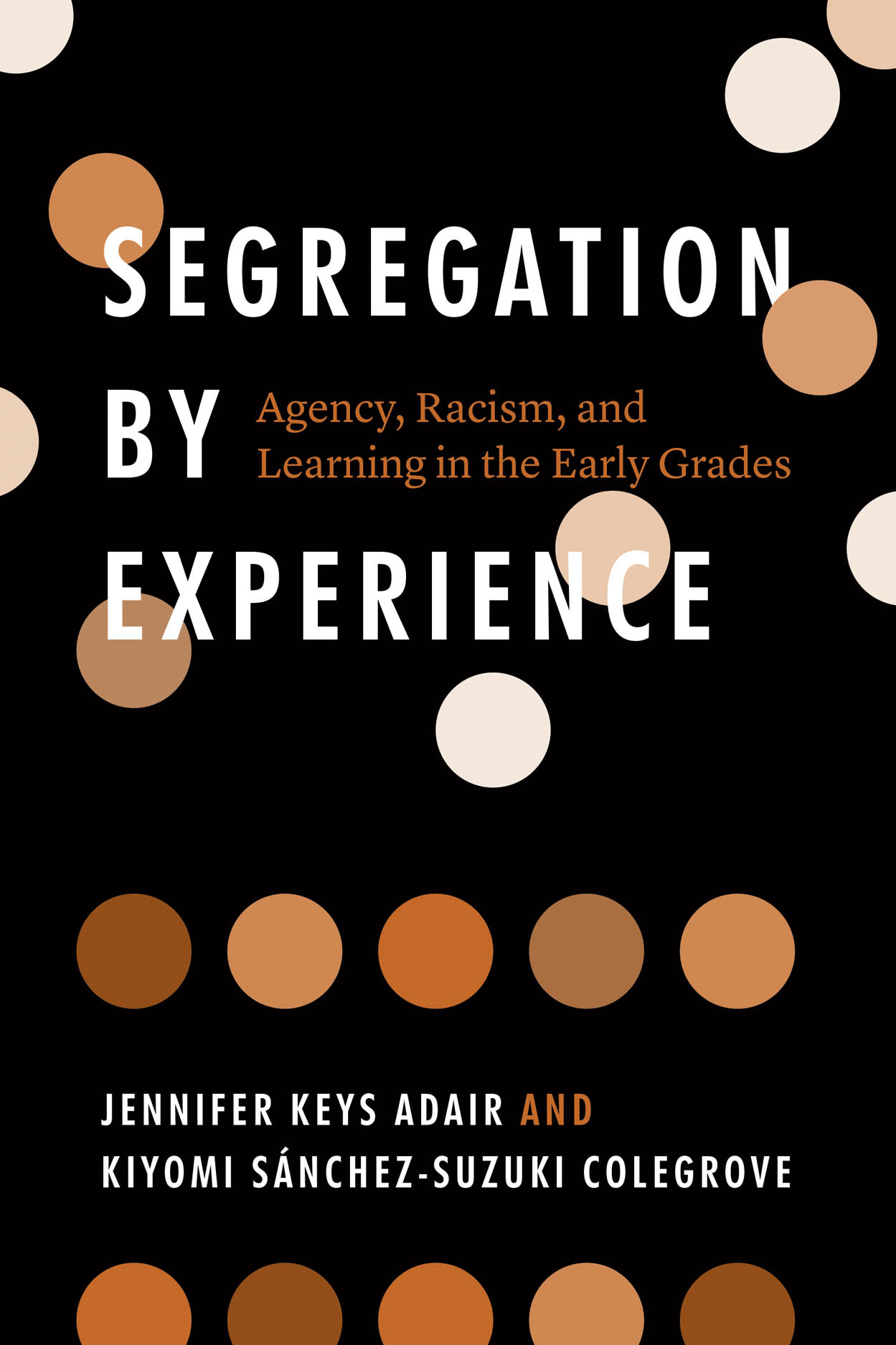
Segregation by Experience: Agency, Racism, And Learning In The Early Grades by Jennifer Keys Adair & Kiyomi Sánchez-Suzuki Colegrove

Interesting book authored by Drs. Jennifer Keys Adair & Kiyomi Sánchez-Suzuki Colegrove that should be helpful to those among us that work with elementary-level, culturally diverse students.  They are having a virtual book launch on May 3rd from 12-1 CST. You can RSVP here. 

According to my colleague, Dr. Adair, "It's an educational ethnography about the impact of racism and white supremacy on young children's schooling. The book privileges ideas about agency from interviews with over 100 Black and Latinx children in the U.S. 

You can order the book from anywhere really but you can get a 30% discount at this website with the discount code: EX56813. In June, the 20% discount is UCPEDU."

Do read the write-up below. All of this sounds so interesting.


-Angela Valenzuela

Segregation by Experience

AGENCY, RACISM, AND LEARNING IN THE EARLY GRADES

Segregation by Experience
2

JENNIFER KEYS ADAIR AND KIYOMI SÁNCHEZ-SUZUKI COLEGROVE

224 pages | 9 halftones, 6 tables | 6 x 9 | © 2021
Early childhood can be a time of rich discovery, a period when educators have an opportunity to harness their students’ fascination to create unique learning opportunities. Some teachers engage with their students’ ideas in ways that make learning collaborative--but not all students have access to these kinds of learning environments.
 
In Segregation by Experience, the authors filmed and studied a a first-grade classroom led by a Black immigrant teacher who encouraged her diverse group of students to exercise their agency. When the researchers showed the film to other schools, everyone struggled. Educators admired the teacher but didn’t think her practices would work with their own Black and brown students. Parents of color—many of them immigrants—liked many of the practices, but worried that they would compromise their children. And the young children who viewed the film thought that the kids in the film were terrible, loud, and badly behaved; they told the authors that learning was supposed to be quiet, still, and obedient. In Segregation by Experience Jennifer Keys Adair and Kiyomi Sánchez-Suzuki Colegrove show us just how much our expectations of children of color affect what and how they learn at school, and they ask us to consider which children get to have sophisticated, dynamic learning experiences at school and which children are denied such experiences because of our continued racist assumptions about them. 

Sunday, August 16, 2020

Early Childhood Resources that explore Race Equity with Young Learners from Paula Johnson at IDRA

Many thanks to Paula Johnson, Senior Education Associate at the Intercultural Development Research Association for Early Childhood Resources that explore race equity with young learners. 


Sunday, February 09, 2020

Can 'White Resentment' Help Explain Higher-Ed Cuts? by Eric Kelderman

It would be good to pair this piece with the one I just posted on how school integration isn't happening even when white parents say that they would prefer diverse schools for their children.  In this piece, researchers Taylor and Cantwell found that Republican lawmakers' decisions to fund higher education is similarly impacted by the proportion of enrolled undergraduate white students relative to their minoritized peers.

The paper it titled, "Partisanship, White Racial Resentment, and State Support for Higher Education."

This should concern us all.  Whites, included.

-Angela Valenzuela

Can 'White Resentment' Help Explain 
Higher-Ed Cuts? by Eric Kelderman

Jan 27, 2020
Graduates turn their tassels at the Y. of Georgia' spring commencement in 2019. "Republican
officials may be more skeptical of higher-education funding when the presumed beneficiaries
of government spending are racially diverse, "says a new scholarly paper.
Joshua L. Jones, The Athens Banner-Herald via AP Images

Blunt discussions of racism are increasingly showing up in research of state higher-education issues. A recent study into state appropriations for public colleges is one of a growing number of efforts to try to understand how considerations of race are driving policy decisions.

Take state appropriations, for example. Most studies of the issue rely on the assumption that state lawmakers are seeking to make rational choices in doling out tax dollars. One common explanation is that higher education serves as a sort of “balance wheel” for the state budget: Money for higher education increases in good economic times and decreases when state revenues fall, according to a new paper by Barrett J. Taylor, at the University of North Texas, and Brendan Cantwell, at Michigan State University.
But Taylor and Cantwell eyed instead a more sinister explanation. They suspected that Republican lawmakers, who are overwhelmingly white, would be less generous to an increasingly diverse higher-education landscape. “Republican officials may be more skeptical of higher-education funding when the presumed beneficiaries of government spending are racially diverse,” they posit in their paper, published last week by The Journal of Higher Education.
Cantwell and Taylor looked specifically at places where Republicans controlled both the legislative and executive branches of state government. And they measured how state appropriations differed when the undergraduate enrollment is either more diverse or less diverse than the overall state.
They found that Republican lawmakers were more generous to higher education in places where there was a higher proportion of white students enrolled as undergraduates. “The findings are quite robust,” said Cantwell, an associate professor of educational administration.
People might interpret those results very differently depending on their political leanings, Cantwell said, because the study doesn’t establish that Republican lawmakers are actively choosing to spend less on diverse populations of college students.
Still, the value of this particular paper may be the approach as much as the specific results, said Taylor, an associate professor of counseling and higher education at the University of North Texas.
Most research into higher education has focused on improving practice and policy and assuming that policy makers are acting in good faith. “There’s another part of research that is very comfortable thinking about higher education as part of the culture war,” Taylor said, “and trying to combine those two is relatively new.”

‘To Punish the Opposition’

The researchers looked at two basic variables: state appropriations between 2006, before the Great Recession, until 2015; and the racial diversity of undergraduates at public colleges.
On average, higher-education appropriations were about $220 less per student in states where Republicans controlled state government, the study found. But cuts to higher education were less in those states when white students were overrepresented in public-college enrollments compared with the state’s overall population. And cuts were greater when white students were underrepresented compared with the state.
Importantly, the differences in appropriations were not shown in states with Democratic control of government and overrepresentation of white students, the researchers found.
Though the differences were not large, per student, they were consistent, Cantwell said. “Part of the thing that can be frustrating to people is that our framework was quite big and the findings were quite narrow.”
And the relatively small amounts of money add up when multiplied by the thousands of students that might be enrolled at public colleges in any single state, Taylor said.
Other issues may have affected some of the outcomes, the study says, but they largely point to resentment among white Republican lawmakers against students of color.
“Some political actors might take positions on higher education in an effort to win electoral support by stirring negative partisanship and White resentment,” the authors write. “The consequences for higher education might be irrelevant when policy positions are intended to win votes.”
Those political dynamics have been on display when past Republican governors like Scott Walker, of Wisconsin, or Rick Scott, of Florida, repeatedly questioned the value and purpose of higher education in recent years, Taylor said.

Saturday, September 07, 2019

In Texas, a call to action against white supremacy by Michelle Garcia, CNN Opinion

Excellent piece in CNN.com written by journalist, Michelle Garcia.  She does a great job of showing how racism and white supremacy are institutionalized in Texas historically with a unique, specific brand of anti-Mexican-ness.  The irony of all this is that those that want to hurt and diminish not only our voices, but our very presence, is that their rhetoric, policies, and actions function to further unify the Latino community in solidarity.  

Glad to see this benefit concert taking place in El Paso soon in order to say "no" to white supremacy.  And as UCLA Professor Dr. Matt Barreto indicates, I, too, feel confident that these sentiments will show up at the ballot box in 2020.

-Angela Valenzuela

#ElPasoStrong
#ElPasoFirme
#TurnTexasBlue
#TexasIsABattlegroundState

In Texas, a call to action against white supremacy