Our Academia Cuauhtli Saturday school is a small school that differs from all the examples provided below in that it is partnered with the Austin Independent School District to provide a culture-rich curriculum to largely immigrant youth in the district's dual language program. Although this may change in the future, we only offer classes on Saturdays during the regular year. However, through the formal partnership and our sharing of our co-constructed curriculum district-wide together with the professional development opportunities with teachers we have conducted over the years, we are able to impact classrooms far beyond our "escuelita," our term of endearment for our little school.
What we all share is a critique of the high-stakes-testing educational landscape to which both public and charter schools are ensconced. We should never give up on our critique or advocacy for less mental testing. In the meantime, escuelitas are the way to go.
-Angela Valenzuela
Rise of the microschool: Small, student-centered learning spaces take off
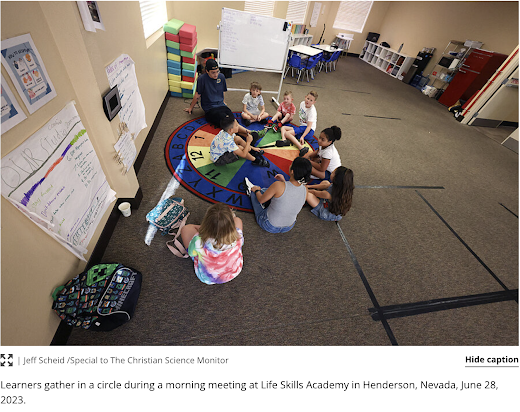
By Jackie Valley Staff writer | Christian Science Monitor
August 14, 2023| HENDERSON, NEV.; AND DENVER
In the back room of a Jewish temple, the kids are running the show.
It’s just after 6 p.m. on a Thursday, and the learners at Life Skills Academy have invited their parents to take a seat. Board games and video games – made by the older children – await the visitors, who, for the next hour, will try them out.
As her classmate gives the go-ahead, 7-year-old Freya Rollinson leads her father and younger brother to a corner. Her exuberant giggles punctuate the directions she’s trying to explain. She says the goal of the game, which features square blocks designated as creatures such as a dog, snake, and unicorn, is to “try not to get tricked.”
“What made you pick all these?” her father, Piers Rollinson, asks.
“My mind,” she replies.
Her answer speaks to the very nature of this learning environment. By Nevada law, Life Skills Academy can’t call itself a school, but education is its mission, albeit in an atypical format. The Montessori-inspired microschool, which rents space at the Jewish temple, served 13 children from age 5 through fifth grade during its inaugural 2022-23 academic year.
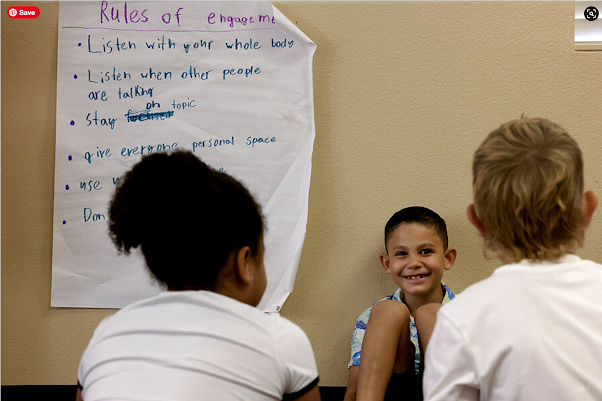
But don’t call them students. Here, they’re “learners” who chart their own educational journey through critical thinking and project-based learning. They even make up the classroom rules. The two teachers, known as “learning guides,” take a supporting role in the background.
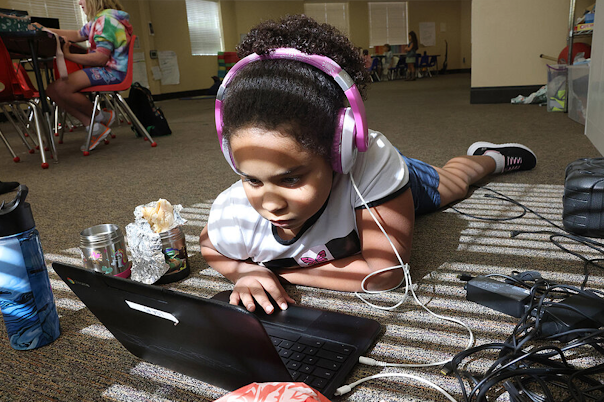
“We’re building a civil society from scratch,” says James Lomax, founder and director of Life Skills Academy, which is part of the Acton Academy network of microschools. “They, over the course of that first six weeks, make the rules that they live by.”
Most passersby wouldn’t know this place exists. And, in some ways, that’s symbolic of the entire microschooling movement. Tiny learning environments – reminiscent of the one-room schoolhouse – are sprouting in churches, temples, commercial spaces, and even houses across the United States. They’re in bustling cities, rural communities, and suburban enclaves.
Oftentimes, they’re created by parents or teachers who wanted something for their children or students that couldn’t be readily found in traditional schools. But it was the pandemic that thrust this model into the limelight, as families scrambled to make remote learning work. So-called learning pods came into vogue, with kids clustered around kitchen tables, working elbow to elbow with neighborhood pals, relatives, or family friends. The city of North Las Vegas even temporarily ran its own microschools in recreation centers during the pandemic.
Some saw this approach as a Band-Aid solution to a difficult situation. For others, it was just the beginning.
“For lots of people, schools just got too big,” says Michael McShane, director of national research at EdChoice. “They felt like they were a number. They did not feel like they knew the other people in their community.”
Ask a dozen microschool leaders to describe their schools, and you’ll likely receive a dozen slightly different responses:
Montessori-inspired, nature-focused, project-based, faith-oriented, child-led, or some combination of other attributes. They may exist independently, as part of a provider network, or in partnership with another entity such as an employer or a faith organization. Their schedules vary, too. Some follow a typical academic calendar, while others operate year-round, and some allow students to attend part time.
In other words, there is no one-size-fits-all definition for microschools. But, in general, they’re intentionally small learning environments. They often serve fewer than 30 students total and operate as learning centers to support home-schooled students or as accredited or unaccredited private schools. Their exact designations differ based on state laws.
“What I love about microschools is that [they’re] kind of providing this middle ground between public school or home schooling,” says Dalena Wallace, founder and president of Wichita Innovative Schools and Educators, a support network for alternative education models.
The National Microschooling Center launched in August 2022 to support this patchwork quilt of tiny learning communities dotting the American landscape. For a sector analysis released in April, the center examined 100 microschools that exist in 34 states, as well as 100 prospective microschools preparing to open. Though it’s difficult, if not impossible, to pinpoint the exact number of students attending microschools, researchers say it’s likely between 1.1 million and 2.1 million. On the low end, that would mean microschools serve an estimated 2% of school-age children in the U.S.
“I don’t expect that it’s ever going to displace public school systems,” says Don Soifer, CEO of the National Microschooling Center, which is based in Las Vegas. “But it really wouldn’t surprise me if you were to get much closer to a 10% market share.”
Rise of the microschool: Small, student-centered learning spaces take off

August 14, 2023| HENDERSON, NEV.; AND DENVER
In the back room of a Jewish temple, the kids are running the show.
It’s just after 6 p.m. on a Thursday, and the learners at Life Skills Academy have invited their parents to take a seat. Board games and video games – made by the older children – await the visitors, who, for the next hour, will try them out.
As her classmate gives the go-ahead, 7-year-old Freya Rollinson leads her father and younger brother to a corner. Her exuberant giggles punctuate the directions she’s trying to explain. She says the goal of the game, which features square blocks designated as creatures such as a dog, snake, and unicorn, is to “try not to get tricked.”
“What made you pick all these?” her father, Piers Rollinson, asks.
“My mind,” she replies.
Her answer speaks to the very nature of this learning environment. By Nevada law, Life Skills Academy can’t call itself a school, but education is its mission, albeit in an atypical format. The Montessori-inspired microschool, which rents space at the Jewish temple, served 13 children from age 5 through fifth grade during its inaugural 2022-23 academic year.
But don’t call them students. Here, they’re “learners” who chart their own educational journey through critical thinking and project-based learning. They even make up the classroom rules. The two teachers, known as “learning guides,” take a supporting role in the background.

“We’re building a civil society from scratch,” says James Lomax, founder and director of Life Skills Academy, which is part of the Acton Academy network of microschools. “They, over the course of that first six weeks, make the rules that they live by.”
Most passersby wouldn’t know this place exists. And, in some ways, that’s symbolic of the entire microschooling movement. Tiny learning environments – reminiscent of the one-room schoolhouse – are sprouting in churches, temples, commercial spaces, and even houses across the United States. They’re in bustling cities, rural communities, and suburban enclaves.
Oftentimes, they’re created by parents or teachers who wanted something for their children or students that couldn’t be readily found in traditional schools. But it was the pandemic that thrust this model into the limelight, as families scrambled to make remote learning work. So-called learning pods came into vogue, with kids clustered around kitchen tables, working elbow to elbow with neighborhood pals, relatives, or family friends. The city of North Las Vegas even temporarily ran its own microschools in recreation centers during the pandemic.
Some saw this approach as a Band-Aid solution to a difficult situation. For others, it was just the beginning.

“For lots of people, schools just got too big,” says Michael McShane, director of national research at EdChoice. “They felt like they were a number. They did not feel like they knew the other people in their community.”
Ask a dozen microschool leaders to describe their schools, and you’ll likely receive a dozen slightly different responses:
Montessori-inspired, nature-focused, project-based, faith-oriented, child-led, or some combination of other attributes. They may exist independently, as part of a provider network, or in partnership with another entity such as an employer or a faith organization. Their schedules vary, too. Some follow a typical academic calendar, while others operate year-round, and some allow students to attend part time.
In other words, there is no one-size-fits-all definition for microschools. But, in general, they’re intentionally small learning environments. They often serve fewer than 30 students total and operate as learning centers to support home-schooled students or as accredited or unaccredited private schools. Their exact designations differ based on state laws.
“What I love about microschools is that [they’re] kind of providing this middle ground between public school or home schooling,” says Dalena Wallace, founder and president of Wichita Innovative Schools and Educators, a support network for alternative education models.
The National Microschooling Center launched in August 2022 to support this patchwork quilt of tiny learning communities dotting the American landscape. For a sector analysis released in April, the center examined 100 microschools that exist in 34 states, as well as 100 prospective microschools preparing to open. Though it’s difficult, if not impossible, to pinpoint the exact number of students attending microschools, researchers say it’s likely between 1.1 million and 2.1 million. On the low end, that would mean microschools serve an estimated 2% of school-age children in the U.S.
“I don’t expect that it’s ever going to displace public school systems,” says Don Soifer, CEO of the National Microschooling Center, which is based in Las Vegas. “But it really wouldn’t surprise me if you were to get much closer to a 10% market share.”


