Translate

Showing posts with label translanguaging. Show all posts

Wednesday, July 26, 2023

What Is Translanguaging and How Is It Used in the Classroom? by Ileana Najarro

Frankly, I always felt that language in the traditional bilingual language classroom was too stiff, creating distinct lanes for English and Spanish despite a real complexity of language often referred to as "Tex-Mex" that teachers looked down on when I was growing up. I imagine that many people still do. 

Not so in the world of bilingual education, with CUNY Graduate Center Professor Dr. Ofelia Garcia and her students like Dr. Nelson Flores and others.

When I think of the concept of translanguaging, the word, "freedom," pops immediately into my head. This piece by Ileana Najarro in Edweek affirms that view.

-Angela Valenzuela


What Is Translanguaging and How Is It Used in the Classroom?


Getty


By Ileana Najarro — July 13, 2023 | Edweek


For years, research into the best instructional approaches for students identified as English learners has pointed to the concept of translanguaging.

Identified by bilingual education researcher Ofelia García, it’s both a skill set and a total shift in the way language is thought of, used, and taught in K-12 classrooms where multiple languages are honored and addressed, even as English remains the dominant language of instruction, said Marybelle Marrero-Colon, the associate director of professional development for the Center for Applied Linguistics.

Researchers are looking into how it can be applied to formal assessments, such as state standardized tests on which English learners might struggle to demonstrate their academic proficiency because they are tested in an unfamiliar language.

Here’s a look at what translanguaging means in the context of classroom instruction and how all educators, including monolingual English-speaking teachers, can cultivate spaces for translanguaging to occur.

What is the definition of translanguaging?

Translanguaging is the ability to move fluidly between languages and a pedagogical approach to teaching in which teachers support this ability.

In translanguaging, students are able to think in multiple languages simultaneously and use their home language as a vehicle to learn academic English.

A student could be reading an article about the solar system in English, but in their brain, they are also thinking and making connections in Spanish. They might annotate in Spanish or first write down reading comprehension responses in Spanish and then figure out how to provide the responses in English, said Marrero-Colon.

It’s all about encouraging students to access their full linguistic repertoires, said Emily Phillips Galloway, an assistant professor at the Peabody College of Education at Vanderbilt University.

Translanguaging is also multimodal. More research is underway, for instance, on hearing impaired translanguaging by students who are part of families with American sign language, Spanish sign language, and signs families create for themselves, said Maria Cieslak, the professional development content manager at the Center for Applied Linguistics.

How is translanguaging used in the classroom?

Teachers can engage in a variety of activities that deliberately encourage translanguaging, ranging from providing vocabulary in multiple languages to collaborative translation opportunities. The goal is to get students translanguaging as a practice that can be leveraged toward supporting literacy outcomes and engagement, as well as other academic endeavors.

For example, two students could be assigned to solve a word problem, and one might be stuck on a word in English. The two students can then use an equivalent word in their home language to make sense of what the word problem is asking of them, Phillips Galloway said.

Or in group activities, students can be prompted to share with the rest of the class how something taught in English would make sense in Spanish by highlighting similar and different grammatical structures between the two languages, Marrero-Colon said.

“When you translate, you don’t have to do it word for word. You’re really trying to capture the feeling of that text,” Marrero-Colon said.

Once teachers start doing these activities, research has found that students who have not spoken before start speaking and students who were not as engaged in text-comprehension activities suddenly are, she added. That’s occurring because they are being encouraged to use their home language in class to think about language use overall.

How is translanguaging different from translation?

Translanguaging extends beyond translation to something where students gain an understanding of how language functions and works.

Although translation activities are a way to engage in translanguaging, it’s not word-for-word translation. It’s about a student using the words and thoughts they have in their home language to make sense of English and then be able to respond in English, said Kia Johnson, the director of PreK–12 language and literacy at the Center for Applied Linguistics.

Translanguaging requires students to think about language components such as the placement of adjectives, what cognates are in various languages, and more in multiple languages at once, Phillips Galloway said.

Does translanguaging require bilingual teachers?

Teachers don’t have to speak the home languages of students to help them engage in translanguaging.

It does require teachers to be comfortable being a learner themselves as students teach them what they know about their own language. Some teachers may fear that students may engage in off-task behavior in languages the teachers don’t understand, but research has found that in such cases, teachers are still able to register what is going on and get students back on task, Phillips Galloway said.

She also said that teachers who work in states with laws requiring English-only instruction can and should still allow students to use other languages in the classroom to help them access academic content.

The key, Marrero-Colon said, is flexibility. For instance, a student may need to write an essay in English. They can instead start with building a PowerPoint primarily of images that convey a story or meaning. The teacher can then use the PowerPoint to help students come up with words and phrases, then move to sentences and paragraphs, and so on.

Does translanguaging just benefit English learners?

All students can benefit from a classroom welcoming of translanguaging because few use academic English at home, regardless of their home language.

For instance, Black students may be fluent in African American Vernacular English and can use translanguaging activities to engage in academic classroom English, Johnson said.

An example of English-only translanguaging is asking students to turn William Shakespeare’s sonnets into modern pop songs, because it is a use of language in different registers, or levels of formality, Phillips Galloway said.

Students are also more interested in acquiring more languages after hearing their peers use their home languages, which helps them succeed in an increasingly global society, she added.

Would translanguaging hinder a student’s ability to acquire English?

The more opportunities students have to use language, whether that’s English or not, breeds more language use, which is then associated with language learning.

“I think the mistake that we often make is that we don’t help students to make the connections between the linguistic resources that they bring in languages other than English,” Phillips Galloway said. “And in the course of doing that, we take a whole set of resources that could be used for comprehending texts as they read in English, or learn to write text in English, we take those resources off the table.”

More research has found that allowing students to participate in translanguaging helps English learners eventually outperform their monolingual peers because they become more flexible in thinking about and using language in academic contexts, Marrero-Colon said.

How can schools overall better encourage translanguaging?

Improved curriculum, professional development, and mindsets around the value of home languages can all help schools to encourage translanguaging and support students in the process.

Phillips Galloway is working with colleagues on a curriculum that better guides teachers in translanguaging activities since not all curricular materials recognize the concept.

Researchers at the Center for Applied Linguistics, including Cieslak, also work on professional development and policy discussions that help educators and policymakers alike understand how English learners bring with them linguistic assets that should be nurtured for overall academic success.

“It’s about understanding cultural identity, and my language is part of my identity,” Cieslak said. “And I’m going to naturally translanguage, whether you tell me I can or cannot.”


Thursday, December 26, 2019

‘¿Qué Es Una Lengua Pura?': College Class Challenges Negative Perceptions of Spanglish

It really is unfair to Mexican Americans and other brown people that they should be expected to know Spanish when this has been mostly denied to us in this country, particularly as non-immigrant, Mexican Americans—who are, of course, the largest share of all Mexican-origin peoples.
I can speak personally to how this is frequently a painful experience to see not only others' expectations frustrated or disappointed, but to hold oneself up to these same expectations when the support for Spanish is intentionally, via language policy, not there either in the classroom, workplace, social media, or society, as a whole.

And then we're even more shamed when non-Latinos—because of their travels abroad or the benefits from a dual language education program—speak Spanish fluently. This despite the fact that for so many of us, as well, our childhood tongue, our first language, is Spanish. I wrote a whole book about this titled, Subtractive Schooling, that I encourage you to read if anything like this describes you—or even if it doesn't so that you can be informed about the complexities of the situation.

Sadly, most Latin@ children in this country are on the receiving end of implicit and explicit messages that their Spanish and identities are wrong—when nothing could be further from the truth! As suggested herein, when their identities and speech are hybridized, the world is that much more nuanced and rich.

For these reasons, speaking, reading, and writing in Spanish has been a lifelong project for me. Career-wise, as well. I advocate with others in my community to extend language rights and opportunities to children and local, district, and state levels. This is and continues to be a Mexican American Civil Rights agenda supported by pretty much all of our national, Civil Rights organizations (e.g., LULAC, MALDEF, LatinosUS, National Association for Bilingual Education [NABE], and the National Latino Education Research and Policy Project [NLERAPP]).

To help at least some children to not have to endure the pain and humiliation associated with unfair societal expectations, on the one hand, and to celebrate bilingualism and multiculturalism, on the other, we founded a Spanish language revitalization project, a Saturday school named Academia Cuauhtli (Eagle Academy), in Austin, Texas. We want our children to value and speak the Spanish language and for our families to be supported in this way. We also want them to think critically about the many social and historical forces that have worked to delimit our power as individuals and as a community and how to struggle effectively against this.
Another point related to this piece below is that the very concept that there is a pure language is false. Languages that are pure die. Remember Latin? Esperanto? With some estimates as low as 20%, only up to 33% maximum of English is derived from Old English. We don't think about it that way, but we're always "code switching" just speaking the English that we speak. Thanks to Noelia Cortez for sharing. -Angela Valenzuela

‘¿Qué Es Una Lengua Pura?': College Class Challenges Negative Perceptions of Spanglish

  OCT 25, 2019


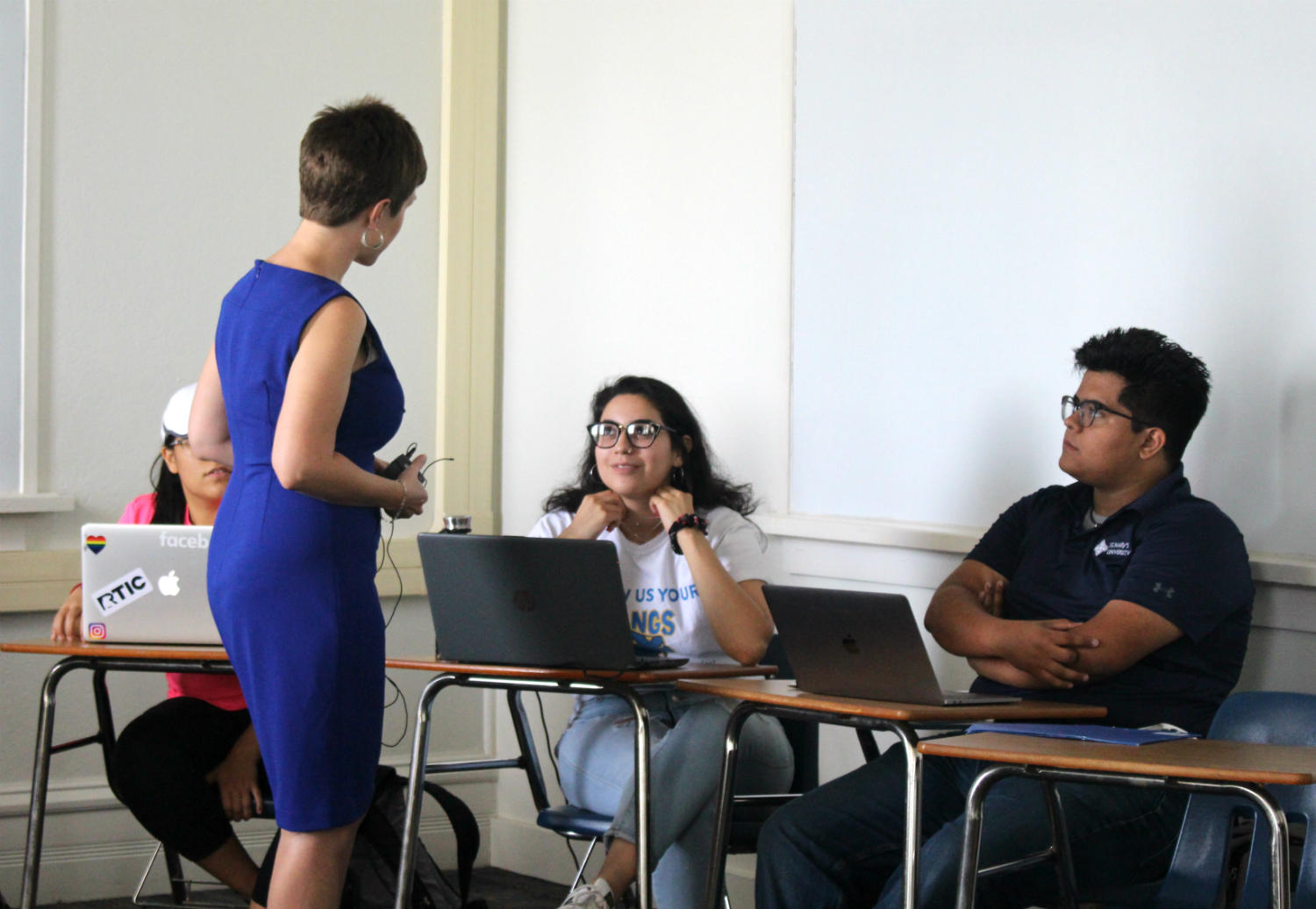
St. Mary's University Professor Meghann Peace speaks to a student in her Heritage Spanish class on Sept. 23, 2019.
CAMILLE PHILLIPS | TEXAS PUBLIC RADIO


College freshman Angie Bravo’s first language is Spanish, but she wishes she were better at it.

The 18-year-old grew up in Laredo, Texas, just across the border from Mexico. Like many of her neighbors, she speaks a version of Spanish influenced by English.


Even in a state like Texas, where nearly 30% of the population speaks Spanish at home, there’s a perception that it’s better to speak “pure Spanish.”

But, as Bravo is learning this semester, there’s nothing wrong with the way she speaks the language. It’s just a different dialect than the one spoken in Madrid or Mexico City.
A Dialect Like Any Other
Instead of focusing on grammar and vocabulary, St. Mary’s University’s Cultural Spanish for Heritage Speakers class covers the history and culture of U.S. Spanish, the dialect commonly called Spanglish.
Professor Meghann Peace set up a recent lesson by asking students to match Spanish words with their languages of origin: Greek, Latin, Arabic, indigenous American tongues.
“What history teaches us is that the only constant is change,” Peace said in Spanish. “Whenever two languages have geographic contact they’re going to influence each other.”
She showed the class quotes about Spanglish from poet Octavio Paz and literary critic Roberto González Echevarria — Paz called it “abominable”; Echevarria called it an “invasion” — and asked the students if they ever get negative reactions like that when they speak in Spanish.
Students in St. Mary's University's Heritage Spanish class look at quotes illustrating negative opinions about the U.S. Spanish dialect commonly called Spanglish.
CREDIT CAMILLE PHILLIPS | TEXAS PUBLIC RADIO

Mary Villines said people who only speak Spanish or English sometimes assume she doesn’t speak their language well if she code-switches.
“But what bothers me is that they only speak one language,” Villines said in Spanish. “Who are you to correct me when you don’t even know what I’m trying to say?”
Peace said that people who speak Spanglish actually know both languages well.
“Spanglish is super systematic,” Peace said in Spanish. “Someone who switches between languages in a single sentence follow the syntax rules of both languages.”
Language and Identity
That explanation resonated with Bravo, who said the class is starting to change her opinion of the way she speaks Spanish.
“It's taught me to be a lot more accepting,” Bravo said. “I'm still aiming to be able to carry a full conversation in Spanish … but I didn't really take into account the rules that we don't speak about, but we understand.”
For her, language is intertwined with the changing way she sees herself.
“When I was growing up, I had a lot of issues being Hispanic. I didn't understand, like, what does it mean to be Hispanic? Should I be Hispanic? Or should I be American? And so I think it's because I struggled with that, that I want to be able to do both,” Bravo said. To be able to speak Spanglish is to be able to say to people that I am Mexican American, and that's okay. I don't have to be either or.”
Bravo said that feels especially important right now “because of the political commotion around what it is to be Hispanic, and all of the violence now being enacted towards the Hispanic groups.”
In August, a man killed 22 people at an El Paso Walmart. The alleged gunman told police when he was arrested that he drove 10 hours to the border town to target Mexicans.
St. Mary's University Professor Meghann Peace shows students how Spanglish speakers follow the syntax rules of both Spanish and English when they code switch on Sept. 23, 2019.
CREDIT CAMILLE PHILLIPS | TEXAS PUBLIC RADIO
The Role of Culture and Society
Bravo’s classmate, Elisha Carrillo, had a different experience with Spanish growing up. But the class is also helping her better understand her family’s relationship to the language.
Carrillo’s family has lived in San Antonio for generations. Her mom and grandma speak Spanish, but they didn’t really teach it to her.  Instead, she learned Spanish in school.
“My grandparents talk a lot about being discriminated in school for speaking Spanish, and, you know, being hit,” Carrillo said. “I think, just like subconsciously, they think we're not supposed to speak that.”
In the 1950s and 60s it was common practice in some schools to punish students for speaking Spanish, even on the playground.  At the time, Texas had an “English only” policy for schools.
For Carrillo, learning Spanish in school is a way to reclaim part of her cultural identity. But, at the same time, she gets frustrated by people who expect her to be able to speak the language.
When she studied abroad in Spain last semester, people were surprised to learn she was American.  When she was little people would walk up to her in stores in San Antonio and ask her questions in Spanish.
“I think people get confused because they assume if you're Brown, you speak perfect Spanish,” Carrillo said. “People everywhere just expect you to be a certain way because of how you look.”

St. Mary's University students discuss code switching with Professor Meghann Peace during their Heritage Spanish class Sept. 23, 2019.
CREDIT CAMILLE PHILLIPS | TEXAS PUBLIC RADIO
Carrillo’s professor, Meghann Peace, said her students know more Spanish than they think they do. Several of them were originally signed up for a more traditional lower-level language class.
“They thought they didn't speak it well. And on the first day, I heard them talking, and I said, ‘Oh, no, no, no. Don't even — don't give me that. You do. You do know this,’” Peace said.
Her goal for the class is for her students to practice writing in standard Spanish, so they can use that dialect if and when they want to. But she also wants them to become more confident in their skills, and be able to defend their use of Spanglish.
“A standard dialect is simply the standard because the people who are in power made it the standard,” Peace said. “Why are we seeing this as something bad or unnatural or an attack against the purity of the language? Which is, of course, silly, because there's no such thing as pure language.”
Peace isn’t the only educator working to normalize Spanglish. According to a 2016 survey by Daniel Villa of New Mexico State University, there are roughly 40 universities across the country that teach a course on U.S. Spanish.
Camille Phillips can be reached at Camille@tpr.org or on Twitter @cmpcamille.