Translate

Showing posts with label #TeachTheTruth. Show all posts

Thursday, June 08, 2023

History Is a Human Right, by Jesse Hagopian


Great piece by Jesse Hagopian. This quote connects well to the earlier piece on fascism that I just posted:

"We now live in an era defined by the rise of anti-truth and anti-history laws. The outlawing of an honest education represents a sharp turn toward authoritarianism in the United States — what historian Barbara Ransby has called proto-fascism — where now almost half of students are subjected to some form of banning of the truth about systemic racism and oppression.

The goal of these laws is to deny young people access to the lessons of history that could aid in building struggles against inequity."

Let's not reproduce the nonsensical statement that we live in a
"post-truth" world when it's really fascism that's at play.

History absolutely is a human right—and it's essential to the fight against book bans and for trans rights, Ethnic Studies, women and genders studies, and so on. and youth and community empowerment. Go to this link by the Zinn Education Project if you want to connect to the June 10th national Teach The Truth mobilization happening on Saturday.

Great job, Jesse!

-Angela Valenzuela

#TeachTheTruth


From Stone Mountain to the Stonewall Inn, the #TeachTruth National Day of Action fights back against anti-history legislation. 

Jesse Hagopian 
May 24, 2023
Word in Black 

Pasadena MD at Banned Books Photo Booth, June 2022, Photograph courtesy of Lynda Davis, Zinn Education Project

With almost half of all students in the United States attending a school whose educators have been given educational gag orders to prohibit them from teaching honestly about the history of systemic racism, a grassroots network of educators, parents, and students across the country are organizing a #TeachTruth National Day of Action on June 10, 2023, to fight back.

Research from the CRT Forward Tracking Project out of the UCLA Law School reveals that measures attacking truthful teaching about race have been passed at either the federal, state, or local level in every state except Vermont — laws that impact “over 22 million public school children, almost half of the country’s 50.8 million public school students.”

The impact of these anti-history laws is difficult to overstate. In Iowa, high school teacher Greg Wickenkamp asked his superintendent, “Knowing that I should stick to the facts, and knowing that to say ‘slavery was wrong,’ that’s not a fact, that’s a stance, is it acceptable for me to teach students that slavery was wrong?” Instead of giving the only morally acceptable answer—”Yes! Slavery was wrong” — Noll replied: “We had people that were slaves within our state. We’re not supposed to say to [students], ‘How does that make you feel?’ We can’t — or, ‘Does that make you feel bad?’ We’re not to do that part of it.”

Wickenkamp described another attack on an Iowa educator that highlights that the worst attacks have been perpetrated against women of color: “I had a colleague who was a Latina teacher. She was pushed out because of hostile treatment. The strain and hostility she faced was much worse than anything I faced. I don’t know if she’ll return to teaching or not, but she was the first generation in her family to go to college — her case is markedly more challenging because of systemic factors.”

Experiences such as those in Iowa have been all too common around the country as attacks on truthful teaching about race, gender, and sexuality are being used as a campaign strategy for the Republican Party. Chris Guerrieri, a 22-year veteran teacher from Duval County, Florida, explained to local media, “An admin of the district recently told the media specialist that if you’re teaching slavery, make sure you’re teaching the positive sides of it as well.”

An admin of the district recently told the media specialist that if you’re teaching slavery, make sure you’re teaching the positive sides of it as well.

Chris Guerrieri, 22-year veteran teacher in Florida

Another educator — in Florida, where a bill was recently passed to make it a third-degree felony (carrying up to five years in jail and a $5,000 fine) to be caught with verboten books on race, gender, or sexuality — responded to a survey by the Zinn Education Project (ZEP), saying, “I’m terrified to say anything about enslavement because it might make students ‘uncomfortable.’ I also can’t recommend ANY books because a parent might not like it and then I could be charged with a felony.”

Another spoke to the way these laws are discouraging many educators from engaging in antiracist lessons: “It is creating a chilling effect on education. We continue to teach the truth, but with much less certainty what the consequences will be for doing so.” As of June 2022, The Washington Post had identified at least 160 educators who lost their job or resigned because they taught about race or LGBTQ+ issues — and there are undoubtedly scores more charged with violating anti-truth laws who have been pushed out of the classroom that have gone unreported.

Faced with this assault on the truth, educators around the country are turning the world into their classroom on June 10 and defying the billionaires funding the attack on antiracist education with public pedagogy at an array of creative events. In Lansing, Michigan, organizers are gathering at the corner where Earl Little — father of Malcolm X — was almost certainly lynched by being thrown in front of a streetcar. They’re walking to the hospital where he died to deliver banned children’s books to the kids in their care. Along the way, they plan to chalk the sidewalks with historical information about the Black Freedom Struggle.


In Boston, the Ethnic Studies Organizing Committee is meeting at the former headquarters of the city’s Black Panther Party chapter to help educate people about history that often gets left out of corporate textbooks.

In New York City, there are multiple gatherings, including one at the Stonewall Inn, where legendary Black transgender activist Marsha P. Johnson helped lead a rebellion against a police raid that became the inspiration for the annual Pride demonstrations around the country.

“At Stonewall, we will discuss what took place within those historic walls in 1969, and what action we can take to support LGBTQIA+ rights today,” organizers wrote. “We will share stories about LGBTQIA+ history that often go overlooked.”

In Stone Mountain, Georgia, the Stone Mountain Action Coalition, and other groups are organizing a rally at Stone Mountain Park, site of the largest Confederate monument in the world. The engraving on the side of Stone Mountain depicts Confederate President Jefferson Davis and Confederate Generals Robert E. Lee and Thomas J. “Stonewall” Jackson.

Organizers will read aloud the picture book, “That Flag” (by Tameka Fryer Brown, illustrated by Nikkolas Smith), a story about two young girls — one Black, one white — whose friendship is tested when the white girl’s family displays the Confederate flag and they learn the truth about its racist history.

It is creating a chilling effect on education. We continue to teach the truth, but with much less certainty what the consequences will be for doing so.

In Harmony, Mississippi, organizers are planning an event to highlight the rich contributions to the Black Freedom Struggle that people from their town have made. During the summer of 1964, members of the Student Nonviolent Coordinating Committee organized a Freedom School site in the Harmony community.

The Teach Truth Day of Action events respond to right-wing attacks that have deep roots. During the late 1940s and 50s, the second Red Scare (characterized by the attacks led by Sen. Joseph McCarthy and others on anyone they wanted to discredit by labeling them communists) was accompanied by the Lavender Scare — the repression of LGBTQ+ people and their mass firing from government service. The combination of the Red Scare and the Lavender Scare led to the firing of thousands of teachers around the country.

Just as the Red Scare and Lavender Scare were used to purge teachers and prohibit discussion of social and racial justice in school, the attacks on what history deniers have labeled “critical race theory” and “gender ideology” are used today to fire educators and exclude discussions about structural racism, sexism, transphobia, and homophobia.

We now live in an era defined by the rise of anti-truth and anti-history laws. The outlawing of an honest education represents a sharp turn toward authoritarianism in the United States — what historian Barbara Ransby has called proto-fascism — where now almost half of students are subjected to some form of banning of the truth about systemic racism and oppression.

The goal of these laws is to deny young people access to the lessons of history that could aid in building struggles against inequity.

The goal of these laws is to deny young people access to the lessons of history that could aid in building struggles against inequity.

History is a human right. The struggle for social justice is many things. However, especially in this era, it must include the recognition of the right to learn honest history — particularly about social movements that have challenged injustice. Without truthful accounts of history and the truthful transmission of that history to the next generations, young people are robbed of the first condition of a democratic society — access to the knowledge needed to shape the future.

You, too, can join the #TeachTruth National Day of Action on June 10. Find an event near you. Or, organize your own. An increasing number of communities refuse to repeat the scapegoating and paranoia of the McCarthy era; we won’t let them use race, gender, and sexuality to divide and conquer us.

Tyler Walker, a high school language arts teacher from Austin, Texas, drove this point home when he signed the Zinn Education Project’s “Pledge to Teach the Truth” and wrote “Students need to know the wonderful stories of the brave folks that fought against systems of oppression and sparked hope and solidarity for the creation of a freer, kinder world.”

Get Word In Black directly in your inbox. Subscribe here today

Jesse Hagopian is a high school teacher in Seattle, an editor for Rethinking Schools magazine, an organizer with Black Lives Matter at School, and serves on the leadership team of the Zinn Education Project. Jesse is the author of the forthcoming book from Haymarket Books, Teach Truth: The Attack on Critical Race Theory and the Struggle for Antiracist Education, and the co-editor of the books, Teaching for Black Lives, Black Lives Matter at School, and Teachers Unions and Social Justice. You can connect with Jesse on Twitter, @jessedhagopian, or IG, @jessehagopian.

Monday, March 27, 2023

"Statue of Liberty Wears Chains and Shackles Honoring Freed Slaves" by Sharon Kyle | The LA Progressive

This is a largely unknown story about Lady Liberty's shackles and the cover up that's ensued since 1865. This is the first that I learn that the Statue of Liberty was, I quote:  "given to the U.S. as a monument to acknowledge the end of one of its biggest mistakes  — slavery."  It's really interesting that the original depiction of Lady Liberty had her "holding broken chains in her left hand, with more broken chains and broken shackles at her feet."

But, what most people don’t know, even today, is that Bartholdi left the broken shackles and chains that were at her feet (my emphasis).  These symbols of state-sponsored bondage, human chattel and the hypocrisy of American exceptionalism remain there on the Statue of Liberty as a permanent reminder of the slaves that contributed to the building of the United States.

This project was the brainchild of Edouard de Laboulaye, a French person behind on of our nation's most important icons.  Laboulaye was an abolitionist from France and co-founder of the French Anti-Slavery Society.  The sculptor, also French, was named Frederic Bartholdi.  The two planned all of this in 1865, the very year the U.S. passed the 13th amendment to the U.S. Constitution officially abolishing slavery.  However, due primarily to financing issuesand possibly, ideological ones, as well, as this story intimates, the actual installation on Liberty Island occurred 21 years later in 1886. Bartholdi ultimately had to compromise on this or jeopardize the financing of the project.

As the author muses, perhaps the financiers of this project themselves profited from slavery and were thus resistant to this representation.  Or maybe they were just exercising their privilege—and thusly, their power over representation and—much like many folks do today to appear as less racist than they really are, thinking, I suppose, that this detail would get lost over the generations.  Only more research can tell.  

In any case, a new book by Yasmin Sabina Kahn titled, Enlightening the World: The Creation of the Statue of Liberty, delves into this story which is deserving of our attention. Kahn refers to
Bartholdi's original depiction where she held broken chains on her left hand, and broken shackles at her feet, symbolizing the end of slavery in the U.S.

This history is totally buried in American lore about Lady Liberty. Geez, what we are not taught or ever told and that our legislatures want to keep us from learning.

-Angela Valenzuela

#TeachTheTruth

Reference

Khan, Y. S. (2010). Enlightening the world: the creation of the Statue of Liberty. Ithaca, NY: Cornell University Press.

Statue of Liberty Wears Chains and Shackles Honoring Freed Slaves


The LA Progressive ran a story in the spring of 2011 that began with a
video of Sarah Palin being interviewed at Liberty Island. In it she is
asked about the symbolism of the Statue of Liberty, she responded:

https://youtu.be/AM2CmpFMnSY

“It is, of course, the symbol for
Americans to be reminded of other countries because this was gifted us,
of course by the French—other countries warning us to never make the
mistakes that some of them had made.”

Paraphrased, Palin was saying that France gave the United States the
statue to warn the U.S. not to commit the mistakes other countries 
committed.

The problem with her response –American exceptionalism and word salad aside
— is that it has no basis in fact. In other words, it is WRONG.

Historians tell us that the Statue of Liberty represents the OPPOSITE of
what Palin suggests. Instead of reminding the United States not to make
mistakes made by other countries, the Statue of Liberty was given to
the U.S. as a monument to acknowledge the end of one of its biggest
mistakes  — slavery.


When we ran the story in 2011, we got lots of feedback from readers
who were surprised to learn that our Statue of Liberty was in any way
connected to American slavery. However, several of our readers did some
checking on their own and commented that they couldn’t find information
corroborating our story. Some mentioned that the U.S. National Park
Service (the federal agency responsible for the Statue of Liberty)
offered information on their site that did not line up with what we were
reporting.


In 2011, the U.S. Park Service made no mention of the chains or the
connection between the emancipation of the American slaves and the gift
from France — the Statue of Liberty.  Even though the U.S. Parks Service
was fully aware of the story, they did not mention it on their website
or any of the pamphlets given to tourists when visiting Lady Liberty.
But sometime between 2011 and 2014 the U.S. Parks Service made a
dramatic change. Today, the National Park Service website tells
the story of how the Statue of Liberty came to be in New York’s harbor
and its relationship to slavery. Following is an abbreviated version.

Statue of Liberty Wears Chains and Shackles

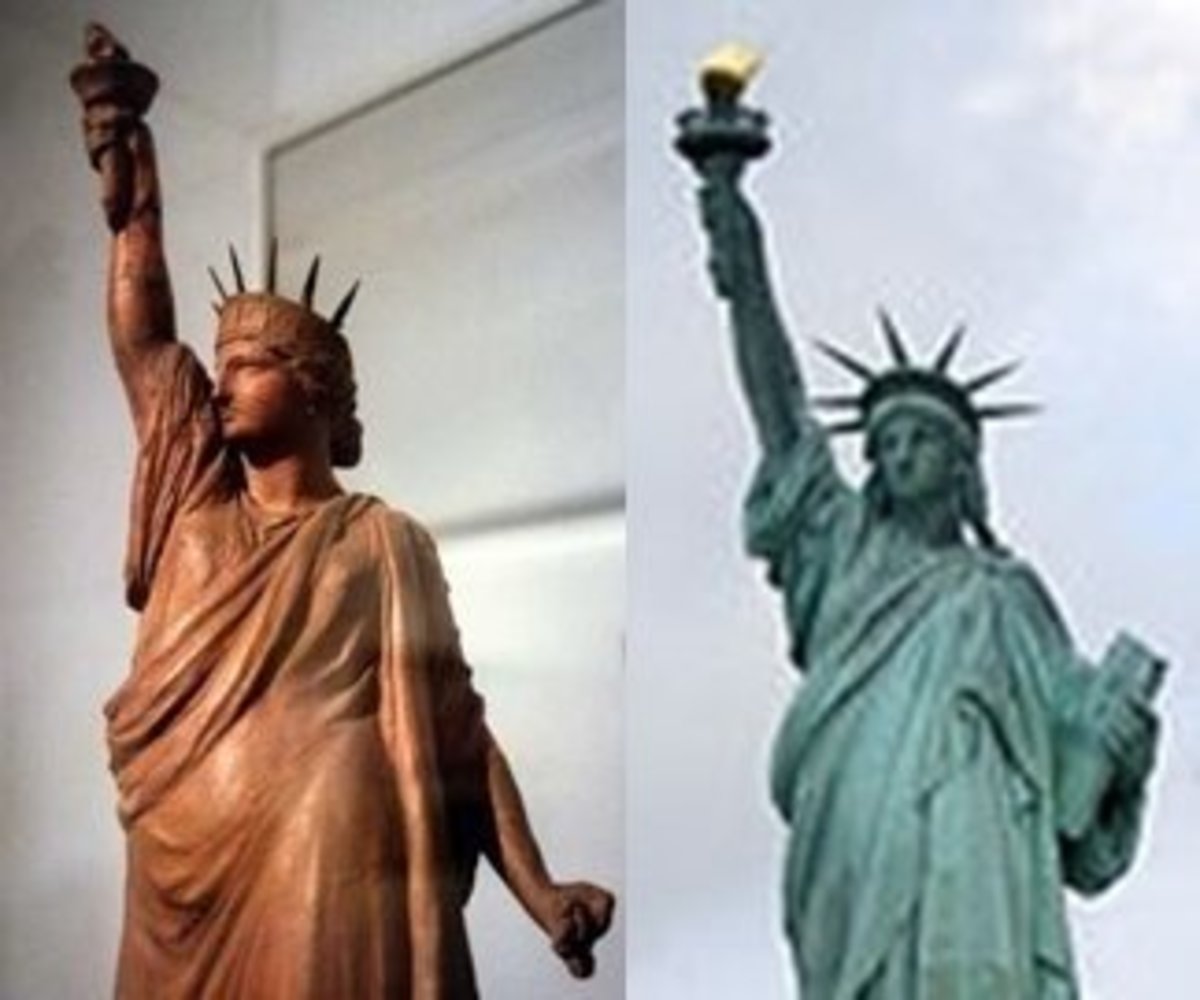
The statue on the left is a copy of an early version of the statue with chains in hand. The one on the right is the way she appears today. The Statue of Liberty that today sits on Liberty Island in New York harbor is known to have been the brainchild of noted Frenchmen and abolitionist Edouard de Laboulayea man so dedicated to the eradication of slavery that he co-founded the French Anti-Slavery Society. The idea for establishing a monument
specifically to honor the emancipation of slaves in America was
discussed between Laboulaye and Frederic Bartholdi, a French sculptor in 1865, the year the U.S. abolished slavery.

In addition to his abolition work, Laboulaye was also a U.S.
Constitution expert. Although we cannot know this for sure, one can only
imagine that the 1865 signing of the 13th amendment to the U.S.
Constitution would be very important to an abolitionist and likely
fueled Laboulaye’s desire to have the monument built. So, in 1865 he
shared this idea with Bartholdi, who later became the designer of the
statue, working closely with Laboulaye to make Laboulaye’s vision a
reality.

The connection between the Statue of Liberty and the abolition of
slavery is one that has been denied for 125 years. Almost from the start
of the project, the American financiers wanted no mention of slavery
and for 125 yrs they got their wish.

Although Laboulaye and Batholdi had envisioned a statue holding
broken chains and shackles (as shown in the image above on the left),
the early financiers that funded the project did not want chains on the
monument. It was the American backers who were most opposed to the
notion that the statue should in anyway acknowledge slavery. Because the
French, who were paying for the statue, were facing difficult economic
times, Laboulaye and Bartholdi relied on Americans to pay for and build
the pedestal where the statue would stand. This was an essential part of
the monument. Without American financial backing, the project could not
be completed, but the American financiers were adamant that Laboulaye
lose the chains and shackles. One can only surmise that some of the
backers may have made their fortunes directly or indirectly
through slavery.

In her book, Enlightening the World: The Creation of the Statue of Liberty,
Yasmin Sabina Kahn explained that although Laboulaye came upon the idea
and communicated it to Bartholdi in 1865, the political climate in
France at the time and a lack of funding made it impossible to raise
enough money to get the project off the ground for several years.
Indeed, it took the sculptor years to raise the funds. According to
Kahn, “Bartholdi’s original depiction of Lady Liberty had her holding
broken chains in her left hand, with more broken chains and broken
shackles at her feet. The chains were symbolic of the end of slavery in
the United States.”

Feet of the Statue of Liberty with chains
In lectures and on speaking tours, noted professor Dr. Joy DeGruy,
frequently talks about the chains that were part of the original
renderings of the Statue of Liberty. DeGruy explains that Bartholdi
intended the statue to represent democracy and to symbolize the end of
all types of oppression. However, according to DeGruy, the American
decision-makers of the day rebuffed Bartholdi for including the chains
and shackles and insisted that he remove them. Bartholdi was adamant
that they remain, although he eventually was forced to compromise
because he didn’t want to risk losing the financial support that was
making the project possible. Finally, he removed the chains from Lady
Liberty’s hand, replacing them with a book.

But, what most people don’t know, even today, is that Bartholdi left
the broken shackles and chains that were at her feet. These symbols of
state-sponsored bondage, human chattel and the hypocrisy of American
exceptionalism remain there on the Statue of Liberty as a permanent
reminder of the slaves that contributed to the building of the United
States.


Because the height of the pedestal built to support the statue makes
it impossible to see the chains and shackles from the ground, most
people visiting Liberty Island remain unaware of them. This is where the
U. S. Parks Service plays a pivotal role.

While it is not surprising that Sarah Palin got it wrong, it should be noted
that if asked, most of us would likely get it wrong too.


Clearly, the chains were obvious when the statue was delivered and installed 125 years ago but that knowledge quickly faded from memory. Aided by the fact that the height of the
pedestal made the chains and shackles impossible to see unless one were
viewing the statue from a helicopter, the wishes of the original funders
were fulfilled. No one need know the true meaning of the Statue of
Liberty. For most of the years since the statue’s installation at
Liberty Island, its true meaning has been kept in the dark. Even the
U.S. agency tasked with the responsibility of caring for and educating
the public about the statue had a hand in keeping the true meaning
hidden.

One contention of those in opposition to the idea that the statue
celebrated the end of slavery was the date the statue was proposed. Due
to lack of funding, more than 20 years passed between the time the
statue was first proposed in 1865 and the actual installation on Liberty
Island in 1886. Those who wanted to downplay the connection between the
statue and slavery insist that the year 1865 played no role in the idea
to build the monument.  In a report released by the U.S. Park Service
in 2000, the Park Service claimed that noted abolitionist Edouard de
Laboulaye did not propose the idea of constructing a monument in 1865.
Their report states:

sharon-kyle-moreThis story is a legend. All available evidence points to its conception in 1870 or 1871. The dinner party legend is traceable to a single source —
an 1885 fund-raising pamphlet written by the statue’s sculptor, Auguste
Bartholdi, after the death of Laboulaye.


But somewhere along the way, the U.S. Parks Service changed its position. They now admit that

  • the year 1865 was a key element of the story;
  • Laboulaye is the father of the idea for the monument; and
  • he was an abolitionist who wanted to honor the emancipation of the slaves.
Perhaps pressure was brought to bear on the agency forcing them to
change their literature and their website but today they devote pages to
the history of the statue and prominently state that the statue was a
gift to the United States from the people of France to celebrate “the
Union’s victory in the American Civil War and the abolition of slavery.”
You can find this and more at The National Parks Service website.

sharon kylestarted this piece with the video of Sarah Palin partly because any mention of Sarah somehow catches people’s attention but mostly because Sarah Palin’s understanding of the symbolism of the Statue of Liberty is probably not very different from most Americans. So while it is not surprising that Sarah Palin got it wrong, it should be noted that if
asked, most of us would likely get it wrong too.

As an American who is a decendent of slaves, I find it all the more shameful that this country continues to have countless monuments honoring men known to have been slaveholders but nothing honoring the millions whose blood, sweat and tears built this country. 

From that perspective, the story of the Statue of Liberty and how it came to be a part of our national landscape is as important as the story of Paul Revere’s Midnight Ride and should be as widely known. The National Park Service took an important step towards that end when it changed its position. And people like Dr. Joy DeGruy and others likely had a hand in making that happen.

To all who made that happen, I say thank you.

Sharon Kyle

Publisher, LA Progressive


(Dr. Joy DeGruy can be seen in the video below. She talks about the
statue at about 43 seconds into the video. She’s a great storyteller.
Watch it – you won’t be disappointed.)

https://youtu.be/gMYwsxVkc6s


Monday, May 02, 2022

"‘Deplorable’ Conditions for Academic Freedom." by Colleen Flaherty , Inside Higher Education, April 18, 2022

Academic freedom and tenure are under attack in many places, including at Linfield University in Oregon as addressed herein. AAUP investigations are necessary but insufficient for pushing back against such attacks. Notwithstanding the particularities of this Oregon case, we should generally understand this attack as part of the current culture wars that include the teaching of Critical Race Theory at higher education institutions. 

Academic freedom is an important front against tyranny in society and for the upholding of integrity in scholarship and the profession. The hopeful thing in the current context is that tenure won't go down without a fight, particularly from university faculty. To join this fight here in Texas as a university faculty member whose charge it is to prepare future teachers, I ask that you consider signing this petition to teach the truth put together by Dr. Noah DeLissovoy and myself: 

Declaration Against Censorship from Texas University Faculty Involved in Teacher and Administrator Preparation in Response to HB 3979

For those of you that have already signed, thank you very much.

-Angela Valenzuela

#TeachTheTruth

AAUP report on Linfield University’s firing of a chaired professor sets 

stage for censure later this year. 

 
April 18, 2022

An American Association of University Professors investigation into why and how Linfield University fired tenured professor Daniel Pollack-Pelzner found that he was dismissed in the “context of eroding shared governance, which has jeopardized the faculty’s exercise of academic freedom and contributed to a culture of abuse.”

“General conditions for academic freedom and shared governance at Linfield University are deplorable,” says the AAUP’s new report on its inquiry. The document will guide the AAUP’s Committee on Academic Freedom and Tenure as it decides whether to recommend censuring Linfield’s administration for alleged violations of faculty rights at the committee’s meeting in June.

The AAUP’s governing council will vote on any recommendation for censure at the council’s own meeting later that month.

Linfield fired Pollack-Pelzner, the former Ronni Lacroute Chair in Shakespeare Studies there, last spring, citing his breaches of “duty” to the institution. Pollack-Pelzner, who was also Linfield’s sole faculty trustee, had recently publicly accused members of Linfield’s Board of Trustees of retaliation and anti-Semitism: he said he became a target after urging the board to do more about reports of sexual misconduct involving multiple trustees, including the criminal groping case against David Jubb (who was sentenced last year to probation), and a faculty member’s allegation that Linfield president Miles K. Davis had touched her inappropriately.

Davis—whom Pollack-Pelzner and other professors accused of making anti-Semitic comments, including one about the size of the average “Jewish nose”—has accused Pollack-Pelzner (who is Jewish) of engaging in a “smear” campaign.

Pollack-Pelzner is now suing Linfield for whistle-blower retaliation.

Regarding the AAUP investigation, which supports Pollack-Pelzner’s account of what happened to him at Linfield, the university said that discovery is underway for the lawsuit and that information gathered thus far “substantially discredits much of the AAUP report.” (Linfield did not share any details about what the AAUP report gets wrong.)

“We politely declined to participate due to the ongoing litigation,” Scott Nelson, university spokesperson, said in a statement. “As with any employee-related issue, critics are free to comment, while the university is often prevented from sharing a complete story, limited by our adherence to policies, procedures, privacy guidelines and the facts. Contrary to the AAUP’s position, Linfield University unequivocally supports academic freedom and faculty tenure. We also take all allegations of misconduct seriously and are committed to creating and fostering a learning and working environment in which all members of the community feel physically and emotionally safe and can thrive.”

Gregory F. Scholtz, director of the AAUP’s department of academic freedom, tenure and governance, said that the Linfield investigation stands out to him for Davis’s “blatant disregard of the university’s own dismissal policy,” which parallels AAUP-approved standards for dismissal.

“The Faculty Handbook incorporates our entire set of recommended institutional regulations, including those on academic due process for dismissal,” Scholtz said. “In some cases, those who wish to rid themselves of a faculty member find subtle and clever ways of doing so. But there was nothing clever or subtle about this approach. This was a direct attack on tenure and academic freedom and the institution’s own policies. And, as the report suggests, President Davis’s offhanded and dismissive admission of ignorance of these policies bespeaks not only irresponsibility but incompetence.”

A ‘Negative Cultural Shift’ and Tenure Concerns


According to the report, individuals at Linfield told AAUP investigators that there had been a negative cultural shift at the institution, with one saying that university had demonstrated an “absence of empathy for victims [of sexual misconduct]—particularly women.”

The report also notes that Ronni Lacroute, a donor who endowed Pollack-Pelzner’s former chair, resigned from Linfield’s board following his firing, saying, “I was incensed” and “You just don’t do that. The university didn’t want negative communication, but that’s not how you stop it. It’s how you make it worse. You take care of the problems. You just don’t suppress speech.”

Lacroute said at the time that she didn’t accept Linfield’s public, after-the-fact argument that the termination wasn’t governed by the Faculty Handbook because Pollack-Pelzner had been fired for cause as an employee, and not as a professor. The AAUP report also accuses Linfield of using this and other revisionist rationales—namely Davis’s public assertion that the handbook had “not been updated”—for how it handled Pollack-Pelzner’s termination.

“The notion that, when convenient, an administration can choose to apply the provisions of the employee handbook rather than those of the faculty handbook when seeking to dismiss a tenured faculty member is inimical to principles of academic freedom and tenure because it allows an administration to dismiss a faculty member without affordance of the academic due process that defines tenure and protects academic freedom,” the report says. “Tenure, as the AAUP understands it, is an indefinite appointment terminable only for cause as demonstrated through an adjudicative hearing before a faculty body. In the absence of this academic due process, tenure does not exist, and academic freedom lacks protection.”

Widely followed AAUP guidelines also say that fired tenured faculty members are entitled to one year’s notice or severance pay, unless they’ve been found responsible for moral turpitude in a formal dismissal proceeding. Pollack-Pelzner reportedly told AAUP investigators that he’d asked for severance and was denied, and that Linfield had also contested his application for unemployment benefits on the grounds that he’d been dismissed for misconduct.

‘No Subtlety’ With Respect to Academic Freedom

Scholtz said that another “striking feature” of the case was how Pollack-Pelzner’s summary dismissal “so clearly implicated academic freedom. Again, no subtlety.”

According to the AAUP, academic freedom protects faculty members “intramurally,” here meaning when they participate in institutional governance. Scholtz continued, “So here we have a professor whom his colleagues elect to represent the faculty on the Board of Trustees. In fulfilling this governance responsibility, he receives credible reports of sexual misconduct by board members and tries to get the administration and governing board to do something about it. When his pleas seem to fall upon deaf ears, he pushes harder, eventually putting all his charges out on Twitter. Three weeks later, he’s fired.”

Linfield, like many small colleges, has faced enrollment and financial concerns in recent years. The report doesn’t delve into this side of life at Linfield, but footnotes mention Davis’s “efforts in 2019 to deal with financial and enrollment problems” and say that enrollments were down again in 2021.

Linfield was considering cutting tenured faculty members in 2019 but was able to avoid layoffs through early retirements. Amid a rebranding under Davis, which involved expanding pre-professional and professional programs and calling Linfield a university instead of a college, enrollments had been increasing ahead of the pandemic.

As the university changed, some professors said they worried about the implications for academic freedom and tenure. And while the AAUP focused its report on Pollack-Pelzner due to his sudden termination, Linfield has faced other criticism that it’s stifling faculty rights. The Foundation for Individual Rights in Education, for example, last month demanded that Linfield drop an inquiry into Reshmi Dutt-Ballerstadt, a professor of English (and a vocal supporter of Pollack-Pelzner’s, as well as an Inside Higher Ed contributor) who posted quotes and comments about English and business scholars on social media.

Dutt-Ballerstadt said last week that she hasn’t heard anything further from Linfield about that inquiry. Of the AAUP’s report, she said it’s “not at all surprising but both damning and retraumatizing for faculty to see once again the egregious violations of academic freedom and due process at Linfield.” (The AAUP’s investigation notes that Linfield apologized to Dutt-Ballerstadt in 2018 for how it handled her own, separate claims of harassment, writing in a letter to her that “the investigation did not comport with expectations of excellence and fairness.”)

The local NAACP branch investigated Linfield last year for racial animus, at the request of Davis, who is Black. It determined that he’d been treated unfairly based on his race, and that the specific allegations against him, originating from within Linfield’s predominantly white culture, reflected harmful racial stereotypes about Black men. Six unnamed faculty members declined to participate in the NAACP investigation, according to that report. (Nelson initially said that Linfield did not initiate the investigation and later said he didn’t know that Davis had requested it.) The AAUP inquiry discusses the NAACP report, saying that faculty members “interviewed by this investigating committee perceived the NAACP investigation as an effort by President Davis and his supporters to counter and perhaps intimidate the president’s harshest critics.”

Susan Agre-Kippenhan, Linfield’s provost, wrote to the university’s faculty last week, saying the AAUP “does not have official standing on our campuses nor authority in this matter.” Moreover, she said the report “does not reflect the important work we are undertaking together to strengthen shared governance at Linfield.” Revised university bylaws, for instance, “call upon each college and school to establish governance structures and in all cases their bylaws are complete or very near completion. The colleges and schools have implemented new structures and demonstrated their effectiveness as each has launched new graduate programs and initiatives.”

Read more by