Translate

Showing posts with label African Americans. Show all posts

Monday, March 27, 2023

"Statue of Liberty Wears Chains and Shackles Honoring Freed Slaves" by Sharon Kyle | The LA Progressive

This is a largely unknown story about Lady Liberty's shackles and the cover up that's ensued since 1865. This is the first that I learn that the Statue of Liberty was, I quote:  "given to the U.S. as a monument to acknowledge the end of one of its biggest mistakes  — slavery."  It's really interesting that the original depiction of Lady Liberty had her "holding broken chains in her left hand, with more broken chains and broken shackles at her feet."

But, what most people don’t know, even today, is that Bartholdi left the broken shackles and chains that were at her feet (my emphasis).  These symbols of state-sponsored bondage, human chattel and the hypocrisy of American exceptionalism remain there on the Statue of Liberty as a permanent reminder of the slaves that contributed to the building of the United States.

This project was the brainchild of Edouard de Laboulaye, a French person behind on of our nation's most important icons.  Laboulaye was an abolitionist from France and co-founder of the French Anti-Slavery Society.  The sculptor, also French, was named Frederic Bartholdi.  The two planned all of this in 1865, the very year the U.S. passed the 13th amendment to the U.S. Constitution officially abolishing slavery.  However, due primarily to financing issuesand possibly, ideological ones, as well, as this story intimates, the actual installation on Liberty Island occurred 21 years later in 1886. Bartholdi ultimately had to compromise on this or jeopardize the financing of the project.

As the author muses, perhaps the financiers of this project themselves profited from slavery and were thus resistant to this representation.  Or maybe they were just exercising their privilege—and thusly, their power over representation and—much like many folks do today to appear as less racist than they really are, thinking, I suppose, that this detail would get lost over the generations.  Only more research can tell.  

In any case, a new book by Yasmin Sabina Kahn titled, Enlightening the World: The Creation of the Statue of Liberty, delves into this story which is deserving of our attention. Kahn refers to
Bartholdi's original depiction where she held broken chains on her left hand, and broken shackles at her feet, symbolizing the end of slavery in the U.S.

This history is totally buried in American lore about Lady Liberty. Geez, what we are not taught or ever told and that our legislatures want to keep us from learning.

-Angela Valenzuela

#TeachTheTruth

Reference

Khan, Y. S. (2010). Enlightening the world: the creation of the Statue of Liberty. Ithaca, NY: Cornell University Press.

Statue of Liberty Wears Chains and Shackles Honoring Freed Slaves


The LA Progressive ran a story in the spring of 2011 that began with a
video of Sarah Palin being interviewed at Liberty Island. In it she is
asked about the symbolism of the Statue of Liberty, she responded:

https://youtu.be/AM2CmpFMnSY

“It is, of course, the symbol for
Americans to be reminded of other countries because this was gifted us,
of course by the French—other countries warning us to never make the
mistakes that some of them had made.”

Paraphrased, Palin was saying that France gave the United States the
statue to warn the U.S. not to commit the mistakes other countries 
committed.

The problem with her response –American exceptionalism and word salad aside
— is that it has no basis in fact. In other words, it is WRONG.

Historians tell us that the Statue of Liberty represents the OPPOSITE of
what Palin suggests. Instead of reminding the United States not to make
mistakes made by other countries, the Statue of Liberty was given to
the U.S. as a monument to acknowledge the end of one of its biggest
mistakes  — slavery.


When we ran the story in 2011, we got lots of feedback from readers
who were surprised to learn that our Statue of Liberty was in any way
connected to American slavery. However, several of our readers did some
checking on their own and commented that they couldn’t find information
corroborating our story. Some mentioned that the U.S. National Park
Service (the federal agency responsible for the Statue of Liberty)
offered information on their site that did not line up with what we were
reporting.


In 2011, the U.S. Park Service made no mention of the chains or the
connection between the emancipation of the American slaves and the gift
from France — the Statue of Liberty.  Even though the U.S. Parks Service
was fully aware of the story, they did not mention it on their website
or any of the pamphlets given to tourists when visiting Lady Liberty.
But sometime between 2011 and 2014 the U.S. Parks Service made a
dramatic change. Today, the National Park Service website tells
the story of how the Statue of Liberty came to be in New York’s harbor
and its relationship to slavery. Following is an abbreviated version.
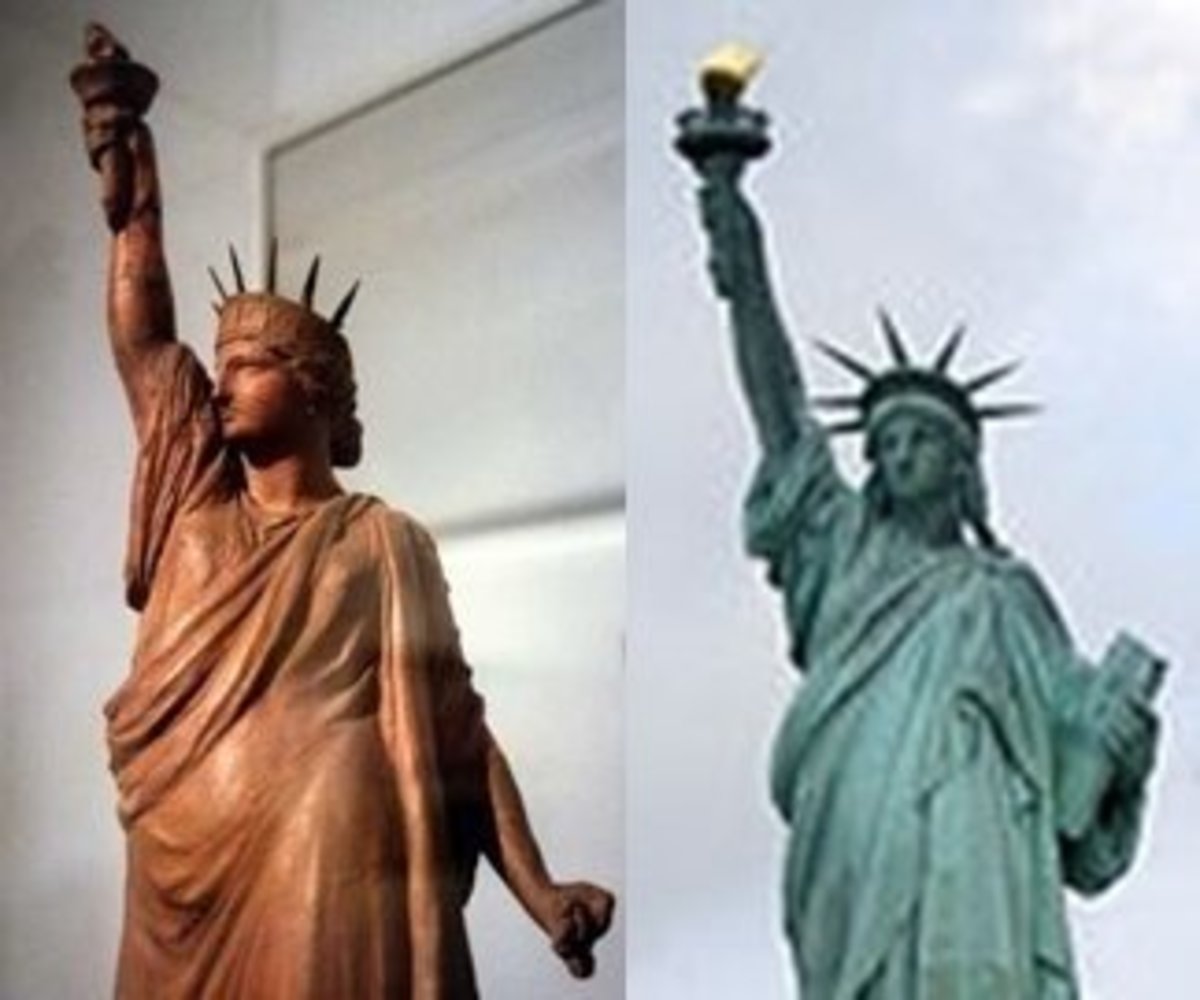
Statue of Liberty Wears Chains and Shackles

The statue on the left is a copy of an early version of the statue with chains in hand. The one on the right is the way she appears today. The Statue of Liberty that today sits on Liberty Island in New York harbor is known to have been the brainchild of noted Frenchmen and abolitionist Edouard de Laboulayea man so dedicated to the eradication of slavery that he co-founded the French Anti-Slavery Society. The idea for establishing a monument
specifically to honor the emancipation of slaves in America was
discussed between Laboulaye and Frederic Bartholdi, a French sculptor in 1865, the year the U.S. abolished slavery.

In addition to his abolition work, Laboulaye was also a U.S.
Constitution expert. Although we cannot know this for sure, one can only
imagine that the 1865 signing of the 13th amendment to the U.S.
Constitution would be very important to an abolitionist and likely
fueled Laboulaye’s desire to have the monument built. So, in 1865 he
shared this idea with Bartholdi, who later became the designer of the
statue, working closely with Laboulaye to make Laboulaye’s vision a
reality.

The connection between the Statue of Liberty and the abolition of
slavery is one that has been denied for 125 years. Almost from the start
of the project, the American financiers wanted no mention of slavery
and for 125 yrs they got their wish.

Although Laboulaye and Batholdi had envisioned a statue holding
broken chains and shackles (as shown in the image above on the left),
the early financiers that funded the project did not want chains on the
monument. It was the American backers who were most opposed to the
notion that the statue should in anyway acknowledge slavery. Because the
French, who were paying for the statue, were facing difficult economic
times, Laboulaye and Bartholdi relied on Americans to pay for and build
the pedestal where the statue would stand. This was an essential part of
the monument. Without American financial backing, the project could not
be completed, but the American financiers were adamant that Laboulaye
lose the chains and shackles. One can only surmise that some of the
backers may have made their fortunes directly or indirectly
through slavery.

In her book, Enlightening the World: The Creation of the Statue of Liberty,
Yasmin Sabina Kahn explained that although Laboulaye came upon the idea
and communicated it to Bartholdi in 1865, the political climate in
France at the time and a lack of funding made it impossible to raise
enough money to get the project off the ground for several years.
Indeed, it took the sculptor years to raise the funds. According to
Kahn, “Bartholdi’s original depiction of Lady Liberty had her holding
broken chains in her left hand, with more broken chains and broken
shackles at her feet. The chains were symbolic of the end of slavery in
the United States.”

Feet of the Statue of Liberty with chains
In lectures and on speaking tours, noted professor Dr. Joy DeGruy,
frequently talks about the chains that were part of the original
renderings of the Statue of Liberty. DeGruy explains that Bartholdi
intended the statue to represent democracy and to symbolize the end of
all types of oppression. However, according to DeGruy, the American
decision-makers of the day rebuffed Bartholdi for including the chains
and shackles and insisted that he remove them. Bartholdi was adamant
that they remain, although he eventually was forced to compromise
because he didn’t want to risk losing the financial support that was
making the project possible. Finally, he removed the chains from Lady
Liberty’s hand, replacing them with a book.

But, what most people don’t know, even today, is that Bartholdi left
the broken shackles and chains that were at her feet. These symbols of
state-sponsored bondage, human chattel and the hypocrisy of American
exceptionalism remain there on the Statue of Liberty as a permanent
reminder of the slaves that contributed to the building of the United
States.


Because the height of the pedestal built to support the statue makes
it impossible to see the chains and shackles from the ground, most
people visiting Liberty Island remain unaware of them. This is where the
U. S. Parks Service plays a pivotal role.

While it is not surprising that Sarah Palin got it wrong, it should be noted
that if asked, most of us would likely get it wrong too.


Clearly, the chains were obvious when the statue was delivered and installed 125 years ago but that knowledge quickly faded from memory. Aided by the fact that the height of the
pedestal made the chains and shackles impossible to see unless one were
viewing the statue from a helicopter, the wishes of the original funders
were fulfilled. No one need know the true meaning of the Statue of
Liberty. For most of the years since the statue’s installation at
Liberty Island, its true meaning has been kept in the dark. Even the
U.S. agency tasked with the responsibility of caring for and educating
the public about the statue had a hand in keeping the true meaning
hidden.

One contention of those in opposition to the idea that the statue
celebrated the end of slavery was the date the statue was proposed. Due
to lack of funding, more than 20 years passed between the time the
statue was first proposed in 1865 and the actual installation on Liberty
Island in 1886. Those who wanted to downplay the connection between the
statue and slavery insist that the year 1865 played no role in the idea
to build the monument.  In a report released by the U.S. Park Service
in 2000, the Park Service claimed that noted abolitionist Edouard de
Laboulaye did not propose the idea of constructing a monument in 1865.
Their report states:

sharon-kyle-moreThis story is a legend. All available evidence points to its conception in 1870 or 1871. The dinner party legend is traceable to a single source —
an 1885 fund-raising pamphlet written by the statue’s sculptor, Auguste
Bartholdi, after the death of Laboulaye.


But somewhere along the way, the U.S. Parks Service changed its position. They now admit that

  • the year 1865 was a key element of the story;
  • Laboulaye is the father of the idea for the monument; and
  • he was an abolitionist who wanted to honor the emancipation of the slaves.
Perhaps pressure was brought to bear on the agency forcing them to
change their literature and their website but today they devote pages to
the history of the statue and prominently state that the statue was a
gift to the United States from the people of France to celebrate “the
Union’s victory in the American Civil War and the abolition of slavery.”
You can find this and more at The National Parks Service website.
sharon kylestarted this piece with the video of Sarah Palin partly because any mention of Sarah somehow catches people’s attention but mostly because Sarah Palin’s understanding of the symbolism of the Statue of Liberty is probably not very different from most Americans. So while it is not surprising that Sarah Palin got it wrong, it should be noted that if
asked, most of us would likely get it wrong too.

As an American who is a decendent of slaves, I find it all the more shameful that this country continues to have countless monuments honoring men known to have been slaveholders but nothing honoring the millions whose blood, sweat and tears built this country. 

From that perspective, the story of the Statue of Liberty and how it came to be a part of our national landscape is as important as the story of Paul Revere’s Midnight Ride and should be as widely known. The National Park Service took an important step towards that end when it changed its position. And people like Dr. Joy DeGruy and others likely had a hand in making that happen.

To all who made that happen, I say thank you.

Sharon Kyle

Publisher, LA Progressive


(Dr. Joy DeGruy can be seen in the video below. She talks about the
statue at about 43 seconds into the video. She’s a great storyteller.
Watch it – you won’t be disappointed.)

https://youtu.be/gMYwsxVkc6s


Friday, May 22, 2020

Learn about "Zapatap" Chicana Dance Crew Blends Tap and Mexican Footwork | KQED Arts


Friends,


Check out this "New percussive Chicana aesthetic," as expressed by Vanessa Sanchez from San Francisco City's mission district that draws on Indigenous, African American, and Veracruz Mexico, combining tap dance and son jarocho zapateado (traditional footwork from Veracruz, Mexico,)  as described here:

San Francisco’s La Mezcla dance company, founded and led by Vanessa Sanchez, uses dance and song to tell stories of Chicana history, culture and resistance. Blending tap dance and son jarocho zapateado (traditional footwork from Veracruz, Mexico,) Sanchez describes this unique dance style as “zapatap.” Watch these dancers perform dynamic choreography in front of iconic Mission District murals and landmarks, then bring us back to the 1940s West Coast Zoot Suit era (popularized by Bay Area playwright Luis Valdez) when young Mexican-American men and women, "pachucos" and “pachucas,” proudly repped their identity, while defying cultural and style taboos. Rocking big hair and flashy zoot suits, the women of La Mezcla reclaim this early California history.

I like how Vanessa Sanchez situates this in African American and California history, as well.  The Fandango where everybody plays instruments and everybody dances, is the coolest, funest part!


Enjoy!


-Angela Valenzuela


Saturday, May 02, 2020

How Black Student Debt Affects the Teacher Pipeline

We have a dearth of African American, Latina/o, and Native American teachers in this country.  This piece gets at why this is so for these, as well as other, under-represented groups in the teaching profession. So unfortunate when teachers of color are so desperately needed.

-Angela Valenzuela

How Black Student Debt Affects the Teacher Pipeline

Public school students are more diverse than ever, but their teachers? Not so much. Even as research shows that students, especially students of color, benefit from a diverse workforce, more than eight in 10 teachers in American public schools identify as white.
One reason—which is receiving more attention from policy makers—is the unequal amount of money that students of color, on average, must borrow to pay for college. On the day they graduate from college, black students owe about $7,400 more than white students, according to a Brookings Institute analysis.
That kind of debt, paired with the prospect of low teacher wages and other factors, makes education an impractical choice for many black and Latino students, say the authors of a 2019 report from the Center for American Progress (CAP) that takes a close look at student debt among teachers of various races.
Many think they simply can’t afford to be teachers.
And they may be right: CAP researchers found that 91 percent of black students who studied to become teachers were forced to borrow from the U.S. Department of Education to finance their college education, compared to 76 percent of white students. Among Latino students studying to be teachers, it was 82 percent. In graduate school, which may be required by states for licensure and certification, the disparity grows even larger: about half of black teachers borrowed, compared to about one in three Latino teachers and one in four white teachers.
These include educators like Tremayne Wootten, a Maryland high school teacher who owes around $115,000 for his undergraduate and master’s degrees. Until the COVID-19 pandemic hit, he was driving Uber to pay for his summer wedding. And Shaniqua Williams, a Virginia school counselor, who owes about $97,000 for her degrees, and testified on Capitol Hill about the problem of educator debt last year.
And yet, students need more teachers who look like Wootten and Williams. Research shows that all students benefit from diverse teachers, but black students specifically do better on tests, attend school more regularly, and have fewer discipline issues when they’re paired with a black teacher. Black students also are more likely to be identified as gifted by black teachers than by white teachers.
These effects may be true for other ethnic-minority groups—Native American teachers and students, for example—but those groups are smaller and have been less studied.
Meanwhile, the trend is heading in the wrong direction. Federal education data shows that the percentage of black teachers actually has declined over the past decade.
“Without specific policies designed to address these issues, the United States is unlikely to solve its persistent diversity problem,” the CAP authors conclude.
What are the answers?
For its part, NEA and its state affiliates have long acknowledged the value of a diverse educator workforce and have invested in programs to develop—and sustain—teachers of color. These programs range from a Nebraska initiative to increase passing rates on the Praxis exam to an anti-racism, professional development program by Education Minnesota. Recently, Connecticut Education Association members advocated for a new state law that would help high school students to consider a career in teaching.
Meanwhile, NEA leaders also are pursuing legislative solutions to the specific issues of student debt, including:
* Increasing Pell Grants, which are federal grants to low-income college students. They helped sustain 57 percent of black college students in 2016;
* Protecting Public Service Loan Forgiveness, which erases the student debt of educators who make 10 years of qualifying payments.
* Increasing support for historically black colleges and universities (HBCUs) and minority-serving institutions (MSIs), which confer 33 percent of the degrees earned by black students; 44 percent of the degrees earned by Hispanic students; and 28 percent of the degrees earned by Asian students.
NEA lobbyists and members also are asking lawmakers to provide a minimum of $30,000 in student debt cancellation, per borrower, in their next COVID-19 relief package. In a letter to Congressional leaders, NEA and its partners note that the “student debt crisis has hit Black and Latinx communities and women particularly hard,” with half of Black borrowers and one-third of Hispanic borrowers forced to default on their loans within 20 years.

Friday, October 13, 2017

The Activist Work of K-12 Educators: Then and Now

Happy to share this publication by Education Policy and Planning Student, Andrene Castro.  It considers the very important role of African American K-12 educator activism historically and its meaningfulness and importance for us today.  It is a reminder that Ethnic Studies and educator activism tend to go hand-in-hand historically.

Angela Valenzuela

The Activist Work of K-12 Educators: Then and Now

Black students’ educational needs are central to Black political and social activism. It is no secret that Black activism in institutions of higher education, particularly during the tumultuous decades from the 1950s through the 1970s, catalyzed new freedom struggles and enhanced the intellectual development of African Diaspora Studies in educational spaces. Yet, the activism of K-12 educators in public schools receives too little attention. While some education scholars have documented Black teachers’ activism since the late eighteenth century, public school teachers deserve broader recognition within Black activism historiography.
From the late nineteenth century through the present, parallel movements shaped teachers’ activism: the 1954 Brown vs. Board of Education ruling to desegregate schools, Civil Rights and Black Power struggles, and the burgeoning women’s movement. Against this backdrop, Black teachers served as recruiting agents for the National Association for the Advancement of Colored People (NAACP) and the Civil Rights movement. They also called for schools to uphold the promises of desegregation, actually integrating schools and reforming school finance through more equitable allocation of resources.
Inspired by the campus movements of the sixties, the collective efforts of K-12 educators, students, and parents at Berkeley High School, for example, led to the development of the first Black Studies department in 1969. Despite this early move to diversify the K-12 curriculum, its legacy remains in flux. Today, many teachers are front-line activists fighting for the constitutionality of African American history and ethnic studies courses in public schools. And still intellectual activism and activist scholarship is often misperceived as a project only for academics, though Black teachers in K-12 settings have long embraced these pursuits. In fact, several scholars point to a strong lineage of sociopolitical activism in education. This scholarship highlights vanguards such as Anna Julia Cooper, Carter G. Woodson, Alain LeRoy Locke, and Sylvia Wynter—Black intellectuals who receive too little credit for advancing curricular theory.
Dunbar High School, Washington DC in 1917. Photo: The Crisis, March 1917, page 221
Anna Julia Cooper’s work as a teacher, leader, and innovator at M Street High School, later known as Dunbar High School in Washington, DC, encouraged Black educators to view their role not only as teachers, but also as intellectuals. Cooper’s contribution to M Street helped establish the school as a premier educational institution, boasting notable faculty and alumnae. Omissions of teachers’ intellectual activism are particularly damaging to Black educators who—without these role models—fail to recognize the broader contributions of Black scholars and educators in the social and political history of schooling in the US.
As the largest professional occupation in the US, teaching accounts for the most professional employees among college-educated white women, Black women, and Black men. While the profession is well received, most teachers receive too little credit for their efforts. Critical education scholars challenge the notion that teaching is an apolitical enterprise. Scholars such as Paulo Freire and Gloria Ladson-Billings argue that teaching is in itself a political act because education is inherently political.
Beyond this conceptualization, the teacher-as-activist is also an identity and a consciousness one comes to assume, characterized by explicit social and political orientations against racism, sexism, homophobia, ableism, and classism. For Bob Moses, an educator and Civil Rights leader, his vision for economic and political freedom connects intricately with education: “When I was in Mississippi [in the 1960s], I saw very graphically how literacy mattered. Sharecroppers weren’t literate, so they were outside the economic arrangement. That’s what’s happening now in the inner cities. We’re growing young people who are outside the economic arrangements for the information-age technologies.”
Despite the commitment that teachers make to educate children, not all teachers are activists. Understanding when and where teachers enter activism begins with recognizing that public schools are social institutions rife with contradictions. As critical sites for socialization, schools reify dominant perspectives of anti-blackness, heteropatriarchy, Eurocentrism, and religiosity, often while providing a public good of “assimilationist” democracy.
A prominent example of this tension emerges from the historical and legal scholarship on school segregation and its impact on the teacher labor market. For example, teacher activists and researchers recounting teacher segregation in Chicago highlight discriminatory labor policies that subjected Black teachers to be newly classified as Full Time Basis Substitutes (FTBs). Despite doing the same work, this distinction amounted to different wages and benefits than white teachers received. Over the course of two years in 1967 and 1968, an organization called Concerned FTBs led more than a hundred schools in a strike against institutional and procedural racism and school segregation.
These histories reveal how societal tensions give rise to Black teacher activism. Even contemporary movements, such as Black Lives Matter, illustrate symbiotic relationships amongst movements, activism, and education. The Movement for Black Lives, a coalition of organizations demanding an end to state-sanctioned violence, considers public schooling a form of the state’s violent apparatus. With numerous policy initiatives addressing federal, state, and local inequities in school funding, excessive discipline and policing in schools, and the neo-liberalization of public schools—teacher activism is inevitable.
Civil Rights leader and education reformer Bob Moses at the Meridian Freedom School Convention, 1964 (Mark Levy Collection, Queens College Civil Rights Archives)
As a result of neoliberalism’s assault on Black youth and educators (i.e., closed schools, loss of Black anchor institutions, as well as the displacement of Black teachers), teachers have grown increasingly politicized. In May 2016 more than 1,500 teachers called in sick at 94 of Detroit’s 97 public schools. Similar activities repeated across the country in school districts in Chicago, Philadelphia, and Los Angeles. These massive protests or “sickouts” targeted many of the same practices waged in the aftermath of the 1954 ruling.
Beyond public demonstrations, forms of Black teacher activism consistently take shape inside the classroom through teaching and learning. These acts generally remain unnoticed and seldom catalyze the masses. However, many teachers express their activism through pedagogy, whereby texts become tactics. In this view, teaching-as-activism is indispensable to Black intellectual and activist scholarship. Teacher activists critique power, encourage intellectual curiosity, deepen self-identity and consciousness, and strive to make history culturally relevant for students.
Nevertheless, positioning teacher activism in this broader canon requires a degree of rupture. We must first acknowledge the traditions of teacher activism that enabled Black teachers, especially Black women, to “uplift the race, develop the community, gain for it the more equitable place in society it deserved, while creating for themselves important positions of leadership.” Second, we must recognize that teaching in schools does indeed “constitute legitimate and necessary forms of activist strategies.” This reconceptualization of activism parallels Black youths’ new age activism in the twenty-first century. At a time when there is a dire need to recruit and retain more teachers of color in the workforce, recognizing the activist work of K-12 educators is vital.

Andrene Castro

Andrene Jones Castro is a PhD student in Educational Policy and Planning with a concentration in African & African Diaspora Studies at The University of Texas at Austin. Her research primarily explores the cultural politics of race and gender in teacher labor markets, education policies, and the intersections of schools and communities. Follow her on Twitter @followurdrene.

Wednesday, November 23, 2016

To help low-income kids, more schools try dual-language programs

Young lives. Old problems. New solutions.


Natalie Gross/The Hechinger Project | Caption

To help low-income kids, more schools try dual-language programs 

by Natalie Gross / The Christian Science Monitor

With eye toward equity, schools in low-income, black neighborhoods try controversial approach. Part 1 of 2.

In Ivonne Kendrick’s classroom at Houston Elementary School, 3-year-olds sit cross-legged in a circle, listening to their teacher sing about the fall season.
Llega el otoño tras el verano,” (Autumn comes after summer), they repeat after her in Spanish. One month into the school’s new dual-language program, their accents are unmistakably American. But they know how to ask for a manzana, or apple, at snack time and recognize that when Ms. Kendrick says “fila,” that’s their cue to form a line. The next day, the students will continue their lessons in English, alternating between the two languages throughout the week.
Houston is a low-performing school in the Deanwood neighborhood of Washington. Its dual-language program is the first to be offered in the area east of the Anacostia River, home to the city’s two poorest wards. The school’s student body is almost entirely African-American.

With bilingualism linked to enhanced academic and social skills, educators say dual-language programs can be used to narrow the achievement gap and equip underserved students for a future in a competitive workforce. Houston is one of a growing number of schools targeting bilingual instruction to black children in low-income areas. Its Spanish-English program opened at the preschool level this school year.
Jimell Sanders, a Houston parent and co-founder of the nonprofit D.C. Language Immersion Project, said there is growing demand for dual-language programs in D.C., with as many as five kids on the waiting list per available slot. And it isn’t just parents in the wealthier Northwest neighborhoods – where a high concentration of such programs are located – who want in.
Ms. Sanders, who is African-American, first presented the idea for a dual-language program at Houston to the District of Columbia Public Schools in 2014. She said the lack of such programs in predominantly black, low-income neighborhoods east of the river “clearly is an equity issue that has to be addressed.”
The United States Department of Education defines dual-language programs as “a type of bilingual education program in which students are taught literacy and academic content in English and a partner language,” often Spanish or Chinese. There are at least 2,000 of these programs in US schools, experts say — up from about 260 in 2000 . On Nov. 8, California became the latest state to embrace dual-language learning , voting to undo the provisions of a 1998 law that had mandated that learning be “overwhelmingly in English.” The growth has largely been driven by advocacy from white, affluent families, as well as by districts responding to an influx of immigrant students.
Meanwhile, schools in metro areas like Miami and Philadelphia and smaller cities like Urbana, Ill., among others, have started programs in predominantly black, low-income neighborhoods to ensure students from all backgrounds have the opportunity to become bilingual.
This approach can be controversial, as Joe Wiemelt, who directs bilingual and multicultural programs in central Illinois’ Urbana School District 116, witnessed firsthand four years ago. When a proposal to expand the district’s bilingual offerings to a school that was 85 percent African-American was presented to the school board, it sparked debates in the community about issues of race. Many wondered whether these students were “the right fit for dual-language,” Mr. Wiemelt says. The motion to start a dual-language program at the school eventually passed by a narrow 4-to-3 vote.
“One of the arguments levied against African-American children, especially in the poor areas where the dual-language programs are springing up, is that, ‘Well, these kids don’t speak standard English anyway, and we need to work on their standard English,’ ” says Howard Smith, a professor of bicultural-bilingual studies at the University of Texas, San Antonio.
It’s a common argument, even among educators. Katarina Brito, a bilingual program developer for D.C. Public Schools, said some would rather see schools ensuring students are proficient in reading and writing in English before teaching those skills in another language.
But research shows dual-language programs may actually enhance students’ learning in English. A multiyear study of students enrolled in two-way dual-language programs in North Carolina between 2007 and 2010, found that low-income black children in these programs scored higher in reading and math than their classmates of the same race and socioeconomic background who were being taught in one language. By fifth grade, these students were reading as well as their monolingual peers in the grade above them, according to the study conducted by George Mason University researchers.

Challenging approach

Based on this research, Ms. Brito sees dual-language programs as a viable intervention for students who are struggling in school – not just as enrichment for children who are already performing at grade level. But she acknowledges there are challenges.
“When you’re talking to a principal who is looking at the school full of kids who are struggling academically, it’s hard to say, ‘And now bring in this really complex, hard-to-manage program with very limited resources and convince all your parents,’ ” she said.


Natalie Gross/The Hechinger Report | Caption
Houston Elementary fits the profile of a struggling school: Just 12 percent of students in third, fourth, and fifth grade last year met expectations on the districtwide standardized math test, and 6 percent met expectations in English language arts.
Houston Principal Rembert Seaward hopes the new preschool program will help lay the foundation for future success. He explained that many of the students face stressful situations at home, which can affect their performance at school. (A recent analysis of public safety in D.C. found that while the city’s violent crime rate has gone down, Deanwood and surrounding neighborhoods have actually experienced an uptick since 2000.)
Nelson Flores, an assistant professor of educational linguistics at the University of Pennsylvania, points out that dual-language programs are not a panacea.
Challenges like staff turnover and low levels of parent engagement, typical in high-poverty schools, can be exacerbated in a dual-language setting, when teachers must have bilingual skills and parents, often working multiple jobs, are not able to help their kids with schoolwork — especially in a language they don’t understand.
In order for dual-language programs to be successful in these settings, schools have to address broader issues such as teacher quality and wraparound services for families in need, Flores said.
At the same time, he believes dual-language programs in majority-black classrooms can embrace students’ cultural and linguistic backgrounds, engaging them in ways traditional schools haven’t.
For example, at the brand new Independence Charter School West in Philadelphia, which is 85 to 90 percent black, Flores has been working with staff to ensure that the experiences of black native Spanish speakers are represented throughout the dual-language curriculum.
These programs can also do a better job of affirming variations of English “than a monolingual program that hasn’t really thought about the value of linguistic diversity,” Flores says.

Way to attract more students?

Sanders and her colleagues at the D.C. Language Immersion Project hope Houston’s new program will make the campus more attractive to families considering their elementary school options through D.C.’s school choice program.
“In the past, anybody socioeconomically advantaged who lived in the Deanwood community would have crossed Houston off their list,” said Vanessa Bertelli, Sanders’s co-founder and executive director of the organization.
And, long-term, the advocates hope that students will see more opportunities for themselves as they enter a workforce in which the demand for multilingual skills is growing.
D.C. has already “reached a point where the bank tellers need to be able to speak Spanish,” Bertelli says. “The health care, the social services people need to be able to speak Spanish.”
For Sanders, more dual-language programs at schools like Houston are good news for kids like her 3-year-old daughter Layla, who is already singing Spanish songs from Kendrick’s classroom at home.
She wants Layla to be able to be “at the table” someday, leading discussions in the workforce and in a global society – conversations, Sanders says, that won’t always happen in English.
This story was produced by The Hechinger Report , a nonprofit, independent news organization focused on inequality and innovation in education. Read more about early education .

Thursday, March 17, 2016

Why Hillary Clinton Doesn’t Deserve the Black Vote by Michelle Alexander

This is piece by Michelle Alexander, author of The New Jim Crow, in The Nation is a must-read. She argues persuasively that the Clinton administration did more harm to the Black community than Reagan ever did.

-Angela

 Why Hillary Clinton Doesn’t Deserve the Black Vote

From the crime bill to welfare reform, policies Bill Clinton enacted—and Hillary Clinton supported—decimated black America.

Hillary Clinton loves black people. And black people love Hillary—or so it seems. Black politicians have lined up in droves to endorse her, eager to prove their loyalty to the Clintons in the hopes that their faithfulness will be remembered and rewarded. Black pastors are opening their church doors, and the Clintons are making themselves comfortably at home once again, engaging effortlessly in all the usual rituals associated with “courting the black vote,” a pursuit that typically begins and ends with Democratic politicians making black people feel liked and taken seriously. Doing something concrete to improve the conditions under which most black people live is generally not required.

Continue reading here.

Wednesday, February 10, 2016

We Need to Change How We Teach Black History

Great piece by my colleague, Dr. Bentley-Edwards in Educational Psychology, at UT.  It appears in the latest issue of Time Magazine.  I like the view expressed herein that to NOT address African American's prior history is to be indifferent to them.  

The inclusive, more comprehensive treatment of history that she calls for carries over well into all area studies curriculum.  

If you see my last post on the prison-curriculum project out of California, we may similarly infer just how dehumanizing our assimilationist educational systems are, on the one hand, and the potential of curriculum, on the other, to illuminate extant hierarchies of power as much as by what is taught, as by what is systematically not taught.  

After all, you cannot defeat a people with a history and therein derives the motivation, the civilizational racism, the unexamined assumptions that are the motors of racist ideologies that keep our current system "working"—not to liberate, but to domesticate—and to do so through the subjugation of specific kinds of knowledge itself. 

-Angela

We Need to Change How We Teach Black History

empty-classroom
Getty Images
Keisha L. Bentley-Edwards is an assistant professor of educational psychology in the College of Education at The University of Texas at Austin

When the teaching of African Americans’ history begins with slavery, it ignores their humanity now

Columnist and Black Lives Matter activist Shaun King recently wrote that Black History Month should not begin and end with lessons of American slavery. This is exactly right but for reasons somewhat different from the ones that he puts forth.
School children, as well as adults, should understand the breadth of black heritage. When we study any other group, we recognize the fullness of their humanity. Just as we should never forget the pain of the Holocaust when we talk about Jewish history, we do not often begin discussions with that horrific event. When you recognize a group’s humanity, you understand that these historical moments were preceded by their own socio-historical contexts.
Well before the rise of European imperialism, the peoples of Africa had their own empires and political systems. In West Africa, the fall of the Songhai Empire and ensuing civil wars left its people vulnerable for colonial exploitation and enslavement. Points in history are also related to events that occur years later and influence current perceptions and policies. Stereotypes of African American men as strong but not smart and women as hypersexual can be traced to common perceptions of enslaved Africans.
I am not suggesting that people should know the vast history of Africans just for knowledge’s sake or for a sense of cultural pride, although each is important. People should learn this history because everyone should know that my black ancestors were humans, not slaves. These Africans were kidnapped and later enslaved.
Enslaved Africans brought culture and norms with them that impacted their language, diet and spirituality. When enslaved Africans are described as slaves instead of as humans, the harms they suffered are diminished. Take, for example, Scholastic’s unfortunate decision to publish a children’s book called “A Birthday Cake for George Washington” just in time for Black History Month. It shows the pervasive misunderstanding of the African American experience.
This modern-day slave book, which was recently rescinded by the publisher, portrays the life of Hercules, George Washington’s enslaved master chef. I don’t know whether it is ironic or blatant indifference to write a book about Hercules having so much pride in baking a grand birthday cake for George Washington while omitting that he escaped bondage on a subsequent birthday. It should be understood that people can have pride in their work, or even a privileged position within the hierarchy of slavery, yet still know they are oppressed and still seek their freedom. If Hercules’ humanity were accepted, then the authors and publishers would understand that a skewed depiction of happy slaves is neither refreshing nor new.

I vividly remember that my elementary history book included depictions of grinning enslaved Africans playing the fiddle, couples dancing and babies toddling about in its two-page section on slavery. I remember being uncomfortable then, and it disturbs me that these or similar images continue to be the introduction to black history for so many people.
Which leads to this point: The ways in which we teach black history need improvement.
Incessantly reciting lists of black inventions and firsts without discussing the contexts of the accomplishments provides only a shell of what Carter G. Woodson intended when he initiated our annual celebration of black people. For example, Benjamin Banneker, who was a freeman and prolific scientist, is most often recognized for being a key surveyor of Washington, D.C. What is not typically discussed is that he gained much of his scientific knowledge from his formerly enslaved father, who was from a learned Wolof family. The Wolof people (in present day Senegal) are an ethnic group that was once part of the Songhai Empire — known for its cultural and intellectual hubs. This context provides insight about how Banneker, with little formal education, would become a scientist and surveyor, among other accomplishments.
When the telling or teaching of African Americans’ history begins with slavery, it ignores their humanity now, just as their humanity was denied in the past. When the profound contributions of African Americans before, during and after their enslavement are recognized, then their humanity — and therefore my humanity — is undeniable, and black lives would, in fact, matter.