Translate

Showing posts with label Angela Valenzuela presentation. Show all posts

Monday, December 29, 2025

Five Years Later: Ethnic Studies as Renewal in an Age of Structured Forgetting, by Angela Valenzuela, Ph.D.

Five Years Later: Ethnic Studies as Renewal in an Age of Structured Forgetting*

by 

Angela Valenzuela, Ph.D.

December 29, 2025

Five years ago, I stood at Teachers College, Columbia University, as the Edmond W. Gordon Lecturer, invited to speak on Liberating Ways of Knowing: The Struggle for Ethnic Studies and the Educators We Need.” Time has passed,but the message has not aged. If anything, it has sharpened—because what was already a struggle over curriculum has become, unmistakably, a struggle over free speech, academic freedom, and democracy itself.

I began that day with land, because land is truth we too often treat as optional. We are never not on Native land. To acknowledge that is not to check a box; it is to practice another relationship to knowledge—one that insists history lives beneath us, not behind us. I've always said that "if there isn't dirt under your fingernails, you're not grassroots enough."

From there, I shared floricanto—meaning flower and song—because education, at its best, is not merely transmission. It is renewal. It is the restoration of spirit, connection, and belonging. We named the feelings the song “Agua de Estrellas” evoked—peace, tenderness, longing, hope—and I remember thinking: these are not “extras.” These are educational indicators and outcomes of a just and worthy education.

What I offered then was not simply an argument for Ethnic Studies as a course. It was an invitation to recognize Ethnic Studies as a different orientation—a framework that refuses the isolated, objectifying logic at the heart of so much assimilationist schooling. 

The Cartesian “I” that stands alone, producing knowledge as if the world were merely an object to be measured, ranked, and managed, is precisely the mindset that makes it possible to treat communities as problems, children as data points, and histories as inconveniences. Ethnic Studies pushes back—not only by adding content, but by challenging the deeper rules: whose knowledge counts, whose humanity is centered, and what education is ultimately for. 

Ethnic Studies pushes back against the Cartesian ego by insisting that learning is not an individual accomplishment detached from context, but a collective practice shaped by memory, power, and care. It recenters the body, spirit, and lived experience as legitimate sources of insight. It affirms that students do not arrive in classrooms as empty vessels, but as carriers of language, culture, ancestral knowledge, and moral imagination. And it asks educators to see themselves not as neutral technicians, but as ethical actors whose work either reproduces or resists injustice.

In this sense, Ethnic Studies is not simply about representation. It is about reorientation. It refuses the idea that schooling should prepare students only to compete, comply, or perform for systems that were never designed with them in mind. Instead, it calls for an education that prepares young people to belong, to think critically, to care deeply, and to act responsibly in a pluralistic democracy.

This is why Ethnic Studies cannot be reduced to a unit, a month, or a box to be checked. Its power lies in its ability to unsettle the assumptions that structure schooling itself—to interrupt the logics of ranking, sorting, and disposability that have long governed public education. And it is precisely this unsettling force that makes Ethnic Studies both transformative and threatening in our current moment.

At a time when Ethnic Studies and DEI initiatives are under sustained political attack—framed as divisive, ideological, or dangerous—the deeper truth is this: what is being resisted is not “identity,” but relational ways of doing, knowing, and being in the world. What is being feared is not history, but the possibility that students might learn to see themselves as fully human, fully entitled to voice, and fully capable of naming the structures that shape their lives.

This is why I shared the work of Academia Cuauhtli (meaning "Eagle Academy" in Nahuatl)—our Saturday academy grounded in bilingual learning, co-constructed curriculum, and community partnership. 

One lesson from that work has stayed with me because it continues to prove true: if you anchor an initiative only in the university, you risk losing it to faculty mobility and institutional drift; if you anchor it only in the district, you risk losing it to organizational restructuring and political turnover. Anchored in the community—the holders of memory, consequence, and continuity—the work sustains.

When I look back now, what feels most enduring from that lecture is not any single policy detail, but a posture: the insistence that education must be a site of relationship rather than extraction; of truth rather than avoidance; of renewal rather than punishment. Five years ago, the urgency was clear. Today, the consequences of ignoring it are unavoidable.

Ethnic Studies pushes back against the Cartesian ego—and against the isolation, erasure, and moral indifference it produces—by offering something far more demanding and far more hopeful: an education rooted in connection and the shared work of becoming fully human together.

Like I always say, "Some day, Ethnic Studies will simply be called 'a good education.'"

Reference

*I draw from Trouillot (1995) who first expressed this concept of "structured forgetting."

Trouillot, M.-R. (1995). Silencing the past: Power and the production of history. Beacon Press.


Monday, May 12, 2025

"State-Sanctioned Censorship in Higher Education: Texas LULAC’s Rejection of SB 37," by Angela Valenzuela, Ph.D.

Friends,

I wear many hats. One is head of the Education Committee Chair for the Texas League of United Latin American Citizens (LULAC). It is the oldest and largest Latina/o/x civil rights organization in our state's history.

Currently, Texas has at least over 130 active LULAC councils, making it the largest state-level contingent of what today is also a national organization that boasts LULAC chapters in 25 states, including on the Island of Puerto Rico and Washington, D.C. 

These councils span urban centers, rural communities, and college campuses, offering a grassroots network of advocacy, service, and policy engagement. LULAC is very strong at the grassroots level, where it mobilizes communities, cultivates local leadership, and responds directly to the everyday needs and injustices faced by Latino families across the country.

I have held this position before and consider it a deep honor, and great privilege and responsibility to represent the state of Texas on matters pertaining to education. I look forward to presenting on our work this session at our state convention in New Braunfels from June 19- 21st. I thank State Director Gabriel Rosales for this opportunity to serve.

On the Education Committee are Alicia Perez-Hodge and Dr. Emilio Zamora. We are a small, yet mighty team.

The legislators only gave us two minutes to speak, and that's why the testimony I share below is so brief. I heard the legislators "listened," so we'll see what happens. Glad to be in partnership with so many other organizations on this horrific bill.

-Angela


State-Sanctioned Censorship in Higher Education: Texas LULAC’s Rejection of SB 37

by

Angela Valenzuela, Ph.D.

Angela Valenzuela and Alicia Perez Hodgetestifying on
May 6, 2025 on behalf of Texas LULAC

My name is Angela Valenzuela, and I am a member of the faculty at UT Austin, but I speak today as Education Committee Chair for Texas LULAC. LULAC is the largest and oldest Latina/o civil rights organization in Texas and the nation. Texas LULAC stands in firm opposition to all forms of Senate Bill 37, a deeply troubling piece of legislation that undermines academic freedom, faculty governance, and the educational rights of Texas students.

This bill places unprecedented power in the hands of political appointees, stripping faculty, the content experts, of their rightful role in shaping curriculum. Instead, it installs ideologically driven oversight committees to dictate what students can learn, censoring instruction on race, ethnicity, sex, politics, and religion.

SB 37 is not about educational excellence—it is about control. It opens the door to state-sanctioned censorship, silencing faculty voices and diminishing the intellectual rigor of Texas’s public universities. 

By removing faculty oversight from curriculum development and centralizing it under gubernatorial and legislative control, this bill dismantles the very foundation of shared governance that protects the integrity of higher education.

Further, this legislation threatens to narrow the core curriculum by “streamlining” courses through partisan committees. This endangers students’ exposure to diverse ideas and perspectives that are essential to critical thinking, civic responsibility, and workforce readiness in a global society.

Texas cannot afford to become a state where politics trumps pedagogy. 

Senate Bill 37 violates the principles of academic freedom, threatens institutional accreditation, and targets honest discussions of our nation’s complex histories and identities. Texas LULAC urges this committee to reject SB 37 in defense of educational integrity, student rights, and our shared democratic values.

Thursday, April 10, 2025

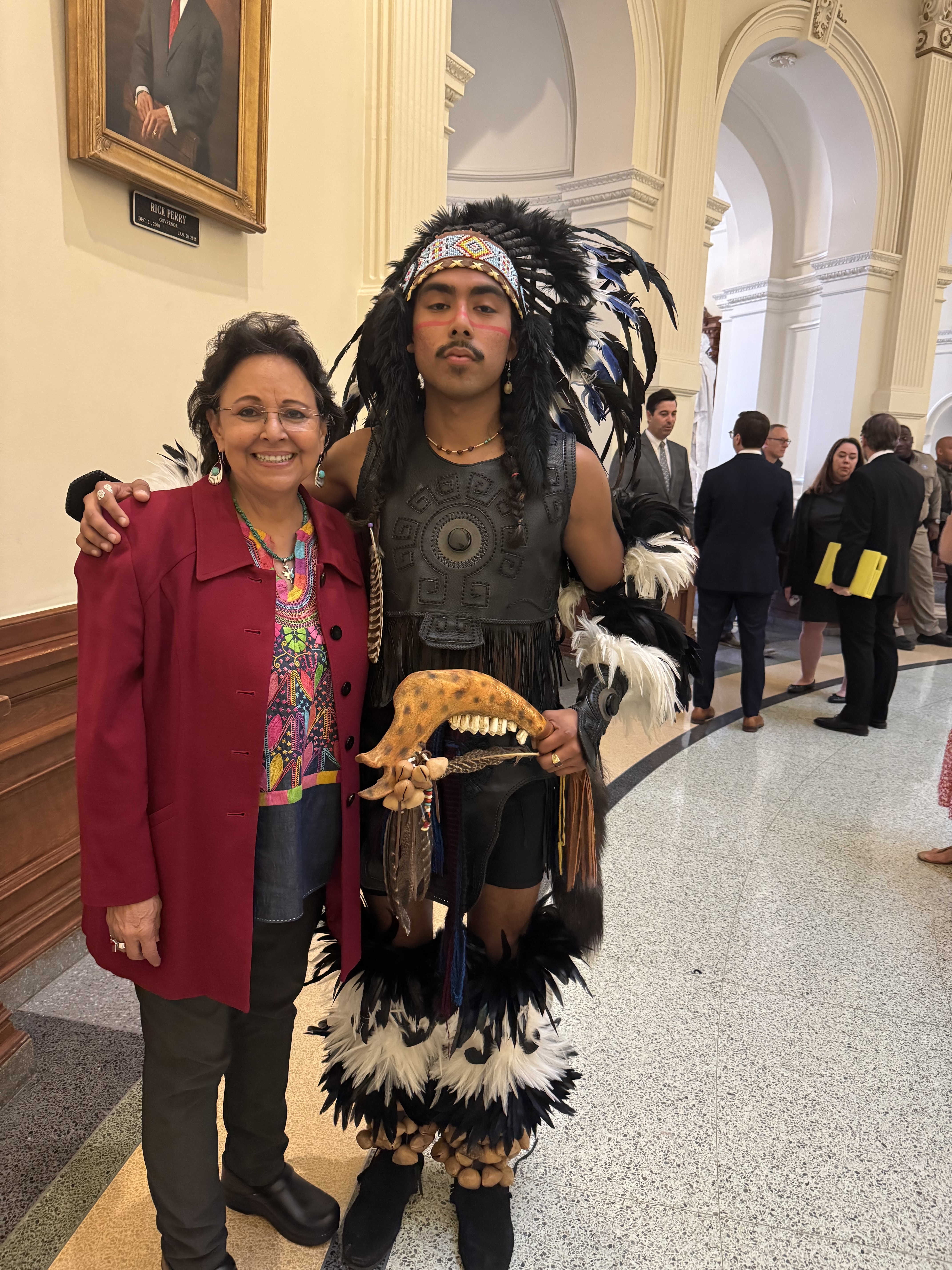
Words shared by Angela Valenzuela, Ph.D. at the Texas State Capitol Rotunda on April 8, 2025 in Honor of Rep. Christina Morales (Houston) [Video]

Friends:

I am happy to share with you what I shared this week on Tuesday
with an audience at the capitol wanting to know about the exquisite Danza Azteca Guadalupana ceremony in the main rotunda of the Texas State Capitol. 
The short of it is that this is to offer up prayers for bills, like Christina Morales' HB 178 in support of Ethnic Studies, as well as, if not especially for, a slew of bad bills that I'll post on when I have time. I've been so busy lately. 
AAUP and Texas AFT, in particular, are doing a great job of keeping us informed of what's happening right now at the capitol.

All of this was also a way to honor Rep. Morales' birthday which is today! She's also having a lowrider show I think at the capitol today that I'm unable to make. I like her taste. Danza Mexica and low riders are a testament to the cultural pride, resilience, and deep-rooted traditions that continue to thrive in our communities. They embody history in motion—whether through the rhythmic steps of ancestral dances or the artistic mastery of gleaming, hydraulically lifted cars cruising the streets. Both carry the spirit of storytelling, resistance, and celebración!!! 

I loved meeting this young man named "Nahuatl," who was grateful for the words I expressed and how important it is to hold onto our culture and the sacred knowledge. I love his name. It's the name of the language spoken by at least 1.6 million people in Mexico according to Mexico’s Instituto Nacional de Estadística y Geografía (INEGI) 2020 data. The rulers of Tenochtitlan (today's Mexico City) allowed for the speaking of Indigenous tongues in the provinces. They mainly cared about tribute. Something to think about as we face the perils of tariffs, the agenda for cultural erasure that anti-DEI measures embody, and tax day itself. As a consequence, language diversity continues into the present. Tariffs and taxes should not ever mean censorship or disdain for non-English speakers. We are of this continent and this hemisphere. We assert our right to exist in and within all this wondrous diversity that is also Afro-Indigenous and Afro-Latinx/o/a. And it's not just racial and ethnic, but also gender diversity and Gen Z loves, and works well, with this diversity.

Woefully under-appreciated is the linguistic diversity Mexico enjoys today—including among Mexicans themselves. I'm so glad that President Sheinbaum celebrates this diversity in Mexico. This is progress for the Indigenous of Mexico. 

Many languages, unfortunately, have suffered over the years as a result of migration and resulting language loss, with some in a precarious state of potential extinction. The Nahuatl language, with its various dialects, remains strong as you can see for yourselves at this link.

The Texas Legislative Session is always a marathon, not a sprint. So hang in there, our beloved advocacy community!

And may you have a wonderful, awesome happy birthday, Rep. Morales! Thanks for all you do! Someday, Ethnic Studies will just be called a good education.

Best,

-Angela Valenzuela

Reference

 Instituto Nacional de Estadística y Geografía. (2024). Population estimates. INEGI.

Saturday, April 20, 2024

Podcast Interview with Dr. Angela Valenzuela on Ethnic Studies, CRT, and Where we Should be Headed in Education


Friends,

Happy to share this podcast Interview that took place during the pandemic on Ethnic Studies, CRT, and where we should be headed in education with Dr. Abdín Noboa-Rios and Dr. Tony Baez. You can link directly to this interview below or view it here on Youtube.

I listened to it recently and happened to like my responses to Drs. Noboa-Rios and Baez' questions. 

As I think about Ethnic Studies and Critical Race Theory (CRT), my biggest concern is not solely with the mischaracterizations but also with the anti-intellectual agenda of not wanting to know minoritized or subaltern voices, histories, cultures, languages, identities, ways of knowing and so on when so much of what they're about is redemptive, intellectually expansive, and fully enhancing of everybody's lived experience.  I speak of these kinds of things in the podcast. 

Someday, Ethnic Studies will simply be called "a good education." Check out the Educa K-16 Podcast sponsored by the The DoMas Group and the various interesting interviews they've gathered over the years.

-Angela Valenzuela


Wednesday, October 05, 2022

Empowerment Zone PODCAST with Dr. Ramona Houston, featuring Angela Valenzuela, Ph.D.—How Can Municipalities Produce Academic Success & Teacher Pipelines Within the Latino Community


Friends:

Check out this podcast with Dr. Ramona Houston of the Empowerment Zone featuring our work here in Austin with respect to Academia Cuauhtli on Spotify. Here is the description:

Angela Valenzuela: Look to Academia Cuauhtli -

Providing educational support with identifiable teachers are important to the academic success of all students. In today’s episode Dr. Angela Valenzuela shares her work with Academia Cuauhtli (Nahuatl for "Eagle Academy”), a partnership model with the Austin Independent School District and the Emma S. Barrientos Mexican American Cultural Center that supports the educational development of students and creates pathways into the teaching profession for bilingual and dual language educators. Listen and learn how the Academy incorporates culturally relevant teaching methods and uses bilingual educators to elevate academic achievement among Latino students.

Dr. Valenzuela is a professor at the University of Texas at Austin in both the Cultural Studies in Education Program within the Department of Curriculum & Instruction and the Educational Policy and Planning Program within the Department of Education Leadership and Policy, where she also serves as the director of the Texas Center for Education Policy. Dr. Valenzuela also founded and operates an education blog entitled, "Educational Equity, Politics, and Policy in Texas.” Originally from San Angelo, Texas, Dr. Valenzuela now makes Austin her home.

To learn more about Dr. Angela Valenzuela, her blog, and Academia Cuauhtli, visit https://education.utexas.edu/faculty/angela_valenzuela

Thanks, Dr. Houston, for this wonderful opportunity to share a little bit about my life, political formation, and our work.

-Angela Valenzuela


Tuesday, September 20, 2022

"Buying the Myth," by Angela Valenzuela, Ph.D. Hispanic Heritage KVUE News Austin 2022

Friends:

None of us should ever succumb to the myth that we're "less than" anybody else. We're not. We're beautiful. We're loved. We're not broken. We don't need to be fixed. We need to be loved.

We're children of the Creator.

Our students, in particular, need to know in deep and meaningful ways that they are loved and cared for. They need to know that every way in which they are different is every way that they are strong.

And as Oscar Wilde once said, "Be yourself; everyone else is already taken."

To get to this place of love, however, one must embark on that intrepid journey to the soul.

-Angela Valenzuela

#HispanicHeritage
#TheEaglesJourney

"On Racism," by Angela Valenzuela, Ph.D., KVUE News Austin 2022

Here is another KVUE Segment on racism. Like the other two posts, this is in
honor of Hispanic Heritage Month for KVUE News Austin. What folks should know is that I have been teaching about racism via my various courses, including my Race, Ethnicity and the Schools course that I'm teaching this semester, for 30 years.

I got a Ph.D. in Sociology at Stanford University after which I taught at Rice University, then at the University of Houston, and then finally, at the University of Texas at Austin where I've been for the last 22 years. I feel blessed and honored to be able to do what I do. This, and more.

Thanks Dena Goldstein and Ysenia Carrizales for making this possible.

Angela Valenzuela

#HispanicHeritage


On Education vs. "Educación" by Angela Valenzuela, Ph.D., KVUE Austin 2022

Hi Friends:

I am so honored! Happy to share these three segments from KVUE News Austin in honor of Hispanic Heritage Month. I'm amazed how they got all of these segments down to seconds. 

Thanks Dena Goldstein and Ysenia Carrizales for making this possible.

Angela Valenzuela


#HispanicHeritage


Friday, December 03, 2021

"The Pandemic as a Portal to a Brighter Future and Better World," Dec. 4, 2021 Commencement Address by Angela Valenzuela, Ph.D.

Students, Friends and Colleagues:

I am so very honored to be the guest speaker for tomorrow's Fall, 2021 College of Education Commencement. The Ceremony will be livestreamed on Youtube and begins at 1:30PM on Saturday, December 4 in case you would like to listen in. 

My address is titled, "The Pandemic as a Portal to a Brighter Future and Better World." Program details are below.

A hearty congratulations to the College of Education's Graduating Class of 2021!

-Angela Valenzuela

                        https://tinyurl.com/2p833cju [at 1:30PM CST tomorrow]

Commencement Program

Welcome and Introductions
Dr. Beth Maloch, Senior Associate Dean and Elizabeth Shatto Massey Endowed Chair in Education


Remarks and Introduction of Speakers
Dr. Charles Martinez, Jr., Dean of the College of Education


Undergraduate Student Speaker
John Gray, B.S., Applied Learning and Development, Youth and Community Studies, Urban Teachers Social Studies Program


Graduate Student Speaker
Allison Zengilowski, Ph.D., Educational Psychology


Guest Speaker
Dr. Angela Valenzuela, Professor in the Department of Educational Leadership and Policy and Director of the University of Texas Center for Education Policy


Doctoral and Master's Graduate Recognition
Dr. Alexandra Loukas, Associate Dean for Research and Graduate Studies


Undergraduate Recognition
Richard Hogeda, Assistant Dean for Student Affairs


Conferring of Degrees
Dr. Charles Martinez, Jr., Dean of the College of Education


Recessional


Current Information


The College of Education Fall 2021 commencement ceremonies for all students will take place on December 4 in Bass Concert Hall.

Important Notice Regarding Parking and Transportation on Saturday, December 4

Please note that in addition to the College’s commencement ceremony at 1:30 PM the university is hosting the UIL State Football 6A-Division 2 Quarterfinal Playoff Game, which begins at 2 PM in Darrell K Royal-Texas Memorial Stadium. 

In anticipation of increased volume and traffic in the area, we encourage all commencement attendees to plan ahead of time and arrive early in order to obtain adequate parking. Parking is free in the San Jacinto, Trinity, and Brazos garages. It is important to note that San Jacinto and Trinity may fill quickly with game day attendees. Please see the map of parking garages to familiarize yourself with the area around Bass Concert Hall. 

For anyone using rideshare for transportation, there will be a designated drop-off location on Trinity.


Monday, September 06, 2021

INVITATION: 11th [Virtual] Conference on Education and Justice, Sept. 17-18, 2021

I and many other scholars are presenting at the wonderful and timely social justice conference organized by esteemed scholar advocate Dr. Kevin Kumashiro.  Conference registration is on a sliding scale such that hopefully most can attend, your availability considering.

UT Cultural Studies in Education Professor, Dr. Noah De Lissovoy, and I are focusing our talk on what higher education faculty in Texas are doing in response to anti-CRT Bill Senate Bill 3.

Please go to this page to register. Scroll down to view the schedule in detail. The roster of presenters is impressive.

-Angela Valenzuela


11th INTERNATIONAL CONFERENCE ON
EDUCATION AND JUSTICE
17-18 September 2021

DETAILED SCHEDULE
(all times in Pacific/California Time Zone)

(updated 5 September 2021)

CONFERENCE THEME: 

“Movement Building Against the Attacks on Teaching—and Toward a Vision of Justice”

CONFERENCE OVERVIEW AND INVITATION:

The 11th International Conference on Education and Justice builds on the vision, themes, analyses, and strategies of the new resource, Understanding the Attacks on Teaching: A Background Brief for Educators and Leaders. Educators, scholars, leaders, advocates, and educational organizations and institutions from across the United States and around the world are invited to present on research, resources, resistance, and reforms that counter the attacks on teaching and teachers while advancing a more just vision through curriculum, legislation and policy, teacher preparation, organizing, leadership, institutional change, reframing, and so on. All presentations should build explicitly on the “Background Brief” and facilitate consciousness raising, critical self-reflection, and collective action as we engage in movement building for justice.

SCHEDULES (all times are in Pacific Time):

All sessions will be live; the conference website will not upload recordings of or handouts from the sessions.

(a) Schedule-at-a Glance

FRIDAY, 17 SEPTEMBER 2021
9:00-10:30PST Plenary Session A
10:45-12:00PST Breakout Sessions #1
12:30-1:30PST Breakout Sessions #2
1:45-3:00PST Breakout Sessions #3

SATURDAY, 18 SEPTEMBER 2021
9:00-10:15PST Plenary Session B
10:30-11:45PST Breakout Sessions #4
12:15-1:30PST Breakout Sessions #5
1:45-3:15PST Breakout Sessions #6

(b) Detailed Schedule (scroll down to view in detail)


Friday, January 08, 2021

A Seat at the Table With Education Week: Testing & Accountability, featuring Dr. Lorrie A. Shepard and Dr. Angela Valenzuela

Friends:


I'm happy to invite you to a conversation that I am honored to be having next week with Dr. Lorrie A. Shepard on the very important topic of testing and accountability in a conversation moderated by Peter Dewitt for his online talk show at Education Week. The event is free and open to the public. It takes place next Wednesday, January 13, 2021,  from 2:00 p.m. -3:00 p.m. EST.


You can listen to the program here: TEMPLATE: Editorial Webinar.

-Angela Valenzuela


The pandemic has disrupted lives and schooling for nearly a year—and some in the education space—and beyond—worry about lost learning. One way to know what has been lost is through testing, but is it reasonable to hold students—or their teachers—accountable for one of the most challenging years in recent memory? This year’s National Assessment of Educational Progress, or NAEP—often referred to as “the Nation’s Report Card—has been postponed because of the pandemic. What impact will this decision have on education in this country?

Join Peter DeWitt as he sits down with researcher Lorrie Shepard, past president of the American Educational Research Association and the National Council on Measurement in Education, as they discuss this critical topic, especially given the circumstances.


Education Week maintains sole editorial control over the selection of the guests and content for this virtual event. References to products or services in the course of this webinar do not constitute endorsements by Education Week or Editorial Projects in Education.


Closed-captioning is available for this event. On the date of the event, you can log in as early as 15 minutes before the start of the webinar. Open the “Closed-Captioning” link from the “resource list” (located at the bottom of the console) to access Communication Access Realtime Translation (CART). A transcript will be available for download from the resource list within five business days after the event.


Your e-mail address may be used to communicate with you about your registration, related products and services, and offers sent to you directly from sponsors. Use of your personal information is otherwise protected according to our privacy policy.


SPEAKERS


Lorrie A. Shepard

Distinguished Professor and Dean Emerita,  University of Colorado Boulder


Lorrie A. Shepard is University Distinguished Professor?at the University of Colorado Boulder in the?Research and Evaluation Methodology program.? Her research focuses on psychometrics and the use and misuse of tests in educational settings.? Her technical work has contributed to validity theory, standard setting, and statistical models for detecting test bias.? Her research studies on test use have addressed the identification of learning disabilities, readiness screening for kindergarten, grade retention, teacher testing, effects of high-stakes accountability testing, and, most recently, the use of classroom assessment to support teaching and learning.


Dr. Shepard is past president of the American Educational Research Association and the National Council on Measurement in Education.? She was elected to the National Academy of Education in 1992 and served as president from 2005-2009.


Angela Valenzuela

Professor, Department of Curriculum & Instruction and the Department of Educational Leadership and Policy,  University of Texas at Austin

Angela Valenzuela is professor in the Department of Curriculum & Instruction and the Department of Educational Leadership and Policy at the University of Texas at Austin. Valenzuela is director of the Texas Center for Education Policy. Previously, she taught in the Department of Sociology at Rice University in Houston, and she was a visiting scholar at the Center for Mexican American Studies at the University of Houston. She completed her Ph.D. at Stanford University. Angela is the award-winning author of the book, Subtractive Schooling: U.S.-Mexican Youth and the Politics of Caring (1999). Valenzuela serves on the LULAC National Task Force on Higher Education, and is the executive director of the National Latina/o Education Research and Policy Project (NLERAPP), a consortium of ten institutions that enhances teaching for high school youth in Texas, California, Wisconsin, Chicago, New York, Colorado, New Mexico, and Arizona.


MODERATOR


Peter DeWitt


FOLLOW

Opinion Contributor,  Education Week

Peter DeWitt is a former K-5 public school principal turned author, presenter, and independent consultant.

* twitter

* linkedin

Related Tags:

Student Learning

For all webinars broadcast by Education Week after August 1, 2019, Certificates of Completion are available to all registered live attendees who attend 53 minutes or more of this webinar. Educators can download a PDF certificate verifying 1 hour of Professional Development credit. As with all professional development hours delivered, Education Week recommends each educator verify ahead of the webinar broadcast that the content will qualify for professional development in your school, district, county, or state with your supervisor, human resources professional, and/or principal or superintendent’s office.


Friday, October 09, 2020

Reclaiming Schooling/ Recuperando la Eseñanza: Radically Reimagining the Work of Education by Angela Valenzuela, Ph.D.

Friends,

I am so honored to have been this year's 2020 Richard T. Castro Distinguished Professor at Metropolitan State University in Denver, Colorado.  It was a two-day event, beginning on Wednesday evening, October 7, featuring myself, Texas State University Professor Dr. Chris L. Milk, and members of Nuestro Grupo, the community-based organization that organizes activities associated with Academia Cuauhtli, our Saturday school in Austin, Texas.


It was a special treat for me to be able to present on the work of our community with them actually present in the audience and sharing directly in the moment. The second day of Thursday, October 8, 2020 consisted of a keynote lecture followed by a community discussion (links provided below).

Thanks again to the organizing committee that brought me, particularly, Dr. Chalane Lechuga, Dr. Adriana Nieto, Virginia Castro, Jeremy VanHooser, Dr. Ruth M'Gonigle, Vice President for Diversity and Inclusion Dr. Michael Benitez, the Department of Chicana and Chicano Studies, and Metro State President Janine Davidson. Kudos to artist Laura de la Cruz for her beautiful work!

-Angela Valenzuela

Reclaiming Schooling/ Recuperando la Eseñanza: Radically Reimagining the Work of Education by Angela Valenzuela, Ph.D.

Wednesday evening, October 7, 2020


October 8, 2020 Part I Keynote Address

October 8, 2020 Part II Community Conversation

Monday, July 08, 2019

A Personal Reflection On Our Recent Travel to China

Hi Friends,
Angela Valenzuela, Institute for Higher
Education, Beijing University, China

It was been awhile since I've blogged.  Just returned from spending five weeks in China. What an  incredible experience.  I was a guest lecturer at the Institute of Higher Education at Beihang University in Beijing, China.  I especially enjoyed getting to know the masters and doctoral students and faculty at Beihang University.  
Sun Wei and Yonghong Ma
and me


Thankfully, since most students study English for many years throughout China, they understood most of what I was saying and when I wasn't communicating, they relied on each other for translations or we relied on phone apps like iTranslate to help us out.  Not unlike our own students in the U.S., they, too, seek to make a positive difference in the world through what they research and write.  I sincerely look forward to future collaborations.

I very much appreciate Dr. Yonghong Ma and Sun Wei for making this possible and look forward to future collaborations.  Aside from visits to historical sights in Beijing, my husband, Emilio Zamora, and I managed to travel to Xi'an, Zhangjiajie, and Shanghai.  It was great having Emilio with me to compare notes, figure things out, and to share in the experience, as whole.  China is a beautiful country with warm, friendly, and loving people—and a world-class cuisine, to boot.  


Emilio and me at
Zhangjiajie
Highlights were the Great Wall, the Forbidden City, the Temple of Heaven, the Terracotta Army at Xi'an and the breathtaking “Hallelujah Mountains” from the movie, “Avatar,” actually of Zhangjiajie, China, made famous by James Cameron as the mythic land of “Pandora.”  On this same trip, we rode the longest, highest, and steepest tramway in the world up to “Heaven’s Gate,” the world-renowned site for skydivers that fly through it—a few to their deaths, tragically.

Terracotta Army at Xi'an
If you ever want to travel in China, I strongly recommend traveling with “China Travel Guide Tours.” Unless you know what you’re doing and can speak the language, it’s pretty hard to travel around the country without a travel guide or guides to pick you up at train stations, airports, and tourist locations. 

Every guide we had was professional, knowledgeable, conversational, and tuned in to the finer details like eating times and places, bio breaks, travel options, and the diverse cultural heritage performances, museums, archeological sites, and the like.

Now we return to our regular lives in Texas, including—for myself—this blog.  Personally, I have much to ponder about China and I'm not ready to write about it. I return with many more questions than answers and realize anew how our country is systematically deprived of  knowledge about a main geopolitical powerhouse in the world with an interesting, ancient history and culture.  

While there, we heard scholars, pundits, and  politicos talking excitedly about a "Greater Asia," as well as building alliances with countries throughout the world.  

Where is the U.S. in all of this?  Our country is going in the opposite direction, and very much to our detriment.  Why aren't we teaching Mandarin in our schools?  Why do we know precious little about China's peoples and history?  We could, of course, extend these same questions to so many other places, including India that is slotted to surpass China in population in the not-too-distant future (Ritchie, 2019).

The celestial mountains of
Zhangjiajie

While many in the U.S, are critical about China's so-called insularity, we fail to note our own and our structured ignorance and silences about one of the world's most populous and influential nations that manages to put food on the table daily for over 1.4 billion people.  

I remain genuinely fascinated and interested in all that I learned and look forward to deepening my learning and understanding in the weeks, months, and years to come.  I am so grateful and deeply honored to have been this year's visiting scholar at Beihang University.

-Angela Valenzuela