Translate

Showing posts with label Danza Mexica. Show all posts

Monday, February 23, 2026

Academia Cuauhtli, the Eagle’s Vision, and the Architecture of Belonging: Education in the Shape of a Circle, by Angela Valenzuela, Ph.D.

Academia Cuauhtli, the Eagle’s Vision, and the Architecture of Belonging: Education in the Shape of a Circle

by 

Angela Valenzuela, Ph.D.

February 23, 2026

In “Academia Cuauhtli and the Eagle: Danza Mexica and the Epistemology of the Circle,” co-authored with Emilio Zamora and Brenda Rubio, we examine what it means to build Academia Cuauhtli as more than a Saturday school program in Austin, Texas. We frame it as an effort to rethink education itself.

The eagle’s vision represents the ability to see in all directions at once—expansively and relationally. For those of us working in community, it reminds us that while no single person can carry all the knowledge required to sustain an ambitious initiative like Academia Cuauhtli—with its Summer School program, parent development component, and curricular writing work—together, we can. 

It also symbolizes the aspirations we collectively hold for the children, families, and community in our care, alongside the disciplined precision with which the eagle, from great heights, fixes its gaze and moves with intention. Analytical clarity. This is what we want for all children—especially in this moment of chaos and uncertainty—so that they may see their world clearly, act with purpose, and rise with confidence rather than confusion.

Access full article here.

At the heart of this work is the circle. It is best exemplified by Danza Mexica or Aztec "dance," connoting not performance, but ceremony and a way of knowing and being in the world, including in educational spaces like Academia Cuauhtli about which I have previously blogged over the years.

In Danza Mexica, individuals form into a circle or concentric circles depending on the size of the group. Movement unfolds collectively. No one stands in front. No one stands above or below. Everyone faces inward toward a shared center—toward memory, spirit, healing, ancestors, and community.

The form itself encodes reciprocity, relationality, and a shared, sacred purpose.

This stands in contrast to the dominant architecture of schooling.

Most classrooms operate through vertical authority structures. Knowledge flows from expert to novice. Students are ranked, sorted, and compared. Time is segmented into benchmarks and testing cycles. Culture is often treated as enrichment rather than foundation.

The circle disrupts this logic.

An epistemology of the circle understands knowledge as generative and co-constructed rather than extractive or subtractive. It recognizes the body as a site of learning. It treats memory as living presence. It invites families, community members, scholars, and children into shared intellectual space. It refuses the idea that culture is peripheral to academic rigor (Colin, 2014).

For us at Academia Cuauhtli, the circle is also a form of pedagogy. It is history enacted through rhythm and specific movements (dance steps) across various ceremonies preserved throughout time. It is language, philosophical concepts, and civic education carried in collective movement. It signals and affirms that children—especially those labeled as “English learners” and targeted by subtractive, deficit-driven discourses—stand within powerful knowledge systems that have survived conquest, colonization, and erasure.

The circle also carries political meaning.

In a moment when ethnic studies programs are dismantled, faculty governance is constrained, and curriculum is policed under the language of “neutrality,” the circle offers another organizing principle. Education can be structured around relational accountability (or "responsibility") rather than surveillance. It can center dignity rather than deficit.

The eagle—or "Cuauhtli," in Nahuatl—symbolizes vision and strength. Yet the eagle rises from within the circle. Aspiration without community becomes isolation. Achievement without memory becomes assimilation.

The circle is not nostalgia. It is infrastructure, a third space situated between the over-prescribed role of the school and the under-prescribed role of the home in the education of our youth.

If we take educational equity seriously, we must ask: What would it mean to organize our classrooms, research partnerships, and institutions around relational centers instead of competitive hierarchies?

The answer does not begin with new mandates.

It begins with remembering—and practicing—the circle as a way of knowing and being in the world.

References

Colín, E. (2014). Indigenous education through dance and ceremony: A Mexica palimpsest. Palgrave MacMillan.

Valenzuela, A., Zamora, E., & Rubio, B. (2015). Academia Cuauhtli and the Eagle:" Danza Mexica" and the Epistemology of the Circle. Voices in Urban Education, 41, 46-56.https://files.eric.ed.gov/fulltext/EJ1074841.pdf

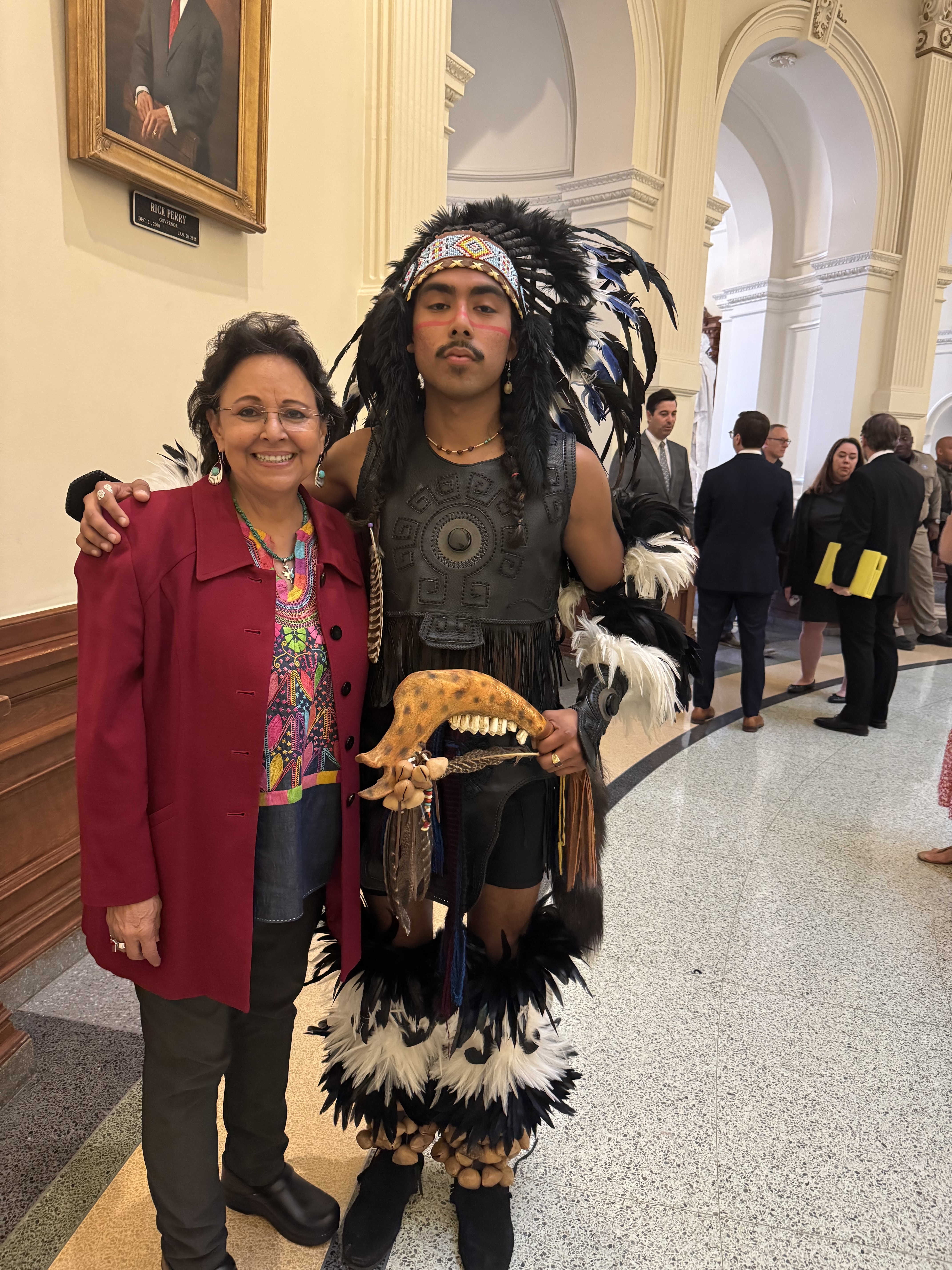

Thursday, April 10, 2025

Words shared by Angela Valenzuela, Ph.D. at the Texas State Capitol Rotunda on April 8, 2025 in Honor of Rep. Christina Morales (Houston) [Video]

Friends:

I am happy to share with you what I shared this week on Tuesday
with an audience at the capitol wanting to know about the exquisite Danza Azteca Guadalupana ceremony in the main rotunda of the Texas State Capitol. 
The short of it is that this is to offer up prayers for bills, like Christina Morales' HB 178 in support of Ethnic Studies, as well as, if not especially for, a slew of bad bills that I'll post on when I have time. I've been so busy lately. 
AAUP and Texas AFT, in particular, are doing a great job of keeping us informed of what's happening right now at the capitol.

All of this was also a way to honor Rep. Morales' birthday which is today! She's also having a lowrider show I think at the capitol today that I'm unable to make. I like her taste. Danza Mexica and low riders are a testament to the cultural pride, resilience, and deep-rooted traditions that continue to thrive in our communities. They embody history in motion—whether through the rhythmic steps of ancestral dances or the artistic mastery of gleaming, hydraulically lifted cars cruising the streets. Both carry the spirit of storytelling, resistance, and celebración!!! 

I loved meeting this young man named "Nahuatl," who was grateful for the words I expressed and how important it is to hold onto our culture and the sacred knowledge. I love his name. It's the name of the language spoken by at least 1.6 million people in Mexico according to Mexico’s Instituto Nacional de Estadística y Geografía (INEGI) 2020 data. The rulers of Tenochtitlan (today's Mexico City) allowed for the speaking of Indigenous tongues in the provinces. They mainly cared about tribute. Something to think about as we face the perils of tariffs, the agenda for cultural erasure that anti-DEI measures embody, and tax day itself. As a consequence, language diversity continues into the present. Tariffs and taxes should not ever mean censorship or disdain for non-English speakers. We are of this continent and this hemisphere. We assert our right to exist in and within all this wondrous diversity that is also Afro-Indigenous and Afro-Latinx/o/a. And it's not just racial and ethnic, but also gender diversity and Gen Z loves, and works well, with this diversity.

Woefully under-appreciated is the linguistic diversity Mexico enjoys today—including among Mexicans themselves. I'm so glad that President Sheinbaum celebrates this diversity in Mexico. This is progress for the Indigenous of Mexico. 

Many languages, unfortunately, have suffered over the years as a result of migration and resulting language loss, with some in a precarious state of potential extinction. The Nahuatl language, with its various dialects, remains strong as you can see for yourselves at this link.

The Texas Legislative Session is always a marathon, not a sprint. So hang in there, our beloved advocacy community!

And may you have a wonderful, awesome happy birthday, Rep. Morales! Thanks for all you do! Someday, Ethnic Studies will just be called a good education.

Best,

-Angela Valenzuela

Reference

 Instituto Nacional de Estadística y Geografía. (2024). Population estimates. INEGI.

Sunday, September 01, 2019

Academia Cuauhtli Enters its Sixth Year! Links to Publications and Resources


I am happy to share that we in Academia Cuauhtli (Nahuatl for "Eagle Academy") 

are entering our 6th year of operation.  We are not a charter school; we are a
partnership, involving the Austin Independent School District, the City of 
Austin's Emma S. Barrientos Mexican American Culture Center, and our
community-based organization named Nuestro Grupo.  We serve fourth-grade
children from Sanchez, Metz, Zavala, Houston, and Perez Elementary 
Schools located in East Austin.

To the best of our knowledge, we are the only Ethnic Studies program at the elementary grade level in the state of Texas and one of only a few nationwide.  The number gets smaller when taking into account that we also offer a TEKS-aligned curriculum in Spanish.  Our curriculum is further place-based, social justice oriented, community-centered, and parent-engaged.  We offer four teaching units this school year as follows:


  1. Raíces (Roots)
  2. Curanderismo y Medioambiente (Folk Medicine and Healing and the Environment)
  3. Defenderse contra la Discriminación (Defending Yourself Against Discrimination)
  4. Danza Mexica (Aztec dance or ceremony)

Check out our publications, media mentions, and other important links.

Publications

·    Valenzuela, A. (2019). The struggle to de-colonize official knowledge in Texas' state curriculum: Side-stepping the colonial matrix of power, Equity & Excellence in Education.

 Zamora, E. & Valenzuela, A. (2019). Ethnic Studies and community-engaged scholarship in Texas: The Weaving of a Broader We, in M. Zavala, T. Cuauhtin, C. Sleeter E, & W. Au. Rethinking Ethnic Studies. Milwaukee, WI: Rethinking Schools Ltd.

·     Valenzuela, A. (2019). Insurrection and the decolonial imaginary at Academia Cuauhtli: The liberating potential of third-space pedagogies in a third space. In Berry, T., Rodriguez, M., & Kalinek-Craig, C. A. (Eds.), Latinx curriculum theorizing (pp. 3-12). Lanham, Maryland: Lexington Books.

Valenzuela, A. (2018). Grow Your Own Educator Programs—Special Edition: A Roadmapto a Community-Based, Partnership Approach.


Valenzuela, A. (2017). Grow your own educator programs: A review of the literature with an  emphasis on equity-based approaches.  Intercultural Development Research Associates-Equity Assistance Center, U.S. Region II.

·     Valenzuela, A. (2017). Academia Cuauhtli: (Re)locatingthe spiritual, if crooked, path to social justice (2017). International Journal of Qualitative Studies in Education, Issue 10.

·     Valenzuela, A., Cabrera, N. & Pitti, S. (2017). The numbers won’t speak for themselves, Inside HigherEducation. 

·     Academia Cuauhtli is noted as a culturally relevant model in the recently published book edited by Angela Valenzuela titled, Growing Critically Conscious Teachers: A Social Justice Curriculum for Educators of Latino/a/a Youth (NY: Teachers College Press, 2016).

·      Valenzuela, A., Zamora, E., & Rubio, B. (2015). “Academia Cuauhtli and the Eagle: Danza Mexica and the Epistemology of the Circle.” Voices in Urban Education, 41, 46-56.

·      Valenzuela, A. & Riojas, C. (2013). No time to waste: We must advocate for books for our    children,” Somos en Escrito.


                                                                  Media

·     Ethnic Studies Symposium at UT-Austin on March 7, 2018: https://youtu.be/n7ZVYf0Yyn4

Santos, A. (January/February 2018).  Dr. Angela Valenzuela and growing your own educatorsLa Voz, 13(1 & 2).


 2018 HornRaiser Campaign Video: https://www.youtube.com/watch?v=EnlfWkKoRws
·      
      Ferlazzo, L. (March 27, 2017). Author Interview: Growing Critically Conscious TeachersQ & A with Larry Ferlazzo, Education Week.

 National Education Association. (2017, April 4). Bold, new program delivers love and   affirmation for Austin’s Latinx Students, Education Votes,  http://www.EdVotes.org.


 Academia Cuauhtli enseñara historia Tejana a Niños. (2016). Austin American-    Statesman: http://www.statesman.com/news/news/academia-cuauhtli-ensenara-historia-tejana-a-ninos/njpNt/


      KLRU/PBS Story: Academia Cuauhtli Works to Bridge History with Language (2015). http://texasedequity.blogspot.com/2015/05/thanks-to-videographer-blair-waltman.html
·     
      Barragán, J. (2015). New Hispanic Enrichment Program to Teach Students About their RootsAustin American-Statesman.


Important Links

·      Academia Cuauhtli Facebook page: https://www.facebook.com/AcademiaCuauhtli

·      Austin Independent School District: http://www.austinisd.org/academics/cuauhtli

·      Tejano History Curriculum Project      

  Press Conference Video, Posted March 4: 

        http://aisdtv.blogspot.com/2015/03/press-conference-inauguration-of.html

·     Academia Cuauhtli 2015 Graduation     Ceremony: http://texasedequity.blogspot.com/2015/05/academia-cuauhtli-graduation.html


These are the wonderful kinds of things that we can accomplish in partnership with teachers, schools, universities, and communities.  As students and scholars, places like these can and should also be our research sites.  

We need programs like these everywhere.

Enjoy!

Angela Valenzuela, Convener
Academia Cuauhtli