This blog on Texas education contains posts on higher education, as well as preK-12 policy accountability, testing, bilingual education, immigration, school finance, race, class, and gender issues at both the state and national level. It also represents my digital footprint, of life and career, as a community-engaged scholar in Texas.
Disrupting Colonial Logics: Transformational Resistance Against SB 17 and the Dismantling of DEI in Texas Higher Education
by
Angela Valenzuela, Ph.D., Maria Del Carmen Unda, & Julio Mena Bernal
In “Disrupting Colonial Logics: Transformational Resistance Against SB 17 and the Dismantling of DEI in Texas Higher Education,” Dr. María del Carmen Unda, Julio Mena Bernal, and I examine how Texas Senate Bill 17—aimed at banning Diversity, Equity, and Inclusion (DEI) programs across the state’s public universities—seeks to erase decades of hard-won progress. We argue that SB 17 is not merely a policy shift, but part of a broader colonial logic that censors and suppresses critical thought.
Drawing on Solórzano & Delgado Bernal’s (2001) framework of transformational resistance and Mignolo’s (2007) concept of the “colonial matrix of power,” we show how SB 17 exemplifies settler colonial efforts to undermine racial and educational justice (Tuck & Yang, 2012). Our article highlights how students, faculty, and communities are enacting creative, purposeful resistance that redefines what it means to fight for equity amid increasingly hostile political conditions. It is both a scholarly intervention and a call to action in defense of public higher education, marginalized communities, and democratic learning spaces.
This piece offers a critique of the current political moment and a celebration of collective struggle to reclaim and reimagine higher education as a liberatory, decolonial space. In response to efforts to silence marginalized voices and dismantle DEI, we uplift the power of grassroots organizing, student activism, and community-rooted scholarship as essential forms of transformational resistance.
We are deeply grateful to lead editors Drs. Marisol Ruiz and Nancy Perez, as well as Dr. Miguel Zavala for publishing our analysis of transformational resistance to SB 17 in the Ethnic Studies Pedagogies Journal—a truly exemplary journal advancing justice-oriented scholarship in support of Ethnic Studies and public education.
You may download the entire issue that contains our contribution here [pdf]. You can also visit the journal's website, Ethnic StudiesPedagogies.org to gain access to all of their publications.
Though under constant attack, the Ethnic Studies movement in Texas—and across the nation—remains resilient and deeply rooted. Still, we find ourselves fighting tooth and nail for a research agenda and curriculum that, in a more just future, will be recognized simply as "a good education."
-Angela Valenzuela
References
Mignolo, W. D. (2007). Delinking: The rhetoric of modernity, the logic of coloniality and the grammar of de-coloniality. Cultural Studies, 21(2–3), 449–514. https://doi.org/10.1080/09502380601162647
Solórzano, D. G., & Delgado Bernal, D. (2001). Examining transformational resistance through a critical race and LatCrit theory framework: Chicana and Chicano students in an urban context. Urban Education, 36(3), 308–342. https://doi.org/10.1177/0042085901363002
Valenzuela, A., Unda, M. D. C., & Mena Bernal, J. (2025). Disrupting colonial logics: Transformational resistance against SB 17 and the dismantling of DEI in Texas higher education. Ethnic Studies Pedagogies, 3(1), [pp. 7-24]. https://www.ethnicstudiespedagogies.org/gallery/Volume3-Issue1-Final.pdf
Here is a definite must-read in the time of #Covid19, written by Los Angeles Times staff writer, Carolina A. Miranda. Dating back to 1576, the "Florentine Codex" was co-constructed by the conquering and colonizing Spanish missionaries in Tenochtitlan (Mexico City today). The "lead editor," if you will, was a Franciscan Friar named Bernardino de Sahagún. He, along with the "NextGen," post-Spanish-Invasion Mexica (Aztec) students of Tlatelolco in Tenochtitlan, generated this masterful 2,000-page tome. With it, the students not only chronicled, but also interpreted, their own history and culture—motivated by the specter of annihilation brought on by the smallpox epidemic at the time. Written in Nahuatl and Spanish in such a way that honored two distinct world views, the "viruela," or small pox, was interpreted in dramatically different ways:
Dufendach says that Spanish texts frequently frame the smallpox pandemics as an act of God. “Sahagún says in the Codex, these people have diminished because of the plagues that God sends them,” she explains.
Whereas the Nahua texts attribute the pandemics to the indigenous concept of tlazolli. “It’s this invasion of filth that has caused the disruption of their entire society,” she explains. “It was not just the war-time invasion but a moral invasion.”
At the end of this piece, Miranda considers the deep introspection that the writers of the Florentine Index must have experienced: They saw the world ending as they knew it, and they tasked themselves with chronicling "the breadth of Nahua life." Similarly, for us in this moment of quarantine, it's important and healthy to ask ourselves about "the most important things we could be doing.” At this precise moment, I am pleased to be both blogging and sharing with you these most profound, encouraging texts I've read of late. Not only will this all eventually pass, but we can take this opportunity to engender new ways of knowing and being in the world—ways that celebrate and honor our individual and shared histories, languages, cultures, and identities. Thanks to Juan Tejeda for sharing. -Angela Valenzuela
It is the middle of a plague — “a pestilence so great and universal, that already it has been three months since it started, and many have died and many more continue to die.”
This does little to stop a group of scholars who have sealed themselves off from the world in a Mexico City convent, where they toil on a series of volumes devoted to indigenous knowledge.
He wrote those words in 1576.
Almost 500 years later, they couldn’t be more resonant.
Sahagún’s potent descriptions of a terrible plague are tucked into a colonial encyclopedia created in the late 16th century by a group of indigenous scholars at the Colegio de Santa Cruz de Tlatelolco.
“The General History of the Things of New Spain” — better known as the Florentine Codex — is a massive 2,000-page compendium of Nahua (a.k.a. Aztec) life in the Valley of Mexico, where Mexico City is now located. In both Spanish and Nahuatl (the Nahua language), the codex is composed of 12 handwritten books featuring almost 2,500 illustrations, which are bound into three massive volumes that now reside at the Laurentian Library in Florence, Italy.
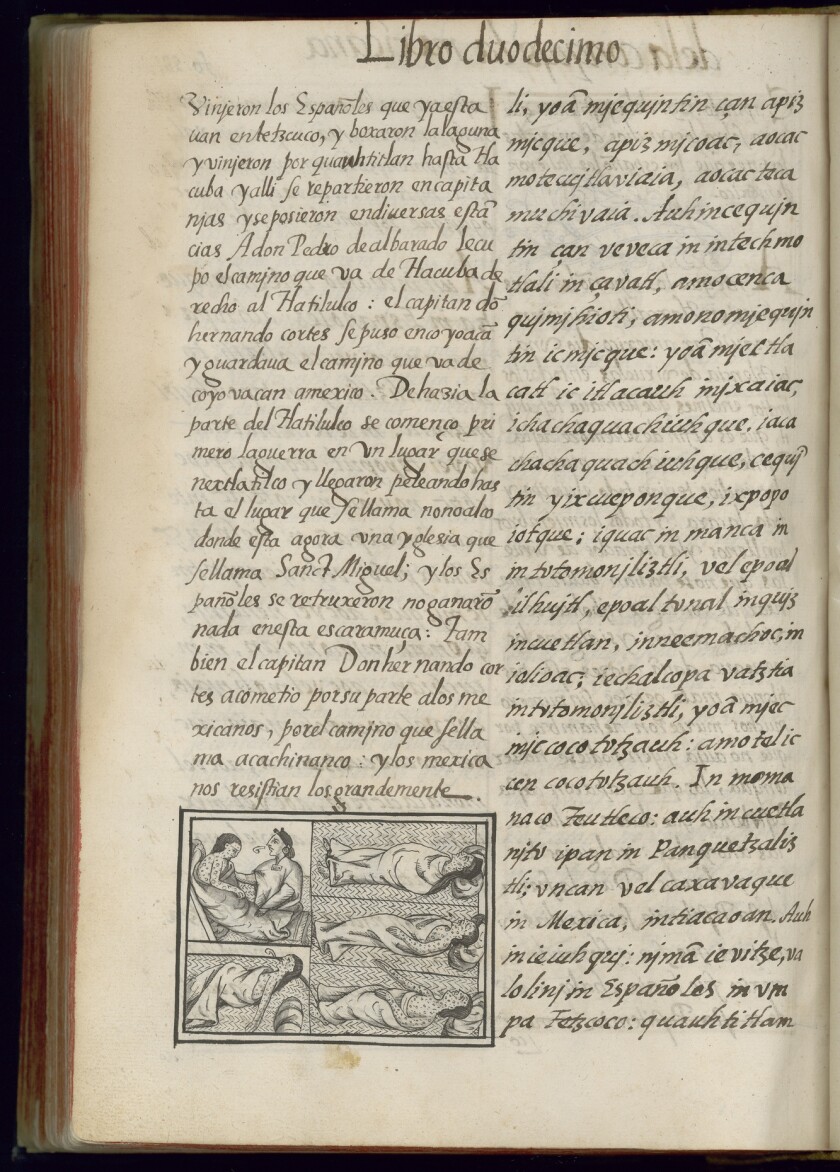
The last two books were created during a smallpox pandemic. As the contagion took its toll and supply lines for pigments fray, color disappears from the illustrations partway through Book 11. By Book 12, it’s as if all life has been drained out of it.
“To read that and see it,” says Mesoamerican scholar Kim Richter of the Getty Research Institute, “we can empathize with this text in a very different way now.”
If before the plague their goal was to create a historical record, it’s now become a race against time and disease: The pandemic is claiming lives outside of their walls. They continue to work even as they run out of pigments to color the illustrations that will accompany their text. It is simply too risky to leave the safety of their cloister to go looking for supplies.
“I don’t know how long it will last or how much harm it will do,” writes Bernardino de Sahagún, the Franciscan friar in charge of the endeavor. “I don’t know what will be of this pestilence.”
In a world turned head over heels by the new coronavirus, it is instructive to look at another cataclysm: the Americas during the 16th century, when European colonization shattered the old indigenous order through war, settlement and, most notably, disease. And not just one disease but several. A lethal cocktail of smallpox, measles and influenza — European illnesses to which indigenous people had no immunity — that decimated populations all over the continent.
(A study published by scientists at University College London in 2018 estimates that 90% of indigenous populations throughout the Americas died from disease in the 16th century — so many it cooled Earth’s climate for a number of decades as untended fields were taken over by carbon dioxide-absorbing overgrowth. It’s an event referred to as “the Great Dying.”)
I buried more than 10,000 bodies, and at the end of the epidemic, I caught the illness and was very ill.
BERNARDINO DE SAHAGÚN, FRANCISCAN FRIAR
In Mexico, this played out in a series of pandemics throughout the 16th century. The first, in 1520, came a year after explorer Hernán Cortés arrived on the shores of the Yucatán Peninsula.
“There came to be prevalent a great sickness, a plague,” reports Book 12 of the Florentine Codex on this terrible event. “There was indeed perishing; many indeed died of it. ... No longer could they move, no longer could they bestir themselves ... And when they bestirred themselves, much did they cry out.”
Similar pandemics struck in 1555 and 1576, the latter being the one that Sahagún refers to in the section in which he wrote: “Since the plague started until today ...the number of dead has increased; ten, twenty, thirty, forty, fifty, seventy, eighty die everyday.”
A page from Book 12 of the Florentine Codex records an early smallpox pandemic in colonial Mexico.
(Biblioteca Medicea Laurenziana / By permission of MiBACT)
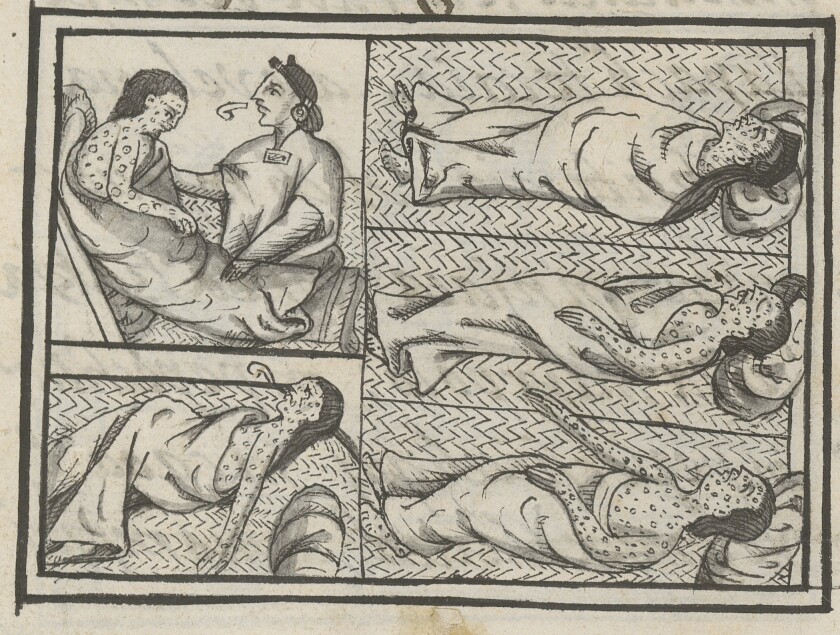
An illustrated detail shows a healer caring for patients lying on petates.
(Biblioteca Medicea Laurenziana / By permission of MiBACT)
If the Florentine Codex marks the creation of a historical artifact — and a brilliant, richly layered work of art — in the face of certain death, it is also an object that speaks to survival and resilience.
It is the story of a group of authors determined to record their history even as fatal illness strikes just beyond their walls.
It is also the story of a book, and the knowledge contained within it, that, against all odds, endured the ravages of history. Shortly after it was created it was sent to Spain, after which its whereabouts remained uncertain for centuries. It reemerged in Italy in the late 18th century — a time capsule of indigenous life, fully intact.
“It’s a connection to that world — all the animals, all the beings,” says Magaloni, who is a deputy director at the Los Angeles County Museum of Art. “It’s comprehensive knowledge. It’s something amazing.”
And it continuously reaches into the present.
This is partly because of the work of organizations like the Laurentian Library, which has lovingly preserved it, and the Getty Research Institute, which is currently funding a digitization effort that is creating a high-resolution scan of the codex, which it aims to put online by 2022 — with translations and tagged, searchable images.
But it has also remained alive through the work of scholars who have studied it for more than a century, and through the artists who have long been inspired by its virtuosity. (Over the last decade, volumes from the codex have been displayed around Los Angeles at the Getty Villa, the Getty Museum and the Huntington Library, Art Museum, and Botanical Gardens.)
Los Angeles painter Sandy Rodriguez creates contemporary paintings using materials of pre-Columbian artists, such as cochineal and mineral oxides. She is a student of the codex and its artistic methodologies, and for a recent show at L.A.'s Charlie James Gallery, which focused on the stories of Central American children who have died while in the custody of U.S. immigration authorities, she gathered a group of poets to create work inspired by Book 12 of the Florentine Codex, which tells the story of the conquest.
“We talked about imagining being one of the tlacuilos [scribes], sequestered and writing your history,” she says, “not being able to go out and get your materials.”
By the time of the show’s March 7 closing, the severity of the coronavirus pandemic had become all too evident in the U.S. — and what had been an interesting historical exercise now had new meaning.
“It’s like we performed this contemporary history in this contemporary moment,” she says.
It’s a moment, Rodriguez says, that she is still trying to process.
It goes without saying that the “Historia General de las cosas de la Nueva España,” as the Florentine Codex was originally titled in Spanish, wasn’t created simply because the Franciscans were in love with Aztec learning. Sahagún conceived of it as an anthropological tool that could provide an understanding of indigenous belief systems, and therefore help facilitate the conversion of the Nahua to Christianity.
To this end, he recruited a group of young men from the Colegio de Santa Cruz to help him research, write and illustrate the epic undertaking.
The colegio had been established at the Convent of Santiago in Tlatelolco in 1536 as a place to acculturate the sons of indigenous nobility to European ways, instruct them in a variety of subjects, and prepare some of them for eventual priesthood and, therefore, further Christian proselytizing. These were the intellectual crème de la crème of early Mexican society and they learned to read and write in a variety of languages, including Spanish, Latin and Nahuatl. (Already Spanish friars had devised a system of writing the previously unwritten Nahuatl using the Latin alphabet.)
It is estimated that Sahagún began work on the project in the late 1540s, assembling draft manuscripts (such as the Códices Matritenses, which still survive) and attempting to devise a taxonomy for how the tome would be organized. In its format and its ambitious scope, it nods to the work of the ancient Roman scholar Pliny the Elder and his “Naturalis Historia” (“The Natural History”).
“It’s based on the concept of the European encyclopedia,” explains Richter. “But it’s focusing on the cultures of the Aztecs and written in the generation after the conquest of the Aztec Empire.”
Sahagún ultimately settled on a bilingual, two-column system, one written in Spanish, the other in Nahuatl, that would cover the breadth of Nahua life: landscape, minerals, animals, food, belief systems, history, art, architecture, social classes and more. There is even an entry on “malas mugeres” — “bad women,” to quote the early modern Spanish — or sex workers.
What makes the book so dynamic is that the codex isn’t mere observation. The indigenous scholars working on the project — Antonio Valeriano, Alonso Vegerano, Pedro de San Buenaventura, Martín Jacobita, Diego de Grado, Bonifacio Maximiliano and Mateo Severino, among others — were actively interviewing the communities from which they hailed.
“They are capturing what their elders are saying, but also their colonial reality,” says Rebecca Dufendach, a research specialist at the Getty Research Institute who has been working with the codex for a decade. “They are trying to capture this world of knowledge.”
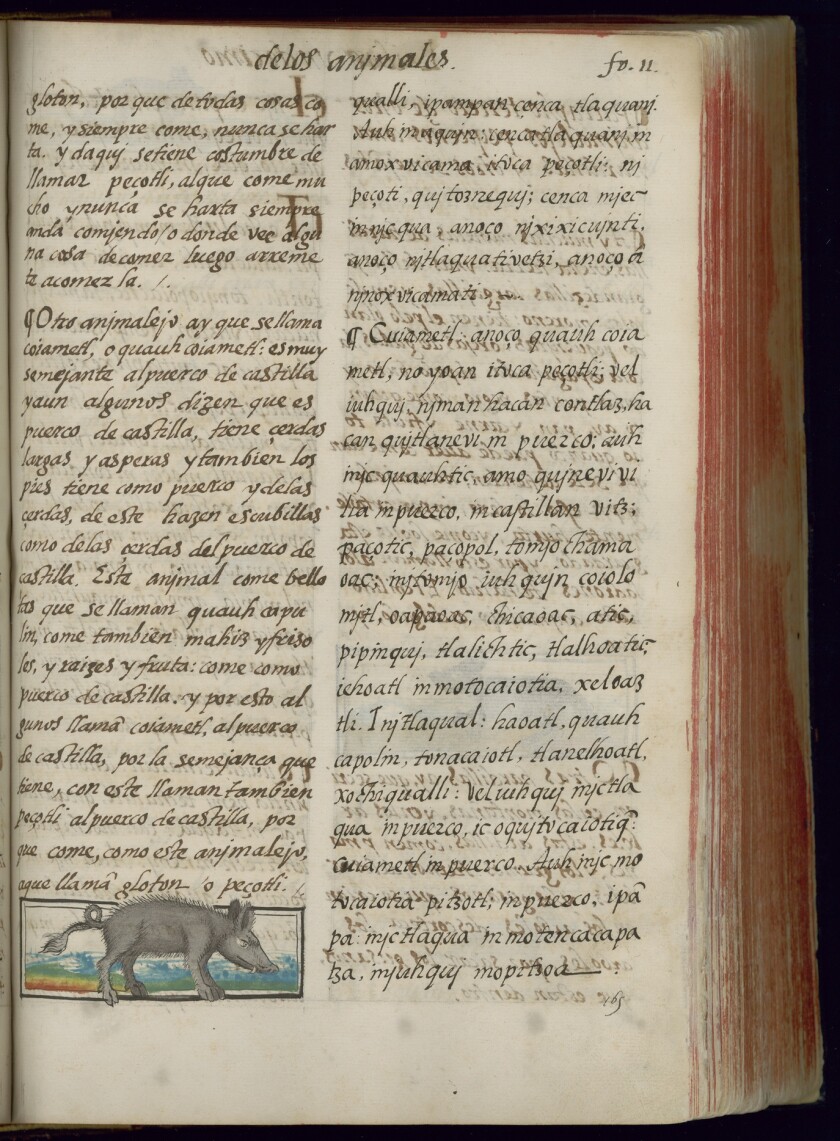
A page from Book 11 of the Florentine Codex, about Mexico’s natural history, features a buoyant illustration of a peccary. Spanish text is on the left, Nahuatl on the right.
(Biblioteca Medicea Laurenziana / By permission of MiBACT)
The Codex therefore reflects a distinct Nahua point of view — one that bears the imprint of people who had memory of a world before the arrival of the Spanish.
It is believed that the Nahuatl text was written first and the Spanish came after. “The Spanish is usually called a translation, but it’s more of an interpretation,” says Richter. “In some places, [Sahagún] leaves the Spanish out completely. At other times, he provides more interpretation.”
This means that the Florentine Codex isn’t simply a bilingual record of events, it’s a pair of world views, presented side by side.
Book 12, which focuses on the Spanish invasion, tells the story of the Matanza de Tóxcatl — known in English as the Massacre in the Great Temple, which took place in May 1520. In that event, Spanish soldiers massacred a group of indigenous nobles celebrating a religious ceremony at the Templo Mayor, an event whose brutality reverberated through the region.
“The Spanish text states very clearly: Here was this ritual that was happening and Pedro de Alvarado went in and killed innocent people,” says Richter. “They aren’t hiding it. But when you read the Nahua text, it’s a gruesome painful thing to read. Nahua is so poetic and it has certain repetitions. The cutting of the flesh and the cracking of bones and people trying to walk and their guts spilling.
“I get goose bumps thinking about it because it’s so awful.”
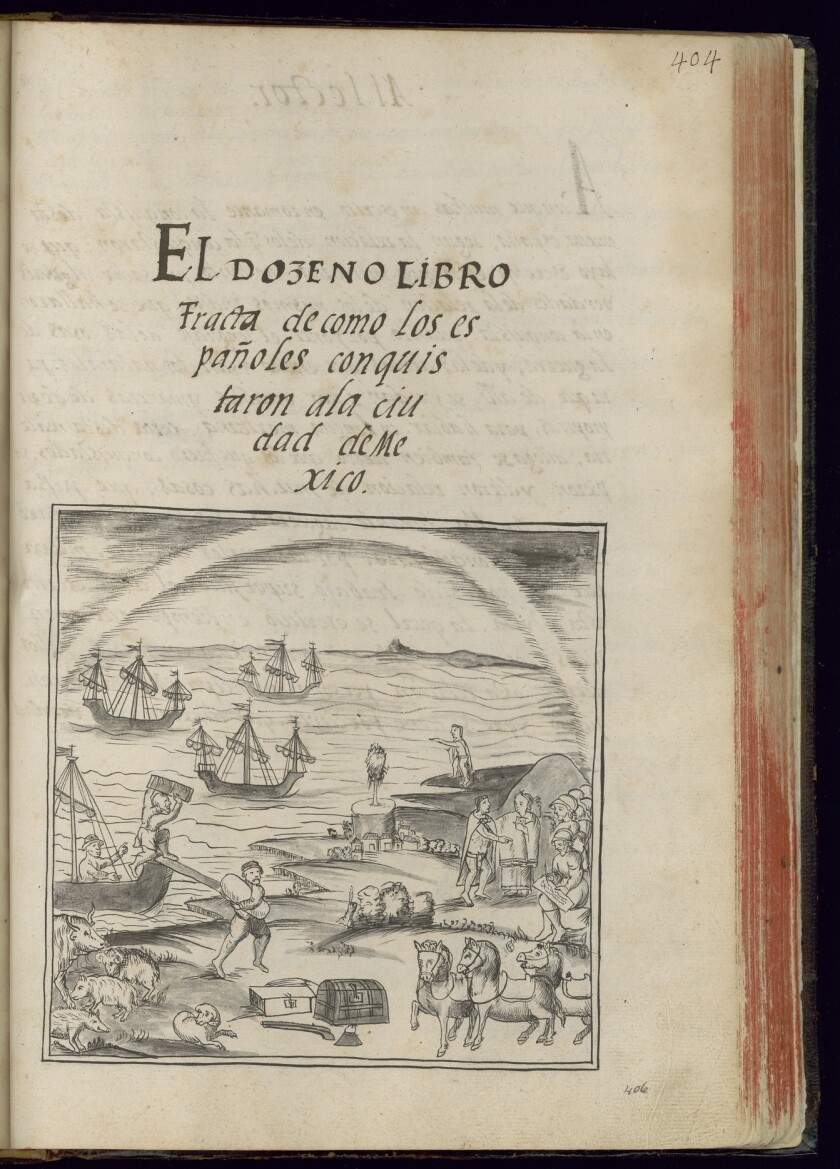
The first page of Book 12 of the Florentine Codex, showing the arrival of the Spanish to the Gulf of Mexico.
(Biblioteca Medicea Laurenziana / By permission of MiBACT)
These different worldviews are brought to bear in the sections that describe disease.
Dufendach says that Spanish texts frequently frame the smallpox pandemics as an act of God. “Sahagún says in the Codex, these people have diminished because of the plagues that God sends them,” she explains.
Whereas the Nahua texts attribute the pandemics to the indigenous concept of tlazolli. “It’s this invasion of filth that has caused the disruption of their entire society,” she explains. “It was not just the war-time invasion but a moral invasion.”
In many cases, the Nahuatl language had absorbed lone Spanish words to describe phenomena introduced by the Europeans — such as the word caballo, for horse. But Dufendach says the Codex never really embraces the use of viruela, the Spanish word for smallpox, in the portions that are written in Nahuatl.
“They are understanding it on their terms,” she says. “They are trying to describe it in the Nahua language.”
Disease shaped not just the ideas in the Florentine Codex, but its manufacture.
Sahagún interrupts an entry on Mexican road systems in Book 11 to write, in first person, about plagues past and present — including the one in 1555. “I buried more than 10,000 bodies,” he writes, “and at the end of the epidemic, I caught the illness and was very ill.”
In fact, it is partway through that book — about the natural world — in which color begins to disappear as the pandemic of 1576 begins to claim victims, disrupt supply lines and force its authors into quarantine.
Though it was set down on European wood-pulp paper, the pigments and other materials used for illustrations are almost entirely Nahua in origin: cochineal for red, indigo for blue, clays and orchid gums used to change tones and fix colors. Almost 500 years later, they remain in dazzling shape.
“What always strikes me is how crisp and how fresh these books look,” says Richter. “It’s so different when you hold the real thing in your hand. The colors, they look like they were painted yesterday.”
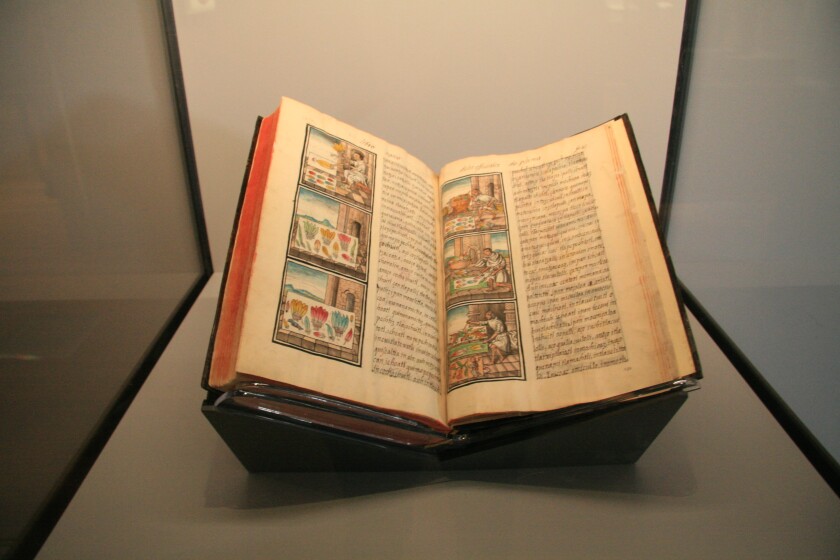
One of the three volumes of the Florentine Codex on view at the Getty Museum in the exhibition “Golden Kingdoms: Luxury and Legacy in the Ancient Americas,” which opened in the fall of 2017.
(J. Paul Getty Museum)
As they ran out of color, scribes used coded images to denote the tones of an object — say, placing a ladybug next to a flower to mark the red of its petals. They also reserved what pigments they had for the most important images.
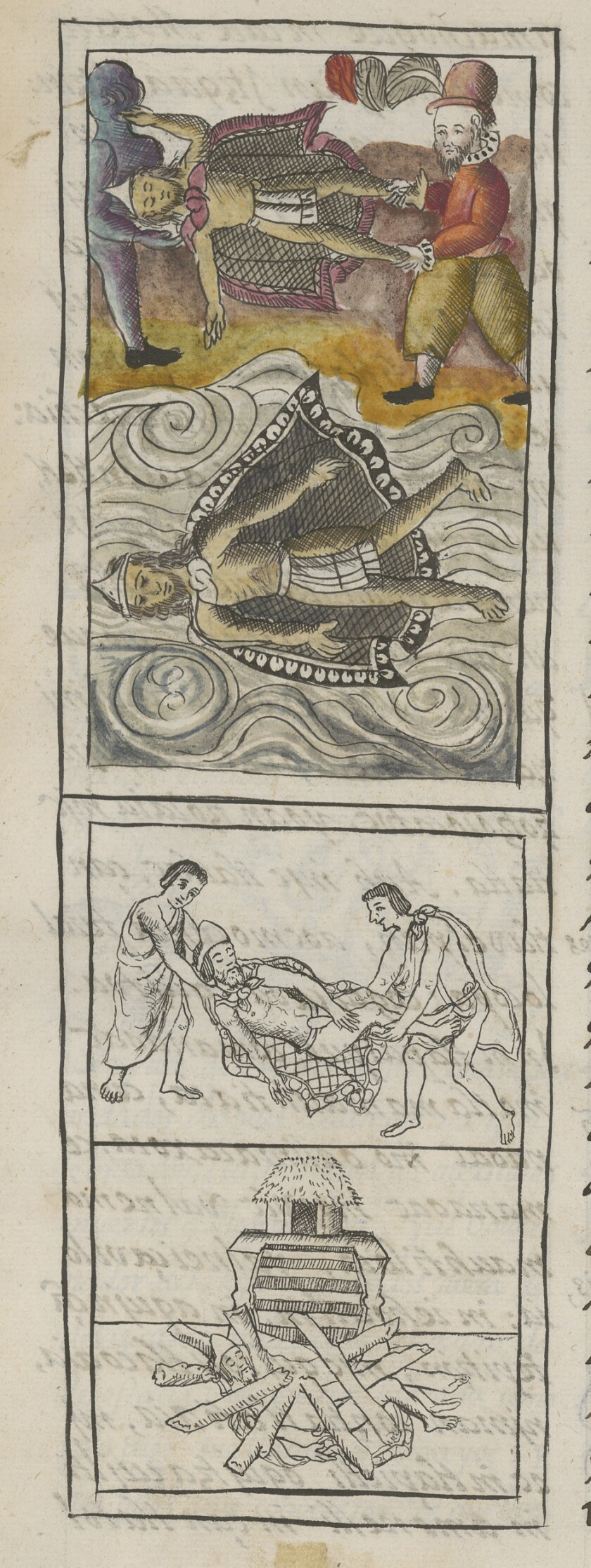
Book 12, the final book, contains only three color illustrations: one in which Cortés and his men are seen entering the Valley of Mexico, featuring a landscape rendered in brilliant shades of Mayan blue and green. Another shows the moment in which a pair of indigenous armies have defeated the Spanish in battle. The last shows two Spanish soldiers casually disposing of the dead bodies of Moctezuma and Itzquauhtzin, the leaders of Tenochtitlán and Tlatelolco, respectively.
“They were saving their pigments for things that were meaningful,” says Magaloni. “The world of color has meaning for them.”
There are three illustrations on the page that features Moctezuma and Itzquauhtzin. Only the image of the fallen indigenous leaders receives color.
A detail from Book 12 shows Spaniards tossing the dead bodies of Moctezuma and Itzquauhtzin into a canal. The artists reserved scarce pigments for this important scene.
(Biblioteca Medicea Laurenziana / By permission of MiBACT)
Little is known about the scholars who created the Florentine Codex or how they lived. Magaloni imagines a high degree of dedication — scholars attempting to put the world of their elders on paper, before it disappears — but also of deep introspection.
“It’s the opportunity to go inside ourselves and think about what we are doing,” she says, “to think about the most important things we could be doing.”
For Rodriguez, that means continuing to paint — much like the scribes of the 1570s.
“I’ve been burning my sage and my copal and asking for strength,” she says. “There would be no sanity to my world if I didn’t get up and read and then paint for a few hours.”
While others were out buying toilet paper, she was stocking up on her materials.
“I will have the supplies,” she says, “to tell the story of whatever goes down.”
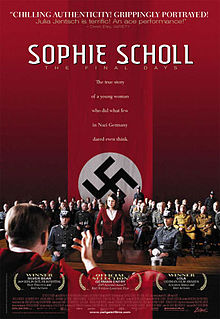
One of the most disturbing, heart-rending and thought-provoking films we have ever seen was “Sophie Scholl – The Final Days”.
The movie covers the efforts of a resistance group fighting the Nazis
called “White Rose” Although the White Rose is well known in Germany,
it is not well known overseas.
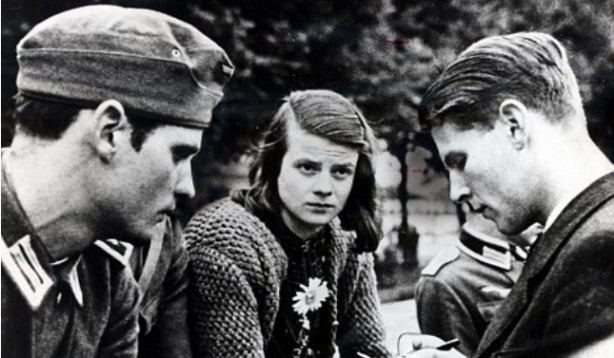
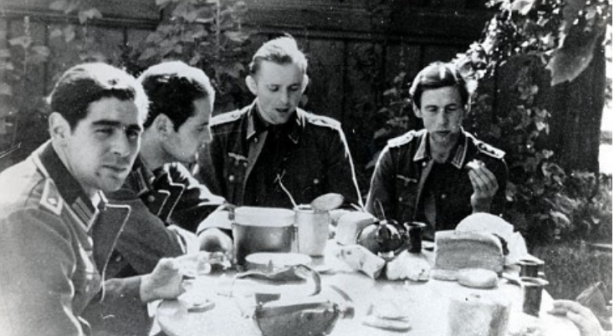
Der Weissen Rose was a group of mostly students at the University of
Munich in Bavaria. Some were studying philosophy. Most, but not all,
were religious in some way. Some of the boys had done military service
but were allowed to do stints at university between stints on the
Eastern Front. This experience provided them with more knowledge of what
was actually going on than the average person living in Germany at the
time, and it appalled them, but in their courageous resistance they
still come across as young and somewhat naïve. It is this naivety that
has made the White Rose so appealing. The operated from “pure”
theological and philosophical intellectual opposition to National
Socialism, to fascism, to dictatorship, to the war, and to the slaughter
of Europe’s Jews.
To believe that there was very little resistance to Hitler inside
Germany is a serious misunderstanding. Resistance to the Nazis began, of
course, before they even came to power, and continued during the
thirties and throughout the war.
Serving members of White Rose
Resistance came from political groups of the left, centre and even
conservatives, from unions, from churches and religious people, from
within the government and branches of the military. Several attempts
were made to assassinate Hitler both by groups and individuals. Although
it did not succeed in overthrowing Hitler or ending the Nazi tyranny,
the resistance did have an impact on the war and the ultimate defeat of
the fascist regime.
Why does it seem otherwise? Well, the Nazi regime set out
systematically and ruthlessly to destroy all opposition. Thousands of
the people who would have been part of an even more effective resistance
movement fled into exile soon after Hitler came to power. Many more
were perfectly understandably frightened by the danger and sank into
silence and inaction.
Sophie
Scholl was guillotined, as was her brother, another brother was lost on
the Eastern front. In a final meeting, Scholl’s father told her he was
proud of her and not to regret her sacrifice. She replied that she would
see them again in Heaven.
Yet many did not and paid the price. At least 5,000 were executed and many more spent time in prison. Some were simply murdered.
There was a feeling within Germany that people really shouldn’t undermine the government during wartime
Many ordinary Germans saw members of the resistance as traitors
because that was what almost every source of information available to
them told them they were.
Unlike in the countries Germany tried to conquer, the resistance had
to assume that much of the population actually supported the government
and would report their activities from a sense of duty or from totally
justified fear, thus making their actions even braver. Nevertheless,
their writings struck a chord with many in the community.
The nations fighting Germany during World War II also decided not to
publicise the German resistance to Hitler during or after the war. The
insistence on unconditional surrender and the strategic bombing raids
which caused so many civilian casualties made it necessary to see
Germany as guilty as a nation rather than as itself a victim of Nazi
tyranny. The allied armies knew about the resistance and benefited from
it but did not want to praise it, at least initially. So
the story of Sophie Scholl and her family and friends remained almost
un-talked about until about the 1970s, when the German community started
to discuss the war years more openly, and then again in 2005 when the
remarkable film about the events was released.
You can watch the entire film, in its original German, with subtitles, below.
If you haven’t seen it, we cannot recommend it highly enough, but we warn you that it is gut wrenching.
Nevertheless, if you haven’t seen it, find a couple of hours, pour
yourself a strong drink, and watch it. Those that died deserve to be
remembered.
When people discuss the White Rose it has been suggested they were a
brave but ineffective resistance movement. That is, in fact, not true.
When they were active they caused the regime considerable annoyance.
Although many who received the leaflets in the mail handed them in to
police, many did not, and the regime had to deal with the fact that
those who handed them in may have read them.
Sophie
Scholl was an ordinary girl – devoutly Catholic, she fell in love with
one of her fellow conspirators, she loved the countryside, she adored
her parents. She was very ordinary, just very, very brave.
They managed to establish branches in Berlin and particularly Hamburg where sadly many of Hamburg White Rose met the same fate.
The White Rose also had a role in a student uprising in Munich— which was quickly suppressed.
After their execution graffiti appeared on walls in Munich: “Ihr Geist lebt wieter” “Their Spirit Lives On”.
Others carried on the fight. Copies of the leaflets were smuggled out
to the Allies and later dropped in their tens of thousands by bombers
over German cities.
An example of the leaflets (there were a total of five) is produced
below. The courage of young people who could make these arguments
against the might of the Nazi Reich simply beggars belief. Especially as
they operated in the sure and certain knowledge that one day they must
be caught, with their horrifying deaths as the inevitable result.
Many brave people died during the Second World War. These young Germans were amongst the bravest. THE THIRD LEAFLET
Salus publica suprema lex (Public safety is the supreme law)
All ideal forms of government are Utopias. A state cannot be
constructed on a purely theoretical basis; instead, it must grow and
develop in the same way an individual human being matures. But we must
not forget that at the beginning of every civilization the state already
existed in a rudimentary form. The family is as old as man himself, and
out of this initial bond man, endowed with reason, created for himself a
state founded on justice, whose highest law was the common good. The
state should reflect the divine order, and the highest of all utopias,
the Civitas dei, is the model it should ultimately resemble. We will not
compare the many possible states here—democracy, constitutional
monarchy, monarchy, and so on, but one issue needs to be made clear and
unambiguous; every human being has the right to a just state, a state
that safeguards the freedom of the individual as well as the good of the
whole. For according to God’s will, man should be free and independent,
while fulfilling his natural duty of living and working together with
his fellow citizens, and strive to achieve earthly happiness through
self-reliance and self-motivation.
But the present “state” is the dictatorship of evil. “Oh, we’ve known
that for a long time,” I hear you object, “and it isn’t necessary to
bring that to our attention again.” But, as I ask you, if you know that,
why do you not rouse yourselves, why do you allow these men in power to
rob you step by step, both openly and in secret, of one of your rights
after another, until one day nothing, nothing at all will be left but a
mechanized state system presided over by criminals and drunkards? Is
your spirit already so crushed by abuse that you forget it is your
right—or rather, your moral duty—to eradicate this system? But if a man
can no longer summon the strength to demand his right, then he will
definitely perish. We would deservedly be scattered over the earth like
dust in the wind if we do not marshal our powers at this late hour and
finally find the courage we have lacked up to now. Do not hide your
cowardice behind a cloak of expedience, for with every new day that you
hesitate, failing to oppose this offspringof Hell, your guilt, like a
parabolic curve, grows higher and higher.
Many, perhaps most, of the readers of these leaflets cannot see
clearly how they can mount an effective opposition. They cannot see any
avenues open to them. We want to try to show them that everyone is in a
position to contribute to the overthrow of this system. Solitary
withdrawal, like embittered hermits, cannot prepare the ground for the
overthrow of this “government” or bring about the revolution at the
earliest possible moment. No, it can only be done through the
cooperation of many convinced energetic people—people who agree on the
means they must use to attain their goal. We have few choices as to
these means. The only one available is passive resistance. The meaning
and the goal of passive resistance is to bring down National Socialism,
and in this struggle we can’t shrink from any means, any act, wherever
it is open to attack. We must bring this monster of a state to an end
soon. A victory for fascist Germany in this war would have inconceivable
and terrible consequences. The first concern of every German is not the
military victory of Bolshevism, but the defeat of National Socialism.
This must be the first order of business; its greater imperative will be
discussed in one of our forthcoming leaflets.
And now every resolute opponent of National Socialism must ask
himself how he can most effectively fight against the present “state”,
how he can inflict the most damaging blows. Through passive resistance,
without a doubt. We can provide each man with a blueprint for his acts;
we can only make general suggestions, and he alone will find the best
way to achieve them.
Sabotage armament industries, sabotage every assembly, rally,
ceremony, and organisation sponsored by the National Socialist Party.
Obstruct the smooth functioning of the war machine (a machine designed
for war that is then used solely to shore up and perpetuate the National
Socialist Party and its dictatorship.) Sabotage in every scientific and
intellectual field involved in continuing this war—whether it be
universities, technical colleges, laboratories, research stations, or
technical agencies. Sabotage all cultural institutions that could
enhance the “prestige” of the fascists among he people. Sabotage all
branches of the arts that have even the slightest dependence on National
Socialism or serve it in any way. Sabotage all publications, all
newspapers, that are in the pay of the “government” and that defend its
ideology and help disseminate the brown lie. Do not give a penny to
public fund-raising drives (even when they are conducted under the guise
of charity), for this is only a cover. In reality the proceeds help
neither the Red Cross nor the needy. The government does not need this
money; it is not financially interested in these fund-raising drives.
After all, the presses run nonstop, printing as much paper currency as
is needed. But the people must never be allowed to slacken! Do not
contribute to the collection of metal, textiles and the like. Try to
convince all your acquaintances, including those in the lower social
classes, of the senselessness of continuing, of the hopelessness of this
war; of our spiritual and economic enslavement at the hands of the
National Socialists, of the destruction of all moral and religious
values; and urge them to adopt passive resistance.
Aristotle, Politics: “Further….[a tyrant] should also endeavor to
know what each of his subjects says, or does, and should employ spies
everywhere…and further, to create disunity and division in the
population: to set friend against friend, the common people against the
notables, and the wealthy among themselves. Also he should impoverish
his subjects; the maintenance of guards and soldiers is thus paid for by
the people, who are forced to work hard and have neither the time nor
the opportunity to conspire against him…Another practice of tyrants is
to increase taxes, after the manner of Dionysius at Syracuse, who
contrived that his subjects paid all their wealth into the treasury
within five years. The tyrant is also inclined to engage in constant
warfare in order to occupy and distract his subjects.
Please make as many copies of this leaflet as possible and pass them on!



 So
the story of Sophie Scholl and her family and friends remained almost
un-talked about until about the 1970s, when the German community started
to discuss the war years more openly, and then again in 2005 when the
remarkable film about the events was released.
So
the story of Sophie Scholl and her family and friends remained almost
un-talked about until about the 1970s, when the German community started
to discuss the war years more openly, and then again in 2005 when the
remarkable film about the events was released.