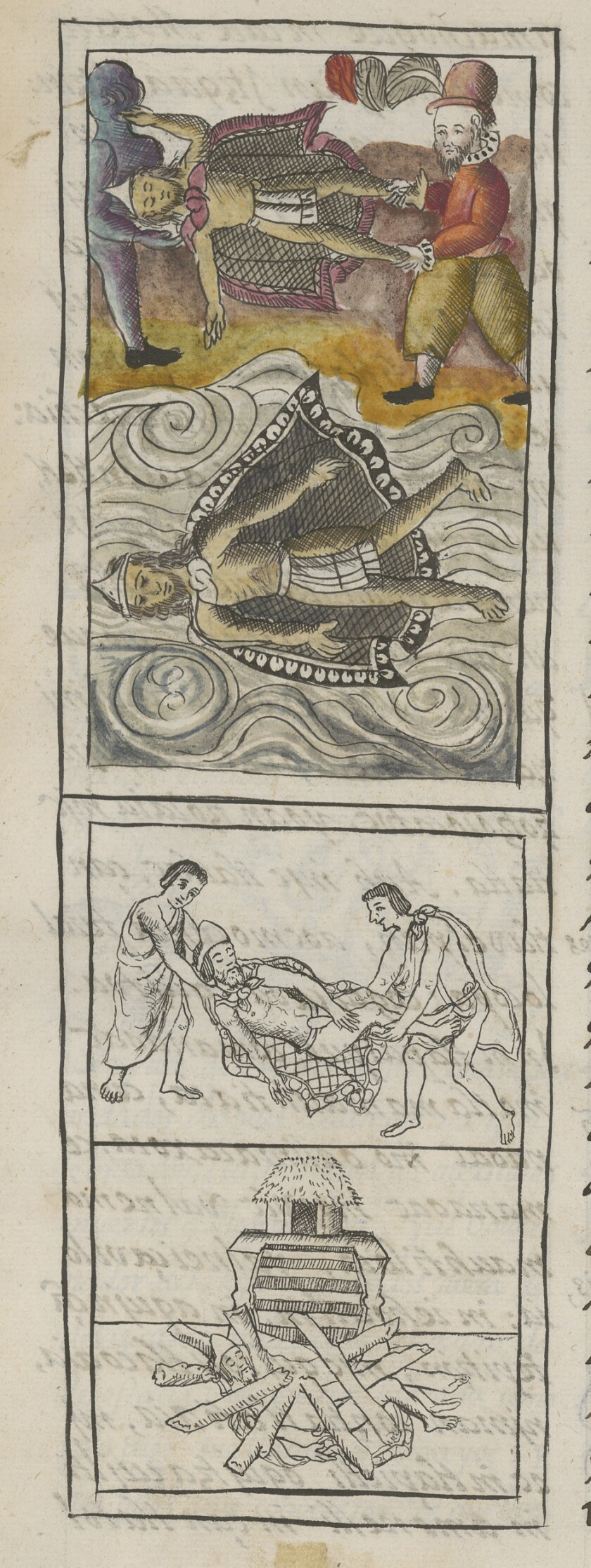
I am happy to re-post this Aztec Bibliography that I received from Chicana activist and writer Dorinda Moreno close to a decade ago. It provides a list of primary and secondary sources. I am interested in other bibliographies that provide additional sources, either primary of secondary, if anyone has one that they can share.
I would be happy to post bibliographies of any other indigenous community, too.
The more common self-referent, by the way, is "Mexica," rather than "Aztec." Mexico and Mexicans get their name from the Nahuatl-speaking Mexica. And Nahuatl, like the Mexica people, is a language that is very much alive today. From a September 11, 2018 post to this blog:
According to Mexico's census bureau, Instituto Nacional de Estadísticas y Geografía (INEGI), in 2015, 25,694,928 people in Mexico, or 21.5% of Mexico's population, self-identified as indigenous, with well over 1.5 million speakers of Nahuatl, the language of the Mexicas, alone.
Increasing numbers today live in the U.S., as well. It's really neat to read and learn about how very much our ancestors valued education; they read poetry and studied the classics of their own time. They had schools and universities, even as parents and families, alongside communities (kalpullis, meaning coalitions of houses), always were recognized as their children's first teacher. Respecting parents and elders and living a disciplined life and working hard and giving back to the community were core, fundamental values that helped you to live a good life and live peacefully in community and society,.
I have actually posted a number of items on Nahuatl and the Mexica to my blog over the years that you can peruse yourself here. It's fun for me to re-read these items and to appreciate anew the value of having a blog. 😊
As we study, develop curriculum, engage in culturally relevant and sustaining pedagogies, and otherwise reconnect to our roots on this continent as the descendants of native peoples, such sources aid in the recovery of that history, knowledge, and culture that not surprisingly, resonate strongly with these same values to which we adhere today.
Moreover, this process of recovery is so incredibly redemptive and healing of ourselves as individuals, communities, and of the planet, our Earth Mother.
We all need to build up our own personal libraries and secure these and other readings that intellectually stimulate our imaginations and deepen our sense of relatedness and being.
Many thanks again to Dorinda Moreno, for making this available.
-Angela Valenzuela
Aztec Bibliography
Primary Sources
Anonymous
Conqueror; Marshall H. Saville, Trans. A Narrative of Some Things of New Spain
and of the Great City of Temestitan MexicoTaxus Baccata Books: 2004. Reprint of
1917 translation with illustrations from 1556 edition, finally back in print
for only $12.95!!
Anderson,
Arthur J. O.; Charles E. Dibble. Florentine Codex, Second Edition Revised, in
Thirteen Parts (13 Volumes). School of American Research & University
of Utah: 1970/1978. F/None
Carvajal,
Luis de, el Mozo. Seymour B. Liebman (translator & editor). The
Enlightened. University of Miami: 1967. VG/No (The only extant text by a Jew in
the Colonial period.)
Columbus,
Christopher; Cecil Jane (translator). The Journal of Christopher Columbus.
Bramhall House: 1960. VG/VG.
Cortes,
Hernan. Irwin R. Blacker (intro & commentaries); Harry M. Rosen
(editor). Conquest: Dispatches of Cortes from the New World. Grosset &
Dunlap: 1962. TP-G
Cortes,
Hernan. J Bayard Morris (translator & ed.). The Letters of Hernando
Cortez 1519-1526 (The Argonaut Series). Robert M. McBride: 1929. VG/G (water
staining to DJ)
de Landa,
Diego; A. R. Pagden (translator). The Maya: Diego de Landa's Account of the
Affairs of Yucatan. J. Philip O'Hara: 1975. (Mayan.) VG/VG
de Oviedo,
Gonzalo Fernandez; Sterling A. Stoudemire (translator). Natural History of the
West Indies (University of North Carolina Studies in the Romance Languages and
Literatures, No. 32) University of North Carolina Press: 1959. TP/VG
Diaz, Bernal
del Castillo. Genaro Garcia (editor), A. P. Maudslay (translator.) The
Discovery and Conquest of Mexico 1517-1521. Farrar, Straus, and Cudahy: 1956.
VG/No
Also have by
Maudsaly & Garcia:TP "The True History of the Conquest of New
Spain." And, Hakluyt Society: 1908. Five volumes, illustrated, one volume
is box of maps. Ex-libris of Edward Lynam, map collector/editor, one-time
secretary of Hakluyt Soc., British Museum curator (?), etc. VG (This is third
copy, so one of others must go.)
Diaz, Bernal;
J. M. Cohen (translator). The Conquest of New Spain. Penguin:
1963. TP-VG.
Duran, Fray Diego; Doris Heyden & Fernando
Horcasitas (translators). The Aztecs: The History of the Indies of New Spain. Orion
Press: 1964. VG/No
Also
have:Univ. Oklahoma: 1994 (this includes all the original illustrations,
complete text. The 1964 edition was a popular version, and so did not. This is
a scholarly one, and also includes annotations, intro, etc.)
Duran, Fray
Diego; translated & edited by Fernando Horcasitas and Doris Heyden.
Book of the Gods and Rites and the Ancient Calendar. University of Oklahoma:
1973. TP-VG
Glubok,
Shirley; Leslie Tillett. The Fall of the Aztecs: Illustrations by the
Conquered, Text by the Conquerors. (Based on Bernal Diaz.) VG/No
Knab, T. J.
(editor); Thelma D. Sullivan (translator.) A Scattering of Jades: Stories,
Poems, and Prayers of the Aztecs. Simon & Schuster: 1994. TP-F
Las Casas,
Bartolome de; edited & translated by Nigel Griffin. A Short Account of
the Destruction of the Indies. Penguin: 1992. TP-F
Leon-Portilla,
Miguel. The Broken Spears: The Aztec Account of the Conquest of Mexico. Beacon
Press: 1962. TP-VG
Leon-Portilla,
Miguel. Pre-Columbian Literatures of Mexico. University of Oklahoma: 1969.
(Leon-Portilla has a lot of his own text in here, but about half of the book is
composed of pre-columbian writings.) VG/VG
Ross, Kurt
(ed.) Codex Mendoza: Aztec Manuscript. Miller Graphics: 1978. Color
reproductions of all full pages of this codex, as well as many close-ups.
Includes some translations of the Spanish written on the codex. VG/VG
Vespucci,
Amerigo; Luciano Formissano (editor); David Jacobson (translator.) Letters from
a New World: Amerigo Vespucci’s Discovery of America. Marsilio: 1992.
(Unrelated to Aztecs.) F/VG
Zorita,
Alonso de; Benjamin Keen (translator). Life and Labor in Ancient Mexico: The
Brief and Summary Relation of the Lords of New Spain. Rutgers University: 1963.
F/VG
The Aztecs
Adams,
Richard E. W. Prehistoric Mesoamerica, Revised Edition. University of Oklahoma:
1991. F/F. Take to store?
Anawalt,
Patricia Rieff. Indian Clothing Before Cortes: Mesoamerican Costumes from the
Codices. University of Oklahoma Press: 1990. TP-VG.
Benson,
Elizabeth P. & Elizabeth Hill Boone, editor. The Art and Iconography of
Late Post-Classic Central Mexico: A Conference at Dumbarton Oaks October 22nd
and 23rd, 1977. Dumbarton Oaks: 1982. F/None
Berdan,
Frances F. The Aztecs of Central Mexico: An Imperial Society. Holt, Rinehart
& Winston: 1982. TP-G. (dry but good sociological overview, good use of
Nahuatl.)
Berlo, Janet
Catherine. Art, Ideology and the City of Teotihuacan: A Symposium at Dumbarton
Oaks 8th and 9th October 1988. Dumbarton Oaks: 1992. F/None
Bernal,
Ignacio; translated by Willis Barnstone. Mexico Before Cortez: Art, History and
Legend, Revised Edition. Anchor: 1975. MM-G
Berrin,
Kathleen; Clara Millon, Rene Millon, Esther Pasztory, Thomas K. Seligman.
Feathered Serpents and Flowering Trees: Reconstructing the Murals of
Teotihuacan. Fine Arts Museum of San Francisco: 1988. Interesting account
relating that the "official" discovery of these murals was prompted
by looted pieces of them all of a sudden showing up in auctions. VG/none/signed
Blanton,
Richard E.; Stephen A. Kowalewski; Gary Feinman; Jill Appel. Ancient
Mesoamerica: A Comparison of Change in Three Regions. Cambridge University:
1981. TP-F Second edition, 1993. TP-G (very well done, with excellent
bibliography.)
Boone,
Elizabeth Hill. The Aztec Templo Mayor: A Symposium at Dumbarton Oaks, 8th and
9th October 1983. Dumbarton Oaks: 1987. F/none
Bray,
Warwick. Everyday Life of the Aztecs. Dorset Press: 1968. F/F
Broda,
Johanna; David Carrasco; Eduardo Matos Moctezuma. The Great Temple of
Tenochtitlan: Center and Periphery in the Aztec World. University of
California: 1987. TP-VG
Brundage,
Burr Cartwright. The Fifth Sun: Aztec Gods, Aztec World. University of Texas:
1979. VG/G
Carrasco,
David. City of Sacrifice: The Aztec Empire and the Role of Violence in
Civilization. Beacon Press: 1999. F/F
Carrasco,
David. Quetzalcoatl and the Irony of Empire: Myths and Prophecies in the Aztec
Tradition. University of Chicago: 1992. TP-VG
Carrasco,
David. The Tenochca Empire of Ancient Mexico: The Triple Alliance of
Tenochtitlan, Tetzcoco, and Tlacopan. University of Oklahoma: 1999.
Caso,
Alfonso. Illustrated by Miguel Covarrubias; Lowell Dunham (tranlsator.) The
Aztecs: People of the Sun. University of Oklahoma: 1958. VG/VG
Clendinnen, Inga. Aztecs: An Interpretation. Cambridge University:
1991. BCE? VG/VG. (One of my favorites, has very lucid descriptions of life
with some fresh & believable interpretations.)
Coe, Michael
D Mexico, Third Edition. Thames & Hudson:1984. TP-G
Covarrubias,
Miguel. Mexico South: The Isthmus of Tehuantepec. Alfred A. Knopf: 1946. VG/VG
1st ed.
Davies,
Nigel. The Aztec Empire: The Toltec Resurgence. University of Oklahoma: 1987.
F/F
Davies, Nigel.
The Aztecs: A History. University of Oklahoma: 1980. TP-VG
Davies,
Nigel. The Toltec Heritage: From the Fall of Tula to the Rise of Tenochtitlan.
University of Oklahoma: 1980. F/VG
Driver,
Harold E. The Americas on the Eve of Discovery. Prentice-Hall:
1964. TP-G.
Enciso, Jorge. Design Motifs of Ancient Mexico. Dover: 1947.
TP-VG
Fastlicht,
Samuel; Javier Romero. El Arte de las
Mutilaciones Dentarias (Encyclopedia Mexicana de Arte #14). Ediciones
Mexicanas: 1951. TP-VG
Furst, Jill Leslie McKeever. The Natural History of
the Soul in Ancient Mexico Yale University: 1995. TP-F
Gillespie,
Susan D. The Aztec Kings: The Construction of Rulership in Mexica History.
University of Arizona: 1989. TP-F
Gillmor,
Frances. Flute of the Smoking Mirror: A Portrait of Nezahualcoyotl, Poet-King
of the Aztecs. University of Utah: 1949. TP-VG
Gillmor,
Frances. The King Danced in the Marketplace. University of Utah: 1964. TP-VG
Hardoy,
Jorge. Urban Planning in Pre-Columbian America. George Braziller: 1968. VG/no
(Short monograph, but lots of excellent photos & drawings.)
Harvey, H. R.
Land and Politics in the Valley of Mexico: A Two Thousand Year Perspective.
University of New Mexico: 1991. F/No
Hassig, Ross.
Aztec Warfare: Imperial Expansion and Political Control. University of
Oklahoma: 1988. F/VG
Hassig, Ross.
Time, History, and Belief in Aztec and Colonial Mexico. University of Texas:
2001. TP-F
Hassig, Ross.
Trade, Tribute, and Transportation: The Sixteenth-Century Political Economy of
the Valley of Mexico. University of Oklahoma: 1985. F/F
Hassig, Ross.
War and Society in Ancient America. University of California: 1992. F/VG
Horcasitas,
Fernando. The Aztecs Then and Now. Minutiae Mexicana: 1979. TP-G
Keen,
Benjamin. The Aztec Image in Western Thought. Rutgers University: 1990. TP-VG
Leon-Portilla,
Miguel. The Aztec Image of Self and Society : An Introduction to Nahua Culture.
University of Utah: 1992. VG/VG
Leon-Portilla,
Miguel. Aztec Thought and Culture: A Study of the Ancient Nahuatl Mind. University of Oklahoma: 1963. VG/VG
Lopez, Angel Raul. El Numero 13 en la Vida de los
Aztecas. Costa-Amic: 1984. TP-VG
Millon, Rene. The Teotihuacan Map (Urbanization at
Teotihuacan, Mexico, Volume 1). University of Texas: 1973. VG. Two parts, the
second being a volume of bound maps with clear plastic overlays, and with a box
of folded maps attached to the rear board.
Moctezuma,
Eduardo Matos. The Great Temple of the Aztecs: Treasures of Tenochtitlan.
Thames & Hudson: 1988. F/VG
Parsons,
Jeffrey R.; Elizabeth Brumfiel; Mary H. Parsons; David J. Wilson; et al.
Prehispanic Settlement Patterns in the Southern Valley of Mexico: The
Chalco-Xochimilco Region. University of Michigan Museum of Anthropology: 1982.
TP-VG
Peterson,
Frederick. Ancient Mexico: An Introduction to the Pre-Hispanic Cultures.
Capricorn: 1959. TP-G
Pohl, John M.
D.; Angus McBride. Aztec, Mixtec and Zapotec Armies. Osprey: 1991. F
Powell, Guy
E. Latest Aztec Discoveries. San Antonio: Naylor Co., 1967. VG/G. (Probably
better shelved in fiction, as author appears to have discovered Aztlan in his
backyard. Nevertheless... it does have map endpapers! Road trip!)
Schroeder,
Susan. Chimalpahin and the Kingdoms of Chalco. University of Arizona: 1991.
VG/No
Sejourne,
Laurette. Burning Water: Thought and Religion in Ancient Mexico. Shambala:
1976. TP-VG
Soustelle,
Jacques. Daily Life of the Aztecs on the Eve of the Spanish Conquest. Stanford:
1955/1961. TP-Fair.
Townsend,
Richard F. The Aztecs, Revised Edition. Thames & Hudson: 2000. TP-F
Vaillant,
George C. Artists and Craftsmen in Ancient Central America. American Museum of
Natural History: 1945. TP-G
Vaillant,
George C. Aztecs of Mexico: Origin, Rise and Fall of the Aztec Nation. American
Museum of Natural History/Doubleday: 1950. VG/VG
Von Hagen,
Victor W. The Aztec: Man and Tribe. Mentor: 1958. MM-VG
Von Hagen,
Victor W. The Ancient Sun Kingdoms of the Americas: Aztec, Maya, Inca. World
Publishing: 1961. VG/VG
Wauchope,
Robert (general editor). Handbook of Middle American Indians (sixteen volumes
plus supplements). University of Texas: 1964-1976, plus supplements. VG/G
Willey,
Gordon R.; Jeremy A. Sabloff (introductions). Pre-Columbian Archaeology
(Readings from Scientific American.) W. H. Freeman: 1980. TP-VG
Wolf, Eric.
Sons of the Shaking Earth: The People of Mexico and Guartemala: Their Land,
History, and Culture. University of Chicago: 1959. TP-VG (Covers prehistory
through Colonial period.)
Wolf, Eric R.
(editor). The Valley of Mexico: Studies in Pre-Hispanic Ecology and Society.
University of New Mexico: 1976. F/G
The Conquest
and Conquistadors
Christensen,
Thomas & Carol (editors.) The Discovery of America & Other
Myths: A New World Reader. Chronicle Books: 1992. TP-VG (Some very good
essays.)
Day, Jane S.;
foreword by Eduardo Matos Moctezuma. Aztec: The World of Moctezuma. Denver
Museum of Natural History/Roberts Rinehart: 1992. Published in conjunction with
exhibition, but not a catalogue per se. TP-VG
Eidsmoe,
John. Columbus and Cortez, Conquerors for Christ. New Leaf Press: 1992. TP-VG.
(poorly researched, hypocritical, but does remind us that Cortez was devout
Catholic.)
Hanke, Lewis.
The Spanish Struggle for Justice in the Conquest of America. Little, Brown:
1949/1965. TP-VG (excellent overview of legalistic concerns of Spaniards.)
Hassig, Ross.
Mexico and the Spanish Conquest (Modern Wars in Perspective series). Longman:
1994. TP-VG
Horgan, Paul.
Conquistadors in North American History. Fawcett: 1963. MM-VG
Padden, R. C.
The Hummingbird and the Hawk: Conquest and Sovereignty in the Valley of Mexico,
1503-1541. Harper: 1967. TP-G
Pohl, John;
Charles M. Robinson III. Aztecs & Conquistadores: The Spanish Invasion
and the Collapse of the Aztec Empire. Osprey: 2005. F/F. (Light reading except
for good military details.)
Prescott,
William H. The Conquest of Mexico & The Conquest of Peru. Modern
Library. VG/G
Stannard,
David E. American Holocaust: The Conquest of the New World. Oxford University:
1992. TP-VG
Thomas, Hugh.
Conquest: Montezuma, Cortes, and the Fall of Old Mexico. Simon &
Schuster: 1993. TP-VG
Thomas, Hugh.
Who's Who of the Conquistadors. Cassell & Co.: 2000. F/F
Todorov,
Tzvetan; Richard Howard (translator). The Conquest of America: The Question of
the Other. Harper & Row: 1987. TP-G. (Perhaps the best interpretation
I’ve read.)
Verrill, A.
Hyatt. Great Conquerors of South and Central America. New Home Library: 1943.
V/V (Dated, but good teen intro.)
Warren, J.
Benedict. The Conquest of Michoacan: The Spanish Domination of the Tarascan
Kingdom in Western Mexico, 1521-1530. University of Oklahoma: 1985. F/F
White, Jon
Manchip. Cortes and the Downfall of the Aztec Empire: A Study in a Conflict of
Cultures. Hamish Hamilton: 1971. HC-VG/no.
Wise,
Terence; Angus McBride. The Conquistadors.
Miscellaneous
Stuff (Colonial, Travelogues, Olmecs, Peopling of Americas, General
Mesoamerican Interest)
Adams,
Richard E. W. Prehistoric Mesoamerica. Little, Brown: 1977. VG/No.
Benson,
Elizabeth P., editor. Death and the Afterlife in Pre-Columbian America: A
Conference at Dumbarton Oaks October 27th, 1973. Dumbarton Oaks: 1975. F/None
Benson,
Elizabeth P., editor. Mesoamerican Writing Systems: A Conference at Dumbarton
Oaks October 30th and 31st, 1971. Dumbarton Oaks: 1973. F/None
Benson,
Elizabeth P., editor. The Sea in the Pre-Columbian World: A Conference at
Dumbarton Oaks October 26th and 27th, 1974. Dumbarton Oaks: 1977. F/None
Bernal,
Ignacio. 100 Great Masterpieces of the Mexican National Museum of Anthropology.
Harry N. Abrams: 1969. VG/G
Bernal,
Ignacio. The Olmec World. University of California: 1976. TP-VG.
Bierhorst,
John. The Mythology of Mexico and Central America. William Morrow: 1990. F/F
(remainder)
Boone,
Elizabeth Hill. Painted Architecture and Polychrome Monumental Sculpture in
Mesoamerica: A Symposium at Dumbarton Oaks, 10th to 11th October 1981.
Dumbarton Oaks: 1985. F/None
Boone,
Elizabeth Hill; Tom Cummins. Native Traditions in the Postconquest World: A
Symposium at Dumbarton Oaks, 2nd through 4th October 1992. Dumbarton Oaks:
1997. F/None
Butler, John
W. Sketches of Mexico. Cincinnati: Cranston & Curts, 1894. VG/None. Son
of missionary. Interesting history of Mexican race, as Butler lists several
theories of the peopling of the Americas, including 6 theories that they
originated from Europe, 4 theories of African origin (including Atlantis which
theory is dealt with at length), and "at least six" theories of
Asiatic origin.
Cervantes, Fernando.
The Devil in the New World: The Impact of Diabolism in New Spain.
Clendinnen,
Inga. Ambivalent Conquests: Maya and Spaniard in Yucatan, 1517-1570. Cambridge
University: 1987. TP-VG
Coe, Michael
D. Archaeological Mexico: A Traveler's Guide to Ancient Cities and Sacred
Sites. Moon Travel Handbooks: 1998. TP-F
Coe, Michael
D.; David Grove; Elizabeth Benson (editor & organizers). The Olmec and
their Neighbors: Essays in Memory of Matthew W. Stirling. Dumbarton Oaks: 1981.
F/None
Coe, Michael
D.; David Grove; Elizabeth Benson (editor & organizers). In the Land of
the Olmec. Vol. I: The Archaeology of San Lorenzo Tenochtitlan; Vol. II: The
People of the River University of Texas: 1980. F/VG Slipcase with F folder
containing four maps
Dossio, Francisco Gonzales de. Cronicas de la Compania
de Jesus en la Nueva Espana. La Universidad Nacional Autonoma, Mexico: 1957.
TP-G (Jesuits in Colonial Mexico.)
Davies,
Nigel. Voyagers to the New World. William Morrow: 1979. (Pretty even-handed
discussion of evidence for pre-Columbian contacts.)
Davies,
Nigel. The Toltecs: Until the Fall of Tula. University of Oklahoma: 1977. VG/G
Day, A.
Grove. Coronado’s Quest: The History-Making Adventures of the First White Men
to Invade the Southwest. University of California: 1964. TP-VG
Diehl,
Richard A. Tula: The Toltec Capital of Ancient Mexico. Thames & Hudson:
1983. F/VG
Dumbarton
Oaks. Studies in Pre-Columbian Art and Archaeology, Numbers Nine through
Eleven. #9: Badner, Mino. “A Possible Focus of Andean Artistic Influence in
Mesoamerica.” #10: Quirarte, Jacinto. “Izapan-Style Art: A Study of Its Form
and Meaning.” #11: Moser, Christopher L. “Human Decapitation in Ancient
Mesoamerica.” Dumbarton Oaks: 1973. F/None
Dumbarton
Oaks. Studies in Pre-Columbian Art and Archaeology, Numbers Twelve through
Fourteen. #12: Wilbert, Johannes. “The Thread of Life: Symbolism of Miniature
Art from Ecuador.” #13: Roe, Peter G. “A Further Exploration of the Rowe Chavin
Seriation and Its Implications for North Central Coast Chronology.” #14:
Benson, Elizabeth P. “A Man and a Feline in Mochica Art.” Dumbarton Oaks: 1974.
F/None
Fagan, Brian
M. The Great Journey: The Peopling of Ancient America. Thames & Hudson:
1987. F/VG
Ferguson,
William M.; Arthur H. Rohn. Mesoamerica’s Ancient Cities: Arial Views of
Precolumbian Ruins in Mexico, Guatemala, Belize and Honduras. University Press
of Colorado: 1990. F/F
Gibson,
Charles. The Aztecs Under Spanish Rule: A History of the Indians of the Valley
of Mexico, 1519-1810. Stanford University: 1964. TP-VG
Graham, John
A. Ancient Mesoamerica: Selected Readings. Peek Publications: 1966. TP-VG (prehistory,
agriculture, Maya, misc.)
Grove, David
C. Chalcatzingo: Excavations on the Olmec Frontier. Thames & Hudson:
1984. VG/VG
Grove, David
C. & Rosemary A. Joyce, editors. Social Patterns in Pre-Classic
Mesoamerica: A Symposium at Dumbarton Oaks 9 and 10 October 1993. Dumbarton
Oaks: 1999. F/None
Gruener,
James C. The Olmec Riddle: An Inquiry Into the Origin of Pre-Columbian
Civilization. Vengreen Publications, 1987. F/F
Hansen, L.
Taylor. He Walked the Americas. Amherst Press: 1963. G/No. (Haven’t read this
yet. Is it Mormon? New Age?)
Hardoy, Jorge
L. Precolumbian Cities. Walker, 1973. Large basic survey with a chapter on the
Aztecs, and a chapter on Tenochtitlan. VG/VG.
Jones,
Lindsay. Twin City Tales: A Hermeneutical Reassessment of Tula and Chichen
Itza. University of Colorado: 1995. F/VG
Kelemen, Pal.
Medieval American Art: Masterpieces of the New World before Columbus, Third
Revised edition in two volumes. Dover: 1969.
Kiev, Ari.
Curanderismo: Mexican-American Folk Psychiatry. Free Press: 1968. TP-G
Killion,
Thomas W. Gardens of Prehistory: Archaeology of Settlement Agriculture in
Mesoamerica University of Alabama: 1992. TP-F
Luckert, Karl
W. Olmec Religion: A Key to Middle America and Beyond. University of Oklahoma:
1976. F/VG
MacKenzie,
Donald A. Pre-Columbian America: Myths and Legends. Random House: 1923/1996.
TP-VG. (Links between Old & New Worlds via mythology. Although much of
the research is now out of date, bottom line remains valid: Do you believe in
contact or archetypes?)
MacNeish,
Richard S. (introduction). Early Man in America (Readings from Scientific
American.) W. H. Freeman: 1973. TP-VG
Malmstrom,
Vincent H. Cycles of the Sun, Mysteries of the Moon: The Calendar in
Mesoamerican Civilization. University of Texas: 1997. TP-VG
Marcus,
Joyce; Kent V. Flannery. Zapotec Civilization: How Urban Society Evolved in
Mexico’s Oaxaca Valley. Thames & Hudson: 1996. VG/VG
Maslow,
Jonathan Evan. Bird of Life, Bird of Death: A Political Ornithology of Central
America. Dell: 1986. TP-VG (Neat travelogue/natural history of the quetzal.)
Miller,
Arthur G. Highland-Lowland Interaction in Mesoamerica: Interdisciplinary
Approaches: A Conference at Dumbarton Oaks, October 18th and 19th, 1980. Dumbarton
Oaks: 1983. F/None
Miller, Mary
Ellen. The Art of Mesoamerica: From Olmec to Aztec, third edition. Thames
& Hudson: 2001. TP-VG
Nelson, Ralph
(translator.) Popul Vuh: The Mythological Book of the Ancient Maya. Houghton
Mifflin: 1976. TP-F
Nuttall,
Zelia (editor); Arthur G. Miller (introduction) The Codex Nuttall: A Picture
Manuscript from Ancient Mexico. Dover: 1902/1975. (Nuttall’s original
manuscript is not reprinted, just the screenfold.) TP-F
O’Hanlon,
Redmond. In Trouble Again: A Journey Between the Orinoco and the Amazon.
Vintage: 1988. TP-VG (take to work?)
Pollard,
Helen Perstein. Tariacuri’s Legacy : The Prehispanic Tarascan State. University
of Oklahoma: 1993. F/F
Posnansky,
Ing. Arthur; translated by James F. Shearer. Tihuanacu
: The Cradle of American Man [La Cuna del Hombre Americano], Vol III, IV.
Ministerio de Educacion, La Paz: 1957. VG/None
Ragghianti, Carol Ludovico; Licia Ragghianti Collobi.
National Museum of Anthropology: Mexico City. Newsweek: 1970. VG/None
Read, Kay
Almere; Jason J. Gonzalez. Mesoamerican Mythology: A guide to the Gods, Heroes,
Rituals, and Beliefs of Mexico and Central America. Oxford University Press:
2000. TP-F
Rice, Don
Stephen. Latin American Horizons: A Symposium at Dumbarton Oaks, 11th and 12th
October 1986. Dumbarton Oaks: 1993. F/None
Riley, Carrol
L. (ed.); J. Charles Kelley; Campbell W. Pennington; Robert L. Rands. Man
across the Sea: Problems of Pre-Columbian Contacts. University of Texas Press:
1971. HC-VG/no
Riley, G.
Micheal. Fernando Cortes and the Marquesado in Morelos, 1522-1547: A Case Study
in the Socioeconomic Development of Sixteenth-Century Mexico. University of New
Mexico Press: 1973. F/VG
Sabloff,
Jeremy A. The Cities of Ancient Mexico: Reconstructing a Lost World, Revised
Edition. Thames & Hudson: 1997. TP-VG
Schwartz,
Marion. A History of Dogs in the Early Americas. Yale
Univeristy: 1997. TP-F
Soustelle, Jacques. The Four Suns: Recollections and Reflections of
an Ethnologist in Mexico. Grossman: 1971. VG/VG
Soustelle,
Jacques. The Olmecs: The Oldest Civilization in Mexico. Doubleday: 1984. F/VG
Spores,
Ronald. The Mixtecs in Ancient and Colonial Times. University of Oklahoma:
1984. F/F
Stark,
Barbara L.; Philip J. Arnold III. Olmec to Aztec: Settlement Patterns in the
Ancient Gulf Lowlands. University of Arizona: 1997. VG/VG
Stephens,
John L. Incidents of Travel in Central America, Chiapas, and Yucatan, with 111
Illustrations, in Two Volumes. Dover: 1854/1969. (Also have old vol. 2 of
Yucatan, Harper & Bros: 1868)
Tompkins,
Peter. Mysteries of the Mexican Pyramids. Harper & Row: 1976. VG/VG
van Roojen,
Pepin. Ancient Mexican Designs w/ CD-ROM (Pepin Press Agile Rabbit Editions)
Pepin Press: 2002. TP-F w/ CD
von Hagen,
Victor Wolfgang. Maya Explorer: John Lloyd Stephens and the Lost Cities of
Central America and Yucatan. University of Oklahoma Press: 1947. VG/No
Von Wuthenau,
Alexander; E. W. Hathaway (translator). Tepotzotlan (Art and Color in Mexico,
Volume 1). Von Stetten Fotocolor: 1941. TP-VG/Slipcase (Awesome illustrations
of Colonial baroque monestary.)
Westheim,
Paul. The Art of Ancient Mexico. Doubleday: 1965, MM-VG
Wilgus, A.
Curtis. Latin America in Maps: Historic, Geographic, Economic. Barnes &
Noble: 1943. TP-G (plumber dropped this one in sink.)
Wilson, James
A. Bits of Old Mexico. Self Published, San Francisco: 1910. G/No. (Amusing and
interesting - but light - travelogue.)
Fiction
Bennett,
Rowena; Fiore Mastri (illustrator). Runner for the King. Follett: 1944. (Kids’
book on the Incas.)
Bishop,
Michael. Stolen Faces. Victor Gollancz: 1977. VG/VG (review copy). The planet
Tezcatl is Aztec-culture society which has an infection of muphormosy, similar
to leprosy . . . or does it?
Davidson,
Avram. Clash of the Star-Kings. Ace (Double): 1966.
Esquivel,
Laura. Malinche. Washington Square Press: 2006. TP-VG
Falkenhorst,
C.; adapted by Elise L. Lathrop. With Cortez in Mexico: A Historical Romance.
Hurst & Co: 1892.
Haggard, H.
Rider. Montezuma's Daughter. Hodder & Stoughton: 1893/1919. Fair/No.
Ingraham,
Joseph Holt. Montezuma, the Serf, or the Revolt of the Mexitili, a Tale of the
Last Days of the Aztec Dynasty. H. L. Williams: 1845. G/No (Virtually no basis
in history, but still a nice tale with a Arthurian/chivalric feel. Scarce.)
Jennings,
Gary. Aztec. Avon: 1980. MM-G (well done, basic historical novel)
Jennings,
Gary. Aztec Autumn. Forge, 1997. F/VG. (Second in the trilogy ending with
"Aztec Blood.")
Kidwell,
Carl. Arrow in the Sun. Viking: 1961. Illustrated with line drawings, possibly
a teen novel? VG/G.
MacLeish,
Archibald. Conquistador. Houghton Mifflin: 1932. VG/no 6/e. (Pulitzer-winning
epic poem of the Conquest.)
Marshall,
Edison. Cortez and Marina. Doubleday/Popular Library: 1963. MM-G
Murray, Yxta
Maya. The Conquest. HarperCollins: 2002. G/G exlib
Novo,
Salvador. The War of the Fatties and Other Stories from Aztec History.
Univesity of Texas: 1994. VG/VG
Saberhagen,
Fred. The Mask of the Sun. Tor: 1979. '87 MM.
Shearer,
Tony. Lord of the Dawn: Quetzalcoatl. Naturegraph Publishers: 1971. TP-G
(poetry inspired by Aztec thought & history.)
Shellabarger,
Samuel. Captain from Castile. Little, Brown: 1945. ‘65-BCE-VG/G
Somerlott, Robert.
Death of the Fifth Sun. Viking: 1987. Xlib-G/VG (Interesting in that it is told
through the voice of Malinche. Some of it actually makes sense in clearing up a
few of the more mysterious parts of the Conquest.)
Steele,
Philip. The Aztec News. Candlewick Press: 1997. (Kids’ book in form of
newspaper. Well done.)
Velasquez,
Pedro. From John L. Stevens et al. Memoir of an Eventful Expedition in Central
America; Resulting in the Discovery of the Idolatrous City of Iximaya, in an
Unexplored Region; and the Possession of Two Remarkable Aztec Children,
Descendants and Specimens of the Sacerdotal Caste, (Now Nearly Extinct) of the
Ancient Aztec Founders of the Ruined Temples of that Country, Described by John
L. Stevens, Esq., and Other Travellers. New York: J. W. Bell, 1850. Taped
covers, possible first, but want the illustrated English edition.
Sabin 98812:
"The Spanish original of the above and its author are myths. The chief
interest lies in its connection with the history of the American circus, having
been published to advertise the exhibition of the supposed "Aztec"
children. A ms. note of E.G. S[quier] filed with Joseph Sabin's memoranda
states that the children were born in the town of Usulutan, or Usulatan, south
west of San Miguel, of mixed Indian, Spanish, and negro stock. Frequently
reprinted in connection with exhibitions in the United States and in England,
with the title 'Illustrated Memoir.' As is hinted in the title, the whole
purpose of this hoax, which became a travelling performance, was to capitalize
on the extraordinary interest that Stephens' two books on his discoveries in
the Mayan lands had aroused. It can also be classed as 'Lost Race
fiction.'"
Wallace, Lew.
The Fair God, or, The Last of the ‘Tzins: A Tale of the Conquest of Mexico.
Houghton, Mifflin: 1873. VG/No 1887.
Watson,
Virginia; Frank E. Schoonover (illus.) With Cortes the Conqueror.
Hampton
Publishing Co.: (orig. 1917). VG/No. (Original edition is by Penn Pub. Co.,
this is probably 30's reprint.)
Misc.
Acosta, Joseph de. De Natura Novi Orbis. Salamanca: 1590. (or any
English translation)
Aguilar, Fray Francisco de. Relacion Breve de la
Conquista de la Nueva Espana (1560-1565) Mexico City: UNAM, 1977
Alva Ixtlilxochitl, Fernando de. Obras Historicas
(1625) Mexico City: UNAM, 1985
Benson, Elizabeth (ed.) Ritual Human Sacrifice in
Mesoamerica.Washington, DC: Dumbarton Oaks, 1984.
Beristain y Souza, Jose Mariano. Biblioteca Hispano
Americana Septentrional . Amecameca: Colegio Catolico, 1883-1889 (3 vols + supplements).
This may have been reprinted in 1980s.
Berlin, Heinrich (ed.) Anales de Tlatelolco (1530). Mexico: Robredo y Editorial Porrua, 1948
Brundage,
Burr Cartwright. A Rain of Darts. Austin: Univ. Texas, 1972.
Emmart, Emily
Walcott (ed.) Badianus Manuscript (Codex Barberini, Latin 241). Baltimore:
Johns Hopkins, 1940.
Lanyon, Anna.
Malinche's Conquest. Allen & Unwin, 2000.
Browsers'
Bookstore
121 NW 4th
St.
Corvallis, OR
97330
(541)
758-1121
Browsers'
Bookstore, Vol. II
1425 Pacific Blvd. SE
Albany, Oregon 97321
(541) 926-2612
--
Dorinda Moreno
Elders of 4
Colors 4 Directions
Hitec Aztec
Collaborations/FM Global
We Are the
Ones We Have Been Waiting For!
 Today huaútli is most commonly known as amaranth, a super-food gaining worldwide recognition as a high-protein plant edible that could easily figure into the solution for world hunger. Although not considered a grain, the tiny amaranth seeds contain eight to nine grams of protein in a one cup serving, offering a nutritionally complete plant food that has all the essential amino acids needed by the human body, without gluten.