Translate

Showing posts with label conquest. Show all posts

Wednesday, December 24, 2025

"The Vision of the Vanquished": Knowledge Europe Destroyed—and that the U.S. Power Structure Still Fears, by Angela Valenzuela, Ph.D.

"The Vision of the Vanquished": Knowledge Europe Destroyed—and that the U.S. Power Structure Still Fears

by

Angela Valenzuela, Ph.D.

December 24, 2025

You may view and listen to this blog here also posted below.

There is a great deal to ponder when we sit with the historical record not from the conqueror’s pen, but from the voices of those who survived conquest.

One learns of some of these communities through Miguel León-Portilla’s landmark work, The Broken Spears (Visión de los vencidos). Drawn from original Nahuatl sources written in the 1500s and published in 1959, the book offers the closest account we have of the invasion of Tenochtitlan—today’s Mexico City—from the perspective of the invaded. 

León-Portilla’s contribution was not to interpret these voices into comfort, but to preserve them as testimony, gathered and preserved across numerous archives by the children of survivors, allowing the vanquished to speak in their own words (León-Portilla, 1959/2006).

This fullest surviving account reveals not only the great cultural and linguistic diversity within and around Tenochtitlan, but also its extraordinary sophistication. At the time of the Spanish invasion, Tenochtitlan was a meticulously planned metropolis with engineered causeways, freshwater aqueducts, regulated markets, and sanitation systems that surpassed those of most European cities. 

It practiced chinampa agriculture—one of the most productive and sustainable farming systems ever developed—and maintained universal education through formal schools for both elites and commoners (León-Portilla, 1959/2006; Mann, 2005). While much of Europe struggled with overcrowding, open sewers, and periodic famine, Tenochtitlan functioned as a clean, ordered, ecologically attuned urban center.


See 3-D digital reconstruction of Tenochtitlan by Thomas Kole (2017)


Perhaps the most revealing evidence of Tenochtitlan’s advancement comes from Spanish eyewitnesses themselves. Bernal Díaz del Castillo, a conquistador who participated in the invasion, wrote in astonishment:

“We were amazed… at the great cities and towns built on the water… it all seemed like an enchantment from a book of chivalry” (Díaz del Castillo, 1632/2012, Book II, chap. 88)

Díaz del Castillo compared Tenochtitlan to Venice, widely regarded as Europe’s most advanced city at the time—a comparison that carries extraordinary weight precisely because it comes from a hostile witness (Díaz del Castillo, 1967). This was not a primitive settlement encountered by Europeans bringing “civilization.” It was a civilization Europe encountered and chose to destroy.

The devastation was led by Hernán Cortés, whose actions would today be unambiguously described as war crimes. The violence was so severe that even Spain eventually distanced itself from him. Yet colonial narratives have long recast this annihilation of an advanced society as discovery or progress.

One of the most haunting statements preserved in The Broken Spears comes from an Indigenous eyewitness, paraphrased but searing in its clarity: they came, they conquered, and they never once asked what our cosmovision was (León-Portilla, 1959/2006). This sentence names colonial violence at its deepest level—not only the theft of land and life, but the refusal to recognize another way of knowing the world.

León-Portilla does not attempt to resolve this wound. Aside from his methodological introduction, the book remains an anthology of voices. That restraint matters. It resists the colonial impulse to narrate devastation into closure or to translate loss into lessons that absolve the conqueror.

The destruction of Tenochtitlan was not the result of cultural inferiority, but of a refusal to recognize another civilization as worthy of study, much less of existing. That refusal did not end in the sixteenth century. Today, it reappears in more bureaucratic and sanitized form—in the backlash against Ethnic Studies, in the dismantling of DEI initiatives, and in policies that treat minoritized knowledge as dangerous, divisive, or expendable.

Once again, majorities move through institutions without asking the descendants of this same history what they know—or what might be redemptive about their ways of knowing, doing, and being in the world. Ethnic Studies does precisely what conquest refused to do: it asks whose cosmovisions were silenced, what knowledge survived anyway, and how those knowledge systems might offer more humane, truthful, and sustainable ways forward. That is precisely why it is being targeted.

The attack on Ethnic Studies and DEI is not about rigor, neutrality, or free inquiry. It is about control—about preserving institutions that still cannot bear to ask what minoritized communities know, remember, value, or imagine beyond the colonial frame. Visión de los vencidos reminds us that dismantling does not always arrive with swords or cannons; sometimes it comes as legislation, budget cuts, appeals to “neutrality,” and so-called program “consolidations” that quietly strip resources, power, and voice—once again refusing to listen.

Until we recognize these attacks for what they are—today’s version of institutional dismantling or "conquest"—we will continue to mistake erasure for "balance" and domination for "progress."

None of this has to be feared. Asking what was never asked—listening to the descendants of conquest and recognizing the redemptive possibilities of their ways of knowing, doing, and being—does not weaken institutions; it humanizes them. What threatens democratic life is not Ethnic Studies or DEI, but the continued refusal to listen and know.

References

Díaz del Castillo, B. (1967). The true history of the conquest of New Spain (Vol. 3). Lulu. com.

Kole, T. (2017). Tenochtitlan: 3-D digital reconstruction of the Aztec capital [Digital reconstruction]. Independent project. https://tenochtitlan.thomaskole.nl/

León-Portilla, M. (1959/2006). The broken spears: The Aztec account of the conquest of Mexico. Beacon Press.

Sunday, March 30, 2025

POWERFUL TEXT FOR THESE TIMES: The Broken Spears (La Visión de lo Vencidos) by Miguel Leon Portilla

Friends,

I encourage everyone to read the truly magisterial text published in 1959 by the Universidad Nacional Autónoma de México (UNAM), The Broken Spears: The Aztec Account of the Conquest of Mexico by Dr. Miguel León-Portilla. Originally compiled from texts written in Nahuatl and translated into Spanish before being rendered into English by Lysander Kemp, this work provides invaluable insight into the Indigenous perspective on the Spanish conquest. The illustrations in the text, adapted from original paintings found in authentic codices, were created by Alberto Beltrán.

A crucial clarification: Dr. Miguel León-Portilla (February 22, 1926 – October 1, 2019) did not write The Broken Spears himself, aside from his introduction. Instead, this text is a meticulously compiled historical record that preserves firsthand Indigenous accounts written in the aftermath of the Spanish invasion of Tenochtitlán, now Mexico City. It's chock full of lessons for today—like right now with the dismantling of our own government institutions and processes.

The Broken Spears draws on evidence from codices and other writings, including formal pleas to King Philip of Spain, imploring his mercy in light of the devastation and trauma suffered by the Aztecs, or Mexica [pronounced me-chí-ca], following the Spanish-led invasion and the ultimate fall of Tenochtitlán in 1521. These accounts acknowledge the complexity of Indigenous responses to the Spanish presence—some groups aligned with Hernán Cortés, believing they were securing their own futures, only to have their trust cruelly betrayed by the invaders.

I sympathize with those who sought peace, for among the Mexica were true peacemakers who hoped for a harmonious coexistence. Yet their choices had lasting, unintended consequences, as is evident from the sorrowful and tragic letters to King Philip. The Indigenous peoples were divided, and some found elements of Christian teachings resonant with their own worship of the Sun God, making conversion to Christianity less alien than commonly assumed.

This text offers an unflinching and vivid portrayal of the fall of Tenochtitlán, immersing readers in the catastrophe as if it had happened yesterday. The narrative is gripping, haunting, and profoundly moving. Even after reading Dr. León-Portilla’s introduction—which is fascinating in its own right—one cannot help but be drawn deeply into the Indigenous testimonies. I highly recommend the audiobook version, which powerfully conveys the intensity of the events described.

Without a doubt, despite his extensive scholarship, The Broken Spears stands as Dr. León-Portilla’s most significant and enduring contribution. He was one of Mexico’s greatest anthropological minds, and La Visión de los Vencidos (the Spanish title of The Broken Spears) remains a groundbreaking work in the study of Indigenous perspectives on the conquest. It gives voice to the Nahuatl people, who perhaps foresaw that future generations would read their words and bear witness to their suffering and resilience. How prescient and thoughtful our ancestors were.

What I additionally find fascinating is it captures a moment in world history before the concept of race or racism existed, but rather ethnicity, including among the "Tenoch" peoples themselves and beyond. 

I look forward to a reading group we have formed that is dedicated to discussing this essential text, and I encourage all of you to read it as well. For ease of reference, I have included a video of Dr. León-Portilla speaking about The Broken Spears, as well as a Wikipedia entry on Miguel León-Portilla. 

Angela Valenzuela


Miguel León-Portilla (22 February 1926 – 1 October 2019)[1] was a Mexican anthropologist and historian, specializing in Aztec culture and literature of the pre-Columbian and colonial eras. Many of his works were translated to English and he was a well-recognized scholar internationally. In 2013, the Library of Congress of the United States bestowed on him the Living Legend Award.[2]

Early life and education[edit]

Born in Mexico City, Miguel León-Portilla had an interest in indigenous Mexico from an early age, fostered by his uncle Manuel Gamio, a distinguished archeologist. Gamio had a lasting influence on his life and career, initially taking him as a boy on trips to important archeological sites in Mexico and later as well.[3] León-Portilla attended the Instituto de Ciencias in Guadalajara and then earned a B.A. (1948) and M.A. summa cum laude (1951) at the Jesuit Loyola University in Los Angeles. Returning to Mexico in 1952, he showed Gamio a play he had written on Quetzalcoatl, which resulted in Gamio introducing his nephew to Ángel Garibay K., whose publications in the 1930s and 1940s first brought Nahuatl literature to widespread public attention in Mexico. Needing to make a living, León-Portilla began attending law school and worked at a financial firm. At the same time he taught at Mexico City College, an English-language school in the Condesa neighborhood. Other instructors included important scholars of Mexican indigenous history and culture, Wigberto Jiménez Moreno, Fernando Horcasitas, and Eduardo Noguera. Gamio persuaded León-Portilla to drop his law studies and job in business to work at the Inter-American Indian Institute [es; pt], a specialized organization of the Organization of American States,[4] which Gamio directed.[5] León-Portilla began graduate studies at the UNAM, completing his doctoral dissertation, La Filosofía Náhuatl estudiada en sus fuentes, in 1956, which launched his scholarly career.[6]

Career[edit]

His dissertation on Nahua philosophy was published in Mexico, and then translated to English as Aztec Thought and Culture: A Study of the Ancient Nahuatl Mind (1967) and then many other languages.[7] It was the first of his many works to be translated to English. His translations of Nahuatl and Spanish texts on the conquest of Mexico, first published in Mexico as Visión de los vencidos, translated to English as The Broken Spears, is the way many undergraduate students in the United States are introduced to accounts from indigenous participants and not Spanish conquistadors.[8]

León-Portilla spearheaded a movement to understand and re-evaluate Nahuatl literature and religion, not only from the pre-Columbian era, but also that of the present day, especially since Nahuatl is still spoken by 1.5 million people.[2] His works in English on literature included Pre-Columbian Literatures of Mexico (1986),[9] Fifteen Poets of the Aztec World (2000),[10] and with Earl Shorris, In the Language of Kings: An Anthology of Mesoamerican Literature, Pre-Columbian to the Present (2002).[11] He also compared the literature of the Nahuas with that of the Inca.[12] Another area of research was on indigenous religion and spirituality, with works including Native Meso-American Spirituality (1980),[13] and South and Meso-American Native Spirituality: From the Cult of the Feathered Serpent to the Theology of Liberation (1997).[14] He also published a work on the Maya, Time and Reality in the Thought of the Maya (1990).[15]

León-Portilla was instrumental in bringing to light the works of Franciscan Fr. Bernardino de Sahagún, a 16th-century primary source on the Aztec civilization, whose twelve-volume General History of the Things of New Spain, often referred to as the Florentine Codex, are crucial for understanding Nahua religion, society, and culture, as well as for providing an account of the conquest of Mexico from the Mexica viewpoint. León-Portilla was the first to denote Sahagún as the "Father of Anthropology in the New World".[16]

He contributed to the understanding of the development of the field of Mesoamerican history in Mexico. With Garibay, León-Portilla made contributions to the study of nineteenth-century Mesoamerican historian Manuel Orozco y Berra.[17][18] León-Portilla also published two volumes on the work of Mesoamerican humanists, including his mentor Garibay.[19]

In the field of colonial Nahuatl studies, particularly the New Philology, León-Portilla's work on a collection of late sixteenth-century wills in Nahuatl, The Testaments of Culhuacan, contributed to the understanding of local-level interactions within a Nahua town.[20][21]

A subordinate but important interest of León-Portilla was the early history and ethnography of the Baja California Peninsula. He addressed this region in more than 30 books and articles, including a 1995 volume collecting several of his earlier publications.[22]

Early in his academic career in 1969, he was awarded a Guggenheim Fellowship.[23] That was the first of many academic awards and recognitions, including the Belisario Domínguez Medal of Honor, the highest award bestowed by the Mexican Senate. In 1970, he was elected to membership of Mexico's National College[24] and, in 1995, to membership of the United States National Academy of Sciences.[25] From 1987 to 1992, he served as his country's permanent delegate to UNESCO, during which time he successfully nominated five pre-Columbian sites in Mexico for inclusion on the World Heritage List.[26] On 12 December 2013, León-Portilla received the Living Legend Award from the U.S. Library of Congress.[2] He was also a member of the Mexican Academy of Language and the Mexican Academy of History.[27]

Personal life[edit]

León-Portilla married Ascensión Hernández Triviño, a Spanish linguist and academic, in 1965. Their daughter, Marisa León-Portilla, is also a historian.[28]

León-Portilla died in Mexico City on 1 October 2019 after having been hospitalized for much of the year.[29] The federal Secretariat of Culture announced that his body would lie in state on 3 October 2019 at the Palacio de Bellas Artes.[29]

Notable works[edit]

Monday, October 26, 2020

Foods of the Americas: Amaranth, the Outlaw Grain, by Chola Con Chelo

Fascinating read on how it came to be that a food so nutritious to Mesoamerican peoples could be so dangerous that it was outlawed, especially since it helped form the "near-perfect core" of their diet. I think that all of the reasons provided below are mutually consistent in explaining why it was banned, particularly considering the end-goal of weakening native peoples so that they could be conquered and colonized.

If you've not tasted it, it's delicious. You find it in some cereals in some stores. I like it in my smoothies. I've eaten it in mole in Mexico, too. I was not aware of any of these aspects of its history, however, that I indeed find intriguing. 

-Angela Valenzuela

Foods of the Americas: Amaranth, the Outlaw Grain

By Chola con Chelo | Nov. 18, 2017

Huaútli is the Aztec name for a plant so important to the people, it was banned by the invading Spanish Empire led by Hernán Cortez and the Catholic Church in 1519.


Today huaútli is most commonly known as amaranth, a super-food gaining worldwide recognition as a high-protein plant edible that could easily figure into the solution for world hunger. Although not considered a grain, the tiny amaranth seeds contain eight to nine grams of protein in a one cup serving, offering a nutritionally complete plant food that has all the essential amino acids needed by the human body, without gluten.


Together with corn, beans and chia, amaranth was a key part of the near-perfect core diet of Mesoamerican Indian civilizations, and a tribute item demanded by the Aztecs. But the invading conquerors prohibited its cultivation and consumption calling it an ungodly pagan food, something full of sin. So for hundreds of years under the rule of Spain, amaranth all but disappeared from the face of the earth except in the highlands of Oaxaca and to the south among the Mayan people where its cultivation most probably began some 10,000 years ago.

Amaranth was a primary crop not only important as food, but central to the spiritual and ritual life of Mesoamerican indigenous civilizations; its precious seeds and leaves were nutritious and therapeutic; it was an offering to the gods as well as the ingredient used by midwives to bathe newborn babies; it was mixed into a paste and transformed into miniature reproductions of the child’s future attributes: a bow, an arrow, the hunter’s instruments; or perhaps a flower or an animal spirit-guide. Amaranth was not only food and medicine for the body it was also valued as a divine plant.

Prized as a gourmet food, amaranth was traditionally prepared like corn: cooked, popped or ground into a flour masa for tortillastamales and atolli (atole), a traditional hot beverage.

Image for post
Atolli or Atole, a traditional Mexican hot beverage, can be made of amaranth

But more importantly, it was used in religious rituals offered to certain deities, as a dish called tzoali, a delicacy of popped amaranth and sweet magüey blue agave syrup or honey, mixed together and shaped. Today those same tzoali are called alegrías and can be found in bakeries and stores throughout Mexico and in the Southwestern United States, or anywhere Mexican culture and cuisine flourish.


Today tzoali are called ‘alegrías’, meaning joy or happiness

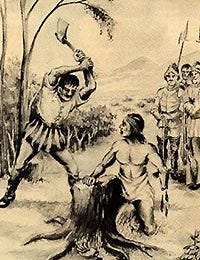
Yet when Spain invaded the Americas, they soon criminalized the cultivation of amaranth, as they did with the quinoa plant in South America. In doing so they banned the cultivation of one the world’s best sources of plant protein. The Spanish Empire imposed the most cruel and uncompromising punishments for growing huaútli, including cutting off the hands of those who dared to plant it.

Image for post
Cutting off the hands of those who dared to plant it

So why did this beautiful nutritious and mystical plant elicit such a savage response from the invaders? This atrocity was most likely triggered by the importance of amaranth both in the people’s diet and in their spiritual life, a plant rightly held in high esteem.

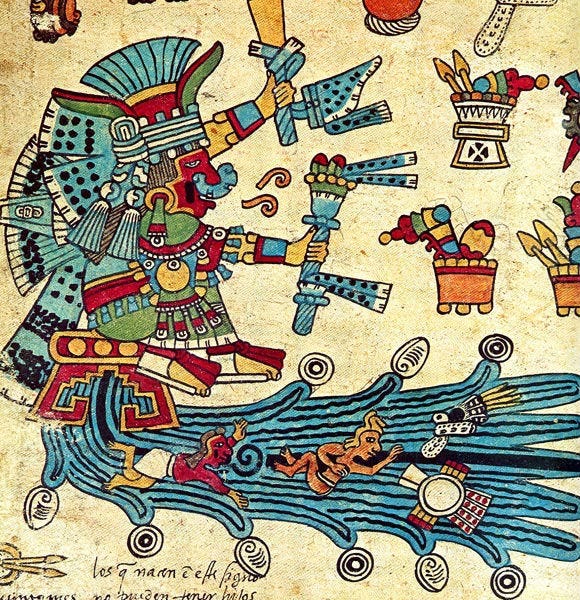
Image for post
Chalchiutlicue, Aztec Goddess of Waters and Purifier of Newborn Babies

Upon their arrival, the Catholic priests were horrified to find that amaranth was considered a deity and used in religious ceremonial rituals. It was consumed and mixed, according to some sources, with the blood of people who were sacrificed, and was perhaps a tad too close to the religious ceremonial ritual of the holy Eucharist, the Catholic ritual that consecrates the body and blood of Christ and is also eaten. But the Eucharist is of course not considered savagery by the church. To the contrary, it is considered a blessed sacrament.

Mexica Aztec Warriors ate amaranth

As many scholars have noted, amaranth was an important part of the diet of warriors as well as a sacred plant that came into the cross-hairs of the Church’s war against paganism. So the more likely truth is that the criminalization of amaranth was both a military strategy intended to weaken the Aztec people allowing for an easier conquest. It was also a brutal tactic used by Catholic Church to eliminate any practices or evidence of an indigenous religion.

Like all warriors, the Mexica Eagle Guild Warriors ate amaranth and were responsible for fighting off and killing about 80% of the Spanish invaders who died in battle, despite their iron swords and their use of horses and dogs as weapons of war. So it was urgent for the Empire and the Church to weaken and crush the masses of people and their warriors by any


means necessary.

Despite its near extinction, today’s amaranth, the hardy survivor huaútli, can be found in contemporary cooking from granola to pancakes and is once again taking it’s place as an important plant food in defiance of its illicit past.

Diverse varieties of amaranth were cultivated all the way to the lands of the Inca people in the South American Andes, where it is consumed to this day. High in protein and the essential amino acid, lysine, amaranth found its way to Europe and is even consumed in India where it is known as rajeera, or the king’s grain.

How ironic that this offering of forbidden toasted amaranth seeds, held together by the sweetness of agave nectar and honey, made round in the shape of the sun and the circle of life, should survive to be called alegría, happiness or joy. No blood this time. Plenty of that was spilled by the Spanish invaders.

From Mesoamerica to East of The L.A. River, from street vendors to neighborhood mercados, bakeries and marketas you will find amaranth sold as the popular treat called alegría, the Spanish word for happiness or joy.

WRITTEN BY María Elena Gaitán (Chola Con Cello) writes about her obsessions, musings and rants from the heart of the universe, East of the Los Angeles River. This is first in a series about the global contribution, politics and cultural impact of Pre-Columbian foods. Thank you for following.


Tuesday, October 06, 2015

"The Last Conquistador" and Epistemological Racism


I showed this video titled, The Last Conquistador, in my class this evening in tandem with Jim Scheurich and Michelle Young's classic piece titled, Coloring Epistemologies: Are Our Research Epistemologies Racially Biased? Educational Researcher Vol. 26, No. 4 (May, 1997), pp. 4-16, that together allowed me to explicate the concept of "civilizational racism."  This is the most profound, unconscious racism that comes out of what we think reality to be (ontology), ways of knowing that reality (epistemology), and deep-seated beliefs about that which we determine to be right or wrong (axiology).

Hats off to filmmakers, John J. Valadez and Cristina Ibarra,  who did an extraordinary job in capturing the moment.  It tells an important story from El Paso, Texas, of renowned sculptor, John Houser, whose dream it was to build this massive—indeed, the world's tallest—bronze equestrian statue with colonizer, Don Juan de Oñate y Salazar, a Spanish Conquistador atop.  Oñate was a brutal, genocidal, colonial governor of the Santa Fe de Nuevo México province to which he was granted dominion by the Viceroyalty of New Spain on April 30, 1598.

As conveyed vividly and poignantly in the film, this action reignited the pain and trauma of Oñate's assertion of power and fought the Pueblo of Acoma in a war that began in January 1599 that not only nearly decimated them, but that also resulted in the enslavement of hundreds of men, women, and children.  The cruelty of this now forever memorialized, albeit ignominious, "hero," knew no limits.  He amputated one foot of the remaining men that survived the battle, literally crippling the Acoma and subjugating the Pueblo and other Indians of New Mexico with indelible consequences unto the present—and that this video brings to light.

Oñate was eventually called to Mexico where he was heard and found guilty for cruelty toward native people.  He had to resign from his post as governor of Santa Fé, but as what could probably have been predicted, was ultimately cleared, on appeal, of all charges.

Thought this might be helpful to others and so I am happy to share.  (Also consider viewing this PBS, animated counter-story to "The Last Conquistador," titled"Frontera! Revolt and Rebellion on the Rio Grande.")  Brace yourself for the Valadez film though for an emotional journey through time that I anticipate will make you both angry and sad.  It illuminates and unmasks a part of our nation's genocidal history of conquest and colonization, and their enduring effects.


Angela Valenzuela
c/s