Friends,
I invite you to take a few minutes to read Dr. César Cruz’s first sermon. It is powerful, tender, and deeply moving.
Here is what I shared on his Medium post:
César, your words bring me to tears. As a Chicana, I know too well how our mothers’ sacrifices have been erased or misnamed as failure, when in truth they are the most radical acts of love. From Tonantzin to La Llorona, from Jochebed to Dylcia Pagán, you remind us that mothers shape history, even through impossible choices.
Treat yourselves to this extraordinary testimony—a profound weaving of scripture, history, and lived experience that affirms the enduring power of a mother’s love.
-Angela Valenzuela
#MothersLove #ImpossibleChoices #MaternalSacrifice #SacredMotherhood
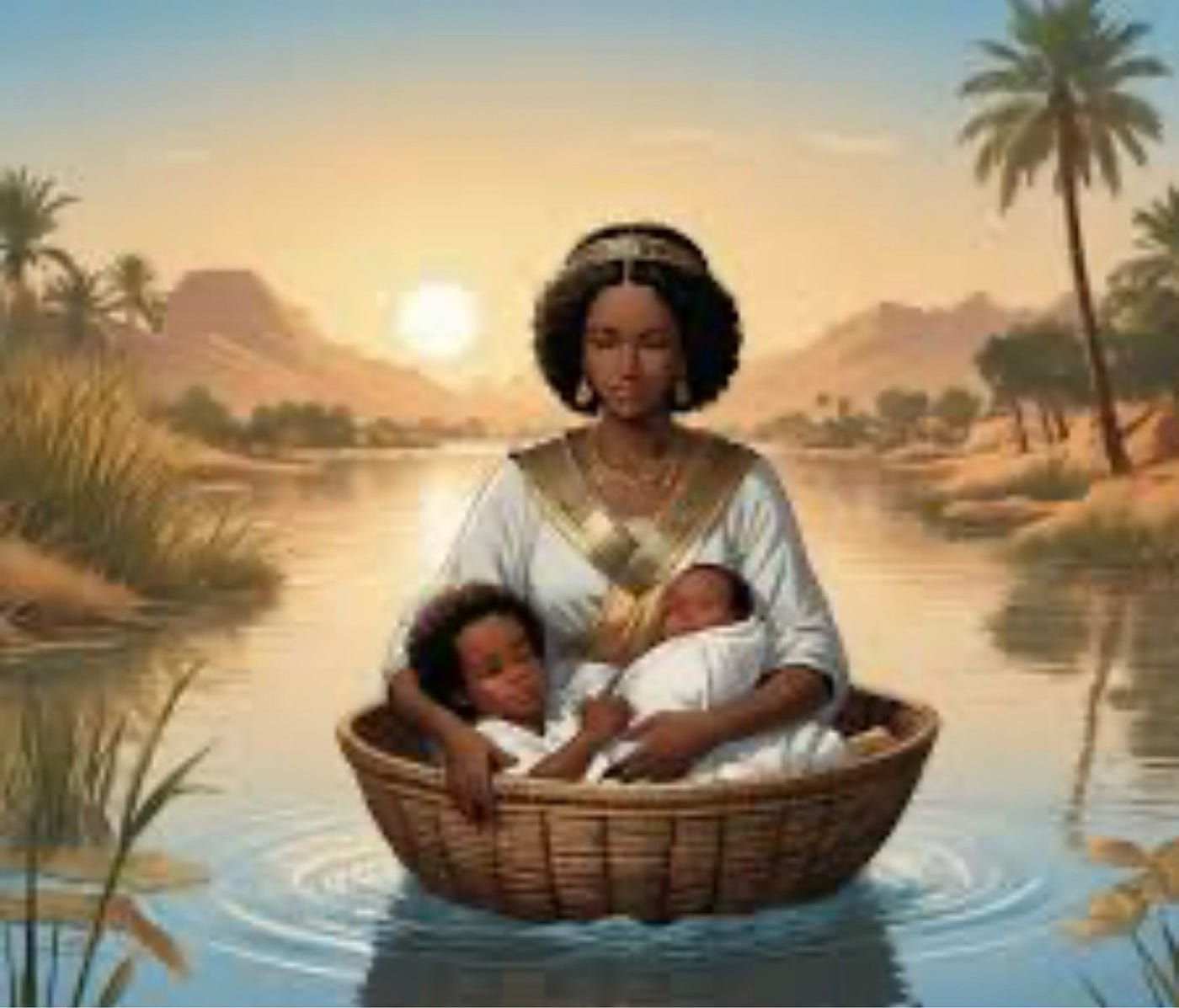
by Cesar Cruz | Medium | August 24, 2025
Throughout history, across cultures and continents, there exists a force more powerful than armies, more enduring than empires, more transformative than revolutions — the love of a mother who will sacrifice everything for her child’s future. This love transcends time, defies borders, and reshapes the very course of human destiny.
In the ancient story of Moses, we witness perhaps one of history’s most profound acts of maternal courage. Jochebed, a Hebrew enslaved woman, made an impossible choice when Pharaoh decreed that all Hebrew boys must die. Rather than watch her son perish, she wove a basket from bulrushes, waterproofed it with pitch, and placed her three-month-old baby in the reeds along the Nile River. As Exodus 2:3 tells us: “When she could hide him no longer, she got a papyrus basket for him and coated it with tar and pitch. Then she placed the child in it and put it among the reeds along the bank of the Nile.”
She chose to trust the unknown waters rather than accept certain death. She placed her child in the hands of God and fate, knowing that love sometimes means letting go. That baby would grow up to liberate an entire people, but it all began with a mother’s impossible choice to save her son by releasing him to the river.
Yet here is what strikes me most profoundly about this story: we know Moses’s name, we know Pharaoh’s name, we know the names of many men in this narrative — but Jochebed’s name appears only briefly. For most of scripture, she is simply “the mother of Moses,” as if her own identity, her own sacrifice, her own impossible courage were secondary to the son she saved. History has a way of rendering invisible the very women whose choices make history possible.
This sacred understanding of maternal love transcends all faiths and traditions. In the Quran, we read of Moses’s mother in Surah Al-Qasas: “And We inspired the mother of Moses, saying: Suckle him and, when you fear for him, then cast him into the river and fear not nor grieve. Lo! We shall bring him back unto you and shall make him one of Our messengers” (28:7).
The Buddha himself spoke of the boundless nature of maternal love, teaching: “Even as a mother protects with her life her child, her only child, so with a boundless heart should one cherish all living beings.”
In Indigenous Mexica(n) tradition, we find Tonantzin, the sacred mother goddess whose name means “Our Revered Mother.” She represents the earth itself as mother, the one who gives life and sustains all existence. When the Spanish conquistadores tried to erase Indigenous spirituality, the people preserved Tonantzin’s essence in the figure of Our Lady of Guadalupe — a brilliant act of spiritual resistance that protected the sacred understanding of motherhood while appearing to submit to colonial religion. Tonantzin teaches us that motherhood is not just personal but cosmic, not just individual but universal. She reminds us that every mother participates in the sacred act of creation itself.
But Indigenous tradition also gives us the haunting story of La Llorona — the Weeping Woman who, in her grief and rage, drowned her own children and now wanders eternally, mourning her loss. While often told as a cautionary tale, La Llorona represents something deeper: she is the embodiment of every mother who has been driven to desperation by impossible circumstances, every woman whose pain has been so great that it transformed her into something unrecognizable even to herself. She reminds us that maternal love, when twisted by trauma and stripped of support, can become its own form of tragedy. Her eternal weeping is not just for her children, but for all mothers who have faced choices no woman should have to make.
This pattern of ignoring or erasing mothers’ stories, rather than seeking to understand them, continues today. In 1991, a young rapper named Tupac Shakur wrote a song that forced America to confront a story it preferred to ignore. “Brenda’s Got a Baby” told the heartbreaking tale of a twelve-year-old girl named Brenda, molested by her own cousin, who became pregnant and — in her terror and confusion — threw her newborn baby into a trash dumpster.
The world was quick to judge Brenda. The headlines screamed about moral decay, about what was wrong with young people, about the failure of communities. But Tupac saw something different. He saw a child who had been failed by every adult who should have protected her. He saw a girl so young she barely understood what was happening to her own body, let alone how to care for another life. He saw someone whose desperation had driven her to an act that horrified even herself.
“Brenda’s got a baby, but Brenda’s barely got a brain,” he rapped, not to mock her but to illuminate the tragedy of a child forced into impossible circumstances by adult cruelty. The song wasn’t an anthem of judgment — it was a call for understanding, a demand that we look deeper than surface actions to see the pain and terror underneath.
But how did our society respond to Brenda’s story? Did we ask how a twelve-year-old girl could be molested by her own family and have nowhere safe to turn? Did we examine the systems that failed to protect her or support her when she became pregnant? Did we wonder what kind of terror and confusion must have driven her to such a desperate act? No. We judged. We pointed fingers. We used her story as evidence of moral decay while ignoring our own moral failure to protect our children.
Like Jochebed, like La Llorona, Brenda became invisible in her own narrative — reduced to a cautionary tale rather than recognized as a child who deserved protection and compassion.
Today, along the borderlands, in detention centers, in hospital rooms, and in courtrooms, there are mothers whose stories echo these ancient and recent acts of courage. They make choices that tear at the very fabric of their being, choices between different forms of love, different forms of loss.
There are the immigrant mothers who send their children on freight trains called “La Bestia” — The Beast — knowing the dangers but also knowing that staying means watching their children’s futures slip away. Picture a mother at dawn, pressing money into her eight-year-old’s small palm, whispering instructions about which train car is safest, teaching survival skills no child should need to know. These mothers don’t sleep for months, wondering if their children are hungry, cold, safe, alive.
And there are mothers like Dylcia Pagan, the Puerto Rican nationalist and revolutionary who understood that the fight for her people’s freedom required the ultimate personal sacrifice. When her baby was just an infant, she faced a choice that would shatter most hearts: she could keep her child close and watch him grow up under occupation, or she could entrust him to a revolutionary Mexican family who would raise him safely while she dedicated her life to the struggle for Puerto Rican independence and faced lifetimes in a cage (incarcerated).
She chose love over proximity. She chose her son’s future over her own comfort. She chose the agony of separation over the slow death of watching her child’s possibilities diminish under colonial rule. For years, she carried the weight of this decision — wondering about his first words, his first steps, his dreams, his fears — all while fighting tirelessly for the freedom that would one day benefit not just her son, but all the children of Puerto Rico.
When they were reunited years later, when her son was a teenager, the revelation shook the foundations of his understanding. He discovered he had been living what felt like a double life — that he was not Mexican but Puerto Rican, that the mother who had raised him with love was not his birth mother, and that his real mother was not absent by choice but was a freedom fighter whose sacrifice had made his very survival possible.
This is the legacy Dylcia Pagan left us: the understanding that revolutionary love sometimes requires revolutionary sacrifice, that fighting for collective liberation can demand the most personal of losses, and that a mother’s love for her child can become inseparable from her love for justice itself. When I had the chance to meet her and learn from her, I witnessed firsthand the strength of a woman who had transformed her maternal love into a force for historical change. May she rest in peace, knowing that her story illuminates the connections between personal sacrifice and political resistance, between individual love and collective freedom.
There are the survivors of sexual assault who face pregnancies conceived in violence. Some choose to carry the child, transforming an act of violence into an act of radical love. Others choose differently, refusing to let their attackers’ violence dictate their entire lives. Still others, like teenage Brenda, make choices born of terror that shock us all — not because they are evil, but because they are broken and afraid and utterly alone.
There are the mothers who lose their children to systems designed to protect — women who love desperately yet find themselves deemed unfit by courts and social workers. Perhaps layered forms of violence has stolen their ability to parent safely. Perhaps intergenerational poverty has devastated homes. Perhaps the trauma of their own childhoods has left them without tools to protect their babies. These mothers sit in courtrooms, watching judges decide their children’s fate, jumping through hoops set by people who have never lived their struggles, never faced their demons, never made their mistakes.
Before we speak of judgment, before we point fingers at mothers whose choices we cannot understand, let us remember the one truth that unites every person who has ever drawn breath: we all had a mother. Each of us exists because a woman — somewhere, somehow — carried us in her body, gave us life, and made the choice for us to be here.
Some of us may be estranged from our mothers. Some of us were raised by others — grandmothers, adoptive parents, foster families, dads. Some of us carry wounds from childhood, anger at choices our mothers made, pain from love we felt we never received. Some of us never knew our mothers, or lost them too soon, or struggled to understand them across barriers of trauma, addiction, mental illness, or simply the vast differences between generations.
But here is what remains true regardless of our relationship with the women who gave us life: we are here because they chose, in that moment, to give us breath. Whether that choice was made with joy or fear, with planning or surprise, with support or in isolation, with resources or in poverty — it was still a choice. And that choice, that act of bringing us into existence, deserves more than a pause. It deserves recognition of the sacred.
When we judge Brenda, when we condemn the immigrant mother who places her child on a train, when we dismiss the woman who loses custody or makes an adoption plan or faces an unwanted pregnancy — we forget that we too are the products of a woman’s impossible choice. We forget that our own existence began with someone else’s act of maternal courage, someone else’s decision to say yes to life even when life was uncertain.
I know this love intimately, though I have lived it from the other side. At five years old, my mother left me in Mexico while she sought a better life for us both. For decades, the world around me whispered the language of abandonment, tried to teach me that being left behind meant being unwanted, unloved, forgotten.
But I have come to understand something profound: what I experienced was not abandonment — it was the deepest kind of love imaginable.
My mother Martha didn’t leave me. She fought for me in the only way she knew how.
She carried me with her in every step she took toward opportunity, in every job she worked, in every night she lay awake planning our reunion.
I don’t carry an abandonment narrative.
I carry a narrative of love.
There is an invisible thread that connects these mothers to their children across miles, across borders, across years of separation, across systems that don’t understand their love, across circumstances that would break lesser hearts.
It is woven from lullabies sung to empty rooms, from money sent with prayers, from dreams of reunification that sustain them through the darkest nights.
From Jochebed placing Moses in the bulrushes, to Dylcia Pagan entrusting her infant son to a revolutionary family while she fought for Puerto Rican liberation, to contemporary mothers making impossible choices about pregnancies conceived in violence, to immigrant mothers watching trains disappear into the horizon carrying their children toward hope, to mothers fighting to regain custody of children taken by the state — these women all share a common thread.
They understand that sometimes the greatest act of love is the act of letting go.They know that keeping someone safe isn’t always about keeping them close. They know that love sometimes requires choices that break your heart but might save your child’s life.
Like Tonantzin, who reminds us that motherhood participates in the sacred act of creation itself, we must recognize these mothers for what they truly are: warriors of love who chose the agony of impossible decisions over the slow death of hopelessness.
Like the weeping La Llorona, we must understand that when we fail to support mothers, when we judge instead of protect, we create tragedies that echo through generations.
When we tell the stories of mothers’ love, let us tell them truly. Let us remember the mothers whose names history forgot — Jochebed, whose courage saved a liberator; Dylcia Pagan, whose revolutionary sacrifice shaped both her son’s life and her people’s struggle for freedom; the countless unnamed women whose sacrifices shaped the world; and yes, even Brenda, whose story should have moved us to protect rather than condemn.
Let us commit to creating a world where mothers face fewer impossible choices. Where survivors of assault receive compassion and comprehensive care. Where children like Brenda are protected from abuse and supported when harm occurs. Where systems designed to protect children also work to preserve families whenever safely possible. Where mothers fighting for justice and liberation receive support for both their political work and their parental responsibilities.
But most importantly, let us commit to seeing these mothers — truly seeing them. Not as cautionary tales or statistics or moral failures, but as human beings whose choices were shaped by circumstances we may never fully understand. Let us ask not just “How could she do that?” but “What drove her to such desperation?”
When we judge without seeking to understand, we perpetuate the very cycles that create these tragedies.
When we erase these mothers from their own stories, we lose the opportunity to learn and prevent future suffering.
Yet of little hope is I, not learning the lessons that my mother has always taught me — that love is not limited by circumstance, that the heart’s capacity to love and sacrifice knows no bounds.
From the spiritual matriarchs to contemporary mothers facing impossible choices, from Tonantzin’s sacred motherhood to La Llorona’s eternal grief, from Dylcia Pagan’s revolutionary sacrifice to the countless unnamed women who have transformed personal love into historical force — let us remember that sometimes the greatest act of keeping someone close is learning how to let them go.
And for those of us fortunate enough to understand this legacy, we know that we were never truly separated at all. We were held in hearts that crossed every border, sustained by love that knew no distance, protected by women whose greatest act of motherhood was sometimes the act of physically letting go while never, ever giving up.
This is the power of a mother’s love. This is the force that has shaped history, liberated peoples, and continues to change the world — one impossible choice at a time.
And I close by saying thank you in the way I know how, Mexica Tiahui, Asé, and Amen.
…
Dr. César Cruz
August 2025- my first sermon dedicated to my mother and all mothers


