Translate

Showing posts with label Community organizing. Show all posts

Friday, July 03, 2026

Organizing as If Social Relations Matter: Cindy Milstein, SEAT, and Youth Leadership in Texas, by Angela Valenzuela, Ph.D. July 3, 2026

Organizing as If Social Relations Matter: Cindy Milstein, SEAT, and Youth Leadership in Texas

by

Angela Valenzuela, Ph.D.

July 3, 2026

Cindy Milstein’s essay, “Organizing Social Spaces as If Social Relations Matter,” deserves to become a classic. It is a must-read because it gives language to something I have been privileged to witness firsthand: young people organizing not only for change, but through relationships of care, trust, joy, and shared responsibility—especially within Students Engaged in Advancing Texas, or SEAT, as well as in LULAC and other community-based youth spaces where I work.

Milstein’s central insight is deceptively simple and deeply profound:

Movements cannot be built only around strategy, demands, protest, or opposition. They must also cultivate new social relations—new ways of being with one another—if they are to prefigure the more democratic and caring world they seek.

I, in fact, first learned of Milstein's essay from youth in SEAT.

She describes resistance, rebellion, and revolution as incomplete without a fourth “R”: reorganization. By this she means not simply reorganizing institutions, but reorganizing how people relate to one another

Without that relational transformation, movements risk reproducing the very hierarchies, exclusions, and harms they oppose. This is one of the essay’s most important contributions: it reminds us that social justice work is not only about what we are against, but also about how we practice what we are for. It is as much or more about beingness as about doingness—who we are and how we show up in our social movements.

This is precisely what I see in SEAT’s leadership. These young people are not simply organizing around issues that matter to them; they are building a culture of care, trust, shared responsibility, and collective courage. Their work is strategic, yes. It is political, yes. But it is also deeply relational. They listen to one another. They make room for vulnerability. They show up for each other. They understand that leadership is not domination, performance, or individual charisma, but a shared practice of building capacity, confidence, and belonging. It's about fun and enjoying the process.

Milstein’s essay helps us see why this matters so much. She cautions that movements often fail not only because of external repression, but because we fail each other. We carry into our organizing spaces the wounds and habits of the very society we are trying to transform—individualism, hierarchy, competition, shame, exclusion, and the temptation to retreat when conflict arises. 

Milstein asks us instead to, in effect, “fail well,” by making "better mistakes" and to treat these and the discomfort that comes along with them not as reasons to abandon one another, but as opportunities to grow in honesty, humility, compassion, and repair. These are tall orders, no doubt, but they are achievable when we commit to practicing them together.

That lesson is especially important for youth organizing. Young people are often expected to perform courage in public while receiving too little care behind the scenes. They are asked to testify, march, mobilize, speak truth to power, and defend democracy, all while coming of age in a world marked by political hostility, ecological crisis, racial injustice, economic precarity, and attacks on education itself. SEAT’s work matters not only because of the policies it contests, but because of the human and democratic relationships it nurtures along the way.

In this regard, SEAT embodies Milstein’s thesis. Its leadership practices suggest that organizing is not merely about occupying public space, but about transforming social space. It is about creating conditions where young people feel seen, heard, trusted, and capable of acting together. It is about learning how to disagree without dehumanizing, how to lead without dominating, how to struggle without losing tenderness, and how to build power without sacrificing care.

For those of us in education, this is a profound lesson. Democracy is not learned only through textbooks, civics lessons, or formal institutions. It is learned in the lived experience of collective work. It is learned when young people discover that their voices matter, that others have their backs, and that public life can be organized around dignity, mutuality, and shared purpose rather than fear or one-upmanship. SEAT’s leadership offers a glimpse of this kind of democratic formation in action.

Milstein gives us language for recognizing what is easy to overlook: the greeting, the check-in, the shared meal, the patient conversation, the willingness to stay present through discomfort, the refusal to reduce one another to mistakes, and the commitment to keep building together. These are not soft additions to the “real” work of organizing. They are the work. They are the ethical infrastructure that makes sustained movement possible.

In a Texas political climate where young people are too often treated as problems to be managed rather than democratic actors to be respected, SEAT offers a different vision. Its members remind us that youth leadership is not future leadership. It is leadership now. And when that leadership is grounded in care, courage, and collective responsibility, it does more than resist the present. It rehearses a freer and more humane future.

That is why Milstein’s essay matters to me. It helps me name what I see in SEAT and other youth organizing: young people organizing as if social relations matter—because they do. We have much to learn from them.

Reference

Milstein, C. (2014, June 14). Organizing social spaces as if social relations matter. Outside the Circle. Originally published in shorter form in ROAR Magazinehttps://cbmilstein.wordpress.com/2014/06/14/organizing-social-spaces-as-if-social-relations-matter/

Organizing Social Spaces as If Social Relations Matter


by Cindy Milstein | June 14, 2014 | Outside the Circle

This essay was originally published, as a shorter version, in ROAR Magazine, “an online journal of the radical imagination providing grassroots perspectives from the front-lines of the global struggle for real democracy,” at http://roarmag.org/2014/06/milstein-social-spaces-relations/.

The Four Rs

Throughout the history of resistance, rebellion, and revolution—the three Rs that should be taught alongside the traditional ones of reading, ’riting, and ’rithmetic—there has always been a fourth R, consciously or not: reorganization. Such reorganization has sought to establish not simply new social structures but also, critically, new social relations.

That has not always ended well. In fact, it has frequently ended badly, with different forms of social organization, to be sure, but ones that ultimately—or too quickly—entailed new forms of domination and terror. If we humans have learned anything from these moments, it’s that the reconstitution of people up to the challenge of enacting goodness in the good society that they are trying to create takes time and practice. Moreover, the time and practices needed far exceed the duration and acts of toppling a king, despot, or dictator, overthrowing colonial, military, or statist rule, or overcoming internecine struggles among radicals.

Various “horizontal” or “from below” experiments, as they’ve been called, have struggled openly during the past two decades in particular with this problematic. They’ve humbly aspired to focus on the social relations side of the puzzle versus—and also within—those exhilarating, necessary instances of popular uprisings.

Some appear to have done it better than others, such as the Zapatistas (recently celebrating twenty years since their first public entrance on the world stage) and Brazilian Landless Workers’ Movement (which became a national movement thirty years ago), at least according to the stories told by some of those born into these autonomous communities, and thus who’ve never known another world and have been socialized by other ways of attempting to live together.

Most of the shorter-lived recent occupations of squares, plazas, and parks, too, quickly set about this task, reveling—at least initially—in the transformed ways people began relating to each other within the myriad of self-organized structures intended to meet everyone’s needs as well as desires.

The same could easily be said of the power of contemporary social movements such as the massive, relatively long-lasting student strike in Quebec in 2012. In that case, months of blockades and nightly illegal street demonstrations, coupled with a plethora of assemblies and collective culture-making, wove a magical fabric of hitherto-unimaginable social interactions across generations and at least two languages.

Here in the United States, the Occupy uprising, in its heady beginnings, created spaces where social-media-isolated people could suddenly “find each other” and (re)discover human(e) connections (see, relatedly, my essay “Occupy Anarchism,” https://cbmilstein.wordpress.com/2014/03/15/occupy-anarchism-musings-on-prehistories-present-imperfects-future-imperfects/). But also here in the United States, where looking through the lens of “I” first and then “we” down the road is so deeply ingrained in us, it too quickly became clear that the ties that bound us Occupiers were spider-web fragile. We torn each other apart in so many varied ways, along so many lines of hurt already scribed into our bodies by white supremacy, heteronormativity, patriarchy, ableism, settler colonialism, classism, overdetermined identity politics, and a long lineage of other violences.

The conundrum of remaking ourselves as we attempt to remake society appears to stymie us here so much faster than in places with greater vestiges of communal lifeways.

It also erects an extra-high hurdle for US social struggles and movements: Can we rise above the learned behaviors inculcated by the mythical origin story and its related American dream of the lone individual making it against all odds, pulling themselves up by their own bootstraps, as entrepreneurial pioneer? Can we surmount the way we tend to instrumentalize each other, “valuing” other people as mere things in relation to our cost-benefit analysis and accountability ledger sheet of strategic organizing and movement needs—relations that have been naturalized in us, made subtle and almost invisible, by capitalism? Can we avoid brushing off the ways that we lack empathy for each other, as ourselves “products” of this damaging society too, with uncompassionate phrases such as “We need to focus on the real enemy”?

It’s too easy to blame the police or state repression alone for why our projects, much less movements, fail. They fail us, and we fail them.

We’ll always fail in ways, of course. But if we don’t allow others—and ourselves—to make mistakes; if we see mishaps as aberrations or, worse, a condemnation of the whole of someone’s being; if we believe that failure and success are separate, stable moments; and if we think that being human, being imperfect, is in itself wrong, then we’ve already lost. We’re already lost.

There are many forces that can be blamed for making most of us, and indeed most of humanity, feel lost at this time in history, from the new layers of alienation heaped on us by high-tech innovations to the palpable sense of “no future” that military-industrial ecological devastation instills. This list, like all the painful -isms, unfurls too far. We don’t just feel lost, though. More to the point, we are tangibly experiencing much loss, and at faster and faster rates, ranging from communities to climates, from homes to loved ones.

This is all the more reason that it’s imperative to rediscover each other, yet in the fullness and complexity of our imperfections, and recognize that such imperfection will be inherent in the revolutionary transformation of present-day society—made up not merely of hierarchical institutions and systemic exploitation but also damaged social relations. It is, then, our perspective on failure that matters.

To conjure up the insight of a teacher-artist friend, Arthur, during a history-oriented study group recently, the point of revolutions is not to achieve some permanently perfect world, or a utopia in the most caricatured of definitions. It is to find ourselves having different, less horrendous conflicts—say, why the delegation of tasks related to community health care isn’t working in an autonomous, directly democratic region as opposed to when and where to go to war as a nation-state. It is to be better equipped to walk toward and through those conflicts in increasingly egalitarian, compassionate ways.

In short, it’s about making better mistakes, and utilizing our better failures as moments of transformation in pursuit of an ever-freer society, filled with ever more dignity and freedom, among other lovely practices.

Another teacher-artist friend, Carla, observed that her goal is, in fact, to have projects fail. That is, she remains open to the likelihood of failure and hence how we might do that well. Her clear-eyed notion grasps the generative attributes of missing the intended mark. Carla’s failures-in-action are amazing to behold, drawing out the best in people, for themselves and toward others. She creates spaces of collaborative empowerment with others, without knowing what will emerge, and strives to curate various contexts in which people can discover the potential of those spaces and themselves together.

Tuesday, March 31, 2026

Scholarship in Action: What Dr. Álvaro Huerta Teaches Us About Organizing for Justice

Scholarship in Action: What Dr. Álvaro Huerta Teaches Us About Organizing for Justice

by 

Angela Valenzuela

March 31, 2026

What does it mean to be both a scholar and an organizer in this moment of backlash? In his manifesto posted below together with helpful videos, Dr. Álvaro Huerta offers a powerful answer: theory without practice is hollow, and practice without theory is directionless. Drawing on the concept of praxis from Paulo Freire, Huerta insists that transformative change requires both reflection and action—grounded in lived struggle.

Across decades of activism—from student-led hunger strikes at University of California, Los Angeles to organizing Latino gardeners against criminalization in Los Angeles and leading environmental justice campaigns—Huerta distills key lessons for organizers. First, learn from history. Social movements are not spontaneous; they are built on knowledge, strategy, and study. Second, organize with communities, not for them. This means humility, deep listening, and rejecting top-down approaches that impose outside agendas.

Huerta is equally clear about what not to do: don’t romanticize poverty or confuse marginalization with virtue. Communities deserve material improvements—but without displacement. Effective organizing builds from existing social networks, honoring the dense webs of relationships that sustain working-class life. At the center of this work is confianza—trust—which cannot be rushed, manufactured, or substituted with flyers and speeches.

Perhaps most striking is Huerta’s insistence that organizing is relational. It happens in homes, at kitchen tables, in churches, and yes—even over tacos and beer. These everyday spaces are not peripheral; they are foundational to building the relationships that make collective action possible.

Finally, Huerta reminds us that organizing requires total commitment. Movements demand focus, sacrifice, and an unwavering belief in the possibility of a better world. In this sense, the scholar-activist is not simply an observer of injustice, but an active participant in its undoing.

At a time when higher education itself is under siege, Huerta’s lessons are instructive: real change does not emerge from policy texts alone, but from organized people, grounded in community, moving together with clarity, strategy, and purpose.

A Chicana/o Manifesto on Community Organizing: Reflections of a Scholar-Activist (OPINION)

As an urban planning and ethnic studies scholar with an extensive background in community activism—over the past three decades— I’ve become an expert in community organizing. While some individuals are experts in the theory of community organizing, they lack the practice. Similarly, while other individuals are experts in the practice of community organizing, they lack the theory. In what I call the “dialectic of community organizing,” I possess both the theory and practice. Throughout my lifelong efforts to transform the world for the better, among other influential thinkers throughout history, I’ve coined this concept from the brilliant educator and philosopher Paulo Freire. In his classic book, Pedagogy of the Oppressed, for instance, Freire advances the notion of praxis as “…reflection and action upon the world in order to transform it.”

Since 1985, starting as a freshman at UCLA, I’ve studied social movements and revolutions—both domestically and internationally. This includes the theoretical foundations and leaders behind major societal transformations. Complementing my university studies, during the mid-1980s, I also engaged in student activism (as a MEChista). This included lobbying for U.S. divestment in South Africa’s then-apartheid regime, advocating for racial/economic diversity in higher education and defending the rights of undocumented students (e.g., eight-day hunger strike). While not one of the five hunger strikers, I played a leadership role in a groundbreaking protest at UCLA (November 11-19, 1987), preserving/securing university funding sources (and other services) for undocumented students. Our successful efforts provided an organizing model for other Chicana/o student activists to stage similar hunger strikes at UCLA (May 24-June 7, 1993), UCSB (April 27-May 5, 1994) and other colleges/universities.


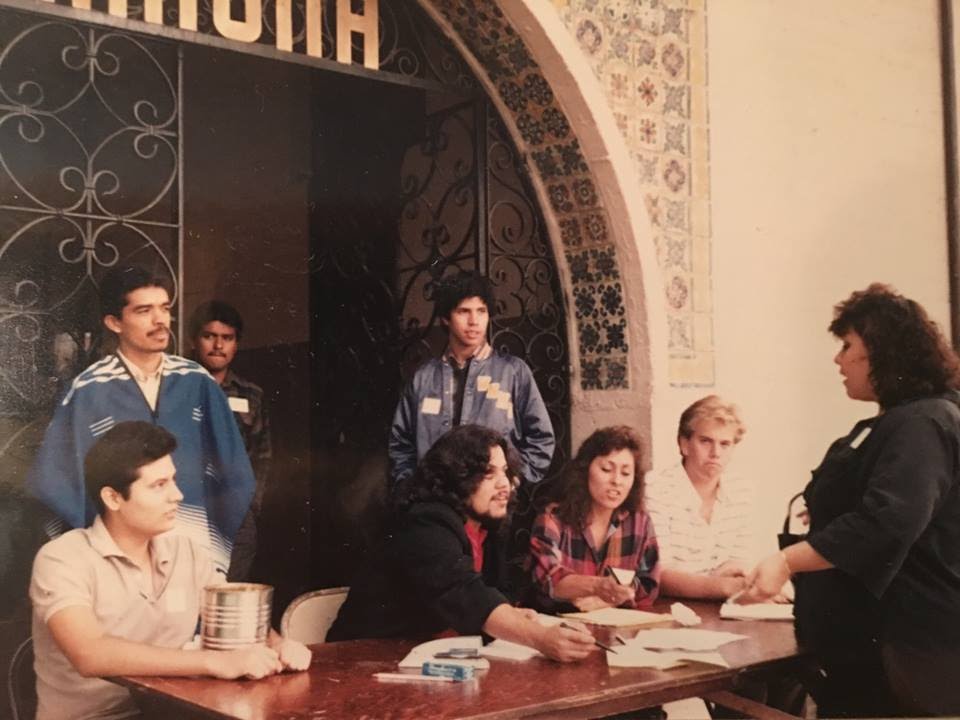
Alvaro Huerta. standing second to left in blue sarape, around 1986 (Photo provided by Alvaro Huerta)

At the community level, I—along with fellow activists—co-founded the Association of Latin American Gardeners of Los Angeles (ALAGLA) to successfully challenge the City of Los Angeles’ leaf blower ban (1996). This draconian ban included a misdemeanor charge, $1,000 fine and up to six months in jail for cited Latino gardeners. Learning from UCLA’s hunger strike, during the pivotal period of this movement, 11 ALAGLA organizers/members staged a six-day hunger strike in front of City Hall (January 3-9, 1998) to demand justice for honest, hard-working Latino gardeners. (To learn more about this social/economic justice campaign, click here for journal article and here for video.)


Following this dynamic grassroots campaign, as the lead organizer at Communities for Better Environment (CBE) —during the late 1990s and early 2000s— I successfully led an organizing campaign to defeat a proposed power plant in Southeast Los Angeles, specifically, the City of South Gate. If built, the proposed power plant (size of
Dodger Stadium) would have emitted over 150 tons of 
pollution per year, such as particulate matter (PM10). PM10 (or fine particles
of soot) has been linked to premature death, including heart failure and
respiratory ailments, such as asthma and bronchitis. (To learn more about this environmental justice (EJ) campaign, click here for journal article and here for video.)


For the record, all successful community-based campaigns represent collective efforts, where all participants (e.g., leadership, membership, volunteers, sympathizers) deserve credit.

That said, given my positionality as a scholar-activist and public policy advocate (e.g., immigration advocacy) on behalf of los de abajo (or those on the bottom), I offer my dos centavos (or two cents) in a non-ranked order for current and future community organizers to benefit from. (While I have more to say on this important question, I’ll do so in future essays.)
Learning from causes for social, racial and economic justice.

Since the turbulent 1960s to the present, college and university students have played a key role in protesting unjust wars (e.g., Vietnam, Iraq), eradicating racism, defending free speech and fighting for a more just society, among other noble causes. Given their privileged status, college/university students have the luxury of time and access to resources to study contemporary and historical social movements and revolutions. This allows this class or group to learn from influential thinkers and leaders responsible for creating transformative change throughout history. While not limited to college/university students, the idea here is for community organizers to study influential causes and their leaders to be better prepared—theoretically and strategically—for emerging causes or struggles.
Demonstrate humility and don’t impose moral values.

When organizing marginalized community members or vulnerable groups, like Kendrick Lamar—greatest rapper alive—says, “be humble.” Need I say more on this point?

In terms of moral values, it’s imperative that community organizers don’t impose their own values or belief systems on the community members they’re “trying to help.” Organizers should not judge or try to change the behavior of community members or presuppose that they know “what’s good for the community.” Be open, listen and engage in dialogue with community members or group members to better understand why individuals or (sub)groups adopt particular conduct, speech, attire, etc.

Overall, instead of operating from a hierarchal or top-down approach (like some non-profits and unions that I worked for), engage with community members on a horizontal or equal level. In other words, don’t organize “for” community members; organize “with” them.
Don’t romanticize poverty.

There’s nothing good about being poor or the objective conditions of the working poor. I should know since I grew up in abject poverty—both in Tijuana (Baja California, Mexico) and East Los Angeles, as I discussed in my TEDxCPP talk (April 27, 2017). Thus, community organizers shouldn’t shy away from improving the living conditions or neighborhoods of historically disenfranchised groups.


The balance, however, is to improve or invest in these communities without the perils of gentrification or displacement of the same people you’re “trying to help.” For instance, the federal urban renewal program of 20th Century—supposedly aimed at “improving” and “transforming cities”—caused havoc for racialized and working-class communities in America’s barrios and ghettos.
Access existing social networks and build from them.

While racialized and working-class communities may be “poor” in terms of financial capital, they are often “rich” in terms of social networks and other forms of social capital. Social networks constitute interpersonal connections among family members, friends, acquaintances, neighbors, co-workers and other relationships, like those via the church (e.g., padrinos/madrinas, compadres/comadres). For instance, in the case of many Chicana/o-Latina/o households, we can clearly see how they effectively organize themselves (and maintain their cultures/identities) around important family events and celebrations, like weddings, quinceañeras, funerals, baptisms and so on.

To effectively organize and mobilize these communities or members around particular campaigns or issues (e.g., legalize street vending, halt deportations, defeat gentrification), it’s key for community organizers to access these pre-existing networks. For instance, when we—Adrian Alvarez, Pedro Perez and myself—first ventured into the streets of Los Angeles to organize Latino gardeners (an informal labor niche which had never been organized before), we did so by accessing the social networks of a Jaime Aleman—a veteran gardener from Zacatecas, Mexico.

I will never forget that cold Saturday night in the summer of 1996, where we first met with some of Jaime’s paisanos and fellow gardeners behind an apartment building. By accessing and expanding upon Jaime’s social networks, a small group of Chicana/o organizers and gardeners successfully organized Latino gardeners—independent and dispersed workers/petty-entrepreneurs throughout the city—to fight City Hall. By chance, like qualitative researchers, we used this opportunity or insider access to initiate a snowball sampling strategy to obtain referrals or contacts with other gardeners throughout the city.
Building confianza or trust.

Without establishing or building confianza (or trust) between the community organizers and community members/impacted members, the organizers will fail miserably. Confianza isn’t something you can establish overnight. It takes time to establish and build. It also takes patience, honest, transparency, consistency and good deeds on behalf of the organizers. Too often, marginalized community members have been taken advantage of by opportunists, politicians, hustlers, hucksters, etc., in this country and, for some, their home countries. This is one reason why marginalized community members are suspicious of outsiders, despite their good intentions to help improve their plight.

Thus, before any organizer arrives into a community/neighborhood that they’re not embedded in and demand action or participation by the community members, they must first get to know the people, especially on a social or personal level. This includes attending events or places where community members congregate, like schools, churches, parks, etc. It helps to start with one person or a family and build confianza from there. It’s impossible to deliver a political speech at a local school or church, expecting community members to trust you or your good intentions. On a similar note, it’s a waste of money and energy to distribute flyers and expect for community members to join your cause without serious reservations.
Eat the tacos de carnitas.

Should an organizer (or organizers) be fortunate enough to be invited into the home of a Latina/o community member or to attend a special occasion, like a quinceañera, don’t offend the host(s) by rejecting their food. In many Mexican households —both in this country and abroad— the host(s) will often serve their guests food without asking. This applies to the poorest barrios of California to the poorest villages of Chiapas, Mexico. Thus, should the guest(s) refuse to eat the served food, the host(s) will be offended.

When organizing against the power plant proposal in South Gate, for example, I noticed some of my fellow organizers commit this crime or insult. I tried to compensate by ordering some extra tacos de carnitas to go, but the damage had already been done.
Organizing at cantinas and Mexican restaurants.

Community organizing shouldn’t be limited to distributing flyers, holding press conferences and organizing protests. Community organizing should also include gatherings informally or socializing at bars, restaurants, coffee shops and back-yard carne asada cookouts with community members. For instance, when organizing gardeners, we (as Chicana/o activists) established strong personal relationships with the Latino gardeners—mostly from rural Mexico—over some Pacifico and Dos Equis beers. (Actually, “some” is an understatement.) This is an insightful point that Adrian Alvarez, president of ALAGLA, discussed at a symposium (on May 13, 2015) at UCLA’s Chicano Studies Research Center (CSRC): “Organizing Latino Immigrants in the Informal Economy: The Successful Case of the Association of Latin American Gardeners of Los Angeles.”


Immerse yourself into organizing campaign.

When organizing a grassroots campaign, you must immerse yourself and focus on the campaign or larger movement. Too often, organizers spread themselves too thin by taking on too many campaigns at once. This is a recipe for failure. When I co-organized the gardeners or led the campaign against the power plant, I immersed or committed myself without external distractions. This allowed me to focus on my particular role within the given organizing campaign and collective objectives.

While there are psychological and physical costs to being fully immersed or committed to a challenging organizing campaign or cause, where you’re constantly thinking about the opponents (e.g., corporation, City Hall, federal government) and major obstacles, etc., this is the price one pays for fighting/dreaming for a better world!

To conclude, I end with the brilliant words of Ricardo Flores Magón (1921)—the precursor of the Mexican Revolution: “The dreamer is the designer of tomorrow… Suppress the dreamer, and the world will deteriorate towards barbarism.”

***

Alvaro Huerta, Ph.D., is an Assistant Professor of Urban & Regional Planning and Ethnic & Women’s Studies (EWS) California State Polytechnic University, Pomona.