Scholarship in Action: What Dr. Álvaro Huerta Teaches Us About Organizing for Justice
by
Angela Valenzuela
March 31, 2026
What does it mean to be both a scholar and an organizer in this moment of backlash? In his manifesto posted below together with helpful videos, Dr. Álvaro Huerta offers a powerful answer: theory without practice is hollow, and practice without theory is directionless. Drawing on the concept of praxis from Paulo Freire, Huerta insists that transformative change requires both reflection and action—grounded in lived struggle.
Across decades of activism—from student-led hunger strikes at University of California, Los Angeles to organizing Latino gardeners against criminalization in Los Angeles and leading environmental justice campaigns—Huerta distills key lessons for organizers. First, learn from history. Social movements are not spontaneous; they are built on knowledge, strategy, and study. Second, organize with communities, not for them. This means humility, deep listening, and rejecting top-down approaches that impose outside agendas.
Huerta is equally clear about what not to do: don’t romanticize poverty or confuse marginalization with virtue. Communities deserve material improvements—but without displacement. Effective organizing builds from existing social networks, honoring the dense webs of relationships that sustain working-class life. At the center of this work is confianza—trust—which cannot be rushed, manufactured, or substituted with flyers and speeches.
Perhaps most striking is Huerta’s insistence that organizing is relational. It happens in homes, at kitchen tables, in churches, and yes—even over tacos and beer. These everyday spaces are not peripheral; they are foundational to building the relationships that make collective action possible.
Finally, Huerta reminds us that organizing requires total commitment. Movements demand focus, sacrifice, and an unwavering belief in the possibility of a better world. In this sense, the scholar-activist is not simply an observer of injustice, but an active participant in its undoing.
At a time when higher education itself is under siege, Huerta’s lessons are instructive: real change does not emerge from policy texts alone, but from organized people, grounded in community, moving together with clarity, strategy, and purpose.
A Chicana/o Manifesto on Community Organizing: Reflections of a Scholar-Activist (OPINION)As an urban planning and ethnic studies scholar with an extensive background in community activism—over the past three decades— I’ve become an expert in community organizing. While some individuals are experts in the theory of community organizing, they lack the practice. Similarly, while other individuals are experts in the practice of community organizing, they lack the theory. In what I call the “dialectic of community organizing,” I possess both the theory and practice. Throughout my lifelong efforts to transform the world for the better, among other influential thinkers throughout history, I’ve coined this concept from the brilliant educator and philosopher Paulo Freire. In his classic book, Pedagogy of the Oppressed, for instance, Freire advances the notion of praxis as “…reflection and action upon the world in order to transform it.”
Since 1985, starting as a freshman at UCLA, I’ve studied social movements and revolutions—both domestically and internationally. This includes the theoretical foundations and leaders behind major societal transformations. Complementing my university studies, during the mid-1980s, I also engaged in student activism (as a MEChista). This included lobbying for U.S. divestment in South Africa’s then-apartheid regime, advocating for racial/economic diversity in higher education and defending the rights of undocumented students (e.g., eight-day hunger strike). While not one of the five hunger strikers, I played a leadership role in a groundbreaking protest at UCLA (November 11-19, 1987), preserving/securing university funding sources (and other services) for undocumented students. Our successful efforts provided an organizing model for other Chicana/o student activists to stage similar hunger strikes at UCLA (May 24-June 7, 1993), UCSB (April 27-May 5, 1994) and other colleges/universities.
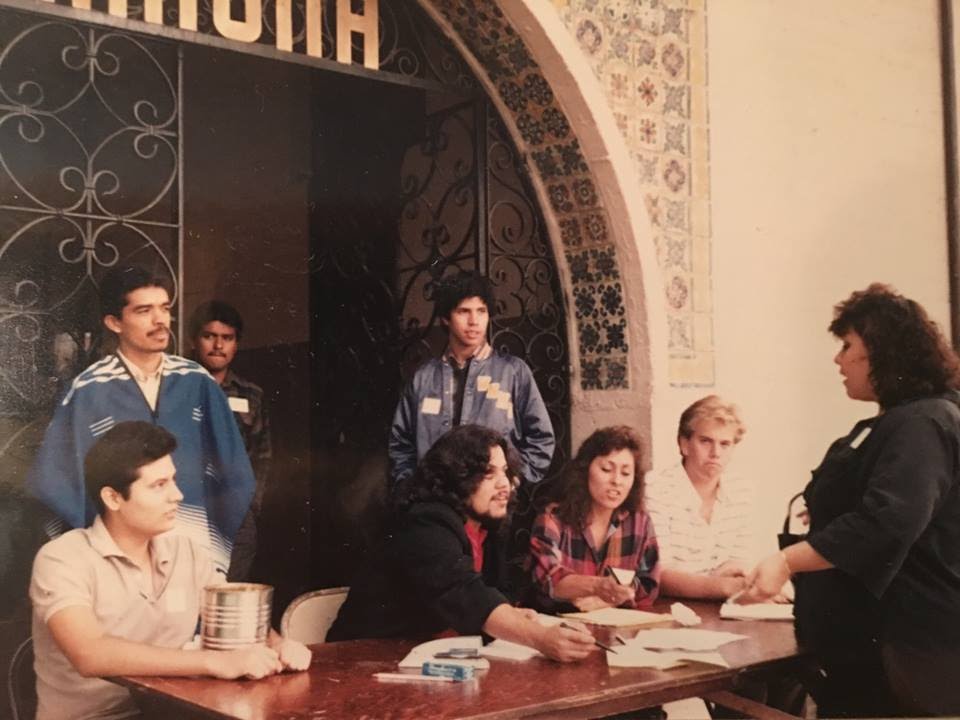
Alvaro Huerta. standing second to left in blue sarape, around 1986 (Photo provided by Alvaro Huerta)
At the community level, I—along with fellow activists—co-founded the Association of Latin American Gardeners of Los Angeles (ALAGLA) to successfully challenge the City of Los Angeles’ leaf blower ban (1996). This draconian ban included a misdemeanor charge, $1,000 fine and up to six months in jail for cited Latino gardeners. Learning from UCLA’s hunger strike, during the pivotal period of this movement, 11 ALAGLA organizers/members staged a six-day hunger strike in front of City Hall (January 3-9, 1998) to demand justice for honest, hard-working Latino gardeners. (To learn more about this social/economic justice campaign, click here for journal article and here for video.)
Following this dynamic grassroots campaign, as the lead organizer at Communities for Better Environment (CBE) —during the late 1990s and early 2000s— I successfully led an organizing campaign to defeat a proposed power plant in Southeast Los Angeles, specifically, the City of South Gate. If built, the proposed power plant (size of Dodger Stadium) would have emitted over 150 tons of pollution per year, such as particulate matter (PM10). PM10 (or fine particles of soot) has been linked to premature death, including heart failure and respiratory ailments, such as asthma and bronchitis. (To learn more about this environmental justice (EJ) campaign, click here for journal article and here for video.)
For the record, all successful community-based campaigns represent collective efforts, where all participants (e.g., leadership, membership, volunteers, sympathizers) deserve credit.
That said, given my positionality as a scholar-activist and public policy advocate (e.g., immigration advocacy) on behalf of los de abajo (or those on the bottom), I offer my dos centavos (or two cents) in a non-ranked order for current and future community organizers to benefit from. (While I have more to say on this important question, I’ll do so in future essays.)
Learning from causes for social, racial and economic justice.
Since the turbulent 1960s to the present, college and university students have played a key role in protesting unjust wars (e.g., Vietnam, Iraq), eradicating racism, defending free speech and fighting for a more just society, among other noble causes. Given their privileged status, college/university students have the luxury of time and access to resources to study contemporary and historical social movements and revolutions. This allows this class or group to learn from influential thinkers and leaders responsible for creating transformative change throughout history. While not limited to college/university students, the idea here is for community organizers to study influential causes and their leaders to be better prepared—theoretically and strategically—for emerging causes or struggles.
Demonstrate humility and don’t impose moral values.
When organizing marginalized community members or vulnerable groups, like Kendrick Lamar—greatest rapper alive—says, “be humble.” Need I say more on this point?
In terms of moral values, it’s imperative that community organizers don’t impose their own values or belief systems on the community members they’re “trying to help.” Organizers should not judge or try to change the behavior of community members or presuppose that they know “what’s good for the community.” Be open, listen and engage in dialogue with community members or group members to better understand why individuals or (sub)groups adopt particular conduct, speech, attire, etc.
Overall, instead of operating from a hierarchal or top-down approach (like some non-profits and unions that I worked for), engage with community members on a horizontal or equal level. In other words, don’t organize “for” community members; organize “with” them.
Don’t romanticize poverty.
There’s nothing good about being poor or the objective conditions of the working poor. I should know since I grew up in abject poverty—both in Tijuana (Baja California, Mexico) and East Los Angeles, as I discussed in my TEDxCPP talk (April 27, 2017). Thus, community organizers shouldn’t shy away from improving the living conditions or neighborhoods of historically disenfranchised groups.
The balance, however, is to improve or invest in these communities without the perils of gentrification or displacement of the same people you’re “trying to help.” For instance, the federal urban renewal program of 20th Century—supposedly aimed at “improving” and “transforming cities”—caused havoc for racialized and working-class communities in America’s barrios and ghettos.
Access existing social networks and build from them.
While racialized and working-class communities may be “poor” in terms of financial capital, they are often “rich” in terms of social networks and other forms of social capital. Social networks constitute interpersonal connections among family members, friends, acquaintances, neighbors, co-workers and other relationships, like those via the church (e.g., padrinos/madrinas, compadres/comadres). For instance, in the case of many Chicana/o-Latina/o households, we can clearly see how they effectively organize themselves (and maintain their cultures/identities) around important family events and celebrations, like weddings, quinceañeras, funerals, baptisms and so on.
To effectively organize and mobilize these communities or members around particular campaigns or issues (e.g., legalize street vending, halt deportations, defeat gentrification), it’s key for community organizers to access these pre-existing networks. For instance, when we—Adrian Alvarez, Pedro Perez and myself—first ventured into the streets of Los Angeles to organize Latino gardeners (an informal labor niche which had never been organized before), we did so by accessing the social networks of a Jaime Aleman—a veteran gardener from Zacatecas, Mexico.
I will never forget that cold Saturday night in the summer of 1996, where we first met with some of Jaime’s paisanos and fellow gardeners behind an apartment building. By accessing and expanding upon Jaime’s social networks, a small group of Chicana/o organizers and gardeners successfully organized Latino gardeners—independent and dispersed workers/petty-entrepreneurs throughout the city—to fight City Hall. By chance, like qualitative researchers, we used this opportunity or insider access to initiate a snowball sampling strategy to obtain referrals or contacts with other gardeners throughout the city.
Building confianza or trust.
Without establishing or building confianza (or trust) between the community organizers and community members/impacted members, the organizers will fail miserably. Confianza isn’t something you can establish overnight. It takes time to establish and build. It also takes patience, honest, transparency, consistency and good deeds on behalf of the organizers. Too often, marginalized community members have been taken advantage of by opportunists, politicians, hustlers, hucksters, etc., in this country and, for some, their home countries. This is one reason why marginalized community members are suspicious of outsiders, despite their good intentions to help improve their plight.
Thus, before any organizer arrives into a community/neighborhood that they’re not embedded in and demand action or participation by the community members, they must first get to know the people, especially on a social or personal level. This includes attending events or places where community members congregate, like schools, churches, parks, etc. It helps to start with one person or a family and build confianza from there. It’s impossible to deliver a political speech at a local school or church, expecting community members to trust you or your good intentions. On a similar note, it’s a waste of money and energy to distribute flyers and expect for community members to join your cause without serious reservations.
Eat the tacos de carnitas.
Should an organizer (or organizers) be fortunate enough to be invited into the home of a Latina/o community member or to attend a special occasion, like a quinceañera, don’t offend the host(s) by rejecting their food. In many Mexican households —both in this country and abroad— the host(s) will often serve their guests food without asking. This applies to the poorest barrios of California to the poorest villages of Chiapas, Mexico. Thus, should the guest(s) refuse to eat the served food, the host(s) will be offended.
When organizing against the power plant proposal in South Gate, for example, I noticed some of my fellow organizers commit this crime or insult. I tried to compensate by ordering some extra tacos de carnitas to go, but the damage had already been done.
Organizing at cantinas and Mexican restaurants.
Community organizing shouldn’t be limited to distributing flyers, holding press conferences and organizing protests. Community organizing should also include gatherings informally or socializing at bars, restaurants, coffee shops and back-yard carne asada cookouts with community members. For instance, when organizing gardeners, we (as Chicana/o activists) established strong personal relationships with the Latino gardeners—mostly from rural Mexico—over some Pacifico and Dos Equis beers. (Actually, “some” is an understatement.) This is an insightful point that Adrian Alvarez, president of ALAGLA, discussed at a symposium (on May 13, 2015) at UCLA’s Chicano Studies Research Center (CSRC): “Organizing Latino Immigrants in the Informal Economy: The Successful Case of the Association of Latin American Gardeners of Los Angeles.”
Immerse yourself into organizing campaign.
When organizing a grassroots campaign, you must immerse yourself and focus on the campaign or larger movement. Too often, organizers spread themselves too thin by taking on too many campaigns at once. This is a recipe for failure. When I co-organized the gardeners or led the campaign against the power plant, I immersed or committed myself without external distractions. This allowed me to focus on my particular role within the given organizing campaign and collective objectives.
While there are psychological and physical costs to being fully immersed or committed to a challenging organizing campaign or cause, where you’re constantly thinking about the opponents (e.g., corporation, City Hall, federal government) and major obstacles, etc., this is the price one pays for fighting/dreaming for a better world!
To conclude, I end with the brilliant words of Ricardo Flores Magón (1921)—the precursor of the Mexican Revolution: “The dreamer is the designer of tomorrow… Suppress the dreamer, and the world will deteriorate towards barbarism.”
***
Alvaro Huerta, Ph.D., is an Assistant Professor of Urban & Regional Planning and Ethnic & Women’s Studies (EWS) California State Polytechnic University, Pomona.

