Translate

Showing posts with label Los Angeles. Show all posts

Tuesday, March 31, 2026

Scholarship in Action: What Dr. Álvaro Huerta Teaches Us About Organizing for Justice

Scholarship in Action: What Dr. Álvaro Huerta Teaches Us About Organizing for Justice

by 

Angela Valenzuela

March 31, 2026

What does it mean to be both a scholar and an organizer in this moment of backlash? In his manifesto posted below together with helpful videos, Dr. Álvaro Huerta offers a powerful answer: theory without practice is hollow, and practice without theory is directionless. Drawing on the concept of praxis from Paulo Freire, Huerta insists that transformative change requires both reflection and action—grounded in lived struggle.

Across decades of activism—from student-led hunger strikes at University of California, Los Angeles to organizing Latino gardeners against criminalization in Los Angeles and leading environmental justice campaigns—Huerta distills key lessons for organizers. First, learn from history. Social movements are not spontaneous; they are built on knowledge, strategy, and study. Second, organize with communities, not for them. This means humility, deep listening, and rejecting top-down approaches that impose outside agendas.

Huerta is equally clear about what not to do: don’t romanticize poverty or confuse marginalization with virtue. Communities deserve material improvements—but without displacement. Effective organizing builds from existing social networks, honoring the dense webs of relationships that sustain working-class life. At the center of this work is confianza—trust—which cannot be rushed, manufactured, or substituted with flyers and speeches.

Perhaps most striking is Huerta’s insistence that organizing is relational. It happens in homes, at kitchen tables, in churches, and yes—even over tacos and beer. These everyday spaces are not peripheral; they are foundational to building the relationships that make collective action possible.

Finally, Huerta reminds us that organizing requires total commitment. Movements demand focus, sacrifice, and an unwavering belief in the possibility of a better world. In this sense, the scholar-activist is not simply an observer of injustice, but an active participant in its undoing.

At a time when higher education itself is under siege, Huerta’s lessons are instructive: real change does not emerge from policy texts alone, but from organized people, grounded in community, moving together with clarity, strategy, and purpose.

A Chicana/o Manifesto on Community Organizing: Reflections of a Scholar-Activist (OPINION)

As an urban planning and ethnic studies scholar with an extensive background in community activism—over the past three decades— I’ve become an expert in community organizing. While some individuals are experts in the theory of community organizing, they lack the practice. Similarly, while other individuals are experts in the practice of community organizing, they lack the theory. In what I call the “dialectic of community organizing,” I possess both the theory and practice. Throughout my lifelong efforts to transform the world for the better, among other influential thinkers throughout history, I’ve coined this concept from the brilliant educator and philosopher Paulo Freire. In his classic book, Pedagogy of the Oppressed, for instance, Freire advances the notion of praxis as “…reflection and action upon the world in order to transform it.”

Since 1985, starting as a freshman at UCLA, I’ve studied social movements and revolutions—both domestically and internationally. This includes the theoretical foundations and leaders behind major societal transformations. Complementing my university studies, during the mid-1980s, I also engaged in student activism (as a MEChista). This included lobbying for U.S. divestment in South Africa’s then-apartheid regime, advocating for racial/economic diversity in higher education and defending the rights of undocumented students (e.g., eight-day hunger strike). While not one of the five hunger strikers, I played a leadership role in a groundbreaking protest at UCLA (November 11-19, 1987), preserving/securing university funding sources (and other services) for undocumented students. Our successful efforts provided an organizing model for other Chicana/o student activists to stage similar hunger strikes at UCLA (May 24-June 7, 1993), UCSB (April 27-May 5, 1994) and other colleges/universities.
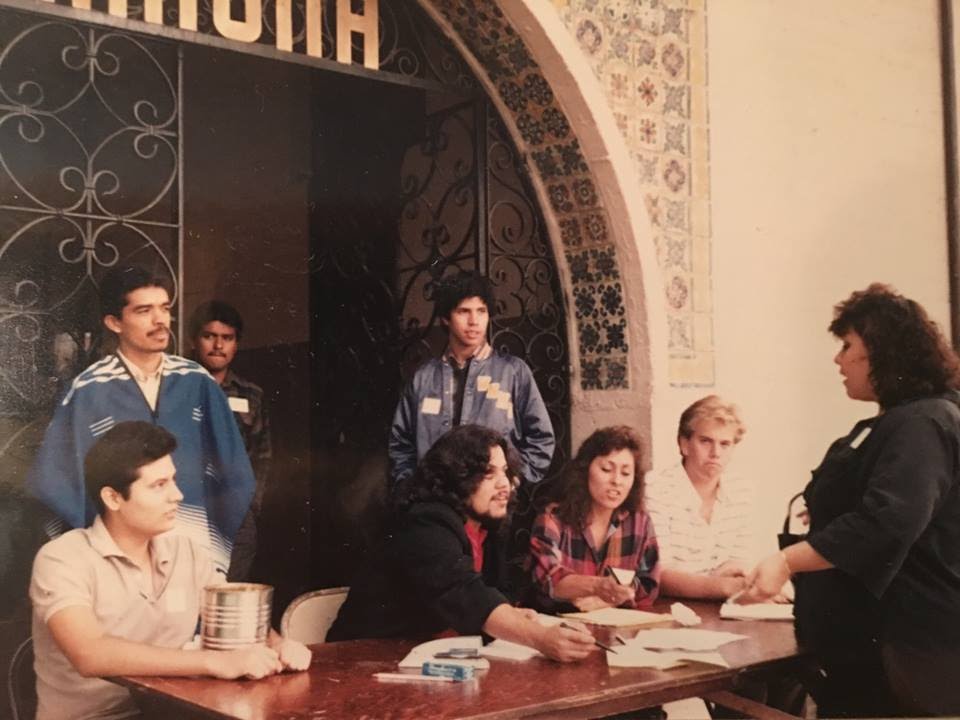

Alvaro Huerta. standing second to left in blue sarape, around 1986 (Photo provided by Alvaro Huerta)

At the community level, I—along with fellow activists—co-founded the Association of Latin American Gardeners of Los Angeles (ALAGLA) to successfully challenge the City of Los Angeles’ leaf blower ban (1996). This draconian ban included a misdemeanor charge, $1,000 fine and up to six months in jail for cited Latino gardeners. Learning from UCLA’s hunger strike, during the pivotal period of this movement, 11 ALAGLA organizers/members staged a six-day hunger strike in front of City Hall (January 3-9, 1998) to demand justice for honest, hard-working Latino gardeners. (To learn more about this social/economic justice campaign, click here for journal article and here for video.)


Following this dynamic grassroots campaign, as the lead organizer at Communities for Better Environment (CBE) —during the late 1990s and early 2000s— I successfully led an organizing campaign to defeat a proposed power plant in Southeast Los Angeles, specifically, the City of South Gate. If built, the proposed power plant (size of
Dodger Stadium) would have emitted over 150 tons of 
pollution per year, such as particulate matter (PM10). PM10 (or fine particles
of soot) has been linked to premature death, including heart failure and
respiratory ailments, such as asthma and bronchitis. (To learn more about this environmental justice (EJ) campaign, click here for journal article and here for video.)


For the record, all successful community-based campaigns represent collective efforts, where all participants (e.g., leadership, membership, volunteers, sympathizers) deserve credit.

That said, given my positionality as a scholar-activist and public policy advocate (e.g., immigration advocacy) on behalf of los de abajo (or those on the bottom), I offer my dos centavos (or two cents) in a non-ranked order for current and future community organizers to benefit from. (While I have more to say on this important question, I’ll do so in future essays.)
Learning from causes for social, racial and economic justice.

Since the turbulent 1960s to the present, college and university students have played a key role in protesting unjust wars (e.g., Vietnam, Iraq), eradicating racism, defending free speech and fighting for a more just society, among other noble causes. Given their privileged status, college/university students have the luxury of time and access to resources to study contemporary and historical social movements and revolutions. This allows this class or group to learn from influential thinkers and leaders responsible for creating transformative change throughout history. While not limited to college/university students, the idea here is for community organizers to study influential causes and their leaders to be better prepared—theoretically and strategically—for emerging causes or struggles.
Demonstrate humility and don’t impose moral values.

When organizing marginalized community members or vulnerable groups, like Kendrick Lamar—greatest rapper alive—says, “be humble.” Need I say more on this point?

In terms of moral values, it’s imperative that community organizers don’t impose their own values or belief systems on the community members they’re “trying to help.” Organizers should not judge or try to change the behavior of community members or presuppose that they know “what’s good for the community.” Be open, listen and engage in dialogue with community members or group members to better understand why individuals or (sub)groups adopt particular conduct, speech, attire, etc.

Overall, instead of operating from a hierarchal or top-down approach (like some non-profits and unions that I worked for), engage with community members on a horizontal or equal level. In other words, don’t organize “for” community members; organize “with” them.
Don’t romanticize poverty.

There’s nothing good about being poor or the objective conditions of the working poor. I should know since I grew up in abject poverty—both in Tijuana (Baja California, Mexico) and East Los Angeles, as I discussed in my TEDxCPP talk (April 27, 2017). Thus, community organizers shouldn’t shy away from improving the living conditions or neighborhoods of historically disenfranchised groups.


The balance, however, is to improve or invest in these communities without the perils of gentrification or displacement of the same people you’re “trying to help.” For instance, the federal urban renewal program of 20th Century—supposedly aimed at “improving” and “transforming cities”—caused havoc for racialized and working-class communities in America’s barrios and ghettos.
Access existing social networks and build from them.

While racialized and working-class communities may be “poor” in terms of financial capital, they are often “rich” in terms of social networks and other forms of social capital. Social networks constitute interpersonal connections among family members, friends, acquaintances, neighbors, co-workers and other relationships, like those via the church (e.g., padrinos/madrinas, compadres/comadres). For instance, in the case of many Chicana/o-Latina/o households, we can clearly see how they effectively organize themselves (and maintain their cultures/identities) around important family events and celebrations, like weddings, quinceañeras, funerals, baptisms and so on.

To effectively organize and mobilize these communities or members around particular campaigns or issues (e.g., legalize street vending, halt deportations, defeat gentrification), it’s key for community organizers to access these pre-existing networks. For instance, when we—Adrian Alvarez, Pedro Perez and myself—first ventured into the streets of Los Angeles to organize Latino gardeners (an informal labor niche which had never been organized before), we did so by accessing the social networks of a Jaime Aleman—a veteran gardener from Zacatecas, Mexico.

I will never forget that cold Saturday night in the summer of 1996, where we first met with some of Jaime’s paisanos and fellow gardeners behind an apartment building. By accessing and expanding upon Jaime’s social networks, a small group of Chicana/o organizers and gardeners successfully organized Latino gardeners—independent and dispersed workers/petty-entrepreneurs throughout the city—to fight City Hall. By chance, like qualitative researchers, we used this opportunity or insider access to initiate a snowball sampling strategy to obtain referrals or contacts with other gardeners throughout the city.
Building confianza or trust.

Without establishing or building confianza (or trust) between the community organizers and community members/impacted members, the organizers will fail miserably. Confianza isn’t something you can establish overnight. It takes time to establish and build. It also takes patience, honest, transparency, consistency and good deeds on behalf of the organizers. Too often, marginalized community members have been taken advantage of by opportunists, politicians, hustlers, hucksters, etc., in this country and, for some, their home countries. This is one reason why marginalized community members are suspicious of outsiders, despite their good intentions to help improve their plight.

Thus, before any organizer arrives into a community/neighborhood that they’re not embedded in and demand action or participation by the community members, they must first get to know the people, especially on a social or personal level. This includes attending events or places where community members congregate, like schools, churches, parks, etc. It helps to start with one person or a family and build confianza from there. It’s impossible to deliver a political speech at a local school or church, expecting community members to trust you or your good intentions. On a similar note, it’s a waste of money and energy to distribute flyers and expect for community members to join your cause without serious reservations.
Eat the tacos de carnitas.

Should an organizer (or organizers) be fortunate enough to be invited into the home of a Latina/o community member or to attend a special occasion, like a quinceañera, don’t offend the host(s) by rejecting their food. In many Mexican households —both in this country and abroad— the host(s) will often serve their guests food without asking. This applies to the poorest barrios of California to the poorest villages of Chiapas, Mexico. Thus, should the guest(s) refuse to eat the served food, the host(s) will be offended.

When organizing against the power plant proposal in South Gate, for example, I noticed some of my fellow organizers commit this crime or insult. I tried to compensate by ordering some extra tacos de carnitas to go, but the damage had already been done.
Organizing at cantinas and Mexican restaurants.

Community organizing shouldn’t be limited to distributing flyers, holding press conferences and organizing protests. Community organizing should also include gatherings informally or socializing at bars, restaurants, coffee shops and back-yard carne asada cookouts with community members. For instance, when organizing gardeners, we (as Chicana/o activists) established strong personal relationships with the Latino gardeners—mostly from rural Mexico—over some Pacifico and Dos Equis beers. (Actually, “some” is an understatement.) This is an insightful point that Adrian Alvarez, president of ALAGLA, discussed at a symposium (on May 13, 2015) at UCLA’s Chicano Studies Research Center (CSRC): “Organizing Latino Immigrants in the Informal Economy: The Successful Case of the Association of Latin American Gardeners of Los Angeles.”


Immerse yourself into organizing campaign.

When organizing a grassroots campaign, you must immerse yourself and focus on the campaign or larger movement. Too often, organizers spread themselves too thin by taking on too many campaigns at once. This is a recipe for failure. When I co-organized the gardeners or led the campaign against the power plant, I immersed or committed myself without external distractions. This allowed me to focus on my particular role within the given organizing campaign and collective objectives.

While there are psychological and physical costs to being fully immersed or committed to a challenging organizing campaign or cause, where you’re constantly thinking about the opponents (e.g., corporation, City Hall, federal government) and major obstacles, etc., this is the price one pays for fighting/dreaming for a better world!

To conclude, I end with the brilliant words of Ricardo Flores Magón (1921)—the precursor of the Mexican Revolution: “The dreamer is the designer of tomorrow… Suppress the dreamer, and the world will deteriorate towards barbarism.”

***

Alvaro Huerta, Ph.D., is an Assistant Professor of Urban & Regional Planning and Ethnic & Women’s Studies (EWS) California State Polytechnic University, Pomona.

Sunday, September 14, 2025

‘I am not the same person.’ Pasadena man recounts 13 days in ICE’s ‘basement’, Jasmine Mendez, Los Angeles Times

 Friends,

I was in California this past week attending a conference on education and justice and learned of this terrifying story of Rami Othmane, a 36-year-old Pasadena resident from Tunisia. On July 13, 2025, Rami was driving to the supermarket when he was suddenly surrounded by masked agents in unmarked cars. Despite showing proof of his pending green card application and following lawful procedures, he was detained and taken to B-18, the infamous “basement” of ICE’s downtown Los Angeles facility.

Rami spent 13 days there — 13 days that felt like an eternity in conditions so degrading they defy belief. No bed, no toothbrush, no soap. The air conditioning blasting like a freezer. The same soggy bean burrito, day after day. An open toilet shared with dozens of other men. Fifteen pounds lost in less than two weeks. And all this while he battled a brain tumor.

How can this happen in a democracy?

Rami’s story is not an isolated one. It is part of a broader strategy to normalize fear — to treat immigrants not as human beings but as disposable bodies. Facilities like B-18 are designed to operate in the shadows, where abuse festers unchallenged. As Rep. Judy Chu observed during her visit, the place was “wiped clean” before her arrival, staged to look good for inspection, while hiding the grim reality. This is how democracies drift toward authoritarianism: when we look away, when “processing centers” become prisons, when national security rhetoric becomes a pretext for erasing lives.

Rami himself says, “I’m not the same person. It’s traumatizing. I hope I go back to where I was, but it’s hard.” His words should haunt us, for he stands in the place of so many more whose suffering remains unseen. They remind us that ICE doesn’t just detain bodies; it breaks spirits.

We cannot allow this to stand. We must demand oversight, accountability, and — most importantly — humanity. Organizations like the National Day Laborer Organizing Network (NDLON), the National Immigration Law Center, immigrant rights coalitions, and countless grassroots groups are leading this fight. They need our support.

-Angela Valenzuela


A man who stayed at a downtown Los Angeles ICE facility described being sick, hungry, sleep-deprived and terrified of what might come next.
(Carlin Stiehl / Los Angeles Times)

  • Rami Othmane recalls sharing an open toilet and sleeping on a concrete floor.
  • He said his wife, chief of medical staff at Huntington Hospital in Pasadena, received death threats and racist comments while he was detained.

Days after her husband’s arrest, Alrashid and the National Day Laborer Organizing Network rallied outside B-18 to shed light on Othmane’s case.  Rami Othmane was driving to the supermarket to pick up ingredients to make dinner when he noticed a car following closely behind. 

Dr. Wafaa Alrashid and Rami Othmane were married in March.
(Dr. Wafaa Alrashid)

“I thought [the driver] was just being aggressive, but a few moments after, they blocked my way,” Othmane said. “They ordered me to leave my car. But I kept asking them — who are you?”

Othmane is a 36-year-old Pasadena resident from Tunisia, and his wife is Dr. Wafaa Alrashid, chief of medical staff at Huntington Hospital in Pasadena, whom he was speaking with as federal agents descended.

“I was surrounded by like five or six masked people in unmarked cars,” Othmane told The Times. “I kept telling them I have my ID and I’m a green card applicant. … I was following the right procedure.”

Othmane spoke with The Times this month about his July 13 arrest and subsequent 13-day

detention in harsh conditions while suffering from a brain tumor. The experience, he said, left him altered.

Immigration and Customs Enforcement did not respond to The Times’ request for comment on Othmane’s case.

Othmane said that prior to the arrest he was in the process of obtaining an I-130 petition, which would allow him to stay in the country by qualifying his marriage to Alrashid — a U.S. citizen. The couple wed in March.

Othmane said he provided the agents with a receipt of his green card application but was ignored and ordered to get out of the car.

“They took my wallet,” he said. “They just took me.”

He was brought to the downtown Los Angeles ICE facility known as B-18, or “the basement,” a temporary immigration processing center. According to the Pasadena-based Barcena Law Offices, “this is where people go to be detained for less than 12 hours ... [and] are either released or deported.”

But Othmane’s stay was many times longer than that. 

The Pasadena resident said he waited 12 hours just to be processed into the facility. This is despite a 2009 lawsuit brought by the American Civil Liberties Union. The suit was brought to end “unsanitary conditions” in B-18, but in a settlement, it was agreed that ICE would not keep detainees for more than 12 hours on any given day or over a two-day period, with limited exceptions.

Further, ICE agreed to put a stop to “the practice of shuttling detainees back and forth to overcrowded local jails in an effort to avoid rules prohibiting long-term detention,” according to an ACLU news release.

“No longer can ICE stuff people into overcrowded cells or deny detainees their right to see a lawyer,” Karen Tumlin, then legal director at the National Immigration Law Center, said in 2009. “As this lawsuit shows, major national policy changes are desperately needed to safeguard against the terrible conditions that afflict so many immigrants held in detention centers across the country.”

After waiting hours to be booked, “the first person I spoke to didn’t understand why they arrested me,” Othmane said. “He said my application was legit.” 

Othmane said he was later booked for overstaying his visa in 2015, although he’d since had that case dismissed by an immigration judge and had a green card application in process. He said he saw an ICE case manager the following day, who also questioned why he’d been booked.

Othmane said he sought to reassure the case manager. “This is how it is, you know, we’ll get through it and survive,” he said.

For 13 days, Othmane endured severe conditions. He lost sleep while sharing a cell and an open toilet with other men who would jockey at night for space to sleep on the cold concrete floor. (“The smell was horrible,” he said.) No bedding was provided. The facility is kept at 50 degrees, according to one Congress member who visited there. 

He lost 15 pounds due to malnutrition. Meanwhile, he was fighting a growing tumor in his head.

“How many nights can you stay without sleep, or without proper food, without brushing your teeth,” Othmane said. “You can hurt your lungs in there because of the horrible AC; you feel like you’re in a freezer.”

Othmane said he was often fed the same finger-sized, wet bean burrito paired with chips and water. He began “to look forward to it,” though, as his quick weight loss began to worry him.

“He does not have a bed to sleep on,” Alrashid said at the rally in July. “My husband is 6 foot 7 inches, for those of you who have met him. He’s a very kind, nice person. But he’s also very tall.”

Othmane said that, while he was detained, his wife received death threats and racist comments on her social media and work email and in letters in the mail. 

“People were telling my wife to leave even though she was born here,” he said. “It’s sad to see that humanity is gone.” 

Due to hunger and severe headaches — a side effect of the tumor — Othmane fainted and was taken to a hospital.

“They gave me liters of IV, food and warm blankets,” he said. “It’s like if you got lost on an island alone for like two weeks or a month, but then they find you ... and try to bring you back to life.”

During the visit, his wrists and ankles were handcuffed, his chest tied down to the hospital bed.

Othmane returned to his cell on July 21. After almost two weeks, he was told he was being transferred to a facility in Arizona — prompting an emotional reaction as the uncertainty of his future in B-18 was coming to an end. 

“I collapsed. I just started crying. It was the best news I ever heard,” he said. “The guards started hugging me; it was like a celebration.”

As Othmane’s transfer was underway, ICE was preparing for a scheduled tour of the facility. U.S. Reps. Brad Sherman (D-Sherman Oaks), Jimmy Gomez (D-Los Angeles) and Judy Chu (D-Monterey Park) visited B-18 on Aug. 11, days after Othmane was moved.

Rep. Chu represents Pasadena, where Othmane lives. She said the facility was “wiped clean.”


Rep. Judy Chu (D-Monterey Park) waits at the entrance to B-18 in downtown Los Angeles on an occasion when she was denied access.

“They let us into the area where the detainees come in. They come in on a van, they are handcuffed and they take them in through this little hallway, where they take their things,” Chu told The Times. “Then we went where the processing desks are, which are surrounded by nine cells capable of holding 336 detainees. But the strange thing is there were so few detainees there.”

Chu later visited the Adelanto ICE Processing Center, which holds about 2,000 people, and spoke with detainees.

“Some of them told me the conditions [in Adelanto] are better than B-18. At least there was a jug of water in the middle of the room. They can talk on the phone, and engage in board games,” the lawmaker said.

ICE agents told Chu that detainees in B-18 are held for no more than 12 hours, but that they have specific waivers that allow them to keep people for 72 hours.

“As we can see,” Chu said, referring to Othmane’s case, “people are being held in B-18 for as long as 13 days. I’m searching if this has happened with others. But B-18 has been a mystery where few have been let in.”

Chu said that during her visit to the facility, she asked about the food and was shown the burritos Othmane was fed. “They told me people could just ask for more food or bottled water by tapping on the window,” she said.

Othmane said more food was provided “if you were lucky.” 

As for hygiene in B-18, Chu said, “there’s no change of clothes, no toothbrush, no toothpaste or soap. They said, well, they’re only here for 12 hours,” she said, although that is not always the case. 

Othmane was removed from the chill of B-18 and driven seven hours inside a truck with no air conditioning to the Eloy Detention Center in Arizona, according to Chu. He spent another 13 days in Eloy before being released on $20,000 bail. Alrashid drove to Arizona to pick him up.


Rami Othmane, shown performing in an undated photo, said his experience in detention was “traumatizing.”(Dr. Wafaa Alrashid)

"When I saw him, it was surreal, honestly,” Alrashid told Newsweek in an interview. “I couldn’t believe I finally could see him in front of me. I could touch him, I could hug him.”

He was released with an ankle monitor, which he said will be removed once he is a green card holder. While awaiting a court hearing in April, he is required to stay within a 70-mile radius of Los Angeles. He also is considering treatment options for his brain tumor.

For now, he remains shaken. 

“I feel so bad for [my wife]. I’m not the same person,” Othmane said. “It’s traumatizing. I hope I go back to where I was, but it’s hard.”

Othmane, a classically trained singer, had a performance scheduled for Aug. 15, seven days after his release. Alrashid asked her husband if he was still up for it; he replied yes.

“I wanted to do it because it’s like therapy,” he said. “But it was one of the toughest performances I’ve ever had. I’m still weak, and I was sick, so I lost my voice.”

Despite his experience at B-18, Othmane said he is trying to stay positive — and is willing to accept deportation if that’s what it comes down to.

But, he said, “I still have faith in the judicial system. Hopefully everything turns out good.”

Sunday, June 29, 2025

When the Ice Cream Man Disappears, So Does Our Humanity

Friends:

I ask you, what kind of country tears a paletero from his community mid-route, leaving only a silent cart as testimony? What kind of nation viciously unleashes federal agents not on traffickers or violent criminals, but on elders, street vendors, and day laborers—on the very people who have made this nation work?

As reported by Alicia Victoria Lozano in today's NBC News, Ambrocio “Enrique” Lozano’s story is not a singular tragedy. It is a microcosm of state-sanctioned violence in the form of ICE raids, carried out with cold precision under the guise of legality. It is terror with a badge.  

More than 1,600 people have been detained in Los Angeles this month alone. Hundreds of homes shattered, lives disrupted, and communities thrown into chaos. And still, our institutions remain shamefully silent.

But the people are not.

From the viral image of an abandoned paleta cart to spontaneous hospital vigils, grassroots groups like Siempre Unidos LA, Centro CSO, and Union del Barrio are writing a new story—one of defiance and deep community love. In this story, ordinary residents become rapid responders. Churches become sanctuaries of resistance. Cell phones become tools of documentation, truth-telling, and justice.

Let’s be clear: these ICE raids are not simply about immigration enforcement. They are about instilling fear. They are about reminding people of color, particularly Latina/o and immigrant communities, that they are disposable. That their labor is welcome, but their lives are not. And in this state of exception, even U.S. citizens—like Andrea Velez—are swept up, reminding us that authoritarian regimes do not stop to check your papers when fear is the real policy.

To those who still believe this is about “law and order,” I ask: what law? Whose order? The law that lets crops rot in the field while farmworkers cower in hiding? The order that lets an Iranian woman collapse in the street while her husband is taken in handcuffs?

Specifically, an Iranian husband and wife were apprehended by ICE outside their multilingual church with the woman collapsing during the encounter. Her arrest, filmed by her pastor and circulated widely, underscores that this crackdown targets not just Latina/o immigrants, but anyone perceived as deportable. 

We must understand this moment not as isolated cruelty, but as part of a broader political project—one that criminalizes care, punishes presence, and seeks to erase the very people who keep our communities alive.

But we refuse to disappear.

We teach. We witness. We organize. We blog.  And like the paleta cart left behind, we remind the world of what was stolen—and what must be reclaimed. Because caring is resistance. Because community is power. Because no one—not anyone—should have to live in fear for selling ice cream on a summer afternoon.

-Angela Valenzuela

Protesters in Los Angeles are shifting their tactics as ICE detentions spread fear 


Activists have shifted to rapid responses instead of mass demonstrations, and social media is filled with videos of arrests on city streets and outside Home Depots.

By Alicia Victoria Lozano | Los Angeles Times | June 29, 2025

LOS ANGELES — An abandoned ice cream cart has become a symbol of resistance to residents of a west Los Angeles neighborhood who oppose President Donald Trump’s aggressive immigration policies.

The cart belonged to a beloved ice cream vendor who was arrested by federal agents Monday afternoon while walking his usual route through Culver City.

The sudden disappearance of Ambrocio “Enrique” Lozano stunned residents who said the vendor was a welcome fixture in their neighborhood for more than 20 years.

“There was always a bright light around him,” said Patricia Pande, a Culver City resident who spent countless days enjoying Lozano’s ice cream with her granddaughter. “The happiest times I know with her are from the ice cream man.”

A photo of Lozano’s lone ice cream cart spread quickly across social media, triggering a tidal wave of responses from immigration advocates, residents and lawmakers.


Hyperlocal grassroots organizations like Siempre Unidos LA began sharing the image, and soon a crowdfunding campaign for Lozano and his family hit its goal of $6,000 to cover their legal fees and living expenses. The campaign topped $57,000 after the photo drew national attention.

The response to Lozano’s arrest highlights a new strategy emerging after large-scale protests overtook downtown Los Angeles earlier this month. Instead of focusing on marches outside federal buildings, residents of sprawling L.A. County are zeroing in on their own blocks and neighborhoods to show their opposition to Trump’s mass deportation efforts.

A loose coalition of dozens of grassroots organizations whose cellphone-toting members are broadcasting immigration arrests in real time over social media to millions of followers has taken shape across the region.

These groups post and repost the locations of arrests, organize spontaneous protests, help families find information about relatives who have been detained and set up donation drives when needed.

It’s difficult to measure the direct effect these actions have had since Trump’s immigration crackdown, but affected families say the outpouring of support is immeasurable.

“I’m in disbelief,” said Kimberly Noriega, Lozano’s niece. “We felt so hopeless, and then suddenly there was this whole community of Culver City and now an even bigger community behind him.”

His relatives will host an event in support of Lozano on Sunday in Culver City, where they hope to sell his remaining ice cream and popsicles before they turn stale.

Lozano is among more than 1,618 people in Los Angeles who have been arrested by the federal government since it began clamping down on residents without citizenship earlier this month, according to the Department of Homeland Security.

The detentions have spread fear across Southern California, where some 1.4 million people are estimated to live without full legal authorization, according to the nonpartisan Migration Policy Institute.

Many Home Depot parking lots, where day laborers congregate to find work, now sit empty. Familiar taco trucks have vanished from street corners. Fresh produce is left to rot in fields because employees are too afraid to report to work.

At one multilingual church whose members hail from Iran and Spanish-speaking countries, parishioners with tenuous legal status have been advised to stay home rather than attend service.

A pastor from the Los Angeles church posted a video last week of an Iranian husband and wife being arrested by federal agents on a west L.A. street. The woman suffered a medical emergency during the encounter, which was filmed by the pastor and shared widely on social media.

Activists who saw the video rushed to the hospital where the woman was being treated and recorded interactions with federal officials inside and outside the medical facility.

The woman was released from the hospital into federal custody, and the viral video has helped to warn the Iranian community that immigration officials are working in the area, the pastor told NBC News.

Liz Ramirez, founder of Siempre Unidos LA, which first reposted the image of Lozano’s ice cream truck, said the proliferation of videos developed organically and the trend shows no signs of slowing down.

“Everyone has a vision for what message you’re trying to get across and to whom,” she said of activists. “For Siempre Unidos, our main focus is to mobilize folks from the comfort of their own home.”

Another group, Union del Barrio, posted a video to Instagram that appears to show four federal officers detaining a U.S. citizen. The family of Andrea Velez said she was wrongfully detained by Immigration and Customs Enforcement officers and falsely accused of “forcefully obstructing” them during an immigration raid in downtown Los Angeles on Tuesday morning.

She was charged Thursday with assaulting a federal officer while he was attempting to arrest a suspect and was released on $5,000 bail. She did not enter a plea and is due back in court on July 17.

The group also posted a video this week appearing to show Los Angeles police officers working with immigration officials, which drew widespread criticism from activists.

The Los Angeles Police Department said in a statement that officers had responded to reports of a kidnapping and encountered an aggressive crowd when they arrived to the scene. The department has a longstanding policy dating back to 1979 of not voluntarily participating in immigration enforcement.

Ron Gochez, a member of Union del Barrio, said dozens of volunteers patrol the streets every day and sift through hundreds of videos submitted each week. Not all content is posted — only what the group can verify through lawyers or firsthand accounts.

“We’re here and we’re here to stay,” he said Wednesday at a rally in downtown Los Angeles.

Centro CSO, a grassroots organization based in the Boyle Heights neighborhood in east Los Angeles, said its social media audience has more than doubled since the raids started this spring.

Like Siempre Unidos, Centro CSO shares videos submitted by residents who witness immigration arrests, and it organizes protests to draw attention to specific cases.

Organizer Gabriel Quiroz Jr. said the group depends on community members to text with information about immigration actions, which it can use to alert vulnerable residents.

“People trust us, rightfully, because we’re out there doing the work,” he said.

Tuesday, June 10, 2025

Immigration Raids Are an Assault on Our Communities and Our Educational Institutions by Enrique Murillo, Ph.D.

Friends:

I really appreciate Cal State San Bernardino professor Dr. Enrique Murillo's editorial below on how these raids are an assault on communities and educational institutions everywhere. 


Here are a couple of photos I took from yesterday's protest in Austin on the ICE raids in Los Angeles.

June 9, 2025, Austin, Texas Photo Credit: A. Valenzuela

Regrettably, Trump's people are vowing to continue their evil deed of separating families. Gov. Gavin Newsom is, of course, protesting this, telling Trump that California is NOT getting invaded. 

June 9, 2025, Austin, Texas Photo Credit: A. Valenzuela


In his LEAD Butterfly Project, Dr. Enrique Murillo offers a robust suite of educational resources and institutional recommendations aimed at supporting undocumented and mixed-status students amid increasing deportation threats. These include Know Your Rights materials, guides for families and employers, rapid response toolkits, and mental health research on toxic stress. 

Dr. Murillo provides a comprehensive policy blueprint for educational institutions to become sanctuary campuses, promoting safe zones, staff training, data privacy, financial aid, community engagement, and institutional support structures like undocumented student centers. He also highlights critical readings and testimony-based scholarship, including two newly published volumes and a special journal issue, to deepen understanding and advocacy for undocumented student success. 

Together, these resources call on educators to create equitable, trauma-informed environments rooted in justice, protection, and systemic transformation. Thank you, Dr. Murillo, for your tremendous leadership in California over the years.

I also appreciate our Austin community for standing up.

-Angela Valenzuela


Immigration Raids Are an Assault on Our Communities and Our Educational Institutions
by 

Enrique Murillo, Ph.D.
The recent immigration raids sweeping across Southern California and other regions are not merely examples of federal overreach — they are calculated acts of terror against the very communities that sustain our schools, colleges, and broader society. These raids do not happen in a vacuum. They rip families apart in the dead of night, traumatize students in classrooms and dorms, and leave educators struggling to maintain a sense of safety, continuity, and care.
Let us be clear: when immigrant and undocumented communities are targeted, our educational institutions are targeted. Our schools and colleges do not operate separately from the communities that support them — they are inextricably linked. The raids are not just about immigration enforcement; they are about instilling fear, undermining education, and dismantling the social fabric that holds our learning communities together.
Many of those impacted by these raids are Indigenous and undocumented — and they have a legal and moral right to education. Their presence in our classrooms and on our campuses enriches the learning environment for everyone. Their stories, languages, histories, and dreams deepen the meaning of education itself. Furthermore, many of our most passionate, innovative, and courageous educators are themselves immigrants, Indigenous migrants, or descendants of immigrant families. They are living proof that inclusive, just policies do not weaken our institutions — they strengthen them.
These raids threaten to undo decades of progress. They unravel trust, sow fear, and erode the basic commitments we make to every student: that school should be a place of growth, support, and safety. We cannot allow campuses to become sites of surveillance, heartbreak, and exclusion.
This moment calls for more than symbolic gestures or generic statements of solidarity. It demands bold, responsive, and compassionate leadership rooted in justice. In the wake of these devastating raids, we recognize and appreciate the initial steps taken by some leaders to stand with immigrant and undocumented students and families. But now is the time to go further. Much further.
We call on all educational leaders, policymakers, and institutions to:
  • Immediately expand access to legal aid, emergency housing, and culturally sensitive mental health support for students and families impacted by immigration raids.
  • Implement and enforce sanctuary policies that keep ICE and all immigration enforcement agencies away from school grounds and higher education campuses.
  • Support and pass legislation that guarantees the safety, legal protection, and long-term employment of immigrant educators, staff, and faculty, recognizing their indispensable role in our educational systems.
We cannot be neutral in moments of injustice. Our values, our communities, and our institutions are at stake. The time to act is now.
We invite you to revisit our LEAD Equity Alert issued earlier this year, which outlines meaningful steps that individuals, educators, institutions, and allies can take to protect and uplift immigrant and undocumented children, students, and their families. These resources offer actionable guidance to help ensure that every learner — regardless of immigration status — is able to attend school, engage fully in their education, and pursue their dreams in an environment of safety, dignity, and support.
This is more than a call to action — it is a call to conscience. Education is a human right. No child should be afraid to walk into a classroom. No student should carry the burden of fear while trying to focus on their studies. And no family should have to choose between opportunity and safety.
LEAD NetRoots remains steadfast in our commitment to defending the rights and humanity of all members of our educational community. We will not waver in our fight for justice, inclusion, and equity. Our vision is one in which every student — regardless of origin, documentation, or language — is free to learn, grow, dream, and live without fear.
Let us stand together in this ongoing struggle. Let us amplify our efforts. Let us lead with compassion and courage. The future of our communities depends on it.

LEAD Butterfly Project: Undocumented Student Success - Recommendations in terms of implementing policies and practices

The current federal administration is conducting both mass and targeted deportation against all undocumented residents of the U.S. This includes DACA and other undocumented students as well as the students’ families.
As educators committed to a secure, equitable learning environment, we cannot allow this. Education entities should make stronger demands for anti-racist, social justice policies and practices.

We need to specifically urge for our institutions to implement policies and practices to ensure a safe, supportive environment for undocumented and mixed status students.
Know Your Rights Under the U.S. Constitution – No Matter Who Is President
No matter who is president, everyone living in the U.S. has certain basic rights under the U.S. Constitution. https://www.nilc.org/resources/everyone-has-certain-basic-rights/ [nilc.org]

What Immigrant Families Should Do Now
It’s important for everyone to know their rights if approached by an immigration (ICE) agent as well as how families can best prepare for something happening. This resource provides practical tips for things immigrant families can do now to prepare as well as information on rights everyone has in the United States, regardless of immigration status. https://www.ilrc.org/resources/know-your-rights-and-what-immigrant-families-should-do-now [ilrc.org]


Warrants & Subpoenas: What to Look Out for and How to Respond
This factsheet clarifies immigration enforcement and subpoena powers and what to do in response to receiving an immigration warrant or subpoena. https://www.nilc.org/resources/warrants-and-subpoenas-facts/ [nilc.org]


Messaging Guide: Immigration Enforcement in Sensitive Locations/Protected Areas
https://docs.google.com/document/d/1BFAvmGR9cJ4UYSwTWyMKpuTHIpXqQNag5oV7GjebsEs/edit?tab=t.0#heading=h.ast3mgpdvh9g [docs.google.com]


Toxic Stress
Research shows that concerns related to immigration enforcement can create toxic stress for entire families, limit access to critical services, and lead to limited mobility and reduced outings, even to places like libraries and playgrounds. This type of anxiety is harmful to children’s development, especially for young children. https://www.clasp.org/wp-content/uploads/2022/01/2018_ourchildrensfears.pdf [clasp.org]


Protecting Student Data
Information and resources about federal protections regarding student data, such as FERPA. https://www.higheredimmigrationportal.org/protecting-student-data/ [higheredimmigrationportal.org]


Data Information
Information and resources about immigration databases, information sharing systems and more. https://www.higheredimmigrationportal.org/datainformation-and-protection-resources/ [higheredimmigrationportal.org]


A Guide for Employers: What to Do if Immigration Comes to Your Workplace
This guide, developed in collaboration with the National Employment Law Project (NELP), provides practical advice for addressing immigration-related actions in the workplace. First published in December 2017, it is available in multiple languages, including Chinese, Korean, Spanish, and Thai. https://www.nilc.org/resources/a-guide-for-employers-what-to-do-if-immigration-comes-to-your-workplace/ [nilc.org]


Protest and Civic Participation
Everyone, regardless of immigration status, has a constitutionally guaranteed right to free speech and lawful assembly. Noncitizens, however, are uniquely placed at a disadvantage when exercising those rights if law enforcement intervene and make arrests.
10 Things Noncitizen Protestors Need to Know - https://www.ilrc.org/resources/10-things-noncitizen-protestors-need-know [ilrc.org]
Immigrants’ Participation in Protests - https://www.nilc.org/resources/immigrant-participation-in-protests-rights/ [nilc.org]


Rapid Response Toolkit
The newly released toolkit is based on best practices and lessons learned from communities conducting rapid responses during ICE raids and arrests. It provides a plan of action for communities to support and guide people during and after a raid, as well as a how-to guide and a model notebook to help you build an inclusive rapid response team. Help empower your community by organizing and staying informed. https://www.cliniclegal.org/toolkits/rapid-response-toolkit [cliniclegal.org]


LEAD Projects - general blueprint to Support Undocumented Students
1. Increase College Access
• Develop a coordinated outreach plan with immigrant youth-led organizations, immigrant advocacy coalitions, and other community-based organizations to build trust and help undocumented students learn about accessing the community college system
• Strengthen the K-12 pipeline to engage undocumented students, parents, teachers, and counselors and facilitate transition to higher education
• Recruit undocumented students as community ambassadors and student role models
• Develop online sites that promote programs and resources for undocumented students
• Promote dual enrollment in high school and college courses as a cost-saving college preparation strategy

2. Make College Affordable Through Financial Assistance
• Assist in finding and applying for available scholarship resources
• Increase college and private fundraising for scholarship opportunities
• Adopt institutional funding for scholarship-based internships

3. Support College Readiness and Success
• Designate staff responsible for advising undocumented students
• Provide professional development to college personnel about unique challenges facing undocumented students and resources to help them
• Engage parents and keep them involved during the college experience


4. Offer Alternatives for Adult Learners
• Connect adult education and community college systems through partnerships and case management
• Adopt ABE-ESL bridge courses, career pathways, and online learning to support adult students

5. Improve College Retention and Completion
• Promote campus safe zones and empower immigrant students as leaders
• Provide a continuum of support services to promote the academic, social, and emotional well-being of undocumented students
• Organize campus-wide events to build institutional awareness and support for undocumented students
• Facilitate transfer to the workplace

Seeking to work towards a sanctuary campus
1. Create or reinvigorate an active campus task force to effectively implement the recommendations below. Include the voices and concerns of those who are directly impacted.
2. Campuses should allocate sufficient resources to provide "Know Your Rights" workshops and literature.
3. Campuses should not share student data with ICE or any entity, including family or financial data from the FAFSA, under any circumstances.
4. Campuses should develop and disseminate a strong message of support for undocumented and mixed status students from the institution’s highest administrative leaders. The message should include steps that each campus community member should take to ensure the highest degree of noncooperation with federal entities allowed by state law. It should be posted on the top administrator’s webpage and disseminated to all members of the campus community.
5. Campuses should provide mandatory training for all faculty and staff regarding the state laws referenced above and the campus’ specific policies and practices regarding contact with federal agencies. In particular, campus administrators should have substantive dialogue with all the different departments that might manage information about students’ or families’ immigration status, such as information technology, admissions, registrar, and financial aid. The training should make explicit that there are consequences for faculty and/or staff that violate these state laws and campus policies and practices.
6. Campuses should follow state law and guidelines regarding noncooperation with ICE and/or other federal entities. In California, for example, this includes SB 54, a 2017 California state law that prevents state and local law enforcement agencies from using their resources on behalf of federal immigration enforcement agencies, and AB21, 2017 legislation that requires California state and community colleges, and requests UC universities to establish various policies and procedures on their campuses to foster a campus environment that is safe and welcoming for all members of our community, regardless of immigration status.
This also includes recent guidelines disseminated by California Attorney General Rob Bonta (Guidance and Model Policies to Assist California’s Colleges and Universities)
7. Representatives from ICE and/or any other federal agency should not be allowed to contact students on campus without a judicial warrant. In California. campuses should follow California's guidelines disseminated by the CA Attorney General to protect students.
8. Campuses should institutionalize its support for undocumented student centers and their services. Such centers cannot work effectively without sufficient, consistent resources and supportive collaboration from faculty and staff. This includes providing sufficient resources to enable undocumented student centers to be fully staffed, including the services of a full-time director/coordinator to manage the day-to-day operations, train and supervise employees, organize events and retention programs, and manage the budget. The staff should also include a full-time counselor for undocumented and mixed status students. The centers should also be resourced to provide emergency funds to undocumented students in crisis.
See general bluprint above, and here: https://www.csusb.edu/lead/events/lead-butterfly-project
9. Campuses should attempt to provide sponsorship for undocumented campus members to ensure their continued institutional contributions.
10. Campuses should take all steps necessary to discourage and/or punish vigilante actions by any member of the campus community, including reports by faculty, staff, and/or students to ICE that allege undocumented status for any member of the campus community.

For additional institutional reflection and action, consult the “10 Practices to Safeguard Undocumented Student Data in Higher Education” developed and disseminated by the Presidents’ Alliance on Higher Education and Immigration: 
https://www.higheredimmigrationportal.org/resources/rights-protections-hub-guidance-for-institutions-and-immigrant-students/?fbclid=IwY2xjawH9GjxleHRuA2FlbQIxMAABHfl5NkMybS-sv0zYGYGQwqzt6wYwJvbGQg_PrC67_i4UzIk0Tov8Ron8qQ_aem_tGDYzwqdhUdTboFhhzR2ZQ [higheredimmigrationportal.org]

Here are two new books on Undocumented Student Success. The research is clear; deportation causes significant harm, as the research has shown. It is a major source of stress, fear, and worry. Detention and deportation involve a sudden removal from one’s home, school, and family; incarceration without due process; and forced migration to a place where students may no longer have family, a home, work connections, or even the facility to speak the language. Then as students’ family members are deported, students are deprived of their family member’s care and support. Deportation leads to major financial and mental health setbacks, threatening their ability to complete their educational journey.


Aspirations and Challenges for Undocumented Student Success: Critical Readings and Testimonios
- Enrique G. Murillo, Jr., Sharon Velarde Pierce


Advocacy and Policy Change for Undocumented Student Success: Critical Readings and Testimonios
- Enrique G. Murillo, Jr., Sharon Velarde Pierce

Special Issue of the Journal of Latinos and Education - Topic: Undocumented Students Volume 20, Issue 3 (2021)
Undocumented College Students in California: Lessons from a Research Collaboration
https://www.tandfonline.com/toc/hjle20/20/3 [tandfonline.com]

Other Useful Articles, Reports and Tools:
- Undocumented Students: History and Implications for Higher Education Administrators - Sage Journals
https://journals.sagepub.com/doi/full/10.1177/1538192719860482 [journals.sagepub.com]
- “They’re in the Shadows”: School Counselors Shar e in the Shadows”: School Counselors Share the Live the Lived Experiences of Latino/a Undocumented Students
https://scholarworks.wmich.edu/cgi/viewcontent.cgi?article=1152&context=jca [scholarworks.wmich.edu]
- Education Equity for Undocumented Graduate Students and the Key Role of My Undocumented Life
https://www.higheredimmigrationportal.org/wp-content/uploads/2023/11/Equity-for-Undocumented-Graduate-Students-and-My-Undocumented-Life.pdf [higheredimmigrationportal.org]
- In Their Voices: Undocumented in California Public Colleges and Universities (The Campaign for College Opportunity)
https://collegecampaign.org/portfolio/in-their-voices/ [collegecampaign.org]
- Use the interactive map below to find information about campus centers for undocumented students, support programs, website addresses with relevant information, and contact information of undocumented allies/liaisons. This information is critical to improve access and success for undocumented students in higher education (The Campaign for College Opportunity)
https://collegecampaign.org/undoc-student-resources/ [collegecampaign.org]
- UNDOCUCOLLEGE GUIDE & EQUITY TOOL - CALIFORNIA 2016
WORKING TOWARD EDUCATIONAL EQUITY & INCLUSION OF UNDOCUMENTEDSTUDENTS AT INSTITUTIONS OF HIGHER EDUCATION IN CALIFORNIA
https://immigrantsrising.org/wp-content/uploads/Immigrants-Rising_CA-UndocuCollege-Guide-and-Equity-Tool_Full-Report.pdf [immigrantsrising.org]


Thank you - Gracias - Tlazokamate, EM
---------------------------------------------------
Enrique G. Murillo, Jr., Ph.D. [emurillo.org]
Full Professor, COLLEGE OF EDUCATION
Executive Director & Founder, LATINO EDUCATION AND ADVOCACY DAYS (LEAD)
Founding Editor-In-Chief, JOURNAL OF LATINOS AND EDUCATION [emurillo.org]
Faculty Director, DOCTOR OF EDUCATION IN EDUCATIONAL LEADERSHIP
California State University, San Bernardino


I acknowledge, recognize and respect the local Indigenous Peoples of where I reside and work: Serrano-Cahuilla-Cupeño-Tongva-Tataviam-Chumash- Kumeyaay, and others from Southern California...as the traditional stewards of these lands and the enduring relationship that exists between Indigenous Peoples and their traditional territories. This acknowledgement, respect and recognition extends to the de-tribalized diaspora, native descendants of Maiz- or Corn-based cultures of the greater Mesoamerican regions who themselves displaced of land, have found ourselves as residents in the homelands and nations of other Indigenous peoples.


Any views or opinions presented in this email are solely those of the author and do not necessarily represent those of CSUSB or the CSU system. Academic freedom gives faculty the right to express their views — in speech, writing, and through electronic communication, both on and off campus — without fear of sanction, unless the manner of expression substantially impairs the rights of others or those views demonstrate that they are professionally ignorant, incompetent, or dishonest with regard to their discipline or fields of expertise. Free inquiry and free speech are the cornerstones of an academic institution to the creation and transfer of knowledge. Expression of diverse points of view is of the highest importance, not solely for those who present and defend some view but for those who would hear, disagree, and pass judgment on those views. The belief that an opinion is pernicious, false, and in any other way despicable, detestable, offensive, or ‘just wrong’ cannot be grounds for its suppression."