This blog on Texas education contains posts on higher education, as well as preK-12 policy accountability, testing, bilingual education, immigration, school finance, race, class, and gender issues at both the state and national level. It also represents my digital footprint, of life and career, as a community-engaged scholar in Texas.
What once sounded “too extreme” to take seriously is increasingly entering mainstream political and cultural discourse. The growing masculinist movement documented in this recent piece is not just internet provocation or fringe performance. It reflects a broader backlash against feminism, gender equality, public education, diversity efforts, and democratic pluralism itself.
Readers should resist the temptation to dismiss these developments simply because they sound outlandish or “too far-fetched.” History teaches us that democratic erosion often begins with ideas first framed as jokes, provocations, or hypothetical thought experiments before becoming normalized through repetition, media amplification, and political power. When influential public figures openly discuss repealing women’s voting rights, restricting women’s participation in public life, or dismantling anti-discrimination protections, we should pay attention—not panic, but pay attention.
I do need to say something about Christian debaterAndrew Wilson's allegation and twisted logic that women "‘covertly undermine or ostracize their enemies,’ and therefore that ‘all cancellations are feminine.’”
This is not at all true. Some of the most devastating forms of censorship, silencing, and social ostracism in U.S. history were not carried out by women exercising “soft power,” but by institutions dominated by men: legislatures banning books, universities purging dissidents, states criminalizing Ethnic Studies, overwhelmingly patriarchal churches enforcing orthodoxy, employers blacklisting organizers, and governments surveilling activists. To describe ostracism as “feminine” erases histories of colonial violence, McCarthyism, segregation, patriarchy, and authoritarian governance.
Inasmuch as women are behind this, it would be status quo, patriarchal women behind this within a larger system of patriarchal power.
The question is not whether every extreme proposal will become law. The question is what happens to a democracy when such ideas increasingly shape the moral and political imagination of an increasingly less-fringe movement about which we should all be concerned.
-Angela Valenzuela, Ph.D.
The Men Who Don't Want Women to Vote or Work, or Have Opinions, by Helen Lewis, The Atlantic
The influential pastor Douglas Wilson has advocated for the repeal of the Nineteenth Amendment. (Photo-illustration by The Atlantic. Source: Lindsey Wasson / AP.)
Douglas Wilson has a modest proposal to improve American life: He wants to repeal the Nineteenth Amendment, which gave women the vote. In his ideal system, “we would do it in our politics the same way we do it in our church structure,” he told me recently. “And that is, we vote by household.”
Wilson is a co-founder of the Communion of Reformed Evangelical Churches, based in Moscow, Idaho. Over the past five decades, he has built a small empire there, dedicated to disseminating his theocratic vision for the United States: a publishing house, a school, a liberal-arts college, and a video-streaming service. His denomination, which has about 170 affiliated churches, counts Defense Secretary Pete Hegseth as a member, and Wilson was invited to lead a prayer service at the Pentagon in February. So when the pastor casually suggests disenfranchising half of America, people listen.
When I asked him about this position, Wilson said it wasn’t his top priority—“We have bigger fish to fry”—but something he sees happening in perhaps 200 years’ time. I found this intellectual footsie maddening. “If I said to you, ‘I think all white men should be put in cages—but not now; it’s not my aspiration for now,’ ” I suggested, “then you wouldn’t be interested in a single other thing that I had to say at that point.”
Wilson chuckled. “Oh, I know you’d probably have all my attention.”
This is twinkly, avuncular Douglas Wilson, the guy who joined a hippie congregation fresh out of the Navy because he liked to play guitar, and ended up leading services once the regular pastor moved on. The same guy who once went on a multicity debating tour with the New Atheist Christopher Hitchens, and bonded with him over their shared love of P. G. Wodehouse. But the 72-year-old shows a different side on his website, Blog & Mablog. For more than two decades, Wilson has been airing piquant opinions on unruly women—or, as he calls them, “small-breasted biddies,” “harridans,” “lumberjack dykes,” and “Jezebels.” He once referred to Gloria Steinem and another feminist as “a couple of cunts.” And this is the polite version. Every year he celebrates “No Quarter November,” when he promises to tell readers what he really thinks.
Wilson believes that women should “not ordinarily” hold political office, and should never serve in combat roles in the military. Husbands should have dominion over misbehaving wives’ weight, spending habits, and choice of television programs. His uncompromising vision for America was once considered marginal, the conservative writer Karen Swallow Prior told me. Since his elevation by Hegseth, however, “no one can credibly say that Doug Wilson is fringe anymore.”
Wilson is a prominent voice in what is sometimes called “masculinism”: a movement to fight back against the advances of feminism and reassert the primacy of men. His version is religious, influenced by the notion of male “headship” of the family and Saint Paul’s belief that godly women should “be quiet.” There are also plenty of secular masculinists, as well as nominally Muslim ones, such as the streamer Sneako, the self-proclaimed pimp Andrew Tate, and the podcaster Myron Gaines. Woman-bashing plays well on social media and sells lots of ads for crypto, sports betting, and supplements. You can make good money telling men that they’re the truly oppressed sex.
But this isn’t just a movement of grifters exploiting a quirk of the algorithm. In the past decade, one of the New Right’s major challenges has been to retrofit a consistent ideology onto the electoral power of Donald Trump. Masculinism has been a great gift, because factions with different views on, say, protectionism or Israel or Big Tech can all agree on the overreach of feminism and the need for a return to traditional gender roles. Far from being a fringe belief system, masculinism has become the single most important force uniting the American right, bringing together an unlikely constellation of pastors, posters, senators, preachers, influencers, podcasters, and fanboys.
The MAGA movement is often framed as a reaction to the first Black president, and to a growing Latino population. But the multiracial appeal of the manosphere and Trump’s 2024 inroads with young minority men point in a different direction. “People ask me what the New Right is furious about,” the author Laura Field, whose book, Furious Minds, describes the intellectual underpinnings of Trumpism, told me. “And I think a good shorthand for that is they’re furious about their own loss of status in society over the last few years and the elites who made that happen, and I think that the pithiest short version of that is that it’s the women. It’s the women who took their status.”
Wilson’s approach to public life clearly has an element of what professional wrestlers call kayfabe—the winking, performative trollishness that now characterizes the online right. He wants feminists like me to get angry with his most outlandish proposals, making ourselves look like scolds or Chicken Littles in the process. But Wilson and a growing number of powerful allies are sincere in these beliefs, and would want to enact them if given the chance.
One of masculinism’s central claims is that no one is talking about men. So true! Men’s issues are not being discussed in Senator Josh Hawley’s 2023 book, Manhood: The Masculine Virtues America Needs. They aren’t being discussed in Tucker Carlson’s documentary The End of Men. They aren’t being discussed in the panoply of Christian books available on Amazon with titles such as Man for the Job, Masculine Christianity, and It’s Good to Be a Man, or in their secular counterparts, such as Why Women Deserve Less. They aren’t being talked about on social-media feeds (which can be highly segregated by sex) or on some of America’s most popular independent podcasts, such as Modern Wisdom, Huberman Lab, and The Diary of a CEO.
For decades, each feminist advance in American public life has prompted an equally strong backlash. The first wave of women’s-rights activists won suffrage for women, against ferocious and sometimes violent opposition. After the second wave secured Title IX and other legal victories against sex discrimination, Phyllis Schlafly successfully fought back against the full ratification of the Equal Rights Amendment. By the identity-obsessed 2010s, the full weight of corporate America had swung behind glib slogans such as “The future is female.” This commercial blitzkrieg inevitably convinced some people that women’s advancement had come at men’s expense. A refrain I kept hearing over the past few years was that boys were being made to feel ashamed of themselves, as if they were stained by some kind of original sin. These years have seen a counterreaction, with the total abandonment of the #MeToo movement, conservative gloating over the fall of Roe v. Wade, and the return of straightforwardly sexist put-downs—“Quiet, piggy”—to public life.
Like most popular movements, masculinism has many entry points, and both defensible and alarming forms. At one end of the spectrum are legitimate concerns about male loneliness, the declining share of men in higher education, stagnant wages for non-college-educated men, and the deadening effects of day-trading, gaming, and porn. At the other end of masculinism are a misogynist vocabulary about AWFULs and the longhouse (terms that we’ll come back to) and a political agenda close to that in The Handmaid’s Tale, whereby women are denied the right to work, vote, and control their own bodies.
On the internet, masculinism is presented as a rebellion—a transgressive middle finger to the liberal establishment, expressed in all the words a corporate HR department would order you not to say. In the past few years, leaked group chats have shown Young Republicans and college conservatives using sexism, infused with racism, as a bonding mechanism. “If your pilot is a she and she looks ten shades darker than someone from Sicily, just end it there. Scream the no no word,” read a message in a Telegram thread used by the leaders of Young Republican chapters in New York, Kansas, Arizona, and Vermont. (Several members of the chat were women.) Richard Hanania, who describes himself as a former white nationalist, calls this kind of in-group signaling “the Based Ritual,” a way for younger MAGA enthusiasts to prove their bona fides to one another. Nick Fuentes has suggested that women be sent to “breeding gulags.” (Photo-illustration by The Atlantic. Source: Jacquelyn Martin / AP.)
Among Gen Zers, Douglas Wilson’s intellectual heir is Nick Fuentes, who leads a loose collection of trolls known as Groypers. A self-professed Christian nationalist, anti-Semite, and virgin, Fuentes has built a fan base in part by deploying vividly misogynistic language. “Our No. 1 political enemy is women, because women constrain everything, every conversation, every man—everything,” Fuentes said on a livestream earlier this year. He added: “Just like Hitler imprisoned Gypsies, Jews, Communists—all of his political rivals—we have to do the same thing with women.” He suggested that they be sent to “breeding gulags. The good ones will be liberated. The bad ones will toil in the mines forever.”
On the topic of feminism and Beyoncé's personal evolution, read this brilliant piece by Janet Mock in defense of her feminism when she received the MTv Michael Jackson Video Vanguard Award in 2014 where the word, "feminist" appeared unapologetically in the background. Mock refers to Chimamanda Ngozi Adichie 2012 Ted Talk titled, "We should all be feminists," as something that perhaps Beyoncé viewed in her own exploration of it when exploring whether she was a "feminist," a term that for some, is inconsistent with "girly" representations of gender that could structure Beyoncé out of being one.
This brought to mind the words of Chicana feminist poet and friend, Vangie Vigil, who said that during the feminist movement of the early 1970s, she was criticized for wearing makeup. She responded critically to that view by insisting on her Indigenous ancestry as legitimating her choice to apply "war paint" as protection with the act of putting on makeup being a ceremonial act to prepare for yet another day of battle. That has forever stayed with me as I think of my own morning rituals and the importance of "me time" and my own daily and lifelong preparation for the day, together with my ongoing pursuit of the sacred harmony.
The best quote for me from Mock's essay that grapples with Beyoncé's own brand of feminism is the following:
"Among my duties as a feminist will be to protect our freedom to self-identify. Our duty is not to police feminists, our duty is to use feminism as a tool to check systems that uphold racism and slut shaming and sex worker erasure and anti-trans woman bias and general policing of other people’s choices."
I'll interject here that It was fascinating in Kamala Harris' speech last week, that she never mentioned that when elected on November 5—I do anticipate that she'll win—that she'd be the first female U.S. president. Perhaps this is beyond obvious and is something that everybody knows.
At least to me, what's cool is that it doesn't feel like the "elephant in the room" that must be expressed quietly in the kitchen or a private living area even if in some American homes, this is a source of strife. Most positively, I see this as a long-awaited and hard-fought cultural shift made possible by decades of activism, feminist knowledge production, and the persistent efforts of those who have challenged the patriarchal status quo.
Did y'all see the movie, "Barbie," by the way? I highly recommend it. I'm hoping that the word, "patriarchy," is now etched into the American psyche as a major problem of society with notions of femininity and masculinity that impede progress and freedom. Treat yourselves to America Ferrera's iconic Barbie speech that sums up the central points of the movie.
What is also possible is that Kamala Harris has deliberately opted to not make this a campaign focus and in so doing, reshaping feminism in politics. Who cares about her clothes and wardrobe style beyond acknowledging that she is a very attractive woman and candidate for office atop being a lovely human being who speaks of, and manifests, joy? Geez, how refreshing!
As Mock and Adichie note, it's what we do to challenge systems of oppression that matter most, beginning with letting people be who they are. So yes, as Tim Walz says, "Mind your own damn business," but let's also continue to work toward a more just and caring world that respects and honors our differences, beginning in and with our own families and community.
As we are all increasingly interconnected within the vast web of humanity on this planet called "Earth," we need each other now more than ever. And Mother Earth wants for this healing to be so, as well. A fresh reconciliation that brings redemptive ways of knowing and being in the world is good for the planet.
I have a reluctant relationship to labels, especially when I feel forced to clothe myself in them to signify my identity. James Baldwin created this beautiful line about identity that I included in my book which speaks closely to how I feel about labels: “Identity would seem to be the garment with which one covers the nakedness of the self, in which case, it is best that the garment be loose, a little like the robes of the desert, through which one’s nakedness can always be felt, and, sometimes, discerned.”
Trepidation is a solid word to describe my feelings surrounding terms like activist, spokesperson and feminist. I remember bell hooks, one of the most widely read black feminist thinkers, reading an interview I gave to Bitch magazine, in which I boldly state that I don’t personally identify as a feminist. Immediately, she called me for a longer explanation.
Was that a misquote? she asked. No, I said. Why aren’t you a feminist? she pushed. I told her that I felt I wanted to push past labels. Labels were given to me without my consent ever since birth. She asked me why I embraced trans to qualify my womanhood. I told her I believe it’s a political statement for me to declare that nothing is wrong with being a woman who is trans, and I chose trans because it was mine. She then pushed, “To say you’re a feminist is a political statement. So why not feminist?” Simply, I said, I never felt like feminist was mine as I felt that black and trans and writer and woman belonged to me, and as a black trans woman writer I never felt like I was centered by feminism. I never felt it was created for or by me.
“Well, I say it’s for you. It’s yours so claim it!” bell said before ending the call.
“I don’t know,” Beyonce said. “That word can be very extreme. But I guess I am a modern-day feminist. I do believe in equality. I do believe in equality and that we have a ways to go and it’s something that’s pushed aside and something that we have been conditioned to accept. But I’m happily married. I love my husband.”
Often, I wonder if it was the sound-biting of that interview (specifically her use of “very extreme” and the myth that marriage is something feminists rally against) that led Beyonce to research the term feminist, and I wonder if her research led her to Chimamanda Ngozi Adichie‘s TED Talk, “We Should All Be Feminists” and if Adichie’s reciting of the dictionary’s definition of feminist (a person who believes in the social, political, and economic equality of the sexes) enabled the singer to say, yes, I can be a happily-married, bootylicious mama who believes in equality, yearns to be successful and sexy and calls herself a feminist — and this is flawless and I am going to sample Adichie’s words in my new song.
Since her self-titled album was released in December, I have seen the totality of that album as Beyonce’s feminist awakening, in which she boldly defines herself for herself — and for us all — a task which Audre Lorde reminds us is vital.
Last Sunday, I watched the MTV Video Music Awards solely because Beyonce was performing and would receive the Michael Jackson Video Vanguard Award (MTVs version of a lifetime achievement award). I was one of the fans live-tweeting, re-centering Beyonce with the hashtag #BeyMAs. But what I did not expect was for Beyonce to center herself, literally, as a feminist during her 16-minute performance. In a culture in which young women seem more and more apprehensive about the image, meaning and importance of feminism, Beyonce provided a mainstream audience and millennials everywhere with a clear definition of feminist, provided by Adichie whose words flashed behind an assembly line of women before FEMINIST overtook the background as Beyonce took her foreground.
To say I was emboldened by this image would be an understatement. It became the crescendo in my own feminist soundtrack, sparked by my conversation with bell months earlier. As a fan who grew up in front of the television with pop stars, VJs, and sitcom characters serving as my playmates, Beyonce was my No. 1 friend-in-my-head. On that VMAs Sunday, I watched Beyonce journey from Destiny’s Child to solo star, from Single Lady to wife and mother, from Independent Woman to feminist cultural icon. I cherished my relationship with Beyonce so much that I dedicated Chapter 14 of Redefining Realness to relay what Destiny’s Child and Beyonce meant to my coming-of-age and search for identity as a teenager.
Pop culture may be dismissed as lowbrow, but to me it is the culture that matters most. Popular culture helped raise me.
Beyonce Knowles and bell hooks and Barbara Smith and Audre Lorde carried me towards claiming feminist as my own, as one garment in which I drape my body to navigate this world. Feminist speaks to me because those women and their work have always spoken to me, and these are women who choose to wear this label and claim it as theirs.
But bell and Barbara and Audre have feminist cred, their work and commitment to feminism stands on solid ground, but Beyonce’s feminist awakening and stance has been widely questioned. Partly, it’s because she appears to be at the beginning of her journey. Partly it’s because her intentions are framed as a marketing ploy. Largely, it’s because her work is not viewed as “serious” work. Pop culture is never framed as a matter that matters. She’s often dismissed because her work exists outside the bounds of academia, outside the gravitas of letters, and solidly based in entertainment, media and music. I am in my 30s and was emboldened by Beyonce’s feminist stance on that stage, and can’t help but believe that that image will be equally as powerful to young people who witness that moment, whose first engagement with feminism will be that moment. Maybe, just maybe, Beyonce will serve as the bridge between pop culture and feminists like bell and Barbara and Audre, maybe some young woman bobbing her head to “Blow” or “Partition” or “Flawless” will do so while reading Ain’t I A Woman? or Homegirls or Sister Outsider.
So I applaud Beyonce and her feminist stance, a declaration of her own independence as a leotard-wearing, butt cheek-baring, Blue Ivy-toting, equal pay-advocating, Independent Woman-saluting, imperfect flawless feminist. And I thank her and our feminist foremothers for fortifying my own declaration as a feminist. Among my duties as a feminist will be to protect our freedom to self-identify. I believe we waste much of our efforts policing one another — one of the many workings of patriarchy is to busy us with policing each other’s choices rather than protecting them. Our duty is not to police feminists, our duty is to use feminism as a tool to check systems that uphold racism and slut shaming and sex worker erasure and anti-trans woman bias and general policing of other people’s choices.
Because of Beyonce, because of Audre, because of bell, because of Barbara and their feminist stances I no longer feel as if feminism is not for me. I will wear my feminism proudly as a crop top-wearing, curly hair-teasing, pop culture-obsessed, sex worker-embracing, LGBTQ-championing black feminist woman writer.
ps: I am not here for folks saying that a feminist owning her sexuality and adorning her body in clothes she chooses, makes her less of a feminist. The clip below is from AM Tonight, but I point you to Beyonce’s own defense: “[Being empowered] is exactly why I can [wear those outfits]!
It's also a major success story for the feminist movement in Mexico and thusly, for Mexican women and families.
The short of it is Mexican women taking abortion into their own hands—"in their own homes,” Jiménez Rubalcava said. “When they realize it can be in their hands—and not in the hands of government or the medical system—there’s going to be no stopping them.”
It makes abundant sense since throughout the span of human history, women have been in charge of reproduction. Read, for example, Midwives In 19th Century America.
On a larger scale—and under the U.S.'s increasingly restrictive abortion policy landscape—it heralds a revolution in how we think about abortion and women's reproductive health. I very much like Mexico's "acompañamiento" model that has received international notoriety and legitimacy.
Texas should welcome this development in women's health and reproductive rights.
The Texas Tribune’s reporting for this story was supported by the Pulitzer Center. Para leer esta nota en español, haz clic aquí.
Texas Tribune | Aug. 4, 2022; Updated Aug. 24, 2022
by Alexa Ura and Greta Díaz González Vázquez
MONTERREY, Mexico — Hi, I’m four weeks pregnant. Eight weeks. Six weeks.
The stream of pings and messages through Facebook, Twitter, Instagram and WhatsApp reach Sandra Cardona Alanís at her home in this mountainous region of northern Mexico. She is an acompañante and a founder of Necesito Abortar México, a volunteer network that has helped thousands of people across Mexico access abortion, usually at home, by providing medication and support.
With the constitutional right to abortion in the United States eliminated and numerous states moving swiftly to cut off all access, more and more of the calls to Mexican organizations like Cardona Alanís’ are coming from places like Texas.
People seeking help are reaching not just over a border but across a cultural divide between two countries following distinct paths in providing reproductive health care. As abortion access is being restricted in the United States, it is expanding in Mexico.
Because abortion-inducing medication can be obtained in Mexico without a prescription, networks like the one Cardona Alanís helped found exist alongside the more traditional medical clinics that typify abortion in the United States.
The Necesito Abortar México network is one of several that operate outside the formal medical establishment, offering people the ability to manage their own abortions without visiting a clinic. They usually hear from two or three new people a day. The day the U.S. Supreme Court ruled against abortion rights, they heard from 70, half of them calling from the United States.
Even before the full effects of Roe v. Wade’s reversal kick in, Texas is being stitched into the Mexican system as the networks build out their models of helping provide safe abortion at home on an international scale. For months, they’ve been helping train volunteers that will prop up new U.S.-based networks. And they have moved thousands of doses of abortion medication into the United States, creating informal stockpiles to more easily distribute the drugs.
Exporting their model likely will not come easily, though, as the legal landscape continues to shift. Abortion-inducing drugs must be discreetly transported into the United States where they’re available only with a prescription.
Those in the United States involved in building an accompaniment system face potential legal risks both criminally and civilly, especially as Republicans in states like Texas seek to choke off any and all possibility of allowing their residents to access abortion.
Adopting the Mexican model would also require a revolution in thinking about abortion in the U.S., removing the procedure from a system of doctors and clinics and shifting it into homes across states like Texas.
But that autonomy, Cardona Alanís and her partner Vanessa Jiménez Rubalcava often say, changes everything.
“This is an opening for women to realize that they can have abortions in their own homes,” Jiménez Rubalcava said. “When they realize it can be in their hands — and not in the hands of government or the medical system — there’s going to be no stopping them.”
A view of Mexico City on June 30, 2022. The country faced a sea change in 2007 when the weight of the growing women’s rights movement helped bring about the legalization of abortion in Mexico City. Credit: Verónica G. Cárdenas for The Texas Tribune
The emergence of acompañamiento
Mexico’s abortion apparatus grew at the edges of the country’s legal and social boundaries when abortion was not only criminalized but widely stigmatized.
In the early 20th century, criminal codes across the country fostered a culture of persecution of women and medical providers that endured for decades.Thousands of people were reported to law enforcement between 2010 and 2020. Hundreds were investigated, and many were criminally convicted. Some were reported by their own doctors or medical staff at hospitals where they sought care.
In response, activists, including many within the feminist movement, worked to build social capital and advance legislative reforms. Meanwhile, the women who would go on to create the acompañamiento model began working to undermine those criminal laws.
Though it translates to “accompaniment,” the model covers a broader support system created by women looking to help each other access safe abortion. Network volunteers distribute pills, give instructions on how to take them and offer medical guidance informed by doctors. They counsel individuals throughout a series of phone calls, video chats or texts. Sometimes they even offer up their own homes as temporary lodging.
The networks are a mix of primarily volunteer organizations and at least one non-governmental organization that rely on donations to function. They are unregulated, though their work does overlap with the medical establishment, which often provides them with donated medication.
“Generally, abortion at home has always been relevant in Mexico,” said Isabel Fulda Graue, the deputy director of the Information Group on Reproductive Choice, a leading abortion rights group in Mexico known as GIRE. “The accompaniment model basically came out of living through those restrictive years.”
The country faced a sea change in 2007 when the weight of the growing women’s rights movement helped bring about the legalization of abortion in Mexico City — a reform that GIRE described as a “social necessity” demonstrated by the more than 7,000 legal abortions it said were provided in public clinics in the first year.
In 2019, the state of Oaxaca became the first to follow Mexico City and legalize abortion, beginning what abortion advocates called a wave of social progress that ushered in reform in several other states even before the Mexican Supreme Court ruled unanimously last year that criminalizing abortion is unconstitutional.
Mexican doctors, government officials and advocates alike credit the accompaniment model with helping open the door to change, citing its role in empowering communities, filling the information void to fight stigma and framing access to abortion medication as fundamental.
Those reforms made way for a still expanding collection of public and private abortion clinics, particularly in Mexico City. That progress did not mark an end for the acompañamiento model, but made it even more crucial, particularly for low-income people and those outside major cities who otherwise still would not have access.
Reproductive rights activists place banners outside the U.S. Embassy in Mexico City on June 29, 2022, in response to the U.S. Supreme Court overturning Roe v. Wade just days before. Credit: Verónica G. Cárdenas for The Texas Tribune
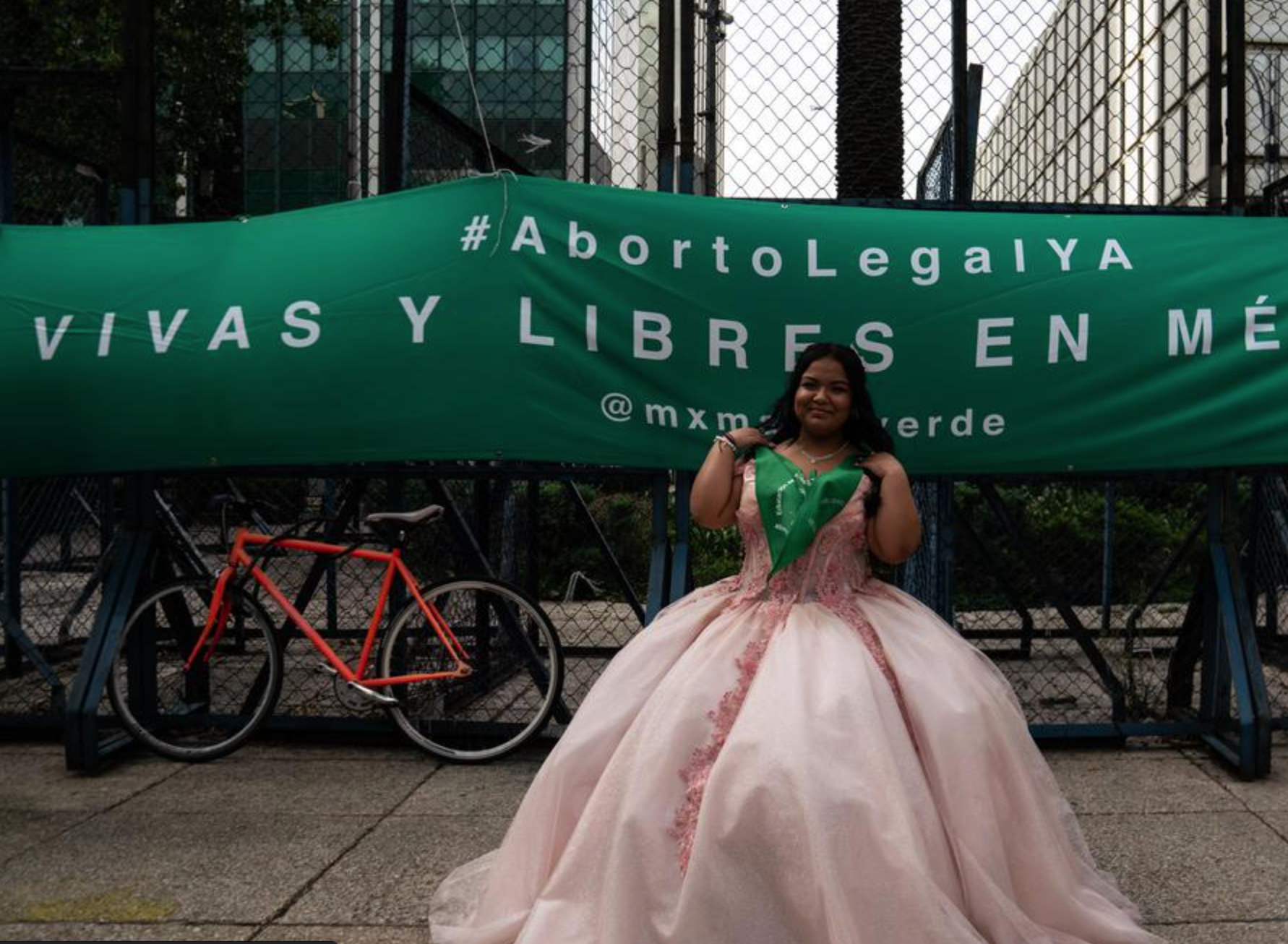
Alessandra Flores, who was passing by while celebrating her quinceaños, turning 15, stops to pose for a photo holding a green bandana in support of reproductive rights across the U.S. Embassy in response to the court case Roe v. Wade being overturned in Mexico City, Mexico on June 29, 2022. Behind Alessandra a banner that reads in Spanish, “Alive and free in Mexico,” is seen. Credit: Verónica G. Cárdenas for The Texas Tribune
Reproductive rights activists place banners across from the U.S. Embassy in Mexico City after Roe v. Wade was overturned on June 29, 2022. Credit: Verónica G. Cárdenas for The Texas Tribune
What began as an under-the-radar effort that broke state laws eventually became an accepted — and even endorsed — pillar of the broader health care system.
Since its emergence, self-managed abortion with medication has been recognized by the World Health Organization as a “non-invasive and highly acceptable” option and a safeaffordable alternative to traditional in-clinic care.
“This is not a process created solely out of desperation, but rather it’s become highly regarded,” said María Antonieta Alcalde Castro, head of the Latin America and Carribean division of Ipas, an international organization that works to broaden access to abortion and contraception. “Part of the reason why it’s been endorsed by the World Health Organization is because it’s been practiced in a way that is very safe.”
Although the safety of medication abortion is widely acknowledged, there are some differences in international and U.S. standards. The WHO recommends that individuals in the first 12 weeks of pregnancy can self-administer a two-medication or a single medication regimen without direct supervision of a health care provider. Under the Food and Drug Administration’s rules, the two-medication regimen is allowed only up to 10 weeks of pregnancy and the medication can be prescribed only under the supervision of certified health providers.
Leaders within Mexican accompaniment networks have built deep relationships with abortion providers in Mexico City with whom they consult informally. The result is a system described by those leaders and abortion advocates as the vanguard of abortion care.
“In the U.S., people may fear abortion itself because it is being restricted, but overall I think it’s about the stigma of having abortions at home and beliefs that abortions are only safe if they occur in a clinic,” said Verónica Cruz, a Guanajuato-based activist who founded Las Libres, one of the earliest abortion support networks in the country.
Over the last decade at least, Cruz and others have formalized and replicated the accompaniment model, training new acompañantes to form networks across the country so that women often turn to them without ever considering traveling to an abortion clinic.
“The United States is very late to this advancement,” Cruz said.
Vanessa Jiménez Rubalcava leads training related to accompaniment, which helps people self-manage abortions, at her home in Monterrey, Mexico, on June 27, 2022. “When they realize it can be in their hands — and not in the hands of government or the medical system — there’s going to be no stopping them,” she said. Credit: Verónica G. Cárdenas for The Texas Tribune
“Taking care into our own hands"
Though these days she helps hundreds of people a month access abortion, Jiménez Rubalcava used to oppose it.
She attended Catholic schools where students were instructed that abortion was a sin. But her views began to shift later in life, particularly after meeting women who had abortions. Early in their relationship, Jiménez Rubalcava, 41, and Cardona Alanís, 54, began working informally as community organizers, creating safe spaces for lesbians and bisexual women. They were pulled into advocacy efforts to legalize abortion.Then the requests to help women access safe abortion started coming in.
“We didn’t go into this planning for it to become something so established; we discovered the network’s objective as we accompanied people,” Jiménez Rubalcava said on a recent weekday morning as she prepared a presentation for a workshop to train prospective acompañantes.
Today, the married couple’s life revolves around abortion. They run the Necesito Abortar México network, which they founded almost six years ago, out of their modest Monterrey home on a residential street backdropped by the famous Cerro de la Silla. They used to offer up their bedroom to people who could not carry out abortions in their own homes but have since converted Jiménez Rubalcava’s old office into a small studio so it can serve as a homestay. Even their dating anniversary falls on the day abortion was legalized in Mexico City.
Their long days are logged between medication distribution, network meetings, trainings and acompañamiento. Cellphones and computers ping nearly every hour with the people they are helping through an abortion.
Their work is interrupted only by the muffled horn of a nearby train and the shrill sound of the doorbell as people arrive for help. On a recent weekday morning, it rang twice within just a few minutes.
With a small white medication box in hand, Jiménez Rubalcava darted across a covered carport to let one of the visitors in through a creaky iron gate. She relayed a quick list of instructions: The initial dose of pills first goes under the tongue for half an hour before what’s left can be downed with a drink of water. Bleeding begins quickly for some but takes longer for others.
Jiménez Rubalcava offered her visitor advice on what to take in case of pain and gently emphasized the need to stay nourished throughout the process. We are here to support you through this, she reminded the visitor.
Later that day, Cardona Alanís would ship five packages containing doses of misoprostol to others seeking to have abortions at home, handing them through the iron gate to a private mail carrier. Necesito Abortar México ships medication so often that the carrier is accustomed to making regular pickups.
Sandra Cardona Alanís, left, and her wife Vanessa Jiménez Rubalcava, at their home in Monterrey, Mexico, on June 27, 2022. Credit: Verónica G. Cárdenas for The Texas Tribune
Necesito Abortar México provides a studio for people who can’t carry out abortions in their own homes. “That autonomy of living it [the abortion experience] as you feel most comfortable, you are not going to experience that in a clinic,” Vanessa Jiménez Rubalcava said. “Here you can cry, you can watch Netflix, you can sleep.” Credit: Verónica G. Cárdenas for The Texas Tribune
Sandra Cardona Alanís hands a delivery person a package on June 27, 2022, that contains abortion medication being mailed to a person who has requested it. Credit: Verónica G. Cárdenas for The Texas Tribune
Medication abortions can be carried out through a combination of mifepristone and misoprostol, or misoprostol alone, though U.S. rules do not approve the use of misoprostol by itself. In Mexico, misoprostol is sold over the counter to treat stomach ulcers. Networks will often receive donations of both drugs, even though mifepristone requires a prescription in Mexico. But that day, the packages contained only misoprostol. The Mexican networks had managed to transport so many doses of mifepristone into the United States that they had run out for the people in Mexico they were accompanying.
The network's mifepristone shortage captured the magnitude — and urgency — of the movement of medication into the United States in recent months.
The distribution chains begin in places like Monterrey and Guanajuato, sourced from local supplies collected by the networks but also with drug donations from Canada. The drugs enter the United States through a dozen volunteers who cross the border with the pills in their luggage, in candy bags or in wrapped gifts. Some of them are elderly women with prescriptions in hand for misoprostol to purportedly treat stomach ulcers.
A health law expert said if and when those carrying the medications might be committing a crime, as well as the legality of the broader movement of abortion-inducing drugs into the United States, are open questions that could soon be tested by prosecutors looking to further clamp down on access.
The cross-border movement of medication has long been a reality in border communities, and even beyond, because medication and other health services are typically more affordable in Mexico. In some instances, federal regulators allow individuals to bring with them up to a three-month supply of certain medications as long as they are not “for further sale or distribution into U.S. commerce.”
But this issue is mired in “legal ambiguities” that could be exacerbated by politics and the potential for disagreement between conservative state leaders or local prosecutors and the federal government, said Nathan Cortez, a law professor at Southern Methodist University who specializes in medical tourism and cross-border health markets.
“Speaking in terms of legal resolutions is difficult because I think different people operating under different circumstances in different jurisdictions are going to have different answers,” Cortez said. “People looking for answers may not be able to find them.”
Even with those legal questions, the Mexican networks say they’ve realized in recent months that awareness of their services has already spread through the United States by word of mouth, similar to how they initially grew their reach within Mexico. When access for millions of people of reproductive age in the United States began to be cut off in the aftermath of the Supreme Court’s ruling, they felt it immediately as their inboxes were flooded by people desperate for help.
“Thank you so much for helping me,” one woman from the U.S. said over a voice memo to Cardona Alanís in the days following the Supreme Court’s ruling. “I didn’t know what I was going to do.”
The woman explained she been left in the lurch when her appointment for an abortion — initially scheduled for three days after the decision — was canceled.
“Now, it’s the U.S.’s turn to take to the streets for their rights,” Cardona Alanís said, noting that may mean taking on work, like acompañamiento, that lies beyond existing norms — and the law. “The objective is for women to have access to their rights so that not a single person is left behind.”
More informal networks or individuals in the United States — the Monterrey network says its strongest ties are to Texas — are clamoring for translated versions of Spanish-language training materials and manuals. But while the accompaniment model is well-known in Mexico, it is rarely openly talked about in the U.S.
Facing state-sanctioned abortion bans and criminal penalties, those taking up the accompaniment-like work are mostly operating under the radar. Asked about emerging U.S. networks, some abortion advocates will acknowledge only that people have long sought abortions outside the health care system and will continue to do so.
El Cerro de la Silla, one of Monterrey’s most recognized landmarks, on June 28, 2022. Credit: Verónica G. Cárdenas for The Texas Tribune
A message that reads in Spanish, “Get your rosaries out of our ovaries” is seen in downtown Monterrey, Mexico on June 28, 2022. Credit: Verónica G. Cárdenas for The Texas Tribune
People walk in the downtown area in Monterrey, Mexico on June 28, 2022. Credit: Verónica G. Cárdenas for The Texas Tribune First: A message reading “Get your rosaries out of our ovaries” in downtown Monterrey on June 28, 2022. Last: People walk in the downtown area in Monterrey, the home base of the Necesito Abortar México network. Credit: Verónica G. Cárdenas for The Texas Tribune
It’s unclear the extent to which networks have formalized within the United States, and how far their reach may be, though connections to the Mexican networks are serving as potential entry points for people seeking abortions.
Cardona Alanís offered a recent example in which she heard from a woman in Ohio seeking help and wanting to travel to Mexico. She mentioned it to a Texas colleague who had abortion-inducing medication on hand and offered to help so the woman wouldn’t have to travel internationally. The Texan ultimately connected the Ohio woman with colleagues in her own state that accompanied her at home.
Within the existing clinical model, a person living in Texas who wants to terminate their pregnancy would have to spend hundreds of dollars to travel out of state — a reality beyond the reach of many Texans, particularly Texans of color who have been most likely to have abortions and who are more likely to be poor or low income.
Acknowledging that disparity, one individual taking on this kind of work in Houston said the need to create abortion access outside of the traditional clinical context became clear early in the pandemic when Gov. Greg Abbott used his executive emergency powers to postpone surgeries that were not “immediately medically necessary.” This led to a near-total ban on abortion when officials said the order extended to abortions.
“Now, it’s a matter of taking care into our own hands in a way that hasn’t been as necessary in this country for decades, but that people all over the world have so much experience doing,” said the individual, who spoke to The Texas Tribune on the condition of anonymity because of the risks involved with doing accompaniment work in the U.S.
Mexican network leaders say there is security within their model because it is decentralized. Medication abortion, they also argue, is dificult to trace.
But beyond questions over the legality of transporting the medication over the border in bulk, Texas laws also target those who help others get abortions. Texas is currently operating under a 1925 law that makes it a crime punishable by up to five years in prison to perform or “furnish the means” for an abortion. Another state law passed in 2021 allows private citizens to sue abortion providers and anyone involved in “aiding or abetting” an abortion as early as six weeks into pregnancy.
Preparations for the individual working in Texas have included crossing into Mexico to purchase the medication, trainings on digital security, readying their home for people who cannot self-manage an abortion at home and tapping into existing networks to learn as much as possible from groups that have long been doing this work.
“We are shifting from decades of relying on state-sanctioned structures,” the individual said.
Messages left by patients at AcércateFem, a women’s health clinic that provides abortions in Mexico City, on June 29, 2022. Patients wrote that they felt safe and confident at the clinic. Credit: Verónica G. Cárdenas for The Texas Tribune
One way or another
For people with resources — and the citizenship or immigration status to travel — Mexico could still offer an avenue for those who want to go to a clinic to terminate pregnancies.
Nine of Mexico’s 32 states have so far legalized abortion. Mexico City is home to dozens of established abortion clinics. Some are privately run, offering abortions at a fraction of the cost in the United States. Others operate within the city’s public health system at clinics and hospitals that may be more difficult to navigate but offer abortions free of charge.
For months, Mexico City’s top health official — Secretary of Health Dr. Oliva López Arellano — has said publicly that the system has the capacity to extend its abortion care to serve a potential influx of people from the United States. In an interview with the Tribune, López Arellano emphasized that abortion squarely fits in within the public health system’s mission to “prevent deaths and prevent the suffering of women,” pointing to governmental data showing that there had been zero deaths among the 250,000 abortions administered through the system since abortion was legalized 15 years ago.
“Because once a woman has decided to terminate their pregnancy, they are going to do it in one way or another,” López Arellano said.
Private abortion providers are also expanding their services to potentially help those who might now look to Mexico for abortions. One private clinic in Mexico City will soon extend hours to serve U.S. patients so they can go and fly back in the same day. Other providers are opening up private clinics in the Mexican border states that recently legalized abortion.
Mexican clinics could play a larger role as appointments in states neighboring those with abortion bans in the United States continue to get booked up further and further out.
A sign reading in part “The legal interruption of a pregnancy is your right” at the entrance of Hospital Materno Infantil Inguarán in Mexico City. Credit: Verónica G. Cárdenas for The Texas Tribune
Abortion medication remains under lock at the pharmacy at Hospital Materno Infantil Inguarán in Mexico City on July 1, 2022. Credit: Verónica G. Cárdenas for The Texas Tribune
But similarly to when Mexico City legalized abortion, Cruz, of the Las Libres group, said they’ve so far seen more U.S. demand for self-managed abortions at home, in part because of travel costs.
“If you give someone the option of getting the pills into their hands so they can have an abortion safely in their home — with someone there to accompany them through it — of course that’s what they prefer,” Cruz said. “Additionally, it’s at no cost to them. … I think that helps overcome any sort of fear someone might have about self-managed abortions because everything is so expensive in the U.S.”
Ultimately, Mexican abortion advocates say success will depend on the acompañamiento model being normalized in the United States as much as it’s been in Mexico. That will take time, they argue, but the increasing cost of obtaining an abortion in a clinic could shift the scales.
“This is something we’ve recently reflected on with our colleagues in the United States — though the United States model was for some time framed as the ideal model, it isn’t,” said Alcalde Castro of Ipas. “We need to use this moment to question this highly clinical model that excludes an important number of women, many of them belonging to groups that are already marginalized and excluded. We’re talking about Black women, Latinas, poor women.”
Looking to build on the momentum of their recent victory, anti-abortion conservatives in Texas are already seeking ways to further cut off access. Legislation is being drafted to prohibit companies from helping employees circumvent state abortion laws by covering travel costs or other services.
Some lawmakers are also looking to empower district attorneys from anywhere in the state to prosecute abortion law violations outside their own jurisdiction if a local DA refuses. So far, there have been no prosecutions, but at least five DAs, almost all in large urban areas, have said they won’t pursue them.
But it’s unclear if the reach of the state Legislature will be able to curtail international efforts like those growing out of Mexico and moving discreetly into individual Texas homes.
Cruz isn’t worried about backlash or U.S. government officials intervening with the spread of acompañamiento. The United States, she said, is a country that fights for individual liberties, but this model is rooted in community.
“It will be very difficult for the U.S. to interfere in this movement,” Cruz said. “This acompañamiento model is communal and based on the idea of collective rights, and that is something the U.S. doesn’t know how to do.”
A message reading “We all love someone who’s had an abortion” is projected by Marea Verde onto a Mexico City building on June 29, 2022, after the U.S. Supreme Court overturned Roe v. Wade. Marea Verde, or “Green Wave,” is a reproductive rights movement that’s become influential in Latin America. Credit: Verónica G. Cárdenas for The Texas Tribune
A room is seen in Acércatefem, a women’s health clinic, where one of the services that they provide are abortions, is seen in Mexico City, Mexico on June 29, 2022. Credit: Verónica G. Cárdenas for The Texas TribuneFirst: A room at AcércateFem, a women’s health clinic which provides abortions, is seen in Mexico City, Mexico on June 29, 2022. Last: Messages of gratitude left by patients at the AcércateFem clinic.