This blog on Texas education contains posts on higher education, as well as preK-12 policy accountability, testing, bilingual education, immigration, school finance, race, class, and gender issues at both the state and national level. It also represents my digital footprint, of life and career, as a community-engaged scholar in Texas.
These numbers are staggering. Tragedy layered over tragedy for rape survivors who are not getting the health care that they need.
One of my relatives was the product of a rape. His mother resented him his entire life. Clearly, his very existence was a daily reminder of the violence that befell her. I felt torn about his recounting of how she abused him as a young child, on the one hand, and how she was herself a victim, on the other. Yes, they were both "survivors," so to speak, but they both lived tough lives.
For survivors and children alike, theirs is a massive burden of fluctuating emotions of pain, anger, and despair. Now multiply this by 26,000 women in our state who are impacted by the Texas state legislature outlawing abortions. In another 16 months, will this figure double and grow to 52,000, and then to 78,000 in yet another 16 months?! This feels horrific to me, setting into motion yet another policy-induced pathology in society that will find expression in the ugliest of ways. What are these legislators thinking?!
We must restore women's reproductive rights, not the least of which is the right to an abortion under circumstances of rape or incest. The current policy is beyond cruel and inhumane.
A pregnant woman stands for a portrait in this 2023 AP file photo. Texas saw an estimated 26,313 rape-related pregnancies during the 16 months after the state outlawed all abortions with no exceptions for survivors of rape or incest, according to a study published Wednesday in the Journal of the American Medical Association.
That’s the highest figure among the 14 states with total abortion bans, with Texas having the largest population, according to the study.
“Survivors who need abortion care should not have their reproductive autonomy further undermined by state policy,” said one of the authors, Dr. Kari White, of the Texas-based Resound Research for Reproductive Health.
The authors noted that while some pregnant rape survivors who need abortion care may be able to travel out of state or manage the pregnancy at home with abortion pills, the bans leave many survivors without a viable alternative.
Following the June 2022 Supreme Court ruling that overturned Roe v. Wade, the researchers estimated there were 519,981 rapes associated with 64,565 pregnancies during the four to 18 months after states implemented total abortion bans. Of those pregnancies, an estimated 5,586 occurred in states with exceptions for rape and 58,979 in states with no exceptions.
Of the five states with rape exceptions, strict gestational limits and requirements to report the rape to law enforcement make it harder for most survivors to qualify, the study said. There were 10 or fewer legal abortions per month in the five states with rape exceptions, the study said, indicating that survivors with access to abortion care still cannot receive it in their home state.
“Politicians use the idea of abortion exceptions to provide political cover, but those so-called exceptions don’t actually help pregnant survivors get the care they need,” the study’s lead author Dr. Samuel Dickman said in the release.
Dickman, a researcher at the City University of New York’s Research Foundation and the Chief Medical Officer at Planned Parenthood of Montana, said rape survivors who become pregnant “deserve to make informed, personal decisions about their pregnancy, and state-level abortion bans–even those with exceptions–don’t allow them to do that.”
Behind Texas, the states with the highest totals were Missouri (5,825), Tennessee (4,990), Arkansas (4,660), Oklahoma (4,530), Louisiana (4,290) and Alabama (4,130).
Researchers at Harvard Medical School and The University of California, San Francisco, also carried out the study. The authors analyzed survey and crime report data from the Centers for Disease Control and Prevention, the FBI and the Bureau of Justice Statistics. They estimated the numbers of girls and women aged 15-45 who had survived rape that could result in pregnancy in each state after the bans took effect, then applied estimates of the pregnancy rate from rape.
Julian Gill is a medical reporter for the Houston Chronicle. He can be reached at julian.gill@houstonchronicle.com. His wide-ranging work on the medical beat, including a three-part narrative on a COVID-19 lung transplant patient, was recognized at the 2022 Texas Managing Editors awards, where he received top honors in the specialty reporting category and second place in the star reporter of the year category.
In addition to his extensive reporting on COVID, he has written about the effects of the Texas abortion ban, the maternal mortality crisis, and advances in the Texas Medical Center.
He joined the paper in 2018 after two years at the Denton Record-Chronicle, where he covered police and county government. He graduated from the University of North Texas. A San Antonio native, he is a die-hard Spurs fan and avid runner.
I am so inspired by Texas State Rep. Talarico's sermon that argues for women's full personhood instead of the second-class status that the denial of reproductive rights signifies.
I couldn't agree more Rep. Talarico's mother's perspective that "Women can never be free until they belong to themselves."
So much wisdom and clarity here. Thanks to George Hornedo for sending this video and message appearing below.
-Angela Valenzuela
***
Rep. James Talarico, the Texas Legislature’s youngest member, just posted a video of a sermon he gave at his hometown congregation in Texas. Rep. Talarico, currently in ministerial school, argued that Jesus Christ was a radical feminist and the Bible is a pro-choice document.
opposition to voter suppression legislation when he challenged Fox News host Pete Hegseth’s lies in a primetime interview. Earlier this year, his speech to the Texas State Democratic Party went viral again as he called out national Democrats for "spineless talking points & soulless fundraising emails." Beto O’Rourke recently called him "the best politician working in the Texas Legislature right now."
Rep. Talarico is available to talk about his sermon, fighting for a pro-choice Texas, and his role as the youngest member of the Texas State Legislature. Please reach out if you have interest in connecting with Rep. Talarico.
“This summer, more than half our population became second-class citizens.
Every one of our neighbors with a uterus became the property of the State.
And nothing is more un-Christian.” [...]
“The only way we can allow an embryo’s rights to trump a woman’s rights is if we believe a woman is not a full person—which has been the default belief for most of human history.”
“Being Christian and being pro-choice are absolutely consistent because Christianity is a feminist religion.” [...]
“When a mob of men threatened to stone a woman for adultery, Jesus called out their hypocrisy.
When a bleeding woman begged for help in a bustling crowd, Jesus stopped to heal her.
When a young woman wanted to do theology instead of housework, Jesus honored her choice.” [...]
“Jesus famously summed up his teachings into two commandments: love God and love neighbor.
He gave no preconditions, no qualifications, no exceptions.
Love thy neighbor regardless of race, class, or gender.” [...]
“The story of Mary is my favorite story in all of scripture…
We only have Jesus because a woman consented to creating him.
The story of Jesus begins with a single, simple, extraordinary act of feminism.” [...]
Faith is deeply personal. And your beliefs might not be the same as mine.
That's why we have a separation of church and state—no government can keep you from expressing your religion or force you to express theirs.
But that doesn’t mean we shouldn’t talk about our faith. [...]
For too long, pro-choice Christians have allowed anti-choice Christians to take over our faith and our country.
On this Sunday before Election Day, we must speak up.
It's also a major success story for the feminist movement in Mexico and thusly, for Mexican women and families.
The short of it is Mexican women taking abortion into their own hands—"in their own homes,” Jiménez Rubalcava said. “When they realize it can be in their hands—and not in the hands of government or the medical system—there’s going to be no stopping them.”
It makes abundant sense since throughout the span of human history, women have been in charge of reproduction. Read, for example, Midwives In 19th Century America.
On a larger scale—and under the U.S.'s increasingly restrictive abortion policy landscape—it heralds a revolution in how we think about abortion and women's reproductive health. I very much like Mexico's "acompañamiento" model that has received international notoriety and legitimacy.
Texas should welcome this development in women's health and reproductive rights.
The Texas Tribune’s reporting for this story was supported by the Pulitzer Center. Para leer esta nota en español, haz clic aquí.
Texas Tribune | Aug. 4, 2022; Updated Aug. 24, 2022
by Alexa Ura and Greta Díaz González Vázquez
MONTERREY, Mexico — Hi, I’m four weeks pregnant. Eight weeks. Six weeks.
The stream of pings and messages through Facebook, Twitter, Instagram and WhatsApp reach Sandra Cardona Alanís at her home in this mountainous region of northern Mexico. She is an acompañante and a founder of Necesito Abortar México, a volunteer network that has helped thousands of people across Mexico access abortion, usually at home, by providing medication and support.
With the constitutional right to abortion in the United States eliminated and numerous states moving swiftly to cut off all access, more and more of the calls to Mexican organizations like Cardona Alanís’ are coming from places like Texas.
People seeking help are reaching not just over a border but across a cultural divide between two countries following distinct paths in providing reproductive health care. As abortion access is being restricted in the United States, it is expanding in Mexico.
Because abortion-inducing medication can be obtained in Mexico without a prescription, networks like the one Cardona Alanís helped found exist alongside the more traditional medical clinics that typify abortion in the United States.
The Necesito Abortar México network is one of several that operate outside the formal medical establishment, offering people the ability to manage their own abortions without visiting a clinic. They usually hear from two or three new people a day. The day the U.S. Supreme Court ruled against abortion rights, they heard from 70, half of them calling from the United States.
Even before the full effects of Roe v. Wade’s reversal kick in, Texas is being stitched into the Mexican system as the networks build out their models of helping provide safe abortion at home on an international scale. For months, they’ve been helping train volunteers that will prop up new U.S.-based networks. And they have moved thousands of doses of abortion medication into the United States, creating informal stockpiles to more easily distribute the drugs.
Exporting their model likely will not come easily, though, as the legal landscape continues to shift. Abortion-inducing drugs must be discreetly transported into the United States where they’re available only with a prescription.
Those in the United States involved in building an accompaniment system face potential legal risks both criminally and civilly, especially as Republicans in states like Texas seek to choke off any and all possibility of allowing their residents to access abortion.
Adopting the Mexican model would also require a revolution in thinking about abortion in the U.S., removing the procedure from a system of doctors and clinics and shifting it into homes across states like Texas.
But that autonomy, Cardona Alanís and her partner Vanessa Jiménez Rubalcava often say, changes everything.
“This is an opening for women to realize that they can have abortions in their own homes,” Jiménez Rubalcava said. “When they realize it can be in their hands — and not in the hands of government or the medical system — there’s going to be no stopping them.”
A view of Mexico City on June 30, 2022. The country faced a sea change in 2007 when the weight of the growing women’s rights movement helped bring about the legalization of abortion in Mexico City. Credit: Verónica G. Cárdenas for The Texas Tribune
The emergence of acompañamiento
Mexico’s abortion apparatus grew at the edges of the country’s legal and social boundaries when abortion was not only criminalized but widely stigmatized.
In the early 20th century, criminal codes across the country fostered a culture of persecution of women and medical providers that endured for decades.Thousands of people were reported to law enforcement between 2010 and 2020. Hundreds were investigated, and many were criminally convicted. Some were reported by their own doctors or medical staff at hospitals where they sought care.
In response, activists, including many within the feminist movement, worked to build social capital and advance legislative reforms. Meanwhile, the women who would go on to create the acompañamiento model began working to undermine those criminal laws.
Though it translates to “accompaniment,” the model covers a broader support system created by women looking to help each other access safe abortion. Network volunteers distribute pills, give instructions on how to take them and offer medical guidance informed by doctors. They counsel individuals throughout a series of phone calls, video chats or texts. Sometimes they even offer up their own homes as temporary lodging.
The networks are a mix of primarily volunteer organizations and at least one non-governmental organization that rely on donations to function. They are unregulated, though their work does overlap with the medical establishment, which often provides them with donated medication.
“Generally, abortion at home has always been relevant in Mexico,” said Isabel Fulda Graue, the deputy director of the Information Group on Reproductive Choice, a leading abortion rights group in Mexico known as GIRE. “The accompaniment model basically came out of living through those restrictive years.”
The country faced a sea change in 2007 when the weight of the growing women’s rights movement helped bring about the legalization of abortion in Mexico City — a reform that GIRE described as a “social necessity” demonstrated by the more than 7,000 legal abortions it said were provided in public clinics in the first year.
In 2019, the state of Oaxaca became the first to follow Mexico City and legalize abortion, beginning what abortion advocates called a wave of social progress that ushered in reform in several other states even before the Mexican Supreme Court ruled unanimously last year that criminalizing abortion is unconstitutional.
Mexican doctors, government officials and advocates alike credit the accompaniment model with helping open the door to change, citing its role in empowering communities, filling the information void to fight stigma and framing access to abortion medication as fundamental.
Those reforms made way for a still expanding collection of public and private abortion clinics, particularly in Mexico City. That progress did not mark an end for the acompañamiento model, but made it even more crucial, particularly for low-income people and those outside major cities who otherwise still would not have access.
Reproductive rights activists place banners outside the U.S. Embassy in Mexico City on June 29, 2022, in response to the U.S. Supreme Court overturning Roe v. Wade just days before. Credit: Verónica G. Cárdenas for The Texas Tribune
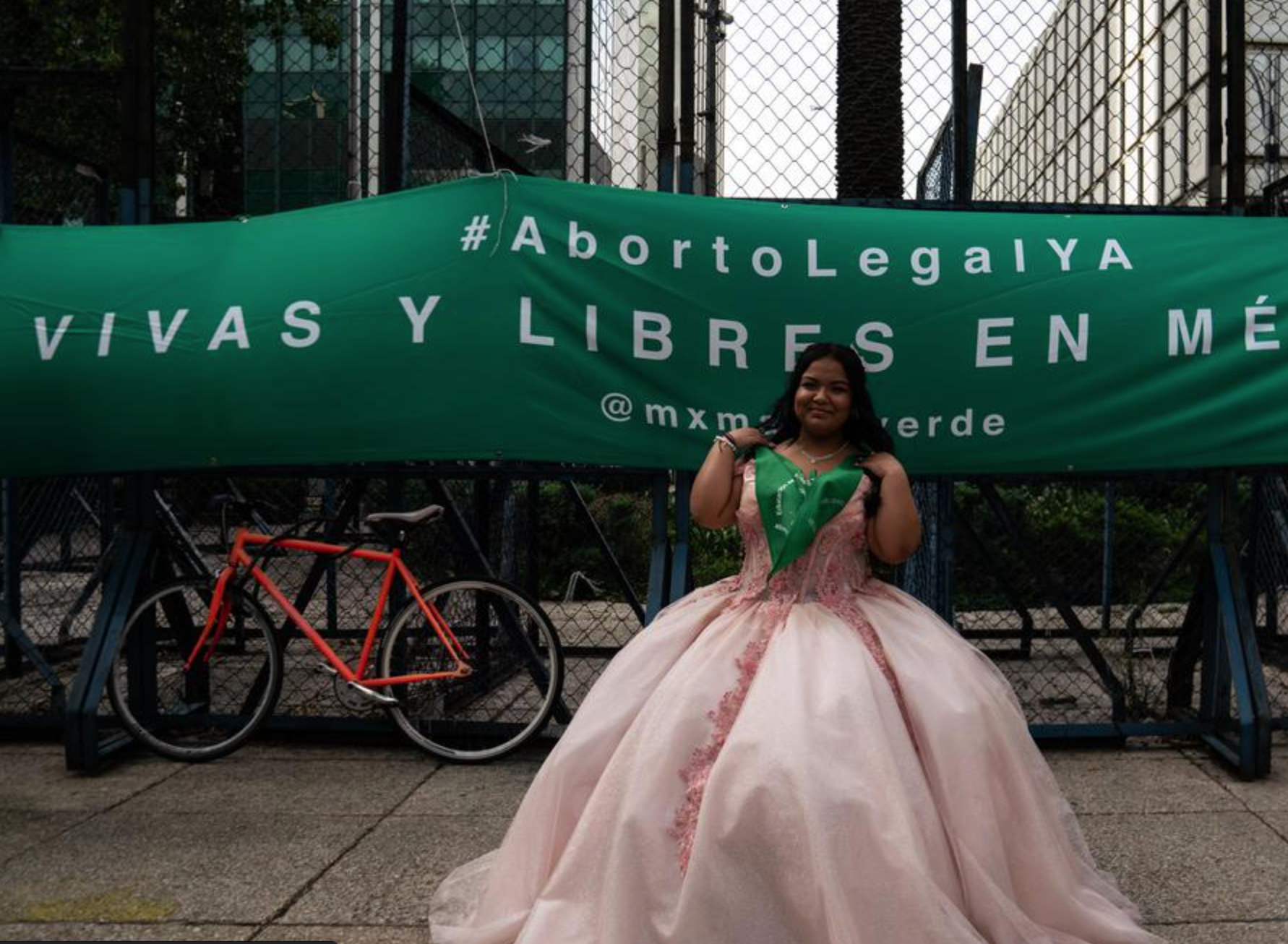
Alessandra Flores, who was passing by while celebrating her quinceaños, turning 15, stops to pose for a photo holding a green bandana in support of reproductive rights across the U.S. Embassy in response to the court case Roe v. Wade being overturned in Mexico City, Mexico on June 29, 2022. Behind Alessandra a banner that reads in Spanish, “Alive and free in Mexico,” is seen. Credit: Verónica G. Cárdenas for The Texas Tribune
Reproductive rights activists place banners across from the U.S. Embassy in Mexico City after Roe v. Wade was overturned on June 29, 2022. Credit: Verónica G. Cárdenas for The Texas Tribune
What began as an under-the-radar effort that broke state laws eventually became an accepted — and even endorsed — pillar of the broader health care system.
Since its emergence, self-managed abortion with medication has been recognized by the World Health Organization as a “non-invasive and highly acceptable” option and a safeaffordable alternative to traditional in-clinic care.
“This is not a process created solely out of desperation, but rather it’s become highly regarded,” said María Antonieta Alcalde Castro, head of the Latin America and Carribean division of Ipas, an international organization that works to broaden access to abortion and contraception. “Part of the reason why it’s been endorsed by the World Health Organization is because it’s been practiced in a way that is very safe.”
Although the safety of medication abortion is widely acknowledged, there are some differences in international and U.S. standards. The WHO recommends that individuals in the first 12 weeks of pregnancy can self-administer a two-medication or a single medication regimen without direct supervision of a health care provider. Under the Food and Drug Administration’s rules, the two-medication regimen is allowed only up to 10 weeks of pregnancy and the medication can be prescribed only under the supervision of certified health providers.
Leaders within Mexican accompaniment networks have built deep relationships with abortion providers in Mexico City with whom they consult informally. The result is a system described by those leaders and abortion advocates as the vanguard of abortion care.
“In the U.S., people may fear abortion itself because it is being restricted, but overall I think it’s about the stigma of having abortions at home and beliefs that abortions are only safe if they occur in a clinic,” said Verónica Cruz, a Guanajuato-based activist who founded Las Libres, one of the earliest abortion support networks in the country.
Over the last decade at least, Cruz and others have formalized and replicated the accompaniment model, training new acompañantes to form networks across the country so that women often turn to them without ever considering traveling to an abortion clinic.
“The United States is very late to this advancement,” Cruz said.
Vanessa Jiménez Rubalcava leads training related to accompaniment, which helps people self-manage abortions, at her home in Monterrey, Mexico, on June 27, 2022. “When they realize it can be in their hands — and not in the hands of government or the medical system — there’s going to be no stopping them,” she said. Credit: Verónica G. Cárdenas for The Texas Tribune
“Taking care into our own hands"
Though these days she helps hundreds of people a month access abortion, Jiménez Rubalcava used to oppose it.
She attended Catholic schools where students were instructed that abortion was a sin. But her views began to shift later in life, particularly after meeting women who had abortions. Early in their relationship, Jiménez Rubalcava, 41, and Cardona Alanís, 54, began working informally as community organizers, creating safe spaces for lesbians and bisexual women. They were pulled into advocacy efforts to legalize abortion.Then the requests to help women access safe abortion started coming in.
“We didn’t go into this planning for it to become something so established; we discovered the network’s objective as we accompanied people,” Jiménez Rubalcava said on a recent weekday morning as she prepared a presentation for a workshop to train prospective acompañantes.
Today, the married couple’s life revolves around abortion. They run the Necesito Abortar México network, which they founded almost six years ago, out of their modest Monterrey home on a residential street backdropped by the famous Cerro de la Silla. They used to offer up their bedroom to people who could not carry out abortions in their own homes but have since converted Jiménez Rubalcava’s old office into a small studio so it can serve as a homestay. Even their dating anniversary falls on the day abortion was legalized in Mexico City.
Their long days are logged between medication distribution, network meetings, trainings and acompañamiento. Cellphones and computers ping nearly every hour with the people they are helping through an abortion.
Their work is interrupted only by the muffled horn of a nearby train and the shrill sound of the doorbell as people arrive for help. On a recent weekday morning, it rang twice within just a few minutes.
With a small white medication box in hand, Jiménez Rubalcava darted across a covered carport to let one of the visitors in through a creaky iron gate. She relayed a quick list of instructions: The initial dose of pills first goes under the tongue for half an hour before what’s left can be downed with a drink of water. Bleeding begins quickly for some but takes longer for others.
Jiménez Rubalcava offered her visitor advice on what to take in case of pain and gently emphasized the need to stay nourished throughout the process. We are here to support you through this, she reminded the visitor.
Later that day, Cardona Alanís would ship five packages containing doses of misoprostol to others seeking to have abortions at home, handing them through the iron gate to a private mail carrier. Necesito Abortar México ships medication so often that the carrier is accustomed to making regular pickups.
Sandra Cardona Alanís, left, and her wife Vanessa Jiménez Rubalcava, at their home in Monterrey, Mexico, on June 27, 2022. Credit: Verónica G. Cárdenas for The Texas Tribune
Necesito Abortar México provides a studio for people who can’t carry out abortions in their own homes. “That autonomy of living it [the abortion experience] as you feel most comfortable, you are not going to experience that in a clinic,” Vanessa Jiménez Rubalcava said. “Here you can cry, you can watch Netflix, you can sleep.” Credit: Verónica G. Cárdenas for The Texas Tribune
Sandra Cardona Alanís hands a delivery person a package on June 27, 2022, that contains abortion medication being mailed to a person who has requested it. Credit: Verónica G. Cárdenas for The Texas Tribune
Medication abortions can be carried out through a combination of mifepristone and misoprostol, or misoprostol alone, though U.S. rules do not approve the use of misoprostol by itself. In Mexico, misoprostol is sold over the counter to treat stomach ulcers. Networks will often receive donations of both drugs, even though mifepristone requires a prescription in Mexico. But that day, the packages contained only misoprostol. The Mexican networks had managed to transport so many doses of mifepristone into the United States that they had run out for the people in Mexico they were accompanying.
The network's mifepristone shortage captured the magnitude — and urgency — of the movement of medication into the United States in recent months.
The distribution chains begin in places like Monterrey and Guanajuato, sourced from local supplies collected by the networks but also with drug donations from Canada. The drugs enter the United States through a dozen volunteers who cross the border with the pills in their luggage, in candy bags or in wrapped gifts. Some of them are elderly women with prescriptions in hand for misoprostol to purportedly treat stomach ulcers.
A health law expert said if and when those carrying the medications might be committing a crime, as well as the legality of the broader movement of abortion-inducing drugs into the United States, are open questions that could soon be tested by prosecutors looking to further clamp down on access.
The cross-border movement of medication has long been a reality in border communities, and even beyond, because medication and other health services are typically more affordable in Mexico. In some instances, federal regulators allow individuals to bring with them up to a three-month supply of certain medications as long as they are not “for further sale or distribution into U.S. commerce.”
But this issue is mired in “legal ambiguities” that could be exacerbated by politics and the potential for disagreement between conservative state leaders or local prosecutors and the federal government, said Nathan Cortez, a law professor at Southern Methodist University who specializes in medical tourism and cross-border health markets.
“Speaking in terms of legal resolutions is difficult because I think different people operating under different circumstances in different jurisdictions are going to have different answers,” Cortez said. “People looking for answers may not be able to find them.”
Even with those legal questions, the Mexican networks say they’ve realized in recent months that awareness of their services has already spread through the United States by word of mouth, similar to how they initially grew their reach within Mexico. When access for millions of people of reproductive age in the United States began to be cut off in the aftermath of the Supreme Court’s ruling, they felt it immediately as their inboxes were flooded by people desperate for help.
“Thank you so much for helping me,” one woman from the U.S. said over a voice memo to Cardona Alanís in the days following the Supreme Court’s ruling. “I didn’t know what I was going to do.”
The woman explained she been left in the lurch when her appointment for an abortion — initially scheduled for three days after the decision — was canceled.
“Now, it’s the U.S.’s turn to take to the streets for their rights,” Cardona Alanís said, noting that may mean taking on work, like acompañamiento, that lies beyond existing norms — and the law. “The objective is for women to have access to their rights so that not a single person is left behind.”
More informal networks or individuals in the United States — the Monterrey network says its strongest ties are to Texas — are clamoring for translated versions of Spanish-language training materials and manuals. But while the accompaniment model is well-known in Mexico, it is rarely openly talked about in the U.S.
Facing state-sanctioned abortion bans and criminal penalties, those taking up the accompaniment-like work are mostly operating under the radar. Asked about emerging U.S. networks, some abortion advocates will acknowledge only that people have long sought abortions outside the health care system and will continue to do so.
El Cerro de la Silla, one of Monterrey’s most recognized landmarks, on June 28, 2022. Credit: Verónica G. Cárdenas for The Texas Tribune
A message that reads in Spanish, “Get your rosaries out of our ovaries” is seen in downtown Monterrey, Mexico on June 28, 2022. Credit: Verónica G. Cárdenas for The Texas Tribune
People walk in the downtown area in Monterrey, Mexico on June 28, 2022. Credit: Verónica G. Cárdenas for The Texas Tribune First: A message reading “Get your rosaries out of our ovaries” in downtown Monterrey on June 28, 2022. Last: People walk in the downtown area in Monterrey, the home base of the Necesito Abortar México network. Credit: Verónica G. Cárdenas for The Texas Tribune
It’s unclear the extent to which networks have formalized within the United States, and how far their reach may be, though connections to the Mexican networks are serving as potential entry points for people seeking abortions.
Cardona Alanís offered a recent example in which she heard from a woman in Ohio seeking help and wanting to travel to Mexico. She mentioned it to a Texas colleague who had abortion-inducing medication on hand and offered to help so the woman wouldn’t have to travel internationally. The Texan ultimately connected the Ohio woman with colleagues in her own state that accompanied her at home.
Within the existing clinical model, a person living in Texas who wants to terminate their pregnancy would have to spend hundreds of dollars to travel out of state — a reality beyond the reach of many Texans, particularly Texans of color who have been most likely to have abortions and who are more likely to be poor or low income.
Acknowledging that disparity, one individual taking on this kind of work in Houston said the need to create abortion access outside of the traditional clinical context became clear early in the pandemic when Gov. Greg Abbott used his executive emergency powers to postpone surgeries that were not “immediately medically necessary.” This led to a near-total ban on abortion when officials said the order extended to abortions.
“Now, it’s a matter of taking care into our own hands in a way that hasn’t been as necessary in this country for decades, but that people all over the world have so much experience doing,” said the individual, who spoke to The Texas Tribune on the condition of anonymity because of the risks involved with doing accompaniment work in the U.S.
Mexican network leaders say there is security within their model because it is decentralized. Medication abortion, they also argue, is dificult to trace.
But beyond questions over the legality of transporting the medication over the border in bulk, Texas laws also target those who help others get abortions. Texas is currently operating under a 1925 law that makes it a crime punishable by up to five years in prison to perform or “furnish the means” for an abortion. Another state law passed in 2021 allows private citizens to sue abortion providers and anyone involved in “aiding or abetting” an abortion as early as six weeks into pregnancy.
Preparations for the individual working in Texas have included crossing into Mexico to purchase the medication, trainings on digital security, readying their home for people who cannot self-manage an abortion at home and tapping into existing networks to learn as much as possible from groups that have long been doing this work.
“We are shifting from decades of relying on state-sanctioned structures,” the individual said.
Messages left by patients at AcércateFem, a women’s health clinic that provides abortions in Mexico City, on June 29, 2022. Patients wrote that they felt safe and confident at the clinic. Credit: Verónica G. Cárdenas for The Texas Tribune
One way or another
For people with resources — and the citizenship or immigration status to travel — Mexico could still offer an avenue for those who want to go to a clinic to terminate pregnancies.
Nine of Mexico’s 32 states have so far legalized abortion. Mexico City is home to dozens of established abortion clinics. Some are privately run, offering abortions at a fraction of the cost in the United States. Others operate within the city’s public health system at clinics and hospitals that may be more difficult to navigate but offer abortions free of charge.
For months, Mexico City’s top health official — Secretary of Health Dr. Oliva López Arellano — has said publicly that the system has the capacity to extend its abortion care to serve a potential influx of people from the United States. In an interview with the Tribune, López Arellano emphasized that abortion squarely fits in within the public health system’s mission to “prevent deaths and prevent the suffering of women,” pointing to governmental data showing that there had been zero deaths among the 250,000 abortions administered through the system since abortion was legalized 15 years ago.
“Because once a woman has decided to terminate their pregnancy, they are going to do it in one way or another,” López Arellano said.
Private abortion providers are also expanding their services to potentially help those who might now look to Mexico for abortions. One private clinic in Mexico City will soon extend hours to serve U.S. patients so they can go and fly back in the same day. Other providers are opening up private clinics in the Mexican border states that recently legalized abortion.
Mexican clinics could play a larger role as appointments in states neighboring those with abortion bans in the United States continue to get booked up further and further out.
A sign reading in part “The legal interruption of a pregnancy is your right” at the entrance of Hospital Materno Infantil Inguarán in Mexico City. Credit: Verónica G. Cárdenas for The Texas Tribune
Abortion medication remains under lock at the pharmacy at Hospital Materno Infantil Inguarán in Mexico City on July 1, 2022. Credit: Verónica G. Cárdenas for The Texas Tribune
But similarly to when Mexico City legalized abortion, Cruz, of the Las Libres group, said they’ve so far seen more U.S. demand for self-managed abortions at home, in part because of travel costs.
“If you give someone the option of getting the pills into their hands so they can have an abortion safely in their home — with someone there to accompany them through it — of course that’s what they prefer,” Cruz said. “Additionally, it’s at no cost to them. … I think that helps overcome any sort of fear someone might have about self-managed abortions because everything is so expensive in the U.S.”
Ultimately, Mexican abortion advocates say success will depend on the acompañamiento model being normalized in the United States as much as it’s been in Mexico. That will take time, they argue, but the increasing cost of obtaining an abortion in a clinic could shift the scales.
“This is something we’ve recently reflected on with our colleagues in the United States — though the United States model was for some time framed as the ideal model, it isn’t,” said Alcalde Castro of Ipas. “We need to use this moment to question this highly clinical model that excludes an important number of women, many of them belonging to groups that are already marginalized and excluded. We’re talking about Black women, Latinas, poor women.”
Looking to build on the momentum of their recent victory, anti-abortion conservatives in Texas are already seeking ways to further cut off access. Legislation is being drafted to prohibit companies from helping employees circumvent state abortion laws by covering travel costs or other services.
Some lawmakers are also looking to empower district attorneys from anywhere in the state to prosecute abortion law violations outside their own jurisdiction if a local DA refuses. So far, there have been no prosecutions, but at least five DAs, almost all in large urban areas, have said they won’t pursue them.
But it’s unclear if the reach of the state Legislature will be able to curtail international efforts like those growing out of Mexico and moving discreetly into individual Texas homes.
Cruz isn’t worried about backlash or U.S. government officials intervening with the spread of acompañamiento. The United States, she said, is a country that fights for individual liberties, but this model is rooted in community.
“It will be very difficult for the U.S. to interfere in this movement,” Cruz said. “This acompañamiento model is communal and based on the idea of collective rights, and that is something the U.S. doesn’t know how to do.”
A message reading “We all love someone who’s had an abortion” is projected by Marea Verde onto a Mexico City building on June 29, 2022, after the U.S. Supreme Court overturned Roe v. Wade. Marea Verde, or “Green Wave,” is a reproductive rights movement that’s become influential in Latin America. Credit: Verónica G. Cárdenas for The Texas Tribune
A room is seen in Acércatefem, a women’s health clinic, where one of the services that they provide are abortions, is seen in Mexico City, Mexico on June 29, 2022. Credit: Verónica G. Cárdenas for The Texas TribuneFirst: A room at AcércateFem, a women’s health clinic which provides abortions, is seen in Mexico City, Mexico on June 29, 2022. Last: Messages of gratitude left by patients at the AcércateFem clinic.