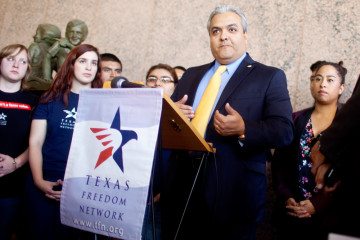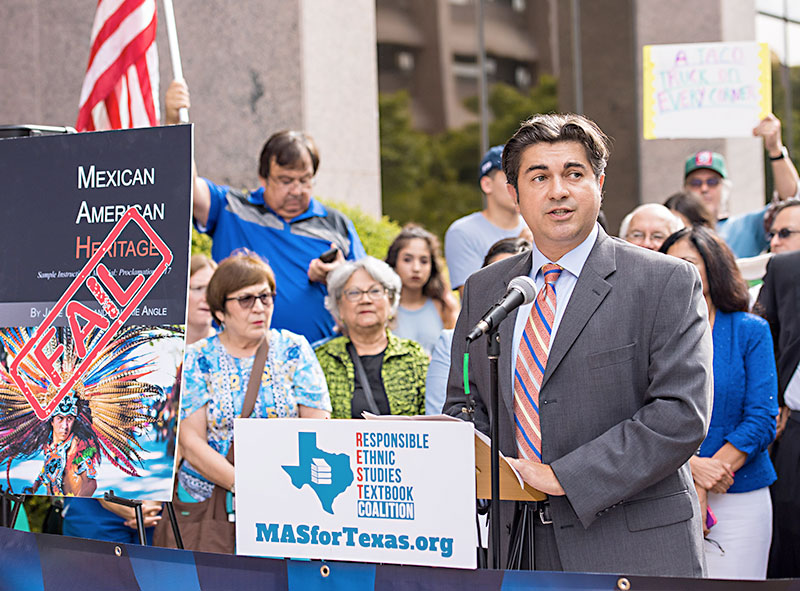
State Rep. Eddie Rodriguez, D-Austin, speaking at the rally on Tue., Sept. 13
Photo by David Brendan Hall
Roughly 200 educators, lawmakers, and activists – many of whom
traveled from all over Texas – gathered outside the William B. Travis
building on Tuesday, Sept. 13, to fervently oppose a newly proposed
ethnic studies textbook
they see as blatantly racist and teeming with unsalvageable factual
errors. The book is so pervasively tainted with offensive bias and
negligent inaccuracies, advocates urged the
Texas State Board of Education to completely discard it.
The book "attempts to indoctrinate students with a twisted and
ignorant version of history at a time when Hispanic students make up 50
percent of Texas public school students," said Rep.
Eddie Rodriguez, D-Austin, representing the
Mexican American Legislative Caucus.
"The utter absence of academic integrity alone should keep this book
out of Texas classrooms. If Texas sanctions this book, they would ...
insidiously put material in classrooms that perpetuates racist
stereotypes. This textbook is an insult to all Texans."
The
Responsible Ethnic Studies Textbook Coalition, comprised
of several organizations including the ACLU of Texas, Education Austin,
the Mexican American Legal Defense and Educational Fund (MALDEF), the
Texas Freedom Network, League of United Latin American Citizens, and the
Texas chapter of the American Federation of Teachers, called on the
SBOE to reject the high school
Mexican American Heritage book for depicting Mexican-Americans as "
lazy"
and a threat to society, among numerous other racially charged
misrepresentations. The group presented 10,000 signatures of citizens
who opposed the book.
How bad is the book? A sampling: In one passage, the text says
Chicanos "adopted a revolutionary narrative that opposed Western
civilization and wanted to destroy this society." Another especially
egregious passage calls Mexican laborers "lazy" compared to their
European and American counterparts. "Industrialists were ... used to
their workers putting in a full day's work, quietly and obediently, and
respecting rules, authority, and property. In contrast, Mexican laborers
were not reared to put in a full day's work so vigorously. There was a
cultural attitude of 'mañana,' or 'tomorrow,' when it came to high-gear
production. It was also traditional to skip work on Mondays, and
drinking on the job could be a problem," the book reads. They also posit
that immigration from Mexico and Central American nations "has been
increasingly tied up with an illegal drug trade."
Recently, an ad hoc committee of educators formed by SBOE District 2 member
Ruben Cortez Jr.,
D-Brownsville, reviewed the text and offered a 54-page critical report
highlighting more than 140 inaccuracies – either factual errors or
errors by omission. The proposed book fails to meet basic professional
standards and offers "a prolific misrepresentation of facts," they
wrote. The book is "really a polemic attempting to masquerade as a
textbook." Cortez addressed the rally on Tuesday, saying the book only
offers "hate" toward Mexican-Americans. "You read this textbook and you
think it was written by someone in the Donald Trump campaign," he said.
Emilio Zamora, a professor of history at UT-Austin and one of the eight members of the ad hoc committee that evaluated the text, told the
Chronicle
that he couldn't find any significant Mexican-American women civil
rights figures or detect any of the more than 50 Mexican-American
studies historians in Texas or their major findings, a gross disregard
for the vast historical literature on the subject.
Angela Valenzuela,
director of UT's Center for Education Policy and another committee
reviewer, echoes the shock of finding the text "dripping with racism."
She told the
Chronicle the errors were so obvious and plentiful, it was almost as though the authors went out of their way to not check the facts.
"You would have to work hard not to find the decades of work that has
gone into researching and writing our history – that's what's so
disturbing and sickening," she says. "It was mind-boggling going through
the pages and finding error after error; I kept asking myself, 'How is
this possible?' You could easily Wikipedia your way through this and do a
better job." At the least the books are problematic, but at their
worst, says Valenzuela, they are an almost Orwellian erasure of history.
So who is behind the deeply flawed, offensive literature? Longtime
SBOE observers likely won't be surprised to learn that rabidly far-right
former board member
Cynthia Dunbar is chief executive officer of the book's publisher,
Momentum Instruction.
The creationist-supporting, Obama-birther theory ideologue literally
wrote the book against public education, which she called a "subtly
deceptive tool of perversion," "tyrannical," and unconstitutional in her
2008 book,
One Nation Under God. She's credited with replacing slavery with the "
Atlantic triangular trade"
and linking the civil rights movement with giving "unrealistic
expectation of equal outcomes" for minorities in a controversial social
studies curriculum. As
Texas Freedom Network's
Kathy Miller
noted during the rally, Dunbar failed to invite Latino scholars to the
book-writing process to prevent looking "biased," as reported by
The Dallas Morning News. Instead, she used "experts in curriculum development" and a Texas A&M University professor to review the book.
Following the rally, the SBOE held a public hearing to debate the
book, with nearly 100 speakers, including legislators, expert scholars,
and advocacy group members signed up to testify. Among them were AISD
board member
Gina Hinojosa and former Austin state Senator
Gonzalo Barrientos, who demanded the SBOE immediately "throw this book out." Rep.
Diego Bernal, D-San Antonio, worried aloud of the damage the books would inflict on students if adopted, while Rep.
Carol Alvarado, D-Houston, pointed out that textbook co-author
James Riddle had authored a telling string of "personalized promise Bible" books as evidence of his lack of credibility.
This is far from the first time Texas textbooks have been criticized
for marginalizing minorities and distorting historical reality. Last
year, a Pearland mom discovered her son's world geography textbook
referred to African slaves as immigrant "workers." (The publisher later
apologized and vowed to correct the text.) An independent review found
that the board's highly criticized social studies textbook standards,
crafted in 2010, contained "serious flaws" with passages on global
warming, Islam, slavery's role in the Civil War, and the Christian
influence on the nation's founding.
By October, the publisher is expected to respond to recommendations for changes, and the
Texas Education Agency
will identify all the errors the publisher is required to correct. The
board will decide whether or not to adopt the textbooks for the
2017-2018 school year in November. If adopted, school districts aren't
required to use the books, but have the option.
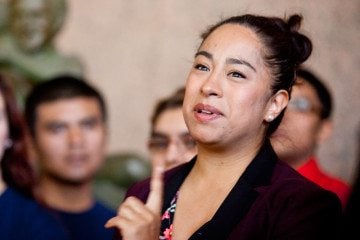
Montserrat Garibay, a teacher and vice president of
Education Austin, tells the
Chronicle
that having the books adopted and put in the hands of AISD students,
would be "detrimental" to critical learning, and already stretched-thin
teachers would need to work overtime to distinguish fact from fiction.
"If we are not showing the truth, teachers need to do our own research
and be analytical," says Garibay. "Not reflecting our culture in these
books is kind of like erasing our history."