Friends and Colleagues:
When we as scholars mention the “colonial gaze,” this harrowing account helps capture what we mean. Author Pamela Newkirk in The Guardian, revisits the life and death of Ota Benga, a young man kidnapped from the Congo in 1904, displayed at the St. Louis World’s Fair, and later caged alongside an orangutan at the Bronx Zoo. He was a Mbuti (Congo pygmy).
His “exhibition”—billed as an ethnological and scientific display—drew more than 220,000 visitors in a single month. White spectators gawked, newspapers mocked, and scientific authorities defended the spectacle as an educational opportunity, invoking what are now long-discredited racial theories that framed African peoples as inferior or subhuman.
Benga’s story is not merely one of personal tragedy, though it is that in the most wrenching sense. It exposes the machinery of U.S. imperialism, white supremacy, and so-called “progressive” science in the early 20th century—a machinery in which leading scientists, museum officials, media outlets, and political elites collaborated to legitimize racial hierarchy.
Even in America’s most cosmopolitan city, decades after the abolition of slavery, Benga’s humanity was denied, his dignity trampled for entertainment, and his story distorted to fit colonial fantasies. He would eventually be freed from the zoo but never from the profound alienation of captivity, ending his life in 1916. Beyond heartbreaking.
We might like to think this history is safely behind us, but Benga’s story resonates in our present. The same gaze that reduced him to a spectacle persists today, operating in subtler yet insidious ways—in the policing of Black bodies, in the devaluation of African and Indigenous knowledges, racial profiling, anti-Critical Race Theory agendas, book bans, and in the separation of immigrant families and the caging of their children.
Let me be clear: the colonial gaze is not only about how the powerful look at the marginalized, but also about how that look shapes policy, culture, and the very boundaries of belonging.
I lament—and call out—how these colonial ways of knowing still lurk in the smug confidence of those who think “our American heritage," or right-wing policies can excuse cruelty, and in the complacent shrug of institutions that protect power over people.
In remembering Ota Benga—and other similarly dehumanized people like Ishi, a Native American who was the last of his Yahi tribe, or Sarah Baartman (referred to as "Hottentot Venus")—we confront the long arc of racial injustice in the United States. And with this, the urgent need to both give voice to the voiceless and dismantle the ideologies that made his captivity possible and that very much continue to haunt us today whenever we witness the callous treatment toward those deemed as "other."
The man who was caged in a zoo
by Pamela Newkirk | The Guardian | June 3, 2015
Ota Benga (second from left) and fellow countrymen at the St Louis World’s Fair, 1904 Photograph: University of
In 1904, Ota Benga was kidnapped from Congo and taken to the US, where he was exhibited with monkeys. His appalling story reveals the roots of a racial prejudice that still haunts us.
The exhibition of a visibly shaken African with apes in the New York Zoological Gardens, four decades after the end of slavery in America, would highlight the precarious status of black people in the nation’s imperial city. It pitted the “coloured” ministers, and a few elite allies, against a wall of white indifference, as New York’s newspapers, scientists, public officials, and ordinary citizens revelled in the spectacle. By the end of September, more than 220,000 people had visited the zoo – twice as many as the same month one year earlier. Nearly all of them headed directly to the primate house to see Ota Benga.
His captivity garnered national and global headlines – most of them inured to his plight. For the clergymen, the sight of one of their own housed with monkeys was startling evidence that in the eyes of their fellow Americans, their lives didn’t matter.
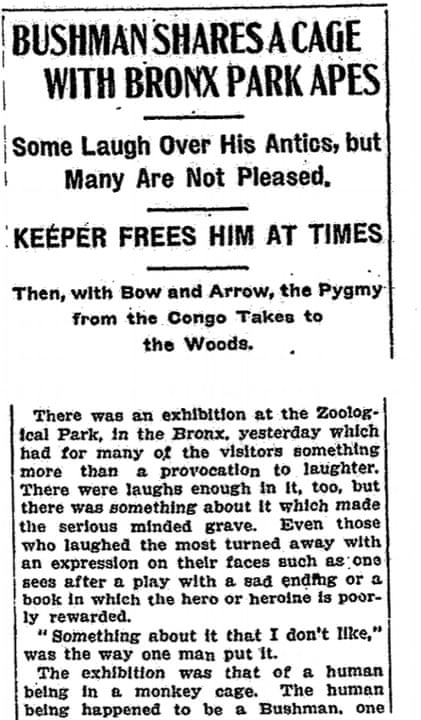
View image in fullscreenThe New York Times report about Ota Benga on 9 September, 1906.Photograph: The New York Times
