Translate

Showing posts with label Africa. Show all posts

Wednesday, October 29, 2025

The Power of Children's Curiosity to Learn: From Matamoros, Tamaulipas, Mexico to India, Africa, and the World, by Angela Valenzuela, Ph.D.

The Power of Children's Curiosity to Learn: From Matamoros, Tamaulipas, Mexico to India, Africa, and the World

by

Angela Valenzuela, Ph.D.

Oct. 29, 2025

It’s truly awesome to be an educator because I’m always learning—often in the very spaces where I teach. Last night, in my Race, Ethnicity, and the Schools course, we viewed the extraordinary film Radical, based on a true story set in Matamoros, Tamaulipas, Mexico—just across the border from Brownsville, where children grow up in the shadows of SpaceX, a striking symbol of both aspiration and inequality. I actually wrote a blog about the film back in December 2023, but revisiting it with my students brought new insights. 

I had invited members of the community to join us, including several teachers, and was deeply moved by what unfolded. One of our guests, Patricia Nuñez—who is pursuing her doctorate in Cultural Studies—shared the story behind Sergio, the visionary teacher portrayed in the film. His approach, she explained, was inspired by the groundbreaking work of Indian educator, Sugata Mitra, whose experiments in self-organized learning among children in India, Africa, and beyond have redefined what is possible in education. 

I can see how Sergio’s approach could be controversial—his methods defy convention and challenge deeply ingrained notions of authority, assessment, and control in schooling. Yet that is precisely what makes his story so powerful. He invites us to imagine what education could look like if curiosity, rather than compliance, became the organizing principle of learning. 

In communities too often written off as “deficient,” such radical trust in children’s capacities becomes an act of resistance—a declaration that brilliance is not the privilege of the few but the birthright of all. 

The movie is available on Amazon Prime. I encourage all to see it—and to connect it to Sugata Mitra’s work as captured in the TED Talk he delivered a number of years ago, linked below.

What Radical ultimately teaches us is that transformative education begins with trust and a caring relationship between teachers and students. It asks us, as educators, parents, and community members, to look beyond limitations and see what is possible when children are given the freedom to learn, to fail, and to discover for themselves. 

Watching my students and community guests wrestle with these questions yesterday afternoon reminded me that learning is never a one-way exchange; it’s a shared act of courage and imagination. It was a joy for us to bridge all our worlds—university and community, theory and lived experience, teacher and learner—and to find common purpose in our love for education and justice. 

Moments like these remind me why I teach: because every time we gather to question, listen, and dream together, something sacred and transformative takes root.

In Sergio’s classroom—and in our own—we are reminded that radical hope is not naïve. It is, rather, the lifeblood of every genuine effort to teach, to nurture, and to believe in the brilliance that already lives within every child.


996,804 views Sep 7, 2010 http://www.ted.com Indian education scientist Sugata Mitra tackles one of the greatest problems of education -- the best teachers and schools don't exist where they're needed most. In a series of real-life experiments from New Delhi to South Africa to Italy, he gave kids self-supervised access to the web and saw results that could revolutionize how we think about teaching.
TEDTalks is a daily video podcast of the best talks and performances from the TED Conference, where the world's leading thinkers and doers give the talk of their lives in 18 minutes. TED stands for Technology, Entertainment, Design, and TEDTalks cover these topics as well as science, business, development and the arts. Closed captions and translated subtitles in a variety of languages are now available on TED.com, at http://www.ted.com/translate. Watch a highlight reel of the Top 10 TEDTalks at http://www.ted.com/index.php/talks/top10

Sunday, September 21, 2025

Generational Dimensions of Decolonization: What the Igbo Can Teach Us About Democracy and Belonging

In a time when so many nations, including our own, are wrestling with questions of democracy, justice, and belonging, I’ve found myself drawn to the history of the Igbo people of Nigeria. One of my mentors, the late Dr. John Ogbu, a UC Berkeley professor and renowned educational anthropologist of Igbo heritage, best known for his cultural-ecological theory of minority school performance, which showed how the histories of slavery, colonization, and systemic exclusion shape the way different communities experience and relate to schooling.

That personal connection is part of why Uche Udenka’s recent piece in The Guardian resonated so strongly with me. Their account reminds us that democracy is not only a Western invention but has long been practiced in deeply participatory ways in other parts of the world. The Igbo story, in particular, offers lessons we can carry into our own struggles today.

Long before colonial rule, the Igbo organized their communities without kings or centralized rulers. Power was distributed across village assemblies, councils of elders, and age-grade associations, creating a highly participatory and consultative form of democracy. 

At its moral core was the principle of Ofo na Ogu—justice and truth—which guided both governance and community accountability. Because authority was so widely diffused, British colonizers struggled to impose their usual model of control. There were no monarchs to dethrone or install, only networks of people bound together by dialogue and collective responsibility.

Fast forward to January 15, 1970. The Biafran surrender had just brought an end to three years of brutal civil war. Nigeria’s Head of State, General Yakubu Gowon, addressed the nation in a radio broadcast that reached both those who had fought on the federal side and those who had endured the devastation in the East. In that moment, he declared:

“The so-called Republic of Biafra ceases to exist. The war is over. The nation is now reunited, and no longer will any Nigerian regard another as a stranger. No victor, no vanquished.”

For Gowon, this phrase was meant to set the tone for reconciliation. It was a way of saying that the war should not be remembered as a triumph for one group and humiliation for another. Instead, all Nigerians were to move forward together as a single people.

Yet the gap between rhetoric and reality was devastating. Many Igbos returned to find their savings wiped out, their homes destroyed, and their opportunities curtailed. Gowon’s words became both a hopeful motto and a painful reminder of how difficult genuine reconciliation can be when justice and equity are absent.

What endures in both the precolonial and postwar stories of the Igbo is the lesson that real unity cannot be declared from above. It must be lived out in everyday practices of justice, accountability, and shared responsibility. 

Whether in the village assemblies of the past or in the struggles of nation-building today, the Igbo remind us that democracy flourishes only when it is grounded in truth-telling, shared responsibility, and the moral courage to see one another not as strangers but as kin—and that when these principles are abandoned, the devastation of civil war leaves wounds that are ruinous for communities and corrosive to society as a whole.

In reflecting on all of this, I find myself thinking about Dr. Ogbu. When I was a graduate student—not at Berkeley, but at Stanford—he showed me a kindness and respect that left a lasting impression, treating me not just as a student but as a fellow thinker and emerging scholar. I wish I had known more about his Igbo heritage then, so we might have shared a deeper conversation about the history of his people—their democratic traditions, their struggles, and their resilience. It is a reminder that some of the greatest wisdom is not only written in books or taught in classrooms, but carried quietly in the lived histories of those who walk beside us.

-Angela Valenzuela

Generational dimensions of decolonisation


From the first encounters with British colonial forces in the late 19th century to the postcolonial challenges of nationhood in Nigeria, the Igbo have been active agents in shaping their destiny across generations. Each generation of Igbos—pre-colonial elders, anti-colonial nationalists, post-independence visionaries, civil war survivors, and contemporary activists—has played a distinct role in the complex project of decolonization. Understanding these generational aspects is vital to appreciating both the enduring struggles and resilient aspirations of the Igbo people.

I will examine the generational dimensions of decolonization among the Igbo, analyzing the historical phases and sociopolitical dynamics that defined each generational experience. Decolonization is not merely a historical event marked by the end of British rule in 1960, but a continuing generational process of reclaiming identity, restoring autonomy, resisting internal colonialisms, and reshaping the future.

The Pre-Colonial and Early Colonial Generation: Confrontation and Resistance

Sovereignty in the Village-Republics.
Before the advent of colonial rule, the Igbo operated a decentralized system of governance characterized by community-based assemblies, councils of elders, and age grades. Political authority was diffused, and the people governed themselves through consultative democracy rooted in the values of Ofo na Ogu (justice and moral order). This traditional structure made it difficult for colonialists to establish centralized control, as there were no kings to co-opt or overthrow.

The Anglo-Aro War and Initial Resistance.
British colonization began in earnest in the early 1900s after years of trade contact. The Anglo-Aro War (1901–1902) marked a significant resistance effort by the Aro Confederacy, a powerful Igbo socio-religious network centered around the IbiniUkpabi oracle in Arochukwu. This conflict exemplifies the first generational response to colonial encroachment: military resistance through traditional alliances and spiritual authority.While the British succeeded militarily, the resistance of this elder generation laid the groundwork for the emerging consciousness that colonial domination was a foreign and unwelcome imposition. The generation that lived through this period witnessed the violent disruption of their world and the imposition of foreign rule, education, religion, and law.

The Early 20th Century Generation: Adaptation and Strategic Engagement.
Missionary Education and the Rise of the New Elite.
The next Igbo generation (1900s–1940s) emerged under the colonial regime but began to appropriate the tools of colonization—especially education and religion—as strategic instruments of empowerment. Missionary schools flourished in Igbo land, producing a Western-educated elite that became clerks, teachers, catechists, and interpreters. These individuals were shaped by the colonial encounter, they began to question its contradictions. Exposure to Christian ethics, Enlightenment ideas, and pan-Africanist thought led to a growing critique of colonial injustice. This generation began to see education not only as a path to individual success but also as a vehicle for communal advancement and eventual emancipation.

Women’s Revolt and Economic Activism.
It is also within this generational cohort that the 1929 Women’s War (Ogu Umunwanyi) occurred—a mass protest led by Igbo women against colonial taxation and administrative abuse. The rebellion was both a critique of colonial oppression and a defense of traditional gender roles that had been undermined by colonial structures. This unique moment highlights how decolonization also had a gendered and generational character.
The Nationalist Generation: Political Mobilization and the Fight for Independence.

The Rise of Igbo Nationalists.
The mid-20th century produced a generation of politically conscious Igbos who played leading roles in Nigeria’s independence movement. This group, born between 1910 and 1935, included figures like Dr. Nnamdi Azikiwe, Mbonu Ojike, K.O. Mbadiwe, and others. Educated abroad or in elite Nigerian institutions, they absorbed anti-colonial, pan-African, and liberal democratic ideologies. Azikiwe, in particular, became a symbol of modern Igbo identity—a nationalist who transcended ethnic boundaries yet remained rooted in Igbo aspirations. His newspaper, West African Pilot, and political party, the NCNC (National Council of Nigeria and the Cameroons), were key instruments of political awakening and mobilization. Under his influence, many young Igbos became politically active, joining student unions, civic groups, and trade unions.

Cultural Renaissance and National Identity.
This generation also witnessed a cultural revival. Writers like Chinua Achebe, with Things Fall Apart, sought to reclaim the Igbo story from colonial distortion. Artists, musicians, and scholars began to articulate a distinctly African—and Igbo—worldview. The decolonization process was thus not only political but also intellectual and cultural. The nationalists of this generation saw decolonization as a path to modernity and progress, believing that independence would restore dignity, prosperity, and self-determination to the Igbo and other Nigerian peoples.

The Post-Independence Generation: Betrayal and the Biafran Dream:
The Crisis of Nationhood.
Nigeria gained independence in 1960, but the dreams of the nationalist generation were quickly dashed. Ethnic rivalries, political instability, and military coups destabilized the country. For many Igbos, the 1966 pogroms in northern Nigeria—where tens of thousands of Igbo civilians were massacred—marked a point of no return. The generation that came of age during this period (1940s–1960s) bore the brunt of the betrayal of the independence dream. The secession of Biafra in 1967 was an attempt to achieve what political independence had failed to deliver: safety, dignity, and self-governance.

The Trauma and Legacy of the Biafran War.
The Nigerian Civil War (1967–1970) profoundly shaped this generation. Young Igbos became soldiers, medics, intellectuals, and victims. The war devastated Igbo land—millions died from starvation, disease, and violence. But it also produced a remarkable spirit of resilience and innovation. The Biafraneconomy, science corps, and propaganda machinery showed the capacity for self-reliance. This generation’s experience of war transformed decolonization from a political project into a survivalist ethic. Post-war reintegration into Nigeria was marked by exclusion, marginalization, and suspicion. The slogan “No victor, no vanquished” rang hollow for many Igbos who faced economic devastation and political repression.

Friday, August 15, 2025

"The Man Who Was Caged in a Zoo" by Pamela Newkirk, The Guardian, June 3, 2015

Friends and Colleagues:

When we as scholars mention the “colonial gaze,” this harrowing account helps capture what we mean. Author Pamela Newkirk in The Guardian, revisits the life and death of Ota Benga, a young man kidnapped from the Congo in 1904, displayed at the St. Louis World’s Fair, and later caged alongside an orangutan at the Bronx Zoo. He was a Mbuti (Congo pygmy). 

His “exhibition”—billed as an ethnological and scientific display—drew more than 220,000 visitors in a single month. White spectators gawked, newspapers mocked, and scientific authorities defended the spectacle as an educational opportunity, invoking what are now long-discredited racial theories that framed African peoples as inferior or subhuman.

Benga’s story is not merely one of personal tragedy, though it is that in the most wrenching sense. It exposes the machinery of U.S. imperialism, white supremacy, and so-called “progressive” science in the early 20th century—a machinery in which leading scientists, museum officials, media outlets, and political elites collaborated to legitimize racial hierarchy. 

Even in America’s most cosmopolitan city, decades after the abolition of slavery, Benga’s humanity was denied, his dignity trampled for entertainment, and his story distorted to fit colonial fantasies. He would eventually be freed from the zoo but never from the profound alienation of captivity, ending his life in 1916. Beyond heartbreaking.

We might like to think this history is safely behind us, but Benga’s story resonates in our present. The same gaze that reduced him to a spectacle persists today, operating in subtler yet insidious ways—in the policing of Black bodies, in the devaluation of African and Indigenous knowledges, racial profiling, anti-Critical Race Theory agendas, book bans, and in the separation of immigrant families and the caging of their children.

Let me be clear: the colonial gaze is not only about how the powerful look at the marginalized, but also about how that look shapes policy, culture, and the very boundaries of belonging. 

I lament—and call out—how these colonial ways of knowing still lurk in the smug confidence of those who think “our American heritage," or right-wing policies can excuse cruelty, and in the complacent shrug of institutions that protect power over people. 

In remembering Ota Benga—and other similarly dehumanized people like Ishi, a Native American who was the last of his Yahi tribe, or Sarah Baartman (referred to as "Hottentot Venus")we confront the long arc of racial injustice in the United States. And with this, the urgent need to both give voice to the voiceless and dismantle the ideologies that made his captivity possible and that very much continue to haunt us today whenever we witness the callous treatment toward those deemed as "other."

-Angela Valenzuela

The man who was caged in a zoo

by Pamela Newkirk | The Guardian | June 3, 2015


Ota Benga (second from left) and fellow countrymen at the St Louis World’s Fair, 1904 Photograph: University of 
South Carolina

In 1904, Ota Benga was kidnapped from Congo and taken to the US, where he was exhibited with monkeys. His appalling story reveals the roots of a racial prejudice that still haunts us.

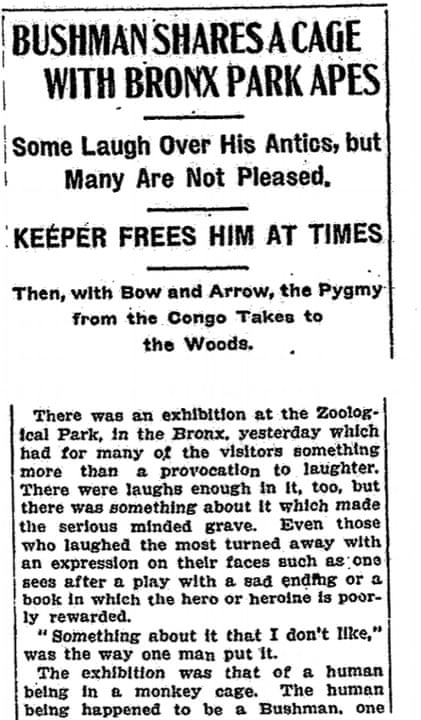
In anticipation of larger crowds after the publicity in the New York Times, Benga was moved from a smaller chimpanzee cage to one far larger, to make him more visible to spectators. He was also joined by an orangutan called Dohang. While crowds massed to leer at him, the boyish Benga, who was said to be 23 but appeared far younger, sat silently on a stool, staring – sometimes glaring – through the bars.

The exhibition of a visibly shaken African with apes in the New York Zoological Gardens, four decades after the end of slavery in America, would highlight the precarious status of black people in the nation’s imperial city. It pitted the “coloured” ministers, and a few elite allies, against a wall of white indifference, as New York’s newspapers, scientists, public officials, and ordinary citizens revelled in the spectacle. By the end of September, more than 220,000 people had visited the zoo – twice as many as the same month one year earlier. Nearly all of them headed directly to the primate house to see Ota Benga.

His captivity garnered national and global headlines – most of them inured to his plight. For the clergymen, the sight of one of their own housed with monkeys was startling evidence that in the eyes of their fellow Americans, their lives didn’t matter.

View image in fullscreenThe New York Times report about Ota Benga on 9 September, 1906. 
Photograph: The New York Times

Monday, August 14, 2023

The man behind Florida’s new Black history standards, WAPO Aug. 11, 2023

The first problem I see here is that there is "this man," William Barclay Allen, who is exerting an undue influence on Black history standards in Florida, impacting the education that youth receive throughout the state. 

I'm with the critics. After all, the inferences drawn from curriculum standards are caught up with the current political context that includes DeSantis' attack on AP African American Studies, threats to academic freedom, and tenure. Language matters. How offensive for there to be standards that represent slavery as providing "beneficial skills to the enslaved."

This is incredibly patronizing, especially when considering that enslaved West Africans weren't tabula rasa, but rather had their own cuisine, cultivation practices, agricultural knowledge systems, and other trades that positively impacted our nation's development (Sousa & Raizada, 2020; also read: African Impact on Colonial Agriculture). I ponder just how beneficial it would be to know more in our school curricula about the origins of specific crops' domestication and how these contributed to enslaved people's nutritional well-being, resilience, and survival—as well as our own in this country.

There is evidence of a “working group” developing the standards in Florida, but Floridians really need Black history scholars, well-versed on U.S. history, Black history, in particular, with the kind of expertise to contribute constructively on the specific standards the state is laying out.

There needs to be greater trust in the process instead of what is a clear pushing of a narrow, conservative view that has made this a hurtful, contentious battle.

-Angela Valenzuela

Reference

African Impact on Colonial Agriculture. Retrieved: https://www.ouramericanrevolution.org/index.cfm/page/view/m0135

Sousa, E. C., & Raizada, M. N. (2020). Contributions of African crops to American culture and beyond: The slave trade and other journeys of resilient peoples and crops. Frontiers in Sustainable Food Systems4, 586340. Retrieved: https://www.frontiersin.org/articles/10.3389/fsufs.2020.586340/full 


The man behind Florida’s new Black history standards


By 
 | Washington Post | Updated August 13, 2023 at 6:44 p.m. EDT|Published August 11, 2023 at 6:00 a.m. EDT


Students head back to class Thursday in Tarpon Springs, Fla., as teachers statewide grapple with new, divisive curriculum standards in subjects like Black history. (Dirk Shadd/Tampa Bay Times/AP)

Florida teachers returning to the classroom this week face what many say are confusing new directives from state education officials over the instruction students should receive in certain classes. Among the most contentious: standards championed by Republican Gov. Ron DeSantis for teaching Black history, which must include discussion of how slavery could have provided beneficial skills to the enslaved and how mob violence against Black people included “acts of violence perpetrated against and by African Americans.”

At a virtual training seminar by the Florida Department of Education — a session for teachers sponsored by the agency’s African American History Task Force — none of the group’s long-standing members spoke. All have objected to the changes and say they were never consulted. One resigned in protest, calling himself “disgusted” with the new curriculum.

In their place at the seminar were recent appointees from DeSantis’s education commissioner, Manny Diaz, and members of a separate “working group” that created the standards. The featured speaker was William Barclay Allen, a conservative scholar who has become the public face of the state’s efforts to rewrite how Black history is taught.

Here are key details about Allen and the controversy.

What is Allen’s professional background?

The 79-year-old retired professor of government and political science has a résumé notable for appointments to high-profile positions by conservative Republicans. In 1984, Ronald Reagan named Allen to the National Council of the Humanities, followed three years later by the U.S. Commission on Civil Rights. In appointing him to the commission, Reagan said Allen would prevent the commission from becoming “an arm of the advocacy groups in the civil rights movement.”

In 1998, Virginia officials chose him as the executive director of the State Council on Higher Education.

A Florida native who helped integrate his Fernandina Beach high school in the 1960s, he has taught at public and private colleges in D.C., California, Colorado and Michigan and authored or co-authored more than half a dozen books.


William Allen discusses the narratives behind the stories at historic presidential homes like Mount Vernon and Monticello during a 2022 Heritage Foundation event. (Photo by C-SPAN)

Why has Allen drawn public attention in the past?

Allen has repeatedly spoken out against affirmative action, and during his leadership of the Virginia higher education council, he also questioned the role of historically Black colleges and universities, or HBCUs. During his chairmanship of the federal civil rights body, he was castigated by fellow commissioners for the title of a 1989 speech, “Blacks? Animals? Homosexuals? What is a Minority?”

That same year, Allen was caught up in a kidnapping case involving a high school student on tribal lands in Arizona. The incident became the subject of a U.S. Senate investigation. Allen refused calls to resign and suggested instead that the entire commission resign.

In 1986, he ran for the U.S. Senate in California. (His campaign chairman was attorney John Eastman, who 34 years later would try to help Donald Trump overturn the outcome of the presidential election.) Allen, one of 13 candidates in the Republican primary, placed 10th and received less than 1 percent of the total votes cast.


How has Allen characterized the new Black history standards?

Allen declined an interview request by The Washington Post but explained in an email exchange that the 13-member working group “operated with a collaborative, consensual process, and the result is a product with no single author.” He noted that there was “no dissent.”

His comments to others have been more elaborative. He posted a 12-minute video on YouTube and discussed his views during appearances on South Florida news station WPLG and the “Megyn Kelly Show” online. He told Kelly that his great-grandfather was enslaved but “had the pluck to seek out opportunity” and “made the commitment to build his family’s life in this country.”

He also criticized Vice President Harris — who blasted the new standards during visits to Florida this summer — as “following a script in the name of an ideological agenda.”

During Monday’s virtual training, he told teachers that they should teach “the whole picture.” As an example, he mentioned the nine students who desegregated Central High School in Little Rock in 1957. Though they were first blocked from entering the school by members of the Arkansas National Guard, after President Dwight D. Eisenhower federalized the unit, some of those same soldiers were “protecting and escorting those children into school,” he recounted.

“If we can convey no other message to our teachers, that’s the message we must convey: that the story is never just one way,” Allen said.

Yet the full history of the Little Rock Nine, as they came to be known, also includes the months of harassment and threats those students endured and their fear of the National Guard forces. Florida educators say it’s unclear how much they can teach about such events, given the Stop Woke law that DeSantis signed last year; the statute prohibits classroom discussion about race that might make students feel uncomfortable.

What’s next for Florida’s curriculum?

The state Education Department is embroiled in multiple controversies, including the decision — also backed by DeSantis — to reject a new Advanced Placement African American studies course. This week, officials first blocked, then announced they would allow, the AP Psychology course; at issue was the material it uses on sexual orientation and gender identity.

The department says the Black history standards will be “implemented” over the coming months, but it’s unclear what that means. The commissioner was scheduled to discuss the curriculum changes on Thursday at a town hall in Miami Gardens, a majority-Black city, but canceled.

About 200 people attended the gathering at Antioch Missionary Baptist Church, with parents and community members expressing concern and anger over the revisions and questioning how the changes were made.

Steve Gallon III, a member of the Miami-Dade School Board, said the working group that Diaz put together was problematic because of the “shared ideology” and “shared agenda” of Allen and the other members.

“The foundation of their thinking needs to be called into question, to marginalize slavery, to misinform the facts about our history,” Gallon said.

He urged the audience to attend school board meetings and vote in every election to change the laws that led to the new curriculum. And parents, he added, need to ensure their children understand that slavery represented “the most horrific, brutal, divisive, destructive, evil experiences that this world has ever known.”

The teaching begins at home, Gallon said. “We can ill afford to totally rely on the school system to educate our children.”


CORRECTION

A previous version of this article incorrectly said that William Barclay Allen's great-great-grandfather was enslaved. It was his great-grandfather. This version has been corrected.