Translate

Showing posts with label Donald Trump. Show all posts

Monday, July 20, 2026

Capturing the Courts: A Chilling Warning About Authoritarianism and Due Process

Friends:

I strongly encourage you to watch Jacob Soboroff’s sobering interview with Professor Margaret Satterthwaite, the United Nations Special Rapporteur on the Independence of Judges and Lawyers (see video below). 

The segment, titled “‘Capturing the Courts’: Chilling New UN Report Shows U.S. ‘More Vulnerable’ to Authoritarianism,” examines the Trump administration’s mass removal of immigration judges and the transformation of immigration courts into what critics describe as deportation machines.

Professor Satterthwaite is a professor of law at New York University and an internationally recognized authority on judicial independence. Together with Gehad Madi, the UN Special Rapporteur on the Human Rights of Migrants, she issued an extraordinary warning on July 16, 2026, about the politicization of the American immigration-court system. These special rapporteurs are independent experts appointed by the United Nations Human Rights Council, rather than representatives speaking on behalf of the United Nations as an institution. That distinction is important, but it does not make their findings any less alarming.

According to the experts, at least 135 immigration adjudicators have been terminated since January 2025: 113 immigration judges, 13 assistant chief immigration judges, and nine appellate immigration judges. The removals reportedly occurred without cause or individualized explanation.

The pattern does not appear random.

Of the 78 removed immigration judges for whom public data were available, 65 had asylum-grant rates higher than either the national average or the average for their particular court. Judges with backgrounds in immigrant defense and humanitarian advocacy were disproportionately removed, as were judges appointed during the Biden administration. More than half of the probationary judges appointed in April and July 2023 were terminated. Only one judge appointed by a Democratic administration reportedly remains on the Board of Immigration Appeals.

This is not ordinary personnel turnover. It bears the hallmarks of court capture: removing adjudicators whose decisions displease the executive, intimidating those who remain, and replacing independent professional judgment with political obedience.

Immigration judges occupy a particularly vulnerable position because immigration courts are housed inside the Department of Justice. Unlike Article III federal judges, immigration judges do not enjoy life tenure or the same structural independence from the executive branch. They are civil servants working under the authority of the attorney general—the same executive branch responsible for pursuing deportation.

That arrangement has always presented concerns about impartiality. What is happening now appears to be the exploitation of that weakness on a mass scale.

At the same time that judges have been removed, the Department of Justice has reportedly issued more than 50 policy memoranda governing immigration adjudication. Some warn judges that they may face disciplinary consequences for being considered too slow or biased. The administration has also expanded “mega” calendar hearings in which a single judge may be expected to preside over the cases of hundreds of people during one half-day session.

No meaningful individualized hearing can take place under such conditions. A person fleeing political persecution, domestic violence, religious repression, torture, or death cannot adequately present a complicated life history as one face among hundreds moving through an administrative assembly line.

The Fifth Amendment does not say that no citizen shall be deprived of liberty without due process. It says that no person shall be deprived of life, liberty, or property without due process of law. Congressional legal analysis confirms that people physically present in the United States, including noncitizens facing removal, possess due-process protections and ordinarily must be provided a meaningful opportunity to be heard.

Those words mean little, however, when judges fear termination for carefully considering the cases before them.

The administration’s actions are particularly perverse given the immense unresolved docket. At the end of May 2026, a staggering more than 3.24 million cases remained pending in immigration court. More than 2.3 million of the people involved had already submitted formal asylum applications and were awaiting hearings or decisions (Transactional Records Access Clearinghouse, 2026).

Yet courts are also being dismantled.

San Francisco’s main immigration court began the Trump administration’s second term with 21 judges. By the time the court closed on May 1, 2026, only two remained. Most of its approximately 117,000 cases were transferred to a court in Concord that already carried about 60,000 cases and had itself lost more than half of its judges. The San Francisco court had one of the country’s highest asylum caseloads and historically granted relief at rates significantly above the national average (Rodriguez, 2026).

A system genuinely concerned with resolving its backlog does not eliminate experienced judges, close a major court, transfer tens of thousands of cases into an already overwhelmed courthouse, and replace seasoned adjudicators with less experienced temporary personnel.

This is not primarily about efficiency. It is about controlling outcomes.

Authoritarianism does not always arrive with soldiers standing at the courthouse door. It can arrive through administrative memoranda, personnel decisions, shortened hearings, unexplained dismissals, impossible productivity requirements, courthouse closures, politically selected replacements, and the gradual normalization of fear among those entrusted with applying the law.

That is why Professor Satterthwaite’s larger warning is so important. Immigration courts may be the testing ground, but they need not be the endpoint. The federal government employs administrative law judges who decide cases involving Social Security disability benefits, labor protections, veterans’ claims, environmental regulations, workplace safety, and other matters affecting millions of Americans. Satterthwaite warns in the Soboroff interview that these administrative adjudicators—including judges deciding Social Security cases—could eventually become targets of similar executive control.

Once a government establishes that judges may be fired because their rulings are considered insufficiently aligned with executive policy, the precedent does not remain confined to immigrants. It becomes a model for disciplining administrative justice everywhere.

This is one of the defining dangers of authoritarian governance: an unpopular or politically marginalized population is targeted first, allowing new mechanisms of state power to be constructed with limited public resistance. Once those mechanisms are accepted, they can be turned toward others.

We therefore cannot regard the removal of immigration judges as merely an immigration-policy dispute. It is an attack on judicial independence, constitutional due process, separation of powers, and the basic democratic principle that courts must decide individual cases according to evidence and law—not according to the political objectives of the president.

As the UN experts declared, efficiency cannot justify the erosion of due process. When the government controls which judges remain, pressures them to produce predetermined results, and eliminates the institutional capacity for meaningful hearings, what remains may still be called a court.

But it no longer functions as one.

Please watch Jacob Soboroff’s interview with Professor Margaret Satterthwaite and share it widely. Immigration courts may be where this experiment in court capture is most visible today. The question before us is how far we will allow it to spread considering that our democracy is truly at risk.

References

MS NOW. (2026, July 19). “Capturing the courts”: Chilling new UN report shows U.S. “more vulnerable” to authoritarianism [Video], MSN Now. https://www.youtube.com/watch?v=eDxDSe0A4Gs

Office of the United Nations High Commissioner for Human Rights. (2026, July 16). USA: UN experts condemn arbitrary terminations of more than 100 immigration judges. https://independence-judges-lawyers.org/

Rodriguez, O. R. (2026, May 24). San Francisco immigration court shuts down after purge of judges, leaving asylum cases in chaos, Associated Press. https://www.latimes.com/world-nation/story/2026-05-24/san-francisco-immigration-court-has-shut-asylum-cases-in-chaos

Transactional Records Access Clearinghouse (2026). Immigration. https://tracreports.org/immigration/

Ward, J. (2026, July 16). UN experts concerned by Trump’s removal of immigration judges. Reuters. https://www.reuters.com/legal/government/un-experts-concerned-by-trumps-removal-immigration-judges-2026-07-16/


UN experts warn that the Trump administration is turning America's immigration courts into "deportation machines" through purges of its judges and using "administrative manipulation" to curb the courts' ability to carry out fair and impartial hearings. And it may not stop at immigration. Administrative judges – including those deciding Social Security cases – could be next, warns Margaret Satterthwaite, the UN Special Rapporteur on the Independence of Judges and Lawyers. MS NOW: My Source for News, Opinion, and the World. » Subscribe to MS NOW:    / @msnow   » Subscribe to MS NOW’s We the People Newsletter for exclusive content from your favorite MS NOW anchors. Sign up now for free at https://ms.now/joinus MS NOW is the go-to destination for domestic and international breaking news, and best-in-class opinion journalism. For more context and news coverage of the most important stories of our day click here: https://www.ms.now/ #Trump #Politics #UnitedNations


Wednesday, July 09, 2025

Shock poll shows Trump's approval rating savaged by key group—Gen Z

Friends,

Trump’s rapidly declining approval among Gen Z—a generation born roughly between 1997 and 2012—is a glaring warning sign for his campaign. Despite a flashy digital outreach effort led by his son Barron, Gen Z voters are increasingly rejecting Trump’s inflationary economic policies, hardline stance on immigration, and authoritarian overreach. 

This generation isn’t fooled by optics. They want substance, integrity, and justice—and they’re not buying what Trump is selling. Nor should they.

Let’s be clear: I don’t expect this shift to make Trump reconsider his agenda. He’s shown us who he is.

What’s more important is how Gen Z responds. As of 2024, around 41 million Gen Z Americans—ages 18 to 27—were eligible to vote, including more than 8 million newly eligible 18–19-year-olds (CIRCLE, 2023). That number continues to grow. 

I count myself as a parent who helped birth this generation. Despite being born into anguishing political and planetary crisis, this generation is poised to reshape our democracy.

And yet, like many, Gen Z is deeply frustrated with politics—and with good reason. But as I often say, “When things get political, get more political.” That’s been my guiding principle. Because when civil and human rights are under assault, silence is not an option. Engagement is the only answer.

I accomplish this as a member and leader in a civil rights organization, LULAC, my work in policy analysis, policy advocacy, and preparing a new generation through the work I do as a professor and scholar at the University of Texas—of course, alongside other staff and faculty who are similarly outstanding in their commitment to youth in these ways. 

I also write and publish from this work. I am also engaged in my local community. For 11 years now, this has occurred mostly  through the work that I and so many others do at Academia Cuauhtli, our Saturday school for underserved, mostly East Austin youth. Even as institutions are getting torn down, our perpetual work is one of building a new architecture for community based education in Austin, Texas. These are examples of how to build a life that is fulfilling and triumphant.

My deepest hope is that Gen Z not only turns out to vote in presidential elections, but also steps up in state and local contests where so much of our daily lives are shaped. I hope they run for office in great numbers, organize their communities, and claim their rightful place in public life. We need their clarity, courage, and vision now more than ever.

Do read on about the "shock poll" below that must surely nevertheless impact those reading the tea leaves and crystal-balling the future right now.

-Angela Valenzuela

Reference

CIRCLE. (2023, December 7). 41 million members of Gen Z will be eligible to vote in 2024. Center for Information & Research on Civic Learning and Engagement, Tufts University. https://circle.tufts.edu/latest-research/41-million-members-gen-z-will-be-eligible-vote-2024

Goorin, J., & Baumgarten, R. (2023, April 4). For Gen Z, identity is what they make it. Vox Media. https://www.voxmedia.com/2023/4/4/23669479/for-gen-z-identity-is-what-they-make-

Shock poll shows Trump's approval rating savaged by key group


By ALEXA CIMINO FOR DAILYMAIL.COM | July 5, 2025

Donald Trump is losing ground fast with Generation Z, with a string of new polls showing his approval among young voters has plunged to record lows.

The latest YouGov/Yahoo survey found Trump's net approval among Gen Z voters collapsed from -23 in May to a staggering -41 in June, with just 27 percent approving of his job performance. 


A separate Quantus poll showed his Gen Z approval dropped from 46 percent in June to just 35 percent in early July, and an ActiVote poll found disapproval surged to 62 percent.


It comes just months after he made surprising gains in the 2024 election.

Experts say the sharp drop reflects frustration with Trump's handling of key issues like the economy, inflation and immigration. 

On inflation alone, YouGov/Economist data shows his Gen Z approval sank from 32 percent to just 23 percent over the past month.

Trump had significantly narrowed the Gen Z gap in 2024, losing 18–29-year-olds to Kamala Harris by just four points. 

A key part of that push was his teenage son Barron, who became an unlikely asset on the campaign trail.

The 18-year-old emerged as a quiet but powerful influence on his father, with some calling him a political ambassador for his generation. 

Barron understood what Gen Z cared about, and used that insight to help steer Trump’s outreach strategy. 

He encouraged his dad to appear on comedian Theo Von’s podcast and helped line up his viral 90-minute interview with Kick streamer Adin Ross, which drew 500,000 live viewers and, according to Trump’s Truth Social account, racked up 100 million total views.

Working alongside conservative influencer Bo Loudon, Barron also pushed Trump to engage with Gen Z favorites like YouTuber-turned-boxer Jake Paul and entrepreneur Patrick Bet-David, host of the PBD Podcast.

The approach appeared to work, at least for a while, but fresh polling suggests that goodwill is rapidly evaporating, as the broader electorate seems largely unfazed by his recent military actions.

Despite authorizing U.S. airstrikes on three Iranian nuclear sites during the so-called '12 Day War' between Israel and Iran, the president's approval rating has remained frozen at 47 percent, according to a new Daily Mail/J.L. Partners poll. 

It is the same figure recorded on June 6 - before Israel launched its initial strikes - and again on June 18, just days before the U.S. entered the conflict. His disapproval rating also held steady at 53 percent.

However, roughly a third of voters said their opinion of Trump had soured in recent weeks, with many citing fears of a broader conflict with Iran, concerns over his 'dictatorial behavior' for bypassing Congress, or frustration over what they saw as ego-driven decisions.

Another 30 percent said their view of the president had improved - crediting him for showing strength, keeping his promises, and taking swift action to defend U.S. interests abroad.

The poll, conducted June 24–25 among 1,025 registered voters, came just after Trump helped broker a ceasefire between Israel and Iran following a barrage of intercepted Iranian missiles. It carries a margin of error of plus or minus 3.1 percent.


Meanwhile, a separate shock poll shows most voters are turning against Trump’s so-called ‘Big Beautiful Bill' - his massive tax-and-spending package that now heads to his desk after clearing both chambers of Congress.


The sprawling Republican-led bill promises $1,000 ‘Trump Accounts’ for newborns, eliminates taxes on tips and overtime, injects billions into the border wall, and bans states from regulating AI for the next decade. It also imposes new work requirements for Medicaid and food stamps.

While Trump and GOP leaders have hailed it as 'the largest tax cut in history,' most voters remain unconvinced.

Just 28 percent support the bill, while 36 percent oppose it, according to a new Daily Mail/J.L. Partners poll - giving it a negative net rating of -8. Support plummets outside of Trump’s base: Republicans back it by +36, but independents oppose it by -14 and Democrats by a staggering -41.

The Congressional Budget Office projects the bill will add $2.4 trillion to the national debt by 2034 while slashing taxes by $3.75 trillion.

Even some Republicans are uneasy. Sen. Ron Johnson threatened to block it over deficit fears, while Sen. Josh Hawley objected to Medicaid cuts.

A CBS News/YouGov poll also found that 47 percent of Americans believe the bill will hurt the middle class - further signaling trouble for Trump’s economic agenda ahead of November.

Wednesday, July 02, 2025

"Alligator Alcatraz: A Monument to Cruelty in the Heart of the Everglades," by Angela Valenzuela, Ph.D.

 Alligator Alcatraz: A Monument to Cruelty in the Heart of the Everglades

by

Angela Valenzuela, Ph.D.

It's time to resurrect the term necropolitics, meaning the politics of death wielded by the state to determine who lives and who dies, who is allowed dignity, and who is cast into suffering or oblivion.

The last time I used this term was in reference to Texas Governor Greg Abbott’s inhumane river buoys near Eagle Pass, a lethal barrier meant to deter migrants from crossing the Rio Grande. I wrote then, in a blog titled "First responders in a Texas town are struggling to cope with the trauma of recovering bodies from the Rio Grande"—based on a published piece by that same title (Chesky & Lozano, 2024)—where I ask how we can be proud of our country and allow this to happen?

Source: Al Jazeera
Today, necropolitics rears its head once more—this time in the Florida Everglades, where Donald Trump has unveiled a new migrant detention center nicknamed “Alligator Alcatraz” (Louallen, 2025). Surrounded by swampland and wildlife, the site is a literal and symbolic enclosure, built to house around 5,000 migrants in trailers and tents, in isolation and obscurity.

During a recent visit to the site, Trump joked:

“Don’t run in a straight line. Run like this,” he said, gesturing in a zigzag motion.
“And you know what? Your chances go up about 1%.” (Gomez Licon, 2025)

This is not humor. This is the normalization of dehumanization, delivered with a smirk. When a former president laughs about migrants being hunted by alligators, he is not merely mocking human suffering—he is sending a message: that cruelty is permissible, and even entertaining.

To joke about people—many of them children—fleeing war, violence, and poverty, and to reduce their desperate bid for safety to a punchline, is not just disturbing. It is authoritarian pageantry. It is a theater of the macabre. It is racist. It is white supremacy on steroids.

We’ve seen where this logic leads in history. First, the jokes. Then the walls. Then the cages. What comes next—camps? Ovens?

We cannot become numb.

There is nothing funny about people risking their lives to survive. There is nothing lighthearted about building prison compounds in ecologically sensitive swamps. And there is nothing acceptable about a political leader mocking the very people whose rights and humanity he systematically undermines.

This isn’t immigration policy.

This is punishment by design.

The location—less than 1,000 feet from Miccosukee tribal villages—is not incidental. It is another instance of Indigenous sovereignty being trampled, as tribal leaders have made clear. Miccosukee Business Council Chairman Talbert Cypress warned of the grave environmental and cultural impacts: no meaningful environmental study has been conducted, and the facility sits in the heart of the Big Cypress National Preserve, where tribal families have lived for generations (Louallen, 2025).

To make matters worse, Trump has announced plans to replicate this model in Louisiana and Alabama (Louallen, 2025), expanding a blueprint of cruelty while bypassing legal due process and basic humanitarian norms.

Let this be the moment we refuse complicity through silence.

Let this be the moment we stand—unapologetically—with migrants, with Indigenous nations, with environmental defenders, and with all who resist this dystopian vision of America.

References

Chesky, M., & Lozano, A. V. (2024, Feb. 25). First responders in a Texas town are struggling to cope with the trauma of recovering bodies from the Rio Grande, 

Gomez Licon, A. (2025, July 2). Trump jokes about immigrants being attacked by alligators during ‘Florida Alcatraz’ tour: "Don't run in a straight line. Run like this’ Mr Trump said, as he moved his hand in a zigzag motion, The Independent. 

Louallen, D. (2025, July 1). Florida tribe fights new 'Alligator Alcatraz' migrant facility near Everglades homes: Tribal chairman says the facility threatens tribal camps and local ecosystem. ABC News

Monday, June 30, 2025

Trump just forfeited the Cold War: How a Russian Intelligence Operation Captured the White House

Friends:

In a February Substack piece that now feels like a lifetime ago, Austin-based Jason Stanford highlights a stunning allegation by former Kazakh intelligence official Alnur Mussayev: that in 1987, Donald Trump was recruited by the KGB under the code name Krasnov.

While U.S. media has largely ignored the claim, the pattern of Trump’s behavior—his flattery of Vladimir Putin, undermining of NATO, and repeated alignment with Russian geopolitical goals—has long raised red flags. Former military leaders like H.R. McMaster and James Mattis couldn’t explain Trump’s consistent deference to Russia. 

But what if this isn’t a mystery at all? What if this is the culmination of a decades-long intelligence operation? After all, if it walks like a duck and talks like a duck...
Trump-Clinton Debate, Oct 19, 2016

The signs have been there. Trump publicly encouraged Russian cyberattacks on Hillary Clinton’s campaign. He later withheld aid from Ukraine to pressure them into smearing a political opponent. 

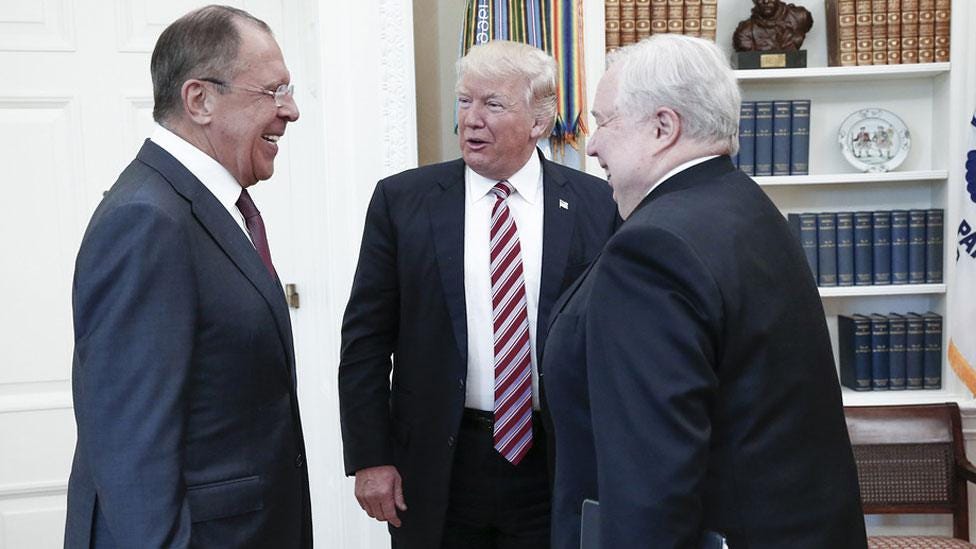
After firing FBI Director James Comey for investigating Russian interference, he handed classified intel to Russian diplomats inside the Oval Office.

Now, with Trump in office, the surrender is accelerating. He’s shut down USAID, compromised CIA security protocols, undermined support for Ukraine, and appointed Tulsi Gabbard—long favored by Russian state media—as Director of National Intelligence. The Cold War, long considered won, is being undone from within.

This is not mere dysfunction; it’s capitulation. 

The U.S. intelligence community warned us in no uncertain terms that Russia’s interference in the 2016 election was “sweeping and systemic.” The question is no longer whether Trump has sided with Russia—it’s how much further he’s willing to go.

Yes, America is far from perfect, as evidenced by today’s cruel and escalating attacks on immigrants of color. But our concerns in this moment are not about perfection or ideological purity. They’re about sovereignty—as Hillary Clinton tried to warn us.

And they’re about whether a once-principled political party will continue to enable a hostile foreign power at the expense of the nation it once claimed to serve.

I, too, am a patriot. And I agree with Stanford: this is nothing short of humiliating.

Read his piece. It’s sharp, detailed, even darkly humorous—and worth your time. You can find it on his Substack, The Experiment. Consider subscribing.

—Angela Valenzuela

P.S. This is not about education, but I know Jason and happy to share this.

Trump just forfeited the Cold War
Trump, a Russian asset since the '80s codenamed "Krasnov," has turned the US into a Russian satellite

Jason Stanford
Feb 22, 2025

Welcome to the weekend edition of The Experiment, your official hopepunk newsletter. If you’d like to support my work, become a paid subscriber or check out the options below. But even if you don’t, this bugga free. Thanks for reading!


Have I ever told you about the time I almost became a spy? I spent the summer after graduating high school at my late grandmother’s ranch in central Oregon. Two important things happened: The weekly newspaper ran an AP article about how the CIA needed people who spoke Russian, Arabic, and Mandarin, and I saw The Hunt for Red October on VHS. “Hey,” I said to myself as I watched the mess that Jack Ryan got himself into for writing a memo. “That’s a job!” I made up my mind to learn Russian and go into intelligence.

Keep in mind, this was the ‘80s, and the glide path was to become a stock broker or something to make money. Now, I had no money, and I grew up with so little money that I never even thought of ordering two scoops at Baskin Robbins, and restaurants with cloth napkins were a luxury reserved for special occasions. Even so, pursuing money held zero interest to me. Once my grandmother’s third husband asked me, “Don’t you want to get rich?” I snapped that I thought I’d just never get divorced so I could keep my money, but the truth was that I’d never considered the possibility not because it was unobtainable but because I couldn’t imagine anything duller than working just to make money.


“Hey, that’s a job!”

I wanted my life to matter and for my days to be spent doing something I enjoyed. And learning secrets and trying to stop the Russians from blowing up the world sounded like a lot of fun. Where do I sign? Learning the language was the easy part. A foreign exchange student in high school, I already knew German, and Russian is basically more complicated German in code. By the end of my first semester I was already telling jokes1 in Russian.2

Then it came time to apply for a job in military intelligence. My Russian professor at my liberal arts college and my classmates, safe to say, were not wild about my decision. I went to college when the Berlin Wall fell and the Soviet Union broke up. Mikhail Gorbachev’s glasnost policy opened up the censored state secrets, and soon Russia was holding real elections. The conventional wisdom was that Russia was becoming an ally and a western-style democracy, and the idea that I would sign up to spy on our new friends did not align with where nearly everyone thought things were headed. I didn’t necessarily disagree with that, but again, spying seemed like a load of fun.

"Next time, Jack, write a goddamn memo." Oh, how I wanted to write memos.

At first, the Navy loved me. They filled my head with visions of Officer Training School and spy bunkers, but then they gave me a physical. “Have you ever done drugs?” a nurse asked. I confessed to smoking marijuana eight times, which for my college was closer to DARE3 than daring. I’d just said no a lot more times than I’d said yes, and I told them I’d happily commit to clean living if it meant I could cosplay as Jack Ryan and write memos for the rest of my life.

“I’m sorry,” said the nurse. “The limit is three.” I was devastated and ashamed. My dad thought it was perhaps the funniest thing he’d ever heard. “In the ‘60s, they would have made you admiral,” he said. I spent my last semester of college in Moscow and then dabbled in journalism for a couple of years before returning home convinced that Russia would never fully embrace democracy. Russians often conflated capitalism and democracy, but even liberal democratic activists confessed to yearning for a strongman like Stalin. If you were interested in making the world a better place, investing cab fare in Russia was a waste of money.

And it never once occurred to me not to take my country’s side against Russia.


I wasn’t the only one who went to Moscow. In 1987, Trump: The Art of the Deal topped the The New York Times best seller list for many weeks, and with Gorbachev slowly opening up the country to western investment, Donald Trump went to Moscow in hopes of building a hotel.4 He didn’t get the hotel, but he did get recruited by the 6th Directorate of the KGB in Moscow, the counter-intelligence unit responsible for “recruiting businessmen from capitalist countries.”5

That’s according to a recent Facebook post by Alnur Mussayev, a retired intelligence officer that’s made the news in Great Britain but is being ignored by American journalists, maybe for good reason. “In 1987, our directorate recruited Donald Trump under the pseudonym Krasnov,” wrote Mussayev.

This could all be fantasy, but it would go a long way toward explaining what Anthony Scaramucci, who served as Trump’s White House communications director for 11 days in 2017, called Vladimir Putin’s “mysterious ‘hold’ on the president.” He wasn’t alone. H.R. McMaster, James Mattis, and John Kelly also couldn’t understand why Trump seemed to always take Russia’s side. “I don’t know why it’s like this,” he said on his podcast The Rest Is Politics: US. “McMaster couldn’t figure it out, Mattis couldn’t figure it out, Kelly couldn’t figure it out.”

It’s also backed up by what Yuri Shvets, a retired KGB major, told The Guardian four years ago. According to Shvets, it was the flattery of KBG offers that introduced the idea of running for office to Trump.


The ex-major recalled: “For the KGB, it was a charm offensive. They had collected a lot of information on his personality so they knew who he was personally. The feeling was that he was extremely vulnerable intellectually, and psychologically, and he was prone to flattery.

“This is what they exploited. They played the game as if they were immensely impressed by his personality and believed this is the guy who should be the president of the United States one day: it is people like him who could change the world. They fed him these so-called active measures soundbites and it happened. So it was a big achievement for the KGB active measures at the time.”


“In 1987, our directorate recruited Donald Trump under the pseudonym Krasnov.”

After returning home, Trump briefly explored a run for the Republican nomination for president, going so far as to speak at a Rotary Club luncheon in Portsmouth, New Hampshire. “If the right man doesn’t get into office,” he told the Rotarians, “you’re going to see a catastrophe in this country in the next four years like you’re never going to believe. And then you’ll be begging for the right man.”

“Krasnov,” by the way, is a last name in Russian that’s derived from krasota, a diminutive for krasa, the word for “beauty.” It’s the perfect choice to manipulate a vain, self-obsessed man, kind of like the time Putin called Trump yarkii, which means “brilliant” in the sense of “colorful” but which Trump interpreted as a compliment of his intelligence.

“I think when he calls me ‘brilliant,’ I'll take the compliment,” said Trump in 2016. “If he says great things about me, I'm going to say great things about him.”

It’s hard to remember how obvious all this stuff was back then. Trump openly encouraged Russia to engage in cyberattacks against Hillary Clinton’s campaign. When that proved fruitful, American political journalists were all-too-happy to treat the stolen materials like regular opposition research and not the illegally obtained evidence of a criminal attack by a hostile foreign power. And everyone acknowledged—except Trump—that this was all going on. He wasn’t exactly a sleeper agent.


“If he says great things about me, I'm going to say great things about him.”

But by that time, the Republican Party had been taken over like zombie ants by a Russian intelligence operation that began in 2015 with the Jade Helm6 embarrassment. “At that point, I’m figuring the Russians are saying, ‘We can go big time,’” said Michael Hayden, the former director of the CIA and NSA. “At that point, I think they made the decision, ‘We’re going to play in the electoral process.’”

It, uh, worked.

A bipartisan U.S. Senate committee concluded that the Russian government “engaged in an aggressive, multifaceted effort to influence, or attempt to influence, the outcome of the 2016 presidential election.” And the Mueller Report called Russia’s interference in the 2016 election “sweeping and systemic” and “identified numerous links between the Russian government and the Trump Campaign,” but Trump fired FBI Director James Comey for investigating his campaign in the first place, and the next day he handed over classified intelligence to Russian Foreign Minister Sergey Lavrov and the Russian ambassador to the United States, Sergey Kislyak, in the Oval Office like a goddamn puppet.

“No puppet. No puppet. You’re the puppet. No, you’re the puppet.”

Trump tried to withhold foreign aid to Ukraine to force them to dig up imagined incriminating evidence against Hunter Biden, and Republicans in Congress, like the good little zombie ants they are, did nothing. Actually, that’s not true. They fell in line and repeated Trump’s bellowing honk that this was all just the “Russia hoax.” The Party told them to reject the evidence of their eyes and ears. It was the final, most essential command, and so the Republican Party took sides against the United States of America when it came to Russia. If this weren’t so heartbreaking, I’d be more impressed with Russia’s feat.

Somehow, we—the west, NATO and all that—survived. When Putin threatened to invade Ukraine, Joe Biden learned from Barack Obama’s failure to appease Putin over Crimea in 2014. Biden didn’t just rally our European and Canadian7 allies, thus reasserting American leadership in the west that Trump had abdicated, but he innovated a new way of dealing with an international crisis by communicating intelligence about Russian movements in real time. This brilliantly pre-empted Putin’s disinformation attempts. Remember what it was like to have a President who took our side?


Trump has forfeited the Cold War.

Then 77,237,942 Americans made one very bad decision and re-elected Trump to the presidency, where he has, in one month, effectively surrendered to Russia.

Repeating Putin’s talking points and lying even more obviously than usual, Trump has begun negotiating away Ukraine’s territory to Russia and turned on Volodymyr Zelenskyy, whom he called an unelected dictator.


The White House ordered the CIA to send a list of new hires via an unclassified email server, making it possible for Russia and other hostile countries to identify our covert agents as well as their own citizens who are helping us.


He, through Elon Musk, shut down USAID, which doesn’t just pull back American soft power in the world but creates a vacuum to be filled by amoral state actors such as Russia, which celebrated Trump’s closure of USAID by issuing sneering insults. “The Trump administration has just put America last, while handing a gift to our biggest adversaries,” said a former USAID official.


And he installed Tulsi Gabbard, who very probably was compromised by a Kremlin agent and who has been described as “sympathetic … toward Russia” and “a favorite of Russia’s state media,” as the Director of National Intelligence, which is suboptimal to everyone but Putin.

Trump has forfeited the Cold War. A decades-long Russian intelligence operation has captured the White House and flipped our foreign policy to its advantage. Maybe this will all result in better poetry and comedy, but God help them if they reboot Hunt for Red October again.

I know America isn’t perfect. We’ve made some massive messes over the centuries. But we were founded on an aspiration to become a more perfect union, never reaching perfection but always getting closer. I don’t need my country to be perfect to take it’s side anymore than S needs to be perfect8 for me to love her forever. I am a patriot, and right now it feels humiliating to see our President hand his keys and his wallet over to Putin—and to see Republican elected officials and voters go right the hell along with him.

Anger and humiliation are not a way to survive the Trump Era. Next week I want to talk about something we might want to consider as a way to rebel against this unholy fuckery that is visiting this country. I think I might have an idea. See you next weekend. Until then, get outside and take a walk. Summer will be cooking us alive before you know it. Enjoy the chill.


Thursday, June 19, 2025

"Are We Heading Toward War? A Growing Fear We Must Name," by Angela Valenzuela, Ph.D.

Are We Heading Toward War? A Growing Fear We Must Name

by 

Angela Valenzuela, Ph.D.

I write today with a heavy heart and a growing sense of dread. It’s a feeling I have not been able to shake for weeks now. With each news headline, each cryptic statement, and each political maneuver, I fear that our country is inching closer to war.

I am fully aware that the decision to go to war lies, constitutionally, with Congress. This is what our founding documents stipulate. This is what checks and balances are supposed to ensure. But I also fear we are in a moment where these democratic norms are being deliberately eroded—where precedent, law, and even public sentiment are too easily cast aside.

And yes, I fear that Donald Trump will not honor the constitutional process. He has made clear through both word and action that he does not feel beholden to the same limits and deliberations that define a functioning democracy. He has already said he would be a "dictator on day one." And when it comes to war—where the stakes are human lives, international order, and the future of our children—such authoritarian impulses should terrify us all.

A recent segment from The Daily Show with Jon Stewart was most definitely cathartic. I encourage you to watch it. He captures, with precision, the absurdity and danger of this political moment. His satire is a sharp political commentary that exposes the contradictions and rhetorical manipulations surrounding the current escalation. I love how he captures my feelings. 

I do not, as yet, see any legitimate provocation or evidence to justify war. And that is precisely what makes this moment so dangerous. History has shown us how easily wars can be waged under false pretenses. 

The 2003 invasion of Iraq, for instance, was premised on the existence of weapons of mass destruction that were never found. Despite repeated claims by President George W. Bush and Secretary of State Condoleezza Rice that Iraq posed an imminent threat—claims later proven to be misleading or outright false—Congress voted to authorize military force.

Most memorable was Rice's infamous warning in 2002, with words designed to instill fear and justify an unnecessary war:

“We don't want the smoking gun to be a mushroom cloud” (Rice, 2002).

Independent investigations, including the U.S. Senate Select Committee on Intelligence (2004), later concluded that key claims about Iraq’s weapons programs were unsupported by the available intelligence (also see Jackson, 2005). The report states:

“The intelligence failures leading up to the war in Iraq were serious and pervasive. So were the failures prior to the September 11 attacks. While the investigations will continue, reform must begin. There can be no delay when the safety and security of America and Americans are at stake” (U.S. Senate Select Committee on Intelligence, 2004, p. 510).

The results were hundreds of thousands dead, a destabilized Middle East, and a deep wound to America’s credibility in the world.

This isn’t just about politics. It’s about our very humanity. War is not an abstract concept. It is not a campaign strategy, a spectacle, or a “theater.” War devastates. It destroys homes, families, futures. And it leaves wounds, seen and unseen, that last for generations.

Some may say I’m being alarmist. But history has shown us what happens when we normalize lawlessness and look the other way. We cannot afford that complacency now. We must speak up, we must organize, and we must hold accountable anyone who threatens to drag our country—and the world—into another reckless and unnecessary war. 

demandpeace.org
The future is not written. But silence, indifference, and disillusionment help write the worst chapters. Let us choose instead to continue raising our voices, to demand peace, and to protect the fragile promise of democracy—while we still can.

One good thing we can all do today is reach out to whoever represents us in Congress and let them know how we feel, while there is still time. We must also demand that our media institutions not function as megaphones for power and instead rigorously press our elected officials for verifiable evidence of an imminent threat. Anything less is complicity in the manufacture of war.

References

Jackson, B. (2005, September 26). Anti-war ad says Bush, Cheney, Rumsfeld & Rice “lied” about Iraq: We find some subtle word-twisting, and place the claims in context. FactCheck.org. https://www.factcheck.org/2005/09/anti-war-ad-says-bush-cheney-rumsfeld/

New York Times. (2025, June 19). Trump Will Decide on Iran Attack ‘in the Next Two Weeks,’ White House Says, New York Times. https://www.nytimes.com/live/2025/06/19/world/iran-israel-trump-news

Rice, C. (2002, September 8). Interview on CNN’s Late Edition with Wolf Blitzer. https://transcripts.cnn.com/show/le/date/2002-09-08/segment/00

The Daily Show. (2024, June 16). Jon Stewart on Israel’s "urgent" Iran strike, Minnesota murders & MAGA’s blame game [Video]. YouTube. https://www.youtube.com/watch?v=3Q08a7BI9XI&t=118s

U.S. Senate Select Committee on Intelligence. (2004). Report on the U.S. Intelligence Community’s Prewar Intelligence Assessments on Iraq.
https://www.intelligence.senate.gov/sites/default/files/publications/108301.pdf

Monday, February 10, 2025

Bernie Sanders' Good Government vs. Steve Bannon's and Donald Trump's Dizzying "Muzzle Velocity"

Been meaning to post this. It should be read in tandem with this opinion by Ezra Klein titled, "Don't Believe Him," that you can read or listen to here. In particular, Klein underscores the power of Steve Bannon's strategy of "muzzle velocity." The idea is to "overwhelm the media — if you give it too many places it needs to look, all at once, if you keep it moving from one thing to the next — no coherent opposition can emerge. It is hard to even think coherently."

They want us all to get the sense that "this is Trump’s country now....It does what he wants. If Trump tells the state to stop spending money, the money stops. If he says that birthright citizenship is over, it’s over."

What gets obscured through this reckless bravado of muzzle velocity on steroids in his first few weeks in office is the reality of Trump's weakness.


Klein makes the excellent point that while he may be impacting the coherence of any opposition, what must also get recognized is that he's flooding his own pond. Lots of good nuggets here. What the opposition must do, Klein wisely says, is to not believe him that he is king. If we treat him that way by surrendering their power, it's as if he were king. 

But good isn't gold.

Muzzle velocity and sowing chaos. 

Geez, how devious.

Bernie is gold. If only he could have been our president.

One last point: the animus he and our Governor hold toward immigrants is very real. The president's, too (never mind that his wife is an immigrant). Hence, the impact of his executive orders is atrocious, and we simply do not know at the moment the limits of his anti-immigrant agenda. Eyes wide open.

-Angela Valenzuela

What Trump didn’t say in his inauguration speech


by Bernie Sanders

The simple truth is that Trump ignored almost every major issue facing this country’s working families in his first speech

Thu 23 Jan 2025 06.08 EST | The Guardian


‘Our healthcare system is broken, is dysfunctional and is wildly expensive.’ Photograph: Carlos Barría/Reuters

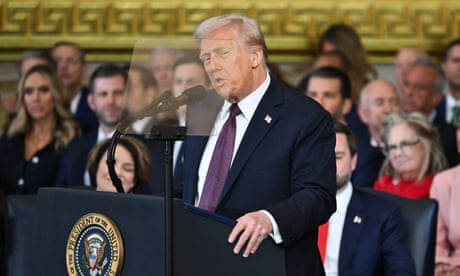
I was at the Trump inauguration on Monday, and needless to say, I disagree with almost everything he had to say.

What really struck me, however, is not what he said, which was not surprising given his general rhetoric – but what he didn’t say. The simple truth is that Donald Trump gave a major speech, the first speech of his second presidency, and ignored almost every significant issue facing the working families of this country.

How crazy is that?

Our healthcare system is broken, is dysfunctional and is wildly expensive. We remain the only wealthy nation not to guarantee healthcare for all. Not one word from Trump about how he is going to address the healthcare crisis.

We pay, by far, the highest prices in the world for prescription drugs – sometimes 10 times more than the people in other countries – and one out of four Americans is unable to afford the prescriptions that their doctors prescribe. Not one word from Donald Trump on the high cost of prescription drugs.


Factchecking Trump’s inauguration speech, from inflation to healthcare


We have 800,000 Americans who are homeless and millions of our people spend 50% or 60% of their limited income on housing. We have a major housing crisis in America – everyone knows it. And Trump, in his inaugural address, did not devote one word to it.

Today in America, we have more income and wealth inequality than we have ever had. The wealthiest three people in America now own more wealth than the bottom half of our society. But Trump had nothing to say about the growing gap between the very rich and everybody else. And maybe that’s because he had those three people – the three wealthiest people in America – sitting right behind him at his inauguration. And, I should add, those three people – if you can believe it – saw their wealth increase by more than $233bn since the November elections. No wonder they were sitting right behind Trump. They couldn’t be happier.

During his inaugural speech, Trump did not have one word to say about how we are going to address the planetary crisis of climate change. The last 10 years have been the warmest ever recorded, and extreme weather disturbances and natural disasters are taking place all over the world – from California to India, across Europe to North Carolina. Not one word about climate change – except, of course, to make it clear that he intends to make this horrific situation even worse with “drill, baby, drill”. Brilliant.

We pay, by far, the highest prices in the world for prescription drugs – sometimes 10 times more than the people in other countries – and one out of four Americans is unable to afford the prescriptions that their doctors prescribe. Not one word from Donald Trump on the high cost of prescription drugs.

We have 800,000 Americans who are homeless and millions of our people spend 50% or 60% of their limited income on housing. We have a major housing crisis in America – everyone knows it. And Trump, in his inaugural address, did not devote one word to it.

Today in America, we have more income and wealth inequality than we have ever had. The wealthiest three people in America now own more wealth than the bottom half of our society. But Trump had nothing to say about the growing gap between the very rich and everybody else. And maybe that’s because he had those three people – the three wealthiest people in America – sitting right behind him at his inauguration. And, I should add, those three people – if you can believe it – saw their wealth increase by more than $233bn since the November elections. No wonder they were sitting right behind Trump. They couldn’t be happier.

During his inaugural speech, Trump did not have one word to say about how we are going to address the planetary crisis of climate change. The last 10 years have been the warmest ever recorded, and extreme weather disturbances and natural disasters are taking place all over the world – from California to India, across Europe to North Carolina. Not one word about climate change – except, of course, to make it clear that he intends to make this horrific situation even worse with “drill, baby, drill”. Brilliant.

As we enter the new Trump presidency, we have got to remain focused. We can’t panicz

In the coming months and years, our job is not just to respond to every absurd statement that Trump makes. That is what the Trump world wants us to do. They want to define the parameters of debate and have us live within their world. That’s a trap we should not fall into.

Our job is to stay focused on the most important issues facing the working families of our country, provide solutions to those crises and demand that Trump responds to us.

Let me mention just some of them:

Yes, healthcare is a human right and we must join every other major country in guaranteeing healthcare to all people through a Medicare for All, single-payer program.

Yes, we must take on the greed of big pharma and substantially lower the cost of prescription drugs in this country.

Yes, we must build millions of units of low-income and affordable housing.

Yes, we must make sure that all of our young people have the ability to get a higher education by making public colleges and universities tuition-free.

Yes, we must work with the global community to combat climate change by cutting carbon emissions and transforming our energy system away from fossil fuels and into sustainable energy.

Yes, we must pass legislation to raise the absurdly low federal minimum wage of $7.25 an hour to a living wage of $17 an hour.

Yes, we must pass the Pro Act, and make it easier for workers to join trade unions and grow the union movement.

Yes, in order to help fund the needs of working families in this country, we must demand that the wealthiest people, including those multibillionaires sitting right behind Donald Trump, start paying their fair share in taxes.

Yes, we must end a corrupt campaign finance system, which allows a handful of billionaires to buy elections and move us rapidly into oligarchy.

Bottom line: as we enter the new Trump presidency, we have got to remain focused. We can’t panic. No matter how many executive orders he signs and statements he issues, our goal remains the same. We have got to educate. We have got to organize. We have got to bring people together around an agenda that works for all, not just the few.

Now more than ever, we have to fight to create an America based on economic, social and environmental justice. Let’s get to work.


Bernie Sanders is a US senator, and chair of the health, education, labor and pensions committee. He represents the state of Vermont, and is the longest-serving independent in the history of Congress