Let’s dispense with the euphemisms. What has happened at New College of Florida is not a “diversification of viewpoints,” a “restoration of balance,” or a principled defense of free speech. It is an ideologically driven takeover—imposed from above, funded lavishly by taxpayers, and justified through a cynical distortion of democratic language.
The hypocrisy is staggering.
Administrators and political operatives insist they are rescuing New College from a so-called “progressive echo chamber,” even as students report syllabi dominated almost exclusively by Hillsdale College and Claremont Institute ideologues. They proclaim devotion to the “marketplace of ideas,” while systematically abolishing entire fields of inquiry—gender studies, race-centered scholarship, critical social analysis—that have long been integral to a liberal arts education. They rail against indoctrination while installing their own.
This is not pluralism. It is replacement. Nor is it supplemental, but supplanting.
Even more galling is the claim that critics are “weaponizing data” when the very metrics that once made New College a nationally respected institution—academic peer reputation, student outcomes, scholarly trajectories—are now collapsing. A nearly 60-spot drop in rankings (also see Moody, 2025). A four-year graduation rate below 50%. Declining faculty resources. These are not abstractions; they are the cumulative effects of governance by fiat rather than by faculty expertise, student need, or institutional mission.
And yet, in the midst of this academic decline, spending per student has exploded—far exceeding that of comparable public institutions in Florida. Taxpayer money has not been invested in teaching, research, or student support, but funneled into rushed athletic expansion, failed modular housing projects, hotel contracts, and symbolic spectacles designed to please political patrons rather than serve students. If this is stewardship, it is stewardship for donors and governors, not for the public.
The rhetoric of democracy rings especially hollow here. Decisions of monumental consequence were made without faculty consent, without student buy-in, and without meaningful public deliberation. Trustees were installed. Presidents were imposed. Programs were eliminated. Mascots were replaced. Statues were proposed. A “compact” drafted by a presidential administration hostile to higher education itself was embraced—not because the campus demanded it, but because ideological loyalty was rewarded with preferential access to power and money.
This is not democratic governance. It is authoritarian management with a populist accent.
The irony, of course, is that the very people accused of silencing dissent—faculty teaching about race, gender, inequality, and power—are the ones now demonstrating what academic courage looks like. Professors who stay. Students who speak. Faculty who refuse to abandon their courses or their commitments. They expose the lie at the heart of this project: that freedom is being expanded when, in fact, it is being selectively granted.
Free speech, it turns out, is protected when it flatters power—and constrained when it challenges it.
New College has become a warning, not a model. A case study in how quickly a public institution can be hollowed out when ideology replaces expertise, when greed replaces care, and when democracy is invoked only to justify its own dismantling.
The tragedy is not merely what has been lost—programs, faculty, trust, academic standing—but what is being normalized: the idea that universities exist to serve political agendas rather than the public good.
That should alarm anyone who believes higher education belongs to students, scholars, and society—not to governors, donors, or culture-war opportunists.
Reference
Moody, J. (2025, Oct. 1). Spending soars, rankings fall at New College of Florida: Student outcomes and rankings are slipping at the liberal arts college while spending is up. Critics believe the college is at risk of implosion, and some are calling for privatization, Inside Higher Education. https://www.insidehighered.com/news/governance/state-oversight/2025/10/01/spending-soars-rankings-fall-new-college-florida
Dec. 11, 2025

New College of Florida student Alexandra Levy is concerned about the changes at her school. She poses for a portrait on the campus on Nov. 12. (Thomas Simonetti for MassLive)
By Juliet Schulman-Hall | JSchulman-Hall@masslive.com | MassLive | Dec. 11, 2025
Every reading was from Hillsdale College, a private Christian school, or The Claremont Institute, a conservative think tank.
Wearing a bright pink scarf and a sweater on a “cold” 60-degree November day in Sarasota, Florida, Levy described the class as one of multiple she has encountered at New College where newly-hired conservative professors have shaped what she is taught.
“I just never experienced only showing one opinion or disguising that opinion as fact,” she said.
Levy began at New College of Florida in 2023, the year Florida Gov. Ron DeSantis transformed the Honors College into an increasingly politically conservative institution through leadership and programmatic changes. The changes were modeled after Hillsdale College’s conservative education.
Read more: How a small Florida college became Trump’s blueprint to threaten higher ed in Mass.
For many higher education leaders, the overhaul of New College has been seen as a blueprint for the Trump administration’s pressure campaign on higher education, including threats and demands toward Harvard University.
They worry that the changes at New College could be coming to their own schools.
Since 2023, New College has dropped nearly 60 spots in national liberal arts rankings, and a recently released report shows that spending per student at the college is more than triple most other publicly-supported colleges in Florida.
 |
| A view of the campus of New College of Florida in Sarasota, Fla. on Nov. 12. (Thomas Simonetti for MassLive) |
The college has also experienced a declining four-year graduation rate, dropping to 47.4% for the class of 2024.
However, to Richard Corcoran, president of New College of Florida, the transformation of the institution embodies more than what some datasets reveal. He argues the college is going in a positive direction despite data that has been “weaponized” by critics without context.
“The old New College is gone. The new New College is rising. The people trying hardest to tear it down are the ones who understand that we are succeeding,” Corcoran wrote in an op-ed last month.
Corcoran said New College hasn’t become a conservative college, but a place with a diversity of perspectives.
“If colleges and universities are not the marketplace of ideas, if they’re not the place to have have every possible debate, idea, discussion, then we fail as a country. And that’s all we’re trying to create here. If we do that, and we do it well, we’ll be the best liberal arts college in the country, Just like we were in the ’70s,” Corcoran told MassLive.
A drop in academic stature at New College
Mimi Fuller, a marine biology student who works as a teacher’s assistant, said she has noticed more students struggling in introductory classes.
“The amount of people that are failing Foundations of Biology is ridiculous. This is the easiest biology class you can take,” Fuller said. “It’s rare that I grade an exam that has an A. It’s so rare.”
But that wasn’t what New College used to be like, according to Benjamin Brown.
Brown, who graduated in 2009, remembers New College as a place where students once went on to earn advanced degrees, many of whom became Fulbright scholars.
 |
| Mimi Fuller, second from left, and her friends hang out between classes at New College of Florida on Nov. 12. (Thomas Simonetti for MassLive) |
New College was on a positive path between 2021 and 2023, under its first female president. The college’s four-year graduation rate and the number of students with a high school GPA of 4.0 or higher were increasing. And yet, the college had continued to grapple with enrollment declines for several years.
Brown was critical of the previous New College presidencies and excited for a fresh set of eyes and values during the overhaul of the New College administration in 2023. He became the college’s alumni association chair that year.
His positivity quickly waned as he watched his alma mater become a “disaster,” he said.
“We’re not achieving anymore,” Brown said. “We’ve fallen by 59 places in the relevant U.S. News ranking that we look to. We used to have a lot of students on track to go into Ph.D. programs, get Fulbright scholarships and also some Goldwater scholarships. You’re not really doing that anymore. There are still some who entered the program before Corcoran came in who were achieving that, but it’s clearly coming to an end.”

The nearly 60-spot drop in New College’s rankings over the past two years is largely due to the academic peer assessment score. The score measures the perception of institutional quality among presidents, provosts and deans at peer liberal arts colleges, according to Eric Brooks, U.S. News’ director of education data analysis. The faculty resource measures also declined, he said.
What’s being taught at New College — and what isn’t
The academic achievement of New College students is one metric, but Mary Churchill, an associate dean at Boston University Wheelock College of Education & Human Development, has a separate concern about what is being taught.
Churchill has heard from New College faculty who are worried about being punished or caught teaching material that the administration might disagree with.
“If the goal in your classroom is dialogue across difference — to debate ideas, to debate pros and cons of any subject — and you are constrained in only being able to present one side, your ability to support your students in their growth of thinking critically and having critical discourse is really limited,” Churchill said.
There has been a censorship issue not only at New College, but across many institutions in predominantly red states, such as Texas or Georgia, that are abolishing gender studies or conversations about race, she said. Academics as far away as France have approached her with concerns about the changes at New College, she said.
“I think you can be academically rigorous within an environment where you have multiple viewpoints, conservative and progressive. But in either situation, when you’re trying to silence the opposite point of view, I do think you are impacting academic excellence,” Churchill said.
While some programs, like gender studies, were abolished under Corcoran’s leadership, others have been emphasized. For instance, New College has focused on the classical liberal arts by requiring all first-year students to take a class on Homer’s The Odyssey.
This year, David Harvey, the dean of the Center for the Study of Western Civilization, signed up to teach an introductory class on The Odyssey, in part to see how freshmen were doing academically. While he saw some concerning statistics about the academic performance of students in 2023, he said the college has bounced back — and is paving a brighter future forward.
“By and large, I’ve been pleased at how they’re doing. Most of the students are engaged; they’re learning what I want them to learn,” Harvey said.
 |
| David Harvey, dean of the Center for the Study of Western Civilization, poses for a portrait on the campus of New College of Florida. (Thomas Simonetti for MassLive) |
Harvey believed New College was becoming a “progressive echochamber” before 2023 and was academically declining, despite its prowess in prior years. The Corcoran administration has been dedicated to restoring political balance on the campus, Harvey said.
“The common refrain, which I actually strongly agree with, is that we want to teach students how to think, not what to think. And by and large, I found that to be true. If you look across our campus, we’ve got a range of courses, programs, a range of opinions. Nobody’s being disciplined for their political views or told what they can and can’t teach,” said Harvey, who has taught at the college for 25 years.
Sarah Hernandez, an associate professor of Sociology and Caribbean and Latin American Studies, has weathered the changes at New College as others left or transferred.
Despite disagreeing with many of the priorities of Corcoran’s administration, Hernandez didn’t want to leave her students, especially those who couldn’t uproot their lives to transfer to places like Hampshire College in Western Massachusetts.
She had left her home once before, moving away from her family in Mexico to study in the U.S., and didn’t want to repeat the experience.
“At some point, one gets done with running,” Hernandez said.
 |
| Sarah Hernandez is a professor of Sociology and Caribbean nd Latin American Studies at the New College of Florida. (Juliet Schulman-Hall/MassLive) |
Covering an entire wall of Hernandez’s office is a raised relief map of Mexico. It was a gift from Mary Elmendorf, an anthropologist who studied Mayan women in Mexico, who was also the wife of a former New College president.
The map isn’t just decoration; Hernandez said her attachment to it reflects a broader commitment she has to bringing diverse cultural perspectives to the classroom.
Hernandez has continued to teach courses such as the Sociology of Race and Ethnicity amid the changes at New College.
This differs from approaches taken by some professors at Harvard, who have stopped teaching courses focused on race and gender in the wake of pressures from the Trump administration.
“I’m not afraid. It’s like, if you want to fire me, let’s have it and see. Because you claim that you are for freedom of academia, freedom of speech,” Hernandez said.
Receiving — and spending — more taxpayer money
Brown, a former alumni association chair, watched in frustration as his dreams for New College’s academic revival fizzled out and DeSantis and New College administrators went on to “take Florida taxpayer money and light it on fire.”
“The impression they were giving is this is going to be a serious college with a more conservative flavor, better matching the public attitudes about this in Florida. But what’s been delivered is a financial disaster,” said Brown, who resigned from his alumni chair position in March over financial concerns.
After years of underfunding, New College faced significant issues of deferred maintenance, such as mold, water leaks and structural issues in buildings. The college received nearly double the amount of state appropriations — jumping from $35.5 million in 2021 to $66.5 million in 2023, according to Suncoast Searchlight.
Some of the school’s funding has gone toward demolishing old buildings. Still, remnants of deteriorating structures remain on campus, with bright green algae or mold coating the windows of old dormitories, obstructing the view of the twin beds and bedframes still inside.
Brown felt like funding was being prioritized for uses that weren’t immediately necessary, such as the beautification of campus or building sizable athletic teams quickly.
A recent report from the Florida State University System shows that New College of Florida has been struggling compared to other Florida institutions. That includes the percentage of students graduating in any year, the cost to produce a degree and operating expenses per student at the college in 2024.
Corcoran refutes a lot of that data.
Some of New College’s issues were inherited from previous administrations, such as the millions of dollars in deferred maintenance that needed to be addressed and graduation and employment metrics, Corcoran said in his op-ed.
He also said the Florida State University System report is simplistic, making graphs look outrageous because of how small New College is compared to large Florida institutions.
Corcoran argued that because New College is required to be a residential college, its costs are higher than other Florida institutions that don’t have as many students living on campus. Expanding the college requires investment, he said.
“Less than three years ago (January 2023), New College wasn’t struggling; it was in a death spiral,” Corcoran wrote in his op-ed.
However, many campus community members have complained about overspending at the college, citing a drastic increase in athlete recruitment without adequate housing.
Corcoran has been in hot water for using $3 million to buy modular housing that was plagued by mold and destroyed by a hurricane and nearly $4 million for hotel contracts between 2024 and 2025 due to a lack of housing on campus, according to the Herald-Tribune. Hotels are still being used.
Are New College athletics to blame?
Part of what has changed the culture — but improved the enrollment — at New College was the creation of collegiate athletic teams.
Athletes have been blamed for disturbing the artsy, alternative culture at New College. In the words of one board of trustees member, recruiting athletes would begin to “rebalance the hormones and the politics on campus.”
Critics also claim New College has overspent on athletics and accepted student athletes without as much regard to their academic merit — to boost enrollment.

On the campus on a November morning, different languages could be heard as groups of athletes shouted at each other across walkways and blasted music out of a portable speaker.
Pickup games of soccer across a green lawn and beach volleyball between a few friends permeated the sunny, palm-tree-heavy campus.
In the afternoon, athletic teams congregated across the campus, from the women’s beach volleyball team warming up on sand courts next to the Sarasota Bay to the baseball and softball teams tightly sharing a field. (Many athletic facilities have been built since 2023, including a million-dollar baseball field, which has been in the works.)
For many of the New College athletes MassLive spoke with, it wasn’t until they arrived that they learned of the college’s contentious overhaul.

The New College of Florida softball team practices on campus. (Thomas Simonetti for MassLive)
Sweaty from an evening of a pickup basketball game, Alexis Monero, a New College baseball recruit, said the college was a unique opportunity for him to get playing time, even if the college has a large baseball team.
Student athletes make up around 30% of the college’s population, but additional students come to New College interested in joining the teams, according to the school.
Since arriving at New College, Monero has noticed a clear divide, in the cafeteria or at parties, between those who are athletes and those he calls “narps” or non-athletic regular people.
Part of that happens naturally from taking part in time-intensive sports, but he has also seen it as a result of non-athletes unfairly blaming athletes for changes at their school.
“We really didn’t want to ruin their school or anything,” Monero said. “We really just came to play college sports. Because right now, college sports is so saturated. Any opportunity you can get, you’re going to take it as an athlete.”

Both Hernandez and Fuller said some athletes at New College have needed more academic support than their non-athlete peers.
Data from 2023 shows that incoming student-athletes had lower high school GPAs and average SAT scores compared to non-athletes accepted at the college as freshmen, according to a records request obtained by MassLive.
The average GPA for admitted first-time-in-college athletes in 2023 was 3.64, compared to 4.05 for non-athletes. Meanwhile, the average SAT score for admitted students was more than 100 points higher for non-athletes, regardless of whether they were freshmen or transfer students.
The college has been improving its SAT scores for freshman students. That upward trend may be in part because New College changed the academic threshold athletes must meet to be recruited, according to one coach.
‘A political spotlight’
Jackson Dawson, a basketball recruit, said there is a misconception about athletes’ academics. He defies it with his 4.0 high school GPA.
However, he has contributed to the newly visible conservative culture on campus.
Sitting in a white lawn chair eyeing the pelicans diving into the water, Dawson crossed his arms over a baby blue quarter zip sweater that read “Trump International Golf Club.”
Weeks earlier, he was standing in a similar spot on campus with about 80 New College community members for a vigil honoring conservative activist Charlie Kirk, who was assassinated in September. It was an event run by the Turning Point USA chapter at New College, where Dawson is the founder and president.
“We just shared what Charlie meant to us and his impact that he had on the world. I was fortunate to meet Charlie five times, I believe. So I always tell people other than my parents, he probably had the biggest impact on my life so far,” Dawson said.
Part of the way Dawson was able to interact with Kirk was through Dawson’s work at the White House and during President Donald Trump’s presidential campaign. Dawson took on a variety of roles in several agencies, including the Department of Homeland Security. He went on trips with Vice President J.D. Vance to Boston, hikes in Montana and attended the NATO Summit in the Netherlands.
He did that work while taking classes at New College. Dawson spoke with his professors through email, Zoom or phone to discuss what was covered in class. And, he wrote essays and completed assignments from afar.
“I was lucky enough to be able to go to New College and have the opportunity to do that because at most schools you’re not allowed to dismiss basically a semester of school. But I was able to do school and work nonstop,” Dawson said.

New College student athlete Jackson Dawson founded the school's Turning Point USA chapter and interned at Donald Trump's White House. (Thomas Simonetti for MassLive)
In the three years Dawson has attended New College, the Turning Point chapter has grown from about a dozen students to 106 — more than 10% of the student body. He said their work isn’t trying to tell people what to think but rather trying to create a community that values free speech and limited government.
That message echoes what the New College administration has claimed the institution is like: a place that doesn’t indoctrinate students, but exposes students to all viewpoints. However, the college has contradicted that mission through some politically conservative moves, according to some college community members.
For instance, New College announced it was planning to erect a statue of Kirk and volunteered to be the first college to sign the Trump administration’s “compact.”
The compact requires institutions to adopt definitions of biological sex, cap international undergraduate student populations to 15% and abolish departments that “purposefully punish, belittle and even spark violence against conservative ideas,” among other standards.
If signed, the school would receive preference for funding from the federal government.
Over 14% of New College’s undergraduate population were international students in 2024, with the most coming from Brazil. Athletic recruiting has helped bring more of that diversity to campus.
 |
| Spectators watch a scrimmage by the New College of Florida softball team on campus in Sarasota, Fla. on Nov. 12. (Thomas Simonetti for MassLive) |
In opposition to the compact, New College’s faculty passed a resolution in November asking Corcoran to decline the Trump administration’s compact for preferential federal funding.
In a large auditorium with dozens of faculty members seated on folding chairs on a November afternoon, some faculty expressed concern about not being consulted by the New College administration and whether the Trump administration could restrict their ability to speak openly about certain topics. Only one faculty member spoke in opposition to the faculty’s resolution.
New College administrators wanted to sign up for the compact because the school has already implemented many of the principles laid out in the compact, they said.
However, many of those principles were what drew over a hundred educators and students away in 2023, including Matthew Lepinski, a former faculty member of New College who abruptly resigned from the Board of Trustees that April.
He saw the campus “thrust into the middle of this education culture wars” under politically conservative leadership, ultimately not benefiting students. Those changes were part of DeSantis trying to build his brand for his presidential campaign, Lepinski said.
“[New College] used to be kind of a secluded, out-of-the-way campus, and now it’s gotten a political spotlight shown on it. And I don’t think that benefits students who are just there to learn,” Lepinski said.
She has felt like other student groups, like Turning Point USA, are favored and treated differently than, for instance, the chapter of the League of Women Voters, where she is president.
Levy has heard of some students being invited to events that she wasn’t, and has felt like there has been a difference in what kinds of free speech are protected, such as signing people up for voting versus talking about gun rights.
“You get rewarded for being the kind of student they want,” Levy said.
Levy’s frustration with New College’s campus culture is one shared by Harvey, the chair of the faculty, though he comes to it from a different point of view.
He believes in the direction the New College administration has taken to restore political balance on campus. At the same time, he said the Kirk statue and the compact could be wrapped up in “conservative virtue signaling,” where the college’s administration has attempted to show the state or potential donors that it is going in the right direction.
“One of the things that has been frustrating to me is that a lot of the traditional supporters of the college, a lot of the alumni have been alienated by some of the rhetoric and the virtue signaling that’s taken place,” Harvey said. “Whereas, from my point of view, the things that they loved about the old New College are all still here.”
A metaphor in New College’s mascot
As the sunset cast red and purple hues across the Sarasota Bay on an abnormally cold November evening, Hernandez, a faculty member at New College, clenched her dark blue water bottle in one hand. She walked toward the rose-colored marble mansion, a former home of circus mogul Charles Ringling.
Hernandez’s office was previously in the building, but Corcoran’s arrival forced her and other academics into the more modest facility next door.
A banyan tree cast its shadow across the top of the mansion as the faint resort-style music echoed from neighboring electric fire pits and sand volleyball courts, formerly home to dozens of trees.
In 2023, as the overhaul of New College took shape, the college removed its mascot, the Null Set — once a placeholder that had been reenvisioned into a mathematical sign representing its academic focus.
Corcoran’s administration changed the mascot to the Mighty Banyans. It was chosen because of how big they are and their ability to live for centuries.
 |
| The Mighty Banyans logo hangs from a necklace on the dugout of the New College of Florida softball team. (Thomas Simonetti for MassLive) |
Banyan trees, also known as “strangler figs,” begin to grow when birds or other animals spread seeds onto other trees. As the seeds grow, the banyan tree sends down roots, strangling the host tree until only the banyan tree, with its networks of trunks, can survive and spread.
To Hernandez, the mascot is an apt metaphor for the overhaul that has taken place over the past two years — a representation of authoritarian decisions without community buy-in.
DeSantis’s installation of Corcoran and other conservative leadership was the seed that ultimately grew to kill what the college once was, according to some students.
What is left is the “Mighty Banyan” of New College, an utterly changed version of the school they loved.
 |
| A banyan tree in front of College Hall on the campus of New College of Florida. (Thomas Simonetti for MassLive) |
Walking past the tree, Hernandez stood under a covered passageway lined with arches connecting her new and old office buildings.
Looking toward Corcoran’s office, Hernandez expressed hope that other institutions now being politically pressured to make changes would stand up for their principles more than New College was able to, pointing to Harvard’s federal lawsuits against the Trump administration.
“You’re not alone,” she said.

LEARN MORE
About the Authors
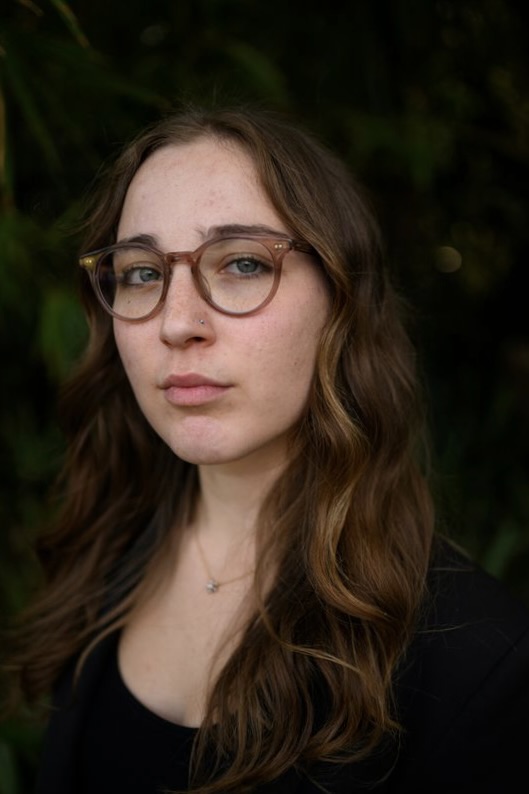
Juliet Schulman-Hall is MassLive's Higher Education Reporter. You can reach her at jschulman-hall@masslive.com or on X at @JSchulmanHall.


