Translate

Showing posts with label early-childhood education. Show all posts

Wednesday, March 27, 2019

New Mexico Gov. Lujan Grisham signs bill establishing Early Childhood Education and Care Department

Wonderful news out of New Mexico.  Texas should also consider providing "families and children from birth through age five with consistent access to high-quality care and education services, to include early intervention, family support, early childhood special education and home visitation as well as early pre-kindergarten and pre-kindergarten."

Sí se puede!  Yes we can!

-Angela

New Mexico Gov. Lujan Grisham signs bill establishing Early Childhood Education and Care Department

  MAR 14, 2019

SANTA FE – Gov. Michelle Lujan Grisham on Thursday signed Senate Bill 22, establishing a new Cabinet-level state department that will lead a unified expansion and transformation of early childhood education in New Mexico.  Here is a statement from the Governor's office:
Surrounded by dozens of legislative leaders, sponsors and child welfare advocates, Gov. Lujan Grisham celebrated the forthcoming launch of the Early Childhood Education and Care Department, which will, in expanding program eligibility and transferring program management currently scattered across other departments, provide New Mexico families and children from birth through age five with consistent access to high-quality care and education services, to include early intervention, family support, early childhood special education and home visitation as well as early pre-kindergarten and pre-kindergarten.
Both chambers, with bipartisan support, overwhelmingly approved the legislation, sponsored by Sen. Michael Padilla. 
“This new department is the vehicle,” Gov. Lujan Grisham said, “to arguably the most important turnaround we must and will make as a state in the coming years. Even while we occasionally disagree on the funding mechanisms, New Mexicans across the political spectrum agree on the importance of early childhood education. This department is an investment in our children, and thus in our shared future. It is an important step forward. We have many more steps to take, and I will continue to lead the push, and, on behalf of families across New Mexico, I’m grateful to legislators who put our shared principles into practice with this bill.” 
“This is perhaps the most important thing that we have done in decades to turn around poverty and improve our economy here in New Mexico,” Sen. Padilla said. “By creating the Department of Early Childhood Education and Care we will see true consistency, accountability, and quality through the entire continuum of early education. I’d like to thank everyone who helped with this monumental effort, and extend a special appreciation to Governor Lujan Grisham for her support and recognition that the welfare of our state’s youngest and most vulnerable should be at the top of any priority list.”
“Every child deserves access to quality early childhood education to unlock their potential,” said co-sponsor Rep. Linda Trujillo. “As we work together to put our children first, the Early Childhood Education and Care Department will improve educational outcomes for our youngest. I am proud that this legislation will be signed into law so that all New Mexico students can truly succeed and thrive.”

Monday, June 29, 2015

Children’s Budget 2015 brings bad news: fewer investments in kids


In reviewing the Urban Institute’s data, Anna Bernasek of Newsweek notes that if this trend continues, “the federal government soon will be spending more on interest payments on the debt than on children.”
Rather than being feared, America’s new diversity – poised to reinvigorate the country at a time when other developed nations are facing advanced aging and population loss – can be celebrated.

He hits it on the nail.  Our nation's new diversity is not only feared, but there is also nothing to fear and everything to gain from reversing this trend and investing not just in our so-called "future," but also our "present."


Children’s Budget 2015 brings bad news: fewer investments in kids


Child Abuse & Neglect Child Rights Childcare Children of Immigrants Early Childhood Education Federal Budget Health Housing & Homelessness Nutrition Poverty & Family Economics Safety Tax Policy
The federal government makes more than 200 distinct investments in children. These include traditional children’s initiatives like education and child abuse and neglect prevention. They also include other investments that improve the lives of kids, like Medicaid and the Supplemental Nutrition Assistance Program (formerly Food Stamps).
Every year, First Focus publishes a Children’s Budget offering a detailed guide to federal spending on children and an invaluable resource for those seeking to improve the lives of America’s youth.
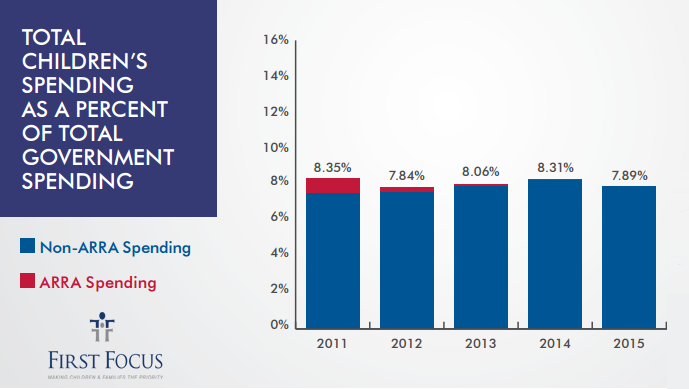
This year’s Children’s Budget 2015 brings more bad and unfortunate news for children. The share of federal spending dedicated to our nation’s children has now fallen to just 7.89 percent, which is down from a high of 8.50 percent in 2010. Consequently, the federal share of discretionary spending dedicated to children has dropped by 7.2 percent over the last five years.
3

In addition, on an inflation-adjusted basis, federal discretionary spending on children has dropped by 11.6 percent between 2010 and 2015. Discretionary funded dedicated to children’s health, education, child welfare, training, safety, and nutrition are all down even without adjusting for inflation.
In reviewing the Urban Institute’s data, Anna Bernasek of Newsweek notes that if this trend continues, “the federal government soon will be spending more on interest payments on the debt than on children.”
1
Few would think these facts reflect the values and priorities of the American people. That is reflected in the fact that, by a 69-25 percent margin, a Battleground Poll in May by the Tarrance Group and Lake Research finds that Americans do not believe the next generation will be better off economically than the current generation. As Chris Cillizza of the Washington Post notes, “The numbers from the Battleground Poll echo other data that has come out over the past few years that suggests a deep pessimism within the electorate about what sort of country they are leaving their children.”
5
We are failing to make the investments in children they need to fulfill their promise. As the Kids’ Share report concludes:

Without adequately funded education, nutrition, housing, early education and care, and other basic supports, the foundation of children’s well-being is at risk. When children grow up without adequate supports, they are less able to support themselves and to contribute to economic growth as adults. . . . A continuous decline in federal support for children over the next decade bodes poorly for their future or the future of the nation.

These assertions paint a bleak picture for our children if we as advocates don’t do something. While we saw increased spending as a result of the American Recovery and Reinvestment Act of 2009, the 2011 Budget Control Act introduced sequestration that involved serious cuts to important domestic programs. The fiscal year 2016 discretionary spending levels, because of a lack of relief from sequestration, are the lowest in a decade. Federal investments in our children and our future are going in the wrong direction.

Simply, we are failing to invest in our children. And some of the problem is related to demographics and is intergenerational.  According to Steve Murdock, former U.S. Census Bureau Director in the Bush administration, and his co-authors Michael Cline and Mary Zey, in our publication Big Ideas: The Children of the Southwest:

What is also evident is that the children of today will not be successful without substantial assistance from an older population that now and in the future is likely to possess superior economic resources. . . .
The major question raised . . . is: Will the United States’ adult population (through elections, taxes and other factors) support the youth who are racially and culturally different from themselves and their children or will they perpetuate a dual class education and economic structure which has dominated many areas in the United States, including many areas in the Southwest?

How that question is answered will be critical to our nation’s future. William Frey, author of Diversity Explosion: How New Racial Demographics Are Remaking America writes:

. . . a growing diverse, globally connected minority population will be absolutely necessary to infuse the aging American labor force with vitality and to sustain populations in many parts of the country that are facing population declines. Rather than being feared, America’s new diversity – poised to reinvigorate the country at a time when other developed nations are facing advanced aging and population loss – can be celebrated.

In 12 U.S. states (Hawaii, New Mexico, California, Texas, Nevada, Arizona, Florida, Maryland, Georgia, New Jersey, Mississippi, and New York), the U.S. Census Bureau estimates that minority children under the age of 10 are in the majority. And, enrollment in our nation’s public schools has also become majority minority, according to the National Center for Education Statistics.
“Yet, as Frey explains, “this youth-driven diversity surge is also creating a ‘cultural generation gap’ between the diverse youth population and the growing, older, still predominately white population.”
Frey points to states where the difference between the percentage of seniors and children who are white as places where there may be greater tension between the generations and competition for resources allocated to children and the elderly, and where children may be significant losers.
Murdock, Cline, and Zey share this concern and point to research by James Poterba that found “in communities with large proportions of elderly residents there were significantly lower per-capita educational spending, especially when the children were of a different race from that of their elders.”
According to Frey, among the states, Arizona leads the way with a “cultural generation gap” of 41 percent (83 percent of seniors and 42 percent of children were white). So, how is Arizona doing by its children?
The Arizona Daily Sun has documented how budget cuts to child protective services in Arizona caused child welfare caseloads to soar and reports of child abuse to be ignored, how cuts to public education resulted in per-public spending during the recession to decline by 24 percent, and how reductions in state funding to higher education were $300 million below pre-recession levels.
In addition, Arizona is the only state in the country to no longer provide health insurance coverage to children under the Children’s Health Insurance Program when it let the program expire at the close of 2013. It now has the second highest uninsured rate for children in the country.
Arizona is a state that enacted some of the some most stringent anti-immigration legislation in the country, SB170, and banned schools from offering courses such as Mexican-American studies, which federal courts have partially overturned.
As Murdock, Cline, and Zey said:
The future of areas such as the Southwest, and of the Nation as a whole, may be markedly affected by the extent to which its older populations are willing to step forward to support its increasingly diverse youth.
What is clearly evident is that the future of the Southwest and the United States as a whole is increasingly tied to the future of its minority populations. . . . Whether the nation prospers or struggles to maintain its current standard of living and whether it can compete internationally will depend on how well the diverse children such as those in the Southwest do. Ultimately, how well these children do will be how well America will do.
To ensure a strong future America, we must overcome the forces and ignorance and prejudice that are cutting – rather than investing – in education and our nation’s children. New York Times columnist Eduardo Porter adds:
If the next generation is going to be handed the bill for our budget deficits, we might as well make the investments needed to help it bear the burden. So far, we seem on track to bequeath our children a double whammy: a mountain of debt and substantial program cuts that will undermine their ability to shoulder it when their time comes.
Ronald Brownstein has also written extensively about this generational political challenge. According to Brownstein:
The nation faces the risk of sustained political tension between its racially diverse, Democratic-leaning youth population and its predominantly white, Republican-trending senior population — what I’ve called the Brown and the Gray. Although it’s rarely discussed now, both groups share an interest in equipping the young to obtain middle-class jobs that will generate the tax base to support a decent safety net for the old.
Since kids do not vote, we need an informed electorate that will translate its long-standing support for children into votes. This requires that advocates for children, including parents, grandparents, educators, etc., work together to build a grassroots movement to educate the public and demand from policymakers that they put forth a real policy agenda – and not just lip service – that would improve child well-being and then hold those policymakers accountable for real results.
Imagine how different things for children might be if politicians were the ones to lose their jobs for failing to improve education, reduce child poverty, etc. What is needed is a focus on the needs of children before it is too late.
Former Republican House Majority Leader Eric Cantor apparently agrees that the new 114th Congress should make children a focus of its agenda. He writes:
As the new Congress convenes, I hope the president and members from both parties will keep one number in mind: 8,053,000. That is an estimate of the number of new Americans expected to be born between now and the end of this Congress and President Obama’s second term two years from now. . . . The future of those 8,053,000 little boys and girls deserve to have the two years of this Congress focused on them and not the next election.
According to the U.S. Census Bureau, “…50.4 percent of our nation’s population younger than age 1 were minorities as of July 1, 2011.”  We need to value each and every one of those children.
I remember understanding this for the first time so clearly when New York Governor Mario Cuomo said in a speech before the Democratic National Convention in 1992 about the plight facing children a generation ago:
They are not my children, perhaps. Perhaps they are not your children, either. But, they are our children. We should love them.
But even if could choose not to love them, we would still need them to be sound and productive. Because they are the nation’s future.
Now is the time for us to work together to educate policymakers at the federal and local level about the harmful path we are on. We must raise our voices in support of those who will put our children and our families first. It is imperative that we, as a country, move down a path that puts children at the forefront of policy decisions.
Download you copy of Children’s Budget 2015.

Download @First_Focus Children’s Budget 2015 on 200+ fed investments in kids: http://bit.ly/1N3ESQK #InvestInKids

Saturday, May 15, 2010

Young Latino Children Show Strong Classroom Skills, Despite Many Growing Up in Poverty

A couple notable findings:
“Culture and language growth play a huge role in boosting achievement, which we now see benefit many Latino children.”

"those attending highly segregated or violent schools went downhill in their own school achievement (Suárez-Orosco and others).

-Patricia


The American Psychological Association
May 3, 2010

But for teens, peer pressure, mediocre schools undercut initial gains.

WASHINGTON – Immigrant Latinos display strong parenting practices and raise socially agile children, but these early gains are likely to be eroded by mediocre schools and peer pressure in poor neighborhoods, according to findings published by the American Psychological Association.

In a special section of the journal Developmental Psychology, a team of researchers examines how no-nonsense parenting practices – especially Latino traditions of strict discipline, respect for adults and strong family bonds – shape children’s social and cognitive growth and their assimilation into mainstream culture.

“Immigrant kids begin school with surprisingly good social skills, eager to engage teachers and classroom tasks, even though many are raised in poor households,” said Bruce Fuller, PhD, of the University of California at Berkeley, who co-edited the special section. “This stems from tight families and tough-headed parenting. Our findings shatter the myth that immigrant or low-income parents necessarily produce troubled children.”

One study, based on 19,500 kindergartners nationwide, found that Latino children engaged in classroom activities and displayed cooperative skills at levels equal to those of white non-Latino children, despite vast differences in family income between the groups. In addition, Latino children’s social skills contributed to their learning about numbers and mathematical concepts during this first year of school, the researchers found.

But children’s social agility and classroom enthusiasm often wanes by middle school, according to the researchers. “These children benefit from a strong foundation against outside negative forces, which contributes to their early school achievement but fades over time, especially during adolescence,” said Cynthia García Coll, PhD, of Brown University, co-editor of the special section. “Assimilation places many children at risk of losing tight bonds to family and [experiencing] school failure.”

The national study of Latino kindergartners included teacher reports of five social competencies: engaged approaches to learning, self-control, interpersonal skills, internalized problem behaviors (anxiety, loneliness, low self-esteem) and externalized problem behaviors (propensity to argue, get angry, act impulsively). “Those Latino children who were the best at focusing on learning tasks showed the steepest learning curves in math,” said Claudia Galindo, PhD, a University of Maryland professor who co-directed the study.

Children from African-American homes did not show comparable levels of classroom engagement and social agility. “Poverty alone does not explain the strength of parenting or the social assets that children bring to school,” Fuller said. “Culture and language growth play a huge role in boosting achievement, which we now see benefit many Latino children.”

Children from Puerto Rican families, in contrast to those of Mexican heritage, showed disparities in social competence when compared to white non-Latino children. Children of Cuban or South American descent (whose parents had higher education levels, on average) showed equal competence when compared to white non-Latino children.

Two additional studies in the journal’s special section show how early gains for Latino children can be undercut during adolescence through peer pressure, weak schools and the perception of ethnic discrimination. In the first study, Latino teens who pulled away from parents and their ethnic identity displayed weaker school engagement (Umaña-Taylor and Guimond). When teens perceived ethnic or racial discrimination, they tended to retain stronger family ties that strengthened their ethnic identity, the researchers found.

The second study – tracking 294 older Latino and Asian immigrant children – found that those attending highly segregated or violent schools went downhill in their own school achievement (Suárez-Orosco and others). The rising rate of single-parent families in many immigrant communities is associated with a drop in children’s school performance.

Other findings include:

* Young Latino children’s enthusiasm and agility in classrooms stems from warm yet firm parenting practices (Livas-Dlott and others). Researchers observed 25 Mexican-American 4-year-olds inside their homes and found that mothers on average were clear and direct when children misbehaved or failed to complete an assigned task. This tough-love parenting occurred within a supportive climate, nurturing cooperative children who expressed mutual obligations to family members, researchers said.

* Another study shows how strong customs from one’s native country can promote learning by teaching children to pay attention to what is going on in front of them (Lopez and others). Researchers gave instructions to 38 6- to 11-year-old siblings in order to examine differences in learning processes between those raised under Mexican traditions and those raised by parents who practiced American customs. Children paid more attention to their siblings’ activities and learned a novel task more readily when living in homes where Mexican customs were practiced. Children paid less attention to their siblings, and learned less, when living in homes where Western traditions and individualistic practices prevailed.

* Researchers surveyed 15,362 African-American, Latino and Asian tenth- graders from 752 schools about their understanding of how racial and socioeconomic barriers affect their expectations for well-paying jobs (Diemer and others). Two years later, the researchers asked the students about their extracurricular activities, school achievement, community participation and vocational expectations. Reading and math achievement had the strongest effect on the students’ expectation of winning high-paying jobs, while awareness of racial and economic barriers had the strongest effect on the value that students placed on work.

Articles in the special section

Citation information: "Latino Children and Families: Development in Cultural Context," Developmental Psychology, Vol. 46, No. 3.

“Learning From Latinos: Contexts, Families, and Child Development in Motion: Introduction to the Special Section” (PDF, 74KB)
Contact Bruce Fuller by phone at 415-595-4320 (cell); or contact Cynthia Garcia Coll by e-mail or by phone 401-447-4590 (cell).

“The Social Competence of Latino Kindergartners and Growth in Mathematical Understanding” (PDF, 117KB)
Contact Claudia Galindo by e-mail or by phone at 814-876-0683.

“Sociopolitical Development, Work Salience, and Vocational Expectations Among Low Socioeconomic Status African American, Latin American, and Asian American Youth” (PDF, 180KB)
Contact Matthew A. Diemer by e-mail or by phone at 517-614-9274.

“Attention to Instruction Directed to Another by U.S. Mexican-Heritage Children of Varying Cultural Backgrounds” (PDF, 155KB) Contact Angelica Lopez by e-mail or by phone at 831-459-2002.

“Academic Trajectories of Newcomer Immigrant Youth” (PDF, 158KB)
Contact Carola Suarez-Orozco by e-mail or by phone at 718-431-4232 or 609-734-8266.

“Commands, Competence, and Carino: Maternal Socialization Practices in Mexican American Families”
(PDF, 133KB)
Contact Alejandra Livas-Dlott by e-mail or by phone at 919-608-4007.

“A Longitudinal Examination of Parenting Behaviors and Perceived Discrimination Predicting Latino Adolescents’ Ethnic Identity” (PDF, 171KB)
Contact Adriana J. Umana-Taylor by e-mail or by phone at 480-727-8670.

Sunday, November 22, 2009

Tips for the Admissions Test ... to Kindergarten

Wow, I don't see how someone can rationalize this test-driven instruction for children after all the work that's been done to show the harms that this cause.

-Patricia


By SHARON OTTERMAN | NY Times
November 20, 2009

But then came something she had never seen before: a visual analogy showing a picture of a whole cake next to a slice of cake. What picture went with a loaf of bread in the same way?

Kayla, who will be 4 in December, held her tiny pointer finger still as she inspected the four choices. “Too hard,” she peeped.

Test preparation has long been a big business catering to students taking SATs and admissions exams for law, medical and other graduate schools. But the new clientele is quite a bit younger: 3- and 4-year-olds whose parents hope that a little assistance — costing upward of $1,000 for several sessions — will help them win coveted spots in the city’s gifted and talented public kindergarten classes.

Motivated by a recession putting private schools out of reach and concern about the state of regular public education, parents — some wealthy, some not — are signing up at companies like Bright Kids NYC. Bright Kids, which opened this spring in the financial district, has some 200 students receiving tutoring, most of them for the gifted exams, for up to $145 a session and 80 children on a waiting list for a weekend “boot camp” program.

These types of businesses have popped up around the country, but took off in New York City when it made the Otis-Lennon School Ability Test, or Olsat, a reasoning exam, and the Bracken School Readiness Assessment, a knowledge test, the universal tests for gifted admissions beginning in 2008.

Kayla’s session at Bright Kids was an initial assessment; her mother, Jena Rosenblum, had not decided whether to put her through a full course of tutoring. She was considering it at the suggestion of Kayla’s preschool teacher. “Even though we live in the West Village and there are great public schools, obviously, any opportunity to step it up a notch in caliber, we would like to try,” Ms. Rosenblum said.

Melisa Kehlmann said her main concern was that her 4-year-old son, Adrian, would be shut out of the well-regarded but overcrowded schools in her Manhattan neighborhood.

“It’s quite pricey, but compared to private school, which averages about $20,000 for kindergarten, the price is right,” she said of the tutoring. “I just want the opportunity to have a choice.”

Private schools warn that they will look negatively on children they suspect of being prepped for the tests they use to select students, like the Educational Records Bureau exam, or E.R.B., even though parents and admissions officers say it quietly takes place. (Bright Kids, for example, also offers E.R.B. tutoring.)

“It’s unethical,” said Dr. Elisabeth Krents, director of admissions at the Dalton School on the Upper East Side. “It completely negates the reason for giving the test, which is to provide a snapshot of their aptitudes, and it doesn’t correlate with their future success in school.”

No similar message, however, has come from the public schools. In fact, the city distributes 16 Olsat practice questions to “level the playing field,” said Anna Commitante, the head of gifted and talented programs for the city’s Department of Education.

As for parents doing more — like hiring a tutor — Ms. Commitante said she finds “anything else a little too stressful for young kids” but that “we can’t dictate what parents choose to do.”

There is no state registry or licensing for these services, but an Internet search turns up numerous companies with names like Another Young Scholar, Junior Test Prep and Thinking to Learn. Harley Evans, the owner of Manhattan Edge Educational Programs, raised prices this year to $90 a session from $65, but still has his maximum load of 70 children. Daniel C. Levine, the founder of Exclusive Education, based in Manhattan, said that a few years ago, 2 percent of his clientele were children under 6. Now it is about 10 percent.

“It’s the same phenomenon as with the SATs: a gradual rise in test prep, until it becomes the norm,” said Emily Glickman, a Manhattan educational consultant. “Given that the demand for high-stakes schools outstrips supply, that’s what’s happening.”

Some of the thousands of students registered to take the gifted tests in January are also preparing at home. Bright Kids is selling a few hundred $90 workbooks per month, said Bige Doruk, the company’s founder. Dr. Robin MacFarlane, who developed the Kindergarten Test Study System, said she was on track to sell more than a thousand of the $60 Olsat prep kits this year, though she advises parents against intensive cramming.

Tutoring preschoolers is not quite the same as drilling high school students for the SAT. At Bright Kids, Kayla was initially stumped by the visual analogy, but once the learning specialist, Meredith Resnick, explained that she was looking at a whole-to-part relationship, she easily found the right answer: a slice of bread. “You can see that when I scaffolded her, she knew it,” Ms. Resnick said.

Children often have to be trained to listen to questions from strangers and to sit still for about an hour, the time it takes to complete the two tests.

“If their mind isn’t keyed into listening, the whole question can fly over their heads,” said one tutor, a retired teacher in gifted programs.

She spoke on condition of anonymity because she has administered the test for the city and wants to do so again.

“Some kids can do well without preparation, but children who are familiar have an edge,” the tutor said. From an equity perspective, she said, “it’s ridiculous.”

Ms. Commitante said the city had not noticed any bias due to test preparation. For this year’s kindergarten class, 3,231 students scored in at least the 90th percentile, the minimum to qualify for a gifted program, a 45 percent increase from the year before.

But that rise was attributable to “a variety of factors,” including increased participation, she said: 14,822 took the tests, an increase of 19 percent. The percentage scoring 90 percent or higher rose to 22 percent from 18 percent.

“I would hope that parents make decisions around this program because they feel that this is an educational option that their child really needs, as opposed to, ‘I have to get my child into this program because that’s the only place where they are going to get a good education,’ ” she said. “I just don’t think that’s true — we have a lot of really good schools.”

Saturday, October 24, 2009

Hispanic Immigrants’ Children Fall Behind Peers Early, Study Finds

By JAMES C. McKINLEY Jr.
Published: October 21, 2009

HOUSTON — The children of Hispanic immigrants tend to be born healthy and start life on an intellectual par with other American children, but by the age of 2 they begin to lag in linguistic and cognitive skills, a new study by researchers at the University of California, Berkeley, shows.

The study highlights a paradox that has bedeviled educators and Hispanic families for some time. By and large, mothers from Latin American countries take care of their health during their pregnancies and give birth to robust children, but those children fall behind their peers in mental development by the time they reach grade school, and the gap tends to widen as they get older.

The new Berkeley study suggests the shortfall may start even before the children enter preschool, supporting calls in Washington to spend more on programs that coach parents to stimulate their children with books, drills and games earlier in their lives.

“Our results show a very significant gap even at age 3,” said Bruce Fuller, one of the study’s authors and a professor of education at Berkeley. “If we don’t attack this disparity early on, these kids are headed quickly for a pretty dismal future in elementary school.”

Professor Fuller said blacks and poor whites also lagged behind the curve, suggesting that poverty remained a factor in predicting how well a young mind develops. But the drop-off in the cognitive scores of Hispanic toddlers, especially those from Mexican backgrounds, was steeper than for other groups and could not be explained by economic status alone, he said.

One possible explanation is that a high percentage of Mexican and Latin American immigrant mothers have less formal schooling than the average American mother, white or black, the study’s authors said. These mothers also tend to have more children than middle-class American families, which means the toddlers get less one-on-one attention from their parents.

“The reading activities, educational games and performing the ABCs for Grandma — so often witnessed in middle-class homes — are less consistently seen in poor Latino households,” Professor Fuller said.

The study is based on data collected on 8,114 infants born in 2001 and tracked through the first two years of life by the National Center for Education Statistics. The findings will be published this week in Maternal and Child Health Journal, and a companion report will appear this fall in the medical journal Pediatrics.

The analysis showed that at 9 to 15 months, Hispanic and white children performed equally on tests of basic cognitive skills, like understanding their mother’s speech and using words and gestures. But from 24 to 36 months, the Hispanic children fell about six months behind their white peers on measures like word comprehension, more complex speech and working with their mothers on simple tasks.

The study comes as the Obama administration has been pushing for more money to help prepare infants and toddlers for school. In September, the House passed an initiative that would channel $8 billion over eight years to states with plans to improve programs serving young children.

In addition, the economic stimulus package included $3 billion for Head Start preschools and for the Early Head Start program, which helps young parents stimulate their children’s mental development.

Eugene Garcia, an education professor at Arizona State University, said the Berkeley-led study confirmed findings by others that the children of Hispanic immigrants, for reasons that remain unclear, tend to fall behind white students by as much as a grade level by the third grade.

“It seems like what might be the most helpful with Latino kids is early intervention,” Dr. Garcia said.

Carmen Rodriguez, the director of the Columbia University Head Start in New York City, said there was a waiting list of parents, most of them Hispanic, who want to take Early Head Start classes with their children.

Dr. Rodriguez said the study’s findings might reflect a surge in interest in early childhood education on the part of middle-class Americans, rather than any deficiency in the immigrant homes.

“Any low-income toddler is disadvantaged if they don’t get this kind of stimulation,” she said.

Monday, June 09, 2008

Long-Term Payoff Seen From Early-Childhood Education

Premium article access compliments of Edweek.org.

Published Online: June 5, 2008
Published in Print: June 11, 2008

Long-Term Payoff Seen From Early-Childhood Education
By Linda Jacobson

The latest analysis of a long-running early-childhood-education program for children of low-income families in Chicago suggests economic payoffs from such services that continue well into adulthood.

Researchers looking at data from the study, which is now more than 20 years old, say that for every dollar spent on children who attended the Chicago Child Parent Centers, almost $10 is returned by age 25 in either benefits to society—such as savings on remediation in school and on the criminal-justice system—or to the participant, in the form of higher earnings.

“The study is significant, given it is the only one of a sustained public school program and one of the very few which go into adulthood,” Arthur J. Reynolds, a child-development professor at the University of Minnesota-Twin Cities and the lead researcher on the project, said in an e-mail.

He added that the benefits are probably underestimated because he has found some unexpected outcomes, such as participants’ being more likely than those in the comparison group to hold private health insurance and less likely to have mental-health problems. ("Chicago Data Bolster Case for Early-Childhood Programs," August 15, 2007.)

But some experts caution that the children served by the Chicago program and similar efforts were very disadvantaged, and that providing such services to middle-class families in universal preschool programs are unlikely to result in the same return on investment.

“The biggest argument against the Chicago economic data is that it is still largely a ‘boutique’ program that cost more and provided more services than most current universal and preschool programs,” said Lisa Snell, the director of education and child welfare at the Los Angeles-based Reason Foundation, a free-market-oriented think tank. “It is hard to imagine that current programs will have the same kinds of economic payoffs as the Chicago program.”

The conclusions were presented late last month at a meeting in San Francisco of the Society for Prevention Research, based in Fairfax, Va.

Parent Involvement

The Chicago Longitudinal Study originally included 1,539 children from low-income African-American and Hispanic families who began in the early-education program run by the Chicago school system at 25 sites in either 1985 or 1986.

The Chicago program began in 1967 at sites in or near elementary schools. Similar to the federal Head Start program, the Child-Parent Centers provide comprehensive education, health, and family-support services to children ages 3 to 9.

Unlike in Head Start, all the teachers in the program have bachelor’s degrees and are paid at the same level as K-12 teachers.

In addition, parents are expected to participate in the classroom—a component that distinguishes the Chicago program from other early-intervention initiatives—and the children in the study received home visits from a “school-community representative.”

“The parents were expected to get involved, and there were 30 different ways [for parents to participate], so nobody said no,” Mr. Reynolds said.

While the study was not designed as a true randomized trial, a comparison group including children who were matched to the participants on socioeconomic factors and demographic variables, wsuch as family size and parents’ employment status, has been used to track the effectiveness of the intervention. Children in the comparison group took part in other early-childhood programs, such as Head Start, or full-day kindergarten.
Last year, Mr. Reynolds released findings in the Archives of Pediatrics and Adolescent Medicine, a monthly journal, based on study of participants at age 24. Those findings showed that the adults had acquired more education and were less likely to commit crimes than those who had not received the same level of service.

A Body of Evidence

Because of its evidence of lasting positive effects, such as lower special education costs and less welfare dependency, Mr. Reynolds’ study on the Chicago program is often used as one of three long-running research projects to argue for public spending on early-childhood education. The other two are the High/Scope Perry Preschool study, which ran in Ypsilanti, Mich., outside Detroit from 1962 to 1967, and the Carolina Abecedarian Project, in Chapel Hill, N.C., which provided services from birth through age 5 to 112 children from low-income families born between 1972 and 1977.

The Chicago study stands out, however, because it is not a demonstration program as are the others. It has been operated by a public school system and thus is likely more “generalizable to other similar and contemporary locations and contexts,” Albert Wat, a state-policy analyst at the Washington-based advocacy group Pre-K Now, wrote last year in the report “Dollars and Sense: A Review of Economic Analyses of Pre-K.

The Chicago program “demonstrates that public schools can effectively implement high-quality pre-K programs that produce long-term positive gains,” he wrote.

Still, Mr. Reynolds concludes that the newest “evidence strengthens the findings of a high return on investment of public programs, if they follow the key principles of effectiveness.”

Mr. Reynolds’ new analysis, which will be released in a research paper later this year, also provides a comparison of the economic benefits of various types of preschool programs.

It uses an average of all the cost-benefit studies that have been conducted on other popular policies, such as full-day kindergarten, class-size reduction, and the federal Women, Infants, and Children, or wic, nutrition program.
The comparison shows that preschool programs have by far the highest return, $6.02 for every $1 spent, compared with $2.47 for small classes, $3.07 for wic, and nothing for full-day kindergarten.

Vol. 27, Issue 41, Page 8