Translate

Showing posts with label grit. Show all posts

Friday, July 01, 2022

Reflections on Creative Resistance: A Personal Note on our work at Academia Cuauhtli by Angela Valenzuela Ph.D.

Friends:

I've been silent on the blog due to a lot of work these days that keeps me busy. Also doing a bit of traveling while keeping up with the seemingly unending craziness and horror in full display. Because of the work that many of us in the community do, it's hard not to see and indeed, important to acknowledge, the hopeful signs before us that our work and commitments inspire.

In this vein, I want to share a bit about travel to Oaxaca, Mexico, next week, as well as some wonderful updates pertaining to our Saturday school, Academia Cuauhtli (or "Eagle Academy" in Nahuatl) here in Austin Texas.

The focus of our school is with Austin's most vulnerable community that is working-class, Spanish speaking, and immigrant, with parents that mostly hold poorly-paid jobs as frontline workers in the Austin area.

In partnership with the Austin Independent School District and the Emma S. Barrientos Mexican American Cultural Center (ESB-MACC) where we are physically located, our school is a language and cultural revitalization project mostly for fifth- and fourth-grade elementary school girls and boys where they are exposed to a culturally enriching curriculum, including danza Mexica (Aztec dance)—where "danza" means ceremony and not dance. This nurtures in youth a deep sense of not just "identity," but their multiple identities where Indigeneity—including Afro-Indigeneity and Afro-Latinidad—gets centered. Our curriculum shifts from year to year, depending on what our parents and teachers seek.

Texas State University professor Dr. Chris Milk and a group of teachers are working over the Summer, as they always do, to produce a professional, standards-aligned, culturally-rich, Spanish-English curriculum that gets taught not only at Academia Cuauhtli in the Fall, but also districtwide, with mostly bilingual/dual language teachers, taking this up, we understand. Thanks to Jessica Jolliffe for another year of funding for this important work and to Chris for his superb leadership and commitment.

Thanks to excellent initiative and leadership by our Academia Cuauhtli Program Manager Maria Unda, website and communications Director Mateo Villafuerte, and Camp Director Azteca Sirias, another highlight this Summer is Academia Cuauhtli's second annual Aztech Kidz Code Summer Camp. It takes place at the end of July and early August at the ESB-MACC.

At this camp, children and youth will learn to code, create their own games, and learn now to monetize them to plant seeds in their minds of possible futures in technology, graphics, and computer design that are fully consistent with Indigenous identity, epistemologies, and aesthetics. This is coupled with danza Mexica. So happy to see maestra Katya Guzman and maestro Mario Ramirez offering instruction again this year.

Our Academia Cuauhtli maestras, our teachers, rock, too. At least 5 teachers will start 5 Academia Cuauhtli after-school programs in 5 AISD Elementary Schools this Fall. All will make use our curriculum and spread the good, healing medicine to other spaces and places. Hence, we are in a period of growth and expansion as we enter our 9th year of operation.

Regarding Oaxaca, Mexico, 13 of us, all educators, head out on Sunday. We will be meeting with our friends and colleagues at La Universidad Autónoma Benito Juarez de Oaxaca (UABJO), or the Autonomous University of Benito Juarez in Oaxaca, Mexico. While there, we'll participate in a symposium at the University and will visit schools taught by Indigenous teachers so that we can deepen our sense of Indigenous pedagogy, curriculum, and practices, and simultaneously with the students and faculty at the university, as well.

Thanks to San Diego State University and Chair of the Dual Language and English Learner Education Department, Dr. Margarita Machado-Casas, as well as to Language Institute Director Fernando Martinez for making this possible. Fernando and his colleagues prepare Indigenous, pre-service teachers to return to their communities to teach in ways that are decolonial, grounded in community-based knowledge, values, and ways of knowing from an asset-based perspective. In the U.S., we might call this a Grow Your Own Teacher program that is also about language and culture revitalization similar to Academia Cuauhtli.

As horrible as the world is right now, Academia Cuauhtli remains an enduring bright spot, a true beacon of hope that fosters resilience and makes our otherwise toxic, current political life as a country, not just bearable, but rewarding and fulfilling.

Ours is a way of knowing that Dr. Roberto Cintli Rodriguez in his book
 2021 titled, "Writing 50 Years (más o menos) Amongst the Gringos," describes as "creation-resistance." Another way to think about this is that the day we become bitter, negative, and withdrawn, is the day that "they," the powers that be, win.


These are matters of the soul. And no person or institution is entitled to the taking of ours, or anyone's joy, love, or striving.

Here is a great point to cite Benito Juarez himself, "El respeto al derecho ajeno es la paz," or "respect for the rights of others is peace." So simple, yet so profound.

Creation-resistance maps on to other concepts like "transformational resistance," advanced by Solorzano and Bernal (2021), as well as the notion of writing from a "theory of the flesh," as put forward by Moraga and Anzaldúa (1981) where our best thinking is born from that tender and frequently fraught place of lived experience where pain, love, joy, and crushing exploitation reside.

Drawing on Vizenor (1999) and Indigenous scholarship, Sabzalian (2019) marshals the concept of "survivance," where surviving and resisting work creatively to negotiate meaning within educational contexts amidst colonial dispossession. Sabzalian also notes how survivance—and I would add, creative and transformational resistance—disrupt individualized notions of "resilience" and "grit" that unjustly place the onus of achievement and conversely, failure, on the students themselves.

Props to University of Oregon Professor Leilani Sabzalian for winning the Outstanding Book Award of the Year in 2020 by the American Educational Research Association for her book titled, Indigenous children’s survivance in public schools. I highly recommend it for the Ethnic Studies and Native American and Indigenous Studies college classroom.

It's all a mix that, at its best, invokes what our ancient ancestors termed, floricanto, translated literally as "flower and song." And how better than to create just such a world in the now, in the present, with the children who will also someday be ancestors to the coming generations?

I saw an amazing Netflix movie this week titled "RRR" (meaning “Rise Roar Revolt”), out of India that I highly recommend as it, too, speaks to the power of flower and song to dismantle oppressive symbolic orders and tumble empires, helping me to think of floricanto, creation-resistance, and survivance as liberatory and revolutionary praxis as non-violent, social justice mechanisms for change.

Taken together, these are ways of knowing that are not always explicit—albeit powerfully tacit— where our heartfelt, collective need for greater peace, justice, and unity in the world is neither a slogan nor an idea, but instead, a creative way of life that holds an array of meanings and possibilities for us.

It means uplifting both our youth and families, together with their bilingual education/dual language teachers so that they can teach from an additive, strengths-based perspective, anchored in children's stories, histories, languages, cultures, and identities so that youth can envision positive, bold, and expressive futures for themselves— just as they are—as members of a community that has their backs.

To us all, this IS the movement that nurtures and empowers self in community. Would that all of our communities had such powerful spaces for teaching, learning, reflection, and healing.

Major thanks for UT doctoral students Patricia Nuñez Porras and Julia Hernandez for working hard these past several months to make our trip to Oaxaca happen. A shout out to Tiffany Guridy at LLILAS, as well, for her hard work in addressing the minutia of detail associated with international travel for us all.

As always, we are also indebted to our ESB-MACC family, Director Michelle Rojas, Lori Navarrete, Olivia Tamzarian, Frank Baca, Ulises Gave, and all the other staff for partnering with us on this truly awesome and beautiful journey.


-Angela Valenzuela


References


Anzaldúa, G., & Moraga, C. (1981). This bridge called my back: Writings by radical women of color. Watertown, MA: Persephone Press.


Rodriguez, R. (2021). Writing 50 Years (más o menos) Amongst the Gringos. San Antonio: Aztlan Libre Press.


Sabzalian, L. (2019). Indigenous children’s survivance in public schools. Routledge.


Solorzano, D. G., & Bernal, D. D. (2001). Examining transformational resistance through a critical race and LatCrit theory framework: Chicana and Chicano students in an urban context. Urban Education, 36(3), 308-342.


Vizenor, G. R. (1999). Manifest manners: Narratives on postindian survivance. University of Nebraska Press.

Tuesday, March 03, 2020

The Hechinger Report. Study: Boosting soft skills is better than raising test scores

This research shows that boosting soft, socio-emotional learning (SEL) skills is better than test-prep curriculum used to boost test scores.  We still need to address the injustices and lack of validity of our high-stakes testing systems and not let the testing companies get off the hook. 

In addition to SEL, let's fully incorporate Ethnic Studies and well-designed, staffed, and funded bilingual education programs to this list given that ample research solidly points to these as not solely achievement boosters, but achievement-gap reducers. 

These are not issues of evidence, but rather politics.  Why can't we do all three?  How and where do we get the leadership and teachers that can implement all three?  I have a lot to say about this, but I'll stop here for now.

-Angela Valenzuela


Study: Boosting soft skills is better than raising test scores

Chicago analysis finds schools that foster social-emotional development get better results for students


Proof Points

High school students comfort each other on Chicago’s South Side. A new Chicago study shows that students who attend schools that foster soft skills do better in high school and beyond. (Photo by Scott Olson/Getty Images)

We hear the phrase “failing schools” a lot but what really defines a failing school? Generally, we look at test scores. Schools that aren’t getting students to improve their math and reading achievement on the standardized tests administered by each state are the ones singled out for shame, punishment and sometimes closure. That’s led to excessive test preparation — and even fraud — to boost scores.
Education researchers are trying to come up with different ways to measure success. One of them, economist Kirabo Jackson of Northwestern University, has zeroed in on soft skills, which include traits like empathy and perseverance, and found that if you were to set up a competition between schools that raise test scores and schools that foster soft skills, the soft skills schools would win.
Sign up for Jill Barshay's Proof Points newsletter
In a large study of more than 150,000 students in all 133 of Chicago’s public high schools, Jackson has calculated that schools that build social-emotional qualities such as the ability to resolve conflicts and the motivation to work hard  are getting even better short-term and long-term results for students than schools that only boost test scores. The schools that develop soft skills produced students with higher grades, fewer absences and fewer disciplinary problems and arrests in high school. Later, the students who attended these high schools graduated and went to college in higher rates. In a few more years, we may learn that the students who attended schools that are strong in soft skills earned more college degrees.
“What we’re showing is that schools that actually cause kids to become more gritty, those kids tend to be likely to persist more in college,” said Jackson.
“You could actually do a lot more good by focusing on schools that promote social-emotional development as opposed to focusing on schools that raise test scores,” he added.
We haven’t been totally misguided to focus on test scores all this time. Schools that boost test scores also tend to be the ones that boost social-emotional skills. But the overlap isn’t perfect. An exemplar school for boosting test scores at the 95th percentile might only be 75th percentile for building soft skills, according to the Chicago high school data. Importantly, Jackson is noticing outliers: schools that are sensational at building soft skills but terrible at boosting test scores, and vice versa.


Jackson declined to identify strong or weak schools by name because the research is in early stages. The study, “School effects on socio-emotional development, school-based arrests and educational attainment,” is still a working paper, which means it has not yet been peer-reviewed and may still undergo revisions. In February 2020, Jackson presented these early findings at conference of the National Center for the Analysis of Longitudinal Data in Education Research (CALDER) and the paper was circulated by the National Bureau of Economic Research. Along with Jackson, there are four co-authors from the University of Chicago Consortium on School Research, Northwestern University and the Mindset Scholars Network.
Measuring squishy soft skills is controversial and complicated. Scholars have found many problems in measuring “grit,” a popular social-emotional trend in schools, for example.

Jackson and his research colleagues relied on students’ responses to a social-emotional survey given to Chicago public school students from 2008 onward. Students answered a range of questions about their own perceptions of their interpersonal skills, social well-being and hard work. For example, students said how much they agree with a statement like, “If I need to study, I don’t go out with my friends.” (For a more examples of survey questions, I typed up a bunch here.)
To tease out how much of these skills could be credited to a student’s high school, the researchers factored in students’ prior academic achievement and how they responded to the surveys in middle school. They also adjusted students’ responses for gender, race/ethnicity, family income and the socio-economic status of the student’s home neighborhood, down to the census block. All these adjustments are important because a student’s context matters in how he or she answers a question. Kids are more likely to say “I’m a hard worker” if they’re surrounded by kids who don’t work hard, Jackson explained.
In the end, the researchers had an estimate of how much each high school boosted soft skills, based on how ninth graders answered surveys from 2011 to 2017. And they found that the students’ self-reported answers had a significant correlation with school grades and attendance in ninth grade. The students who went to the high schools that were good at developing soft skills also had fewer disciplinary incidents.
For the older students in the study, the ones who entered ninth grade between 2011 and 2014, researchers saw that students who attended these soft-skills high schools had fewer arrests throughout their high school years and graduated high school in greater numbers. After high school, these students attended college, both two-year and four-year institutions, in higher numbers and persisted in college in higher rates. It’s too early to see college graduation rates for these students.
To check their findings, the researchers compared siblings who attended different high schools and the ones that attended to schools that were better at boosting soft skills had better outcomes.

The study is making several important contributions to educational research. It’s more proof that students are self-aware and honest enough to give survey answers that can actually measure social-emotional skills. It also indicates that increases in students’ soft skills matter for the educational outcomes that we care about like better grades and college attendance.

There’s a debate in the research community about whether interventions to boost “grit” or  “growth mindset”  actually cause students to learn a lot more or do better in school. Those trendy social-emotional concepts weren’t tested in this study. But schools that improved social well-being had larger effects on attendance and behavioral infractions while those that promoted hard work, which is closely related to the concepts of grit and growth mindset, had bigger impacts on grades. Jackson’s research is making a case that some schools are able to develop these soft skills much better than other schools.
A big question is what the schools are doing to achieve that result. Further research is needed to learn if the above-average schools had adopted a social-emotional curriculum or trained their teachers to foster these skills. Jackson told me he wasn’t aware of a particular social-emotional curriculum that was in widespread use. It’s also possible that successful schools weren’t doing anything special but were staffed by adults who treated students with respect, fostered a sense of community and inspired students to study hard.
What do we do with this research? Should we start surveying every high school student in America and rank schools based on how well they’re boosting soft skills? Jackson said that kind of ranking would be “misguided.”
“Anything can be gamed,” said Jackson. “If you say, ‘We’re going to reward you if you have students who say they are gritty,’ you’re going to have schools training students to report that they’re gritty. That’s not going to be very helpful.”
Jackson’s goal is to go into the schools that are at the top and learn what the grownups are doing in the building to promote social-emotional skills and see if those things can be replicated at other schools.
“Once we figure out what those are, maybe we can attach stakes to those behaviors,” said Jackson. “We can use the self reports [student surveys] as a way to figure out which practices we want to promote in professional development or teacher evaluation.”


This story about social-emotional development was written by Jill Barshay and produced by The Hechinger Report, a nonprofit, independent news organization focused on inequality and innovation in education. Sign up for the Hechinger newsletter.

Sunday, November 08, 2015

Why Aren't Low-Income Students Succeeding in School?

I don't even know if I  should even post a piece like this that is so incredibly deficit oriented except for the fact that individualistic, "success-oriented" arguments about low-income students' school failure are so appealing to so many--particularly that segment of the public that refuses to acknowledge the "savage inequalities" (to use Jonathan Kozol's term) that characterize inequities in our schools, neighborhoods, and society.


This piece pretends to be explanatory, yet it fails to acknowledge society's unwillingness to equitably and adequately fund our schools.  Racism is powerfully systemic, as well, where race is not only historic and profound, but is also an organizing principle of society.  Segregation, bias, prejudice, discrimination stubbornly find expression in policies and practices to the point that it is the air that we breathe.  One can hardly turn on the morning or evening news and not address racial inequalities in America.  

And why is speaking another language even a "language barrier?"  Why is English monolingualism even a goal given that bilingualism and multilingualism have always been the gem of the upper class in our own country?  For an increasingly multilingual world, this goal is not only passé, it is also a target that represents the interests of those that want to perpetuate a parochial mentality that reinscribes their statuses or positions within our highly unequal and massively diverse status quo. It's problematic that this person would view English monolingualism as a marker of success, particularly for our children who are wonderfully poised for biliteracy, biculturalism, and multilingualism.

Education Secretary Arne Duncan's comments to CNN are pathetic.  Give me a break.  We don't have African American teacher role models in schools because we are losing them to gangs? The way that this is written, that is exactly what Carter suggests.  Even if  this were anywhere close to true, for our schools, policies, and policymakers to have no onus in the matter is off base, at best, and blaming the victims, at worst.  Ever heard of the school-to-prison pipeline...?

The author ends her piece with statements about children's resilience.  If our children could get "success-coached" into  success, this would have happened a long time ago.  Indeed, our children are resilient...which includes their capacity to weather good, power-evasive and power-neutral, liberals like her.

Angela Valenzuela
c/s

Why Aren't Low-Income Students Succeeding in School?

Posted: Updated:


Many low income first-generation college students who are reading and doing math at a seventh or eighth grade level are admitted into college. Every year, as many as 1.7 million first-year students entering both two- and four-year colleges will take a remedial course to learn the skills they need to enroll in a college-level course. African American, Hispanic, and low-income students represent the largest populations of entering college freshmen who require remedial courses. In fact, 64.7 percent of low-income students who are enrolled in a 2-year college and 31.9 percent enrolled in a 4-year college will require remediation. Academic challenges are often deep-seeded and begin in primary and secondary school, which when left unaddressed, often leads to remediation at the postsecondary level. There are several factors that contribute to low-income students entering college with poor math and reading skills. Here are some of them:

1. Lack of exposure. In early childhood, many low-income students aren't exposed to books. Contrast that with the amount of books in middle-income students' homes.
  • In low-income neighborhoods there is one book per every 300 children.
  • In middle-income neighborhoods there are 13 books per one child.
Children from low-income families hear as many as 30 million fewer words by the age of 4 than their higher-income peers. In homes where education is not a priority, high standards need to be set for students from birth where language skills, language exposure, reading expectations, a love of learning, and a connection can be made between academic success and future success. Geoffrey Canada, who runs Harlem Children's Zone, emphasizes teaching these skills to pregnant moms so that their unborn children can benefit from increased access to learning. An exposure to books, after school programs, summer learning experiences, volunteering, and positive role models are crucial for all students, and can be provided after school in libraries, community facilities, and many of the housing projects where residents live.
2. Language barriers. English Language Learners (ELL) are defined as having English as a second language and predominately speaking a language other than English at home. While there are many affluent and advantaged ELLs in our schools, two-thirds of ELL students come from low-income families and nearly half of ELLs in grades pre-K to 5 have parents who did not graduate from high school. About 8 percent of students enrolled in U.S. schools are ELL. Research shows that ELL students are much less likely to score at or above proficient levels in both math and reading/language arts. The same report found, in Florida, a difference of 34 percentage points in math proficiency between ELLs and white students.
3. Lack of stability. Many low-income households can be tumultuous environments and create challenges for students to get to school, have an area at home that is conducive to learning, and engage in safe activities after school. The following statistics from the Urban Institute illustrate only some of the struggles a low-income family might face:
  • Single-parent families are almost twice as likely to have low incomes compared to all families with children, and almost three times as likely to have low incomes compared to married-couple families with children.
  • Health problems are more prevalent among low-income families, and these families are more likely to be uninsured.
In a separate study, research showed schools with high rates of student mobility -- those who change schools for reasons other than grade promotion -- generally have a large population of children migrant workers, homeless children, and or low-income families. Mobile students who don't have the opportunity to form enduring connections are likely to experience lower achievement levels and are at high-risk for dropping out.

4. Lack of role models. In low-income households where adults are less likely to hold high school diplomas or degrees of higher education, students lack positive academic role models. Even in the classroom, less than two percent of America's teachers are black men, according to the Department of Education. In response to the number of positive male role models, Education Secretary Arne Duncan said to CNN:
I think what we haven't talked about enough is that we're competing with the gangs, we're competing with the drug dealers on the corner, and when students fall through the cracks, when young people don't have that positive mentor, in a school setting, in the church or community, there's always a guy on the street corner that can say come my way.
5. First Generation. Of entering college freshmen, 30 percent are first-generation college students, meaning no one in their family has earned a degree, and 24 percent are first-generation and low income. Within six years, 89 percent of low-income first generation students leave without a degree. First-generation low income students are four times as likely to drop out of college in their first year (USA Today). This may be due in part to the fact that first-generation students often straddle two cultures -- the family culture and the college culture -- each with its own set of expectations, rules, and demands. Without support, it can be difficult for students to navigate the challenges of college and face sometimes conflicting demands.
Perhaps not surprising, some of the students who are from our roughest neighborhoods have the toughest skin and are often best equipped to deal with hardship, setbacks, and disappointment. Many deal better with these life realities than their suburban counterparts. The resilience that they possess is something that can inspire all of us. Sadly, they often don't know early enough how valuable their own difficulties are in the real experience that catapults people from poverty to self-sufficiency to prosperity. Next week, I will explore how low-income graduates can beat the odds, succeed, and thrive.

Sunday, August 16, 2015

The education fad that’s hurting our kids: What you need to know about “Growth Mindset” theory — and the harmful lessons it imparts

Alfie Kohn calls out the faddish attention given these days to the concept of a "growth mindset."  I, too, feel that it can function as yet another weapon of mass distraction.  By this, I mean distraction from our test-driven curriculum and unfair and inappropriate over-testing of our youth in schools.  I quote Kohn:

But books, articles, TED talks, and teacher-training sessions devoted to
the wonders of adopting a growth mindset rarely bother to ask whether
the curriculum is meaningful, whether the pedagogy is thoughtful, or
whether the assessment of students’ learning is authentic (as opposed to
defining success merely as higher scores on dreadful standardized
tests).
-Angela


The education fad that’s hurting our kids: What you need to know about “Growth Mindset” theory — and the harmful lessons it imparts


How a promising but oversimplified idea
caught fire, then got coopted by conservative ideology


The education fad that's hurting our kids: What you need to know  about "Growth Mindset" theory — and the harmful lessons it imparts (Credit: AP/Jose F. Moreno)

One
of the most popular ideas in education these days can be summarized in a
single sentence (a fact that may help to account for its popularity).

Here’s the sentence:

Kids
tend to fare better when they regard intelligence and other abilities
not as fixed traits that they either have or lack, but as attributes
that can be improved through effort.


In a series of
monographs over many years and in a book published in 2000, psychologist
Carol Dweck used the label “incremental theory” to describe the
self-fulfilling belief that one can become smarter. Rebranding
it more catchily as the “growth mindset” allowed her to recycle the idea
a few years later in a best-selling book for general readers.

By
now, the growth mindset has approached the status of a cultural meme.
The premise is repeated with uncritical enthusiasm by educators and a
growing number of parents, managers, and journalists — to the point that
one half expects supporters to start referring to their smartphones as
“effortphones.” But, like the buzz over the related concept known as
“grit” (a form of self-discipline involving long-term persistence),
there’s something disconcerting about how the idea has been used — and
about the broader assumption that what students most need is a “mindset”
adjustment.

Unlike grit — which, as I’ve argued elsewhere,
is driven more by conservative ideology than by solid research —
Dweck’s basic thesis is supported by decades’ worth of good data. It’s
not just the habit of attributing your failure to being stupid that
holds you back, but also the habit of attributing your success to being
smart. Regardless of their track record, kids tend to do better in the
future if they believe that how well they did in the past was primarily a
result of effort.


Continue reading here.


Friday, February 27, 2015

The Poverty Trap: Slack, Not Grit, Creates Achievement

Excellent read.  This piece articulates well just how wrong-headed the discourse on "grit" in education is. -Angela

by P. L. Thomas, Furman University


Poverty is a trap children are born into:

No child has ever chosen to be poor. Children have never caused the poverty that defines their lives, and their education.
Yet, the adults with political, corporate, and educational wealth and power—who demand “no excuses” from schools and teachers serving the new majority of impoverished children in public schools and “grit” from children living in poverty and attending increasingly segregated schools that offer primarily test-prep—embrace a very odd stance themselves: Their “no excuses” and “grit” mottos stand on an excuse that there is nothing they can do about out-of-school factors such as poverty.
Living in poverty is a bear trap (and it is), and education is a race, a 100-meter dash.
“No excuses” advocates calling for grit, then, are facing this fact:
Children in poverty line up at the starting line with a bear trap on one leg; middle-class children start at the 20-, 30-, and 40-meter marks; and the affluent stand at the 70-, 80-, and 90-meter marks.
And while gazing at education as a stratified sprint, “no excuses” reformers shout to the children in poverty: “Run twice as fast! Ignore the bear trap! And if you have real grit, gnaw off your foot, and run twice as fast with one leg!”
These “no excuses” advocates turn to the public and shrug, “There’s nothing we can do about the trap, sorry.”
What is also revealed in this staggered 100-meter race is that all the children living and learning in relative affluence are afforded slack by the accidents of their birth: “Slack” is the term identified by Mullainathan and Shafir as the space created by abundance that allows any person access to more of her/his cognitive and emotional resources.
In the race to the top that public education has become, affluent children starting at the 90-meter line can jog, walk, lie down, and even quit before the finish line. They have the slack necessary to fail, to quit, and to try again—the sort of slack all children deserve.
Children in relative affluence do not have to wrestle with hunger, worry about where they’ll sleep, feel shame for needing medical treatment when they know their family has no insurance and a tight budget, or watch their families live every moment of their lives in the grip of poverty’s trap.
As Mullainathan and Shafir explain: “Scarcity captures the mind.” And thus, children in poverty do not have such slack, and as a result, their cognitive and emotional resources are drained, preoccupied.
The ugly little secret behind calls for “no excuses” and “grit” is that achievement is the result of slack, not grit.
Children living and learning in abundance are not inherently smarter and they do not work harder than children living and learning in poverty. Again, abundance and slack actually allow children to work slower, to make more mistakes, to quit, and to start again (and again).
Quite possibly, an even uglier secret behind the “no excuses” claim that there is nothing the rich and powerful can do about poverty is that this excuses is also a lie.
David Berliner (2013) carefully details, “To those who say that poverty will always exist, it is important to remember that many Northern European countries such as Norway and Finland have virtually wiped out childhood poverty” (p. 208).
More children are being born into the trap of poverty in the U.S., and as a result, public schools are now serving impoverished students as the typical student.
The “no excuses” and “grit” mantras driving the accountability era have been exposed as ineffective, but have yet to be acknowledged as dehumanizing.
Instead of allowing some children to remain in lives they didn’t choose or create and then condemning them also to schools unlike the schools affluent children enjoy, our first obligation as free people must be to remove the trap of poverty from every leg of every child.
Reference
David C. Berliner (2013) Inequality, Poverty, and the Socialization of America’s Youth for the Responsibilities of Citizenship, Theory Into Practice, 52:3, 203-209, DOI: 10.1080/00405841.2013.804314

Tuesday, November 25, 2014

Unaccompanied minors bring hope, past trauma to American schools

Unaccompanied minors bring hope, past trauma to American schools

By

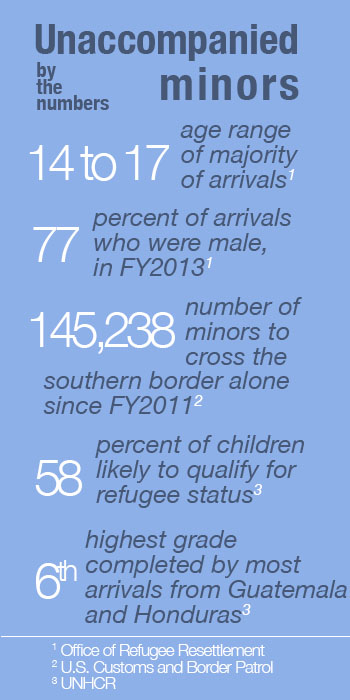
Brandon, who did not want to give his last name because of a pending deportation hearing, is one of 66,127 young people traveling alone who were caught on their way across the U.S.-Mexican border between Oct. 1, 2013 and Aug. 31, 2014.
In 2011, U.S. Customs and Border Patrol began to see a sharp rise in the number of unaccompanied children coming from Guatemala, Honduras and El Salvador. So far in fiscal year 2014, the number of unaccompanied minors caught on the southern border is more than triple the number apprehended in 2010.
Like most new arrivals, Brandon is a here for a complex web of reasons: to flee wanton violence, to escape grinding poverty, and to reunite with family living in the U.S.
Whatever their reasons for coming, the vast majority of the newly arrived children — both the ones the government caught on the way here and the unknown number who made it across without getting picked up by Border Patrol — are now attending the one American institution legally bound to serve them: public schools.
Arriving After Trauma
A majority, 58 percent, of the children arriving here have left war-like conditions that could qualify them for international protection as refugees, according to a recent report by the Office of the United Nations High Commissioner for Refugees, commonly known as UNHCR. The international agency recommends a thorough screening of each arriving minor to determine if he or she qualifies for that protection. Buffeted by shouting matches in Washington, D.C. and several state capitals, that process is underway.
In the meantime, schools across the country are enrolling large numbers of newly arrived Central American students and trying to figure out the best way to serve them.
Related: Q&A with Elizabeth Yelen: Traumatized children have trouble learning – here’s how to help
Many new arrivals have had little formal schooling. A majority stopped attending school after sixth grade, according to UNHCR. In addition to learning English and the subject matter of their various classes, they also must learn to raise their hands to answer questions, change classes when a bell rings and never wander the halls without a bathroom pass. And there are still those normal teenage concerns: remembering one’s locker combination and flirting, now in a new language.
Half of the 390 students at Oakland International High School have arrived in the U.S. from Central America in recent years. Many of them came without a parent or guardian. (Photo: Lillian Mongeau)
A full introduction to all of the requirements of attending school, along with continued support and understanding as students figure things out, will help with this massive shift, said Mary Beth Klotz, director of education practice at the National Association of School Psychologists. So will trauma-informed instruction that takes the new students’ background into account.
Even those who are here more for economic opportunities than out of fear have undertaken a long journey without parents before arriving in a foreign land. And teachers should keep in mind that students who have been here for quite a while still may not be fully settled in, Klotz said.
“There may be a honeymoon period where (students) are absorbing everything new and it may take a while to absorb it before behaviors come out that are concerning,” like tearing up a frustrating assignment or crying at the slightest provocation, Klotz said.
Both reactions are common for people who have survived trauma, Klotz said.
Klotz said she would urge teachers and other school staff to avoid rushing to judgment if a student has emotional problems after only a few weeks in a new country. “It’s really going to take time,” she said.
‘Cobbling Together Resources’
California received 4,680 children from detention centers between Jan. 1 and Aug. 31, 2014 according to the federal Office for Refugee Resettlement. (That gave California the third-largest number of children from detention centers, following New York, with 4,799 children, and Texas, with 6,217.) It’s impossible to calculate how many others have arrived without notifying officials.
Click to enlarge
Click to enlarge


Continue reading here.


Interpreting and reporting for this story were contributed by Jasmín López.
This story was written by The Hechinger Report, a nonprofit, independent news website focused on inequality and innovation in education. Read more about California education.