Translate

Showing posts with label indigenous epistemology. Show all posts

Monday, February 23, 2026

Academia Cuauhtli, the Eagle’s Vision, and the Architecture of Belonging: Education in the Shape of a Circle, by Angela Valenzuela, Ph.D.

Academia Cuauhtli, the Eagle’s Vision, and the Architecture of Belonging: Education in the Shape of a Circle

by 

Angela Valenzuela, Ph.D.

February 23, 2026

In “Academia Cuauhtli and the Eagle: Danza Mexica and the Epistemology of the Circle,” co-authored with Emilio Zamora and Brenda Rubio, we examine what it means to build Academia Cuauhtli as more than a Saturday school program in Austin, Texas. We frame it as an effort to rethink education itself.

The eagle’s vision represents the ability to see in all directions at once—expansively and relationally. For those of us working in community, it reminds us that while no single person can carry all the knowledge required to sustain an ambitious initiative like Academia Cuauhtli—with its Summer School program, parent development component, and curricular writing work—together, we can. 

It also symbolizes the aspirations we collectively hold for the children, families, and community in our care, alongside the disciplined precision with which the eagle, from great heights, fixes its gaze and moves with intention. Analytical clarity. This is what we want for all children—especially in this moment of chaos and uncertainty—so that they may see their world clearly, act with purpose, and rise with confidence rather than confusion.

Access full article here.

At the heart of this work is the circle. It is best exemplified by Danza Mexica or Aztec "dance," connoting not performance, but ceremony and a way of knowing and being in the world, including in educational spaces like Academia Cuauhtli about which I have previously blogged over the years.

In Danza Mexica, individuals form into a circle or concentric circles depending on the size of the group. Movement unfolds collectively. No one stands in front. No one stands above or below. Everyone faces inward toward a shared center—toward memory, spirit, healing, ancestors, and community.

The form itself encodes reciprocity, relationality, and a shared, sacred purpose.

This stands in contrast to the dominant architecture of schooling.

Most classrooms operate through vertical authority structures. Knowledge flows from expert to novice. Students are ranked, sorted, and compared. Time is segmented into benchmarks and testing cycles. Culture is often treated as enrichment rather than foundation.

The circle disrupts this logic.

An epistemology of the circle understands knowledge as generative and co-constructed rather than extractive or subtractive. It recognizes the body as a site of learning. It treats memory as living presence. It invites families, community members, scholars, and children into shared intellectual space. It refuses the idea that culture is peripheral to academic rigor (Colin, 2014).

For us at Academia Cuauhtli, the circle is also a form of pedagogy. It is history enacted through rhythm and specific movements (dance steps) across various ceremonies preserved throughout time. It is language, philosophical concepts, and civic education carried in collective movement. It signals and affirms that children—especially those labeled as “English learners” and targeted by subtractive, deficit-driven discourses—stand within powerful knowledge systems that have survived conquest, colonization, and erasure.

The circle also carries political meaning.

In a moment when ethnic studies programs are dismantled, faculty governance is constrained, and curriculum is policed under the language of “neutrality,” the circle offers another organizing principle. Education can be structured around relational accountability (or "responsibility") rather than surveillance. It can center dignity rather than deficit.

The eagle—or "Cuauhtli," in Nahuatl—symbolizes vision and strength. Yet the eagle rises from within the circle. Aspiration without community becomes isolation. Achievement without memory becomes assimilation.

The circle is not nostalgia. It is infrastructure, a third space situated between the over-prescribed role of the school and the under-prescribed role of the home in the education of our youth.

If we take educational equity seriously, we must ask: What would it mean to organize our classrooms, research partnerships, and institutions around relational centers instead of competitive hierarchies?

The answer does not begin with new mandates.

It begins with remembering—and practicing—the circle as a way of knowing and being in the world.

References

Colín, E. (2014). Indigenous education through dance and ceremony: A Mexica palimpsest. Palgrave MacMillan.

Valenzuela, A., Zamora, E., & Rubio, B. (2015). Academia Cuauhtli and the Eagle:" Danza Mexica" and the Epistemology of the Circle. Voices in Urban Education, 41, 46-56.https://files.eric.ed.gov/fulltext/EJ1074841.pdf



Tuesday, October 15, 2019

Language Carries More Than Words. An Interview of Ojibwe Scholar David Treuer

Epistemology, or ways of knowing, is a concept that is oftentimes hard to grasp because it's hard for us to imagine ourselves outside of our current ways of knowing.  Though not always, one tends to grasp it more readily if you speak two or more languages.  

That said, how we know what we know is mediated by language and culture as this exquisite interview with Ojibwe scholar, David Treuer.  His most recent text that is receiving significant notoriety is titled, The Heartbeat of Wounded Knee: Native America From 1890 to the Present 

Certain concepts, ideas, and the feelings that accompany them, particularly in the realm of identity caught up with a deeps sense of history and place, simply cannot be fully translated.  Hence, the importance of language and cultural preservation and revitalization.

The interview transcript appears below.  However, I encourage you to hear his interview with Krista Tippett in this On Being podcast.

-Angela Valenzuela

On Being with Krista Tippett 

featuring David Treuer

Image by Dan Koeck, © All Rights Reserved.

Language Carries More Than Words


Writer David Treuer’s work tells a story that is richer and more multi-dimensional than the American history most of us learned in school. Treuer, who grew up on the Leech Lake Reservation in northern Minnesota, helped compile the first practical grammar of the Ojibwe people. He says the recovery of tribal languages and names is part of a fuller recovery of our national story — and the human story. And it holds unexpected observations altogether about language and meaning that most of us express unselfconsciously in our mother tongues.

Image of David Treuer


David Treuer divides his time between the Leech Lake Reservation and Los Angeles, where he teaches literature and creative writing at the University of Southern California. His books include Native American Fiction: A User’s Manual, The Translation of Dr. Apelles, and most recently, The Heartbeat of Wounded Knee: Native America From 1890 to the Present. His writing has also appeared in the New York Times, the Los Angeles Times, and The Washington Post.


Monday, January 07, 2019

"The Power of Indigenous Intergenerational Intelligence," by Victor A. Lopez TED Talk


I encourage you to hear this wonderful TED talk by Victor A. Lopez-Carmen on Indigenous Intergenerational Intelligence.  I first heard of this framework from his father many years ago.  You'll hear many quote-worthy statements, including "Eighty percent of the biodiversity left on our planet today is situated in Indigenous-controlled territories despite indigenous people being 5 percent of the global population."

Another is "Intergenerational awareness is the highest form of politics."

My expression for all of this is "ancestral accountability."  This is a way of knowing that is foreign to the Western mind.  As Victor states, it is nevertheless essential to the survival of the coming generations, just as it has been for millenia.


-Angela Valenzuela


Thursday, December 13, 2018

Native Knowledge: What Ecologists Are Learning from Indigenous People


Amazing piece.  I love the assemblage of interconnected words and concepts that come into focus, including "Traditional Ecological Knowledge (TEK)," "traditional wisdom," "biocultural diversity," "climate change," "ethnosphere," and "ecological governance," among others.  

This is the kind of language and languaging that we need in our school curricula that can become a common vocabulary behind what I truly hope will be a Green New Deal with the next administration.  

This shift also needs to inform our thinking towards Indigenous knowledge and ways of knowing, or epistemologies, themselves.  Not as something backward or that can be "usefully" appropriated (stolen) but rather approached in a respectul, humble way. For example, as mentioned in this piece, the indigenous uses of fire provide a complex view that is entirely new to Western thinking. To this end, land managers need to partner, on an equal basis, with native communities everywhere. 

Finally, although not mentioned but abundantly related is that we also have to preserve all indigenous languages, as well, as it is this very life- and planet-saving knowledge that is contained within. 

Enjoy!

-Angela Valenzuela

ILLUSTRATION BY LUISA RIVERA/YALE E360

From Alaska to Australia, scientists are turning to the knowledge of traditional people for a deeper understanding of the natural world. What they are learning is helping them discover more about everything from melting Arctic ice, to protecting fish stocks, to controlling wildfires.

BY JIM ROBBINS  APRIL 26, 2018
·       Facebook

·     Twitter
·       Ema
While he was interviewing Inuit elders in Alaska to find out more about their knowledge of beluga whales and how the mammals might respond to the changing Arctic, researcher Henry Huntington lost track of the conversation as the hunters suddenly switched from the subject of belugas to beavers.
It turned out though, that the hunters were still really talking about whales. There had been an increase in beaver populations, they explained, which had reduced spawning habitat for salmon and other fish, which meant less prey for the belugas and so fewer whales.
“It was a more holistic view of the ecosystem,” said Huntington. And an important tip for whale researchers. “It would be pretty rare for someone studying belugas to be thinking about freshwater ecology.”
Around the globe, researchers are turning to what is known as Traditional Ecological Knowledge (TEK) to fill out an understanding of the natural world. TEK is deep knowledge of a place that has been painstakingly discovered by those who have adapted to it over thousands of years. “People have relied on this detailed knowledge for their survival,” Huntington and a colleague wrote in an article on the subject. “They have literally staked their lives on its accuracy and repeatability.”
Tapping into this traditional wisdom is playing an outsized role in the Arctic, where change is happening rapidly.
This realm has long been studied by disciplines under headings such as ethno-biology, ethno-ornithology, and biocultural diversity. But it has gotten more attention from mainstream scientists lately because of efforts to better understand the world in the face of climate change and the accelerating loss of biodiversity.
Anthropologist Wade Davis, now at the University of British Columbia, refers to the constellation of the world’s cultures as the “ethnosphere,” or “the sum total of all thoughts and dreams, myths, ideas, inspirations, intuitions, brought into being by human imagination since the dawn of consciousness. It’s a symbol of all that we are, and all that we can be, as an astonishingly inquisitive species.”  
One estimate says that while native peoples only comprise some 4 or 5 percent of the world’s population, they use almost a quarter of the world’s land surface and manage 11 percent of its forests. “In doing so, they maintain 80 percent of the planet’s biodiversity in, or adjacent to, 85 percent of the world’s protected areas,” writes Gleb Raygorodetsky, a researcher with the POLIS Project on Ecological Governance at the University of Victoria and the author of The Archipelago of Hope: Wisdom and Resilience from the Edge of Climate Change.
Tapping into this wisdom is playing an outsized role in sparsely settled places such as the Arctic, where change is happening rapidly – warming is occurring twice as fast as other parts of the world. Tero Mustonen, a Finnish researcher and chief of his village of Selkie, is pioneering the blending of TEK and mainstream science as the director of a project called the Snowchange Cooperative. “Remote sensing can detect changes,” he says. “But what happens as a result, what does it mean?” That’s where traditional knowledge can come into play as native people who make a living on the landscape as hunters and fishers note the dramatic changes taking place in remote locales – everything from thawing permafrost to change in reindeer migration and other types of biodiversity redistribution.


The Skolt Sami people of Finland have documented a local decline in Atlantic salmon and are collaborating with scientists on a project to restore them.  GLEB RAYGORODETSKY

The Skolt Sami people of Finland, for example, participated in a study that was published in the journal Science last year, which adopted indicators of environmental changes based on TEK. The Sami have seen and documented a decline in salmon in the Näätämö River, for instance. Now, based on their knowledge, they are adapting – reducing the number of seine nets they use to catch fish, restoring spawning sites, and also taking more pike, which prey on young salmon, as part of their catch. The project is part of a co-management process between the Sami and the government of Finland.
ALSO ON YALE E360
Food Insecurity: Arctic heat is threatening indigenous life. Read more.
The project has also gathered information from the Sami about insects, which are temperature dependent and provide an important indicator of a changing Arctic. The Sami have witnessed dramatic changes in the range of insects that are making their way north. The scarbaeid beetle, for example, was documented by Sami people as the invader arrived in the forests of Finland and Norway, far north of its customary range. It has also become part of the Sami oral history.
It’s not only in the Arctic. Around the world there are efforts to make use of traditional wisdom to gain a better and deeper understanding of the planet – and there is sometimes a lot at stake.
Record brush fires burned across Australia in 2009, killing 173 people and injuring more than 400. The day the number of fires peaked – February 7 – is known as Black Saturday. It led to a great deal of soul searching in Australia, especially as climate warming has exacerbated fire seasons there.
Land managers in Australia have adopted many of the fire-control practices of the aborigines and have partnered with native people.
Bill Gammage is an academic historian and fellow at the Humanities Research Center of the Australian National University, and his book, The Biggest Estate on Earth: How the Aborigines Made Australia, looks at the complex and adept way that aborigines, prior to colonization in 1789, managed the landscape with “fire and no fire” – something called “fire stick farming.”
They used “cool” fires to control everything from biodiversity to water supply to the abundance of wildlife and edible plants. Gammage noted five stages of the indigenous use of fire – first was to control wildfire fuel; second, to maintain diversity; third, to balance species; fourth, to ensure abundance; and five, to locate resources conveniently and predictably. The current regime, he says, is still struggling with number one.
“Controlled fire averted uncontrolled fire,” Gammage says, “and fire or no-fire distributed plants with the precision of a flame edge. In turn, this attracted or deterred grazing animals and located them in habitats each preferred, making them abundant, convenient, and predictable. All was where fire or no-fire put it. Australia was not natural in 1788, but made.”
While the skill of aborigines with fire had been noted before the giant brushfires – early settlers remarked on the “park-like” nature of the landscape – and studied before, it’s taken on new urgency. That’s why Australian land managers have adopted many of the ideas and partnered with native people as co-managers. The fire practices of the aborigines are also being taught and used in other countries.
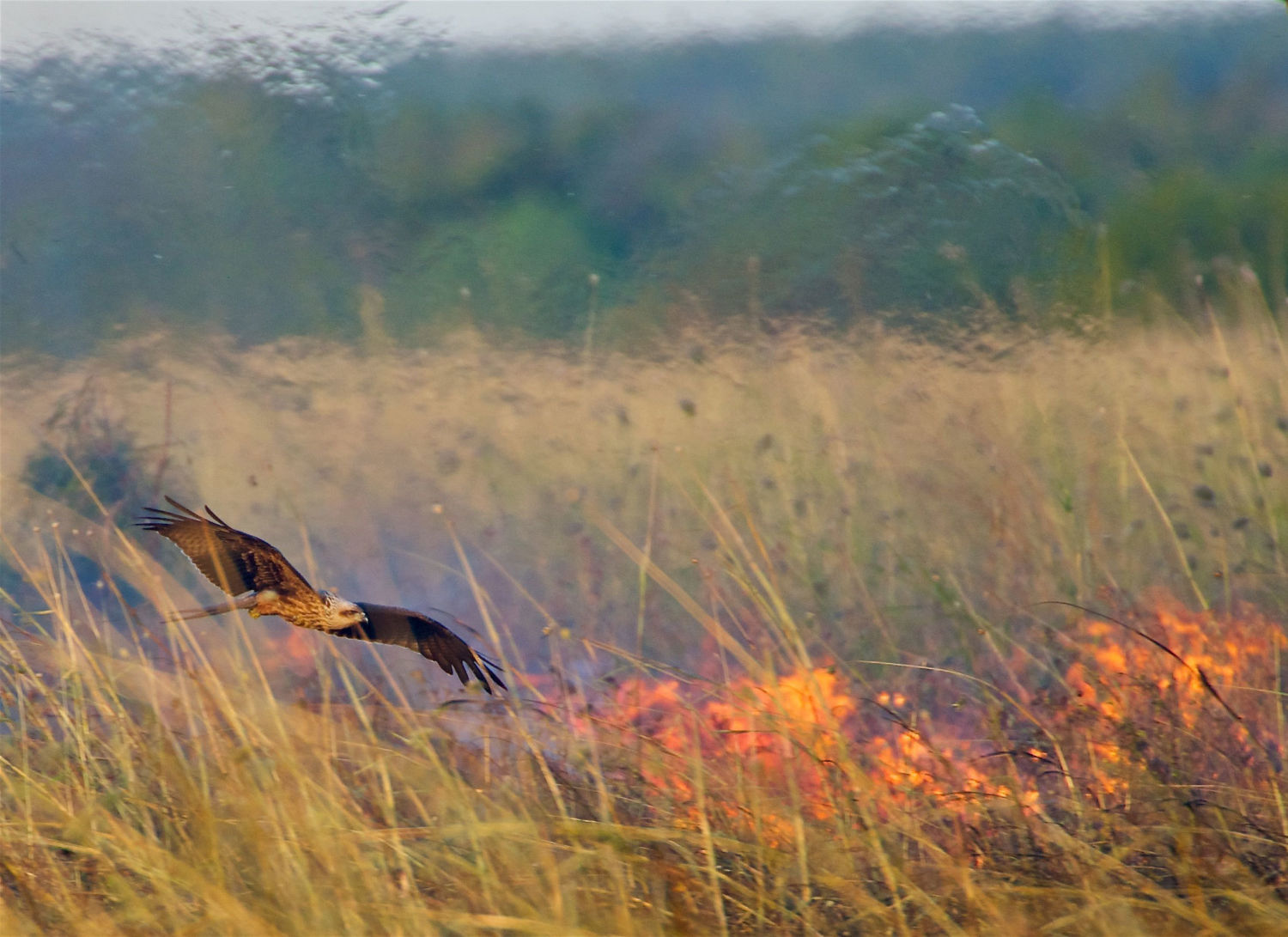
Scientists have looked to Australian natives for other insights into the natural world. A team of researchers collaborated with natives based on their observations of kites and falcons that fly with flaming branches from a forest fire to start other fires. It’s well known that birds will hunt mice and lizards as they flee the flames of a wildfire. But stories among indigenous people in northern Australia held that some birds actually started fires by dropping a burning branch in unburned places. Based on this TEK, researchers watched and documented this behavior.
Aboriginal Australians were the first to observe that kites hunt their prey by dropping burning branches to start new brush fires. BOB GOSFORD

“It’s a feeding frenzy, because out of these grasslands comes small birds, lizards, insects, everything fleeing in front of the fire,” said Bob Gosford, an indigenous rights lawyer and ornithologist, who worked on the research, in an interview with the Australian Broadcasting Corporation in 2016.
Another recent study down under found that an ancient practice of using fire to clear land to improve hunting also creates a more diverse mosaic of re-growth that increases the number of the primate prey species: monitor lizards and kangaroos.  
“Westerners  have done little but isolate ourselves from nature,” said Mark Bonta, an assistant professor at Penn State Altoona who was on a co-author on the paper on fire and raptors. “Yet those who make a point of connecting with our earth in some form have enormous knowledge because they interact with a species. When you get into conservation, [that knowledge] is even more important.” Aboriginal people “don’t see themselves as superior to or separated from animals. They are walking storehouses of knowledge,” he said.
The Maya people of Mesoamerica have much to teach us about farming, experts say. Researchers have found that they preserve an astonishing amount of biodiversity in their forest gardens, in harmony with the surrounding forest. “The active gardens found around Maya forest villagers’ houses shows that it’s the most diverse domestic system in the world,” integrated into the forest ecosystem, writes Anabel Ford, who is head of the MesoAmerican Research Center at the University of California at Santa Barbara. “These forest gardeners are heroes, yet their skill and sophistication have too long been set aside and devalued.”
Some native people have the ability to adopt the “perspective of many creatures and objects – rocks, water, clouds,” a researcher says.
Valuing these life ways is an important part of the process. For the Skolt Sami, writes Mustonen, “seeing their language and culture valued led to an increase in self-esteem and power over their resources.”
It may not just be facts about the natural world that are important in these exchanges, but different ways of being and perceiving. In fact, there are researchers looking into the relationship between some indigenous people and the very different ways they see the world.  
Felice Wyndham is an ecological anthropologist and ethnobiologist who has noted that people she has worked with can intimately sense the world beyond their body. “It’s a form of enhanced mindfulness,” she says. “It’s quite common, you see it in most hunter-gatherer groups. It’s an extremely developed skill base of cognitive agility, of being able to put yourself into a viewpoint and perspective of many creatures or objects – rocks, water, clouds. 

“We, as humans, have a remarkable sensitivity, imagination, and ability to be cognitively agile,” Wyndham says. “If we are open to it and train ourselves to learn how to drop all of the distractions to our sensory capacity, we’re able to do so much more biologically than we use in contemporary industrial society.”
Among the most important messages from traditional people is their equanimity and optimism. There “is no sense of doom and gloom,” says Raygorodetsky. “Despite dire circumstances, they maintain hope for the future.”
·       Facebook·       Twitter

·       Email
Jim Robbins is a veteran journalist based in Helena, Montana. He has written for the New York Times, Conde Nast Traveler, and numerous other publications. His latest book, The Wonder of Birds: What they Tell Us about the World, Ourselves and a Better Future, is due out in May. MOREABOUT JIM ROBBINS →