Translate

Showing posts with label Native American and Indigenous Studies (NAIS). Show all posts

Thursday, May 21, 2026

What the Proposed Texas Middle School TEKS Leave Out About Indigenous Peoples, by The Social Studies Advocate

Friends,

I invite you to read this deeply concerning analysis published in The Social Studies Advocate on what the proposed Texas middle school social studies TEKS leave out about Indigenous peoples.

The piece documents serious omissions, biases, and erasures in the proposed grades 6–8 standards, including the absence of sustained attention to tribal sovereignty, the Doctrine of Discovery, boarding schools, allotment, the Indian Citizenship Act, the Indian Reorganization Act, the Indian Child Welfare Act, and the contemporary presence of Indigenous nations and communities in Texas. These are not minor gaps. They shape how generations of Texas students will understand land, history, law, citizenship, and the peoples who were here long before Texas existed.

The Texas State Board of Education is scheduled to meet June 22–26, 2026, and I understand that Texas Freedom Network and other organizations may be organizing public opposition to these omissions, biases, and erasures. I will keep you posted as the date draws nearer.

In the meantime, please read and share widely. Also consider following The Social Studies Advocate on Instagram. These proposed standards deserve careful public scrutiny before they become the law of Texas classrooms.

In solidarity,

Angela Valenzuela


What the Proposed Texas Middle School TEKS Leave Out About Indigenous Peoples

A review of the proposed grades 6–8 social studies standards reveals systematic gaps in the treatment of American Indian history

The Social Studies Advocate

Apr 20, 2026

When Texas school districts begin implementing the proposed 2026 social studies TEKS in the 2030–2031 school year, students across the state will receive their foundational understanding of Texas and American history in grades 6 through 8. What they learn in those three years, and what they don’t, will shape how they understand the land they live on, the government that serves them, and the people who were here long before the state existed.

The analysis below is based on critiques offered by Dr. Scott Langston, Ph.D., a religion scholar and Native American studies researcher who retired from Texas Christian University, where he served as the inaugural Native American Nations and Communities Liaison, reviewed a draft of the proposed middle school TEKS and produced a detailed written analysis. Langston is the author of Exodus through the Centuries (Wiley/Blackwell, 2006) and co-author of Being in Relation: Indigenous Peoples, the Land, and Texas Christian University, 1873–2023 (TCU Press, 2025). He has been quoted in the Dallas Morning News on the history of Indigenous peoples in North Texas, including on Mirabeau Lamar’s policy of “exterminating war” against Native nations. His analysis of the TEKS draft is thorough, specific, and grounded in Texas-specific historical scholarship.

After much debate at the SBOE meeting from April 7 to 10, and numerous amendments until early in the morning, the version that emerged from the most recent round of Work Group B revisions and SBOE amendments addresses essentially none of the concerns Langston raised. This piece summarizes his critique and compares it against what the current draft actually contains.

Moving Moccasins group brings Native American artists into schools and classrooms, https://austinpowwow.net/great-promise-dancers/


The Structural Problem: American Indians as Historical Rather Than Contemporary


The most fundamental concern is not about any individual omission. It is about the cumulative effect of how American Indian peoples appear, and disappear, across the grades 6–8 curriculum. We are specifically looking at grades 6-8 because this is when students will learn the bulk of U.S. and Texas history, from 1800 to modern day.

In the proposed standards, Indigenous peoples are present in the early grades as part of the westward expansion narrative, appear briefly during the Texas frontier period, and then largely vanish. There is no sustained treatment of American Indians through the 20th century and into the present. This is not a minor gap but a structural failure: it leaves students with the impression that Indigenous peoples belong to the past, frozen somewhere in the 19th century, rather than existing as contemporary peoples with ongoing legal relationships with the state and federal government.

This matters because those relationships did not end in the 1850s. Three federally recognized tribes and several non-recognized tribes reside in Texas today. The period from the late 19th to the early 21st century saw significant developments and shifts in U.S. American Indian policy, including, boarding schools, allotment of reservations (especially the Dawes Act of 1887), Indian Reorganization Act (1934), termination of federal relationships with tribes, federal Relocation program, Indian Adoption project, Indian Self-Determination and Education Assistance Act (1975), Indian Child Welfare Act (1978) and the challenge to it in Haaland v. Brackeen (2023), American Indian Religious Freedom Act (1978), and McGirt v. Oklahoma (2020). This curriculum removes and excludes American Indians from U.S. history. It is a major gap in the curriculum.

These are not distant historical footnotes. They are active legal and political realities with direct Texas connections, and they appear nowhere in the proposed standards.

The Doctrine of Discovery: The Missing Foundation

The most significant omission is the Doctrine of Discovery, and particularly the U.S. Supreme Court’s 1823 opinion in Johnson v. M’Intosh. The Doctrine of Discovery was set out in a series of declarations by popes in the 15th century. Papal bulls provided religious authority for Christian empires to invade and subjugate non‐Christian lands, and impose Christianity on these populations. These papal bulls provided justification to European empires embarking on widescale colonial expansion.

The proposed standards explicitly emphasize the importance of strong property rights and the free enterprise system as core values. What Johnson v. M’Intosh establishes, however, is the legal foundation upon which American property rights rest, a foundation that, as the Court itself acknowledged, derived from European claims of discovery and explicitly did not recognize Indigenous peoples as owners of the land they had occupied for millennia.

In other words, students are being taught that strong property rights are a cornerstone of the American system, without being taught the legal history that defines whose property rights were recognized and whose were not. Students cannot fully understand American property law, westward expansion, or the free enterprise system without knowing it.

The Doctrine of Discovery does not appear in the current draft. Neither does Johnson v. M’Intosh.

Tribal Sovereignty: A Constitutional Relationship, Unnamed

Closely related is another structural omission: the proposed TEKS never establish that American Indian tribes hold the status of sovereign nations in a government-to-government relationship with the United States, a status grounded in Article I, Section 8 of the U.S. Constitution and affirmed repeatedly by the Supreme Court.

Throughout the grades 6–8 standards, Indigenous peoples are referred to as “communities” or “tribes,” but never as “nations” with the legal standing that word implies. This has practical consequences for how students understand Texas history. When settlers moved into Mexican Texas, they were entering the territory of American Indian nations. When the Republic of Texas claimed land, it was asserting ownership over territory those nations had occupied for centuries. When Mirabeau Lamar pursued his policy of expulsion and extermination, he was conducting a war against sovereign peoples. None of this context is available to students if they have not been taught that tribes hold recognized national status under U.S. law.

The proposed TEKS do require students to compare the presidencies of Lamar and Sam Houston, “including views on annexation, American Indians, and Mexico.” But Lamar’s own words, “total extinction” and “total expulsion,” are not named. The standard as written does not require students to understand what Lamar’s policy actually entailed.
Major Omissions by Grade

Grade 6 (1800-1900)

The massive disruptions to Indigenous peoples caused by the Louisiana Purchase, the War of 1812, and Andrew Jackson’s Indian Removal Act are not connected to their consequences for American Indian nations who were displaced into Texas, which then created the conditions for later conflicts during the Republic period. Students cannot understand why various non-indigenous tribes were present in Texas without this context.

Several experts raised flags over the wording of this SE: “explain how the Trail of Tears impacted tribal relations along the Northern border of Texas.” Despite the numerous amendments raised during the week of April 7, it remains unchanged. This language shifts the impact of Jackson’s policies from the impact of U.S. policies on indigenous nations, to tribal relations. Additionally, it omits the decision in Worcester v. Georgia (1832), which recognized Cherokee sovereignty and the unconstitutionality of state encroachment on tribal territory under federal treaties, a ruling that both Georgia and the Jackson administration refused to enforce, proceeding with removal regardless.

In the Civil War and Reconstruction unit, there is no mention of the participation of Indigenous peoples in the war, or of slavery’s distinct application to Indigenous peoples.

Most significantly, the standards covering the late 19th century, the closing of the frontier, the Gilded Age, contain no mention of boarding schools or forced allotment of reservation lands. This is inconceivable for any credible curriculum. The boarding school system, which operated from the 1870s through the mid-20th century, was one of the most deliberately destructive policies in American history toward Indigenous cultural survival. The Dawes Act of 1887 and the Supreme Court’s 1903 decision in Lone Wolf v. Hitchcock, which enabled the forced allotment of reservation lands over tribal objection, shaped the lives of Indigenous peoples for generations. The Dawes Act and boarding schools are taught in current U.S. history standards in 11th grade. Neither appears in the proposed standards, and it begs the question, why are these being removed?

Grade 7 (1900-2000)

Grade 7 covers the Progressive Era through the early 21st century. Among the many topics covered across more than a century of American history, there is not a single mention of American Indian peoples in the course introduction. The standards move from the 1890s to the present as though Indigenous peoples ceased to exist at the close of the frontier.

The specific omissions are extensive. The Indian Citizenship Act of 1924 is absent. The Indian Reorganization Act of 1934, which restructured the relationship between the federal government and tribal governments and remains foundational to understanding tribal governance today, is absent. The Termination policy of the 1950s, which ended the federal relationship with some tribes and proved devastating, is absent.

The Indian Relocation Act of 1956 is absent, despite the fact that Dallas was designated as a federal relocation center, bringing thousands of American Indians to North Texas over several decades. The Indian Self-Determination and Education Assistance Act of 1975, the American Indian Religious Freedom Act of 1978, and the Indian Child Welfare Act of 1978 are all absent.

The Grade 7 standards do include the American Indian Movement and the Wounded Knee Occupation in the Civil Rights era section. However, the inclusion is decontextualized without the broader Red Power movement, the Indian Civil Rights Act of 1968, or the legislative achievements of the 1970s that were the movement’s most significant outcomes.

Grade 8 (Capstone Texas History Course)


In Grade 8 the omissions carry particular weight because this is where students are expected to develop a comprehensive understanding of the state’s past.

The course introduction refers to “the earliest human presence” in Texas without naming American Indians specifically, a terminological choice that obscures the millennia-long Indigenous presence in the region. Similarly, the use of “prehistoric” to describe ancient Indigenous cultures carries connotations of primitiveness that “ancient” would not.

The Gault Site, one of the most significant archaeological sites in North America for understanding early human presence on the continent, is not mentioned. Caddo Mounds State Historical Site, a Texas State Historical Commission site that documents the sophisticated culture of the Caddo people, is not mentioned.

The Grade 8 standards do include coverage of conflicts between the Republic of Texas and American Indian groups, including Fort Parker, the Council House Fight, and the Battle of Neches. But the framing does not require students to understand these events as Indigenous peoples defending their homelands and legal standing as nations.

The standards covering the Civil Rights era in Texas contain no mention of American Indians. The Indian Relocation Act’s connection to Dallas is absent. The contemporary Texas section, which closes the course, does not address the three federally recognized tribes currently residing

in Texas, the ongoing legal and cultural work of non-federally recognized tribes, or the existence of American Indians as contemporary peoples with active civic and economic lives.

Why This Matters Beyond Representation

The proposed TEKS emphasize the free enterprise system, strong property rights, and the foundational importance of constitutional law. Students cannot fully understand any of these things without understanding the Doctrine of Discovery, Johnson v. M’Intosh, the federal Indian trust responsibility, and tribal sovereignty. These are not alternative or oppositional values. They are part of the same legal and constitutional framework the TEKS claim to be teaching.

A curriculum that teaches strong property rights without teaching the legal history of whose property rights were recognized, and whose were not, by design, is an incomplete curriculum. A curriculum that teaches the U.S. Constitution without teaching the government-to-government relationships it established with tribal nations is an incomplete curriculum. These are not ideological claims. They are observations about what the documents say.

What You Can Do

The proposed TEKS are still subject to revision before final adoption. We remain concerned about the undisclosed financial relationship between Content Advisor Don Frazier’s Texas Center at Schreiner University and the Texas Public Policy Foundation, including the $70,000 in TPPF funding to that center, and what it means for the independence of this revision process. The standards as proposed reflect a consistent ideological perspective that raises legitimate questions about whether Texan students are receiving history education or something closer to political formation.

If you want to weigh in on these standards, you can:

Contact the legislature and demand oversight into the process as a whole. It has been rushed and the input of stakeholders, including experts and educators, has been significantly curtailed while politically motivated interest groups have had an outsized influence. Specifically reach out to members of the Senate Education Committee and House Public Education Committee, James Talarico and Gina Hinojosa. Ask them to pause this process and conduct a review of the connection between TPPF and Don Frazier.

Contact all the SBOE representative directly. Write or call with specific concerns about the treatment of American Indian history in the proposed grades 6–8 standards.

The most up-to-date drafts from the April Board meeting will be posted at least 30 days before the next SBOE meeting June 22 (so by mid-May). Submit written public comment to the SBOE ahead of upcoming hearings. Specific, evidence-based comments citing the standards by section number carry the most weight.

Share this analysis with educators, school board members, and community members who may not be following the TEKS revision process closely.

The Texas Essential Knowledge and Skills are not just a list of topics. They are a set of decisions about what Texas students are expected to know and be able to do. The decisions embedded in the current draft, including what has been left out, deserve careful public scrutiny before they become the law of Texas classrooms.

Thanks for reading! This post is public so feel free to share it.

Share

This analysis draws on Dr. Scott Langston’s written review of the proposed middle school TEKS and on the post-April 2026 draft of the proposed standards (Attachment II, Chapter 113, Subchapter B).


Monday, November 10, 2025

“It’s Unwritten History”: The Long Fight for Native American and Indigenous Studies for Texas Public Schools, by Angela Valenzuela, Ph.D.

“It’s Unwritten History”: The Long Fight for Native American and Indigenous Studies for Texas Public Schools

by

Angela Valenzuela, Ph.D.

November 10, 2025

This excellent, half-hour conversation on the unwritten history of the long struggle for the inclusion of Native American and Indigenous Studies for Texas schools is both clarifying and deeply engaging. It shines light on voices that have too often been excluded from our state’s curriculum — and on the persistence of those who have worked tirelessly to change that.

I encourage readers to pair this Fronteras segment with an earlier blog post I shared, “Texas State Board of Education renews American Indian/Native Studies course," by Riddhi Bora in Shift/Press, July 4, 2025,” by Riddhi Bora, published in Shift/Press on July 4, 2025. Together, these pieces trace a remarkable trajectory of advocacy, collaboration, and resilience that has brought us to this historic moment.

My heartfelt thanks to Norma MartinezMarian Navarro, and Texas Public Radio for hosting this important conversation. Their coverage reminds us that Native Studies is not simply about adding another elective to the curriculum—it’s about restoring visibility and dignity to Indigenous histories and worldviews that have been systematically erased or distorted for generations.

As the program notes, the new American Indian/Native Studies course was formally approved by the Texas State Board of Education in June, giving districts across the state the option to offer it as an elective. Students who enroll will now have the opportunity to learn about the histories and living cultures of American Indian peoples and to understand contemporary issues from Native perspectives.

This victory follows years of organizing, from early pilot programs like the one launched in Grand Prairie ISD in 2021 to sustained advocacy by educators, tribal leaders, and allies such as Hawana Townsley—a descendant of Comanche leader Quanah Parker—who helped design the original curriculum. As Townsley so beautifully put it, “We want to ignite that spark of interest so that maybe these students… will take a lifelong journey to learn more about us now and historically.”

Equally inspiring are the words of Marisa Pérez-Díaz, a steadfast advocate on the State Board of Education: “If we provide resonant curriculums where our students can see themselves in the language and experiences, there's a connection there—a deeper commitment to their education, and we'll see more successes.”

And as Orlando Lara, co-founder of the Ethnic Studies Network of Texas, reminds us, this victory is part of a much longer lineage: “The call for ethnic studies in Texas has a long, long history… there’s this long kind of unwritten history that we’re sort of starting to write now.”

Indeed, that history is being written—by educators, parents, students, and community leaders who refuse to let erasure define our collective memory.

As the Department of Education recently clarified in its letter to the National Indian Education Association, the teaching of American Indian, Alaska Native, and Native Hawaiian history does not constitute “DEI” or “CRT.” It is, rather, an act of historical honesty and educational equity—something our democracy requires if it is to survive and thrive.

And similarly, the inclusion of Mexican American Studies and African American Studies in public schools does not constitute DEI or CRT—it is about rightful representation, rigorous scholarship, and honoring historically marginalized peoples whose intellectual traditions and lived realities have been excluded from mainstream curricula.

Clearly, there is more work ahead. But our progress is real, and it is worth celebrating.

You can listen to the full Fronteras episode here.


Fronteras: ‘It’s unwritten history’— The years-long fight to offer American Indian/Native Studies in Texas public schools

by Norma Martinez & Marian Navarro | Texas Public Radio | August 29, 2025
A photo from the North Texas Ethnic Studies Regional gathering in Ft. Worth, Texas 2019.
Jonathan Perez

Following approval from the Texas State Board of Education in June, school districts across the state now have the option to offer American Indian/Native Studies as an elective course.

Students who enroll in the course will learn about the history and living cultures of American Indians and understand issues and events from Native perspectives, according to the Texas Education Agency.

Approval came following a years-long process and amid a new state law that bans diversity, equity, and inclusion initiatives in public schools.

The basis of the Native American Studies course was piloted in 2021 in the Grand Prairie Independent School District.

Hawana Townsley — a descendant of 19th century Comanche leader, Quanah Parker —helped craft the curriculum from the beginning.

“We want to ignite that spark of interest so that maybe these students that are in the class will find an interest, and this will become a lifelong journey that they are taking to learn more about us now and historically,” she said.

Marisa Pérez-Díaz, a member of the Texas State Board of Education, has been a champion for ethnic studies.

“(If) we provide resonant curriculums where our students can see themselves in the language and in the experiences, there's a connection there,” she said. “There's a deeper commitment to their education, and we'll see more successes.”

Orlando Lara, co-founder of the Ethnic Studies Network of Texas, agreed.

“The call for ethnic studies in Texas has a long, long history,” he said. “There's this long kind of unwritten history that we're sort of starting to write now.”

Read a recent letter from the Department of Education below on why American Indian, Alaska Native, and Native Hawaiian history is not classified as diversity, equity, and inclusion (DEI) or Critical Race Theory (CRT).

Letter From Department of Education to NIEA by Texas Public Radio 

TPR was founded by and is supported by our community. If you value our commitment to the highest standards of responsible journalism and are able to do so, please consider making your gift of support today.

Tags
Fronteras TPRTop Stories

Norma Martinez
Norma Martinez can be reached at norma@tpr.org and on Twitter at @NormDog1
See stories by Norma Martinez

Marian Navarro
marian@tpr.org
See stories by Marian Navarro

Sunday, November 17, 2024

Please Sign and Share American Indian/Native Studies Petition for Texas Public, K-12 Schools

Art by Deante’ Moore.
Friends:

Do read and learn about the context within which we seek support for this American Indian/Native Studies petition for Texas Public,
K-12 Schools.

This is part of the ongoing Ethnic Studies Movement in Texas. Please Sign and Share.

Angela Valenzuela


What happens in Texas public education impacts the rest of the United States because of the role the state plays in developing K-12 textbooks and instructional materials that get adopted in other parts of the US. Texas has also helped lead the nation in book-banning and censorship, all while severely under-funding public education. The state's hard turn toward academic censorship has now also impacted Ethnic Studies. Prior to 2024, Texas educators were well on their way to developing a complete roster of high school level Ethnic Studies courses, with record enrollment for the already adopted Mexican American and African American Studies courses. Since Governor Abbot appointed a new SBOE Chair in December of 2023, the process of Ethnic Studies course adoption has ground to a halt, with a ground-breaking course in American/Indian Studies being the first course to get side-lined in the process.

IMPORTANT UPDATE: SBOE Chair Kinsey did not add the AI/NS course to the June agenda. However, we still want him to add the course at the next available SBOE board meeting. Please sign this petition.

If you live in District 15, we encourage you to write and call Chair Kinsey. Check here to see if you live in Chair Kinsey's District, which includes cities such as Lubbock, Abilene, Odessa, Midland, and others.

How did we get here?

In 2018, the Texas State Board of Education called for the creation of four specific Ethnic Studies courses. "Native American Studies" was among them. In the summer of 2019, course developers began discussing the creation of Native Studies course at an Ethnic Studies regional gathering held at TCU. In the Spring of 2020, a committee of native community members and allies hosted a conversation hosted by Grand Prairie ISD to gather community feedback for a 10-12th grade course in American Indian/Native Studies. Grand Prairie ISD began piloting the course in 2021 and the Texas Education Agency approved the Innovative Course in the summer of 2023. The AI/NS course has now been piloted for three years and has been adopted in Robstown ISD, Crowley ISD, and is being considered by some other districts. SBOE board members and the public has had since June of 2023 to review the TEA-approved course and its recommended course materials. These materials are not part of the official TEKS adoption process.

The AI/NS course was slated to be heard for “First Reading” in January of 2024, but the item was mysteriously absent when the agenda was released on January 19. We learned later that new SBOE Board Chair, Aaron Kinsey, who was appointed by Governor Abbott in December of 2023, decided to pull the item to have more time to review the course. On February 2, Chair Kinsey stated that he would discuss the course with fellow SBOE members in February. During this time, more than 200 community members throughout Texas sent a total of more than 3 thousand emails to SBOE members, including Chair Kinsey, asking him to put the course back on the SBOE agenda for April of this year.

As the April SBOE meeting approached, there was very little indication that Chair Kinsey had used the extra time to discuss the course details with fellow board members, instead using that time to focus on the course's recommended course materials, which are not part of the official TEKS adoption process. By the end of March, he stated that the course had never been put on the April agenda and that the course was already available to students as an innovative course. Unfortunately, the current AI/NS Innovative course, expires after 2025 (confirmed on the TEA website), and there is no guarantee that the course will be renewed. If the SBOE does not review the course this year, Kinsey and the board will oversee the renewal process next year, but, if approved, this would only extend its innovative pilot status temporarily. This will create confusion and uncertainty for many districts in Texas. The course is running out of time. The course should be reviewed and adopted as soon as possible so that districts can have time to incorporate the course into their Fall 2025 calendars.

We continue to call on all Texas parents, educators, students, and community members to help get the American Indian/Native Studies course back on track for review and approval this year.


While we advocate for the TEKS-based course review process to be completed this year, districts can and should continue to offer the course in current and future academic years.


Districts do not have to wait for the Texas SBOE to approve the course in order to offer it.


Why should you support this course?

The Texas SBOE was one of the first state boards to adopt high-school level courses in Mexican American Studies in 2018 and an African American Studies course in 2020. Since the 2020-2021 school year, course enrollment has grown from 6,500 students for both classes combined to nearly 21,000 students in 2023 and 2024. MAS and AAS make up 25% of all Social Studies course electives. Both courses have been among the top 3 most popular Social Studies electives for the past 3 years with MAS being the most popular in recent years. Simply put, Texas students want Ethnic Studies in their schools.

A total of 74 tribal councils, organizations, churches, and elected officials have called on bringing the AI/NS Innovative course into the Social Studies TEKS by the end of 2024.

The following 20 tribal councils, departments, cultural organizations, and officials have reviewed the AI/NS Innovative course standards and endorsed the course as written. See the letters here.The Lipan Apache Tribe of Texas
The Citizen Potawatomi Nation
The Comanche Nation
The Society for Native Nations
American Indians at the Spanish Colonial Missions
The Indigenous Cultures Institute
The Institute of Texan Cultures
Indigenous Peoples Caucus of the Texas Democratic Party
TCU's Native and Indigenous Student Association
UNT’s Native American Student Association
UTA’s Native American Student Association
Texas Unitarian Universalist Justice Ministry (TXUUJM)
Lubbock Compact Foundation
NAACP Lubbock Branch
Mexican American Studies at Texas Tech University
Southwestern University’s Education Department
TCU’s Department of Comparative Race and Ethnic Studies
Vikki Goodwin, Texas State Representative, District 47
Salman Bhojani, Texas State Representative , District 92
Perla Bojorquez, Democratic Nominee, Texas House of Representatives, District 93
James Talarico, Texas State Representative, District 50


An additional 60 organizations have called on the Texas SBOE to review and adopt the AI/NS course in 2024. The Dallas Morning News Editorial Board has also called for the course to move forward.

For more than 40 years, Texas educators, parents, community members, and students have been calling on the Texas SBOE to create Ethnic Studies courses. In fact, the Texas SBOE has approved courses in Ethnic Studies since the late 1960s, only to fail to give them the needed support. Today, Texas students have voted with their feet and shown that they want Ethnic Studies in their high schools.

By approving the first American Indian/Native Studies course in Texas history, the Texas SBOE has the chance to not only make Texas proud. It has the chance to make history by acting differently than their predecessors have acted in the past.

If you would like to support the AI/NS course, please sign the petition below and share this petition with your family, friends, co-workers, and most active listservs.Who should sign this petition?

Texas communities need your help! Anyone in the US can sign this petition. Anyone who care about making native knowledge accessible to students in schools should sign the petition, including native people and allies from outside the US. If you are a member of a tribal community in the US or anywhere in the world, please note that when you sign the petition.What if I live in Texas or if Chair Kinsey is my SBOE Rep?

If you live in District 15 (Midland, Lubbock, etc.), WE NEED YOUR HELP to call and email Chair Kinsey! Visit this website to check if Chair Kinsey is your SBOE member.

If you live in Texas, you can also write and call Chair Kinsey. As a Texas tax-payer, the matter of what is included in the SBOE agenda impacts all Texans, including you.

Use this call and email tool to call and email Chair Kinsey.

Can organizations, associations, or academic units do anything to help?

If you are a member of or a leader in a community organization, educational or scholarly association, or academic program, please consider signing onto this organizational sign on letter.

Can tribal councils, community groups, or other elected officials do anything to help?


Absolutely! If you are a member of a tribal council, a community group, or are an elected official, you can review the course and draft an individual endorsement letter. Please email ethnicstudiesnetworkoftexas@gmail.com so that we can provide you with some support.

Additional links and information:Public Testimony at the Texas SBOE and Press Conferences:Course Development Committee Testimony at the Committee of Instruction (August 31, 2023)
Course Testimony at “First Discussion” before the Texas SBOE (November 15, 2023)
Public Testimony at the SBOE General Meeting (February 2, 2024)
Public Testimony at the SBOE General Meeting (April 12, 2024)
Public Testimony at the SBOE General Meeting (June 28, 2024)
Community Press Conference at the Texas SBOE (June 28, 2024)


Media Coverage and Community Posts:“A Brief History of the AINS Course” by the Indigenous Institute of the Americas (January 2024)
Vote on Native studies class for Texas Schools postponed” (January 23, 2024)
Abbot Appointee Slams Brakes on American Indian/Native Studies Course” (January 30, 2024)
Advocates call on Texas education officials to approve AI/NS course” (February 1, 2024)
Texas State Board of Education delays Native American course approval” (February 6, 2024)
Texas’ Native American studies program should move forward” (March 6, 2024)
"‘We’re still here’: Native Americans push for native studies elective in Texas" (March 27, 2024)
"Texas Native American studies course further delayed, triggering frustration" (April 1, 2024)
"State Board of Education again delays discussion on whether to approve new Native studies course" (April 1, 2024)
"Decision on Native Studies course in Texas delayed" (April 3, 2024)
"KUT Morning News Cast" (April 12, 2024)
"State Board of Education delays vote on Native American studies course" (April 15, 2024)
#WeAreStillHere: A Multi-city Hybrid Press Conference - Live from Lubbock” (June 10, 2024)
Advocates for Native American studies push for new elective in Texas schools” (June 10, 2024)
Lubbock community leaders, tribal members urge inclusion of American Indian/Native Studies course on SBOE agenda” (June 10, 2024)
"Coalition petitions Texas’ education board to adopt American Indian/Native studies course" (June 28, 2024)


Local Implementation:

Local school districts and community members should know that the AI/NS Innovative course can be implemented at the district level in 2024-2025. This will help course creators renew the innovative course in 2025, should that be necessary, but in no way is innovative course status enough. The AI/NS course deserves a more stable place in the Social Studies TEKS-approved elective course roster. Either way, we encourage you to begin the process of local adoption now.

Contact information:

For questions about this petition or if you would like to write a letter of endorsement or support in other ways, please email the Ethnic Studies Network of Texas at ethnicstudiesnetworkoftexas@gmail.com.

Sponsored by Ethnic Studies Network of Texas

To: The Texas State Board of Education
From: [Your Name]


I stand in strong support of the American Indian/Native Studies innovative course as approved by the Texas Education Agency in the summer of 2023. I call on the Texas State Board of Education to place the AI/NS innovative course on the next available agenda so that it can be reviewed by SBOE members and adopted into the Social Studies TEKS by the end of 2024.

The AI/NS course is fair, rigorous, and balanced. The course standards are “high-quality” and are more than ready for the TEKS review process. The course is also “age-appropriate” as it would be available to students from 10th to 12th grade.

Native and Ethnic Studies communities in Texas strongly support the AI/NS innovative course as approved by the TEA in the summer of 2023. The course has gone through rigorous review and revision, including, two years under development at GPISD, a summer with the TEA’s own Social Studies TEKS Review Work Group E, two and a half years of a pilot at GPISD, and six months working with the TEA to arrive at the innovative course that is available for public view. In addition, Robstown ISD and Crowley ISD have adopted the innovative course, and Fort Worth ISD and several other districts are in the process of adopting the course as well. In August of 2023, the Curriculum of Instruction reviewed the course and voted to bring it to the full board for review. In November of 2023, then SBOE Board Chair Ellis expressed his intent to bring the course for review the following year without any objection.

The new SBOE Chair, Aaron Kinsey, appointed by Governor Abbott in December of 2023, did not bring the AI/NS course for review in January as expected. Instead, he asked for more time to review the course himself, a step that replicates the work already done by the Curriculum of Instruction in August of 2023. Additionally, SBOE reps have had since June of 2023 to review the course if they had any concerns.

The AI/NS course was not added to the April or June 2024 SBOE agenda. For this reason, we call for the following:

1) We call on SBOE Chair Kinsey to bring the AI/NS innovative course for “First Reading” at the next available SBOE board meeting. The course is fair, balanced, and of "high quality." It is ready to review.

2) We call on SBOE board members to engage in a good faith review of the course that honors the field and tradition of American Indian/Native Studies and engages with Native scholars and knowledge-keepers. AI/NS scholars, educators, and community members stand at the ready to help address any concerns that may arise during the review process. For this to be possible, however, the course has to be brought to “First Reading.”

3) We call on the Texas SBOE to work together to complete the review and adoption process in time for the course to be added to the Social Studies TEKS-based catalogue by the end of 2024.

The Texas State Board of Education has a history of leadership when it comes to Ethnic Studies. The Texas SBOE made Texas the first state in the nation to adopt a secondary level Mexican American Studies (MAS) course in 2018 and, in 2020, unanimously approved an African American Studies (AAS) course. Since then, course enrollment for MAS and AAS grew to nearly 6,500 students during the 2020-2021 school year. Just two years later, and despite going through a major pandemic, Ethnic Studies course enrollment is up nearly 300%, with close to 18,000 students enrolled in a TEKS-based MAS or AAS course during the 2022-2023 school year (Source: TEA).

Simply put, Texas students want Ethnic Studies in their schools.

Students take and complete these courses for good reason. Academic and empirical studies have shown that Ethnic Studies courses can improve school attendance, raise academic interest, and elevate academic achievement across multiple subject areas (Cabrera et tal 2012; Penner and Dee 2017).

Thousands of hours of volunteer and TEA staff time have gone into developing the AI/NS innovative course. More than 1000 Texans want this course to be available to their students.

Let’s make Texas proud. Let’s honor our history. Let’s honor the history of American Indian and Native people in Texas. Let’s make American Indian/Native Studies available to all Texas high school students who would like the opportunity to take the course.

Sincerely,By signing this petition, you are agreeing to be added to the ESNTX email supporter list so that you can receive further information about this campaign and future matters related to Ethnic Studies in Texas. Once subscribed, you can edit your preferences.

Tuesday, November 01, 2022

Honoring Native American Heritage Month and Its Origins [Video]

Good morning! Today is Nov. 1, marking the beginning of Native American Heritage Month, sometimes referred to as American Indian Heritage Month. Here is a great video on how Native American Heritage Month came to be, with roots that easily go back to 1914. If you're a professor or a school teacher, it might be a cool thing to do a land acknowledgement and talk about what this month means to you personally.

For my part, I would like to acknowledge that my home sits on the Indigenous lands of Turtle Island, the ancestral name for what now is called North America. Moreover, I would like to acknowledge the Alabama-Coushatta, Caddo, Carrizo/Comecrudo, Coahuiltecan, Comanche, Kickapoo, Lipan Apache, Tonkawa and Ysleta Del Sur Pueblo, and all the American Indian and Indigenous Peoples and communities who have been or have become a part of these lands and territories in Texas.

I also want to acknowledge my own Indigeneity—of Purépecha and Apache descendancy—from Michoacán, Mexico and the Southwestern region of Arizona/Northern Sonora/Southeastern California, respectively. I owe my very life and well-being to my ancestors.

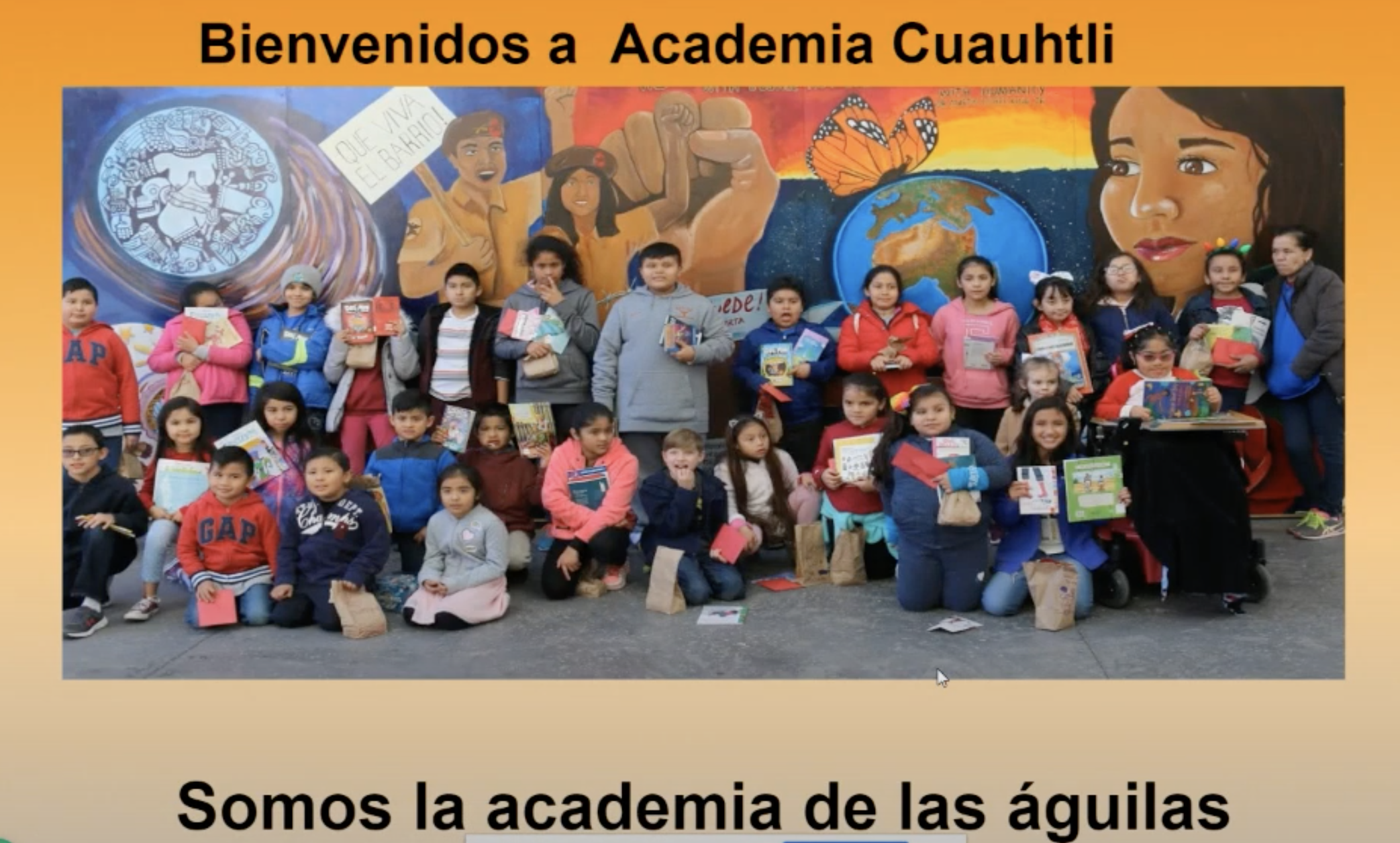
I also want to acknowledge the important work that we do at our Saturday School, Academia Cuauhtli (or Eagle Academy in Nahuatl) together with the Kalpulli Teokalli Teoyolotl that teaches danza to the children at the school. We are in partnership with the Indigenous Cultures Institute in San Marcos, the Austin Independent School    District, and the Emma S. Barrientos Mexican American Cultural Center. A key partnership is with Azteca Sirias' Aztech Kidz Code Summer Camp that offers our Indigenous STEM Summer program. We are largely comprised of volunteers and all of our educators are certified bilingual/dual language teachers from within the Austin Independent School District. 

Academia Cuauhtli is in its ninth year of operation. In addition to our two-week summer program that promises to expand to even greater numbers of students next summer, we have already expanded to five after-school programs in AISD directed by current and former Academia Cuauhtli teachers. In nine years, we have prepared well over 250 teachers to teach our co-constructed curriculum and the units are made available districtwide to all AISD teachers.

As student, professor, elder, and parent volunteers, our work in maintaining the school is truly a labor of love to offer an East Austin, largely immigrant, Spanish-speaking, working class community a free, culturally revitalizing and enriching curriculum. Many thanks to the staff at the Emma S. Barrientos Mexican American Culture Center, our physical home. Many thanks, as well, to our AISD partners for working with us and supporting our work despite shrinking budgets.

We all benefit from this magnificent work that invites the sacred into education. After all, what could be more sacred that the education of our youth? That we, in the process, are ourselves revitalized, speaks not only to ways that we are capable of knowing, but also a lived experience that combines a life of the mind, heart and spirit that lives in and breathes through community.

At our best, as once expressed by the Rev. Dr. King, our efforts equate to the "beloved community" about which he spoke. In Spanish, "El pueblo amado," is so incredibly sonorous and resonant, if not inviting.

Shouldn't this be the gold standard anyway toward which we should all aspire in education? Are we not better with, than without, escuelita (our school)? Should there not be many more? Should there not be many more everywhere?

No question about it. Because of Academia Cuauhtli, our lives, if not our very species-being, which is, at its base, communal, finds fulfillment—a replenishing source of joy, love and identity. We are alway much more than we know ourselves to be. We are always much more than who we are told that we are. Hence, an ingrained need for self-discovery, a kind of psychic anchoring and epistemological commitment.

It's all so very tender and humbling. Working around, with, and for children and youth does that to you...💗

Friends, do get out and vote. Native Americans have also fought long and hard for the franchise.

We must all do our part to perfect the union.

Check out the video below. Happy Native American Heritage Month!

-Angela Valenzuela

#StandNVote #NativeVote #EveryNativeVoteCounts #Indigeneity  #IndianCountryCounts #NativeAmericanHeritageMonth @AcadCuauhtli @IndigeCultures


Wednesday, December 29, 2021

Ken Burns: The Sand Creek Massacre: "Confronting America's shameful, violent history makes us stronger as a nation"

With implications for current battles over Critical Race Theory and the teaching of U.S. history in our schools, do listen to this Nov. 23, 2021 interview on Morning Joe of filmmaker, Ken Burns, who comments both on the Sand Creek Massacre of 1864 and on the meaning of patriotism. This interview takes place in the context of a November 22, 2021 Opinion piece in the Washington Post titled, "Confronting America's shameful, violent history makes us stronger as a nation, that I post after the interview below.

I remember first learning about the Sand Creek Massacre in Dee Brown's classic, Bury My Heart at Wounded Knee. It was required reading in my Race and Ethnic Relations sociology class that I used to teach. I remember feeling particularly impacted by this horrific story despite an entire volume fraught with despicable enmity and terror against Native Americans.   

Counter to existing lore, Sand Creek was not at all a battle, but a massacre. In fact, a Burns notes, the National Historic Site designation by the National Park Service—for which U.S. Senator Ben Nighthorse Campbell fought hard—registers Sand Creek as the only one with the word, "massacre," in its title.

Former U.S. Senator Ben Nighthorse Campbell fought many years for Sand Creek Massacre to get federally acknowledged on April 28, 2007.

Here is what happened on that horrific day of Tuesday, November 29, 1864.

Around 650 U.S. volunteer soldiers and their leader, Methodist minister and Colonel, John M. Chivington, attacked a village of Cheyenne and Arapaho Indians who were camped along the Sand Creek dry river bed in what is today known as southeastern Colorado. The troops killed 230 people, most of whom where defenseless women, children, and the elderly. This heinous action resulted in a sharp rebuke by Congress' Joint Committee on the Conduct of War as follows:

"As to Colonel Chivington, your committee can hardly find fitting terms to describe his conduct. Wearing the uniform of the United States, which should be the emblem of justice and humanity; holding the important position of commander of a military district, and therefore having the honor of the government to that extent in his keeping, he deliberately planned and executed a foul and dastardly massacre which would have disgraced the veriest savage among those who were the victims of his cruelty. Having full knowledge of their friendly character, having himself been instrumental to some extent in placing them in their position of fancied security, he took advantage of their inapprehension and defenceless condition to gratify the worst passions that ever cursed the heart of man. It is thought by some that desire for political preferment prompted him to this cowardly act; that he supposed that by pandering to the inflamed passions of an excited population he could recommend himself to their regard and consideration."

Despite this rebuke, justice was never served, with Chivington and his men getting away with this atrocity. As for Chivington, his term of office expired and he left for the Midwest. He later returned to live in Denver until his passing in 1894. 

Ken Burns' point is that "Nobody's diminished by having a complicated past. People are enriched. A great country is in fact greater for acknowledging the things that it has gotten wrong, as well as celebrating the things that it has gotten right." He goes on to say that "curating the facts of our past" is how to not be a good country.

Do listen to his interview with Morning Joe, and read, as well, his timely opinion editorial in the Washington Post that I also post below. As Burns wisely expresses and captures through this corrective reading and exposure of subjugated historical knowledge, how we remember history is also part of the historical record itself.

Let's all of us people of good conscience commit, or re-commit, to greater openness to the truth so that we might not only correct the record but also do our part, individually and collectively, to perfect the nation.

-Angela Valenzuela


In 2007, the Sand Creek Massacre National Historic Site became the only National Park Service unit to use 'massacre' in its name. Director Ken Burns 

Monday, October 11, 2021

California becomes first state to require ethnic studies for high school graduation

So happy for California's children. All the efforts by Ethnic Studies' advocates have finally paid off.  We here in Texas hope to pass similar, albeit different, legislation that allows for currently elective Ethnic Studies courses to count toward high school graduation. My dear friend and colleague, Dr. Theresa Montaño's comments are the most pointed in this piece:

“It’s high time that we addressed the demographic imperative,” said Theresa Montaño, professor of Chicana/o studies at Cal State Northridge. She noted that the battle over ethnic studies courses began in the 1960s. “In California, 70% of students are students of color. They go through 12 years of an education — taking everything from mathematics to biology — and yet it’s taken 53 years to get a single course in something that is relevant to their own personal historical trajectory.”

Curriculum, and whose knowledge counts, are inescapably political processes that as we can see here, involve compromise. Once a bill becomes law, it can be amended at a future point should the goals of the legislation get thwarted or minimized. May all take a breather now. Having it "in the books," is an essential first step.

In the meantime, congratulations to our many friends and colleagues in California who are making history with this legislation. Someday, Ethnic Studies will simply be called "a good education."

-Angela Valenzuela

California becomes first state to require ethnic studies for high school graduation


A student presentation on Mayan math is displayed in teacher Ron Espiritu’s ethnic studies classroom at Camino Nuevo Charter Academy in Los Angeles. 
(Kent Nishimura / Los Angeles Times)

After more than five years of intense scrutiny and effort, California on Friday became the first state to make ethnic studies a required class for high school graduation to help students understand the past and present struggles and contributions of Black, Asian, Latino, Native/Indigenous Americans and other groups that have experienced racism and marginalization in America.

Although critics from across the political spectrum remain, the bill garnered overwhelming support in the Legislature and was signed into law by Gov. Gavin Newsom, who had vetoed a nearly identical measure last year. At that time, he called for a revised and completed state curriculum guide for ethnic studies — one that would be, he said, balanced, fair and “inclusive of all communities.”

The revised teaching guide was completed and approved in March by the state Board of Education. The requirement would first apply to those who graduate in 2030.

“Ethnic studies courses enable students to learn their own stories — and those of their classmates,” Newsom said in a signing statement. A news release from his office predicted ethnic studies will “help expand educational opportunities in schools, teach students about the diverse communities that comprise California and boost academic engagement and attainment for students.

The signing was lauded by Assemblyman Jose Medina (D-Riverside), the bill‘s author. Medina called the new requirement “long overdue” and “one step in the long struggle for equal education for all students.”

Ethnic studies in California classrooms will move forward as a compromise between advocates who wanted an activist, anti-imperialist approach and those who asserted that the first version of the state teaching guide was filled with radical ideology, obscure academic jargon and bias against capitalism.

Alterations toned down these elements and also added the experiences of Jewish, Armenian and Sikh communities in the U.S.

With the issue seemingly settled at the state level, debate could now move to schools and school districts — and become entangled in a volatile political divide over critical race theory and the extent to which it is incorporated in the state’s ethnic studies curriculum. School boards must hold public hearings on the courses they plan to offer.

Critical race theory was first developed at the university level as an academic lens through which to analyze how race and racism are enmeshed in institutional and systemic inequities in America. A footnote in the state’s ethnic studies teaching guide states that critical race theory “acknowledges that racism is embedded within systems and institutions.”

Critical race theory is rarely mentioned in the teaching guide, but critic Williamson M. Evers said the overall model curriculum is “permeated” with content that makes it “racially divisive and burdened by faddish ideology.” According to Evers, a former U.S. assistant secretary of Education, and some other opponents, the problematic issues include a reliance on the concepts of critical race theory, leading to a portrayal of American culture and institutions through a racially divisive prism of oppressor and victim.

Newsom didn’t see it that way.

“America is shaped by our shared history, much of it painful and etched with woeful injustice,” the governor said in his signing statement. Students “must understand our nation’s full history if we expect them to one day build a more just society.”

Individual school districts will have the task of developing courses using the state’s teaching guide, which is called a “model curriculum.” Educators can pick and choose elements to include in a local course but are expected to be faithful to the main ideas of this framework.

Students in Glendale, with its large Armenian American population, for example, could study the Armenian immigrant experience in that community.

Under the law, students in the class of 2030, who will start high school in the fall of 2026, must pass at least one single-semester course. And by the fall of 2025, all public high schools will have to offer such a class.

Secretary of State Shirley Weber, a longtime professor of Africana studies and a former member of the Instructional Quality Commission, which reviewed the model curriculum, said the successful push for ethnic studies sets California apart.

“At a time when some states are retreating from an accurate discussion of our history, I am proud that California continues to lead in its teaching of ethnic studies,” Weber said. “This subject not only has academic benefits but also has the capacity to build character as students learn how people from their own or different backgrounds face challenges, overcome them and make contributions to American society.”

Even before the statewide requirement, an increasing number of schools and districts were offering ethnic studies, and some, including the Los Angeles Unified School District, already had made the class a graduation requirement.

Ultimately, many California ethnic studies critics were at least mollified by changes to the teaching guide or to the legislation. These included Jewish and pro-Israel advocates, who asserted that the original draft of the model curriculum was anti-Israel and defined Islamophobia but not antisemitism.

The final version deletes the lessons and references that offended some Jewish groups.

When the bill passed with overwhelming approval in both the Assembly and the Senate, the Legislature’s five “diversity caucuses” — lawmakers who identify with and evaluate legislation with sensitivity to Asians and Pacific Islanders, Black people, Jews, Latinos, and Native Americans — issued a joint statement of support.

“Requiring ethnic studies in high schools is an integral part of cultivating a classroom environment that is accepting of diversity,” the joint statement said.

The revised curriculum now includes two sample lessons about the experience of Jews in America. Arab Americans are included with a sample lesson titled “An Introduction to Arab American Studies.” Another lesson is “The Sikh American Community in California.”

A Sikh representative said the changes represent a step in the right direction.

“While this is an extremely positive development for the California Sikh community, we also must acknowledge that the curriculum which passed in March 2021 did fall short and leave many other marginalized communities behind,” said Pritpal Kaur, education director of the Sikh Coalition.

Another change: A glossary with terms developed largely at the college level, such as cisheteropatriarchy (“a system of power that is based on the dominance of cisheterosexual men”) was deleted.

And language directly associating capitalism with oppression also was struck from the revision.

But those who wrote the original draft say the final teaching guide is too diluted. They objected to the extent of the expansion beyond the four groups that have traditionally been the focus of ethnic studies: Latinos, Asian Americans, African Americans and Indigenous peoples — those who lived in the Americas before the arrival of colonizers from Europe. They were not invited to take part in the revision and have disassociated themselves from it.

Even so, a leader of that group applauded the new graduation requirement.

“It’s high time that we addressed the demographic imperative,” said Theresa Montaño, professor of Chicana/o studies at Cal State Northridge. She noted that the battle over ethnic studies courses began in the 1960s. “In California, 70% of students are students of color. They go through 12 years of an education — taking everything from mathematics to biology — and yet it’s taken 53 years to get a single course in something that is relevant to their own personal historical trajectory.”

Two provisions of the bill bother Montaño and others who favored the original draft of the teaching guide.

The bill specifically advises that school districts avoid using anything that was removed from the original draft. The new law also requires that course materials be provided for public review, including a public hearing, before being approved at a later meeting.

Montaño said these two provisions could become a recipe for litigation and unruly board meetings at which educators could become targets for intimidation from uninformed or hostile critics. Already, she noted, opposing ethnic studies has become a rallying point for the political right.

This year, protesters descended on the Los Alamitos Unified School District to complain that a proposed ethnic studies class and social justice learning resources would spread “hate for America and all America stands for.” Others strongly challenged those claims, and the Los Alamitos Board of Education eventually approved the learning materials.

Newsom defended the additions that Montaño objected to.

“I appreciate that the legislation provides a number of guardrails to ensure that courses will be free from bias or bigotry and appropriate for all students,” Newsom said in his signing statement. “The bill also expresses the Legislature’s intent that courses should not include portions of the initial draft curriculum that had been rejected by the Instructional Quality Commission due to concerns related to bias, bigotry, and discrimination.”

Assemblyman Medina, a former ethnic studies teacher, said the new requirement, along with the revised teaching guide, embodies reasonable compromise.

“As we’ve seen in this lengthy process, there are criticisms from different sides, from the left and the right,” Medina said. “This wasn’t an easy task, but at the end of the day, in the adopted version, I say that it’s a model curriculum that we can all be proud of.”