Translate

Showing posts with label Mexican American Studies Curriculum. Show all posts

Monday, October 11, 2021

California becomes first state to require ethnic studies for high school graduation

So happy for California's children. All the efforts by Ethnic Studies' advocates have finally paid off.  We here in Texas hope to pass similar, albeit different, legislation that allows for currently elective Ethnic Studies courses to count toward high school graduation. My dear friend and colleague, Dr. Theresa Montaño's comments are the most pointed in this piece:

“It’s high time that we addressed the demographic imperative,” said Theresa Montaño, professor of Chicana/o studies at Cal State Northridge. She noted that the battle over ethnic studies courses began in the 1960s. “In California, 70% of students are students of color. They go through 12 years of an education — taking everything from mathematics to biology — and yet it’s taken 53 years to get a single course in something that is relevant to their own personal historical trajectory.”

Curriculum, and whose knowledge counts, are inescapably political processes that as we can see here, involve compromise. Once a bill becomes law, it can be amended at a future point should the goals of the legislation get thwarted or minimized. May all take a breather now. Having it "in the books," is an essential first step.

In the meantime, congratulations to our many friends and colleagues in California who are making history with this legislation. Someday, Ethnic Studies will simply be called "a good education."

-Angela Valenzuela

California becomes first state to require ethnic studies for high school graduation


A student presentation on Mayan math is displayed in teacher Ron Espiritu’s ethnic studies classroom at Camino Nuevo Charter Academy in Los Angeles. 
(Kent Nishimura / Los Angeles Times)

After more than five years of intense scrutiny and effort, California on Friday became the first state to make ethnic studies a required class for high school graduation to help students understand the past and present struggles and contributions of Black, Asian, Latino, Native/Indigenous Americans and other groups that have experienced racism and marginalization in America.

Although critics from across the political spectrum remain, the bill garnered overwhelming support in the Legislature and was signed into law by Gov. Gavin Newsom, who had vetoed a nearly identical measure last year. At that time, he called for a revised and completed state curriculum guide for ethnic studies — one that would be, he said, balanced, fair and “inclusive of all communities.”

The revised teaching guide was completed and approved in March by the state Board of Education. The requirement would first apply to those who graduate in 2030.

“Ethnic studies courses enable students to learn their own stories — and those of their classmates,” Newsom said in a signing statement. A news release from his office predicted ethnic studies will “help expand educational opportunities in schools, teach students about the diverse communities that comprise California and boost academic engagement and attainment for students.

The signing was lauded by Assemblyman Jose Medina (D-Riverside), the bill‘s author. Medina called the new requirement “long overdue” and “one step in the long struggle for equal education for all students.”

Ethnic studies in California classrooms will move forward as a compromise between advocates who wanted an activist, anti-imperialist approach and those who asserted that the first version of the state teaching guide was filled with radical ideology, obscure academic jargon and bias against capitalism.

Alterations toned down these elements and also added the experiences of Jewish, Armenian and Sikh communities in the U.S.

With the issue seemingly settled at the state level, debate could now move to schools and school districts — and become entangled in a volatile political divide over critical race theory and the extent to which it is incorporated in the state’s ethnic studies curriculum. School boards must hold public hearings on the courses they plan to offer.

Critical race theory was first developed at the university level as an academic lens through which to analyze how race and racism are enmeshed in institutional and systemic inequities in America. A footnote in the state’s ethnic studies teaching guide states that critical race theory “acknowledges that racism is embedded within systems and institutions.”

Critical race theory is rarely mentioned in the teaching guide, but critic Williamson M. Evers said the overall model curriculum is “permeated” with content that makes it “racially divisive and burdened by faddish ideology.” According to Evers, a former U.S. assistant secretary of Education, and some other opponents, the problematic issues include a reliance on the concepts of critical race theory, leading to a portrayal of American culture and institutions through a racially divisive prism of oppressor and victim.

Newsom didn’t see it that way.

“America is shaped by our shared history, much of it painful and etched with woeful injustice,” the governor said in his signing statement. Students “must understand our nation’s full history if we expect them to one day build a more just society.”

Individual school districts will have the task of developing courses using the state’s teaching guide, which is called a “model curriculum.” Educators can pick and choose elements to include in a local course but are expected to be faithful to the main ideas of this framework.

Students in Glendale, with its large Armenian American population, for example, could study the Armenian immigrant experience in that community.

Under the law, students in the class of 2030, who will start high school in the fall of 2026, must pass at least one single-semester course. And by the fall of 2025, all public high schools will have to offer such a class.

Secretary of State Shirley Weber, a longtime professor of Africana studies and a former member of the Instructional Quality Commission, which reviewed the model curriculum, said the successful push for ethnic studies sets California apart.

“At a time when some states are retreating from an accurate discussion of our history, I am proud that California continues to lead in its teaching of ethnic studies,” Weber said. “This subject not only has academic benefits but also has the capacity to build character as students learn how people from their own or different backgrounds face challenges, overcome them and make contributions to American society.”

Even before the statewide requirement, an increasing number of schools and districts were offering ethnic studies, and some, including the Los Angeles Unified School District, already had made the class a graduation requirement.

Ultimately, many California ethnic studies critics were at least mollified by changes to the teaching guide or to the legislation. These included Jewish and pro-Israel advocates, who asserted that the original draft of the model curriculum was anti-Israel and defined Islamophobia but not antisemitism.

The final version deletes the lessons and references that offended some Jewish groups.

When the bill passed with overwhelming approval in both the Assembly and the Senate, the Legislature’s five “diversity caucuses” — lawmakers who identify with and evaluate legislation with sensitivity to Asians and Pacific Islanders, Black people, Jews, Latinos, and Native Americans — issued a joint statement of support.

“Requiring ethnic studies in high schools is an integral part of cultivating a classroom environment that is accepting of diversity,” the joint statement said.

The revised curriculum now includes two sample lessons about the experience of Jews in America. Arab Americans are included with a sample lesson titled “An Introduction to Arab American Studies.” Another lesson is “The Sikh American Community in California.”

A Sikh representative said the changes represent a step in the right direction.

“While this is an extremely positive development for the California Sikh community, we also must acknowledge that the curriculum which passed in March 2021 did fall short and leave many other marginalized communities behind,” said Pritpal Kaur, education director of the Sikh Coalition.

Another change: A glossary with terms developed largely at the college level, such as cisheteropatriarchy (“a system of power that is based on the dominance of cisheterosexual men”) was deleted.

And language directly associating capitalism with oppression also was struck from the revision.

But those who wrote the original draft say the final teaching guide is too diluted. They objected to the extent of the expansion beyond the four groups that have traditionally been the focus of ethnic studies: Latinos, Asian Americans, African Americans and Indigenous peoples — those who lived in the Americas before the arrival of colonizers from Europe. They were not invited to take part in the revision and have disassociated themselves from it.

Even so, a leader of that group applauded the new graduation requirement.

“It’s high time that we addressed the demographic imperative,” said Theresa Montaño, professor of Chicana/o studies at Cal State Northridge. She noted that the battle over ethnic studies courses began in the 1960s. “In California, 70% of students are students of color. They go through 12 years of an education — taking everything from mathematics to biology — and yet it’s taken 53 years to get a single course in something that is relevant to their own personal historical trajectory.”

Two provisions of the bill bother Montaño and others who favored the original draft of the teaching guide.

The bill specifically advises that school districts avoid using anything that was removed from the original draft. The new law also requires that course materials be provided for public review, including a public hearing, before being approved at a later meeting.

Montaño said these two provisions could become a recipe for litigation and unruly board meetings at which educators could become targets for intimidation from uninformed or hostile critics. Already, she noted, opposing ethnic studies has become a rallying point for the political right.

This year, protesters descended on the Los Alamitos Unified School District to complain that a proposed ethnic studies class and social justice learning resources would spread “hate for America and all America stands for.” Others strongly challenged those claims, and the Los Alamitos Board of Education eventually approved the learning materials.

Newsom defended the additions that Montaño objected to.

“I appreciate that the legislation provides a number of guardrails to ensure that courses will be free from bias or bigotry and appropriate for all students,” Newsom said in his signing statement. “The bill also expresses the Legislature’s intent that courses should not include portions of the initial draft curriculum that had been rejected by the Instructional Quality Commission due to concerns related to bias, bigotry, and discrimination.”

Assemblyman Medina, a former ethnic studies teacher, said the new requirement, along with the revised teaching guide, embodies reasonable compromise.

“As we’ve seen in this lengthy process, there are criticisms from different sides, from the left and the right,” Medina said. “This wasn’t an easy task, but at the end of the day, in the adopted version, I say that it’s a model curriculum that we can all be proud of.”

Friday, September 21, 2018

Letters To The World From Willie Velasquez

The late Willie C. Velasquez is a beloved leader in the Mexican American community of Texas and beyond for many reasons, including his passionate devotion to expanding the vote to the Chican@/Latin@/Mexican American community.  He was not a perfect man, as you can hear for yourself below by his wonderfully written letter read by author extraordinaire, Barbara Renaud Gonzalez.  
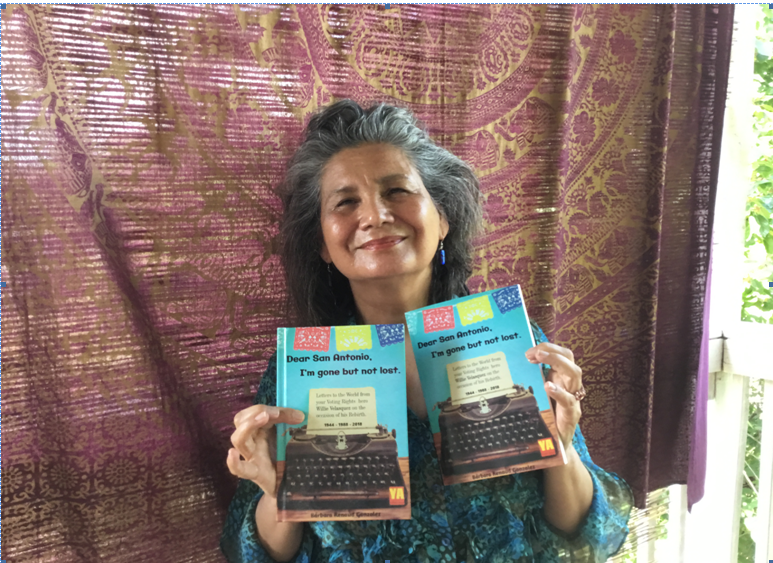
Renaud Gonzalez has written her own Young Adult book on Willie Velasquez titled, "Dear San Antonio, I’m Gone but not Lost. Letters to the World from your Voting Rights Hero Willie Velasquez on the Occasion of his Rebirth."
I love what Renaud Gonzalez says about Mexican American Studies—the genre into which this book fits—in her comments that you yourself can listen to below.
"I want people to understand that Mexican American Studies is really, really about love.  If you know who you are, you know that you belong to the world, that you are equal to the world.  That's the power of Mexican American Studies."
We all owe so much to Willie Velasquez.  Her love for him—which is what I think we all should also share—is palpable and moving.  
Congratulations, Barbara!  I am very excited to see your book on him coming out soon!
-Angela Valenzuela

Fronteras Extra: Letters To The World From Willie Velasquez


  SEP 14, 2018

Willie Velasquez grew up on San Antonio’s West Side, and learned early on that by empowering his fellow Latinos, they could bring change to their own neighborhoods.
In 1974, Velasquez founded the Southwest Voter Registration Education Project and organized 1,000 voter drives across the Southwest. His efforts also more than doubled the number of Latino elected officials, from 1,500 in 1974 to 3,300 in 1988.
Velasquez died in 1988 at 44. Writer Bárbara Renaud Gonzalez has resurrected him in her new book, “Dear San Antonio, I’m Gone but not Lost. Letters to the World from your Voting Rights Hero Willie Velasquez on the Occasion of his Rebirth.” In the book geared towards young adults, Velasquez responds to God’s request to reflect upon his life.

Bárbara Renaud Gonzalez
CREDIT DENISE MCVEY
Renaud Gonzalez said that Velasquez’s activism often drew the ire of more mainstream Latino politicians, including former San Antonio Congressman Henry B. González.
“(González) was basically a political god – demigod – of San Antonio. … He was a mentor of Willie Velasquez,” said Renaud Gonzalez. “Ultimately, they split. They had a difference of opinion. Willie was very caught up in the Chicano movement, calling himself a Chicano, involved in the farm worker struggle. Henry B. did not appreciate that.”
Renaud Gonzalez has hopes her book and the lessons Velasquez was trying to share with the Latino community will be embraced by teachers and students in Mexican-American studies courses.
She was recently talking to students at a San Antonio high school and was surprised to find they did not know about the Voting Rights Act, which prohibited discrimination in voting.
“I cannot impress enough that our democracy fails or succeeds depending on how young people in the inner city schools understand democracy, understand voting,” said Renaud Gonzalez. “It’s essential. It’s tragic. Hopefully the story of Willie Velasquez … will give them a sense of purpose. We need to have meaning in our lives.”
Local release date is Oct. 28. National launch date is Nov. 2 at the Guadalupe Cultural Center.
Norma Martinez can be reached by email at norma@tpr.org and on Twitter @NormDog1

Saturday, May 26, 2018

Amid anti-immigrant and racial clashes, ethnic studies programs blossom in public schools

Interestingly, despite anti-immigrant politics and policies and toxic racism that seems to be a daily affair these days, the amazing Ethnic Studies grassroots movement discussed by Jaweek Kaleem below is on how this call for inclusion is happening across the country.

The press on what's happening in Texas can be confusing but the gist of it is that while we here in Texas won the battle associated with the larger Ethnic Studies battle—such that we now have Latino Studies, African American Studies, Asian American and Pacific Islander Studies, and Native American Studies—we still did not get the "Mexican American Studies" course for which we, as a community of educators, elders, teachers, students, university faculty, and civil rights community, advocated. 

And now we have been put in the position of still having to struggle with the Texas State Board of Education in order to challenge the name that THEY gave US, namely, "Ethnic Studies: An Overview of Americans of Mexican Descent."  Many of us have expressed just how paternalistic and repulsive this name is—with echoes that go back to McCarthyism and subtractive cultural assimilation to which my parents were subjected in the public schools throughout the 1940s, 50s, and early-to-mid-60s.

The sought-after curricular and pedagogical approach centers children in their own experiences and thusly, their own possibilities in order to help them live more meaningful and fulfilling lives.  This not only helps our children to feel a part of the grand American narrative, but as mentioned in the article below, encourages prejudice reduction and openness to other cultures for all children exposed to this curriculum.

Just like every single individual deserves to get called their name, we, too, as a Mexican American Studies constituency, similarly warrant and demand as much.

Angela Valenzuela
c/s


Amid anti-immigrant and racial clashes, ethnic studies programs blossom in public schools

As public debates swirl around "Dreamers," President Trump's border wall and Black Lives Matter, the study of race and ethnicity is booming in public schools.
Nationwide, states and school systems are refining, expanding or adopting courses that explore history, literature and politics through the eyes of people who aren't white. The programs, which until recently were banned in Arizona and derided as anti-American, are thriving in unexpected places. Some districts are making ethnic studies compulsory — for whites as well as minorities.

"In our current political context, especially with the president, there has been a huge gain in the critical study of race and ethnicity, and the desire for students to see themselves reflected in what they are learning," said Julia Jordan-Zachery, a professor at Providence College in Rhode Island and president of the National Assn. for Ethnic Studies. "The interest predates Trump, but it's only growing now. It's a way of flipping the script on what teaching is traditionally supposed to be."
It's a profound shift from just seven years ago, when the closing of a Mexican American studies program in Tucson caused national uproar.

Last May, Indiana Gov. Eric Holcomb — who took over the job from Vice President Mike Pence — signed a law requiring every high school to offer an ethnic or racial studies elective each year. The move came after years of failed attempts to get similar laws on the books. What changed? Republicans teamed up with Democrats and called for classes to be electives instead of requirements. Students need the "opportunity to take a class that relates to their experiences and heritage," bill co-sponsor state Rep. Robert Behning, a Republican, said at the time.

Indiana leaders of the National Assn. for the Advancement of Colored People launched an aggressive lobbying effort, spurred in part by police shootings of unarmed black Americans.

In June, Oregon Gov. Kate Brown signed a bill requiring ethnic studies for all public school students between kindergarten and 12th grade. As in Indiana, racial minority groups — emboldened in part by a number of hate crimes in one of the country's whitest states — were behind the change.

The law compels Oregon educators to look at where they fail "to recognize the histories, contributions and perspectives of ethnic minorities and social minorities." It includes women, disabled people, refugees, immigrants and LGBTQ people among "social minorities."

Also last June, the Seattle school board said it would weave ethnic studies into its schools' curriculums after coming underNAACP pressure.

While previous campaigns to establish ethnic studies programs around the U.S. targeted minority groups, the Seattle NAACP made a different case, asserting on its website, "Ethnic studies courses benefit white students, who disproportionately have the privilege to be unaware of the realities of racism." The argument was similar in the mostly black and Latino city of Bridgeport, Conn., where last October school administrators decided to require students to take a half-year class on African American studies, Caribbean/Latin American studies or a course on race to graduate.
"Even in places where it hasn't fully blossomed, there are steps being taken to incorporate ethnic studies," Jordan-Zachery said. That includes Kansas and Texas, where legislators are pushing measures that would institute Mexican American studies classes and those on other ethnic groups.
"For much of the history of education in the U.S., we have been deleted and erased in textbooks," said Georgina C. Perez, a Latina Democrat on the Texas state Board of Education. Through ethnic studies, she said, "we're reclaiming our history."
States and cities are following California, where education officials are standardizing what's taught in ethnic studies classes after highly touted programs in San Francisco, San Diego and Los Angeles.
Ethnic studies grew out of the civil rights and anti-colonial movements of the 1960s. San Francisco State University was a pioneer, with its College of Ethnic Studies that launched in 1968. UC Berkeley opened an ethnic studies department a year later. In 1994, Berkeley High School became one of the first public high schools in the nation to offer ethnic studies.
A key for many programs is their reading lists. At Barack and Michelle Obama Elementary School in St. Paul, Minn., kids in an African American studies class read "Desmond and the Very Mean Word," a story based of the childhood of future Anglican Archbishop Desmond Tutu in apartheid South Africa.
At John O'Connell High School in San Francisco, ninth-grade ethnic studies students look at how news and entertainment media portray minorities, and they read from the autobiography of black nationalist Assata Shakur and the Eddie Huang memoir on his experience as an Asian American,"Fresh off the Boat."
In Sarah Rodriguez's ethnic studies class at Santa Monica High School, a recent lesson revolved around students discussing activism against gentrification in Boyle Heights, where art galleries and coffee shops have attracted white and more well-off newcomers in the traditionally Mexican American, working-class neighborhood.
Activists celebrated last year after an arts nonprofit called PSSST shut down amid criticism that it was helping to displace locals.
Rodriguez told the 17 students — a mix of sophomores, juniors and seniors — to discuss a Boyle Heights blog that suggested gentrification counted as a form of racist state violence.
She asked students if they agreed that the transformation of a neighborhood, often fueled by government policies that cater to business interests, could be described that way. Some said yes. Some said the answer wasn't so simple, especially after they watched a documentary about a Latina artist who praised the arrival of galleries and said the neighborhood was now safer than when she grew up there.
"The class really challenges you to think about your identity yourself," said Diana Hernandez, a Mexican American sophomore enrolled. "It helps us make more sense of what we're learning throughout the school day."
Nationally, supporters of ethnic studies say they lead to better grades and graduation rates. They frequently cite a 2016 Stanford University study assessing the San Francisco Unified School District's ethnic studies program when it was a pilot between 2010 and 2014. The study found that students who took ethnic studies courses, including many who came from lower-income families, performed better overall than other students.


Ethnic studies students' attendance rates were 21 percentage points higher, they earned more points toward graduation, and their grade-point averages rose by 1.4 points. Students made the biggest gains in science and math, and boys and Latino students made the greatest improvements.
Jr Arimboanga, an ethnic studies teacher at John O'Connell High, one of the schools in the San Francisco study, said confidence and study skills have increased among students who have taken the classes.
"When you look at traditional world history that many of our students take, the textbook is the dominant narrative," Arimboanga said. "It focuses on a Eurocentric experience. People of color are mentioned in negative or simplified ways. The African American experience only starts with slavery and forgets the previous rich history in Africa. Latinos and Mexican American students often have a paragraph around the Mexican-American War, but don't read about the native experience of Latinx peoples before colonialism."
His syllabus includes a screening of "Precious Knowledge," a PBS documentary about the fight for Mexican American studies in Tucson. The Arizona school district shut down the program in 2012 after state officials threatened to withhold more than $14 million for violating a newly passed law banning courses tailored for a particular ethnic group or that were deemed to fuel anti-American sentiment.
Then-Arizona Supt. of Education John Huppenthal said a Tucson class he observed — where a Che Guevara image hung on a wall and he said a lecture described Benjamin Franklin as racist — seemed anti-white. Kids "understood the framework that was being laid out — that Hispanics are the oppressed and Caucasians are the oppressors. That's very troubling," he told the Los Angeles Times at the time.
In response, the district introduced a program for "culturally relevant" teaching that didn't run afoul of the law but still allowed classes on government and history with Mexican American and African American perspectives.
In August, a federal judge in Phoenix declared the ban on ethnic studies unconstitutional, saying it violated Latino students' 1st Amendment "right to receive information and ideas." In December the same judge banned Arizona from enforcing the law, and cited Huppenthal's crusade against the courses.
Ethnic studies supporters hailed the decision, hoping it would spur the growth of such programs across the U.S.
But in Arizona, the subject remains touchy. State education officials said they want to preserve elements of the ban. Trustees of the Tucson Unified School District, although given the green light by the federal judge, held off on resuming Mexican American studies courses last month.
"While it's growing in California and elsewhere, it's still a controversial issue here," said school board member Kristel Foster, who sponsored the proposal to once again allow Mexican American studies. "Every election here people still ask about Mexican American studies. The ban is gone, and things have moved in many places nationally, but it's still having an effect here."​
Jaweed Kaleem is The Times' national race and justice correspondent. Follow him on Twitter, Facebook and Instagram.

Monday, March 19, 2018

Texas needs a proven Mexican American studies curriculum by Greg Pulte

So happy to see blog contributing writer and UT doctoral student, Greg Pulte's Op-Ed on the struggle for Mexican American Studies in Texas get published in today's Texas Tribune!  His piece will pretty much bring you up to date on where we are at this point with the Texas State Board of Education (SBOE).

On the topic of the Texas SBOE, there will be a statewide rally and testimony from folks from across the state on April 11, 2018, at their next meeting taking place at the William B. Travis Building, 1701 N. Congress, 78701 (across from the Bullock History Museum where the Texas Education Agency is located, first floor).

Details forthcoming.  You can also get details on Twitter at @NACCSTejasFoco and #ApproveMAS

Great work, Greg!

Angela Valenzuela

Texas needs a proven Mexican American studies curriculum

"The Mexican American Studies Toolkit," written by Tony Diaz. The State Board of Education might approve the first ethnic studies textbook this year, after critics shot down a previous submission as racist. Photo by Laura Skelding for The Texas Tribune
 
At January’s Texas State Board of Education (SBOE) meeting, the purpose of agenda item #10 was to discuss statewide academic standards for the teaching of Mexican American Studies (MAS) in Texas public schools. Currently, MAS is taught across the state, but no statewide standards exist. A standardized curriculum would provide guidance for the significant number of MAS courses taught in Texas and for publishers to write textbooks according to these standards.
Immediately following the testimony of several professors, teachers and experts, a cadre of SBOE members dismissed the preceding testimony and directed the conversation away from MAS standards to discuss “Latino Studies.” Born out of a history of political activism and a struggle for equity, MAS is a field that examines the historical and cultural contributions of indigenous, Mexican, and Mexican American peoples. In contrast, Latino Studies looks generally at the experiences of Hispanics in the U.S. A shift from MAS to Latino Studies would mean the civic engagement, activism and the transformative aspects of MAS would be lost.
Through this redirection away from MAS, the SBOE signaled that it would support Latino Studies standards at the upcoming meeting. If standards for a Latino Studies course are approved, this would signify the end for MAS course standards in Texas, as future efforts would be met with the response that standards for a Latino Studies course that include MAS already exist. A vote for Latino Studies would eliminate, by design, the rich historical and cultural content offered by MAS as well as its benefits to students. This possibility did not stop SBOE members from maneuvering the discussion to engineer, in an ad hoc manner, a replacement for MAS. A vote for Latino Studies standards would be no small substitution of curriculum. The looming threat of a Latino Studies vote is a rejection of thousands of MAS advocates, Mexican Americans and most importantly the students of Texas.
Unlike Latino Studies, still in its infancy by comparison, MAS is an expansive academic field that is 50 years old, is sanctioned by the Texas Higher Education Coordinating Board, is an area of study that maintains centers, departments, initiatives, journals, and organizations and holds state and national conferences. In Texas, a coalition of educators has worked diligently for the past five years to institute standards for MAS courses taught in Texas.
While a few SBOE members maintain that Latino Studies would be “inclusive” of other Latino groups, the truth is that the presence of other Latino groups in Texas is a relatively recent occurrence and one that cannot be understood without first understanding the Mexican American experience. This explains why, in contrast to Latino Studies, MAS courses have been offered in Texas schools for decades. In practice, the inclusion of other Latino groups already takes place. MAS courses in public schools, colleges and universities incorporate Latino Studies within the curriculum including material related to other ethnic groups in Texas and the U.S.
It is the history of activism, the affirmation of a minority cultural identity and the threat of political engagement among Mexican American students and all students that has some SBOE members fearful that MAS standards will produce an identity-affirming curriculum. Call it what you will, but a denial of MAS standards in Texas looks an awful lot like the perpetuation of historical and cultural oppression. The SBOE must provide standards that allow school districts to create MAS curriculum should they decide to offer a MAS course or to streamline the course already in place.
Given the longstanding presence of Mexican-origin people in Texas, it is preferable to create standards for the proposed MAS course with Latino representation over an excessively broad, non-research-based, untested Latino Studies alternative for which no curriculum exists and for which few, if any, courses are taught. The course infrastructure for MAS is long-established and would be considerably less difficult to implement and less costly given the number of MAS courses taught in Texas.
Studies from education researchers Nolan Cabrera (Missing the student achievement forest for all the political trees), Thomas Dee and Emily Penner (Causal effects of cultural relevance), and Francesca Lopez (Culturally responsive pedagogies in Arizona and Latino students) confirm the positive outcomes for students taking MAS courses in public schools. Their research shows significant reductions in the achievement gap as well as openness to members of other cultures regardless of the students’ ethnic or racial background.
A rejection of MAS therefore amounts to the denial of a course that promotes academic success for all students. MAS boosts academic success precisely because MAS connects students cut off from mainstream curriculum. MAS provides students with a curriculum of liberation. A Latino Studies course, even if inclusive of MAS, would be too broad and too shallow to explore the types of questions surrounding identity, equity and inclusion that are fundamental to MAS. To include MAS in a Latino Studies course would be like covering Texas History in a World History class. The transformative aspects of the MAS curriculum would receive short shrift, if covered at all, and would be rendered ineffectual.  
A replacement with Latino Studies material is neither a compromise nor a win-win as there is no Latino Studies coalition calling for the creation of standards. In this case, the groups at odds are those who favor MAS versus SBOE members bent on denying MAS to Texas students despite Texas’ unique history, our strong demographic representation of Mexican American youth in our schools and a successfully proven curriculum.
MAS advocates have fought too long and hard for a scholar-vetted, standards-aligned course to see it relegated to the dustbin of history. Our indigenous, Spanish, Mexican and Texan histories form important aspects of our culture and must be acknowledged and studied. Our place in Texas and our uniquely Texan and Tejano character requires nothing less than MAS standards. The SBOE must reflect carefully before making a decision whose outcome would be the deliberate and continued denial of our people, our history and our culture.

The University of Texas has been a financial supporter of The Texas Tribune, a nonprofit, nonpartisan news organization that is funded in part by donations from members, foundations and corporate sponsors. Financial supporters play no role in the Tribune's journalism. Find a complete list of them here.
PhD student, University of Texas at Austin

Thursday, February 01, 2018

Update on Texas SBOE's Consideration of a Mexican American Studies Course


For those of you keeping up with this story, Tuesday evening's consideration by the Texas State Board of Education (SBOE) of our community's long-standing demand for a Mexican American Studies (MAS) course in state curriculum got muddled in an ad hoc discussion about Latino Studies and whether the course should actually be the latter than the former.  

Excuse me, this is a board that doesn't know diddly squat about the differences between MAS and "Latino Studies," nor has it ever cared.  As award-winning UTRGV Professor Stephanie Alvarez brilliantly explained about these two courses that she has actually taught, namely, MAS and Latino Studies, the latter is taught east of the Mississippi River and the former, west of it.  Ours is a distinct history in Texas with respect to Mexico, the border, and Mexican Americans that one has to grasp if one hopes to understand the experiences of other non-Mexican Latino groups in Texas.  It's a different history for Latinos east of the Mississippi and so these courses are radically different.  


Dr. Alvarez herself is a Cubana and she adheres passionately to this view in her leadership and instruction as Director of MAS at her home institution in South Texas. But not even this, her expert testimony, swayed the board discussion. It was as if she had not spoken at all.  Same for the rest of us present who also testified.


Plus, our community of NACCS Tejas foco scholars—and other allies like the Texas Freedom Network and the broader REST Coalition—have been solidly advocating for MAS since 2014.  While we are a large, breathing, statewide constituency, Latino Studies has no such counterpart.  We should know.  They would have surfaced by now.


This is not to say that there aren't some Latino Studies scholars who, by the way, haven't done this serious advocacy or in-depth K-12 curriculum development work that may seek to profit from our efforts—and God forbid—actually get a course that no one either teaches or is prepared to teach by the end of next April's SBOE meeting.  While stranger things have happened, it's not over 'til it's over.


Disturbingly, while SBOE agenda item 10 made no reference at all to Latino Studies, that is what surfaced in conversation—not, of course, with our statewide constituency—but with the Anglo members of the board itself, resulting in concomitant board inaction as Dr. Trini Gonzales' piece below lays out.  This unwillingness to give the community an official course in state curriculum is dismissive and insulting.


  As I expressed earlier on Facebook,
"Tony Diaz is totally on point that the problem is not that our community doesn't play by the rules, but rather the opposite: The rule makers, the Texas State Board of Education, does not [begin listening at 4:20]. In reference to the antics by the Texas State Board of Education, they indeed "keep moving the goal posts," changing the rules and playing us through their politics of manufactured uncertainty and confusion.

Not those, of course, that have championed Mexican American Studies like Ruben Cortez, Marisa B. Perez , or Erika Beltran who fight the good fight, and do so honorably and in the full light of day.

Hats off to our community gathered from far and wide, and to our students, too, who got a lesson in cultural chauvinism and white supremacy today, while bearing witness to the mischievious machinations of power.

Keep carrying the torch and remember the Mexican proverb that even when they think they've buried us, we're actually seeds.
Many in our community were, of course, deflated and offended by the board's ploys to divert our agenda.  Community, we must mobilize.  Reach out to your board member that represents you and let them know how you feel.  Find out who represents you here and call them or visit with them.

Also, our organization of scholars and advocates will be discussing next steps with respect to the SBOE to create an MAS class at this year's NACCS TEJAS CONFERENCE.  

Come one, come all.  


Angela Valenzuela
c/s

State board to vote on Mexican American studies in April

Local experts advocated for state curriculum at meeting this week


McALLEN — The State Board of Education listened to testimony from Mexican American studies experts from all over Texas on Tuesday, most advocating for the creation of a state-approved curriculum. While no decision was made, the board indicated a vote is soon  to come.

Advocates of Mexican American studies, MAS, including several from the Rio Grande Valley, traveled to Austin asking for Texas Essential Knowledge Skills, known as TEKS, to be created as a way to standardized learning throughout the State.

The vote on whether or not the Texas Education Agency will create a course curriculum is expected during the board’s meeting in April.


“This is going to be a historic vote in April, because at the end of the day a class is going to be created but what will be decided at that meeting is how that class will look,” said Trinidad Gonzales, history instructor at South Texas College and advocate for the creation of the MAS TEKS.

The board had the opportunity to ask questions of the experts as they seemed not to have a clear understanding of the need behind the curriculum since the courses are currently being taught in some districts.

If approved, the TEKS would provide districts that wish to offer the course all necessary materials that ensure every student has a solid base of knowledge in the subject before leaving the system, advocates argued, as well as providing guidelines to textbook makers to supplement the courses.
School districts currently have two avenues to teach the course — as a dual-enrollment course or using a course curriculum developed by the Houston school district.

But while the two methods provide a viable avenue for districts to adopt the course, there are no clear guidelines of what the curriculum can and should include, making it hard for districts to want to invest the resources needed to develop them. The same goes for textbook publishers.

“This doesn’t have to take a long time,” said board member Ruben Cortez Jr. “These individuals here and probably others that are represented here today have offered as we’ve done in the past to be a working group with the agency to help develop this. You’ve got decades and decades of experience here from all universities across the state.”
SBOE Member Rubén Cortez
 Cortez was one of the board members who called for the item to be discussed, and expressed his desire to approve a working group on the Mexican American studies curriculum. “This has obviously gone long enough,” he said.

The discussion on the need for statewide curriculum and guidance on the subject has been going on for about three years. And the board has already placed the subject on its list of possible future courses.

Another issue discussed was the possibility of creating a Latino studies course as well or instead.
Having two courses would be ideal, Gonzales said, but this could take a long time and the fact that there is already some framework to guide the creation of curriculum for the Mexican American studies course would speed the process.

“There’s some board members who want to do a Latino studies class, there are other board members who want the Mexican American studies class, and then there’s the other option of having a Mexican American studies class that includes Latino studies,” Gonzales said.

TEA staff was present at the meeting to discuss the feasibility of the project. At some point, Monica Martinez, associate commissioner of standards and policy, said the agency doesn’t have the resources necessary to compensate a committee of experts to help create the TEKS.

The agency usually summons experts from across the state for guidance and compensates them for lodging and other expenses. But those present said they would be willing to freely volunteer their time.

For now, Gonzales said the National Association of Chicana ChicanoStudies-Tejas Foco Working Group, of which he is a member, will meet next month to discuss their options as the SBOE vote approaches.

“It seems like a general consensus of all the speakers by the end of the testimony is that whatever that class is, it has to be based on Mexican American Studies,” he said. “Including a Latino studies or the creation of a separate Latino studies course as another option.”
dperez-hernandez@themonitor.com