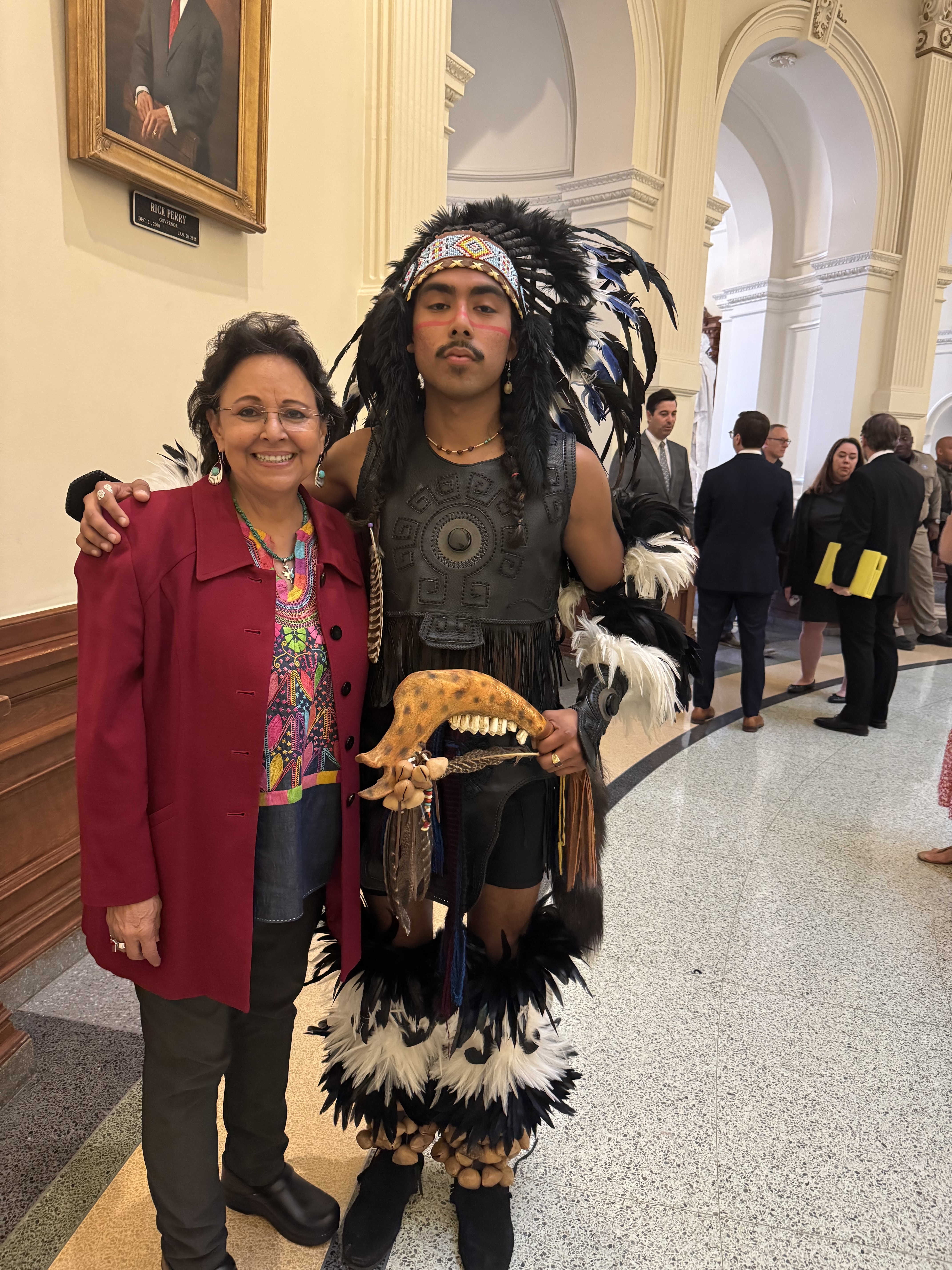
Academia Cuauhtli, the Eagle’s Vision, and the Architecture of Belonging: Education in the Shape of a Circle
by
Angela Valenzuela, Ph.D.
February 23, 2026
In “Academia Cuauhtli and the Eagle: Danza Mexica and the Epistemology of the Circle,” co-authored with Emilio Zamora and Brenda Rubio, we examine what it means to build Academia Cuauhtli as more than a Saturday school program in Austin, Texas. We frame it as an effort to rethink education itself.
The eagle’s vision represents the ability to see in all directions at once—expansively and relationally. For those of us working in community, it reminds us that while no single person can carry all the knowledge required to sustain an ambitious initiative like Academia Cuauhtli—with its Summer School program, parent development component, and curricular writing work—together, we can.
It also symbolizes the aspirations we collectively hold for the children, families, and community in our care, alongside the disciplined precision with which the eagle, from great heights, fixes its gaze and moves with intention. Analytical clarity. This is what we want for all children—especially in this moment of chaos and uncertainty—so that they may see their world clearly, act with purpose, and rise with confidence rather than confusion.
 |
| Access full article here. |
At the heart of this work is the circle. It is best exemplified by Danza Mexica or Aztec "dance," connoting not performance, but ceremony and a way of knowing and being in the world, including in educational spaces like Academia Cuauhtli about which I have previously blogged over the years.
In Danza Mexica, individuals form into a circle or concentric circles depending on the size of the group. Movement unfolds collectively. No one stands in front. No one stands above or below. Everyone faces inward toward a shared center—toward memory, spirit, healing, ancestors, and community.
The form itself encodes reciprocity, relationality, and a shared, sacred purpose.
This stands in contrast to the dominant architecture of schooling.
Most classrooms operate through vertical authority structures. Knowledge flows from expert to novice. Students are ranked, sorted, and compared. Time is segmented into benchmarks and testing cycles. Culture is often treated as enrichment rather than foundation.
The circle disrupts this logic.
An epistemology of the circle understands knowledge as generative and co-constructed rather than extractive or subtractive. It recognizes the body as a site of learning. It treats memory as living presence. It invites families, community members, scholars, and children into shared intellectual space. It refuses the idea that culture is peripheral to academic rigor (Colin, 2014).
For us at Academia Cuauhtli, the circle is also a form of pedagogy. It is history enacted through rhythm and specific movements (dance steps) across various ceremonies preserved throughout time. It is language, philosophical concepts, and civic education carried in collective movement. It signals and affirms that children—especially those labeled as “English learners” and targeted by subtractive, deficit-driven discourses—stand within powerful knowledge systems that have survived conquest, colonization, and erasure.
The circle also carries political meaning.
In a moment when ethnic studies programs are dismantled, faculty governance is constrained, and curriculum is policed under the language of “neutrality,” the circle offers another organizing principle. Education can be structured around relational accountability (or "responsibility") rather than surveillance. It can center dignity rather than deficit.
The eagle—or "Cuauhtli," in Nahuatl—symbolizes vision and strength. Yet the eagle rises from within the circle. Aspiration without community becomes isolation. Achievement without memory becomes assimilation.
The circle is not nostalgia. It is infrastructure, a third space situated between the over-prescribed role of the school and the under-prescribed role of the home in the education of our youth.
If we take educational equity seriously, we must ask: What would it mean to organize our classrooms, research partnerships, and institutions around relational centers instead of competitive hierarchies?
The answer does not begin with new mandates.
It begins with remembering—and practicing—the circle as a way of knowing and being in the world.
References
Colín, E. (2014). Indigenous education through dance and ceremony: A Mexica palimpsest. Palgrave MacMillan.
Valenzuela, A., Zamora, E., & Rubio, B. (2015). Academia Cuauhtli and the Eagle:" Danza Mexica" and the Epistemology of the Circle. Voices in Urban Education, 41, 46-56.https://files.eric.ed.gov/fulltext/EJ1074841.pdf