Translate

Showing posts with label HB 178. Show all posts

Wednesday, May 21, 2025

"The Need for Ethnic Studies Policy in Texas," by Angela Valenzuela, Ph.D. and Emilio Zamora, Ph.D. May 21, 2025

The Need for Ethnic Studies Policy in Texas


by

Angela Valenzuela, Ph.D. and Emilio Zamora, Ph.D. 

May 21, 2025


In the midst of the so-called culture wars, we must ask: Is Ethnic Studies House Bill 178, authored by Representative Christina Morales, a radical departure from the conventional interpretation of history? Or is it, more accurately, a democratizing call—a "We the People" project aimed at healing and rebuilding a fragmented nation?

We argue it is the latter. If this were truly a radical departure, it might resemble calls for secession—an idea still whispered in some corners of the Texas Anglo community. It might also involve rejecting assimilation or the English language, despite the fact that, throughout our civil rights history, Black and Brown communities—alongside our allies—have never taken such a stance. Instead, we have consistently fought to expand the American narrative, not abandon it.

Despite being filed for three consecutive sessions by Rep. Morales and passing out of the House Committee on Public Education, the Ethnic Studies bill—HB 178—failed to reach the House floor this session. It is, for now, “dead.”

From the moment it was filed, HB 178 faced an uphill battle in today’s hostile political climate. At its core, the resistance to this bill appears rooted in a deeper discomfort: the challenge it poses to a dominant narrative that seeks to silence, erase, or distort the histories and lived realities of marginalized communities.

In an era marked by book bans, curriculum censorship, and the systematic dismantling of DEI efforts, defending Ethnic Studies is more than a policy stance—it’s an act of resistance against forces that falsely equate truth-telling with division.

So many people who advocate for Ethnic Studies are themselves either teachers or students who want to promote critical thinking and affirm the value of diverse cultural perspectives, even when doing so invites backlash.

Morales’ House Bill 178 is reasonable, forward-looking policy. It does not make Ethnic Studies a requirement for high school graduation. Rather, it establishes a pathway to a high school diploma that for a given student, can include the taking of Ethnic Studies courses like Mexican American Studies, Native American Studies, African American Studies, and Asian American Studies.

As Mexican American Studies scholars, we find it striking that high school enrollment in Mexican American Studies courses has grown from just 40 students in Houston in 2015 to an impressive 11,941 students statewide in 2024. This is an extraordinary growth rate, indicative of massive and sustained interest, organizing, and curriculum development in Mexican American Studies across Texas.

University of Texas San Antonio professor and researcher Dr. Lilliana SaldaƱa attributes this meteoric rise not only to student interest but also to the steady growth in teacher preparation. In 2015, only four educators joined the Mexican American Studies Academy that she and her colleagues established to train teachers in the field. In contrast, over the past two years alone, the academy has welcomed more than 80 teachers annually—a testament to the growing demand for Ethnic Studies and the infrastructure needed to sustain it.

Failing to pass sound Ethnic Studies policy disrupts the natural progression of integrating decades of historical scholarship into our classrooms. House Bill 178 seeks to address the longstanding logjam that has prevented the inclusion of vital historical findings, particularly those produced since the 1970s. Put simply, our current curriculum lags significantly behind the breadth of knowledge that scholars have already brought to light. It’s time to break through that impasse and ensure our educational standards reflect the richness and complexity of our shared history.

Studies consistently demonstrate that well-structured Ethnic Studies programs enhance students’ academic success. A review by Christine Sleeter, conducted for the National Education Association, underscores that Ethnic Studies courses boost student engagement, encourage critical thinking, and elevate graduation rates.

Further research from the NEA confirms that students enrolled in Ethnic Studies cultivate a greater sense of self-efficacy and achieve higher academic performance. These outcomes highlight the transformative power of acquiring windows into both one another's experiences and one's own.

Advocates for Ethnic Studies are not just fighting for curriculum—they’re defending the right of students to see themselves reflected in the classroom and to engage honestly with the complex realities of the as yet unfinished great American story.

***

The authors, Angela Valenzuela and Emilio Zamora, are married and are longtime advocates for Ethnic Studies in Texas and are formally affiliated with the Mexican American Studies program at the University of Texas at Austin.





Monday, May 12, 2025

Ethnic Studies Under Attack and Senate Bill 12 Toolkit: The REAL Target of Sen. Creighton's SB 12

Okay, Friends—

Happy Monday! Most people never actually read any bills, so here’s your chance to see a key section for yourself of a particularly horrible one. Scroll below to read this together with detailed instructions, compliments of @txstudentsfordei
 on Instagram, on what you can do to speak up against this bill, including signing up to testify on Tuesday morning.


The essence of SB 12 is both simple and chilling: it seeks to eliminate virtually all Diversity, Equity, and Inclusion (DEI) efforts in Texas public schools, offering only a few token exceptions. If SB 3 from the last session was vague and burdensome, 
SB 12 is more direct and more dangerous, targeting any K–12 initiative that dares to center equity, identity, or belonging.

Let’s be clear: this is a thinly veiled attack on Ethnic Studies, as well as anti-trans and anti-LGBTQ—and on every educator, ally, student, and community member committed to truth, dignity, and educational justice.

And here’s the glaring contradiction: According to the Texas Education Agency 
Enrollment in Texas public schools, 2022–23 (2023) dataBlack and Brown children now make up the majority (66 %) of students in Texas public schools—a demographic reality that will only continue to grow. 

To pass a law that denies these students a curriculum that reflects their cultures, histories, and identities is not just shortsighted—it is morally indefensible. At best, it’s nonsensical. At worst, it’s terribly hostile, pushing back on the many positive gains we've made in Texas in Ethnic Studies policy and practice. 

What we should be doing instead is passing Rep. Christina Morales' Ethnic Studies bill House Bill 178 that is stuck in the House Calendars committee waiting to get heard in the Texas House.

I plan to testify tomorrow, May 13th, on behalf of Texas LULAC against 
SB 12. I hope you’ll be there with us—testifying, supporting, or just being present.

The underlined text reflects proposed changes to the Texas Education Code—and unless we speak out, these changes could become law.

We need every voice in the room. The future of our public schools and quality public education depends on it. 

Some day, Ethnic Studies will simply be a good education, I always say. 

There may be a rally on SB 37 and SB 12. Will keep y'all posted.

Peace/Paz,

Angela Valenzuela

Reference

Texas Education Agency. (2023). Enrollment in Texas public schools, 2022–23. https://tea.texas.gov/sites/default/files/enroll-2022-23.pdf

Senate Bill 12, Section 3

SECTION 3.  Subchapter A, Chapter 11, Education Code, is amended by adding Section 11.005 to read as follows:

Sec. 11.005.  PROHIBITION ON DIVERSITY, EQUITY, AND INCLUSION DUTIES.  (a)  In this section, "diversity, equity, and inclusion duties" means:

(1)  influencing hiring or employment practices with respect to race, sex, color, or ethnicity except as necessary to comply with state or federal antidiscrimination laws;

(2)  promoting differential treatment of or providing special benefits to individuals on the basis of race, color, or ethnicity;

(3)  developing or implementing policies, procedures, trainings, activities, or programs that reference race, color, ethnicity, gender identity, or sexual orientation except as necessary to comply with state or federal law; and

(4)  compelling, requiring, inducing, or soliciting any person to provide a diversity, equity, and inclusion statement or giving preferential consideration to any person based on the provision of a diversity, equity, and inclusion statement.

(b)  Except as required by state or federal law, a school district:

(1)  may not assign diversity, equity, and inclusion duties to any person; and

(2)  shall prohibit a district employee, contractor, or volunteer from engaging in diversity, equity, and inclusion duties at, for, or on behalf of the district.

(c)  A school district shall adopt a policy and procedure for the appropriate discipline, including termination, of a district employee or contractor who intentionally or knowingly engages in or assigns to another person diversity, equity, and inclusion duties.  The district shall provide a physical and electronic copy of the policy and procedure to each district employee or contractor.

(d)  Nothing in this section may be construed to:

(1)  limit or prohibit a school district from acknowledging or teaching the significance of state and federal holidays or commemorative months and how those holidays or months fit into the themes of history and the stories of this state and the United States of America in accordance with the essential knowledge and skills adopted under Subchapter A, Chapter 28;

(2)  affect a student's rights under the First Amendment to the United States Constitution or Section 8, Article I, Texas Constitution;

(3)  limit or prohibit a school district from analyzing school-based causes and taking steps to eliminate unlawful discriminatory practices as necessary to address achievement gaps and differentials described by Section 39.053; or

(4)  apply to:

(A)  classroom instruction that is consistent with the essential knowledge and skills adopted by the State Board of Education;

(B)  the collection, monitoring, or reporting of data;

(C)  a policy, practice, procedure, program, or activity intended to enhance student academic achievement or postgraduate outcomes that is designed and implemented without regard to race, sex, color, or ethnicity; or

(D)  a student club that is in compliance with the requirements of Section 33.0815.


05/08 - SB 12

89TH LEGE ADVO TOOLKIT

Updated May 11, 2025 12:00 PM CST 

On May 6, 2025, Governor Greg Abbott urged Senator Creighton and the Texas Legislature to pass Senate Bill 12 in Texas K-12 classrooms. As hearing deadlines approach for the 89th Texas Legislative Session, lawmakers are scrambling to fulfill priorities of Governor Greg Abbott and Lieutenant Governor Dan Patrick. Senate Bill 12 is an anti-DEI, anti-LGBTQIA+, and anti-student protection bill under the facade of “parent rights.”  On Tuesday, May 13th at 8 AM, the House Public Education Committee will hear Senate Bill 12.

DATE:                         Tuesday, May 13th, 2025

TIME:                         8:00 AM CST

LOCATION:                 John H Reagan Building, (1400 Congress Ave., Austin, TX 78701) - Building Access Help

ROOM:                 JHR 140

** Note: On the hearing notice, Chairman Brad Buckly can cut and limit testimony if he thinks the hearing will go into the next calendar day. Please arrive before 8:00 AM to register. If you cannot arrive before 8:00 AM, please email txstudentsfordei@gmail.com.

CALL OR EMAIL THE MEMBERS

Office

Email

Phone Number

Brad Buckley (Chair)

Brad.Buckley@house.texas.gov

(512) 463-0684

Diego Bernal (Vice Chair)

Diego.Bernal@House.texas.gov

(512) 463-0532

Alma Allen

Alma.Allen@house.texas.gov

(512) 463-0744

Trent Ashby

Trent.Ashby@house.texas.gov

(512) 463-0508

John Bryant

John.Bryant@house.texas.gov

(512) 463-0576

Charles Cunningham

Charles.Cunningham@house.texas.gov

(512) 463-0520

Harold V Dutton, Jr.

Harold.Dutton@house.texas.gov

(512) 463-0510

James B Frank

James.Frank@house.texas.gov

(512) 463-0534

Gina Hinojosa

Gina.Hinojosa@house.texas.gov

(512) 463-0668

Todd Hunter

Todd.Hunter@house.texas.gov

(512) 463-0672

Helen Kerwin

Helen.Kerwin@house.texas.gov

(512) 463-0538

Jeff Leach

Jeff.Leach@house.texas.gov

(512) 463-0544

Terri Leo-Wilson

Terri.Leo-Wilson@house.texas.gov

(512) 463-0502

Alan Schoolcraft

Alan.Schoolcraft@house.texas.gov

(512) 463-0602

James Talarico

James.Talarico@house.texas.gov

(512) 463-0821

2. TESTIFY IN-PERSON OR SUBMIT WRITTEN TESTIMONY

WRITTEN:

There’s no limit on the length of written testimonies. Please submit written testimony here.

AND

In the House, Texas residents are allowed to provide written comments via online portal from anywhere. We encourage you to submit a written comment AGAINST S.B. 12.

TESTIFY: We encourage you to write out your testimony before the hearing! Testimonies read out loud should be two-minutes to be read to the committee during the hearing. However, written testimonies do not have any page or word limit. To get an idea of what to write about, please see these testimony guides:

For in-person, individuals can write out and read their testimonies. If you are providing a written testimony, please bring 15 copies for the members and their staff.

Please go here to watch the livestream of the Texas House. Tweet or DM us at at @txstudentsforDEI for the commentary and any questions you may have.

SPREAD THE WORD

Reach out to your friends, fellow students, colleagues - anyone who cares about higher education in Texas - to get them involved! There’s a template below to get you started.

Hey! The Texas House is holding a public hearing on SB 12, an anti-LGBTQIA+, anti-DEI, and anti-student protection bill under the guise of “parental rights.” We need more students to get involved in this legislative advocacy and to share their stories. Are you interested in getting involved. It won’t take more than 10 minutes of your time! Here’s the link: www.tinyurl.com/legetoolkit.

Saturday, April 19, 2025

Ethnic Studies Hearing this Tuesday in the Texas Legislature: See Supporter Guide from the Office of State Rep. Christina Morales

ETHNIC STUDIES GETS HEARD THIS TUESDAY IN THE LEGISLATURE!


PLEASE LET OTHERS KNOW AND FOLLOW THIS GUIDE TO LEND YOUR SUPPORT! 

-ANGELA VALENZUELA
 

HB 178 Supporter Guide—Office of State Rep. Christina Morales


Thank you for supporting HB 178 and ethnic studies courses in Texas public schools!


Find information about HB 178 here.


Social media toolkit coming soon.


To Support from Outside the Capitol


Submit a public comment electronically before the hearing adjourns on Tuesday


Watch the live stream during or after the hearing here


To Support in Person


If you plan to testify, please contact Chief of Staff Hannah Horick. We are very grateful for the widespread support this bill continues to receive, but want to be mindful of the time we take in front of the committee and how extended testimony may impact the response of the committee membership. We welcome everyone to attend in support of the bill and visit the offices of committee members to express your support!


Itinerary: Tuesday, April 22, 2025 


7:30 AM - Arrive at the State Capitol


8:00 AM - House Committee on Public Education Convenes

John H. Reagan Building, Room 140

Capitol Complex Map


HB 178 is likely to be heard first in Tuesday’s public hearing.

Find the full hearing notice here.


Submit a public comment electronically before the hearing adjourns.


Thursday, April 10, 2025

Words shared by Angela Valenzuela, Ph.D. at the Texas State Capitol Rotunda on April 8, 2025 in Honor of Rep. Christina Morales (Houston) [Video]

Friends:

I am happy to share with you what I shared this week on Tuesday
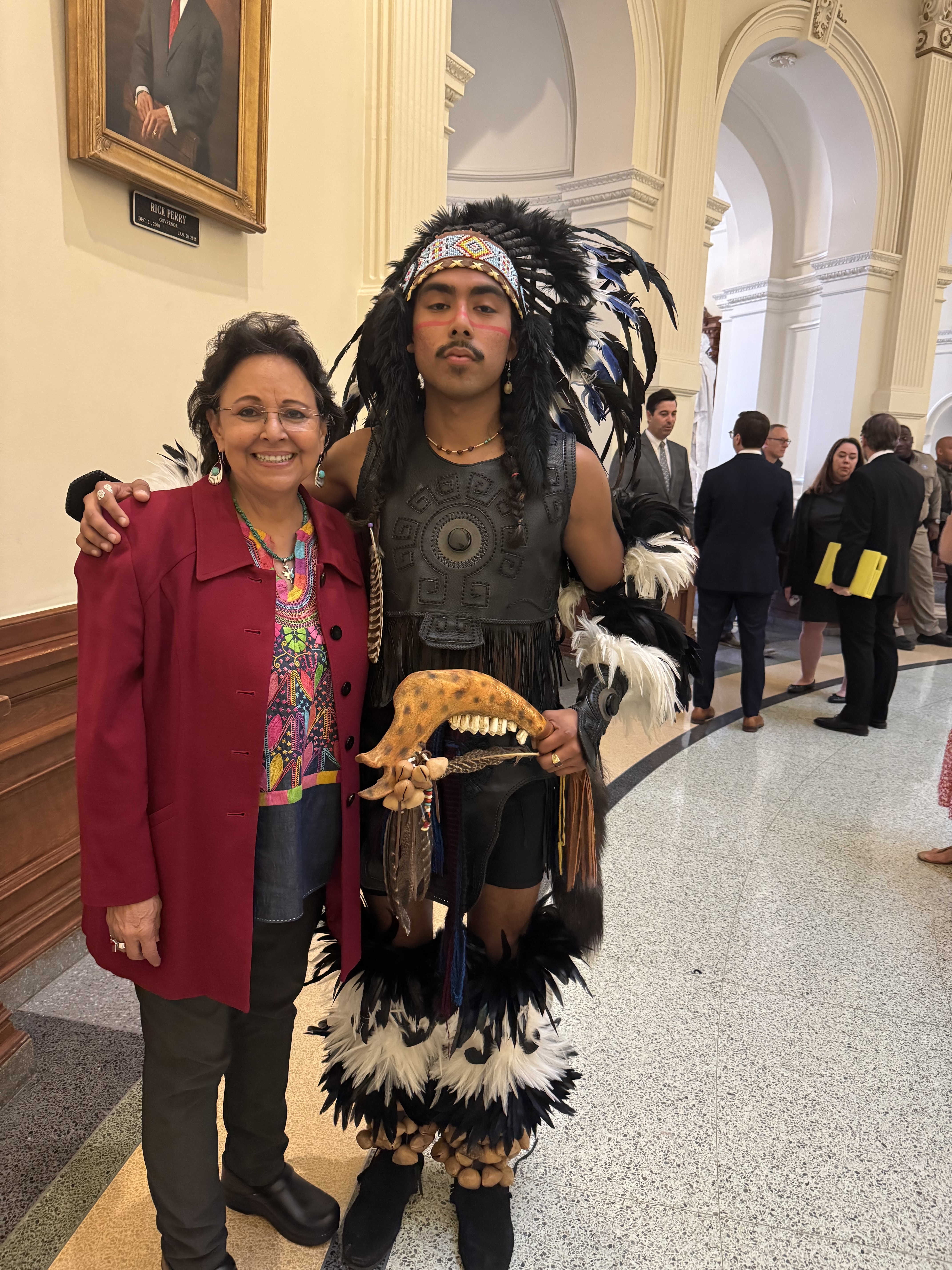
with an audience at the capitol wanting to know about the exquisite Danza Azteca Guadalupana ceremony in the main rotunda of the Texas State Capitol. 
The short of it is that this is to offer up prayers for bills, like Christina Morales' HB 178 in support of Ethnic Studies, as well as, if not especially for, a slew of bad bills that I'll post on when I have time. I've been so busy lately. 
AAUP and Texas AFT, in particular, are doing a great job of keeping us informed of what's happening right now at the capitol.

All of this was also a way to honor Rep. Morales' birthday which is today! She's also having a lowrider show I think at the capitol today that I'm unable to make. I like her taste. Danza Mexica and low riders are a testament to the cultural pride, resilience, and deep-rooted traditions that continue to thrive in our communities. They embody history in motion—whether through the rhythmic steps of ancestral dances or the artistic mastery of gleaming, hydraulically lifted cars cruising the streets. Both carry the spirit of storytelling, resistance, and celebración!!! 

I loved meeting this young man named "Nahuatl," who was grateful for the words I expressed and how important it is to hold onto our culture and the sacred knowledge. I love his name. It's the name of the language spoken by at least 1.6 million people in Mexico according to Mexico’s Instituto Nacional de EstadĆ­stica y GeografĆ­a (INEGI) 2020 data. The rulers of Tenochtitlan (today's Mexico City) allowed for the speaking of Indigenous tongues in the provinces. They mainly cared about tribute. Something to think about as we face the perils of tariffs, the agenda for cultural erasure that anti-DEI measures embody, and tax day itself. As a consequence, language diversity continues into the present. Tariffs and taxes should not ever mean censorship or disdain for non-English speakers. We are of this continent and this hemisphere. We assert our right to exist in and within all this wondrous diversity that is also Afro-Indigenous and Afro-Latinx/o/a. And it's not just racial and ethnic, but also gender diversity and Gen Z loves, and works well, with this diversity.

Woefully under-appreciated is the linguistic diversity Mexico enjoys today—including among Mexicans themselves. I'm so glad that President Sheinbaum celebrates this diversity in Mexico. This is progress for the Indigenous of Mexico. 

Many languages, unfortunately, have suffered over the years as a result of migration and resulting language loss, with some in a precarious state of potential extinction. The Nahuatl language, with its various dialects, remains strong as you can see for yourselves at this link.

The Texas Legislative Session is always a marathon, not a sprint. So hang in there, our beloved advocacy community!

And may you have a wonderful, awesome happy birthday, Rep. Morales! Thanks for all you do! Someday, Ethnic Studies will just be called a good education.

Best,

-Angela Valenzuela

Reference

 Instituto Nacional de EstadĆ­stica y GeografĆ­a. (2024). Population estimates. INEGI.

Sunday, March 30, 2025

‘Evil and Cruel Intent’: Trump Demands Smithsonian Toe the Line and Do Its Part to Whitewash America’s Past—or Lose Funding As Outrage Mounts Over Attempt to ‘Erase History’

Friends:

I want to remind you that whitewashing the Smithsonian and other institutions is blatant censorship. And then calling it "divisive" is a deliberate attempt to silence historically marginalized voices and erase uncomfortable truths rather than engage in honest discourse about the past.

First, the reason these museums and exhibits exist to begin with, at least in part—if not in great part—is that our standard curriculum is already whitewashed. That's what my book, published 25 years ago, Subtractive Schooling (1999), critiqued as part of a larger systemic process of culturally and linguistically subtractive educational assimilation that is the norm, hardly the exception, in U.S. public education. 

Cultural and linguistic erasure is another way to express this.

Second, this illuminates how textbook bans and why deliberations over Texas state standards are so high stakes. They're about the reproduction of a critical consciousness in youth and practitioners. After all, greater inclusion in state curriculum is what we, as civil rights groups alongside various other coalitions and organizations, have advocated for, a number of us for decades. Right now, for example, is Christina Morales' social studies bill, House Bill 178, really needs a hearing.

Third, this attack exists because extremists don't want us, as Black, Brown, and Indigenous communities, to have power. They don't want us to have a curriculum that will tell our children and youth that there are people and institutions in world history who, in their drunkenness with power, commit horrible acts like censoring knowledge and erasing the histories of marginalized communities. 

They fear an education that empowers our children to think critically, to question injustice, and to recognize the patterns of oppression that have shaped the world. By controlling the narrative, they seek to maintain the status quo—one where ignorance prevails, and the voices of Black, Brown, and Indigenous communities are silenced. 

Fourth, we refuse to be erased. Our own history already tells us that we will continue to teach, to learn, and to fight for a future where truth is not a privilege but a right. To draw on Dr. Dolores Delgado-Bernal, we will always have those "pedagogies of the home" that correct sins of omission and commission in state curriculum with the actual truths of history. 

I know my Mom and Dad taught us about their own experiences under McCarthyism with lessons that called out white supremacy while watching the evening news, having conversations at church or around the dinner table that served as correctives to history and social studies textbooks intended to tell us our story with incomplete or biased accounts. My mom always said she knew better than the textbooks because "I lived it," she would say. She could not be gaslighted.

I'm also always reminiscent of the late Gloria AnzaldĆŗa who in her pathbreaking book, Borderlands/La Frontera: The New Mestiza, stated correctly that there isn't a Tejana or Tejano alive who doesn't know that the lands were taken from them. She nailed it with that statement. It's in our genetic memory.

Here is another similar article to the one posted below that is about this censoriousness that I'm calling out. Trump Moves to Rewrite Black History at Smithsonian, Targets African American Museum and DEI in New Order

May cool heads prevail. This has happened before in U.S. history. Elections are a real solution to all this nonsense, by the way. Midterms are scheduled for November 2026 and involve every single seat in the U.S. House of Representatives and one-third or so of the Senate. We must get the vote out.

-Angela Valenzuela

‘Evil and Cruel Intent’: Trump Demands Smithsonian Toe the Line and Do Its Part to Whitewash America’s Past—or Lose Funding As Outrage Mounts Over Attempt to ‘Erase History’

By Christian Boone | Atlanta Black Star | March 28, 2025

President Donald Trump has claimed to have “saved free speech” and he’s issued an executive order empowering Vice President JD Vance to “eliminate improper, divisive, or anti-American ideology” from the 21 museums and learning centers operated by the Smithsonian Institution, including the National Zoo.

Vance, who currently serves on the Smithsonian Institution’s Board of Regent, will coordinate with the White House budget office to ensure future funding isn’t spent on programs that “degrade shared American values, divide Americans based on race, or promote programs or ideologies inconsistent with federal law and policy.”

Republican presidential nominee, former President Donald Trump holds a campaign rally at the PPG Paints Arena on November 04, 2024 in Pittsburgh, Pennsylvania. With one day left before the general election, Trump is campaigning for re-election in the battleground states of North Carolina, Pennsylvania and Michigan. (Photo by Chip Somodevilla/Getty Images)


The order could have a chilling effect on programs or exhibits that chronicle shameful chapters in American history, such as slavery or Jim Crow laws.

Trump addressed what he called a “concerted and widespread” effort over the past decade to rewrite American history by replacing “objective facts” with a “distorted narrative driven by ideology rather than truth,” adding that it casts the “founding principles” of the United States in a “negative light.”

During his re-election campaign, Trump threatened to withhold funding from schools that taught slavery was central to American history. The president’s pledge closely aligns with the stated goals of Project 2025, the right-wing policy document that Trump disavowed on the campaign trail but has widely implemented since reassuming power.

In his latest order, the president has specially targeted the National Museum of African American History and Culture, which opened in 2016 as President Barack Obama was concluding his second term.

Trump says the museum promotes “divisive narratives,” alleging the museum “has proclaimed that ‘hard work,’ ‘individualism,’ and ‘the nuclear family” are aspects of ‘White culture.'”

Trump has also put the spotlight on the Women’s History Museum, which he claimed planned to recognize “men as women.”

Trump had made no secret of his attempt to reshape the country’s culture, which he says has been corrupted by “wokeness.” He’s signed a slew of executive orders aimed at eliminating diversity, equity and inclusion measures within the federal government, which has elicited a number of legal challenges.

The president has already fired the board of the John F Kennedy Center for the Performing Arts in Washington, D.C., and installed himself as chairman. The move led to widespread criticism from actors and directors, causing several to cancel upcoming performances. Since then, Trump-friendly acts, like the J6 chorus and Lee Greenwood, have been booked in their place.

The president’s acolytes have also pushed to implement similarly themed, MAGA-friendly materials into public schools. In Oklahoma, teachers are encouraged to use content created by PragerU, founded by conservative radio host Dennis Prager and funded by right-wing donors. PragerU has more than 3 million subscribers on YouTube and calls itself “a free alternative to the dominant left-wing ideology in culture, media, and education.”

America’s troubled racial history is de-emphasized, if not whitewashed, in the PragerU curriculum.

According to Yahoo! News, a PragerU video features an animated Frederick Douglass calling slavery “a compromise” while criticizing abolitionist William Lloyd Garrison for being too strident. Another PragerU video, about the end of the Civil War, has Ulysses S. Grant complimenting Confederate general Robert E. Lee, calling him “a good man” who just happened to be caught on the opposite side.

In the “Restoring Truth and Sanity to American History” order, Trump has called for the interior secretary to restore federal properties, including parks, memorials and statues, which “have been improperly removed or changed in the last five years to perpetuate a false revision of history.” In most cases, the names or statues removed were of Confederate generals.

Recasting troubled times in a more positive light is at the heart of Trump’s agenda, which he said aims to promote “American greatness.” Vance will join the Smithsonian Board of Regents and to spearhead the purge. The Smithsonian museums offer free entry to up to 30 million visitors each year.

The blowback to Trump’s plan has been swift and hostile.

One volunteer at the NMAAHC noted that the museum helps people trace their genealogy back to slavery.

“The rest of the museum talks about the slave trade, slavery & Civil Rights,” he wrote on X. “Let that f****** piece of s*** try to change that.”

Another former volunteer wrote, “Sometimes history is hard and painful, but needs to be seen and heard so it’s not repeated and that is not anti-American as he claims.”

One critic described the order as “a direct attack,” while another pointed out that Trump’s order is “an attempt to erase history.” Another added, “Evil and cruel intent, always smh.”

“First Trump removes any reference of diversity from the present — now he’s trying to remove it from our history,” Texas congresswoman Jasmine Crockett wrote on X. “Let me be PERFECTLY clear— you cannot erase our past and you cannot stop us from fulfilling our future.”