Friends,
I’m pleased to share a newly-published article co-authored with Luke Metzger, executive director of the Environment Texas Research & Policy Center, and published on the Center’s website.
Project Matador, a massive artificial-intelligence and energy campus under construction near Amarillo, raises urgent questions about water, natural gas, public land, corporate accountability, and the proper role of a public university in facilitating private development. At the center of our concern is the already-declining Ogallala Aquifer, upon which agriculture, communities, and future generations throughout the Texas Panhandle—and seven other states—depend.
AI is often presented as an immaterial technology existing somewhere in “the cloud,” but its infrastructure is being built on Texas soil—and it requires enormous quantities of water, electricity, land, and other public resources. Decisions of this magnitude should not proceed without transparency, independent environmental analysis, enforceable protections, and meaningful public participation.
I am grateful to Luke Metzger for this collaboration and to the Environment Texas Research & Policy Center for publishing our analysis. I also appreciate the work of the Panhandle 1st Coalition and others who are raising critical questions about Project Matador and its long-term consequences.
I invite you to read and share the article. This is not simply a regional issue. It is a question of what kinds of technological development Texas will support, who will bear the environmental costs, and what obligations we have to citizens and residents in other states, as well as to the generations that follow us. -AV
A 17-gigawatt AI campus in the Texas Panhandle is staking its future on water the region doesn't have to spare.

Google Data Center, Council Bluffs, Iowa
All of this infrastructure is intended principally to power AI.
The project’s name carries an unsettling irony. In Spanish, matador literally means “one who kills”—the bullfighter charged with dispatching the bull. It was presumably chosen to evoke daring and spectacle, but for a project that could drain a declining aquifer and deepen reliance on natural gas, the literal meaning reads less like incidental branding and more like a warning.
What, exactly, might Project Matador ultimately kill—or help exhaust—if not the Ogallala Aquifer, one of the largest groundwater systems in the United States?
Project Matador is therefore more than an industrial development. It represents an extraordinary commitment of land, energy, water, public institutional resources, and environmental capacity to a privately controlled computational enterprise whose long-term public benefits remain uncertain.
Artificial intelligence is often described as though it were immaterial, existing somewhere in the “cloud.” In reality, AI depends on a vast physical infrastructure of data centers, chips, pipelines, power plants, transmission lines, cooling systems, and water. The cloud is not floating above us. It is being built on Texas soil.
Although Fermi America describes a diversified energy mix, the project’s near-term foundation appears to rely heavily on natural gas. The company boasts about both receiving a clean air permit for up to 6 GW of natural gas power generation and having easy access to both underground gas and ”Waha Hub, a giant U.S. marketplace for natural gas.” In addition, the company has a long-term agreement to purchase a large amount of natural gas each day. This exposes a contradiction at the heart of the AI boom: A technology marketed as futuristic may deepen dependence on anachronistic fossil-fuel extraction and combustion.
Calling Project Matador an “advanced energy” campus does not erase the environmental consequences of its reliance on natural gas. Natural-gas production and combustion release greenhouse gases, including carbon dioxide and methane, as well as nitrogen oxides and other air pollutants from burning gas. Nitrogen oxides released through fossil-fuel combustion can also contribute to the formation of fine particulate matter, smog, and ground-level ozone. Nor does the prospect of adding solar or nuclear power in later phases cannot retroactively undo the environmental effects of the gas pipelines, gas-fired generating facilities, data centers, and other infrastructure being constructed now. Moreover, considering that the development of pipelines and power plants are durable investments, these may extend fossil-fuel dependence for decades.
The most urgent concern, however, may be water.
Project Matador is being built in a region heavily dependent on the Ogallala Aquifer, the foundation of agriculture, ranching, municipal life, and economic survival across much of the Great Plains.
Yet the Ogallala is being steadily depleted. In large portions of the Texas Panhandle and High Plains, water is being withdrawn far more rapidly than rainfall and natural recharge can replace it.
That makes every major new industrial claim on Panhandle water a matter of profound public importance. Water committed to data centers may no longer be available to farmers, ranchers, towns, ecosystems, or future generations. The question is not merely whether a corporation can afford to buy water. It is whether Texas should permit one of its most resource-intensive technological projects to expand in a region whose principal aquifer is already under severe strain.
The City of Amarillo approved an arrangement allowing Fermi America to purchase as much as 2.5 million gallons of municipal water per day at twice the standard rate. At the maximum level, that allocation alone would equal approximately 912.5 million gallons annually and more than 18 billion gallons over the initial 20-year term.
Yet this represents only part of the project’s potential supply. Fermi America has stated that it secured access to as much as 18.5 million gallons per day through a combination of municipal and private groundwater arrangements. At that upper limit, Project Matador would have access to approximately 6.75 billion gallons annually. Over 20 years, continuous use at that level would total approximately 135 billion gallons.
Access to 18.5 million gallons per day does not necessarily mean the completed project will consume that amount every day. Actual use will depend on the number and size of the data centers, cooling technologies, generating facilities, recycling systems, weather, and the pace of construction. Still, securing access to billions of gallons annually reveals the magnitude of the project’s anticipated water needs.
Fermi America says it will employ closed-loop cooling, recycle water, pay above-market rates, and finance infrastructure improvements. Those claims require independent verification. Closed-loop cooling can reduce withdrawals, but it does not make data centers water-free. Water is still lost through evaporation, cooling-tower blowdown, treatment, maintenance, and other industrial processes. Gas-fired and nuclear facilities will also require substantial water.
Paying more for water does not make it renewable. A higher price may generate municipal revenue, but it does not restore the Ogallala Aquifer. Money cannot quickly replenish groundwater accumulated over thousands of years.
The relevant question is not whether Fermi America can afford this water. It is whether the people of the Panhandle can afford the long-term consequences of surrendering so much of it.
Project Matador also raises serious questions about the role of public universities. The campus is being developed on land controlled by the Texas Tech University System under a 99-year ground lease. Texas Tech describes the partnership as an opportunity for research and workforce development.
Those possibilities should not be dismissed. The project may create construction work, technical employment, tax revenue, research partnerships, and investment in a region often overlooked by major development initiatives. But public benefit cannot simply be asserted. It must be demonstrated.
Texans deserve to know what risks Texas Tech has assumed, what tax abatements or infrastructure commitments support the project, and what protections exist if it is delayed, downsized, sold, or abandoned. They also deserve assurance that university researchers will remain free to independently study and publish findings on water use, pollution, labor conditions, nuclear safety, and community effects.
A public university should not serve merely as a landlord, workforce provider, branding partner, or source of legitimacy for private capital. Its first obligation is to the public.
The project’s employment claims also require scrutiny. Data centers employ large numbers of workers during construction but are highly automated once operational. The public needs independently verified estimates of permanent jobs, wages, local hiring, worker protections, and net public revenue after subsidies and tax abatements are considered.
The promise of four large nuclear reactors should likewise be treated cautiously. Such construction would involve extraordinary financial, engineering, regulatory, and logistical challenges. Communities should evaluate binding agreements and actual construction, not only promotional renderings of what may exist decades from now.
The final form of Project Matador may differ substantially from the sweeping vision now being marketed. In April 2026, Fermi announced that it was looking for a replacement for CEO Toby Neugebauer, the company’s co-founder and largest shareholder. The company’s interim leadership subsequently outlined a restructured strategy labeled “Fermi 2.0.” Neugebauer publicly urged the board to pursue an independent sale of the company and criticized the new direction, while Fermi disclosed a year-to-date net loss exceeding $486 million and confirmed that its first prospective anchor tenant had walked away from a construction-funding agreement. Given’s Fermi’s leadership upheaval and financial strain, regardless of the company’s intentions at the time of its commitments, it’s unclear what will survive the transition.
Beyond the environmental and economic questions lies a larger democratic one. We are increasingly told that artificial intelligence is inevitable and that communities must compete to host its infrastructure or be left behind. This conflates political choices with technological destiny and asks the public to accept nearly any expenditure of water, energy, land, and public resources in the name of AI.
But just because someone says something is inevitable doesn’t make it so, nor should it guide public policy.
Artificial intelligence may advance medicine, science, education, accessibility, and communication. It may also displace workers, intensify surveillance, reproduce discrimination, flood the information environment with synthetic content, and concentrate wealth and political power.
Before committing billions of gallons of water and city-scale quantities of electricity to AI infrastructure, Texans deserve to know what the computing capacity will be used for, who will control it, who will profit, and what enforceable public benefits will result.
Not every use of AI carries equal social value. Computing used for medical research or climate modeling cannot simply be equated with computing used to automate advertising, expand surveillance, replace workers, produce disposable content, or accelerate financial speculation. Yet all may draw from the same aquifer and impose costs on the same communities.
Project Matador should therefore be subject to independent water-impact studies, annual reporting of actual withdrawals and consumption, disclosure of cooling systems and recycling rates, aquifer monitoring, cumulative pollution assessments, drought-response requirements, disclosure of subsidies and tax incentives, and meaningful public participation.
The project must also be evaluated as a whole. A proposed 17-gigawatt campus should not be fragmented into separate permits for wells, pipelines, turbines, data halls, transmission lines, and nuclear facilities in ways that obscure its cumulative impact.
There must also be enforceable limits. During droughts or groundwater emergencies, household, agricultural, and community needs should take priority over nonessential computational demand.
Project Matador embodies a vision of ever-larger data centers, ever-greater computational capacity, and seemingly limitless technological growth. Yet it is being built in a region where water is finite and the Ogallala Aquifer is already declining.
That contradiction cannot be engineered away through corporate branding.
The issue is not whether one is simply for or against artificial intelligence. It is whether private technological ambition should be allowed to outrun democratic governance, environmental stewardship, and the rights of future generations.
The Ogallala Aquifer is not infinite. Natural gas is not clean merely because it powers computers instead of factories. Public land does not cease to be a public trust because it has been leased for nearly a century. And the promise of innovation does not relieve a corporation or public university of its obligation to demonstrate lasting public value.
Project Matador may become a monument to technological achievement. It could just as easily become a monument to an era that mistook computational power for wisdom, corporate scale for progress, and the ability to purchase water for the right to consume it.
Before Texas commits its water, energy, public land, and future to Project Matador, the people of the Panhandle—and the people of Texas—deserve transparency, independent science, enforceable protections, and a genuine democratic voice.
 Angela Valenzuela, Ph.D.
Professor of Educational Leadership and Policy at The University of Texas at Austin
Angela Valenzuela, Ph.D., is Professor of Educational Leadership and Policy at The University of Texas at Austin. Although she has taught environmental policy, her primary scholarship centers on K–12 and higher education policy, with particular attention to educational equity, culture, language, and the politics of education. She earned her Ph.D. in sociology from Stanford University and is the author of the award-winning book Subtractive Schooling: U.S.-Mexican Youth and the Politics of Caring (1999).
Dr. Valenzuela is also the founder and author of Educational Equity, Politics, and Policy in Texas, which is regarded as one of the nation’s leading education reform blogs. She is a co-founder of Academia Cuauhtli, a partnership-based, community-anchored Saturday school with district-wide impacts across the Austin Independent School District, where she regularly mentors young people and advances culturally sustaining education.
She was named among the nation’s top 200 education scholars in the 2025 Edu-Scholar Public Influence Rankings and is a member of the National Academy of Education.
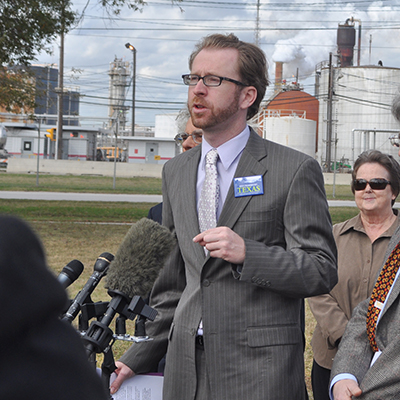
Luke Metzger
Executive Director, Environment Texas Research & Policy Center
As the executive director of Environment Texas, Luke is a leading voice in the state for clean air and water, parks and wildlife, and a livable climate. Luke recently led the successful campaign to get the Texas Legislature and voters to invest $1 billion to buy land for new state parks. He also helped win permanent protection for the Christmas Mountains of Big Bend; helped compel Exxon, Shell and Chevron Phillips to cut air pollution at four Texas refineries and chemical plants; and got the Austin and Houston school districts to install filters on water fountains to protect children from lead in drinking water. The San Antonio Current has called Luke "long one of the most energetic and dedicated defenders of environmental issues in the state." He has been named one of the "Top Lobbyists for Causes" by Capitol Inside and received the President's Award from the Texas Recreation and Parks Society for his work to protect Texas parks. He is a board member of the Clean Air Force of Central Texas and an advisory board member of the Texas Tech University Masters of Public Administration program. Luke, his wife, son and daughters are working to visit every state park in Texas.

No comments:
Post a Comment