Translate

Showing posts with label white culture. Show all posts

Friday, March 25, 2022

"How White Backlash Controls American Progress," by Lawrence Glickman

As outlined in this piece by Lawrence Glickman in The Atlantic, the underpinnings of modern conservativism are premised on zero-sum logic, paranoia, and fear which dictate that African American and minority gains, in general, equate to white loss and victimization. For white "backlashers," a loss of "white tranquility” finds expression in other backlashes like we're seeing today against women, undocumented immigrants, transgender youth, and in the attack on the teaching of race in schools and universities.

Glickman nails these backlashes as not quite a series of discrete actions, but rather as a reactionary tradition 

"that is deeply woven into American political culture and that extends back to the era of Reconstruction, at least. And the backlashes are powerful not only for the fury they represent, but in the fear they instill in political leaders, even progressives, who hesitate to push things 'too far.'"

May this piece serve as a cautionary tale to liberals and progressives. After all, to give sway is to support not just "creeping fascism," but full-blown fascism manifest as anti-diversity, sexism, homophobia, transphobia, genocidal racism together with systematic campaigns against the right to vote and the republican agenda to not only legislate but also police how we are to think and teach, all in the interest of preserving "white tranquility," however punishing, regressive, or unconstitutional.

This "White Backlash" framework helps explain why Donald Trump’s MAGA discourse and politics found fertile ground in America, that for fascists, conveniently exposed a gaping hole that Putin and his minions could exploit by helping get Trump elected and softening Republicans' posture toward Russia (read: Donald Trump Softened the GOP on Russia—At Least for Now).

I'll conclude with my thoughts this morning by providing you with this apt quote here by the beloved and legendary educator, Deborah Meier who once expressed, "If there's a problem with democracy, the answer is always more democracy, not less democracy."

-Angela Valenzuela

How White Backlash Controls American Progress

Backlash dynamics are one of the defining patterns of the country’s history.

About the author: Lawrence B. Glickman is a history professor at Cornell University. He is the author, most recently, of Free Enterprise: An American History.

MAY 21, 2020 Updated at 10:41 a.m. ET on May 22, 2020 | The Atlantic

The word backlash gained popularity in the summer of 1963, when, after dallying on the issue for the first two years of his presidency, President John F. Kennedy proposed significant civil-rights legislation. In response, the word, which had primarily denoted the recoil of a fishing line, was repurposed, usually as “white backlash,” to refer to opposition to the increased pace of African American civil-rights activism or the Kennedy (and, after his assassination in November 1963, the Lyndon B. Johnson) administration’s legislative proposals and executive actions, or both.

In 1966, a commentator, speaking of “the grand new word, backlash,” claimed without much exaggeration that “just about everything that happened could be (and was) attributed to some form of backlash.” The word came to stand for a topsy-turvy rebellion in which white people with relative societal power perceived themselves as victimized by what they described as overly aggressive African Americans demanding equal rights. Backlash, as the New York Times columnist Tom Wicker wrote, “is nothing more nor less than white resentment of Negroes.”

Moving beyond an opposition to civil rights, the word backlash—less frequently qualified as “white”—quickly became a synonym for a new and growing conservative force, signifying a virulent counterreaction to all manner of social movements and cultural transformations that became central to American politics. Over time, observers noted manifestations of this reaction in a “Southern backlash,” a “male backlash,” a “heterosexual backlash,” a “property tax backlash” and a “backlash against environmentalists.” Just a month after the passage of the Civil Rights Act, a journalist described the United States as being in the midst of “a multitude of backlashes.” But as one commentator pointed out, “The word which gave rise to all sorts of other ‘lashes’ was coined in reference to white opposition to Negro gains.”

Backlash may have burst onto the scene as “the word of the year in American politics” in 1964, but it described one of the oldest and deepest patterns in American politics, one that is once again playing out today in the right-wing campaign against social distancing. Backlashes appear as seemingly serial and discrete events—against the civil-rights movement in the 1960s, or the women’s movement in the ’70s, or the gay-rights movement in the ’90s. But this obscures an underlying continuity: These individual backlashes are all instances of a reactionary tradition, one that is deeply woven into American political culture and that extends back to the era of Reconstruction, at least. And the backlashes are powerful not only for the fury they represent, but in the fear they instill in political leaders, even progressives, who hesitate to push things “too far.”

During Reconstruction, opponents of the black-freedom struggle deployed preemptive, apocalyptic, slippery-slope arguments that have remained enduring features of backlash politics up to the present. They treated federal support for African American civil rights, economic and social equality—however delayed, reluctant, underfunded, and incomplete it may have been—as a cataclysmic overreaction and framed it as a far more dangerous threat to liberty than the injustice it was designed to address. In 1867, not even two years after ratification of the Thirteenth Amendment, the Brooklyn Daily Eagle decried the placement of political power “in the hands of a property-less and ignorant class of the population,” and pronounced that “the pending Reconstruction scheme must be abandoned.”

Since then, such framing has done more than merely shape the politics of reaction in the United States; it has also constrained putatively supportive political leaders, who live in fear of setting off backlashes. Responding to a moderate plan to enfranchise only free blacks in Louisiana in 1864, the Union general Nathaniel P. Banks, worrying about a negative response from the state’s whites, who were being defeated in the Civil War, said, “Revolutions which are not controlled and held within reasonable limits produce counter-revolution.” That obeisance to a defeated group in 1864 was an extreme version of a general pattern that has remained a hallmark of backlashes ever since: solicitousness to white fears.

For many white backlashers in the 1960s, the era of what the historian C. Vann Woodward called the “second Reconstruction,” the first Reconstruction remained a negative model. They viewed its reform as overly fast-paced, and felt that it foregrounded black civil rights at the cost of white people’s peace of mind. They associated civil-rights activism with what popular historians and commentators of the day called the “excesses” of Reconstruction, by which they meant a combination of “militant” African American demands for basic equality with overweening, aggressive, and hasty federal action in support of interracial democracy. Thurman Sensing of the Southern States Industrial Council, a conservative business group, described the civil-rights movement in 1966 as an effort to force “the Reconstruction of American customs,” showing the degree to which the post–Civil War campaign for racial equality remained a central metaphor for white backlashers. The journalist in December 1963 who noted the political power of those opposed to “Negro pressure for equal opportunity and the Federal Government’s pace on the Civil Rights front,” could just as easily have been describing the origins of the counterrevolution of the 1870s.

There was, then, nothing particularly novel about the constituent elements of white backlash to the civil-rights movement: its smoldering resentment, its belief that the movement was proceeding “too fast,” its demands for emotional and psychological sympathy, and its displacement of African Americans’ struggles with its own claims of grievance.

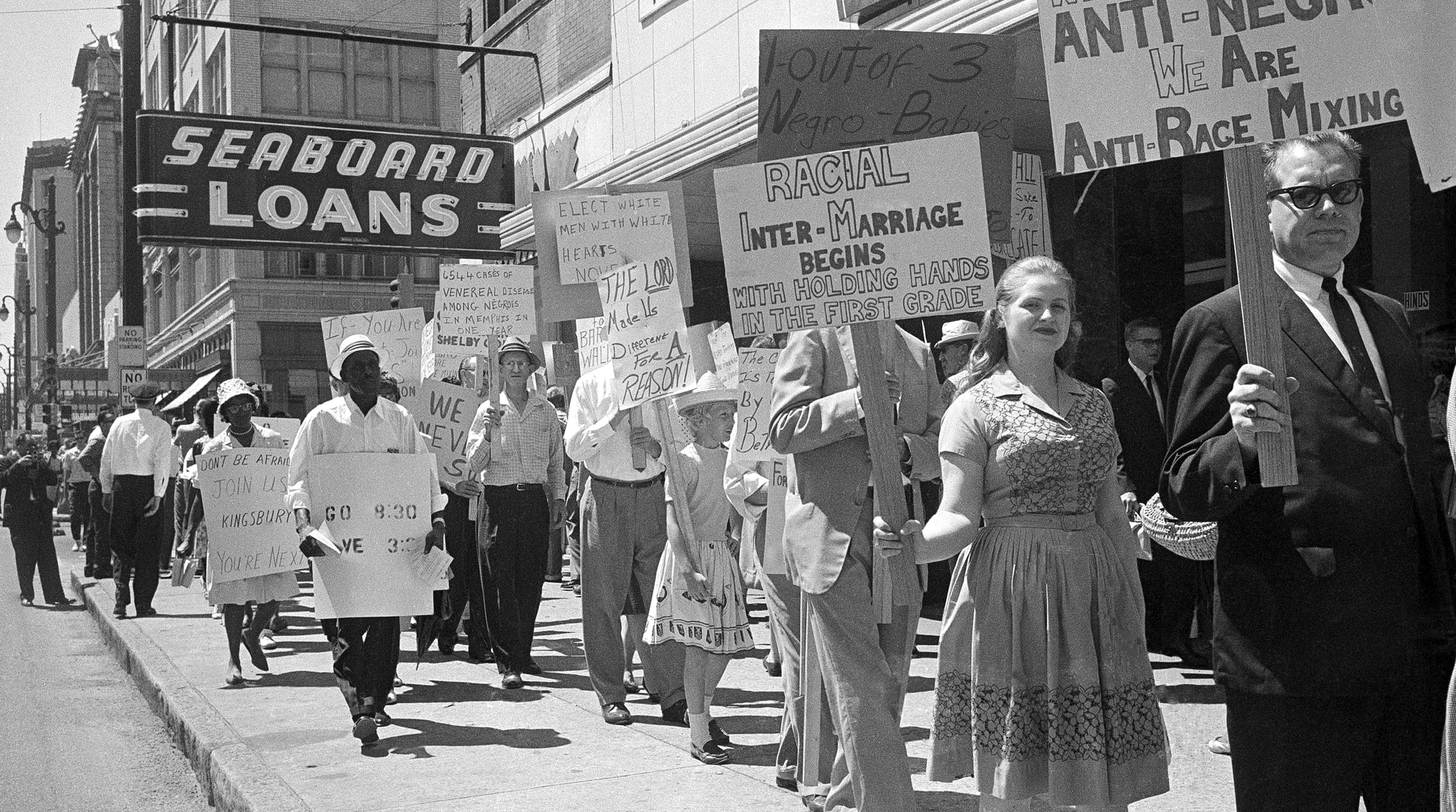
What is particularly noteworthy is that the white backlash in this case was in place before the passage of the Civil Rights Act in July 1964. The pattern is this: American reactionary politics is nearly always preemptive, predicting catastrophe and highlighting potential slippery slopes. “White backlash,” after all, got its name in 1963, just months after African Americans in Birmingham risked attacks from police dogs and high-pressure fire hoses in order to demand justice, and immediately after Kennedy mooted the idea of substantive legislation—both events taking place well before the Civil Rights Act became law. What one reporter called “white panic” was driven by fears of “favoritism” and “special privileges” for African Americans—that white “workers would be forced out of their jobs to make way for Negroes,” as one article put it that year, when Jim Crow still prevailed. “Many of my people think the Negroes want to take over the country,” a midwestern Republican politician said in a Wall Street Journal article published on April 10 of the following year, still months before the Act’s passage. “They think there are things in the bill that just aren’t there, like forced sales of housing to Negroes and stuff like that.” White backlashers imagined coercion where it did not exist. They embraced a lexicon and posture of victimization that hearkened back to the era of Reconstruction and anticipated the deceiving, self-pitying MAGA discourse that drives reactionary politics in Donald Trump’s America.


Residents of Levittown, Pennsylvania, are shown during a rally on 
August 17, 1957, to protest plans by William Myers, a black man, 
to move into a home in the all-white community of 60,000 people.
(Bill Ingraham / AP)

Thursday, August 06, 2020

How Can I Have a Positive Racial Identity? I'm White! | Ali Michael | TEDTalk


Great Ted Talk by Ali Michaels that addresses whiteness. Drawing on psychologist Janet Helm, she offer the following definition of what a positive racial identity means for white people:

“A positive racial identity [for a white person] is not about feeling good about being white.  It’s also not feeling bad about being white. It’s about understanding what it means to be white in this context of a heavily racialized society that has historically—still today—distributes resources and opportunities inequitably, favoring white people against people of color. Understanding what it means to live in a society that teaches people of color internalized oppression and teaches white people internalized superiority. And dealing with that sense of internalized superiority so that I can show up and be and live in a healthy multi-racial community with people of color in which we work against racism and other oppressions, knowing that all oppressions are connected.”


I like how she framed her own transformation as a result of taking an African American Studies course. This is why so many of us who are teachers advocate for Ethnic Studies. The criticality that such courses provide bring justice and new ways of knowing and being in the world that no longer reinscribe white privilege and white supremacist ways of knowing and being, helping us to live together peacefully in the world.


-Angela Valenzuela

Sunday, September 30, 2018

"White people in Ethnic Studies" by Dr. Christine Sleeter


Very interesting piece here by Dr. Christine Sleeter titled, "White people in Ethnic Studies."  It offers much food for thought, especially for the Ethnic Studies classroom.  The readings on white ethnicity are certain worthwhile and informative.  One of my favorite texts from the past was The Ethnic Myth: Race, Ethnicity, and Class in America by Stephen Steinberg.

Do read this piece in its entirety and do visit her website.  Dr. Sleeter, a nationally-renowned scholar and friend, who has spent decades researching Ethnic Studies and her suggestions for the classroom are more than helpful.

-Angela Valenzuela

Ethnic Studies is experiencing a vibrant growth at the K-12 level. I am sometimes asked what place there should be, if any, for white people in Ethnic Studies. This is an important question. Simply leaving white people out of Ethnic studies will alienate them. In addition, Ethnic Studies is invaluable for helping white people see ourselves within rather than outside a multicultural democracy, and as potential racial justice allies. 
But it is important to use lessons from past experience and research to inform what including white people in Ethnic Studies might look like.
Roots too?
Recent history provides an example of how white people’s attempt to be part of Ethnic Studies can go wrong. Writing in his 2006 book Roots Too, Matthew F. Jacobson analyzed the Euro-American ethnic revival movement of the 1970s – 1990s. He argued that, in the absence of a critique of social class, following the Civil Rights movement and rapid diversification of the U.S. population, descendants of eastern and southern European immigrants found the language of ethnic identity and collective rights to express their own concerns. Euro-Americans worked to reclaim history and immigrant heritage; part of this work involved tracing ancestors to European homelands. At the same time, they dissociated themselves from racism by pointing out that ancestors immigrating after the latter 1800s had not owned slaves nor taken land from Indians. Stories of immigrant ancestors’ hardships glossed over forms of racial discrimination that did benefit them in areas such as housing, hiring, and unionizing. Jacobson argued this attempt to be included in ethnic discourse became less a process of remembering history than of re-writing it.
Ironically, in a search for ethnic roots, white people used narratives from diverse ethnic histories to construct a homogenizing narrative of heroic and downtrodden, not quite white, European immigrants who triumphed through hard work. This narrative dismissed specificity and privilege while drowning out the Civil Rights narrative that challenged racial dominance. Jacobson observed that, “The ethnic contributions model of American nationality may have been a significant departure from the homogenizing model of the melting pot, but did share . . . an almost absolute erasure of power relations that made for a fairly sanitized and happy national narrative: diversity as feast, the nation as smorgasbord” (p. 56).
The use of white ethnicity to create a national mythology that denies racism asserts racialized power. As we think about how to include white people in Ethnic Studies, it is crucial that we not create a contemporary version of the same thing.
The conundrum of culture
Historically, as diverse European American immigrant groups submerged their own cultures and languages in order to claim racial power, most lost a sense of ourselves as cultural beings, as well as knowledge of our own ethnic origins. As a result, a growing proportion of white Americans see ourselves as “culture-less,” culture as unimportant, and race as a version of ethnicity that will wither away. For example, in interviews with Ruth Frankenberg (1993) about race, racial dominance, and white identity, white women expressed awareness of and discomfort with racial inequality, but had few concepts with which to examine it other than “long-established modes of cultural description” (p. 196). They could describe “others” as cultural, but not themselves, and they had no other language with which to understand racism. Similarly, Pamela Perry’s ethnographic study of white middle class youth in two high schools (Shades of White, 2002) found them dismissive of culture and ignorant about race. Those in a predominantly white school never had to think about race, ethnicity, or culture, and had difficulty interpreting the question of what white culture means. Those in a multiracial school viewed culture as an attachment to the past, and were simply not interested in that past.
Sociologist Stanley Lieberson (1985) reported a link between how many generations removed people are from their immigrant pasts, and awareness of ethnic roots. While about half of white Americans in his study saw themselves as “un-hyphenated,” this was true of about two-thirds of those in the South, particularly in the Southeast where 80% were at least fourth generation. The rate of intermarriage among Euro-Americans rises with distance from immigration, and that distance, combined with intermarriage, prompts disinterest in ethnicity. Yet, many white people assign symbolic value to ethnicity, perhaps as a counterbalance to a sense of lacking culture.
Richard Alba and Mitchell Chamlin, writing in the American Sociological Review in 1983, found that ethnically mixed white people often claim a single European ethnic ancestry (such as German-American or Norwegian-American), particularly those in inner cities and suburbs outside the South, and those with more education. That ethnic identity seems symbolically important. Richard Alba, in his 1990 book Ethnic Identity, found white people to view culture as something static that “other people” brought from somewhere else, and ethnicity to be a source of enrichment and uniqueness, experienced mainly through cultural expressions such as food, customs, family celebrations, festivals, and words or phrases from a heritage language. Ethnicity also provided a language with which to talk about extended family.
So, when white people take up multicultural education or ethnic studies, their interpretations of what that means stems from their understandings of culture and ethnicity, and lack of understanding or avoidance of race and racism. These are areas that Ethnic Studies involving white people should directly address.
White people in Ethnic Studies
I suggest four areas that should be part of Ethnic Studies that involves white people.
1. What culture means; self as a cultural being. White students commonly see culture as quaint or colorful practices brought from elsewhere, which people of color seem to have much more of than white people. This huge misunderstanding of culture positions white people as nostalgic for something lost, while failing to recognize how everyone is culturally constructed, and how the normalization of white people’s culture maintains power relationships.
Anthropologist Ward Goodenough (1976) defined culture as “the concepts, beliefs, and principles of action and organization that . . . could be attributed successfully to the members of that society” (p. 4). By this, he meant all of the knowledge and principles that guide shared behavior and understandings. Understood in this way, everyone is a cultural being; we all participate in shared behaviors and understandings. White people are fully cultural, but use power to make what is cultural appear natural or normal. I do not find it particularly helpful, by the way, to hand students a list of white cultural traits, as such lists sometimes cause defensiveness and do not help them learn to see with a cultural eye.
I do find it very helpful, however, to teach students to read their own everyday lives through a cultural lens. There are many ways of doing so. For example, since much culture is learned in the family, I have had students analyze how things are done in their own families through a cultural lens, using questions such as: What is your family’s structure?  What roles do family members play? How is affection communicated? How are disagreements handled? How is time structured? What kinds of behaviors are rewarded and how; what kids are punished and how?  How are meals handled – what is a “proper” meal, who fixes, it, and when and with whom are meals eaten? Such questions begin to get at cultural practices we learn while growing up. When students compare their descriptions, often they see similarities and differences among their peers, which begins to make culture visible.
With respect to Euro-American ethnic culture, rather than attending only to what was brought from Europe, learning how culture developed in the U.S. can be very interesting. A particularly interesting example is Appalachian culture. Research on Appalachian culture dates back to the early 1900s, but was given a considerable boost in 1977 when the Appalachian Studies Association was formed by group of “scholars, teachers, and regional activists who believed that shared community has been and will continue to be important” (Appalachian Studies Association). (My mother’s mother was of Appalachian descent, a term I never heard growing up probably because of the stigma applied to Appalachia.)
2. Remembering rather than re-writing history. Students usually encounter textbook history as boring, and few (including white students) see themselves in that history. At least white students, however, see widely varied representation of people who look like them; students of color do not get even this much.  In contrast students find family history to be a highly interesting and viable entree into national history. However, people often interpret their family history within dominant national narratives rather than using family history to create new (and more accurate) narratives.
I developed Critical Family History specifically as a framework and methodology to disrupt dominant narratives. For example, if one asks what other sociocultural groups were in the vicinity of an ancestral family, and what the power relationships were among groups (a question white people rarely ask when doing family history), one begins to situate one’s own family story within larger and sometimes conflicting conversations about our pasts. For example, a past involving homesteading is also a past taking up settler colonialism and dispossession of Indigenous peoples. What does it mean to both acknowledge hardships and challenges of one’s ancestors as well as their participation in land theft?
When I work with Critical Family History with students, I encourage them to attend carefully to historical records, including those that are unsettling. There will be ancestors that one comes to admire and others one may dislike. Most, if you get to know them, were complex people that you cannot simply venerate or abhor (just like the people in our lives today). But in addition to whatever feelings this research may generate toward one’s forebears, the point is to get to know history in a much more personal and nuanced way, and one in which you can situate yourself and your family.
3. Historical construction and current workings of racism. Whiteness studies interrogates the position of power that Euro-Americans occupy within the context of racism. Whiteness studies focuses on invisibility of racial power to whites, social privileges associated with white supremacy, and relationships between whiteness and identity. Whiteness studies examine the historical processes through which people of European descent constructed race as a concept to justify conquest and exploitation, then gradually submerged their own ethnic identities in order to claim power, trading in power for a sense of themselves as cultural beings. Study of the historical construction and current workings of racism is in many ways no different for white students than for students of color, except that white students typically bring much more defensiveness and denial than do students of color, which may have implications for how it is taught.
In addition to grappling with how race works, it is very important to help students see how multiple forms of inequality are linked. In the U.S., we maintain a mythology that we are a fairly classless society. As a result, people often use race to explain class inequalities, or, conversely, reduce racial inequalities to economic poverty. Ethnic studies, in its unpacking of race and racism, should attend to social class as well, including probing historic and contemporary tensions between the white working class and people of color.
4. Becoming allies. Ultimately, including white people in Ethnic Studies should help students envision themselves as allies in work for racial justice. There are various ways doing this, such as involving white students in multiracial YPAR (Youth Participatory Action Research) activities addressing racism locally. Another way is by identifying white moral ancestors, in the words of Linda Christensen — white people who worked for justice. When I began doing my own family history research, I hoped to find at least one anti-racist activist in my family tree. I didn’t, but I did bump into some white moral ancestors along the way, such as Benjamin Butler, for whom an ancestral family seem to have named one of their children. A Union general during the Civil War, Butler helped to free slaves and bring literacy to Blacks in New Orleans after the Civil War. While one can critique other things about him, his work challenging slavery in notable. For white people, learning about white moral ancestors provides a set of racial justice ally role models.
I hope these ideas help in thinking about how to include white people in the growing Ethnic Studies movement.