-Angela Valenzuela
Supreme Court rules for ‘Dreamers,’ rejects Trump’s repeal of immigration program

By DAVID G. SAVAGESTAFF WRITER | LA times
JUNE 18, 2020
7:07 AM
UPDATED7:31 AM
WASHINGTON —
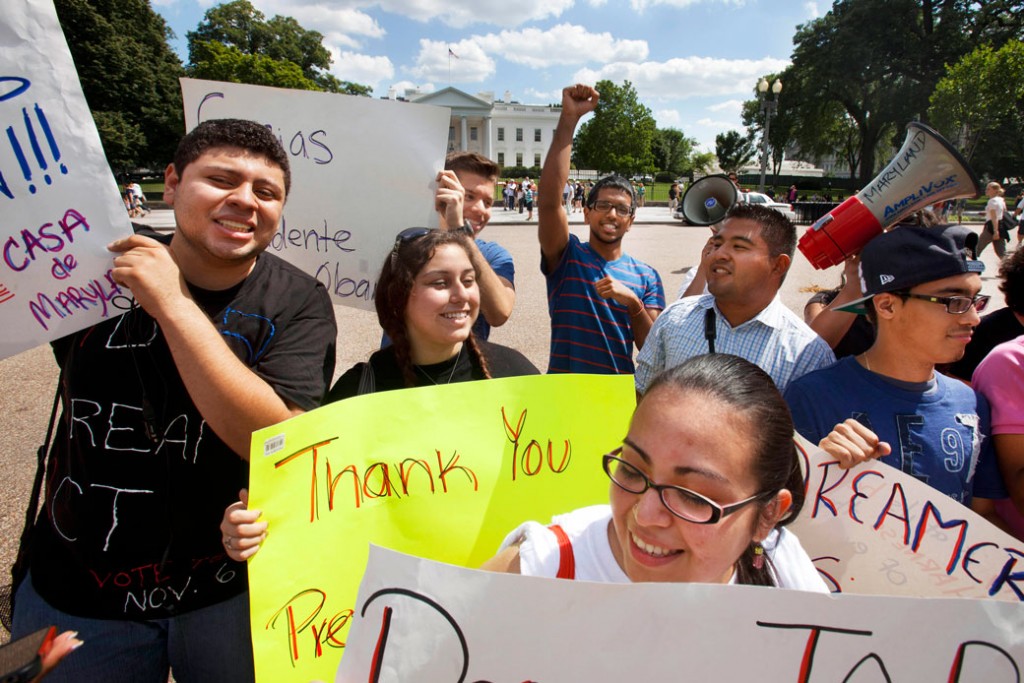
In a striking rebuke to President Trump, the Supreme Court Thursday rejected his plan to repeal the popular Obama-era order that protected so-called Dreamers, the nearly 800,000 young immigrants who were brought to this country illegally as children.
 Led by Chief Justice John G. Roberts Jr., the court called the decision to cancel the program known as Deferred Action for Childhood Arrivals, or DACA, as arbitrary and not justified. The program allows these young people to register with the government, and if they have clean records, to obtain a work permit. At least 27,000 of these DACA recipients are employed as healthcare workers.
Trump had been the confident that high court with its majority of Republican appointees would rule in his favor and say the chief executive had the power to “unwind” the policy.
The decision follows several other defeats this week for Trump. On Monday the court rejected the Trump administration’s position that a 1964 civil rights law should not protect LGBTQ workers from discrimination, and separately it sided with California in a legal battle over so-called sanctuary laws.
The DACA case was perhaps the year’s biggest immigration dispute at the high court.
Today’s decision is similar to last year’s ruling that blocked Trump’s plan to add a citizenship question to the 2020 census.
On Monday, Roberts spoke for the same 5-4 majority, and his opinion follows the same reasoning. The chief justice said Trump’s Homeland Security officials did not put forth a valid reason for revoking the DACA program, just as he said it did not provide a valid reason for adding the citizenship question.
“We do not decide whether DACA or its rescission are sound policies,” Roberts wrote. “We address only whether the agency complied with the procedural requirement that it provide a reasoned explanation for its action. Here the agency failed to consider the conspicuous issues of whether to retain forbearance and what, if anything, to do about the hardship to DACA recipients. That dual failure raises doubts about whether the agency appreciated the scope of its discretion or exercised that discretion in a reasonable manner. The appropriate recourse is therefore to remand to DHS so that it may consider the problem anew.”
It is a remarkable turn of events for Roberts and the court. Two years ago, the chief justice wrote a 5-4 opinion deferring to Trump and upholding his travel ban on foreign visitors and immigrants. Now he has switched sides in several momentous cases and blocked Trump’s action as unwarranted and unjustified.
The Obama administration announced the policy in 2012 and said the government had no interest in arresting and deporting young people who were working in this country, contributing to their communities and obeying the laws. The order allowed them to register with the government, and if they had a clean record, to obtain a work permit.
The policy proved to be popular with Republicans as well as Democrats, and it went largely unchallenged until 2017 when Trump’s Atty. Gen. Jeff Sessions, a hardliner on immigration, decreed the policy of “deferred” enforcement was unconstitutional and should be revoked.
President Obama relied on his executive authority over enforcement policy when he announced the DACA policy in 2012. Obama said he wanted federal agents to pursue criminals, drug traffickers and smugglers, but “defer action” against those who had done nothing wrong and were contributing to their communities and the nation. At the time, Obama was urging Congress to adopt an immigration reform law, but those hopes were dashed in 2013 when House Republicans blocked a broad reform measure that passed by a large bipartisan majority in the Senate.
Several months after taking office, Trump and his homeland security advisors announced they planned to “wind down” the DACA program. They did so based on an opinion from then-Atty. Gen. Jeff Sessions that Obama’s policy was illegal.
University of California President Janet Napolitano, who launched the DACA program when she was Obama’s secretary of Homeland Security, filed a lawsuit against the Trump administration in federal court in San Francisco along with California Atty. Gen. Xavier Becerra. They argued that Trump’s lawyers had not put forth a valid reason for terminating the popular program.
U.S. District Judge William Alsup agreed in January 2018 and handed down a nationwide order that put the repeal on hold. Trump’s lawyers had acted based on “a flawed legal premise,” he said, adding that “DACA was and remains a valid legal exercise” by immigration officials.
The administration appealed, but in November 2018, the U.S. 9th Circuit Court upheld the judge’s order in a 3-0 decision.
The Supreme Court refused to intervene for a time, but agreed last year to hear the government’s appeal in U.S. Department of Homeland Security vs. Regents of the University of California, along with parallel cases from New York and Washington, D.C..