Very good news and reason to be hopeful from Michelle H. Davis, writing for the LonestarLeft. The question is less about whether Texas will turn blue as it is about when this will happen. I certainly hope this happens in this election.
Data do suggest this real possibility. Perhaps Puerto Ricans can help us out here. According to 2021 data, there were 253,800 (see infogram) Puerto Ricans living in Texas. Relatedly, see my earlier post from this morning: Puerto Rico is No Joke: A response to the racist remarks made by Tony Hinchcliffe which points to just how important the Puerto Rican vote is in this election.
Conversely, according to Davis, "Statewide, the Republican lead has decreased from -21.9% in 2000 to -5.7% in 2020, indicating Texas is becoming less Republican over time."
The short of it is that the political landscape is changing with Black and Brown folks poised to not just turn Texas blue, but also lead in meaningful ways for all Texans. Those resistant to changes like these fail to see just how interesting and exciting this could be, as well as what a privilege to live in this moment of not just a change, but a real shifting of our state into a multi-ethnic, multi-racial democracy. Thanks to Dr. Jenna Doane for sharing.
-Angela Valenzuela
Will Texas Ever Turn Blue? Here's What The Data Tells Us: Debunking the 'Texas Will Never Be Blue' Narrative
by Michelle H. Davis
March 13, 2024

Yesterday, I posted a map I made on 270toWin on Twitter, which caused interesting reactions and a few ongoing debates. I made every toss-up state blue, Texas and North Carolina blue and asked, “What do you think?”

Some people pointed out my map was “wishful thinking,” while others rejoiced at Texas’s blueness. However, two groups of people wanted to let me know, “Texas will never be blue.” Those two groups were Democrats/Liberals who aren’t from Texas and Texas Republicans.
They’re wrong. Texas will be blue, it’s inevitable, it’s only a matter of when. And the data back it up. So, let’s talk about it.
Texas has moved further left in each presidential cycle for over a decade.
This graph presents the two-way vote margin in presidential elections across various regions in Texas for every presidential election since 2000.

Here are the key takeaways for Texas in presidential elections:
Harris County has transitioned from a Republican lead in 2000 to a Democratic lead in 2020.
Dallas County has seen a significant shift towards the Democrats since 2004.
Travis County (Austin) is shown as strongly Democratic, with the margin increasing over time.
Lower Rio Grande Valley and Southeast Texas show fluctuating patterns but lean Democratic.
Areas like the High Plains/Panhandle and West Texas have remained consistently Republican, though the margin has decreased slightly.
Statewide, the Republican lead has decreased from -21.9% in 2000 to -5.7% in 2020, indicating Texas is becoming less Republican over time.
by Michelle H. Davis
March 13, 2024
Yesterday, I posted a map I made on 270toWin on Twitter, which caused interesting reactions and a few ongoing debates. I made every toss-up state blue, Texas and North Carolina blue and asked, “What do you think?”

Some people pointed out my map was “wishful thinking,” while others rejoiced at Texas’s blueness. However, two groups of people wanted to let me know, “Texas will never be blue.” Those two groups were Democrats/Liberals who aren’t from Texas and Texas Republicans.
They’re wrong. Texas will be blue, it’s inevitable, it’s only a matter of when. And the data back it up. So, let’s talk about it.
Texas has moved further left in each presidential cycle for over a decade.
This graph presents the two-way vote margin in presidential elections across various regions in Texas for every presidential election since 2000.

Here are the key takeaways for Texas in presidential elections:
Harris County has transitioned from a Republican lead in 2000 to a Democratic lead in 2020.
Dallas County has seen a significant shift towards the Democrats since 2004.
Travis County (Austin) is shown as strongly Democratic, with the margin increasing over time.
Lower Rio Grande Valley and Southeast Texas show fluctuating patterns but lean Democratic.
Areas like the High Plains/Panhandle and West Texas have remained consistently Republican, though the margin has decreased slightly.
Statewide, the Republican lead has decreased from -21.9% in 2000 to -5.7% in 2020, indicating Texas is becoming less Republican over time.

Who determines the outcome of elections in Texas?
Each region is broken down by how much of the vote is determined by that region. For example, Houston contributed 14.5% of the total vote in 2020, whereas the Upper Rio Grande Valley contributed only 2.5%.
From this graph, we can discern about the blue areas:
In 2020, Houston accounted for 14% of Texas’ total vote.
Dallas accounted for 8.1% of Texas’ total vote.
Tarrant County accounted for 7.4% of Texas’ total vote.
San Antonio accounted for 6.8% of Texas’ total vote.
Austin accounted for 5.4% of Texas’ total vote.
Lower Rio Grande Valley accounted for 4.4% of Texas’ total vote.
Greater Austin accounted for 4% of Texas’ total vote.
Upper Rio Grande Valley accounted for 2.5% of Texas’ total vote.
So, let’s do the math. 52.6% of the votes in Texas come from majority blue areas, which doesn’t include Collin and Denton Counties, which may flip either this election cycle or in 2026. Of course, not all votes are blue votes, but this gives us a good starting point.
These blue areas (almost all urban), should be focusing on a high voter turnout this coming elections. Like 75% turnout. A high turnout in already blue areas is key to flipping this state.
ALSO READ: Why Texas Democrats Must Focus On An Urban First Strategy And Embrace Progressivism, by Michelle H. Davis July 10, 2023
Read full story
But didn’t Texas move further right in the last election (2022)?
First, 9.5 million Texans stayed home during the 2022 elections, which was a massive blunder on the Democrats’ part. However, it’s important to remember that 2022 was a midterm election, and 2024 was a presidential election. The two cannot and should not be compared.

Data source: Texas Secretary of State
It’s a common misconception to draw direct comparisons between midterm and presidential year election data, as these electoral events often differ significantly in voter turnout and demographics.
Midterm elections historically see a drop in participation, particularly among groups that tend to vote Democratic, such as young voters and minority populations. Presidential elections, on the other hand, typically generate higher overall turnout, drawing a more diverse electorate that can more noticeably shift the political landscape.
Of course, the most significant driver is Republicans in Texas are hyper-focused on state elections, while Democrats primarily pay more attention to DC politics. We need to change this, but it likely won’t change overnight.
In Texas, the growing urban and suburban populations—areas that are increasingly leaning Democratic—are more likely to turn out in presidential years. This turnout contributes to the gradual leftward shift in the presidential cycle data.
While the 2022 midterm elections might suggest a swing toward the right, they do not necessarily indicate a reversal of the longer-term trend toward a more competitive political environment in Texas. The state’s changing demographics and the dynamics of presidential election years suggest that Texas’s journey toward becoming a blue state should be assessed through presidential election data rather than midterms alone.
Then there’s the demographic changes rapidly taking place in Texas.
Only 33% of children born in Texas in 2020 were white. 48% were Latino, another 13% were Black, and 5% were Asian. The only states/areas with a lower birthrate of white babies than Texas are California and New Mexico, both blue states. Washington, DC, also has a 33% white birth rate. DC is blue.
According to the 2020 Census, Texas is 39.8% white (non-Hispanic), 39.3% Hispanic, 11.8% Black, and 5.4% Asian. Of course, that doesn't include the half-million Texans who were undercounted. The only states/areas less white than Texas are Washington, DC, New Mexico, California, and Hawaii. Once again, all blue states.
Although Anglos (white, non-Hispanic) people only make up 38% of the population in Texas, during the 2022 election, they made up 62% of the vote. That was higher than in the 2020 election when Anglos made up 60% of the vote.

What we know about voter turnout in Texas is that the majority of non-white people vote blue, but we also know that the majority of voters are white, even though they are now a minority in this state.
The significance of Black and Hispanic voter turnout in Texas cannot be overstated. These demographic groups not only represent a substantial portion of the state's population but are also pivotal to the shifting political landscape in Texas. Given the demographic trends and the gradual blue shift in key urban and suburban areas, mobilizing these voters could very well tip the scales in favor of the Democrats in upcoming elections.
For Texas Democrats, the path to turning Texas blue involves a multifaceted approach that includes:
Developing targeted strategies to engage Black and Hispanic voters, focusing on issues that directly impact their communities and lives.
Continuing to fight against voter suppression tactics that disproportionately affect minority communities, ensuring equitable access to the ballot box.
Strengthening alliances with grassroots organizations, community leaders, and activists within Black and Hispanic communities to amplify their voices and concerns.
For Democrats aiming to turn Texas blue, recognizing and acting on the pivotal role of these communities is not just strategic; it's essential to achieving their political aspirations in the Lone Star State.
Will Texas ever be blue?
Of course it will, silly. It’s inevitable. At this point, it’s only a matter of when. All the data points to how Texas has shifted left consistently over the last decade, and how the demographics are increasingly blue.
But, when?
Political engagement and the strategies employed by the Democratic Party will play crucial roles in determining the timeline for Texas turning blue. Engaging underrepresented communities, particularly young voters, Black, and Hispanic populations, through grassroots organizing and digital campaigns, can significantly impact voter turnout. Moreover, addressing the issues that matter most to these groups, such as healthcare, education, and economic opportunities, can strengthen the Democratic base.
If you missed the article from James Bedwell a few months ago, I urge you to read it for further analysis of the shifting political landscape in Texas.

Even though Texas is trending toward a bluer and more equitable state, we can’t just sit on our hands waiting for it to happen. Everyone needs to be putting in the work, and they need to be putting in overtime work in the areas which are already blue (Houston, Dallas, Austin, etc).
In 2024, we’ll probably flip a few House seats, maybe even a Congressional seat or two, if the work is done. While flipping the Texas House is what it will take to completely shut down Republicans in Texas, we should be realistic that it may not happen this cycle. It will happen by 2028.
We’ll have to see how things go in the next few elections, but the data tells us by 2028, (or maybe 2032 if the Texas Democratic Party keeps fucking up), Texas will be blue. While the exact timing remains uncertain, the trends suggest that Texas is on a path towards becoming a battleground state, with the potential to lean blue in the near future. The outcome will depend on the efforts of those on the ground, the responses of the political parties, and the evolving priorities of the Texas electorate.
The data is on our side. All we have to do is show up. Vote early, vote often, and vote in every single election.
Share
Important 2024 primary RUNOFF election days:
April 29, 2024: Last day to register to vote.
May 17, 2024: Last day to apply by mail
May 20, 2024: First day of early voting.
May 24, 2024: Last day of early voting.
May 28, 2024: Last day to receive a ballot by mail.
May 28, 2024: Election day.
LoneStarLeft’s Newsletter is a reader-supported publication. To receive new posts and support my work, consider becoming a free or paid subscriber.
Follow me on Facebook, Twitter, TikTok, Threads, YouTube, and Instagram.
Each region is broken down by how much of the vote is determined by that region. For example, Houston contributed 14.5% of the total vote in 2020, whereas the Upper Rio Grande Valley contributed only 2.5%.
From this graph, we can discern about the blue areas:
In 2020, Houston accounted for 14% of Texas’ total vote.
Dallas accounted for 8.1% of Texas’ total vote.
Tarrant County accounted for 7.4% of Texas’ total vote.
San Antonio accounted for 6.8% of Texas’ total vote.
Austin accounted for 5.4% of Texas’ total vote.
Lower Rio Grande Valley accounted for 4.4% of Texas’ total vote.
Greater Austin accounted for 4% of Texas’ total vote.
Upper Rio Grande Valley accounted for 2.5% of Texas’ total vote.
So, let’s do the math. 52.6% of the votes in Texas come from majority blue areas, which doesn’t include Collin and Denton Counties, which may flip either this election cycle or in 2026. Of course, not all votes are blue votes, but this gives us a good starting point.
These blue areas (almost all urban), should be focusing on a high voter turnout this coming elections. Like 75% turnout. A high turnout in already blue areas is key to flipping this state.
ALSO READ: Why Texas Democrats Must Focus On An Urban First Strategy And Embrace Progressivism, by Michelle H. Davis July 10, 2023
Read full story
But didn’t Texas move further right in the last election (2022)?
First, 9.5 million Texans stayed home during the 2022 elections, which was a massive blunder on the Democrats’ part. However, it’s important to remember that 2022 was a midterm election, and 2024 was a presidential election. The two cannot and should not be compared.
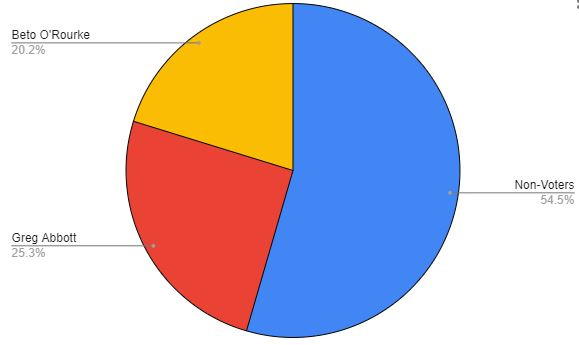
Data source: Texas Secretary of State
It’s a common misconception to draw direct comparisons between midterm and presidential year election data, as these electoral events often differ significantly in voter turnout and demographics.
Midterm elections historically see a drop in participation, particularly among groups that tend to vote Democratic, such as young voters and minority populations. Presidential elections, on the other hand, typically generate higher overall turnout, drawing a more diverse electorate that can more noticeably shift the political landscape.
Of course, the most significant driver is Republicans in Texas are hyper-focused on state elections, while Democrats primarily pay more attention to DC politics. We need to change this, but it likely won’t change overnight.
In Texas, the growing urban and suburban populations—areas that are increasingly leaning Democratic—are more likely to turn out in presidential years. This turnout contributes to the gradual leftward shift in the presidential cycle data.
While the 2022 midterm elections might suggest a swing toward the right, they do not necessarily indicate a reversal of the longer-term trend toward a more competitive political environment in Texas. The state’s changing demographics and the dynamics of presidential election years suggest that Texas’s journey toward becoming a blue state should be assessed through presidential election data rather than midterms alone.
Then there’s the demographic changes rapidly taking place in Texas.
Only 33% of children born in Texas in 2020 were white. 48% were Latino, another 13% were Black, and 5% were Asian. The only states/areas with a lower birthrate of white babies than Texas are California and New Mexico, both blue states. Washington, DC, also has a 33% white birth rate. DC is blue.
According to the 2020 Census, Texas is 39.8% white (non-Hispanic), 39.3% Hispanic, 11.8% Black, and 5.4% Asian. Of course, that doesn't include the half-million Texans who were undercounted. The only states/areas less white than Texas are Washington, DC, New Mexico, California, and Hawaii. Once again, all blue states.
Although Anglos (white, non-Hispanic) people only make up 38% of the population in Texas, during the 2022 election, they made up 62% of the vote. That was higher than in the 2020 election when Anglos made up 60% of the vote.
The significance of Black and Hispanic voter turnout in Texas cannot be overstated. These demographic groups not only represent a substantial portion of the state's population but are also pivotal to the shifting political landscape in Texas. Given the demographic trends and the gradual blue shift in key urban and suburban areas, mobilizing these voters could very well tip the scales in favor of the Democrats in upcoming elections.
For Texas Democrats, the path to turning Texas blue involves a multifaceted approach that includes:
Developing targeted strategies to engage Black and Hispanic voters, focusing on issues that directly impact their communities and lives.
Continuing to fight against voter suppression tactics that disproportionately affect minority communities, ensuring equitable access to the ballot box.
Strengthening alliances with grassroots organizations, community leaders, and activists within Black and Hispanic communities to amplify their voices and concerns.
For Democrats aiming to turn Texas blue, recognizing and acting on the pivotal role of these communities is not just strategic; it's essential to achieving their political aspirations in the Lone Star State.
Will Texas ever be blue?
Of course it will, silly. It’s inevitable. At this point, it’s only a matter of when. All the data points to how Texas has shifted left consistently over the last decade, and how the demographics are increasingly blue.
But, when?
Political engagement and the strategies employed by the Democratic Party will play crucial roles in determining the timeline for Texas turning blue. Engaging underrepresented communities, particularly young voters, Black, and Hispanic populations, through grassroots organizing and digital campaigns, can significantly impact voter turnout. Moreover, addressing the issues that matter most to these groups, such as healthcare, education, and economic opportunities, can strengthen the Democratic base.
If you missed the article from James Bedwell a few months ago, I urge you to read it for further analysis of the shifting political landscape in Texas.
James Bedwell, Jan 9 Read full story
Even though Texas is trending toward a bluer and more equitable state, we can’t just sit on our hands waiting for it to happen. Everyone needs to be putting in the work, and they need to be putting in overtime work in the areas which are already blue (Houston, Dallas, Austin, etc).
In 2024, we’ll probably flip a few House seats, maybe even a Congressional seat or two, if the work is done. While flipping the Texas House is what it will take to completely shut down Republicans in Texas, we should be realistic that it may not happen this cycle. It will happen by 2028.
We’ll have to see how things go in the next few elections, but the data tells us by 2028, (or maybe 2032 if the Texas Democratic Party keeps fucking up), Texas will be blue. While the exact timing remains uncertain, the trends suggest that Texas is on a path towards becoming a battleground state, with the potential to lean blue in the near future. The outcome will depend on the efforts of those on the ground, the responses of the political parties, and the evolving priorities of the Texas electorate.
The data is on our side. All we have to do is show up. Vote early, vote often, and vote in every single election.
Share
Important 2024 primary RUNOFF election days:
April 29, 2024: Last day to register to vote.
May 17, 2024: Last day to apply by mail
May 20, 2024: First day of early voting.
May 24, 2024: Last day of early voting.
May 28, 2024: Last day to receive a ballot by mail.
May 28, 2024: Election day.
LoneStarLeft’s Newsletter is a reader-supported publication. To receive new posts and support my work, consider becoming a free or paid subscriber.
Follow me on Facebook, Twitter, TikTok, Threads, YouTube, and Instagram.

