Translate

Showing posts with label Álvaro Huerta. Show all posts

Tuesday, March 31, 2026

Scholarship in Action: What Dr. Álvaro Huerta Teaches Us About Organizing for Justice

Scholarship in Action: What Dr. Álvaro Huerta Teaches Us About Organizing for Justice

by 

Angela Valenzuela

March 31, 2026

What does it mean to be both a scholar and an organizer in this moment of backlash? In his manifesto posted below together with helpful videos, Dr. Álvaro Huerta offers a powerful answer: theory without practice is hollow, and practice without theory is directionless. Drawing on the concept of praxis from Paulo Freire, Huerta insists that transformative change requires both reflection and action—grounded in lived struggle.

Across decades of activism—from student-led hunger strikes at University of California, Los Angeles to organizing Latino gardeners against criminalization in Los Angeles and leading environmental justice campaigns—Huerta distills key lessons for organizers. First, learn from history. Social movements are not spontaneous; they are built on knowledge, strategy, and study. Second, organize with communities, not for them. This means humility, deep listening, and rejecting top-down approaches that impose outside agendas.

Huerta is equally clear about what not to do: don’t romanticize poverty or confuse marginalization with virtue. Communities deserve material improvements—but without displacement. Effective organizing builds from existing social networks, honoring the dense webs of relationships that sustain working-class life. At the center of this work is confianza—trust—which cannot be rushed, manufactured, or substituted with flyers and speeches.

Perhaps most striking is Huerta’s insistence that organizing is relational. It happens in homes, at kitchen tables, in churches, and yes—even over tacos and beer. These everyday spaces are not peripheral; they are foundational to building the relationships that make collective action possible.

Finally, Huerta reminds us that organizing requires total commitment. Movements demand focus, sacrifice, and an unwavering belief in the possibility of a better world. In this sense, the scholar-activist is not simply an observer of injustice, but an active participant in its undoing.

At a time when higher education itself is under siege, Huerta’s lessons are instructive: real change does not emerge from policy texts alone, but from organized people, grounded in community, moving together with clarity, strategy, and purpose.

A Chicana/o Manifesto on Community Organizing: Reflections of a Scholar-Activist (OPINION)

As an urban planning and ethnic studies scholar with an extensive background in community activism—over the past three decades— I’ve become an expert in community organizing. While some individuals are experts in the theory of community organizing, they lack the practice. Similarly, while other individuals are experts in the practice of community organizing, they lack the theory. In what I call the “dialectic of community organizing,” I possess both the theory and practice. Throughout my lifelong efforts to transform the world for the better, among other influential thinkers throughout history, I’ve coined this concept from the brilliant educator and philosopher Paulo Freire. In his classic book, Pedagogy of the Oppressed, for instance, Freire advances the notion of praxis as “…reflection and action upon the world in order to transform it.”

Since 1985, starting as a freshman at UCLA, I’ve studied social movements and revolutions—both domestically and internationally. This includes the theoretical foundations and leaders behind major societal transformations. Complementing my university studies, during the mid-1980s, I also engaged in student activism (as a MEChista). This included lobbying for U.S. divestment in South Africa’s then-apartheid regime, advocating for racial/economic diversity in higher education and defending the rights of undocumented students (e.g., eight-day hunger strike). While not one of the five hunger strikers, I played a leadership role in a groundbreaking protest at UCLA (November 11-19, 1987), preserving/securing university funding sources (and other services) for undocumented students. Our successful efforts provided an organizing model for other Chicana/o student activists to stage similar hunger strikes at UCLA (May 24-June 7, 1993), UCSB (April 27-May 5, 1994) and other colleges/universities.
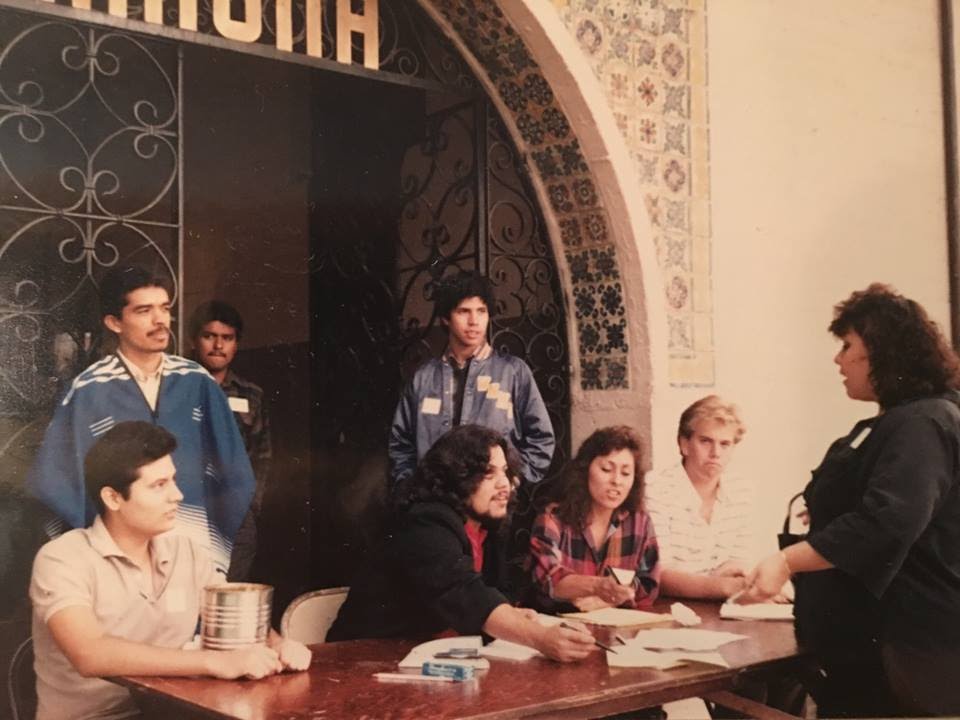

Alvaro Huerta. standing second to left in blue sarape, around 1986 (Photo provided by Alvaro Huerta)

At the community level, I—along with fellow activists—co-founded the Association of Latin American Gardeners of Los Angeles (ALAGLA) to successfully challenge the City of Los Angeles’ leaf blower ban (1996). This draconian ban included a misdemeanor charge, $1,000 fine and up to six months in jail for cited Latino gardeners. Learning from UCLA’s hunger strike, during the pivotal period of this movement, 11 ALAGLA organizers/members staged a six-day hunger strike in front of City Hall (January 3-9, 1998) to demand justice for honest, hard-working Latino gardeners. (To learn more about this social/economic justice campaign, click here for journal article and here for video.)


Following this dynamic grassroots campaign, as the lead organizer at Communities for Better Environment (CBE) —during the late 1990s and early 2000s— I successfully led an organizing campaign to defeat a proposed power plant in Southeast Los Angeles, specifically, the City of South Gate. If built, the proposed power plant (size of
Dodger Stadium) would have emitted over 150 tons of 
pollution per year, such as particulate matter (PM10). PM10 (or fine particles
of soot) has been linked to premature death, including heart failure and
respiratory ailments, such as asthma and bronchitis. (To learn more about this environmental justice (EJ) campaign, click here for journal article and here for video.)


For the record, all successful community-based campaigns represent collective efforts, where all participants (e.g., leadership, membership, volunteers, sympathizers) deserve credit.

That said, given my positionality as a scholar-activist and public policy advocate (e.g., immigration advocacy) on behalf of los de abajo (or those on the bottom), I offer my dos centavos (or two cents) in a non-ranked order for current and future community organizers to benefit from. (While I have more to say on this important question, I’ll do so in future essays.)
Learning from causes for social, racial and economic justice.

Since the turbulent 1960s to the present, college and university students have played a key role in protesting unjust wars (e.g., Vietnam, Iraq), eradicating racism, defending free speech and fighting for a more just society, among other noble causes. Given their privileged status, college/university students have the luxury of time and access to resources to study contemporary and historical social movements and revolutions. This allows this class or group to learn from influential thinkers and leaders responsible for creating transformative change throughout history. While not limited to college/university students, the idea here is for community organizers to study influential causes and their leaders to be better prepared—theoretically and strategically—for emerging causes or struggles.
Demonstrate humility and don’t impose moral values.

When organizing marginalized community members or vulnerable groups, like Kendrick Lamar—greatest rapper alive—says, “be humble.” Need I say more on this point?

In terms of moral values, it’s imperative that community organizers don’t impose their own values or belief systems on the community members they’re “trying to help.” Organizers should not judge or try to change the behavior of community members or presuppose that they know “what’s good for the community.” Be open, listen and engage in dialogue with community members or group members to better understand why individuals or (sub)groups adopt particular conduct, speech, attire, etc.

Overall, instead of operating from a hierarchal or top-down approach (like some non-profits and unions that I worked for), engage with community members on a horizontal or equal level. In other words, don’t organize “for” community members; organize “with” them.
Don’t romanticize poverty.

There’s nothing good about being poor or the objective conditions of the working poor. I should know since I grew up in abject poverty—both in Tijuana (Baja California, Mexico) and East Los Angeles, as I discussed in my TEDxCPP talk (April 27, 2017). Thus, community organizers shouldn’t shy away from improving the living conditions or neighborhoods of historically disenfranchised groups.


The balance, however, is to improve or invest in these communities without the perils of gentrification or displacement of the same people you’re “trying to help.” For instance, the federal urban renewal program of 20th Century—supposedly aimed at “improving” and “transforming cities”—caused havoc for racialized and working-class communities in America’s barrios and ghettos.
Access existing social networks and build from them.

While racialized and working-class communities may be “poor” in terms of financial capital, they are often “rich” in terms of social networks and other forms of social capital. Social networks constitute interpersonal connections among family members, friends, acquaintances, neighbors, co-workers and other relationships, like those via the church (e.g., padrinos/madrinas, compadres/comadres). For instance, in the case of many Chicana/o-Latina/o households, we can clearly see how they effectively organize themselves (and maintain their cultures/identities) around important family events and celebrations, like weddings, quinceañeras, funerals, baptisms and so on.

To effectively organize and mobilize these communities or members around particular campaigns or issues (e.g., legalize street vending, halt deportations, defeat gentrification), it’s key for community organizers to access these pre-existing networks. For instance, when we—Adrian Alvarez, Pedro Perez and myself—first ventured into the streets of Los Angeles to organize Latino gardeners (an informal labor niche which had never been organized before), we did so by accessing the social networks of a Jaime Aleman—a veteran gardener from Zacatecas, Mexico.

I will never forget that cold Saturday night in the summer of 1996, where we first met with some of Jaime’s paisanos and fellow gardeners behind an apartment building. By accessing and expanding upon Jaime’s social networks, a small group of Chicana/o organizers and gardeners successfully organized Latino gardeners—independent and dispersed workers/petty-entrepreneurs throughout the city—to fight City Hall. By chance, like qualitative researchers, we used this opportunity or insider access to initiate a snowball sampling strategy to obtain referrals or contacts with other gardeners throughout the city.
Building confianza or trust.

Without establishing or building confianza (or trust) between the community organizers and community members/impacted members, the organizers will fail miserably. Confianza isn’t something you can establish overnight. It takes time to establish and build. It also takes patience, honest, transparency, consistency and good deeds on behalf of the organizers. Too often, marginalized community members have been taken advantage of by opportunists, politicians, hustlers, hucksters, etc., in this country and, for some, their home countries. This is one reason why marginalized community members are suspicious of outsiders, despite their good intentions to help improve their plight.

Thus, before any organizer arrives into a community/neighborhood that they’re not embedded in and demand action or participation by the community members, they must first get to know the people, especially on a social or personal level. This includes attending events or places where community members congregate, like schools, churches, parks, etc. It helps to start with one person or a family and build confianza from there. It’s impossible to deliver a political speech at a local school or church, expecting community members to trust you or your good intentions. On a similar note, it’s a waste of money and energy to distribute flyers and expect for community members to join your cause without serious reservations.
Eat the tacos de carnitas.

Should an organizer (or organizers) be fortunate enough to be invited into the home of a Latina/o community member or to attend a special occasion, like a quinceañera, don’t offend the host(s) by rejecting their food. In many Mexican households —both in this country and abroad— the host(s) will often serve their guests food without asking. This applies to the poorest barrios of California to the poorest villages of Chiapas, Mexico. Thus, should the guest(s) refuse to eat the served food, the host(s) will be offended.

When organizing against the power plant proposal in South Gate, for example, I noticed some of my fellow organizers commit this crime or insult. I tried to compensate by ordering some extra tacos de carnitas to go, but the damage had already been done.
Organizing at cantinas and Mexican restaurants.

Community organizing shouldn’t be limited to distributing flyers, holding press conferences and organizing protests. Community organizing should also include gatherings informally or socializing at bars, restaurants, coffee shops and back-yard carne asada cookouts with community members. For instance, when organizing gardeners, we (as Chicana/o activists) established strong personal relationships with the Latino gardeners—mostly from rural Mexico—over some Pacifico and Dos Equis beers. (Actually, “some” is an understatement.) This is an insightful point that Adrian Alvarez, president of ALAGLA, discussed at a symposium (on May 13, 2015) at UCLA’s Chicano Studies Research Center (CSRC): “Organizing Latino Immigrants in the Informal Economy: The Successful Case of the Association of Latin American Gardeners of Los Angeles.”


Immerse yourself into organizing campaign.

When organizing a grassroots campaign, you must immerse yourself and focus on the campaign or larger movement. Too often, organizers spread themselves too thin by taking on too many campaigns at once. This is a recipe for failure. When I co-organized the gardeners or led the campaign against the power plant, I immersed or committed myself without external distractions. This allowed me to focus on my particular role within the given organizing campaign and collective objectives.

While there are psychological and physical costs to being fully immersed or committed to a challenging organizing campaign or cause, where you’re constantly thinking about the opponents (e.g., corporation, City Hall, federal government) and major obstacles, etc., this is the price one pays for fighting/dreaming for a better world!

To conclude, I end with the brilliant words of Ricardo Flores Magón (1921)—the precursor of the Mexican Revolution: “The dreamer is the designer of tomorrow… Suppress the dreamer, and the world will deteriorate towards barbarism.”

***

Alvaro Huerta, Ph.D., is an Assistant Professor of Urban & Regional Planning and Ethnic & Women’s Studies (EWS) California State Polytechnic University, Pomona.

Thursday, November 21, 2024

Dear America: My immigrant mother 'stole' American jobs: A 'confession' from a child of Mexican immigrants

Friends:

I appreciate Dr. Alvaro Huerta's "confession" and it should provide a helpful perspective on how his mother never stole an American job. Hence, no confession is necessary, but I appreciate the satire (see below).

What folks need to know, however, is that when his mother crossed the border, it was no more a "crime" than running a red light. Yes, it was more like a traffic violation as opposed to a criminal offense at least until Bill Clinton came along. 

So disgraceful, President Clinton for signing the Illegal Immigration Reform and Immigrant Responsibility Act of 1996 (IIRIRA) that criminalized immigration with changes that took place on April 1, 1997. 

I remember 1997 well. It was a tough year for those in the know and, most especially, for those directly affected by it—a regime that continues through to the present.

For those that want to research this, the IIRIRA was enacted as Division C of the Omnibus Consolidated Appropriations Act of 1997, introducing significant amendments to the Immigration and Nationality Act passed in 1965 by President Lyndon B. Johnson. Immigration historians notwithstanding, I found Wikipedia's discussion of the IIRIRA to be quite informative.

My grandmother was U.S.-born and grew up in Bisbee, Arizona, right on the U.S.-Mexico border. In her era, the border was called "la linea," because it was little more than a line in the sand with people moving freely back and forth not unlike our ancestors who moved freely up and down the continent. 

Knowing this is why I often think that we didn't cross the border at all, but rather the border crossed us. As Mexican Americans from the Southwest, like my grandmother whose ancestors were Indigenous, there was never anywhere "to go back to"—as we're often told—because they were always home.

Borders are thusly powerful and historic fictions and social creations that get codified in statute. 

That said, social creations like Greg Abbott's $4 Billion biennium expenditure of troops and his militarizing of the border termed "Operation Lonestar" (2022 numbers) are insanely costly creations that are and should be the onus of the federal, as opposed to state, government. All of that money could have funded the entirety of K-12 public and higher education and still leave some change for health care, and investments in clean energy. Not being prudent with these dollars is costly, too, as we know. Symbolically, it signifies not wanting to empower our low-income Black and Brown communities.

Posturing represents an enormous cost to taxpayers. It provides great fodder for campaigns and builds a Republican constituency in South Texas by giving people jobs. 

Families simply can’t live on an annual salary of $40k or less, especially in this economy. Not all benefitted equally, if at all for many, from Biden’s post-pandemic economic stimulants. Hence, the Biden Administration and Kamala Harris, directly associated with it, could not compete with the living wage that "migra jobs" provide, especially for folks with a high school diploma.

Sadly, though, folks have been hoodwinked into believing that Trump’s economy will be better for them as his impetus is to bilk the economic purse—our precious taxpayer dollars—for payback to the billionaire class that supported him and to which he identifies. These are concerning times. Still, we must organize and call for unity in the face of this consolidation of power.Dr. Huerta, I do agree that migration is a human right and, most especially, to seek asylum to escape persecution as laid out in the Universal Declaration of Human Rights that the U.S. still has not signed for reasons that are probably obvious. Never mind that Eleanor Roosevelt played a major role in its development.

Álvaro, God bless your dear mother's memory, and keep doing what you're doing!

-Angela Valenzuela

Opinion: My immigrant mother 'stole' American jobs: A 'confession' from a child of Mexican immigrants

 Updated 

Dear America,

I have a confession to make, just like when I was a good Catholic boy at Santa Teresita Church in East Los Angeles. My late immigrant mother “stole” American jobs. Yes, my mother Mejía Huerta was a “criminal.” While she was never convicted of 34 felonies in New York, she was a “Mexican immigrant criminal,” nevertheless!

As a U.S.-born citizen, I was in denial about my mother’s “thievery” for many years. It’s time that I come clean about how she “robbed” hard-working Americans of their precious jobs for several decades. Since “all” Americans aspire to engage in hard work, as part of the Protestant work ethic that the sociologist Max Weber wrote about over 100 years ago, it’s only “fair” that they reclaim these “immigrant jobs” from these “brown criminals.”

When my extended Huerta clan migrated in the early 1960s from a small rancho, Zajo Grande—located in the beautiful state of Michoacán—to Tijuana, Baja California, they experienced abject poverty in this Mexican border city. It was in Tijuana that my mother first worked in el norte as a transborder domestic worker. Securing a U.S. visa, she worked in San Diego, California, for days or weeks at a time, cleaning the homes of affluent White Americans. She would then return to Tijuana for a few days and then repeat the brutal work schedule for several years.

During one of her many work trips to el norte, when she was pregnant with me, she planned for me to be born in Sacramento, California. When I eventually joined my familia in Tijuana, as my mother continued her rigorous work schedule in el norte, my older sisters, who were in their teens, helped with childcare duties. That included working as minors in Mexico and the U.S.

As my memory is fuzzy during my first four years in Tijuana, I sometimes wonder how my mother “stole” her first American home to clean. Did she break into their home in the middle of the night and start to clean when the middle-class, White family was asleep? Did she help feed little Brad and Jenny breakfast while their parents were enjoying their beauty sleep? Or did she enter the house through the chimney, like Santa Claus, and leave the house sparkling without a trace? While I hold a Ph.D. from UC Berkeley in City and Regional Planning, I have yet to resolve this conundrum.

Now that America will “miraculously” be “great again,” especially with expected draconian measures against immigrants, where millions of hard-working immigrants (like my late mother) will be targeted, I’m sure that countless of MAGA parents will raise their children to forgo college and reclaim these “immigrant jobs.” While there’s no shame in cleaning houses for a living or working as farmworkers, like my late father Salomón ChávezHuerta, I’m wondering how they will enjoy (or enter) the American Dream that “immigrant jobs” offer in terms of financial compensation, benefits (or lack thereof) and upward mobility opportunities?

As for all the American-born workers who delusionally think they will replace and compete against workers with the “Mexican immigrant work ethic,” like we say in East Los Angeles, no te rajes / don’t quit!


Sunday, September 03, 2023

“En memoria de (in memory of) Dr. Roberto ‘Cintli’ Rodriguez,” for CALÓ News

Many of us are still mourning the loss of Dr. Roberto Cintli Rodriguez. I so appreciate this tribute by Álvaro Huerta in Caló News. Roberto was a dear friend and colleague of mine. We discussed plans of sending Austin teachers to Teotihuacán where he lived to visit the pyramids and learn about our MesoAmerican ancestors' knowledge of agricultural practices, scientific and mathematical knowledge, knowledge of the seasons, planets, together with their spiritual and philosophical understandings. He was himself an encyclopedia of such knowledge, having spent the greater part of his life and career investigating these.

He and I spent a great deal of time talking in the lead up to the publication of his book, "Writing 50 Years (más o menos) Amongst the Gringos, published by Juan Tejeda in 2021 by Aztlán Libre Press‎I was only charged by Juan to write a blurb for his text, but his memoir was so compelling that I would stop midstream and took the liberty of calling him several times so that he could share with me in greater depth about his experiences. 

Since I had known Dr. Cintli for longer than I've had this blog (since 2014), I do cite his work throughout. My most recent is titled, "Reflections on Creative Resistance: A Personal Note on our work at Academia Cuauhtli by Angela Valenzuela Ph.D."

In Álvaro Huerta's tribute to Dr. Cintli, he appropriately reminds us of the long arm of police brutality and its enduring impact throughout Roberto's life that appears to have contributed to his untimely death. Thank you Roberto for your life's work, particularly your countless writings in the service of social justice that, as Juan Tejeda aptly says (paraphrasing), amount to a present-day codice that provides guidance, direction, and wise counsel to our lives.

Yes, may you rest in power!

-Angela Valenzuela


En memoria de (in memory of) Dr. Roberto ‘Cintli’ Rodriguez,” for CALÓ News

COMMENTARY: En memoria de (in memory of) Dr. Roberto ‘Cintli’ Rodriguez


Dr. Roberto ‘Cintli’ Rodriguez was a Chicano, scholar, journalist, writer, runner, traditional expert on maíz, elder and compañero en la lucha.
by Álvaro Huerta | August 29, 2023 | Caló News


Today is the 53rd anniversary of the National Chicano Moratorium and we honor the late and great Dr. Roberto ‘Cintli’ Rodriguez. 

On July 31, 2023, he transitioned from Mother Earth at the young age of 69 to the spirit world—Mictlan. One day he’s a mortal among us, the next day he’s an ancestor of the struggle. He joins the likes of Dr. Juan Gómez-Quiñones and Dr. Gloria E. Anzaldúa. He also joins the likes of Elizabeth “Bebita” Martinez and Rudolfo Anaya, including countless who fought for la Raza in occupied America—a term borrowed from Dr. Rodolfo F. Acuña’s classic book.

Dr. Cintli (or Roberto) had many identities: Chicano, scholar, journalist, writer, runner, traditional expert on maíz, elder and compañero en la lucha.

Born in Aguascalientes, Mexico, and raised in East Los Angeles, Roberto apparently died while living in Mexico’s sacred Teotihuacan. The symptom of his untimely death is a reported heart attack. Yet, the root cause of his sudden death occurred 44 years on East Los Angeles’ Whittier Boulevard—the capital of lowrider cruising—when the cops brutally assaulted him.

On March 23, 1979, on the same night that the movie Boulevard Nights premiered, four cops (or Los Angeles County Sheriff deputies) jumped Roberto. They repeatedly hit, kicked and beat him with their batons. Causing him brain damage and PTSD, they almost killed him that tragic night. Instead of calling for an ambulance, the cops drove Roberto to the Los Angeles County General Hospital (or General Hospital) on State Street. On the way to General Hospital, they repeatedly threatened his life. They even threatened to drop him off in the notorious Ramona Gardens public housing project (or Big Hazard projects) in the middle of the night, telling the homies that he belonged to a rival gang. This is an old, racist cop trick. 

Adding insult to injury, they charged him with assault with a deadly weapon against the same cops that almost killed him. His alleged weapon? A camera! As a then-reporter/photographer for Low Rider Magazine, he dared to photograph the cops beating up an unarmed Chicano on East Los Angeles’ Whittier Boulevard during a cruising night–a Chicana/o ritual. As a result, the cops turned their fascist gaze onto Roberto. This is a case of what the late and brilliant Chicano historian Dr. Juan Gómez-Quiñones refers to as anti-Mexicanism. 

Thanks to his resilience and legal defense, Roberto was eventually cleared of all criminal charges and reached a settlement in 1986 for over $205,000 with the police state. Instead of using the money for personal use, which he had all the right to do, he invested it in a bilingual magazine, Americas 2001

I first met Roberto at UCLA during the inaugural issue of his magazine. As an alum of UCLA, he visited us—as MEChistas—at our office on the fourth floor of Kerckhoff Hall. He spoke to us about his horrific police abuse experience and the importance of Raza publications. While a student at UCLA during the 1970s, he was the Editor-in-Chief of La Gente de Aztlán (or La Gente)a Chicana/o student-run magazine. This was the start of his promising and uncompromising writing vocation in service of our people. 

The more I got to know Roberto and all his contributions to la Raza since the 1970s, the more I appreciated him and looked up to him as an elder in the Chicana/o movement. There was a unique bond and kinship that I shared with him. For instance, we have deep roots with Mexico. We both once lived in East Los Angeles. While his case with the police was extreme, I experienced police abuse and harassment while growing up in the Big Hazard projects. While he attended UCLA in the 1970s, I attended this elite university in the 1980s. We received our doctorates after engaging in community-orientation actions on behalf of (and with) los de abajo–where we derive from–for several years. As scholar activists, we engaged in scholarship at the academic and public level. We also participated in countless community-based events and protests for el movimiento

While we have a lot in common, his generation (and previous ones) of Chicana and Chicano leaders paved the road for my generation and future ones to challenge systemic racism in America. For those of us of Mexican origin, respect for our elders is deeply embedded in our culture. This is something that the assimilated Mexican American forgets–as a ticket to be accepted by the dominant culture. 

By sheer chance or coincidence, on the same night that he was almost killed by the cops on Whittier Boulevard, our generational paths almost crossed. For me, it started when my older sister Ofelia took my brother Salomón (an acclaimed artist) and I in her Impala lowrider to watch the premier of Boulevard Nights at the Fiesta Four Drive-In in Pico Rivera. (As kids from the projects, as passengers, we always snuck in the truck to save money. It was one of our street hustles.) After rival gangs engaged in a shoot-out at the start of the movie, my sister quickly fled and took us cruising on Whittier Boulevard. 

For over four decades, Roberto was a constant critic against police abuse. He did so in the form of his many articles, books (e.g., Yolqui…), lectures and protests. It takes a lot of courage to do so, given the potential consequences from violent agents of the state.

He helped launch the Raza Killings Database Project to find a more accurate number on how many Latinos are being killed by law enforcement nationwide. He asserted that Latinos are vastly undercounted in many public databases, such as the Washington Post’s Fatal Force Report. Roberto said this newspaper’s database places many Latina/o-sounding names in their “unknown” racial category or their white racial category–causing a vast undercount for Latinos. CALÓ NEWS interviewed Roberto in April 2022.

“For me, everything goes back to when Ruben Salazar [the first Latino columnist for the Los Angeles Times] was killed. That’s why I wanted to be a journalist, because he was killed right down the street from where I grew up. I grew up on Whittier Boulevard in East Los Angeles. I was almost killed about four or five blocks from where he was killed. That’s always been part of my psyche. Having that consciousness is what pretty much motivated me, has always motivated me to keep fighting,” he told CALÓ NEWS at the time.

Despite suffering from PTSD and retaliations from the police state, he didn’t stop speaking out against police abuse towards Brown people. He was also in solidarity with Black communities, Native American communities and other oppressed people in el norte and the Global South. He understood the necessity for all oppressed people to unite and fight against all forms of oppression. 

As a human being, however, he could only take so much. Hence, on that fateful day of July 31, 2023, the heart of a warrior finally gave out. 

While his heart could no longer take the abuse of racial capitalism, his indigenous warrior spirit lives on for current and future generations of Brown people to continue en la lucha

Rest in power, Dr. Cintli.