Translate

Showing posts with label David Bacon. Show all posts

Wednesday, July 20, 2022

"Migrant Justice Means Facing Root Causes," by David Bacon in Truthout

I so respect and admire photojournalist David Bacon who has been following the plight of impoverished, vulnerable migrants and how their experiences are implicated in the deep injustices associated with international and domestic capitalism that exploits their labor for profits as the cost of doing business.

Like my friend, feminist scholar Martha Cotera said the other day, "We should stop calling poor people poor and start naming this situation and context as "wage theft." She is absolutely right. And David Bacon's cutting analysis of U.S.-Mexico-Latin American relations maps on well to Martha's comments.

Bacon is very clear that bandaids like aid and loans are not anywhere near sufficient in stopping the flow of migrants as structural change in the relationship between the U.S. and Latin America. Addressing root causes anchored in the brutal excesses of capitalism, is what's needed.

Do read all of this. It offers an enhanced understanding of the larger forces that cause migration and how folks here in the U.S. are impacted. In an ideal world, folks from Mexico, Central, South America and the Caribbean, wouldn't have to migrate to make ends meet. It's not that they want to; it's that they have to. Understanding this fosters empathy and awareness of how our country negatively impacts lives and well-being in places far beyond our borders.

-Angela Valenzuela

#RacialCapitalism

Factory workers halt their work to protest against the lack of safety measures against COVID-19, outside Electrocomponentes of Mexico, a company in the Mexican city of Ciudad Juárez in Chihuahua, Mexico, on April 20, 2020.

MIGRANT JUSTICE MEANS FACING ROOT CAUSES

By David Bacon, Truthout, 6/23/22

MEXICO CITY - 10/2/14 - Students  and workers march from the Plaza of Three Cultures (Tlatelolco) to commemorate the massacre of hundreds of students by the army in 1968.  Some marchers also were farmers who held corn and machetes to protest the impact of free trade agreements.

At the end of the just-concluded Summit of (some of) the Americas, President Joe Biden announced a “Los Angeles Declaration on Migration and Protection,” claiming that participant countries are “transforming our approach to managing migration in the Americas … [recognizing] the responsibility that impacts on all of our nations.”

Recognizing that the U.S. has some responsibility for addressing the causes of migration is important. But President Biden stopped well short of acknowledging the U.S.’s two centuries of intervention in Mexico, Central America and the Caribbean, which lies at the root.

Biden pledged $300 million to help U.S. “partners in the region continue to welcome refugees and migrants” augmented by further World Bank loans. World Bank loans are often tied to demands for austerity and reforms to attract corporate investment, and therefore themselves are a cause of poverty and displacement. Aid and loans will not stop the flow of migrants because dealing with the root causes of migration requires fundamental, structural change in the relationship between the U.S. and Latin America.

When we go to the border and listen to people in the migrant camps, or talk with the families here who have members in immigration detention centers, we hear the living experiences of people who have had no alternative to leaving home. Escaping violence, war and poverty, they now find themselves imprisoned, and we have to ask, who is responsible? Where did the violence and poverty come from that forced people to leave home, to cross our border with Mexico, and then to be picked up and incarcerated here?

Overwhelmingly, it has come from the actions of the government of this country, and the wealthy elites it has defended.

It came from two centuries of colonialism, from the announcement of the Monroe Doctrine in 1823, when this government said that it had the right to do as it wanted in all of the countries of Latin America. It came from the wars that turned Puerto Rico and the Philippines into direct colonies over a century ago.

It came from more wars and interventions fought to keep in power those who would willingly ensure the wealth and profits of U.S. corporations, and the misery and poverty of the vast majority of their own countries.

Smedley Butler, a decorated Marine Corp general, told the truth about what he did a century ago, writing, “I was a racketeer, a gangster for capitalism…. I helped make Mexico and especially Tampico safe for American oil interests in 1914. I helped make Haiti and Cuba a decent place for the National City Bank boys to collect revenues in. I helped in the raping of half a dozen Central American republics for the benefit of Wall Street.”

When people in El Salvador, Guatemala, Honduras and Haiti tried to change this injustice, the U.S. armed right-wing governments that made war on their own people. Sergio Sosa, a social activist during Guatemala’s civil war who now heads a workers’ center in Omaha, Nebraska, told me simply, “You sent the guns, and we buried the dead.”

Over 1 million people left El Salvador in the 1980s and an estimated half million crossed the border to the U.S. at that time. How many more hundreds of thousands crossed from Guatemala? How many more after the U.S. helped overthrow Jean-Bertrand Aristide in Haiti? How many from Honduras after Manuel Zelaya was forced from office in 2009, and U.S. officials said nothing while sending arms to the army that used them against Honduran people?

Since 1994, 8 million Mexicans have come as migrants to work in the U.S. In 1990, 4.5 million Mexican migrants lived in the U.S. In 2008, the number peaked at 12.67 million. About 5.7 million were able to get some kind of visa; another 7 million couldn’t but came nevertheless. Almost 10 percent of the people of Mexico live in the U.S.

The poverty that forced 3 million corn farmers, many of them Indigenous, from Mexico to come here was a product of the 1994 North American Free Trade Agreement (NAFTA), making it impossible for them to grow the maize they domesticated and gave to the world. Archer-Daniels-Midland and Continental Grain Company used NAFTA’s stolen inheritance from Indigenous Oaxacans to take over the Mexican corn market. One of the most important movements in Mexico today is for the right to stay home, the right to an alternative.

What has produced migration from rural parts of Mexico is the same thing that closed factories in the U.S: Green Giant closed its broccoli freezer in Watsonville, California, and 1,000 immigrant Mexican workers lost their jobs when it moved to Irapuato in central Mexico, where the company could pay lower wages.

In a Tijuana factory assembling flat panel televisions for export to the U.S., a woman on the line has to labor for half a day to buy a gallon of milk for her children. Maquiladora workers live in homes made from pallets and other materials cast off by the factories, in barrios with no sewers, running water or electrical lines.

Because our two economies are linked, Mexico suffers when the U.S. economy takes a dive. When recessions hit the U.S., customers stop buying the products made in the maquiladoras, and hundreds of thousands of workers lose their jobs. Where do they go?

When the U.S. sought to impose the Central American Free Trade Agreement (CAFTA) on El Salvador in 2004, then-U.S. Assistant Secretary of State for Western Hemisphere Affairs Otto Reich told Salvadorans that if they elected a government that wouldn’t go along with CAFTA, the U.S. would cut off the remittances sent by Salvadorans in the U.S. back to their families at home.

Young people, brought from El Salvador as children, joined gangs in Los Angeles so they could survive in the city’s most dangerous neighborhoods. Then they were arrested and deported back to El Salvador, and the gang culture of L.A. took root there, with the drug trade sending cocaine and heroin back to the U.S. barrios and working-class neighborhoods here.

When people arrive at the U.S. border, they are treated as criminals. John Kelly, the dishonest general who advised Donald Trump in the White House, called migration “a crime-terror convergence.”

Yet people coming to the U.S. are part of the labor force that puts vegetables and fruit on the table, cleans the office buildings, and empties the bedpans and takes care of people here when they get old and sick. Turning people into criminals and passing laws saying people can’t work legally makes people vulnerable and forces them into the lowest wages in our economy.

To employers, migration is a labor supply system, and for them it works well because they don’t have to pay for what the system really costs, either in Mexico or in the U.S. Trade policy and immigration policy are inextricably bound up with each other. They’re part of the same system.

NAFTA didn’t just displace Mexicans. It displaced people in the U.S., too. In the last few decades Detroit lost 40 percent of its population as the auto industry left. Today many Ford parts come from Mexico. But the working families who lost those outsourced jobs didn’t disappear. Instead, hundreds of thousands of people began an internal migration within the U.S. larger than the dustbowl displacement of the 1930s.

Knowing where the violence and poverty are coming from, and who is benefitting from this system, is one step toward ending it. But we also have to know what we want in its place. What is our alternative to detention centers and imprisonment? To the hundreds of people who still die at the border every year?

The migrant justice movement has had alternative proposals for many years. One was called the Dignity Campaign. The American Friends Service Committee proposed A New Path. What we want isn’t hard to imagine.

We want an end to mass detention and deportations, and the closing of the detention centers. The militarization of the border has to be reversed, so that it becomes a region of solidarity and friendship between people on both sides. Working should not be a crime for those without papers. Instead, people need real visas that allow them to travel and work, and the right to claim Social Security benefits for the contributions they’ve made over years of labor.

But we also want to deal with the root causes of migration.

U.S. auto companies employ more workers in Mexico now than in the U.S. Every flat-panel TV sold here is made in Mexico or another country. While the workers at General Motors’ Silao factory in Guanajuato, Mexico, recently voted courageously for an independent union and negotiated a new contract with important wage gains, a worker in that factory still earns less in a whole day than a U.S. autoworker earns in an hour.

Decades of trade agreements and economic reforms have created that difference and forced people into poverty. For many, that makes migration involuntary, the only means to survive. We need hearings in Congress that face that history squarely — its impact on both sides of the border.

We have a long history of solidarity with progressive Mexican unions in our own labor movement. That’s a big part of the answer to the problems of NAFTA and free trade that we’ve always advocated. Our unions on each side need to support each other, so that we can lift up workers regardless of the location of their factories.

We also want an end to military intervention, to military aid to right-wing governments, and to U.S. support for the repression of the movements fighting for change.

U.S. companies have been investing in Mexico since the late 1800s. They are not simply going to abandon their investment in Mexico, and the U.S. government is not going to abandon its effort to control the Mexican economy because wages rise. The key elements in how we fight against what this means for workers on both sides of the border is unity and coordinated action.

In both countries copper miners have been on strike against the Mexican conglomerate Grupo Mexico in the last decade. Their unions see solidarity as the answer. So do the United Electrical Workers and the Frente Auténtico del Trabajo, and my union, Communications Workers of America, with the Sindicato de Telefonistas de la República Mexicana, and others.

If you think this isn’t possible or just a dream, remember that a decade after Emmett Till was lynched in Mississippi in 1955, the U.S. Congress passed the Civil Rights Act. (That same year, Congress put the family preference immigration system into law — the only pro-immigrant legislation we’ve had for 100 years.)

That was no gift. A civil rights movement made Congress pass that law. When that law was passed we had no detention centers like the ones that imprison migrants today. There were no walls on our border with Mexico, and no one died crossing it. There is nothing permanent or unchangeable about these institutions of oppression. We have changed our world before, and a people’s movement can do it again.

MORE THAN A WALL / MAS QUE UN MURO
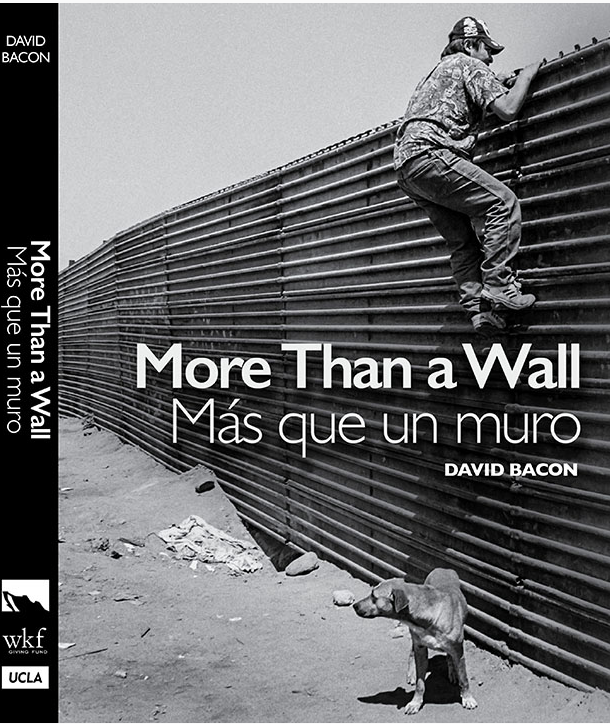
More Than a Wall / Mas que Un Muro explores the many aspects of the border region through photographs taken by David Bacon over a period of 30 years. These photographs trace the changes in the border wall itself, and the social movements in border communities, factories and fields. This bilingual book provides a reality check, to allow us to see the border region as its people, with their own history of movements for rights and equality, and develop an alternative vision in which the border can be a region where people can live and work in solidarity with each other. - Gaspar Rivera-Salgado

David Bacon has given us, through his beautiful portraits, the plight of the American migrant worker, and the fierce spirit of those who provide and bring to us comfort and sustenance. -- Lila Downs

MORE THAN A WALL / MAS QUE UN MURO

- a book of photographs by David Bacon and oral histories created during 30 years of covering the people and social movements of the Mexico/U.S. border

- a complex, richly textured documentation of a world in newspaper headlines daily, but whose reality, as it's lived by border residents, is virtually invisible.

- 440 pages

- 354 duotone black-and-white photographs

- a dozen oral histories

-  incisive journalism and analysis by David Bacon, Don Bartletti, Luis Escala, Guillermo Alonso and Alberto del Castillo.

- completely bilingual in English and Spanish

- published by El Colegio de la Frontera Norte with support from the UCLA Institute for Labor Research and Education and the Center for Mexican Studies, the Werner Kohlstamm Family Fund, and the Green Library at Stanford University

Price:  $35 plus postage and handling

To order, click here:  

https://david-bacon-photography.square.site/product/more-than-a-wall-mas-que-un-muro/1?cp=true&sa=true&sbp=false&q=false

"The "border" is just a line. It's the people who matter - their relationships with or without or across that line. The book helps us feel the impact of the border on people living there, and helps us figure out how we talk to each other about it. The germ of the discussion are these wonderful and eye-opening pictures, and the voices that help us understand what these pictures mean." - JoAnn Intili, director, The Werner-Kohnstamm Family Fund 

Friday, June 12, 2020

FAMILY FARMERS AND FARM WORKERS FACE THE VIRUS: How food sovereignty activists see the crisis as a pivotal moment for change

This piece by photojournalist David Bacon makes me realize how little I know about food production and distribution at the same time that I am learning that significant reforms are long overdue. Even as this COVID crisis lays bare the dysfunctions, I imagine that most of us have taken this for granted. "Food apartheid" mentioned here means a systemic lack of access to healthy produce for low-income people of color.  I like the idea of re-purposing city lands to reimagine food production and distribution. "Food sovereignty" is another important concept. 
"It includes making people of color in the food system central to demands, ensuring a fair livelihood for everyone in it, strengthening local systems, protecting small and medium size farmers and fishing operations from predatory banks and corporations, and ensuring a dignified way to obtain nutritious food for every person in the country."
The nexus of political and agricultural education is another important area for all of us to develop further, if not formally in our public school system.

"Agroecology" together with the politics and priorities of food production is another very good concept as follows:
"Patti Naylor, a board member of Family Farm Defenders in Iowa, writes, "Farmers support agroecology because it recognizes the interdependencies between rural communities, local ecosystems, and healthy competitive economies. Agroecology offers an inspiring alternative to the industrial agriculture model that is failing rural communities. However it cannot thrive without the political support that agribusiness currently receives. U.S. agriculture policy needs to prioritize agroecology and ensure farmers' rights to seeds, safe water, and pricing structures that ensure farm viability."
Relatedly and best of all, these shifts that put the onus of food production on local growers which will allow us as societies to "transcend the consumer slavery relations that caused our problems to begin with."  I would like all of this to find its way into K-12 curriculum everywhere.

Way to go David Bacon.  You never cease to impress.

-Angela Valenzuela

#farmers #farmworkers #seedsovereignty #foodsovereignty #freeseeds #seedsharing #seedbanking @UFWupdates #blacklivesmatter #ATX

FAMILY FARMERS AND FARM WORKERS FACE THE VIRUS: How food sovereignty activists see the crisis as a pivotal moment for change

By David Bacon
Food First Backgrounder, 6/11/20


At the Graton Day Labor Center in Sonoma County, in California's wine country, immigrant day laborers look for work. At the center workers have a garden, and grow and distribute food to those who are hungry.
The COVID crisis and urban communities

Malik Yakini speaks for many people in the movements for food sovereignty and sustainability as they face the crisis of the novel coronavirus.  He sees it from the perspective of the urban farms of Detroit, as the executive director of the Black Community Food Security Network.  "The problems people see now, from the difficulty they're experiencing getting to markets to the absence of food on the shelves when they get there, really highlight the need for a new food system," he says.  

The city's urban farmers have had to make immediate changes, just to keep functioning.  In Michigan the planting season is just starting, and farmers have yet to figure out how they'll sell what they intend to grow.  "We've got collards that we're just transitioning into the ground now, with green onions, leeks, onions, kale, and soon romaine," he explains.  "To keep everyone safe, we've limited the number of people in our farm who can be at work to four at a time, with no volunteers.  That's a big change from the past, when we'd have 15-20 people on a weekend."

To Yakini, the coronavirus has thrown into high relief the questions that have historically faced the growth of the urban farm system.  "Detroit has 139 square miles of land, and a third of it is vacant - more land potentially available than any other city.  So one question is how the city will dispose of that part of it that they own, which is managed by the Detroit Land Bank Authority.  But it's really more than just allowing residents to gain ownership.  Successful farms have to develop the soil, which is a multi-year project.  We need skilled people, and an infrastructure that includes cooling facilities, so that farmers don't have to sell immediately after harvesting.  And the city has to loosen its policies on water use.  The need for long-term planning has become much sharper as a result of the crisis we're experiencing."

Like Yakini, Karen Washington in New York City sees the crisis as a moment to question the way the food system has failed, especially low-income families and people of color.  "We have to acknowledge that we can't go back, not to business as usual," she says.  "The emphasis has to be on people and planning, not profit.  Now we know how valuable food is.  What is all your jewelry worth when you have to wait in line to feed your family?  But if you can grow food, you can survive.  Food and water are more precious than gold."

Already community activism has changed the way food is being distributed in the Bronx, where Washington lives.  In her neighborhood, volunteers from Mothers on the Move and the Mary Mitchell Center deliver bags to older people, who would be vulnerable to infection if they tried to shop for themselves.  "Every week I get a delivery of three bags, and then I distribute that food to the seniors I know on my block," she says.  Washington goes across the street to the Garden of Happiness, her community garden, to clean out the chicken coop.  She gets a dozen eggs a day that she also gives to elderly people she know are going hungry.  "I've been on my block for 32 years and I know who's hungry.  That's what having a community garden means - that we know each other and take care of each other."

The Bronx has about 150 community gardens in its food chain, and many have been talking in virtual meetings since the crisis started.  "We're asking, what can we grow for our community?  In the past we've grown for ourselves, and for the farmers markets.  Now we're asking, how we can set aside a growing box specifically for people in the community, and then aggregate the food grown in those boxes together?"

Will the community markets, however, like the one she organized 19 years ago, be able to open when the gardens begin to harvest?  "Normally it starts in July, which I hope it will this year.  We have a mix of urban and rural farmers who come, but the banks now are putting up barriers to quickly reimbursing them for coupons from SNAP and SMNP nutrition programs.  The farmers need money right away and can't wait for reimbursements.  I don't know if they'll come to our market this year.  We need our elected officials to take action to protect, not just our market, but all the community markets, because together with our gardens, we are a system serving low income people of color."

In California, Black Earth Farm has developed a system for directly connecting community residents with food.  "We used to go to events to distribute our produce, but they all got cancelled when the crisis started," says jabril kyser, and earth worker at the farm.  "But because we met people at those events, they became part of our cultural network and we know who they are."  Black Earth Farm now has a system for online ordering and delivery for some community members.  For others, who don't live in traditional housing, the farm's members deliver food to them.

"Our community was affected by food apartheid long before the virus arrived," kyser explains.  "So we've developed systems in which it can have access to healthy produce outside of the market-based one, which has never met their needs.  What's holding us back now is capacity."  The farm just acquired new acreage in a small city not far from its base in Oakland and Berkeley, and now is planting watermelon and other melons, tomatoes, strawberries, and collards and other leafy vegetables.

"Our work is way more important now," kyser says, "because we are providing political and agricultural education to our community at a time when the crisis has shown the shortcomings and failures of the industrial food system.  Once the crisis has abated, people will still want to grow their own food if we get organized and teach our community how to do it.  We can transcend the consumer slavery relations that caused our problems to begin with."


Dozens of dairies in California's Central Valley, in Tulare and Kern Counties, produce milk in industrial conditions.   Wages are low and workers complain of injuries caused by pressure to work fast, and mistreatment. Young dairy cows live in cramped stalls in rundown sheds that are so narrow they can hardly turn around.

Dumping Milk, Then and Now

Up the Hudson from the Bronx, the coronavirus is having an enormous impact on rural farmers, especially dairies.  One of the enduring images of the Great Depression was that of farmers pouring milk into ditches.  Today milk dumping, like the facemask, is likely to become a visual icon for the pandemic, particularly in states like New York and Wisconsin where small farmers still depend heavily on milk production.

The dumping of the Depression was often an act of protest, especially during Wisconsin's milk strike of 1933.  Then farmers sought to withhold it from the market to force big distributors to pay a price that might keep banks from foreclosing on farms.

The milk dumping of this past March and April is more an act of desperation.  "Some farmers tell me they see the streams running white," says John Peck, executive director of Family Farm Defenders in Madison.  "The price of milk was already down to $12 [per hundredweight], when it takes $20, and $30 for organic, to actually pay what farmers need to survive.  We don't have a fair price in agriculture.  Monopolies dictate the price, and farmers have to take it or leave it.  Now with the virus, many farmers can't sell their milk at all."

 Milk dumping is one heart-rending symbol of the pandemic's impact.  Another is the empty refrigerator case in the supermarket, with no milk or eggs on the shelves.  "One of the biggest effects of this crisis is that it has torn away the veil on the dysfunction of our food system, and shown how fragile it really is," explains Jim Goodman, president of the National Family Farm Coalition.

Small farmers were all too familiar with this dysfunction long before the virus began its spread.  According to retired New York farmer Liz Henderson, board member of the Agricultural Justice Project, "We've had five years of prices that don't cover costs.  Wisconsin alone lost 800 farms last year.  This crisis could result in more concentration, with smaller producers bought out by big bigger ones who can stand a few months with reduced or no income.  That's happened to family-run dairies already."  

However, the virus has made vulnerable those farmers who concentrated on direct sales as a way to beat corporate domination of the market.  Henderson explains: "We've had a big effort over 50 years to campaign for buying locally.  If farmers can sell directly, they cut out the middleman.  In some New England markets direct sales make up 10% of farm sales, enough for corporations to worry about us.  Now, though, if you're selling to a co-op that bottles and sells to stores, you might be ok.  If you sell directly to restaurants or schools, you probably have to dump your milk."

Could those farmers throwing away their milk instead bring it into the cities to feed hungry people?  Karen Washington says yes.  "I got a phone call from a farmer last week, asking me how food could be brought into the Bronx.  I started asking the city for permission, and got delays and no answers.  If we go through the government and the red tape, the food will be wasted.  So I said, bring it down, we're not waiting on red tape.  They can put me in jail if they want, but I won't see people hungry.  If the farmers are willing, what are they going to say?  Why can't we use community gardens as drop off centers, to get it out?  We'd have to package it, in a way that protects people from COVID, and then the community could distribute it to the people who need it the most."  "

Yakini sees barriers, however, some inherent in the distribution system.  "The first challenge would be getting the food into the city, which costs money for farmers who don't have it.  Then, would they be willing to give food away and take a loss?  In the past there have been differences in our worldviews here in Michigan, with Detroit versus the rest of the state.  In terms of agriculture, large rural farms have not taken urban farms seriously.  But we've attempted to develop relations with rural farms in the past, and this is a moment when things could change."

"It hurts people see the milk getting dumped, especially when they can't feed their children," Washington responds.  "Yet no one said, come to our farm and get it.  Why do the farms have to throw it away?  Why can't they open fields to gleaning.  If they did, an army of people would get in their vans and go up there.  And there are poor people in rural communities who need the food too.  Families in rural America are starving.  How can they even get to the food if they don't even have money to put gas in their car?  This is all shining a light on the fact our food system has to be changed.  What exists is good for a market-based economy, but it's not good for people."


Sandra and Samantha Tello, Mexican farm workers, receive bags of food in the Migrant Labor Camp, a housing project for migrant farm workers in Hollister, California.  The food is brought to the camp in a truck from the San Benito County Community Food Bank.  Although the families work in the fields picking crops, their income is so low they sometimes don't have enough food themselves.  

Small Farmers Get Shafted in the Bailout

Through the Coronavirus Preparedness and Response Supplemental Appropriations Act (HR 6074) and the Coronavirus Aid, Relief, and Economic Security (CARES) Act (HR 748) farmers in trouble were supposed to be able to qualify for small business loans to keep above water.  The Families First Coronavirus Response Act (HR 6210) was supposed to help with tax credits.  

For small farmers, however, the bills were a bust.  "The bailouts aren't dealing with them," says Jim Goodman.  "Some tried to qualify for the small business loans, but the fund was exhausted by businesses that should never have had access to it, long before farmers could even get their applications processed.  Milk prices were already low, and now they're even lower."

One example hit the national news when the NY Times revealed that the Ruth's Chris Steak House chain of high-end restaurants got a $20 million loan and the Potbelly chain $10 million.  Shake Shack was so embarrassed by the publicity that it gave back its $10 million, acknowledging that it had access to other capital through an "equity transaction."  

Family farmers with no similar access were pushed out of the line.  To Peck "we're always the last boat on the gravy train.  You can talk about the 'politics of resentment' but people are angry when they see the fat cats getting all the money."

Hidden in one bill was a rule (supported by both Republicans and Democrats) that giant chains could qualify for small business loans so long as they had no more than 500 employees per location.  The carve-out was the result of a push by the National Restaurant Association, and the chains had their lobbyists at the ready to ensure their applications were first in line as soon as the doors were open.  Meanwhile, banks were still trying to figure out how to file applications for farmers, and in some cases, even declined to do so.  As a result, 45 percent of the $349 billion in small-business relief went to loans over $1 million, and nearly 70 percent to loans over $350,000.

Beyond the bailout, small farmers, including milk producers, have advocated long-term measures to support higher prices.  "Corporations are proposing limited supply management similar to Canada's," Peck says.  "But we need a better one.  For farmers the most important things are guaranteeing a fair price, restricting imports, prohibiting dumping, and labeling products with their place of origin.  The distributors don't want any of that."

Large producers organizations, like the National Milk Producers Federation and the National Farm Bureau, also want a $16 cap on prices to farmers.  "That won't cut it for most family dairies," Goodman says.  "To help farmers we have to make them whole, long term.  Instead I'm afraid the next plan will have nothing for us.  The Progressive Caucus and people like Tammy Baldwin and Ro Khanna are willing to promote bailouts to help farmers, and at the same time get good food to urban people. But the number of people who listen to us is small."

In the meantime, small farmers and rural communities are faced with surviving the virus itself.  Wisconsin already has it in every county.  According to Peck, "the average age of farmers is pretty old, which makes us a vulnerable population.  Some farmers now just send their kids to the farmers' markets.  We're already sheltering in place a lot during normal times, but now our cultural fabric is being disrupted.  We have no church, and people in isolated communities depend on personal connection. That isn't easy when the opportunities are gone."

Farmers are scared, he says.  "In lots of rural areas we have no healthcare.  Some places have even put up signs saying,  'Snowbirds - don't come back this year.  You will overwhelm our little clinic.'"  That fear, however, also makes many farmers advocates of universal healthcare.  The biggest cause of farm bankruptcies are health crises.  

Another reason for fear is the lack of easy communication that urban areas take for granted.  Governments close schools to avoid spreading infection, but then tell families to have students continue their studies online.  "But we live in a broadband desert," Peck explains.  "20-30% of rural Wisconsin has no internet at all.  Parents have to drive 20 miles, and sit in their car with their kids in the parking lot of the public library so they can connect to their teacher.  This crisis is really revealing the impact of the digital divide.  You can see that broadband should be a public utility, since everyone needs it."


Hungry families gather in Orange Grove, California, to hear state officials explain how food would be distributed.  Mexican farmworker families had no work because a freeze caused the loss of the orange crop.  Workers had no unemployment benefits or relief because most have no legal immigration status.

A Moment of Opportunity

Disaster brings change, however.  Many grassroots organizations and movements are trying to seize the moment to propose alternatives, and in some cases, to begin implementing them.  Some are breathing new life into proposals made before the COVID-19 crisis began.

In her writing prior to the pandemic, Dr. Katia Aviles Vasquez pointed to the impact of earlier economic and physical disasters in opening doors to change in Puerto Rico.  "After the earthquakes of 2020," she noted, "while small scale farms have continued to produce and even served as shelter to affected families, large agri-businesses are losing crops due to lack of local labor as a result of migration and displacement.  In the midst of all this devastation and suffering, a new PR is rising. The hurricanes laid bare the vulnerability of the islands to climate change and the inability of the government to respond. The hurricanes also laid bare the communal culture that US colonialism could not eliminate. People organized mutual support centers in their communities to generate endogenous alternatives for self-sufficiency."

Aviles Vasquez pointed to the importance of reconnecting communities to elements of culture that help people survive.  "Our culture and traditions have been our means of resistance to colonialism," she wrote.  "Root crops and legumes, Puerto Rican diet staples before industrialization, were critical in post-Maria [hurricane] survival and are regaining popularity as new recipes combine traditional cuisine with innovative flavors. A new cadre of young agroecological farmers, educators, chefs and entrepreneurs are working toward a more just and regenerative food system."

Aviles vision is becoming a reality, as the community-based food system of Puerto Rico responds successfully to the COVID-19 crisis, while the corporate system flounders and fails.  According to Magha Garcia, a farmer and president of the Organizacion Boricua, "the small agroecological farms on the island, and the corner and cooperative markets, already had a close relationship with the consumers of what they grow.  They knew each other.  That was the key."

The first two weeks after Puerto Rico's governor issued an executive order, closing non-essential businesses and ordering people to shelter in place, was nevertheless very difficult for the farmers.  The order didn't have an explicit exception that allowed farmers to travel with their products, and the police intervened to stop them on the roads.  "Many organizations, including the Cooperativa Madre Tierra and the Organizacion Boricua, wrote a letter, declaring that small farmers had a right to function," Garcia recalls.  "And there was some acknowledgement of the fact that farmers needed to distribute and sell the food, and the people needed it.  But we had to find a new system that didn't expose anyone to the virus."

Travel has continued to be difficult.  Police stopped the vehicles of timoneros, who bring oxen from farm to farm to plough the land for planting.  "We had to defend the right of rural people to be on the road," Garcia says.  Other problems had to be overcome as well.  Because of Puerto Rico's colonial economy, all the protective equipment on the island - gloves, masks, gel - comes from the U.S., and the U.S. government halted shipments.  "Sometimes we're part of the U.S., when it's convenient for them, and sometimes we're not," Garcia laughs bitterly.  "But we got on the internet and found venders, and people made their own masks."

With the help of students, the Organizacion Boricua put together an infogram and educational materials for farmers that explained the importance of washing hands, and how to clean shoes and maintain physical distance.  While the majority of farmers have internet access, there are remote parts of the island where the damage from Hurricane Maria and the following earthquake have keep communities isolated, without power.  Those areas, however, have developed mutual support centers whose members then knocked on doors to explain things to residents in person.

A system developed quickly, based on direct communication between small agroecological farmers, cooperatives like Madre Tierra, and consumers themselves.  The system established in Puerto Rico resembles in some ways the one being developed in Oakland by Black Earth Farms.  "On the internet, consumers now can order a box of food, which the farmers will put together," Garcia explains.  "Then the consumers will go to a pre-arranged spot to pick up the box.  They can pay on the internet, or if they only have cash, they have to put it into a sealed envelope, which is the wiped with sanitizing gel.  After we presented evidence of the need, and that this would protect people, the police had to accept it."

People called the boxes "surprise boxes" because they didn't know exactly what they would get.  And there was another surprise as well.  "Small agroecological farmers didn't suffer a reduction in their market.  Once they were allowed to function and the government order was clarified, their market grew," she says.  "People who hadn't come to the corner markets or to the Cooperativa Madre Tierra and other coops before began using this system too.  Going to supermarkets is really a problem for most people.  You spend a whole day because the lines are so long.  Using this alternative system is easier.  

"When we get past this crisis, our next problem will be how to keep these new people.  But there are a lot of folks in Puerto Rico with health problems - diabetes, cancer and a compromised immune system.  Getting the box is a safe alternative for them that minimizes risk, and it's healthier food."

It has been a chance for this alternative system to prove its value.  "Conventional farmers lost their crop because they lost their market when restaurants closed and the distribution chains broke down," Garcia explains.  "Puerto Rico still gets most of its food from outside, so the supply problems meant the supermarkets didn't have food on the shelves.  Prices went up for what they did have.  Plus, who knows who's been touching that product or where it comes from.  People are wary of it.  

"The small agroecological farmers had new costs, but they could function when the other system couldn't.  Now even conventional farmers are starting to copy this new system.  In the middle of this crisis we've seen an answer we didn't expect.  We thought we would be losing a crop, and instead we grew."


Farm workers and their supporters march to protest the death of Honesto Silva, on the anniversary of his death a year earlier.  Honesto Silva was a guestworker recruited to work at Sarbanand Farms, who died because of excessive heat and pressure by the company to keep working.  The march was organized by Community2Community and the new union for Washington farm workers, Familias Unidas por la Justicia.

Farm workers in the COVID crisis

Other community-based alternatives revolve around fighting for the welfare of workers in the food supply chain.  For many years Community2Community and Washington state's new union for farmworkers, Familias Unidas por la Justicia, have warned that growers are increasing the recruitment of guest workers in the H-2A visa program, endangering both guest workers themselves and local farmworkers.  

As the COVID-19 crisis began, earlier in Washington than other states, C2C called on the state's governor to enact emergency orders with funding to ensure that all protective measures were taken.  For H-2A workers the dangers start with a total lack of testing for the virus as they enter the country, as well as during the period of their contract employment.  Many are not aware of the health crisis that has engulfed their destination communities.  And since they must return to Mexico or other countries at the end of their work contract, COVID-19 contracted in the U.S. can then spread there.

"In addition to informing workers about the terms and conditions of employment when they are being hired," C2C said, "people recruiting for agricultural employment in Washington must provide detailed information about the risks of COVID-19, including how employers will protect their safety while transporting and housing them, and in the workplace ... There must be designated sanitized quarantine living facilities with access to medical personnel."

Farmworkers are forced to work in close proximity and share close living and eating quarters, as well as when they're taken to and from work in vans and buses, in large groups.  "The current protocols are not enforceable and have huge gaps, giving individual corporate farms loopholes," C2C charged.  "This has potentially deadly consequences for farmworkers and rural communities that are already underserved."

When the state did not take the measures advocates were seeking, C2C then joined Washington's two farm labor unions, Familias Unidas por la Justicia and the United Farm Workers, along with Columbian Legal Services, and filed suit.  They seek to force Washington's Department of Health and Labor & Industries to come up with mandatory measures growers must take to protect workers, in place of voluntary "guidelines."  

The need for stricter oversight of the H-2A program became even clearer when the Trump administration announced that, although it was closing off all channels for legal immigration to the U.S., it was making an exception for H-2A guest workers.  Trump told growers  "I know you have to have them."  The program has expanded from 50,000 grower applications to 250,000 since 2014, and Congressional and administration proposals would undermine its weak labor protections even further.  Battles over the expansion of the program, regulations to cut workers wages, and bills in Congress to make it even more grower-friendly, will outlast the virus crisis.

"The increase in growers' use of the H-2A guest worker program," says C2C director Rosalinda Guillen, "has had a huge impact on working conditions in the fields. We've had to feed guest workers who come to us hungry, fight to get them paid their wages, and help them deal with extreme work requirements. At the same time, our local workers find they're not being hired for jobs they've done for many seasons.

"In the capitalist system we are disposable and easily replaceable, and the guest worker program is a good example.  You bring people in and ship em out and make money off of them. It's time to end that. We're human beings and we're part of the community.  We have to be the first ones to speak out because we're the first ones to die. The average lifespan of a farmworker was 49 years even before the virus, just two years up from what it was in year 2000."  


Hungry people wait for food at a food pantry run by volunteers from Project Help in the parking lot of a laundromat in East Oakland, California.

The Political Opening

Henderson points out, however, that the rules of political conflict are being changed by political openings the pandemic has created.  "The discombobulation of the supply chain is being revealed, which makes direct sales so important, whether to consumers or to farmers themselves.  We need to take the things we're learning, and instead of trying to put things back the way they were, we should move forward, strengthening family-scale farms, farmworkers and food coops."  

Peck agrees:  "The COVID-19 crisis has clearly shown the inherent weaknesses and fundamental injustices of our corporatized, globalized, industrialized food/farm system.  But it has also revealed the path we need to take towards a more equitable and sustainable one.  We need to rediscover and reinvigorate the mutual aid ties and solidarity relationships that are already found within our diverse communities.

" Second Harvest in Wisconsin, for instance, allocated a million dollars to buy milk to help farmers, and because they've had a 60% increase in food bank visits.  That's something the government should be doing.  Why don't they earmark $300 million to buy products being thrown away, give them to hungry people and give the bill to the corporations?"

Can the system afford it?  "There's lots of money in the food system," Henderson believes.  "If we could take the billions of the Waltons and Jeff Bezos and redistribute them more fairly, we could pay workers a decent wage."

All these activists agree:  lack of access has never been about a lack of food.  "It's a problem of distribution," says the National Family Farm Coalition, "with people of color and tribal nations across all sectors impacted disproportionately. As the pandemic threatens to strip even more families of their income, more will be unable to afford healthy, safe and nutritious food in the near future."

To meet this threat, the Coalition and other food sovereignty advocates have given a set of demands to Congress for any future stimulus package.  It includes making people of color in the food system central to demands, ensuring a fair livelihood for everyone in it, strengthening local systems, protecting small and medium size farmers and fishing operations from predatory banks and corporations, and ensuring a dignified way to obtain nutritious food for every person in the country.

Patti Naylor, a board member of Family Farm Defenders in Iowa, writes, "Farmers support agroecology because it recognizes the interdependencies between rural communities, local ecosystems, and healthy competitive economies. Agroecology offers an inspiring alternative to the industrial agriculture model that is failing rural communities. However it cannot thrive without the political support that agribusiness currently receives. U.S. agriculture policy needs to prioritize agroecology and ensure farmers' rights to seeds, safe water, and pricing structures that ensure farm viability."

The NFFC's Goodman concludes:  "We are seeing how fragile our food system is, with the globalization and concentration of production, and a few huge processing plants.  We have to go back to regional and local food systems.  The pandemic can be a driver to change this.  In times of crisis people are more willing to look to the government for help.  What has to happen is that the government must step in.  What happens to farmers and farmworkers has to have the same level of importance as fair wages or climate change. With the pandemic, we have to think about changing the policies for when we come out on the other side."


Willie Mills drives a truck from community to community, setting up the food distributions to impoverished families living near the border fence between the U.S. and Mexico, in the desert in Eastern San Diego County.


Saturday, April 04, 2020

Farmworkers Are "Essential" But Excluded, Awaiting The Virus by David Bacon

This piece by photojournalist David Bacon is disconcerting.  If farmworkers are the "essential workers" that they've been declared to be under COVID—which we all would agree that they are—we should all ensure that they receive all the protections and benefits they deserve regardless of documentation status.

It's time for enlightened policy and practice as 
"Without their labor there would be no fruits, vegetables or dairy products in the stores.  Yet the economic situation of farmworkers has never reflected that essential status - nor does it now.  The last National Agricultural Workers Survey (NAWS) by the U.S. Department of Labor in 2017 found that the average farmworker family had an annual income between $17,500 and $20,000." 

Without this, what happens in the fields throughout our country is a disaster of colossal proportions waiting to happen.  Reach out to whoever represents you and register your concerns.  We must elevate the status and concerns of this truly essential workforce.  Read on.

-Angela Valenzuela

David Bacon Fotografias y Historias
A worker cuts lettuce in a crew in California's Coachella Valley.


By David Bacon

The American Prospect and Capital & Main, 4/1/20


In fields and rural communities across the United States the nation's 2.5 million agricultural laborers are waiting for the shoe to drop - for the first cases of coronavirus among farmworkers.  As they wait they are already feeling sharply the effects of the measures taken to contain the virus' spread.

Francisco Lozano, a farmworker in Santa Maria on California's central coast, says poverty makes this crisis much worse.  In the winter, when there's no work, families live off meager savings from the previous season, and when those are exhausted, they borrow from family and friends.  "This is the time work starts up again, picking strawberries," he says.  "But instead of pulling ourselves out of debt our situation is worse now than ever.  The fruit is bad, and they're paying by the hour - minimum wage [California's hourly minimum wage is $13].  That's not enough to live on."

Working conditions themselves have deteriorated. "Because of the rains we're working in the mud," he explains.  "We work close to each other so social distancing is impossible.  They tell us to wash our hands, but there are lots of people for each station and the soap runs out.  People normally have colds at this time of year, and many of us have to work anyway because of the economic pressure.  With the virus, that's dangerous. But the growers just want production."


Picking strawberries in the mud in Santa Maria


In Washington State one of the few farm jobs in March is cutting tulips, and Skagit County normally hosts a Tulip Festival in April.  But three crews, each with 80 to 100 workers, started cutting only to be told that most would be laid off.  According to Ramon Torres, president of Familias Unidas por la Justicia, the state's new farmworker union, "growers told them that no one is buying tulips.  But the workers also suspect growers couldn't comply with the governor's orders to maintain social distancing of six feet between people.  And now the workers who lost their jobs haven't been able to find any others."

Luis Jimenez, head of the Alianza Agricola in New York State, charges that the needs of farmworkers are ignored.  With 4000 farms the state produces more yogurt and sour cream than any other area of the country, and most workers live in housing provided by the dairies.  "But we can't buy food until we get off work, and by then the store shelves are empty - no rice or eggs or meat or paper," he says.  "The growers tell us we have to stay home when we're not working, but then how do we eat?"

Like all workers interviewed for this story, Jimenez fears the arrival of the virus.  "We live 8 to 10 people in a house, so how would we isolate?  Some have their own room, but I know one farm where everyone sleeps in bunk beds in a big room.  At work we have to help each other all the time, like when we have to move a cow.  You can't do this alone, and the job requires it.  The ranchers say that health is important, but I feel they're really only concerned with getting the work done."


Who Are These Essential Workers?

For the first time in U.S. history farmworkers have been officially declared "essential workers."  Without their labor there would be no fruits, vegetables or dairy products in the stores.  Yet the economic situation of farmworkers has never reflected that essential status - nor does it now.  The last National Agricultural Workers Survey (NAWS) by the U.S. Department of Labor in 2017 found that the average farmworker family had an annual income between $17,500 and $20,000.

More than half relied on at least one public assistance program, with 44 percent using Medicaid (Medi-Cal in California).  A third received either food stamps or WIC nutrition assistance.  But most telling for families facing the pandemic, less than half of farmworker families have health insurance, and among them, only a third got it from their employer.  A third of farmworker families paid cash for doctor visits, and a quarter relied on Medicaid or Medicare.


Guiillermina Ortiz Diaz, Graciela, Eliadora, Ana Lilia and their mother Bernardina Diaz Martinez sleep and live in a single room in a house in Oxnard, where three other migrant families also live.


Exacerbating these problems, according to NAWS, half of all farmworkers are undocumented.  Lack of legal status makes workers ineligible for almost all public benefits.  Emergency rooms normally must accept people with serious conditions regardless of status, but otherwise, no papers usually means no healthcare.

Sandy Young, a family nurse practitioner at the Las Islas Family Medical Group clinic in Oxnard, California, says that "it's always been true that undocumented people fear that if they go to hospitals or clinics, their names will be give to ICE [Immigration and Customs Enforcement].  In our present situation that lack of free access can be critical."  

The Las Islas clinic has a specific program to provide care in Mixteco, the language of the valley's main population of indigenous Mexican immigrants.  Young describes them as "a young population, which in the current crisis is a plus factor.  But their general health is bad and they usually get healthcare in a hospital emergency room, which is the most dangerous place."

The new interpretation by the Trump administration of the "public charge" policy would disqualify anyone from applying for a visa if they were deemed likely to receive public healthcare, housing or nutrition benefits.  Undocumented families, therefore, fear that getting healthcare will stop them from gaining legal status in the future or being able to reunite families.  People might stay at home with the coronavirus rather than seeking testing or treatment, she fears.

Further, without sick pay the pressure to keep working is intense.  "We won't stop working," Jimenez declares.  "We're willing to risk the virus.  But I didn't come here to die.  I came so that my family in Mexico will live.  We don't know what will happen to those who get sick.  How will we pay our bills and send money to help our families survive?"


The barracks for H-2A workers behind a razorwire-topped fence in central Washington State.

Undocumented workers are not the only group of farmworkers who are particularly vulnerable.  Another group are workers in the H-2A visa program, through which growers and contractors recruit workers in other countries, who then work for the duration of a contract and afterwards must return home. Last year over 250,000 workers were brought to the U.S. under that program.

For these workers, living conditions make maintaining a social distance of six feet virtually impossible.  Housing for H-2A workers in central Washington often consists of prefab dormitories, in which four workers sleep on bunk beds in a single small room, and many workers share a common kitchen.

According to attorney Corrie Arellano with California Rural Legal Assistance (CRLA), the legal aid organization for the state's farmworkers, growers and contractors bring about 800 workers to Santa Maria each year.  "At first they filled up almost all the inexpensive motel rooms in town," she said.  "Now they're renting out houses and apartments, and pushing up rents."  In a case filed by CRLA attorneys in Santa Maria, Jose Gonzalez, Efrain Cruz, Ana Teresa Cruz and Rosaura Chavez were held a house in which 18 to 20 workers slept in two bedrooms, and were told they could only leave to go to work.  One Santa Maria residence (at 1318 North Broadway) was listed as the residence of 80 of these workers.

According to Mary Bauer, general counsel for the Centro de los Derechos del Migrante, a group that advocates for the rights and welfare of H-2A workers, "it is unclear how workers will access medical care or be able to self-isolate if conditions require them to do so.  Employers are not currently required to provide housing which allows workers to be quarantined where necessary."


A room in a dormitory for H-2A workers in central Washington State.

Despite the Trump administration's toxic anti-immigrant rhetoric, it has directed U.S. consulates to process H-2A visa applications by growers and contractors, while most other visa applications have been stopped.  It even dropped a previous restriction in which visas would be given only to workers who had been contracted in previous years.  

According to Edgar Franks, an organizer with Familias Unidas por la Justicia, "there are already 5000 H-2A workers in central Washington, and growers expect to have 20,000 by the end of August."  In Santa Maria Francisco Lozano also reports the arrival of H-2A workers, and as growers bid for available apartments to house them, "rents have gone up very rapidly. Prices are going up too, and the stores are making a lot of money."

A Union Makes a Difference

While only a tiny percentage of farmworkers have unions, those who do usually have a better relationship with their employers and more secure rights and benefits, which translate into better preparation for the advent of the virus.  

In Washington State Familias Unidas por la Justicia advocates for farmworkers with the state government.  "The Governor says there should be money for workers," Torres says, "but it's distributed through the unemployment benefit system, where undocumented people can't get it because you have to have a Social Security number.  We have a committee now that's meeting with him to recommend a better system."

At Sakuma Farms, where the union has its first contract, there are still big questions about the future.  The strawberry harvest doesn't start until May, and the company calls workers who live in California in April to come for jobs that their union contract guarantees.  "But will people be able to come?" Torres wonders.  "And if and when they do come, they'll live in a labor camp with about 250 people close together.  Will that be safe?  If they can't come what will happen to them, and who will do the work here?"


Women in the labor camp at Sakuma Farms during the 2013 strike when their union, Familias Unidas pro la Justicia, was founded.


At another Washington employer, the big Chateau Ste. Michelle winery, worker Adelaida Mendoza, a member of the United Farm Workers, says the company provides safety training about the virus.  "They've put out hand sanitizer and sanitizing wipes in the lunchrooms," she says.  In addition to implementing social distancing, "they always have soap, water, and paper towels to clean our hands and disposable cups to drink water."  Workers at the company have a union medical plan and sick leave.

Armando Elenes, the UFW's secretary treasurer, says that at Gallo Sonoma workers are assigned to separate rows of grape vines to provide social distancing, and have sick pay available.  "In the mushroom sheds workers used to pick in pairs, because it's faster on the piece rate," he says.  "Now each worker is given a different [growing] bed so they're not working side by side."

At the big Salinas-based D'Arrigo Brothers vegetable company UFW member Oswaldo Cisneros says that workers are making their own suggestions to the company for safer conditions.  One broccoli rabe cutter, for instance, proposed harvesting plants on one side of a row first, and then afterwards the other, instead of cutting on both sides at the same time.  Such an arrangement would keep workers more widely separated.  "We think we should be at least 80 inches apart," he says.

Even in unionized companies, however, social distancing is not possible for some jobs.  On machines for harvesting lettuce or other vegetables, there are often seats a fixed distance apart, corresponding to the distance between rows in the field underneath.  "We don't push special equipment like masks and gloves because they can be carriers themselves," Elenes asserts.  "People need to be trained not to touch their faces, to wash frequently and avoid physical contact."  To do that the union has a network of stewards who themselves get training about how to help workers in the crew protect themselves.  


A crew of union workers harvests lettuce in 2018 at D'Arrigo Brothers behind the lettuce machine.  


"But some things are more difficult," he acknowledges.  "People have to ride to work together.  I don't know how you can get around that.  If you can be contaminated opening a door, the only way is to wash your hands getting into and out of the car."  

Other organizations are also trying to intervene to help keep the fields safe for workers. CRLA has sixteen offices in the agricultural valleys.  In the past, lawyers interviewed workers in those offices, documenting complaints of violations of labor and health and safety laws.  Community workers went out to the fields, interviewing laborers and making sure they had bathrooms and fresh water.

Now the group's lawyers and community outreach workers are challenged by the need to work remotely.  "We do intake by phone," says Esmeralda Zendejas, Legal Director of CRLA's Agricultural Worker Program.  "Our community workers can't go out to the fields, so now they call the people they know in the community to find out if there are violations.  We're concerned not just about the normal issues like wage theft, but also about the new regulations to protect workers during the pandemic, and the benefits they should know about."

A recent outreach flyer tells workers that even though they are called "essential workers," they still have the right to shelter in place to maintain social distance, to leave home for work or other purposes only when it's necessary, and to stay home if they're sick or need to care for a sick family member.  At work they have the right to hand-washing stations with soap and towels, clean bathrooms, accessible water with disposable cups, and protection equipment provided by the employer, like masks and gloves.  Community workers leave the flyers in supermarkets and pharmacies, and speak out in social media and on radio programs.


Workers get into a crowded van to go to the fields in Oxnard.


Enforcement and Exclusion

Enforcement, however, is the big question.  "California is coming up with good new measures to meet this crisis, but we need to be concerned about enforcement," Zendejas warns.  "Some employers are trying to do the right thing but others are not.  The price of the lack of enforcement could be very high."  In Santa Maria, Lozano charges, "the growers won't even talk about giving sick leave, and they don't recognize sick days."

Pushing in the opposite direction, the UFW sent an open letter to the state's growers on March 17 calling them to take measures to protect workers' health.  Those measures include providing 40 hours of sick leave; eliminating waiting periods for sick pay and the requirement for doctors' notes when workers claim it; cleaning and disinfecting frequently touched surfaces multiple times daily; and daycare assistance since schools are closed.

Union president Teresa Romero says she's received no response.  The union also advocates legislation to extend federal relief and unemployment benefits to undocumented workers, mandatory plans to ensure social distancing, and accessible medical services including free testing, especially for non-union workers with no health care.  Monterey County agricultural groups, she fumed, announced an "advisory" for worker protection, but "their only clear message to farm workers was they should keep working," she said.


Sandy Young with a patient at the Las Islas clinic in Oxnard.


Santa Barbara County has created a rapid response team.  Heavily agricultural Ventura County next door, where nurse Sandy Young works, doesn't have one yet.  She thinks it should. "We need that and practical measures like making free thermometers available to everyone, along with good information.  A team could do assessments of the pressing needs.  We have a mobile van we could use to give tests in neighborhoods, but we need a dedicated person to run it, and tests of course.  In reality, though, our public health system here is completely overwhelmed."

As Congress began discussing a possible bailout and relief package, unions and community organizations began drafting proposals and demands.  Thirty six organizations signed a letter to the administration drafted by the Washington DC advocacy organization Farmworker Justice, calling for more protections for H-2A workers.  The recommendations included safe housing with quarantining facilities, safe transportation, testing of workers before entering the U.S., social distancing at work, and paid treatment for those who get sick.

For its part, CRLA provided two pages of bullet-point recommendations.  Included were free testing and coverage for all COVID-19 related care regardless of insurance and immigration status, suspension of co-pays and sliding fee payments at clinics, improved food and nutrition services, and expansion of Medi-Cal eligibility to all ages regardless of immigration status.

Some groups went even further.  The Food Chain Workers Alliance, a coalition of worker groups in food production and distribution, called for hazard pay at time-and-a-half for food workers, who "must have the right to organize so they can meaningfully exercise their labor rights and protect themselves and their communities."  In addition, the Alliance advocated for supplemental income and unemployment benefits, 15 paid sick days per year and free healthcare for all workers.  


On a crowded lettuce machine in Winterhaven, California, the distance between workers is much less than six feet.

The Food Chain Alliance was among several immigrant rights groups that have called for eliminating immigration status as a barrier to benefits, eliminating the public charge rule, and ending immigration enforcement against the undocumented and H-2A workers during the pandemic crisis.

The final $2 trillion bailout and relief package adopted by Congress, however, includes a bar forbidding the undocumented from receiving its benefits.  The legislation, the CARES Act, provides extended unemployment and one-time cash payments to low and middle-income families.  People who lack legal immigration status, and even U.S. citizen children who have at least one undocumented parent, are excluded, however.  That exclusion encompasses the majority of the nation's farmworkers, and in California, as many as 70 percent of them.

Reaction was bitter.  To Cisneros, "it's just a slap in the face.  We're on the front lines.  We're taking risks every day, and we never stop.  It's not just the money.  The fact that we do this work that people depend on should earn us the right to stay here."

"The bosses say we're essential to giving food to the country," Jimenez says, "It is unjust to exclude us because we don't have good Social Security numbers.  We all pay taxes.  Don't ignore us.  Include us like other industries.  We're here every day."

FUJ President Ramon Torres charges, "First they want to deport us, then they poison us with pesticides and pay us bad wages, and now they're afraid that there won't be any workers.  They say we're essential and we should keep working during the coronavirus, but they don't give us the same benefits and protections that workers get in other industries.  We need amnesty, a halt to the detentions and deportations, $25 an hour with overtime, health insurance, childcare, paid vacations and unions.  That's the minimum we deserve!"

Nevertheless, Sandy Young tries to stay positive.  "At least we're recognizing the importance of farmworkers and indigenous people in the broader community.  Now we need to translate that into concern for their health."  But the exclusion, and the anti-immigrant hysteria behind it, is still a troubling sign.  "If things get worse, with 'us versus them,' it could be really bad," she warns.


Francisco Lozano with his wife at home in Santa Maria.


TARTINE HARDSHIP FUND
Newly organized Tartine Bakery workers in the Bay Area need your help and assistance!  This fund, supported by the International Longhsore and Warehouse Union, will help hose workers unable to collect unemployment insurance.


In the Fields of the North / En los Campos del Norte
Photographs and text by David Bacon
University of California Press / Colegio de la Frontera Norte

302 photographs, 450pp, 9”x9”
paperback, $34.95 (in the U.S.)

order the book on the UC Press website:
ucpress.edu/9780520296077
use source code  16M4197  at checkout, receive a 30% discount

En Mexico se puede pedir el libro en el sitio de COLEF:

https://www.colef.mx

Los Angeles Times reviews In the Fields of the North / En los Campos del Norte - clickhere


 "The Criminalization of Migration: A Socialist Perspective" with David Bacon and Rafael Pizarro.
http://ouleft.org/wp-content/uploads/David-Bacon-The-Criminalization-of-migration.mp4  


En los campos del Norte documenta la vida de trabajadores agrícolas en Estados Unidos -
Entrevista con el Instituto Nacional de la Antropologia y Historia
http://www.inah.gob.mx/es/boletines/6863-en-los-campos-del-norte-documenta-la-vida-de-trabajadores-agricolas-en-estados-unidos

Entrevista en la television de UNAM

https://www.youtube.com/watch?v=xdSaBKZ_k0o

David Bacon comparte su mirada del trabajo agrícola de migrantes mexicanos en el Museo Archivo de la Fotografia
http://www.cultura.cdmx.gob.mx/comunicacion/nota/0038-18


Trabajo agrícola, migración y resistencia cultural: el mosaico de los “Campos del Norte”
Entrevista de David Bacon por Iván Gutiérrez / A los 4 Vientos
http://www.4vientos.net/2017/10/04/trabajo-agricola-migracion-y-resistencia-cultural-el-mosaico-de-los-campos-del-norte/

"Los fotógrafos tomamos partido"
Entrevista por Melina Balcázar Moreno - Milenio.com Laberinto
http://www.milenio.com/cultura/laberinto/david_baconm-fotografia-melina_balcazar-laberinto-milenio_0_959904035.html
Die Apfel-Pflücker aus dem Yakima-Tal
http://www.nrhz.de/flyer/beitrag.php?id=23990

EN LOS CAMPOS DEL NORTE:  Farm worker photographs on the U.S./Mexico border wall
http://us7.campaign-archive2.com/?u=fc67a76dbb9c31aaee896aff7&id=0644c65ae5&e=dde0321ee7
Entrevista sobre la exhibicion con Alfonso Caraveo (Español)
https://www.youtube.com/watch?v=lJeE1NO4c_M&feature=youtu.be


THE REALITY CHECK - David Bacon blog
http://davidbaconrealitycheck.blogspot.com

Books by David Bacon

The Right to Stay Home:  How US Policy Drives Mexican Migration  (Beacon Press, 2013)

http://www.beacon.org/productdetails.cfm?PC=2328
Illegal People -- How Globalization Creates Migration and Criminalizes Immigrants  (Beacon Press, 2008)
Recipient: C.L.R. James Award, best book of 2007-2008

http://www.beacon.org/Illegal-People-P780.aspx

Communities Without Borders (Cornell University/ILR Press, 2006)
http://www.cornellpress.cornell.edu/book/?GCOI=80140100558350

The Children of NAFTA, Labor Wars on the U.S./Mexico Border (University of California, 2004)
http://www.ucpress.edu/book.php?isbn=9780520244726

En Español:

EL DERECHO A QUEDARSE EN CASA  (Critica - Planeta de Libros)

http://www.planetadelibros.com.mx/el-derecho-a-quedarse-en-casa-libro-205607.html

HIJOS DE LIBRE COMERCIA (El Viejo Topo)
http://www.tienda.elviejotopo.com/prestashop/capitalismo/1080-hijos-del-libre-comercio-deslocalizaciones-y-precariedad-9788496356368.html?search_query=david+bacon&results=1

For more articles and images, see  http://dbacon.igc.org and http://davidbaconrealitycheck.blogspot.com
and https://www.flickr.com/photos/56646659@N05/albums