Translate

Showing posts with label Heather Cox Richardson. Show all posts

Wednesday, May 28, 2025

Exposing the Backlash in Forward Kentucky: Kimberly Kennedy on the White Supremacist Roots and Real Costs of Anti-DEI Legislation

Friends,

In her powerful two-part series for Forward Kentucky, former multicultural educator Kimberly Kennedy offers a searing and well-informed critique of the anti-DEI movement that has taken root in Kentucky and across the nation. She begins by methodically dismantling the false narratives being circulated by legislators—debunking myths about tuition hikes, so-called liberal indoctrination, and the alleged divisiveness of DEI efforts. 

Drawing from her own experiences, Kennedy defends DEI not as a partisan agenda, but as a basic commitment to equity, accurate historical education, and democratic learning spaces where all students belong. 

In the second installment also posted below, she courageously connects the dots between this wave of legislation and its origins in white nationalist ideology—naming institutions like the Claremont Institute that are engineering this backlash and feeding ready-made bills to lawmakers in conservative strongholds, including Kentucky and Texas.

Like what we’ve seen with Texas’ SB 17, Kennedy makes clear that these measures are not about cost-savings or academic integrity—they are about narrative control and cultural erasure. 

The ultimate harm isn’t just the silencing of marginalized communities or the gutting of student support systems; it’s the long-term degradation of our public universities and our democratic capacity as a society. Kennedy’s work is both a warning and a moral call to action: to defend truth-telling in education, to resist the rollback of civil rights gains, and to reject the normalization of white supremacist logic under the guise of “neutral” policy.

I wholeheartedly agree that the white supremacist vision for America is not only

dangerous but utterly obsolete—out of step with the multiracial, multiethnic, and gender-diverse pluralist democracy we are poised to become. I urge everyone to listen to this powerful conversation on Red, Wine, and Blue featuring Jasmine Crockett and Heather Cox Richardson. Among many important insights, they emphasize the urgency of civic engagement and call on everyday Americans to consider running for office, especially in this moment of constitutional crisis, as Representative Crockett compellingly argues.

Sí se puede! Yes we can!

-Angela Valenzuela


What anti-DEI politicos get wrong. Part 1 – the myths

The attacks on DEI programs come from a base of half-truths, mis-truths, and outright lies. In this two-part series, Kimberly Kennedy lays out what our politicians get wrong about DEI.


Kimberly Kennedy, February 22, 2024


As a former multicultural educator, my antenna went up when I heard about anti-DEI legislation proposed in Kentucky: SB 93 for K-12, plus SB 6 and HB 9 for higher education. In short, DEI refers to programs addressing Diversity (people from the rainbow of sub-cultures), Equity (fairness, equal opportunity, and justice), and Inclusion (belonging and feeling valued). As I look at each of these concepts, I can’t imagine having a problem with any of them. So I set out to investigate the objections, and here’s what I found. (Although I focus primarily upon higher education, many of the principles apply to K–12 as well.) Kentucky legislators were heard repeating the following myths:

Myth: DEI programs raise the cost of tuition.

First, tuition is set by the Kentucky Council on Postsecondary Education. Their web site illuminates the issue well: “[S]tate cuts to higher education over the last decade have shifted a larger portion of college costs to students and their families.”

Further, tuition cost is impacted by a multitude of factors, like increased operating costs and a shift in the burden of higher costs to families, who are encouraged to take on student-loan debt. There are also capital projects, including facilities to accommodate increased student population, as well as increased research and program offerings (including DEI), which respond to the needs of a changing society and technological advancements and make Kentucky’s universities competitive.

Naturally, there is an interest in faculty salaries. At the University of Kentucky, for example, top salaries are not for DEI employees, but for top administrators and athletic coaches, ranging from $400K to $1.7Mil. Salaries for DEI faculty range from $50–105K, with a few outliers being more — but still below $400K. Most importantly, all staff appear to wear multiple hats, with their DEI role being one. This suggests that cutting DEI programs may have little if any impact on faculty and salaries, thus little effect on tuition cost.

Myth: Public universities are bastions of liberal indoctrination.

Although this makes a great conservative rallying point, this assumption has been debunked by research. As conservative Matthew Woessner of Penn State observes, “[Our] results do not paint a picture of conservative students under siege.”

One explanation for this myth stems from the erroneous idea that the term “liberal” in Liberal Arts Education means the same as the word “liberal” which is opposite from a “conservative” political ideology, and thus should be attacked. But “liberal” in academia comes from the Latin “liberalis,” which means “relating to freedom,” as in thought.

This myth also assumes that 1) all professors are progressive, and 2) aren’t “professional[s] capable of divorcing their own political ideologies from their work,” says Dr. Kelly Wilz, University of Wisconsin professor.

Most important, it doesn’t accurately reflect what occurs in a classroom. (Perhaps some legislators should revisit one.) Educators present information and then, as Dr. Wilz explains, “get [students] to think critically ... not ... tell them what to think. My job is to teach them to question the validity of sources, to learn how to conduct research, and ... to question authority, even if that ‘authority’ is me.”

And what about the students? Dr. Wilz asserts, “[This] presumes that students are so gullible and incapable of free thought, professors can shape their minds.”


Myth: DEI stifles free speech.


Dr. Wilz articulates that, in a classroom, all voices are welcome – but not all ideas have merit. Students are expected to defend their positions with evidence; if they cannot, they may sense pushback from other students “because they have not survived the challenge of scrutiny. The resistance I see is from people who can’t take that scrutiny and who can’t defend their ideas,” she says.

That is Democracy with a capital “D” in action.

In contrast, anti-DEI legislation threatens to illegalize a wide swath of speech in favor of a conservative worldview – hardly democratic. Legislators can’t claim to support Free Speech while banning speech they disagree with.

“Legislators can’t claim to support Free Speech while banning speech they disagree with.”

– from the comments

Myth: DEI programs cause division.

The argument here is that diversity programs focus upon our differences and thus divide us, sometimes causing reverse discrimination of white heteronormatives. But there is not substantive evidence of this – just a boatload of conservative rhetoric plus an anecdote here and there.

In fact, a 2023 Pew research poll of employees in a traditional work environment found that 56% felt DEI initiatives were a good thing – not divisive.

My experience has also been completely opposite of the myth. People who learn about cultural differences experience empathy, which produces insights and better understanding of the sub-group, thus leading to respect and improved relationships. Think about how you respond differently to a person on the autism spectrum once you learn more about it.

The most basic form of Diversity Training (DT) is teaching an accurate, unvarnished history of American sub-cultures. Kathryn Wiley, a white professor from Howard University, eloquently explains her reaction to learning a more detailed African-American history: “[M]y entire understanding of this country changed. ... I gained significant respect and reverence for communities of color. ... It made me more committed to our democratic ideals and to building community. ... It made me feel a healthy sense of responsibility to those different from myself.” Wiley indicates that if others could have this experience, they would have a renewed sense of civic responsibility.

Which brings me to Rebekah Keith, the white UK student who gave testimony to the legislature about feeling discriminated against: Her testimony was remarkable evidence of the need for DT; for had she experienced it, she would likely be able to demonstrate the insights and understanding necessary for the job that requires “relatability to non-whites.”

In conclusion: Legislators, where is your evidence of harm caused by DEI? (A handful of anecdotes does not a pattern make.)
Looking ahead: the broader white supremacist conspiracy


Many conservatives have bought into the anti-DEI rhetoric popularized via conservative media outlets without realizing its origins in white supremacist ideology. I’ll examine that in the next installment.

----------------------------------Continue with Part 2 here------------------------------

Tuesday, November 19, 2024

A Texas University Tells Professors Their Teaching and Research Will Be Under ‘Intense Scrutiny’

Friends:

With an important exception, this post is similar to the following related ones from last week:
What’s important here is that the story below on what is happening right now at the University of North Texas Denton is that it appears in the Chronicle of Higher Education, widely recognized as one of the most authoritative resources for those of us in higher education. Thankfully, it exposes Texas to a national audience for being authoritarian. 
Glad that this issue is getting the attention it deserves.

-Angela Valenzuela


A Texas University Tells Professors Their Teaching and Research Will Be Under ‘Intense Scrutiny’ 

By Megan Zahneis November 13, 2024 | Chronicle of Higher Education

Faculty 


Faculty members at the University of North Texas at Denton fear their teaching and research on topics related to diversity, equity, and inclusion will be curtailed by their own university’s interpretation of a state law targeting DEI efforts — and, in one college, they say it already has.

Texas attracted national attention last year by passing Senate Bill 17, which went into effect in January and bans diversity, equity, and inclusion offices, training, and statements at the state’s public universities. While the bill’s text carves out exemptions for teaching and research, faculty members on the Denton campus were surprised to find out last month that the university’s Integrity & Compliance offices would, in fact, be monitoring those areas to ensure they didn’t run afoul of the law. It’s a striking development in a state where legislative attacks on DEI have already resulted in widespread uncertainty about what teaching and scholarship is and is not permissible, and created a chilling effect for some faculty members who fear professional repercussions.

The news at North Texas came in an October presentation to the Faculty Senate by Clay Simmons, the university’s chief integrity officer, who said his office was in turn relying on the University of North Texas system’s general counsel’s interpretation of Senate Bill 17. With state funding at risk if the university is seen as breaking the law, Simmons explained, extra scrutiny was necessary. But several faculty members told The Chronicle that they saw the university’s interpretation of the law’s language as overly broad, and as guided by the “spirit” of the law as opposed to its actual language.

In his presentation, Simmons said that the university’s “tolerance for violations” of Senate Bill 17 “is pretty low, mainly because of that intense scrutiny that we’re receiving by the legislature.” He added: “There are also interest groups that are out there going around with hidden cameras trying to catch people doing things that they’re not supposed to do anymore underneath that law.” (This year, administrators at multiple Texas institutions landed in hot water after being captured on undercover video by a right-wing news group.) Then, Simmons added, there was the question of state funding. Losing that money, he said, “would be an existential issue for the university.” (In the 2024 fiscal year, 21 percent of the Denton campus’s revenue came from state appropriations.)

‘A Very Stringent Read’

Given those threats, Simmons said at the meeting, “we’re very cautious about how we approach these topics, and we’re trying to take a very stringent read of the law.” Teaching and research, he acknowledged, were not restricted under Senate Bill 17. “However, in true legal fashion, there are exceptions to the exception,” he said, explaining that classroom lessons on DEI-related topics “must be limited to the elements of the course” and that activities listed on a syllabus must be linked to a course objective.

Research, meanwhile, “must meet the definition of true research,” as described in the university’s research-misconduct policy, Simmons said. “The identity-based aspects must be essential to the research,” he said. “So if you’re doing research on homelessness, you have to be very careful if you’re going to focus on a certain identity within homelessness. So if you’re looking at LGBTQ homeless individuals, then you’ll have to make sure that that is narrowly tailored within the scope of work.” (Kelley Reese, a university spokesperson, said that Simmons and other university administrators were unavailable to speak to The Chronicle. “Faculty members are entitled to full freedom in research and in the publication or presentation of the results, subject to the adequate performance of their other academic duties and the requirements of UNT policy,” Reese said in a statement to The Chronicle. They are also, she said, “entitled to freedom in teaching and discussing their subject and in the selection of textbooks and other materials for their courses, and as noted in the UNT academic freedom and responsibility policy, they should not introduce controversial matter that has no relation to their subject into the curriculum.”)

Adam Briggle, a professor and director of graduate studies in the philosophy department, asked in the October meeting whether a paper on the rights of transgender people, published in a peer-reviewed journal, would be permissible. His work is often flagged by the university’s Institutional Review Board, Briggle explained, for not contributing to “generalizable knowledge,” as dictated by federal guidelines on human-subjects research. For the same reason, Simmons responded, such work would not be exempt from Senate Bill 17.

“If this gets to a point where an entire discipline isn’t free to publish stuff,” Briggle said, “then we need the university to have our back.”

“That is above my pay grade,” Simmons replied. “I’m the chief compliance officer, and so my job is to ensure compliance with the law. If the university would like to push back on legislation that’s been enacted, that would be a decision for, probably, the board to make.”

Later that month, Simmons sent an email to the Faculty Senate clarifying that policy. Senate Bill 17, he wrote, does not apply to research that meets the university’s definition:

“a systematic investigation, including development, testing, evaluation, or publication to develop or contribute to generalizable knowledge,” including scholarly activities and creative works. But Briggle told The Chronicle that he and other faculty members found Simmons’s memo only compounded their confusion, in part because it was not clear how “generalizable knowledge” would be defined, or by whom. In Reese’s statement to The Chronicle, she said the bill “does not apply to research, scholarly activity, creative works, and course instruction.

“There is no review of generalizable knowledge.”

Briggle and his colleagues condemn what they see as a too-cautious interpretation of the law. “This is precisely what the Texas Legislature wanted,” he told The Chronicle, “to scare people so much that they will be hesitant to do the sorts of things, or talk about the sorts of ideas, that the legislature doesn’t like.” The result, Briggle added, has been “intentional silencing” on campus. “You look around at faculty meetings now and people are wondering, What can we put in the syllabus? Where can I publish my stuff?”

Briggle said he’d like his institution to “draw a very clear line and just make it abundantly clear that academic freedom means that we’re allowed to teach and research whatever we want.” Instead, “we just keep retreating.”

Changes Underway

In the College of Education, changes to courses are already underway, according to documents shared with The Chronicle. Administrators in that college have, this semester, made 130 changes to undergraduate courses and 78 to graduate courses — including to course titles, descriptions, and syllabi — to bring them into compliance. For example, an associate dean suggested changing one graduate course’s title from “Race, Class and Gender Issues in Education” to “Critical Inquiry in Education,” and removing references to race, class, and gender in the course’s description.

The changes were initiated when College of Education administrators learned in early October of a set of legislative charges from Lt. Gov. Dan Patrick, among them a mandate for the state Subcommittee on Higher Education to “examine programs and certificates at higher education institutions that maintain discriminatory diversity, equity, and inclusion (DEI) policies,” according to the North Texas Daily, the student newspaper. The college’s interim dean and associate dean then conferred with Simmons’s office and decided to modify course names and descriptions because they are “public-facing,” as a professor described it in an email to colleagues that the North Texas Daily obtained.

Brian McFarlin, the associate dean for undergraduate studies and research, who made the course changes, indicated that he was sympathetic to faculty concerns about them, according to an email sent by Lok-Sze Wong, an assistant professor of teacher education, to her colleagues. “He would feel similarly [upset] if he were in [faculty members’] shoes,” she wrote. (McFarlin was not made available for an interview with The Chronicle.)

To date, none of the university’s other colleges and schools have been subject to such changes. Reese, the university spokesperson, denied any connection between Senate Bill 17 and the changes in the College of Education, which she said were the result of a state- mandated review to align with state teacher-education standards.

Check out The Chronicle’s latest diversity, equity, and inclusion coverage

The course changes, faculty members told The Chronicle, were based on reviews of content posted to the Canvas learning-management system for each course, though it was not clear to them who was conducting those reviews. And because of the shifting standards for compliance, “the dean asked people to change things in their courses well into the semester,” said one faculty member, who requested anonymity for fear of professional repercussions. One colleague, the faculty member said, had to remove optional readings from their Canvas site.

Thus far, the faculty member said, all of their colleagues have agreed to the changes, if not happily. “In a couple of meetings,” they said, “it has been made clear that if we do not comply, we will face disciplinary action, including termination.” (Reese said that the law “does not establish consequences for individual noncompliance,” and that the university plans to respond to violations of Senate Bill 17 as it does any other law, “with additional education and training and the appropriate policies.”)

Meanwhile, the impacts on research are already being felt. According to the faculty member in the College of Education, one prestigious grant from the Spencer Foundation has been delayed until it’s determined to be in compliance with Senate Bill 17. As a result, they said, “we’re already putting in jeopardy relationships with major funders across the nation.” Those in the College of Education were also told that they will not receive travel funds to present research at conferences that deal with race, color, ethnicity, gender identity, or sexual orientation. If scholars choose to pay out-of-pocket to attend such conferences, the faculty member added, they must say that they are not representing the university. (Reese, meanwhile, said that faculty members can get travel funding to engage in activities “whereby scholarly and professional stature are demonstrated and may be appraised.” She denied any delay concerning the Spencer Foundation grant.)

“The stars aligned” for the university to make the College of Education a guinea pig of sorts, the faculty member said. The teacher-education program was recently placed on probation for the second straight year, after too many students failed to pass their examinations. Faculty members have speculated that this made the college especially leery of crossing the line. Syllabi from the college have also been posted online by Parents Defending Education, which describes itself as “a national grassroots organization working to reclaim our schools from activists promoting harmful agendas.”

Also criticizing the administration’s actions was Brian L. Evans, president of the Texas Conference of the American Association of University Professors. That body, Evans said in an emailed statement, “expresses utmost concern” over North Texas’ “censoring course

content,” given what he called a “clear exception for academic course instruction” in Senate Bill 17. The course changes, he said, violate the university’s academic-freedom and shared-governance policies.

Determining Compliance

Simmons, the chief integrity officer, said at the Faculty Senate meeting last month that faculty members with questions about whether their course material or research complies with the law should consult with their departmental and school leaders. “The reason for that is that not only are we looking at legal risks that are presented with some of these activities, but we’re also looking at the political risk that comes along with a lot of these,” he said. “Sometimes things will be legal, but a dean just isn’t comfortable going quite that far into that territory, and will be more prone to want to change it or modify it, or rethink the whole idea. It just depends on your particular chain of command as to what they’re comfortable with.” Those concerns, Simmons said, would then be forwarded to his office by the dean. (Reese, though, said that if individual faculty members had questions about how the system’s guidance on Senate Bill 17 applied to their work, they should turn to Simmons’s office.)

Simmons’s presentation also pointed to a “Trust Line” run through the risk-and-compliance software company OneTrust, through which people could report potential violations. Reese did not respond to a question about whether any such complaints have yet been lodged.

In the meantime, several faculty members told The Chronicle, they’re left to question whether the university’s interpretation of the law will continue to shift, and whether their work will be implicated. Tracy Everbach, a professor of journalism, said she’s particularly concerned about a course she teaches called “Race, Gender, and the Media,” which draws on her 20 years of scholarship in those areas.“Am I going to be told, ‘None of your work counts anymore. You can’t teach that class. Your research is obliterated’?” Everbach said. “My mind leaps there. I haven’t been told anything like that, but I know that these kinds of fears and discussions are going on among faculty, and no one really can tell us.”

Read other items in this The Assault on DEI package.

We welcome your thoughts and questions about this article. Please email the editors or submit a letter for publication.

Sunday, September 15, 2024

Historian Heather Cox Richardson issues STUNNING WARNING about Trump

Friends:

Take a little time to listen to Historian Dr. Heather Cox Richardson speaking with Brian Tyler Cohen on what a Trump presidency would mean in light of Project 2025 and all the kinds of extreme proposals that seem so wild that they're hard to take seriously. She elaborates further that this was how Nazis were so ingenious in their approach primarily by being outrageous, exploiting the lack of an "emotional groundwork" that allows people to process this.

With a Trump presidency which means that we'll never have to vote again because, by implication, we'll have power concentrated at the top combined with a one-party state, she clearly suggests that we need to take this as their exact plan and not let him get close to our nation's highest office.

It is dangerous to have a one-party system because it literally means an overturning of democracy. It would not be helpful to the economy, politics, or society, ushering in an extended period of domestic unrest and violence with the polity having to claw back from this. 

More than Trump, Dr. Cox Richardson expresses greater concern about J.D. Vance and his billionaire "Tech Bros" that want to control the world's mining, cotton, copper, oil and by extension, the world's money supply that would have disastrous consequences for people globally, as well as the planet. 

My thoughts take me to this disheartening piece I just read in the Wall Street Journal titled, "The Texas Billionaire Who Has Greenpeace USA on the Verge of Bankruptcy Energy Transfer’s Kelcy Warren, a hypercompetitive mogul, is behind a lawsuit that could deal environmentalists a grievous blow." Geez, a country without Greenpeace is unnerving. I hope they prevail although the WSJ piece was not encouraging. 

Do learn about the promised horrors of Project 2025. I have some helpful resources on this page from an earlier blog.

Consider yourselves duly warned. The short of it is that every vote counts. 

-Angela Valenzuela

Star Historian issues STUNNING WARNING about Trump


Monday, June 19, 2023

Happy Juneteenth! Excellent history lesson by Dr. Heather Cox Richardson


 June 18, 2023 (Sunday)

by Heather Cox-Richardson, Ph.D.

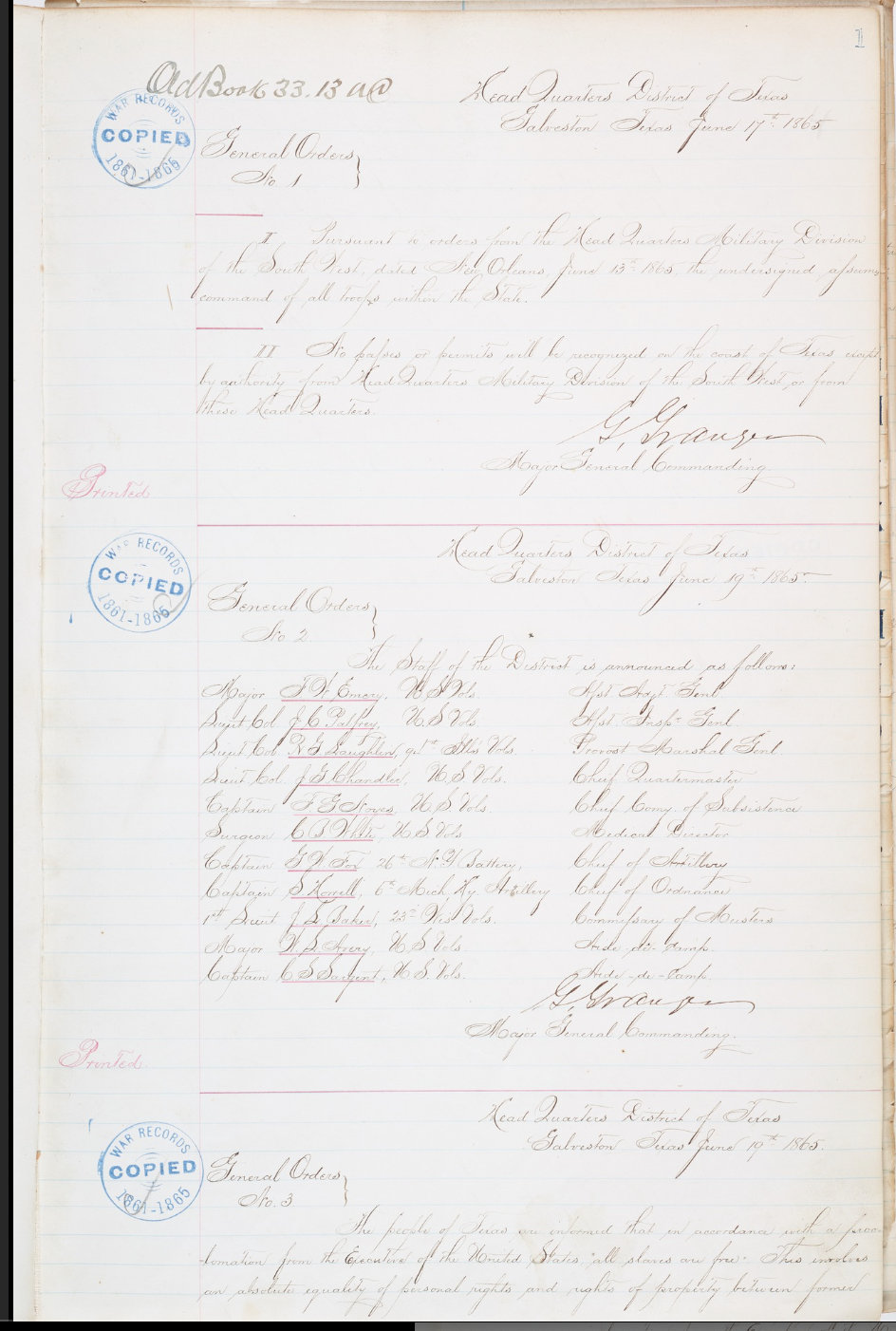
Tomorrow is the federal holiday honoring Juneteenth, the celebration of the announcement in Texas on June 19th, 1865, that enslaved Americans were free.
On April 9, 1865, General Robert E. Lee surrendered his Army of Northern Virginia to General Ulysses S. Grant of the U.S. Army, but it was not until June 2 that General Edmund Kirby Smith surrendered the Trans-Mississippi Department, the last major army of the Confederacy, to the United States, in Galveston, Texas. Smith then fled to Mexico.
Seventeen days later, Major General Gordon Granger of the U.S. Army arrived to take charge of the soldiers stationed there. On June 19, he issued General Order Number 3. It read:
“The people of Texas are informed that, in accordance with a proclamation from the Executive of the United States, all slaves are free. This involves an absolute equality of personal rights and rights of property between former masters and slaves, and the connection heretofore existing between them becomes that between employer and hired labor.”
The order went on: “The freedmen are advised to remain quietly at their present homes and work for wages. They are informed that they will not be allowed to collect at military posts and that they will not be supported in idleness either there or elsewhere.”
While the Thirteenth Amendment to the Constitution abolishing enslavement except as punishment for a crime had passed through Congress on January 31, 1865, and Lincoln had signed it on February 1, the states were still in the process of ratifying it.
So Granger’s order referred not to the Thirteenth Amendment, but to the Emancipation Proclamation of January 1, 1863, which declared that Americans enslaved in states that were in rebellion against the United States “shall be then, thenceforward, and forever free; and that the Executive Government of the United States, including the military and naval authority thereof, will recognize and maintain the freedom of such persons.” Granger was informing the people of Galveston that, Texas having been in rebellion on January 1, 1863, their world had changed. The federal government would see to it that, going forward, white people and Black people would be equal.
Black people in Galveston met the news Order No. 3 brought with celebrations in the streets, but emancipation was not a gift from white Americans. Black Americans had fought for the United States and worked in the fields to grow cotton the government could sell. Those unable to leave their homes had hidden U.S. soldiers, while those who could leave indicated their hatred of the Confederacy and enslavement with their feet. They had demonstrated their equality and their importance to the postwar United States.
The next year, after the Thirteenth Amendment had been added to the Constitution, Texas freedpeople gathered on June 19, 1866, to celebrate with prayers, speeches, food, and socializing the coming of their freedom. By the following year, the federal government encouraged “Juneteenth” celebrations, eager to explain to Black citizens the voting rights that had been put in place by the Military Reconstruction Act in early March 1867, and the tradition of Juneteenth began to spread to Black communities across the nation.
But white former Confederates in Texas were demoralized and angered by the changes in their circumstances. “It looked like everything worth living for was gone,” Texas cattleman Charles Goodnight later recalled.
In summer 1865, as white legislators in the states of the former Confederacy grudgingly ratified the Thirteenth Amendment, they also passed laws to keep freedpeople subservient to their white neighbors. These laws, known as the Black Codes, varied by state, but they generally bound Black Americans to yearlong contracts working in the fields owned by white men; prohibited Black people from meeting in groups, owning guns or property, or testifying in court; outlawed interracial marriage; and permitted white men to buy out the jail terms of Black people convicted of a wide swath of petty crimes, and then to force those former prisoners into labor to pay off their debt.
In 1865, Congress refused to readmit the Southern states under the Black Codes, and in 1866, congressmen wrote and passed the Fourteenth Amendment to the Constitution. Its first section established that “All persons born or naturalized in the United States, and subject to the jurisdiction thereof, are citizens of the United States and of the State wherein they reside.” It went on: “No State shall make or enforce any law which shall abridge the privileges or immunities of citizens of the United States; nor shall any State deprive any person of life, liberty, or property, without due process of law; nor deny to any person within its jurisdiction the equal protection of the laws.”
That was the whole ball game. The federal government had declared that a state could not discriminate against any of its citizens or arbitrarily take away any of a citizen’s rights. Then, like the Thirteenth Amendment before it, the Fourteenth declared that “Congress shall have the power to enforce, by appropriate legislation, the provisions of this article,” strengthening the federal government.
The addition of the Fourteenth Amendment to the Constitution in 1868 remade the United States. But those determined to preserve a world that discriminated between Americans according to race, gender, ability, and so on, continued to find workarounds.
On Friday, June 16, 2023, the Department of Justice—created in 1870 to enforce the Fourteenth Amendment—released the report of its investigation into the Minneapolis Police Department (MPD) and the City of Minneapolis in the wake of the May 2020 murder of George Floyd by a police officer. The 19-page document found systemic “conduct that deprives people of their rights under the Constitution and federal law,” discriminating against Black and Native American people, people with behavioral health disabilities, and protesters. Those systemic problems in the MPD’s institutional culture enabled Floyd’s killing.
Minneapolis police performed 22% more searches, 27% more vehicle searches, and 24% more uses of force on Black people than on white residents behaving in similar ways. They conducted 23% more searches and used force 20% more on Indigenous Americans.
The Justice Department’s press release specified that the city and the police department “cooperated fully.” The two parties have “agreed in principle” to fix the problem with sweeping reforms based on community input, with an independent monitor rather than litigation.
While the Senate unanimously approved the measure creating the Juneteenth holiday last year, fourteen far-right Republicans voted against it, many of them complaining that such a holiday would be divisive.
How we remember our history matters.
[General Order No. 3, National Records and Archives Administration, public domain.]

Thursday, June 08, 2023

What is Fascism? It's "Government by the Few and For the Few" and this is Deeply Concerning

A day doesn't seem go by that I don't think of creeping fascism in the U.S. Glad to see renowned scholar Dr. Heather Cox Richardson giving this some ink—in historical perspective.

I'm disgusted, for example, at the Texas Legislature's multiple power grabs, most notably, the one aimed at Harris County. The lege is basically giving control over elections to a single Republican state official that involves completely eliminating the Elections Administrator office. Read Texas Republicans single out one blue county as they push election bills that captures this struggle over voting in the last regular legislative session, illuminating well why reigning in Harris County is important to Texas Republicans.

Relatedly, I just got a message from Harris County Judge Lina Hidalgo who is raising funds to fight this anti-democratic attack that she refers to as a "murder-suicide plot against us ALL." Chip in, if you can, at linahidalgo.co/20230608?t=TNFJq to help in the struggle.

There is a glimmer of hope from today's SCOTUS ruling that suggests the Voting Rights Act still lives (read: Supreme Court: Alabama’s voting maps unfair to Black residents). It was a 5-4 decision where Chief Justices John Roberts Jr. and Brett Kavanaugh joined with the court's 3 liberals, namely, Ketanji Brown Jackson, Elena Kagan, and Sonia Sotomayor. 

In light of today's court ruling, I'm hoping that they're noticing that not supporting minorities' voting rights is either fascist, or paves the way for it. Regardless, this is indeed a much-welcomed surprise.

-Angela Valenzuela

Letters from an American

Beginning in 1943, the War Department published a series of pamphlets for U.S. Army personnel in the European theater of World War II. Titled Army Talks, the series was designed “to help [the personnel] become better-informed men and women and therefore better soldiers.”

On March 24, 1945, the topic for the week was “FASCISM!” 

“You are away from home, separated from your families, no longer at a civilian job or at school and many of you are risking your very lives,” the pamphlet explained, “because of a thing called fascism.” But, the publication asked, what is fascism? “Fascism is not the easiest thing to identify and analyze,” it said, “nor, once in power, is it easy to destroy. It is important for our future and that of the world that as many of us as possible understand the causes and practices of fascism, in order to combat it.”

Fascism, the U.S. government document explained, “is government by the few and for the few. The objective is seizure and control of the economic, political, social, and cultural life of the state.” “The people run democratic governments, but fascist governments run the people.” 

“The basic principles of democracy stand in the way of their desires; hence—democracy must go! Anyone who is not a member of their inner gang has to do what he’s told. They permit no civil liberties, no equality before the law.” “Fascism treats women as mere breeders. ‘Children, kitchen, and the church,’ was the Nazi slogan for women,” the pamphlet said. 

Fascists “make their own rules and change them when they choose…. They maintain themselves in power by use of force combined with propaganda based on primitive ideas of ‘blood’ and ‘race,’ by skillful manipulation of fear and hate, and by false promise of security. The propaganda glorifies war and insists it is smart and ‘realistic’ to be pitiless and violent.” 

Fascists understood that “the fundamental principle of democracy—faith in the common sense of the common people—was the direct opposite of the fascist principle of rule by the elite few,” it explained, “[s]o they fought democracy…. They played political, religious, social, and economic groups against each other and seized power while these groups struggled.” 

Americans should not be fooled into thinking that fascism could not come to America, the pamphlet warned; after all, “[w]e once laughed Hitler off as a harmless little clown with a funny mustache.” And indeed, the U.S. had experienced “sorry instances of mob sadism, lynchings, vigilantism, terror, and suppression of civil liberties. We have had our hooded gangs, Black Legions, Silver Shirts, and racial and religious bigots. All of them, in the name of Americanism, have used undemocratic methods and doctrines which…can be properly identified as ‘fascist.’”

The War Department thought it was important for Americans to understand the tactics fascists would use to take power in the United States. They would try to gain power “under the guise of ‘super-patriotism’ and ‘super-Americanism.’” And they would use three techniques: 

First, they would pit religious, racial, and economic groups against one another to break down national unity. Part of that effort to divide and conquer would be a “well-planned ‘hate campaign’ against minority races, religions, and other groups.”

Second, they would deny any need for international cooperation, because that would fly in the face of their insistence that their supporters were better than everyone else. “In place of international cooperation, the fascists seek to substitute a perverted sort of ultra-nationalism which tells their people that they are the only people in the world who count. With this goes hatred and suspicion toward the people of all other nations.” 

Third, fascists would insist that “the world has but two choices—either fascism or communism, and they label as ‘communists’ everyone who refuses to support them.”

It is “vitally important” to learn to spot native fascists, the government said, “even though they adopt names and slogans with popular appeal, drape themselves with the American flag, and attempt to carry out their program in the name of the democracy they are trying to destroy.” 

The only way to stop the rise of fascism in the United States, the document said, “is by making our democracy work and by actively cooperating to preserve world peace and security.” In the midst of the insecurity of the modern world, the hatred at the root of fascism “fulfills a triple mission.” By dividing people, it weakens democracy. “By getting men to hate rather than to think,” it prevents them “from seeking the real cause and a democratic solution to the problem.” By falsely promising prosperity, it lures people to embrace its security.

“Fascism thrives on indifference and ignorance,” it warned. Freedom requires “being alert and on guard against the infringement not only of our own freedom but the freedom of every American. If we permit discrimination, prejudice, or hate to rob anyone of his democratic rights, our own freedom and all democracy is threatened.” And if “we want to make certain that fascism does not come to America, we must make certain that it does not thrive anywhere in the world.” 

Seventy-eight years after the publication of “FASCISM!” with its program for recognizing that political system and stopping it from taking over the United States, President Joe Biden today at Arlington National Cemetery in Arlington, Virginia, honored those who gave their lives fighting to preserve democracy. “On this day, we come together again to reflect, to remember, but above all, to recommit to the future our fallen heroes fought for, …a future grounded in freedom, democracy, equality, tolerance, opportunity, and…justice.”

“[T]he truest memorial to their lives,” the president said, is to act “every day to ensure that our democracy endures, our Constitution endures, and the soul of our nation and our decency endures.”

Notes:

https://onlinebooks.library.upenn.edu/webbin/serial?id=armytalks

War Department, “Army Talk 64: FASCISM!” March 24, 1945, at https://archive.org/details/ArmyTalkOrientationFactSheet64-Fascism/mode/2up

https://www.whitehouse.gov/briefing-room/speeches-remarks/2023/05/29/remarks-by-president-biden-at-the-155th-national-memorial-day-observance/

https://twitter.com/WhiteHouse/status/1663379851716198400